Original Author: Thejaswini M A
Original Compilation: Chopper, Foresight News
In 1487, King Henry VII of England was in urgent need of funds. Having won the English throne two years earlier at the Battle of Bosworth Field, maintaining his rule incurred immense costs. The task of taxation fell to his Chancellor, John Morton.
Legend has it that Morton had his own methods. Visiting the estates of nobles, he observed their lifestyles: if a noble lived in luxury, Morton deemed him wealthy and thus obligated to pay tribute to the king; if a noble lived frugally, Morton judged him to be skilled at saving and equally capable of paying.
There was no third scenario. Regardless of what Morton witnessed, the outcome was always the same: the noble had to pay.
This anecdote is a secondhand account. Francis Bacon recorded it in 1622 when the story was still widely circulated. The term "Morton's Fork" was not widely used until the 19th century, but its logic endures due to its relevance. The "fork" refers to two choices that ultimately lead to the same unfavorable outcome, the opposite of a win-win situation.
Today, Ethereum and Solana find themselves trapped in a similar dilemma.
Both blockchains reward validators by issuing new tokens (inflation), and both are attempting to reduce these issuance subsidies. Relevant adjustment proposals for Ethereum have faced strong opposition; Solana's proposal is currently under vote, with the decision deadline set for August 18th.
On one hand, maintaining the current staking rewards for validators further advantages large, well-capitalized institutional service providers. On the other hand, reducing rewards places immediate pressure on smaller node operators, who face fixed operational costs and already operate on thin profit margins.
Regardless of the path chosen, the ultimate result is a contraction in the number of validators. This article analyzes the inflation policy debates on both chains: they are forced to make a choice, essentially deciding which form of centralization to move towards.
Ethereum: EIP-8363 Proposal for Progressive Issuance Burning
On August 4th, Ethereum researchers including Justin Drake and Jérôme de Tychey released a draft proposal titled "A Progressive Issuance Burn," known as EIP-8363. Its core mechanism involves increasing the proportion of validator rewards burned by the protocol as the total amount of staked ETH rises.
Once the total staked amount reaches 60.25 million ETH (approximately half the total supply), the reward burn rate would hit 100%, reducing the staking issuance yield to zero.
Currently, about 41.4 million ETH is staked, representing 34% of the total supply, corresponding to roughly 890,000 validators with an average staking yield of 2.67%. A calculation by Aave founder Stani Kulechov suggests that under this proposal, the validator yield would drop from 2.862% to 1.476%, nearly halving it.
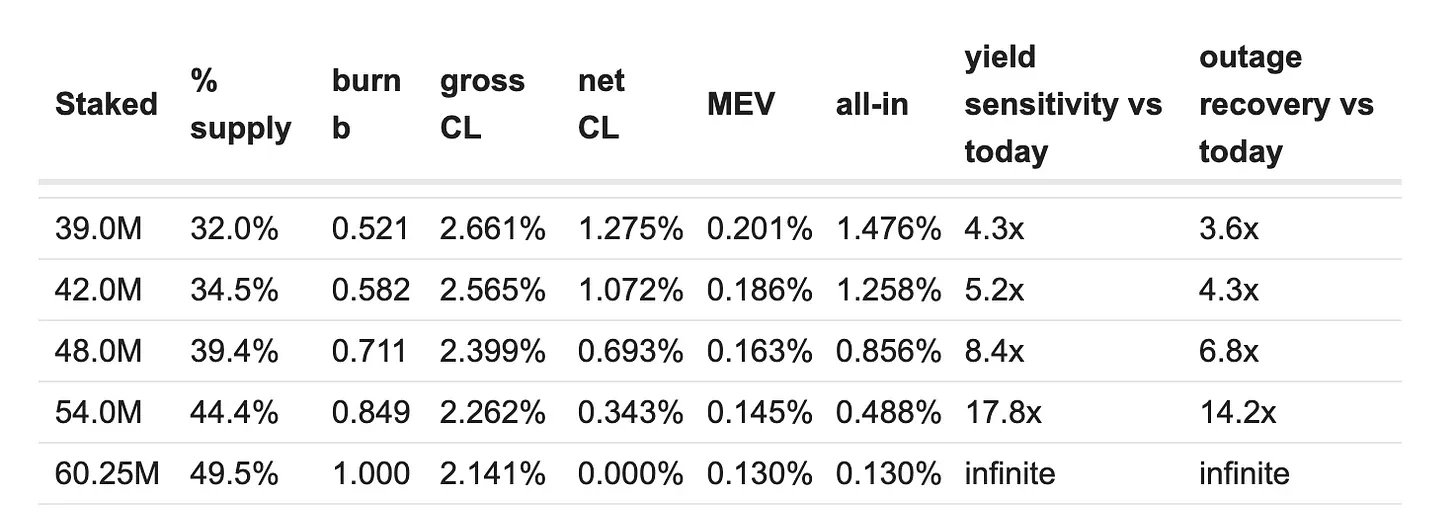
The proposal faced public opposition within three days from figures like Stani Kulechov, SharpLink CEO Joseph Chalom, and ether.fi's Mike Silagadze.
EIP-8363 is currently in the early draft stage, undergoing preliminary review on GitHub. It is far from finalization and implementation and is not included in Ethereum's upcoming Hegotá upgrade; however, it may still be submitted for consideration in future network upgrades.
To understand the strong resistance from the staking community to reward cuts, one must look at the size of this revenue pie. Ethereum incentivizes participants to secure the network by issuing new tokens, minting approximately 1.1 million ETH annually for validators. At a price of $1,921, this constitutes an annual salary pool worth $21 billion.
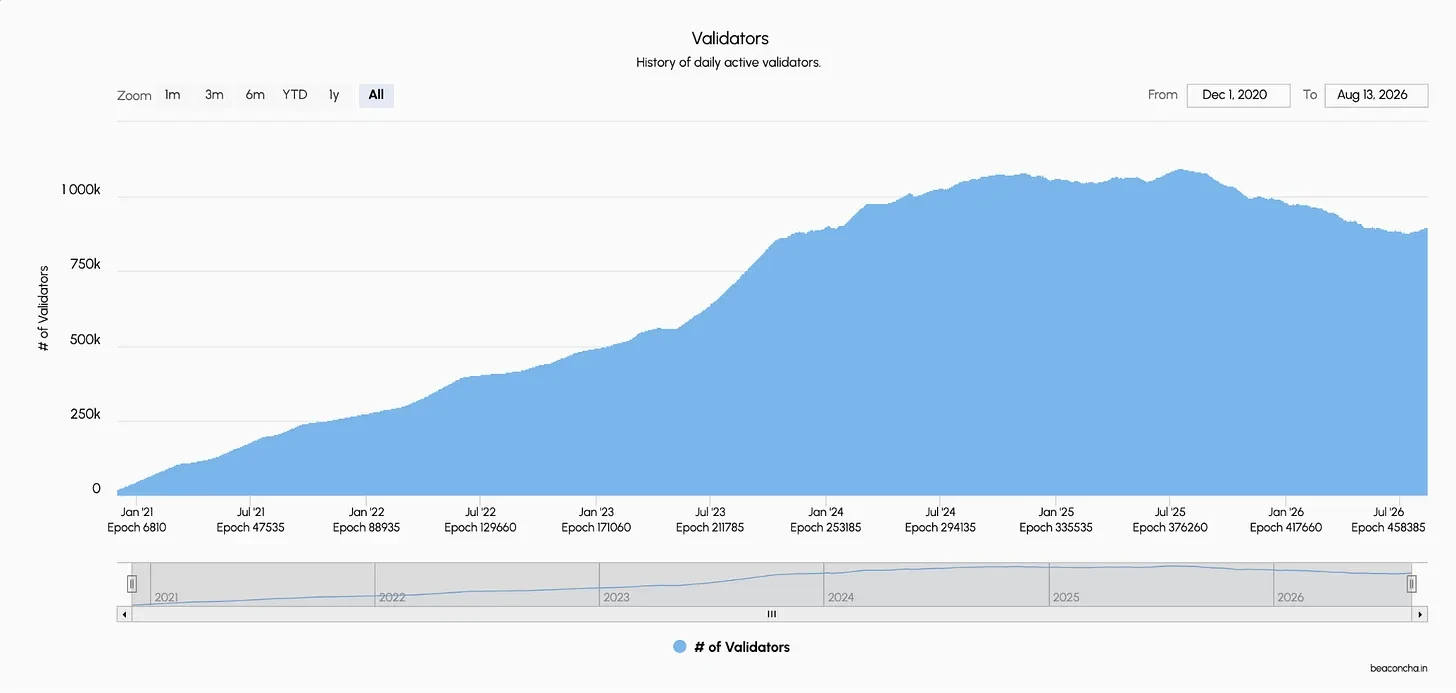
Number of Active Ethereum Validators
Solana has a similar mechanism, but its issuance is larger relative to its economic size. Solana issues approximately 19 to 22 million SOL annually, valued at around $1.5 billion at current prices. Users pay about 6,400–9,600 SOL daily in transaction fees and Jito tips, totaling about $225 million annually. This means user fees cover only about 13% of validator income, with the rest funded by token issuance. The situation is similar on Ethereum, where Chalom estimates tips and fees constitute about 15% of staking rewards, with the remaining 85% coming from issuance.
Solana's annual inflation rate is 3.7%, while Ethereum's is just 0.85%. Non-staking SOL holders see their assets diluted at more than four times the rate of equivalent ETH holders.
In traditional finance, the National Securities Clearing Corporation (NSCC) participates in nearly all stock and bond transactions in the United States. Its parent company, DTCC, processed $4.7 quadrillion in securities transactions in 2025 and custodied assets worth $115 trillion. NSCC maintains a Member's Clearing Fund, sized at $19.7 billion, funded by its members, with NSCC itself contributing only $130 million.
To attack the Ethereum network, an attacker would need to control 41.4 million staked ETH, representing a capital barrier of $79.6 billion—four times the size of the NSCC's fund. This is just the minimum; any large-scale ETH purchase would rapidly drive up the price. Additionally, the attacker would need to deploy a massive global server infrastructure to utilize these tokens. Ethereum has built-in defenses: malicious actions can trigger the network to directly slash (destroy) the attacker's entire staked assets, meaning a failed attack results in a total loss.
However, the operational logic of the two systems remains vastly different.
NSCC members contribute $19.7 billion as a collateral requirement for participation; this capital generates no yield, and members want this amount to be as low as possible. In contrast, Ethereum provides a 2.67% annual yield on equivalent staked capital, while Solana's staking yield is 5%–8%.
Years of stable staking yields have fostered a complete commercial ecosystem built upon them. Currently, about $35 billion worth of liquid staking tokens (LSTs) like stETH are used as collateral across various crypto lending platforms. Traders build leveraged loop strategies with these tokens: deposit LSTs into Aave, Morpho, borrow WETH to stake again, and repeat. This strategy hinges on the staking yield being higher than the borrowing rate. Pendle has built fixed-rate markets based on staking yields; Curve establishes trading pools for investors to exit; SharpLink holds $3 billion in ETH reserves, much of it staked through Coinbase, Anchorage, Figment, Galaxy.
Staking yield has become the benchmark interest rate for the entire DeFi market. If the consensus layer reward were halved, leveraged loop strategies would turn unprofitable, forcing Pendle to reprice fixed rates, and lending platforms would have to comprehensively reassess the collateral value of all liquid staking tokens.
The Key Difference Pre- and Post-Merge: Miners and Stakers Are Not the Same
Before the Ethereum Merge, the protocol issued about 13,000 ETH daily to miners; after the Merge, daily issuance dropped to about 1,700, an 88% reduction. Miners, who had invested tens of billions in hardware over years, strongly resisted the change, leading to a fork that created ETHW, a token now worth less than 1% of ETH's value.
But the mining ecosystem and the DeFi financial system were largely independent. Miners provided hash power for rewards; no one built complex financial products around mining revenue. Their income was not used as collateral for chain-wide lending, so even if their rewards went to zero overnight, the lending markets would remain unaffected. When miners left, the rest of the system could continue without adjustment.
Stakers play a dual role. On one hand, they secure the network; on the other, the staked tokens they receive serve as the underlying collateral for about half of DeFi lending. Therefore, cutting staking rewards impacts the entire financial ecosystem built on top of it.
Mancur Olson proposed a theory in 1965: small groups with significant potential gains often have more motivation and effectiveness in collective action than large groups where individual stakes are small. Small groups have stronger incentives to voice opinions and engage in political processes.
Running a validator node incurs fixed costs: servers, electricity, internet, etc., regardless of profitability. Currently, staking 32 ETH yields about 0.92 ETH annually (~$1,760). Under the new progressive proposal, annual income would drop to 0.47 ETH (~$900). With operational costs unchanged, expenses that were 20% of revenue would suddenly approach half of it. Slashing penalties for attestation mistakes would represent double the proportion of earnings lost for the same absolute amount.
Following Olson's theory, general token holders constitute a large group: Ethereum mints new tokens annually for stakers, continuously diluting the holdings of non-stakers. But this dilution is minuscule per individual—only fractions of a percent annually—which most people barely perceive, giving them little incentive to protest.
Large staking service providers constitute a small group: a significant portion of all newly issued tokens flows to them, representing tens of billions in revenue, which their businesses rely on entirely. If the network cuts rewards, these companies would face massive losses.
The argument from those supporting reduced issuance is that current staking rewards are too high, continuously attracting ETH inflows, and these rewards are concentrated among top exchanges and staking services. Institutional capital drove a ~15% increase in staked ETH in the first half of 2026. The proposal's logic is to raise the marginal cost of staking, making new staking unprofitable, thereby curbing centralization.
The opposing view is that cutting rewards directly would first bankrupt ordinary individual operators running nodes from home. In fact, both sides share the same goal—preventing a few capital giants from controlling Ethereum. The disagreement lies in which approach—reducing rewards or maintaining them—would harm network decentralization faster.
Solana Faces the Same Dilemma
Solana validators must pay about 389 SOL annually in voting fees, a cost incurred regardless of node profitability, market conditions, or whether they receive delegated stakes. The current staking yield is around 6.5%, with the break-even point for a node requiring about 200,000 SOL in delegated stake. The number of active Solana validators has dropped from a peak of 2,500 to 683; however, the total staked SOL has climbed to 430 million, representing nearly 68% of the stakeable supply.
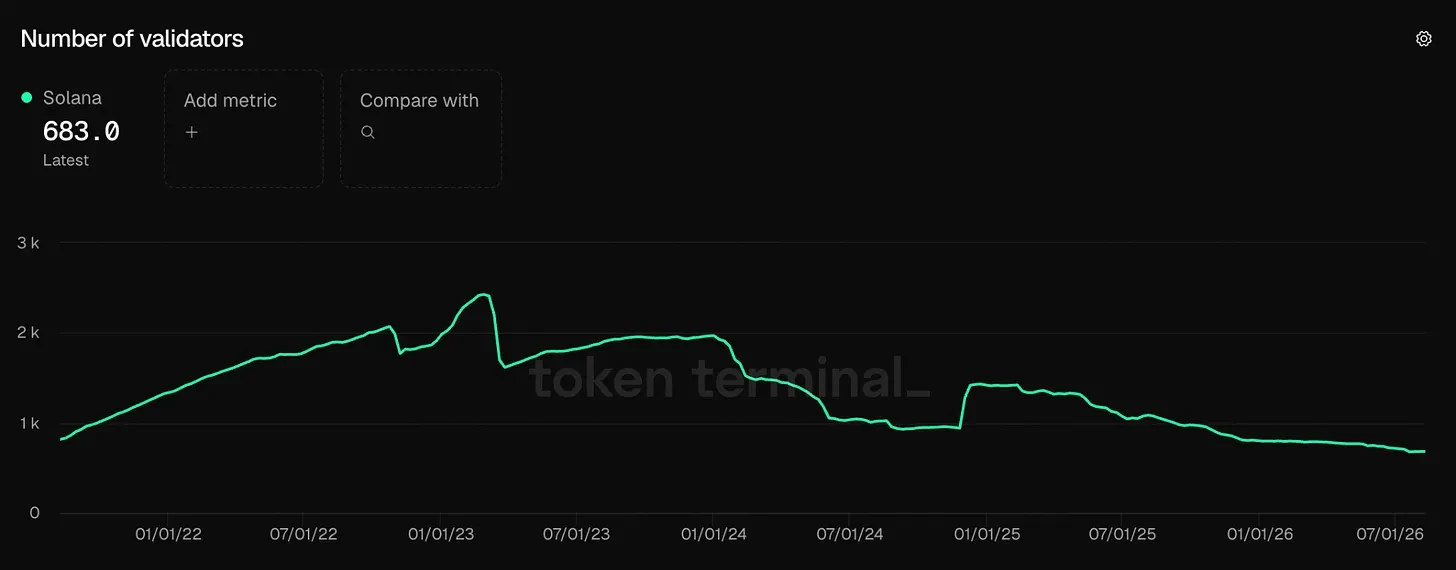
Change in Number of Solana Validator Nodes
Solana is currently voting on reward reforms. Proposal SIMD-0550 would increase the annual disinflation ramp from 15% to 30%, accelerating the achievement of the long-term 1.5% inflation target from 2032 to 2029, aiming to reduce future issuance by 18.9 million SOL. Proposal SIMD-0553 redesigns the fee mechanism based on resource usage, increasing daily burns from 648 SOL to 7,500–9,000 SOL. Even at the upper limit, the burn volume remains far below the daily issuance of ~60,000 SOL in rewards.
The vote concludes on August 18th. Proposals require an absolute majority of over 66.67% of the total staked supply to pass.
We are accustomed to viewing blockchain governance as a practice of autonomous decision-making, where code and community voting shape the future of digital economies. But Ethereum and Solana show a similar trend: protocol rules are ultimately constrained by real-world financial principles. Early architects designed economic models hoping markets would spontaneously maintain decentralization. Yet once a public chain's assets grow into a cornerstone of global liquidity and a target for institutional asset allocation, the underlying economic forces of yield, leverage, and corporate operational costs eventually override the original design vision.
If a blockchain relies on distributing yields to attract users to lock assets for expansion, it will inevitably hit this wall. Regardless of Solana's voting outcome next Monday, and regardless of Ethereum's future decisions on related proposals, they are merely choosing: how soon will we reach the endpoint, how soon will we hit the barrier.