AMD's Revenue Focus: How It Shifted Toward Data Centers Over 12 Quarters

marsbit發佈於 2026-08-05更新於 2026-08-05

文章摘要

AMD's second-quarter earnings highlight a significant shift in its revenue composition over the past twelve quarters. While total company revenue grew substantially, the data center segment emerged as the dominant driver, now accounting for over half (58.2%) of AMD's total revenue. This segment reached $6.718 billion in Q2, a 107% year-over-year increase, and became AMD's largest revenue division in Q4 2025. Conversely, the gaming segment revenue declined to $779 million, down 31%, primarily due to lower semi-custom sales. The analysis shows the company's overall revenue base expanded, indicating growth was not a simple zero-sum resource transfer from gaming to data centers. A comparative view with NVIDIA and Intel reveals AMD's data center revenue growth trajectory is steep, though from a significantly smaller absolute base than NVIDIA's. The report confirms data center's rise as AMD's primary revenue focus, but public segment data alone cannot definitively attribute this shift to a direct internal reallocation of resources from the gaming business.

A second-quarter earnings report has pulled AMD's two revenue curves in opposite directions. According to AMD's quarterly report, Data Center segment revenue reached $6.718 billion, a 107% increase year-over-year.

Within the same report, Gaming segment revenue was $779 million, a 31% decrease year-over-year. Placing these two side by side easily gives rise to an intuition: is AMD shifting business originally belonging to Gaming over to Data Center?

Public financial reports can only answer where revenue comes from; they cannot directly reveal how R&D, wafer capacity, or customer resources flow within the company. However, by placing the segment data from these 12 quarters together, we can at least break down that intuition in finer detail.

First, Look at the Total Pie: Is Growth Just Internal Reallocation?
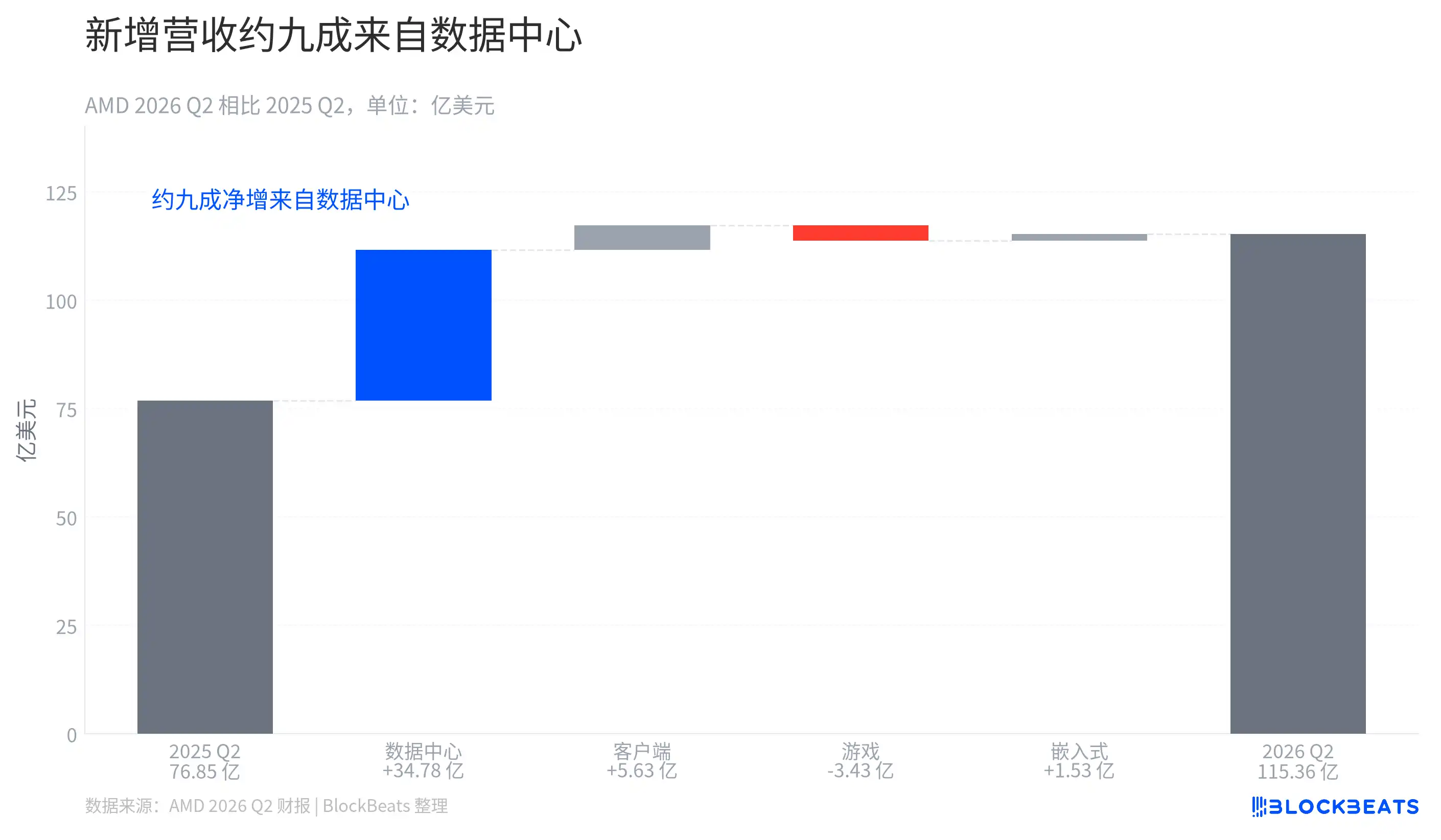
First, look at the year-over-year bridge. The answer is more restrained than "one falls as another rises." According to AMD's quarterly report, the company's total revenue increased from $7.685 billion to $11.536 billion. The end point is significantly higher than the starting point, indicating that growth first occurred in the total pie, not as an equal exchange between two existing businesses.

The tallest blue bar in the chart comes from Data Center. According to AMD's report, this segment increased by $3.478 billion year-over-year, accounting for about 90% of the company's net revenue increase for the quarter. This is an addition/subtraction of revenue; it cannot be inferred from this that R&D, production capacity, or customer resources have been shifted from one business to another.

Client and Embedded segments also increased in the quarter. Gaming segment revenue, however, decreased by $343 million year-over-year. According to AMD's report, this decline indeed exists, but it is insufficient to explain the scale of the new additions brought by Data Center. Therefore, this chart supports "an expansion of the total revenue base," and does not prove a one-to-one resource substitution between the two businesses.

There is also a nuance often omitted. AMD attributes the year-over-year decline in Gaming revenue primarily to lower semi-custom revenue, as the Gaming segment also includes console semi-custom business. Directly reading this line as sales of Radeon discrete graphics cards or consumer GPU demand would be narrowing the scope of the segment definition.

When Did Data Center Become the Revenue Focus?
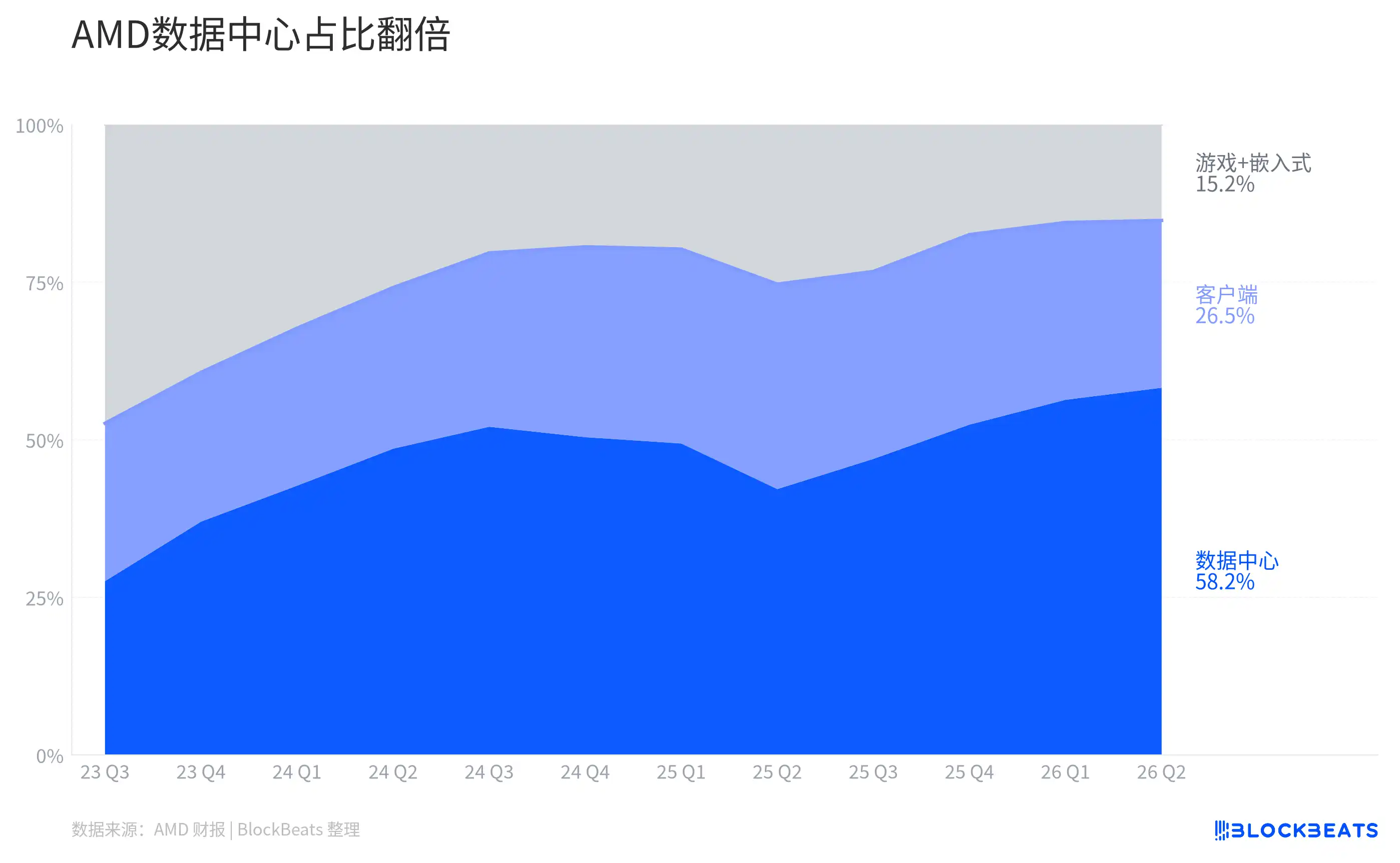
Highs and lows in a single quarter are always influenced by product delivery cycles. Structural changes across consecutive quarters better reflect the revenue mix. According to AMD's consecutive quarterly reports, Data Center's share of total revenue increased from 27.6% to 58.2%. In the imagination of every hundred dollars of revenue, Data Center has gone from accounting for less than thirty cents to becoming the source of over half.

This crossing of the midpoint occurred in Q4 2025. The dark blue area in the chart has not since retreated below the halfway mark, and Data Center has thus become AMD's largest revenue segment. Client, Gaming, and Embedded remain revenue sources. The latter two are merged into one layer in the chart to avoid misreading changes in the Gaming segment as the rise and fall of a specific graphics card product.

The rising share of Data Center also does not mean AMD has become a company that only sells AI chips. According to AMD's description of the segment, it covers multiple businesses including server processors and accelerators. The report does not further break down all incremental revenue by a single product. The chart shows the change in revenue mix. It can show which segment has a higher revenue share, but it cannot substitute for an internal ledger detailing product configuration or investment trade-offs.

This area chart also preserves a reading that is easy to overlook. The sum of the three layers each quarter is always 100%. The widening of the dark blue area is not only due to the absolute increase in Data Center revenue but also indicates its higher relative position within AMD's overall revenue. It can show *how* the segment revenue structure has changed, but it cannot, by itself, explain product configuration, capacity allocation, or internal investment trade-offs.

Placed Among Peers, Where Does AMD Stand?
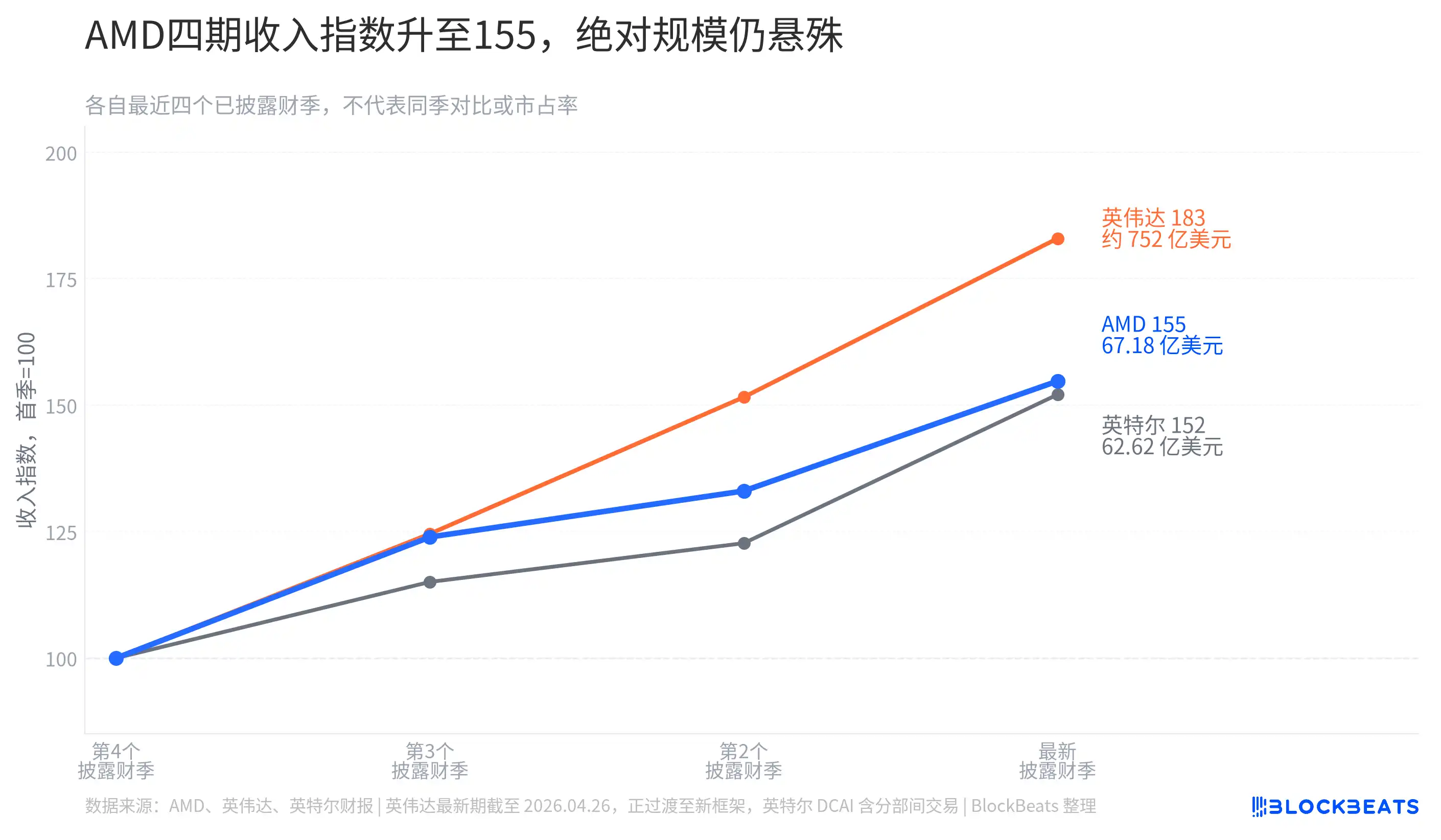
Putting AMD back among its peers, the easiest mistake is to treat the same indexed chart as the same race. According to the respective financial reports of AMD, NVIDIA, and Intel, Chart 2 normalizes the revenue of each company's four most recently disclosed fiscal quarters to 100. The blue line ends at 155, indicating that AMD's Data Center revenue grew rapidly during this disclosed sequence. NVIDIA's line is steeper, and Intel's line is also rising.

Beyond speed, there is also scale. According to the latest available reports from the three companies, AMD's Data Center revenue is $6.718 billion, while NVIDIA's is approximately $75.2 billion. Looking at both endpoint labels together prevents misreading an upward-sloping blue line as an already occurred swap in competitive positioning.

The latest segment revenue figures for AMD and Intel are close. According to Intel's report, Intel's DCAI (Data Center and AI) segment revenue is $6.262 billion. This proximity also requires a footnote: Intel's DCAI includes intersegment transactions, and its definition is not equivalent to AMD's Data Center business.

The timing is also not perfectly aligned. According to NVIDIA's FY2027 Q1 report, the latest fiscal quarter on the chart ended on April 26, 2026, earlier than AMD's and Intel's June quarters. NVIDIA stated at the time that it was transitioning to a new reporting framework, dividing its market platforms into Data Center & Edge Computing, and further subdividing Data Center into Hyperscale & ACIE sub-markets.

Chart 2 retains only the disclosed total Data Center revenue for the three companies and does not combine sub-categories from NVIDIA's old and new frameworks. The three lines can only be used to observe the trajectory of each company's disclosed revenue. They cannot be converted into market share, nor can they serve as a strict same-quarter ranking.

Therefore, this earnings report confirms that Data Center has become AMD's largest revenue segment. The contraction of the Gaming business occurred during the same period, but the public segment data is insufficient to explain it as a simple internal swap.


熱門幣種推薦

相關問答

QAccording to the article, how has the Data Center segment's contribution to AMD's total revenue changed over the past 12 quarters?

AAccording to the article, Data Center's share of AMD's total revenue increased from 27.6% to 58.2% over the 12 quarters analyzed. It became AMD's largest revenue segment, crossing the 50% mark in Q4 2025.

QBased on the Q2 data, what was the primary driver for AMD's overall revenue growth?

AThe primary driver was the Data Center segment, which added approximately $3.478 billion year-over-year. This increase accounted for about 90% of AMD's total quarterly revenue growth, significantly expanding the company's overall revenue base.

QWhat caution does the article advise when interpreting the decline in AMD's Gaming business revenue?

AThe article cautions that the Gaming segment decline should not be directly read as a drop in consumer GPU (Radeon) sales. The segment includes semi-custom business for gaming consoles, and the reported decline is primarily attributed to lower semi-custom revenue, making the segment's composition broader than just discrete graphics cards.

QHow does AMD's Data Center revenue compare to NVIDIA's according to their latest reported figures?

AWhile AMD's Data Center revenue grew faster in the analyzed sequence, NVIDIA's absolute scale is much larger. AMD's latest Data Center revenue was $6.718 billion, while NVIDIA's was approximately $75.2 billion. Therefore, the growth trajectories should not be misinterpreted as a reversal of competitive positions.

QWhat key point does the article make about the relationship between Data Center growth and Gaming decline at AMD?

AThe article argues that the public financial data does not support the intuitive idea of a simple internal resource swap. While the Gaming segment declined and Data Center grew significantly in the same period, the decline in Gaming was smaller than the massive growth in Data Center. The overall revenue base expanded, indicating growth was not merely a zero-sum transfer between the two existing segments.

你可能也喜歡

以太坊和Solana即将迎来大规模更新:将有哪些变化?

Galaxy Research研究报告指出,以太坊和Solana正考虑对其代币供应与通胀政策进行重大调整,核心在于如何平衡网络安全所需的激励预算与代币供应的长期压力。 以太坊方面,EIP-8361提案旨在推行“奖励渐近销毁”机制。随着质押的ETH比例增加,验证者奖励中将有越来越大部分被销毁。当质押比例达到总供应量的50%时,所有新质押奖励将被销毁,以消除超过此水平的质押经济激励。目前约三分之一的ETH处于质押状态,若提案实施,共识层年收益率或将从约2.6%降至1.2%(MEV和优先费收入不受影响)。提案若被纳入Hegotá升级,预计最早也要到2027年底才能上线。支持者认为这能增强ETH的货币属性,反对者则担心这会伤害独立验证者和DeFi生态。 Solana方面,两个独立提案正在审议中。SIMD-0550提议将年通胀衰减率从15%提高至30%,使SOL达到最终1.5%通胀率的时间从2032年提前至2029年。SIMD-0553则计划改革交易费结构,从固定签名费改为按计算资源消耗定价,且全部费用销毁,预计将使网络日销毁SOL量大幅提升。 两家网络的提议虽结构不同,但都围绕着“需要发行多少代币来保障安全”以及“为降低通胀可接受哪些安全妥协”展开。Galaxy Research认为,Solana的提案更直接地旨在提升代币稀缺性。报告同时强调,供应侧的调整虽有助于形成看涨叙事,但并非价格的主要决定因素,最终推动资产价格的仍是需求侧。因此,改善技术基础设施、扩大企业采用和开发用户产品应保持优先。

cryptonews.ru1 小時前

以太坊和Solana即将迎来大规模更新:将有哪些变化?

cryptonews.ru1 小時前

交易

現貨

熱門文章

什麼是 $S$

理解 SPERO:全面概述 SPERO 簡介 隨著創新領域的不斷演變,web3 技術和加密貨幣項目的出現在塑造數字未來中扮演著關鍵角色。在這個動態領域中,SPERO(標記為 SPERO,$$s$)是一個引起關注的項目。本文旨在收集並呈現有關 SPERO 的詳細信息,以幫助愛好者和投資者理解其基礎、目標和在 web3 和加密領域內的創新。 SPERO,$$s$ 是什麼? SPERO,$$s$ 是加密空間中的一個獨特項目,旨在利用去中心化和區塊鏈技術的原則,創建一個促進參與、實用性和金融包容性的生態系統。該項目旨在以新的方式促進點對點互動,為用戶提供創新的金融解決方案和服務。 SPERO,$$s$ 的核心目標是通過提供增強用戶體驗的工具和平台來賦能個人。這包括使交易方式更加靈活、促進社區驅動的倡議,以及通過去中心化應用程序(dApps)創造金融機會的途徑。SPERO,$$s$ 的基本願景圍繞包容性展開,旨在彌合傳統金融中的差距,同時利用區塊鏈技術的優勢。 誰是 SPERO,$$s$ 的創建者? SPERO,$$s$ 的創建者身份仍然有些模糊,因為公開可用的資源對其創始人提供的詳細背景信息有限。這種缺乏透明度可能源於該項目對去中心化的承諾——這是一種許多 web3 項目所共享的精神,優先考慮集體貢獻而非個人認可。 通過將討論重心放在社區及其共同目標上,SPERO,$$s$ 體現了賦能的本質,而不特別突出某些個體。因此,理解 SPERO 的精神和使命比識別單一創建者更為重要。 誰是 SPERO,$$s$ 的投資者? SPERO,$$s$ 得到了來自風險投資家到天使投資者的多樣化投資者的支持,他們致力於促進加密領域的創新。這些投資者的關注點通常與 SPERO 的使命一致——優先考慮那些承諾社會技術進步、金融包容性和去中心化治理的項目。 這些投資者通常對不僅提供創新產品,還對區塊鏈社區及其生態系統做出積極貢獻的項目感興趣。這些投資者的支持強化了 SPERO,$$s$ 作為快速發展的加密項目領域中的一個重要競爭者。 SPERO,$$s$ 如何運作? SPERO,$$s$ 採用多面向的框架,使其與傳統的加密貨幣項目區別開來。以下是一些突顯其獨特性和創新的關鍵特徵: 去中心化治理:SPERO,$$s$ 整合了去中心化治理模型,賦予用戶積極參與決策過程的權力,關於項目的未來。這種方法促進了社區成員之間的擁有感和責任感。 代幣實用性:SPERO,$$s$ 使用其自己的加密貨幣代幣,旨在在生態系統內部提供多種功能。這些代幣使交易、獎勵和平台上提供的服務得以促進,增強了整體參與度和實用性。 分層架構:SPERO,$$s$ 的技術架構支持模塊化和可擴展性,允許在項目發展過程中無縫整合額外的功能和應用。這種適應性對於在不斷變化的加密環境中保持相關性至關重要。 社區參與:該項目強調社區驅動的倡議,採用激勵合作和反饋的機制。通過培養強大的社區,SPERO,$$s$ 能夠更好地滿足用戶需求並適應市場趨勢。 專注於包容性:通過提供低交易費用和用戶友好的界面,SPERO,$$s$ 旨在吸引多樣化的用戶群體,包括那些以前可能未曾參與加密領域的個體。這種對包容性的承諾與其通過可及性賦能的總體使命相一致。 SPERO,$$s$ 的時間線 理解一個項目的歷史提供了對其發展軌跡和里程碑的關鍵見解。以下是建議的時間線,映射 SPERO,$$s$ 演變中的重要事件: 概念化和構思階段:形成 SPERO,$$s$ 基礎的初步想法被提出,與區塊鏈行業內的去中心化和社區聚焦原則密切相關。 項目白皮書的發布:在概念階段之後,發布了一份全面的白皮書,詳細說明了 SPERO,$$s$ 的願景、目標和技術基礎設施,以吸引社區的興趣和反饋。 社區建設和早期參與:積極進行外展工作,建立早期採用者和潛在投資者的社區,促進圍繞項目目標的討論並獲得支持。 代幣生成事件:SPERO,$$s$ 進行了一次代幣生成事件(TGE),向早期支持者分發其原生代幣,並在生態系統內建立初步流動性。 首次 dApp 上線:與 SPERO,$$s$ 相關的第一個去中心化應用程序(dApp)上線,允許用戶參與平台的核心功能。 持續發展和夥伴關係:對項目產品的持續更新和增強,包括與區塊鏈領域其他參與者的戰略夥伴關係,使 SPERO,$$s$ 成為加密市場中一個具有競爭力和不斷演變的參與者。 結論 SPERO,$$s$ 是 web3 和加密貨幣潛力的見證,能夠徹底改變金融系統並賦能個人。憑藉對去中心化治理、社區參與和創新設計功能的承諾,它為更具包容性的金融環境鋪平了道路。 與任何在快速發展的加密領域中的投資一樣,潛在的投資者和用戶都被鼓勵進行徹底研究,並對 SPERO,$$s$ 的持續發展進行深思熟慮的參與。該項目展示了加密行業的創新精神,邀請人們進一步探索其無數可能性。儘管 SPERO,$$s$ 的旅程仍在展開,但其基礎原則確實可能影響我們在互聯網數字生態系統中如何與技術、金融和彼此互動的未來。

481 人學過發佈於 2024.12.17更新於 2024.12.17

什麼是 $S$

什麼是 AGENT S

Agent S:Web3中自主互動的未來 介紹 在不斷演變的Web3和加密貨幣領域,創新不斷重新定義個人如何與數字平台互動。Agent S是一個開創性的項目,承諾通過其開放的代理框架徹底改變人機互動。Agent S旨在簡化複雜任務,為人工智能(AI)提供變革性的應用,鋪平自主互動的道路。本詳細探索將深入研究該項目的複雜性、其獨特特徵以及對加密貨幣領域的影響。 什麼是Agent S? Agent S是一個突破性的開放代理框架,專門設計用來解決計算機任務自動化中的三個基本挑戰: 獲取特定領域知識:該框架智能地從各種外部知識來源和內部經驗中學習。這種雙重方法使其能夠建立豐富的特定領域知識庫,提升其在任務執行中的表現。 長期任務規劃:Agent S採用經驗增強的分層規劃,這是一種戰略方法,可以有效地分解和執行複雜任務。此特徵顯著提升了其高效和有效地管理多個子任務的能力。 處理動態、不均勻的界面:該項目引入了代理-計算機界面(ACI),這是一種創新的解決方案,增強了代理和用戶之間的互動。利用多模態大型語言模型(MLLMs),Agent S能夠無縫導航和操作各種圖形用戶界面。 通過這些開創性特徵,Agent S提供了一個強大的框架,解決了自動化人機互動中涉及的複雜性,為AI及其他領域的無數應用奠定了基礎。 誰是Agent S的創建者? 儘管Agent S的概念根本上是創新的,但有關其創建者的具體信息仍然難以捉摸。創建者目前尚不清楚,這突顯了該項目的初期階段或戰略選擇將創始成員保密。無論是否匿名,重點仍然在於框架的能力和潛力。 誰是Agent S的投資者? 由於Agent S在加密生態系統中相對較新,關於其投資者和財務支持者的詳細信息並未明確記錄。缺乏對支持該項目的投資基礎或組織的公開見解,引發了對其資金結構和發展路線圖的質疑。了解其支持背景對於評估該項目的可持續性和潛在市場影響至關重要。 Agent S如何運作? Agent S的核心是尖端技術,使其能夠在多種環境中有效運作。其運營模型圍繞幾個關鍵特徵構建: 類人計算機互動:該框架提供先進的AI規劃,力求使與計算機的互動更加直觀。通過模仿人類在任務執行中的行為,承諾提升用戶體驗。 敘事記憶:用於利用高級經驗,Agent S利用敘事記憶來跟蹤任務歷史,從而增強其決策過程。 情節記憶:此特徵為用戶提供逐步指導,使框架能夠在任務展開時提供上下文支持。 支持OpenACI:Agent S能夠在本地運行,使用戶能夠控制其互動和工作流程,與Web3的去中心化理念相一致。 與外部API的輕鬆集成:其多功能性和與各種AI平台的兼容性確保了Agent S能夠無縫融入現有技術生態系統,成為開發者和組織的理想選擇。 這些功能共同促成了Agent S在加密領域的獨特地位,因為它以最小的人類干預自動化複雜的多步任務。隨著項目的發展,其在Web3中的潛在應用可能重新定義數字互動的展開方式。 Agent S的時間線 Agent S的發展和里程碑可以用一個時間線來概括,突顯其重要事件: 2024年9月27日:Agent S的概念在一篇名為《一個像人類一樣使用計算機的開放代理框架》的綜合研究論文中推出,展示了該項目的基礎工作。 2024年10月10日:該研究論文在arXiv上公開,提供了對框架及其基於OSWorld基準的性能評估的深入探索。 2024年10月12日:發布了一個視頻演示,提供了對Agent S能力和特徵的視覺洞察,進一步吸引潛在用戶和投資者。 這些時間線上的標記不僅展示了Agent S的進展,還表明了其對透明度和社區參與的承諾。 有關Agent S的要點 隨著Agent S框架的持續演變,幾個關鍵特徵脫穎而出,強調其創新性和潛力: 創新框架:旨在提供類似人類互動的直觀計算機使用,Agent S為任務自動化帶來了新穎的方法。 自主互動:通過GUI自主與計算機互動的能力標誌著向更智能和高效的計算解決方案邁進了一步。 複雜任務自動化:憑藉其強大的方法論,能夠自動化複雜的多步任務,使過程更快且更少出錯。 持續改進:學習機制使Agent S能夠從過去的經驗中改進,不斷提升其性能和效率。 多功能性:其在OSWorld和WindowsAgentArena等不同操作環境中的適應性確保了它能夠服務於廣泛的應用。 隨著Agent S在Web3和加密領域中的定位,其增強互動能力和自動化過程的潛力標誌著AI技術的一次重大進步。通過其創新框架,Agent S展現了數字互動的未來,為各行各業的用戶承諾提供更無縫和高效的體驗。 結論 Agent S代表了AI與Web3結合的一次大膽飛躍,具有重新定義我們與技術互動方式的能力。儘管仍處於早期階段,但其應用的可能性廣泛且引人入勝。通過其全面的框架解決關鍵挑戰,Agent S旨在將自主互動帶到數字體驗的最前沿。隨著我們深入加密貨幣和去中心化的領域,像Agent S這樣的項目無疑將在塑造技術和人機協作的未來中發揮關鍵作用。

1.2k 人學過發佈於 2025.01.14更新於 2025.01.14

什麼是 AGENT S

如何購買S

歡迎來到HTX.com!在這裡,購買Sonic (S)變得簡單而便捷。跟隨我們的逐步指南,放心開始您的加密貨幣之旅。第一步:創建您的HTX帳戶使用您的 Email、手機號碼在HTX註冊一個免費帳戶。體驗無憂的註冊過程並解鎖所有平台功能。立即註冊第二步:前往買幣頁面,選擇您的支付方式信用卡/金融卡購買:使用您的Visa或Mastercard即時購買Sonic (S)。餘額購買:使用您HTX帳戶餘額中的資金進行無縫交易。第三方購買:探索諸如Google Pay或Apple Pay等流行支付方式以增加便利性。C2C購買:在HTX平台上直接與其他用戶交易。HTX 場外交易 (OTC) 購買:為大量交易者提供個性化服務和競爭性匯率。第三步:存儲您的Sonic (S)購買Sonic (S)後,將其存儲在您的HTX帳戶中。您也可以透過區塊鏈轉帳將其發送到其他地址或者用於交易其他加密貨幣。第四步:交易Sonic (S)在HTX的現貨市場輕鬆交易Sonic (S)。前往您的帳戶,選擇交易對,執行交易,並即時監控。HTX為初學者和經驗豐富的交易者提供了友好的用戶體驗。

2.7k 人學過發佈於 2025.01.15更新於 2026.06.02

如何購買S

相關討論

歡迎來到 HTX 社群。在這裡,您可以了解最新的平台發展動態並獲得專業的市場意見。 以下是用戶對 S (S)幣價的意見。

活动图片