Written by:@ryanberckmans, Member of the Ethereum Community
Compiled by:Saoirse, Foresight News
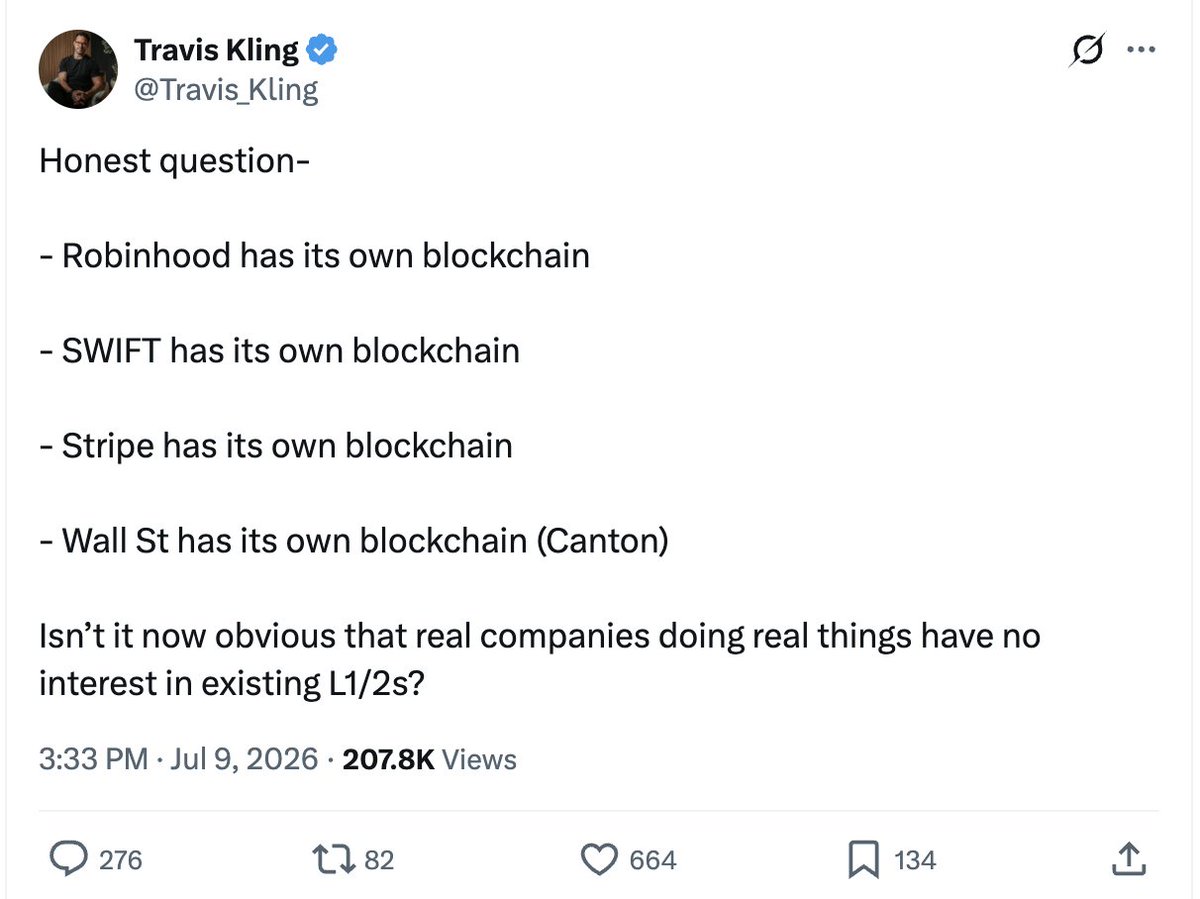
Travis Kling recently proposed a viewpoint: Is there now an obvious conclusion that businesses seriously conducting real-world operations have no interest whatsoever in the various existing L1 and L2 solutions? His first example was Robinhood. Yet, Robinhood is precisely the perfect counterexample: when real-world enterprises make decisions based on business logic, the vast majority will choose the Ethereum L1+L2 architecture.
(Note: Travis Kling is the founder and chief investment officer of the crypto asset management firm Ikigai, with years of investment experience at institutions like Point72 on Wall Street, and is a well-known crypto macro investor.)
Robinhood chose Ethereum as the underlying L1 and subsequently built its own Ethereum layer-2 network based on Arbitrum technology. Robinhood Chain relies on Ethereum Blobs for data availability, uses ETH as the native gas token, and is equipped with a standard cross-chain bridge secured by Ethereum.
This does not negate the Ethereum L1+L2 model; on the contrary, it confirms that this architecture is operating as originally designed.
The deeper core lies in the vastly different incentive mechanisms among participants. Early crypto industry players built public chains and chose technology stacks with the goal of issuing tokens. The emerging real-world on-chain economy is gradually establishing Ethereum L1+L2 as the underlying standard for cash-flow businesses.
These two types of participants have entirely different objective functions. As the market participant structure shifts, Ethereum's advantages will become increasingly evident.
Old Crypto Economy: Everything Optimized for Tokens
The "real-world enterprises serving real users" referred to in this article follow the classic corporate operation model: creating products consumers need, generating cash flow by providing services, and increasing the equity value corresponding to that cash flow.
Here, "real users" have demands stemming from normal economic activities, not merely speculative demand created by a new round of token issuance. Of course, crypto-native users also belong to real users.
This is not a judgment on whether various protocols are useful or whether builders have pure intentions; it is not a moral distinction. The core differentiating point lies in the economic objectives of the operating entities.
The value of a token can only come from three sources:
- Cash Flow: Possessing a reliable claim on future cash flow, akin to on-chain equity or bonds;
- Utility Value: Granting holders privileged access to, control over, or governance of a high-value system. Even without cash flow, a token that can control critical resources still holds value;
- Monetary Premium: People are willing to hold the asset long-term, convinced that others will recognize and accept it later. The asset transforms into a store-of-value carrier, becoming an ultimate unit of account, not just a voucher awaiting redemption for rights.
The monetary premium is real but extremely difficult to maintain. It requires powerful network effects in market confidence, liquidity, ecosystem adoption, scenario integration, and practical application. Gold, the US dollar, Bitcoin, and Ethereum have each established their own forms of monetary premium; hardly any other assets have achieved this.
Looking back, since the proliferation of programmable crypto assets, the vast majority of participants in the industry have not been formal enterprises pursuing stable cash flow. Their business models mostly involve selling tokens, with token value supported by utility expectations, hype-driven monetary premium, or distant, hard-to-fulfill cash flow narratives.
Some paths are very direct: developing a protocol and directly issuing a native token. Some are more roundabout: receiving grants from ecosystem projects funded by token sales, then selling the received tokens. Some projects do plan to generate revenue in the future. However, when token valuations are severely disconnected from reasonable expected cash flow, the essential business model still relies on market confidence in the token.
Almost everyone replicated similar playbooks, so this model slowly became the industry norm.
Important exceptions exist, of course: centralized exchanges are mostly pure cash-flow businesses, naturally adopting multi-chain strategies, where adding a new public chain is like adding a deposit/withdrawal channel. Some stablecoin issuers are also real-world cash-flow enterprises, initially serving the crypto circle but now expanding into the broader real economy.
But these exceptions precisely prove the core point: enterprises aiming to earn cash choose infrastructure to maximize their own business returns, not to boost token appreciation.
Incentive Mechanisms Ultimately Shape Technical Architecture
An entity's objective function determines its technical route choices. If a business's core mission is to operate a cash-flow business, the blockchain is just infrastructure. The enterprise selects a public chain to reduce risk, optimize products, reach users, and protect profits.
If the primary goal is token monetization, the choice of public chain becomes extremely flexible. Whichever public chain provides ecosystem grants, projects will develop on it. Seeing a successful protocol on Chain A, replicate a similar product on Chain B to facilitate investor valuation comparisons. As long as issuing a new token is desired, a brand new L1, L2, appchain, gas token, governance system, or niche technology stack can be packaged as marketing highlights.
The issue is not technological diversity itself. The crypto field will continue to see a Cambrian explosion of innovation with numerous applications, protocols, layer-2 solutions, and specialized execution environments emerging. The real industry-distorting trend is: for every new idea, there's a rush to independently build a sovereign ecosystem, separately set up an L1, prepare a security budget, cultivate liquidity, issue native monetary assets, completely disregarding whether the business itself necessitates it.
As the industry's focus gradually shifts towards cash-flow real-world businesses, innovation and exploration will not cease but will increasingly be built upon a unified underlying foundation. Enterprises will focus on differentiated development at the application layer and layer-2, relying on Ethereum L1 for settlement, security guarantees, liquidity hosting, and value storage. Ultimately, the industry will form a dumbbell structure: diverse applications flourish at the edges, while underlying infrastructure continues to consolidate.
The common logic of the old crypto industry: build the entire technical architecture around the token you want to sell to investors.
Market Participants Are Evolving
The future shape of the crypto industry will inevitably differ from the past, for one core reason: the players have changed.
The previous US administration persistently suppressed on-chain industry development, but now the wind has shifted. The "GENIUS Act" has been formally enacted, establishing a federal regulatory framework for payment stablecoins. The EU's MiCA regulatory framework is fully effective. Brokers, payment companies, banks, asset management institutions, and governments worldwide are beginning to deploy strategies around stablecoins, asset tokenization, and on-chain business.
This does not mean all regulatory challenges are solved, but large institutions can finally engage in long-term planning for on-chain business.
We are at the starting point of the large-scale adoption S-curve.
As the industry matures, crypto and traditional financial systems will no longer be fragmented. Assets, money, transactions, finance, identity, and trust will all be carried by a combination of on-chain and off-chain systems. Eventually, the term "Web3" will fade from public consciousness, much like "Web2" did, and everything will simply be called the internet.
By then, within the crypto market, the proportion of real-world enterprises serving ordinary users from the real economy will significantly increase. Not only will the number of such enterprises rise, but more crucially, capital volume, user scale, asset volume, and institutional influence will tilt towards these entities.
They will no longer be crypto projects struggling to find business models merely to support token narratives. Instead, they will be real companies using blockchain to improve existing businesses and create entirely new cash-flow avenues.
The market landscape will be rewritten. The infrastructure selection logic of the token economy era is entirely unsuitable for the cash-flow real economy.
Real-World Enterprises Procure Blockchain Infrastructure
Real-world enterprises have very low budgets for infrastructure trial-and-error risks. Companies do not want to bear the extra burden of consensus mechanisms, cross-chain bridges, validator systems, gas assets, governance tokens, liquidity operations, and a pile of unrelated additional modules. Any new technical module must create user value; otherwise, it is a liability.
Blockchain should serve the business, not the other way around.
Some businesses are naturally suited for multi-chain deployment: exchanges, wallets, stablecoin issuers, and various asset issuance platforms require broad user coverage. However, even when operating across multiple chains, it doesn't mean all public chains are equal; usually, a core public chain is designated to handle liquidity, asset issuance, settlement, business data storage, and deep ecosystem integration.
For the vast majority of on-chain businesses, the focus will be on deeply cultivating one main chain or a few chains within the same system.
Enterprises generally have three choices:
- Ethereum L1: Used when the business pursues ultimate decentralization, credible neutrality, minimal risk, and deep liquidity. L1 has higher transaction costs, exchanged for the industry's strongest shared security environment.
- Build a custom Ethereum L2: Used when the enterprise needs operational control, high customization, compliance capabilities, stable cost models, low latency, and high throughput. This allows operating an independent blockchain according to its own needs while remaining bound to the Ethereum foundation.
- Use mature shared layer-2: Used when the business scale is insufficient to support an independent L2, deploying directly on existing public L2s. Base, Arbitrum One, Robinhood Chain, and other Ethereum layer-2s become general-purpose development platforms.
Such enterprises will still engage in asset cross-chain operations, export products externally, and connect to other networks. Having a core main chain does not equate to isolation; asset interoperability and business interconnection have become standard for on-chain businesses.
But the core home chain is crucial. It determines the security foundation, standard data state, liquidity flows, operational model, and long-term development dependencies of the entire system.
Why the Ethereum L1+L2 Architecture Fits Enterprise Needs
Ethereum precisely splits the two core demands of large enterprises: L1 creates a highly decentralized, credibly neutral, and liquidity-rich global settlement hub; various L2s constitute a diverse market of execution environments, enabling high speed, low cost, vertical customization, and operator autonomy.
The foundation remains solid and neutral, while the upper layers flexibly adapt to different operating entities, jurisdictions, differentiated products, and user groups. Layer-2 solutions not only achieve Ethereum scaling at the technical level but also achieve scaling at the institutional level: institutions can operate their businesses according to their own rules without requiring the global base layer to accommodate their needs.
Independent L1s can also provide operational autonomy and high performance. In some scenarios, having full control over consensus and data availability holds value. But full sovereignty comes at a high cost.
A brand new independent L1 must build from scratch and continuously maintain a security budget, validator nodes, cross-chain trust assumptions, liquidity, development tools, ecosystem partnerships, and institutional credibility.
It creates a new security and liquidity island, significantly increasing friction costs for interaction with Ethereum L1 and the vast layer-2 ecosystem. Only when the independent consensus mechanism itself can create enormous commercial value is it worth bearing these costs for an enterprise.
For the vast majority of enterprises, the benefits of building an independent L1 cannot cover the comprehensive costs.
A customized Ethereum layer-2 can secure almost all the advantages of an independent L1: high TPS, control over execution logic, independent upgrades, custom fee structures, transaction ordering, latency control, access rules, and product-specific features.
Simultaneously, layer-2 inherently possesses advantages that are difficult for a native L1 to build quickly: settlement and data availability relying on Ethereum, native standard cross-chain bridges, seamless connection to Ethereum's existing funds and assets, and cross-chain interaction with minimized trust requirements based on the same underlying layer.
The design details of layer-2 solutions remain crucial. Admin permissions, upgrade keys, proof systems, and withdrawal guarantee mechanisms determine how much underlying security users can inherit.
Even a layer-2 with relatively high operator control still relies on Ethereum L1 to establish an unbreakable settlement foundation. For an enterprise simply conducting business, there's no need to independently operate and secure a base-layer L1.
An Ethereum layer-2 is both an independent blockchain and part of the Ethereum economic system. The operator can customize the execution environment while reusing Ethereum for settlement, Blob data storage, and cross-chain interoperability. Most will deeply integrate ETH into the ecosystem, directly using ETH as the gas token. The native standard bridge allows L1 assets to flow into the layer-2 economy with low trust thresholds.
Each new layer-2 creates a differentiated product segment, continuously amplifying Ethereum's network effects.
Robinhood's Decision is Highly Instructive
Robinhood's development path holds textbook-level reference value. The company first launched its stock token business on the mature shared layer-2 Arbitrum One. After validating the product model and clarifying its needs, it launched its own proprietary blockchain based on the Arbitrum platform.
This will likely become a common industry development path: first validate the product using shared infrastructure, then upgrade to a proprietary L2 once business scale, product requirements, and profit models are met.
Robinhood Chain is customized for financial services. Leveraging Arbitrum technology, it achieves 100-millisecond latency, predictable transaction pricing, and high throughput. The entire infrastructure meets all of Robinhood's requirements for performance, security, and regulatory compliance.
Simultaneously, Robinhood Chain is inherently an Ethereum layer-2: it relies on Ethereum Blobs for data, uses ETH for gas, and connects via a standard bridge to Ethereum that doesn't require third-party verifiers.
This is the standard template for real-world enterprises building on-chain products.
Robinhood doesn't need to create its own gas token from scratch and then justify to the market that the token possesses a long-term monetary premium. Robinhood itself is a publicly traded company with equity; all its profit growth comes from users, products, existing assets, and transaction-generated cash flow.
Blockchain is just infrastructure.
Choosing ETH to pay for gas is a purely rational business decision. The layer-2 itself needs to pay ETH to Ethereum for L1 underlying services. ETH has ample liquidity and is natively integrated across the ecosystem. Issuing a proprietary gas token would only add extra costs for promotion, liquidity maintenance, price volatility, and reputational risk without improving Robinhood's core business.
The metric for judging Robinhood's success or failure is the application-layer product and its off-chain derivative businesses, not whether it can create a new asset with monetary properties.
Therefore, many people misunderstand: some claim Robinhood developing its own blockchain means it abandoned the existing L1/L2 system. The opposite is true: Robinhood simply did not want to share a single execution environment with everyone. It did not abandon Ethereum; it chose Ethereum as the underlying parent chain for its own blockchain.
The Ethereum L1+L2 architecture is no longer just a theoretical concept.
Coinbase made the same choice when building Base. Coinbase is not an Ethereum evangelist; Brian Armstrong (Coinbase co-founder and CEO) has publicly stated he is more bullish on Bitcoin long-term. Yet, when the enterprise selected underlying infrastructure for its on-chain business, it still built Base as an Ethereum layer-2.
This choice is highly persuasive—the decision stemmed from commercial interests, unrelated to belief preferences.
When an enterprise's goal is to build a cash-flow business, not to host a token sale, it will ultimately only make rational business judgments. The default optimal commercial solution at this stage: Ethereum L1+L2.
What the Landscape Shift Means for Ethereum and ETH
The shift in market participant structure is extremely beneficial for Ethereum in the long term.
In the past, the competitive landscape of the public chain sector was largely dominated by projects enthusiastic about issuing tokens, distributing ecosystem grants, and relying on token valuation narratives.
Going forward, the industry's competitive entities become real-world enterprises, making decisions centered around security, user acquisition, operational control, market coverage, liquidity, and cross-chain interoperability optimization—all serving cash-flow businesses.
Market demand will continue to aggregate towards Ethereum's dumbbell architecture: L1 bears the demands for ultimate security and liquidity; various L2s handle demands for scaling, customization, and autonomous operation.
Ethereum's path to mass adoption does not lie in forcing all enterprises onto the same shared execution chain but in becoming the common settlement, security, liquidity, and asset foundation for thousands of upper-layer environments.
This also benefits ETH. ETH's growth logic relies on building a global monetary network and accumulating market consensus; it is not itself a cash-flow business.
ETH is a high-quality store-of-value asset, the native asset of Ethereum's global settlement layer. It serves as collateral, a liquidity vehicle, treasury reserve asset, productive asset within the ecosystem, and is continuously growing into an ultimate store-of-value asset.
As more real-world enterprises conduct business based on Ethereum, they will continuously expose ETH to massive numbers of users, embed ETH into various products, and constantly expand application scenarios. As liquidity and consensus deepen, ETH's monetary premium is further consolidated, and the monetary premium is essentially a powerful network effect.
Old crypto economy: Design the entire technical architecture around the token you want to sell. Emerging on-chain real economy: Choose the technical architecture around the product you want to deliver to customers.
These two types of participants have completely different optimization objectives, which will shape a drastically different public chain competitive landscape.
Robinhood is not an exception; it is a beacon.
Real-world enterprises choose Ethereum L1 when pursuing the industry's strongest neutrality, lowest risk, and top-tier shared liquidity environment. They build Ethereum L2 when needing operational autonomy, customization capabilities, and high performance. When business scale is insufficient to support an independent blockchain, they deploy on mature shared layer-2s (mostly Ethereum-based L2s).
Enterprises make this choice not because they are Ethereum maximalists, but purely out of business considerations.