Author: Claude, Shenchao TechFlow
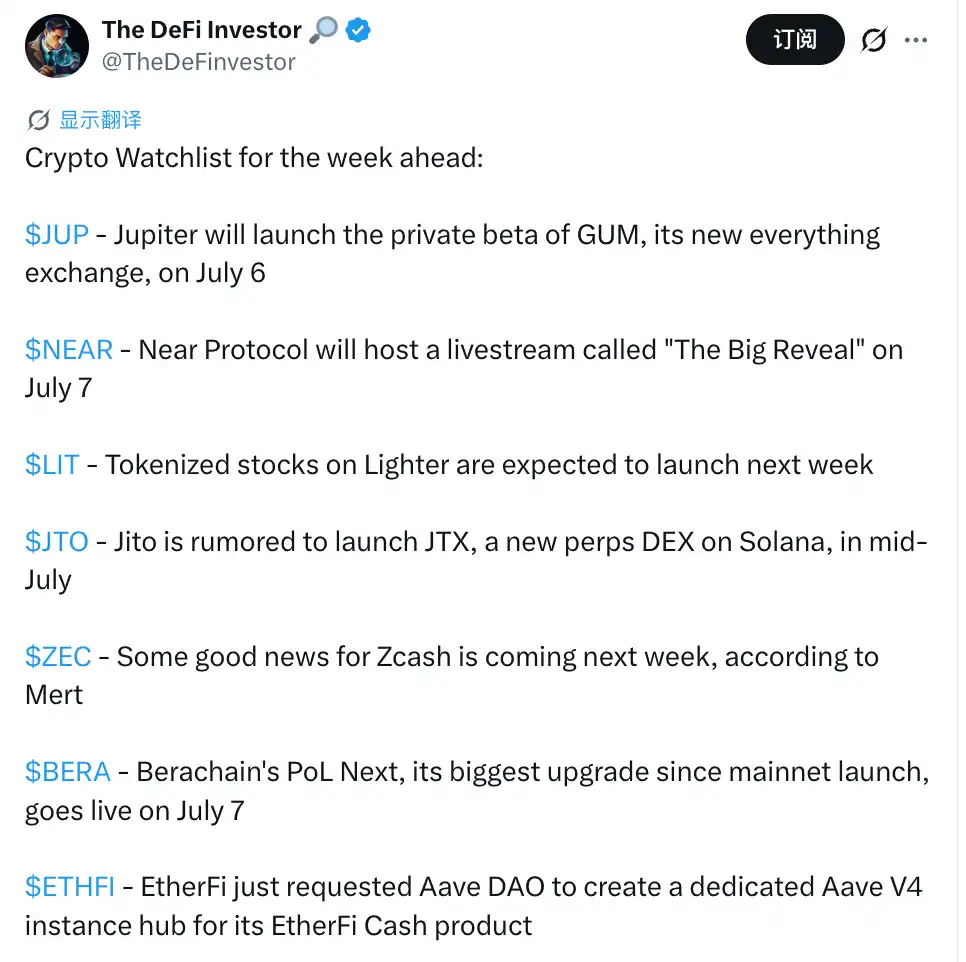
Shenchao Guide: If you're holding these altcoins or planning to buy into the SOL ecosystem's resurgence, this week's schedule is worth adding to your calendar. Crypto KOL @TheDeFinvestor compiled a list of catalysts for this week, with seven projects releasing positive news intensively from July 6th to next week: Jupiter launches the private beta of its unified market GUM today, NEAR has a "big reveal" live stream tomorrow, Berachain hard forks on July 7-8 to rewrite its token model, Zcash's Ironwood upgrade at month-end...
We further summarize the context behind each event and the overall timeline below.
Jupiter Launches GUM Private Beta Today, Taking a Substantial Step Towards the 'Everything Exchange' Vision
The most immediate event involves JUP. Jupiter is launching the private beta of GUM on July 6th (today).
Jupiter is the largest DEX aggregator on Solana, essentially a tool that helps users find the best prices for token swaps across dozens of trading venues. GUM (Giant Unified Market) is its core strategy launched in May 2024, aiming to bring assets like meme coins, stocks, forex, and real estate on-chain into a unified interface where users can swap them for less than a cent. DinariGlobal has already committed to offering 1:1 backed tokens for stocks like Apple and Coinbase on Solana.
This private beta is for GUM's unified market API, integrating login, deposits, cross-chain spot, and perpetual contracts. The market has already shown a significant positive reaction to this expectation, with JUP rising up to 13% in the past 24 hours, becoming one of the few mainstream coins bucking the overall cautious trend. One study listed Jupiter among the top 15 revenue-generating crypto protocols, estimating its revenue over the past 12 months at approximately $130 million. Its governance forum also has proposals requesting more protocol fees to be allocated for JUP buybacks.
However, the biggest caution for JUP is its supply. According to the public unlock schedule, around 253 million JUP tokens are set to unlock by the end of February 2026. Product milestones can drive sentiment, but the increased circulating supply from the unlock could create selling pressure, potentially offsetting the "buy the rumor" gains.
NEAR's 'Big Reveal' Live Stream Tomorrow, Focusing on Enterprise-Grade 'Black Box'
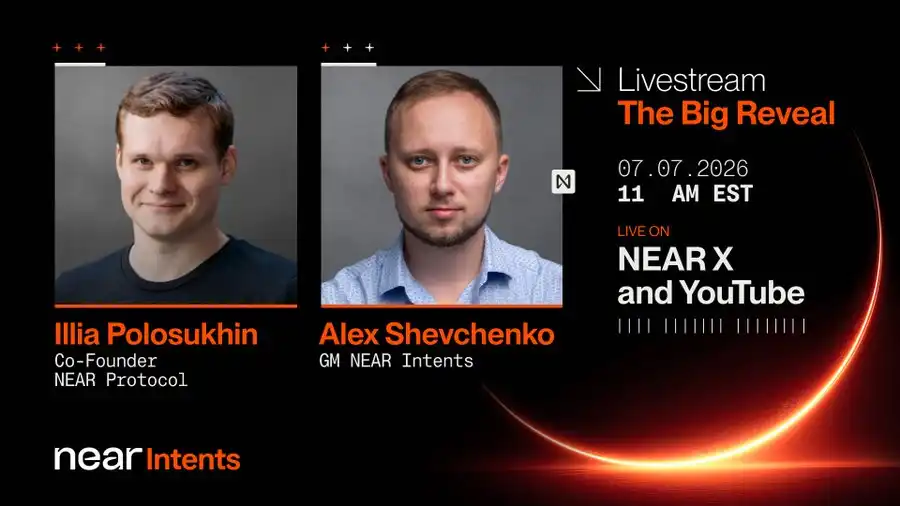
On July 7th at 16:00 UTC (11 AM Eastern Time), NEAR will host a live stream titled "The Big Reveal" on X and YouTube, led by founders Illia Polosukhin and Alex Shevchenko. The theme is "Unboxing the Black Box for Enterprise Users."
NEAR's recent focus has been on Intents (intent-based trading, where users specify a desired outcome and the system automatically completes the path), AI integration, and confidential computing. Data from last month showed that NEAR Intents has processed over $22 billion in cumulative transaction volume. The team previously teased the next major protocol upgrade, SPICE. This live stream is likely to announce that, or perhaps the black box technology for business clients.
Risk note for holders: These "reveal live streams" are typical expectation-driven events. Sentiment often runs ahead before the announcement, and afterwards, it depends on whether the revealed content has real substance. If it's just concepts and roadmaps without tangible products or named partners, the impact may be limited.
Berachain Hard Fork on July 7-8, Directly Cuts BGT Token
Also on July 7-8, Berachain is undergoing its largest upgrade since mainnet launch: PoL Next. This isn't a patch but a hard fork that rewrites its core incentive layer.
Berachain's core mechanism is called Proof of Liquidity (rewarding and granting governance rights based on providing liquidity rather than simple staking). The old model involved two tokens, BGT and BERA, plus a Boost mechanism, which confused many traditional investors.
PoL Next simplifies this into a single token: BGT and Boost are gradually phased out, with all emissions converted to BERA, and value accrual unified to sWBERA (staked version of BERA). The new emissions mechanism, ERAs, requires projects to provide real on-chain revenue and usage data to receive incentives, replacing the old system where emissions were voted in.
This direction is structurally positive for BERA's tokenomics, but the implementation comes with clear risks. Currently, BERA's market cap and on-chain total value locked (TVL) are severely inverted (DeFi TVL was around $55 million, while its market cap once hovered around $66 million). During the mechanism transition, holders of old incentives adjusting their positions could create selling pressure. Additionally, unlocking sWBERA to convert back to BERA has a 7-day unlock period, sacrificing flexibility.

Zcash's Ironwood Upgrade at Month-End, Climbing Out of 'Counterfeit Coin Panic'
The catalyst for ZEC is the most vaguely worded. The original list only says, "According to Mert (CEO of Helius Labs), good news is coming next week." This requires some context.
In late May this year, security researcher Taylor Hornby discovered a four-year-old vulnerability in Zcash's Orchard privacy pool that theoretically allowed attackers to mint an unlimited number of counterfeit ZEC undetected. Due to the nature of privacy coins, developers couldn't confirm if the vulnerability had been exploited before the fake coins were found. Upon the news, ZEC plummeted from over $600 to around $250 within two days, and BitMEX co-founder Arthur Hayes liquidated his entire ZEC position.
Reference Reading: "Zcash Privacy Coin Trust Crisis: After Claude Discovers Vulnerability, Arthur Hayes Sells Off, Core Developer Josh Swihart's Latest Response Explained"
The fix for this issue is the Ironwood upgrade, currently scheduled for mainnet activation on July 21st.
It creates a new privacy pool, closes the old Orchard pool, and leverages the existing turnstile mechanism to allow any node to independently verify the circulating supply, essentially providing verifiable proof that no counterfeit coins were minted. Following the announcement of the fix, ZEC has already rebounded over 50% from its low, trading at $462 on July 4th, up 13.3% over the past week. (Note: Hornby originally discovered this vulnerability using Anthropic's Claude Opus 4.8.)
Risk note for holders: The confirmed schedule is the mainnet upgrade on July 21st. Any "good news" before that is more about sentiment, so don't take a passing comment as guaranteed news.
Lighter's Tokenized Stocks Launching Next Week, Tapping into Robinhood's Massive User Base
The catalyst for LIT is the expected launch of tokenized stocks on Lighter next week.
Lighter is a zero-knowledge proof-based perpetual futures DEX (processing transactions off the Ethereum main chain and using cryptographic proofs to verify their legitimacy, resulting in low costs and high speed). Its real appeal lies in its connection with Robinhood: Robinhood's Ethereum L2, "Robinhood Chain," went live on July 1st, and Lighter became the default perpetual DEX on this chain.
Users can deposit tokenized stocks like Nvidia and Apple into lending pools as collateral—something not possible with a regular brokerage account.
Robinhood has approximately 24 million funded accounts. Even if only a small portion migrates on-chain, it would mean a significant volume boost for Lighter. Lighter is also allocating $11 million worth of LIT tokens for incentives to the Robinhood community, with Robinhood covering users' gas fees for 90 days. Following the news, LIT rose up to 24%, hitting a stage high of $2.14.
Risk note for holders: Robinhood explicitly excludes users from regions like the UK, US, Canada, Switzerland, UAE, and Singapore from its perpetual contract services, limiting the actual addressable user base. Additionally, the perp DEX space is competitive with players like Hyperliquid, Aster, and dYdX's Arcus vying for the same order flow, and token unlocks remain a downside risk.
Jito to Launch JTX in Mid-July, Moving from 'Background Toll Booth' to Compete for Order Flow
The catalyst for JTO is the rumored launch of its new trading platform, JTX, in mid-July.
Jito is a core infrastructure provider on Solana, involved in both liquid staking (JitoSOL) and MEV (Miner Extractable Value, which refers to extra profit earned by reordering transactions, money that partly belongs to regular traders).
Its MEV client already runs on over 95% of Solana's active stake, essentially acting as a toll booth for the entire chain. JitoSOL's TVL surpassed $2.9 billion in Q1 2026.
JTX represents Jito's move from the backend to the application layer: a self-custody trading terminal aiming to provide professional traders with CEX-level execution speed and tools while users hold their own assets.
Early access began on June 26th, with plans for a full public launch in July, starting with spot trading and later integrating perpetual and prediction markets. The key is token capture. According to Jito's materials, approximately 80% of JTX's protocol revenue will flow back to JTO holders through buybacks.
Risk note for holders: The 80% revenue flow-back is the hardest part of the JTX narrative, but it hinges on JTX actually generating trading volume. The perpetuals space is dominated by Hyperliquid. As a new entrant, it's unclear how much order flow JTX can capture. Jito's revenue is highly tied to Solana's on-chain activity; once on-chain transaction volume declines, the fee stream can quickly shrink.
Ether.fi Requests a Dedicated Aave V4 Instance to Serve as Credit Backend for Visa Card
Finally, ETHFI. It just submitted a proposal to the Aave DAO on July 1st, requesting the deployment of a fully managed, dedicated Aave V4 instance (whitelabel hub) on the OP Mainnet to serve as the backend for EtherFi Cash.
EtherFi Cash is a physical Visa card that allows users to borrow stablecoins against yield-bearing assets (like restaked ETH) for direct spending. It previously used its self-built Debt Manager system but now wants to adopt the more mature and liquid Aave V4 infrastructure. Proposal details: isolated whitelist mode, GHO as the primary borrowing asset, maximum launch liquidity target of $175 million, an 80/20 revenue split (Aave DAO gets ~20%), with the Optimism Foundation potentially providing $20 million in supply and $1.2 million in incentives.
Risk note for holders: This is the most "early-stage" of the seven catalysts. Currently, it's only in the "temperature check" phase. It must go through a full DAO vote before implementation, and whether it passes and when are uncertain. Treat this as a directional signal, not a catalyst that will materialize this week.
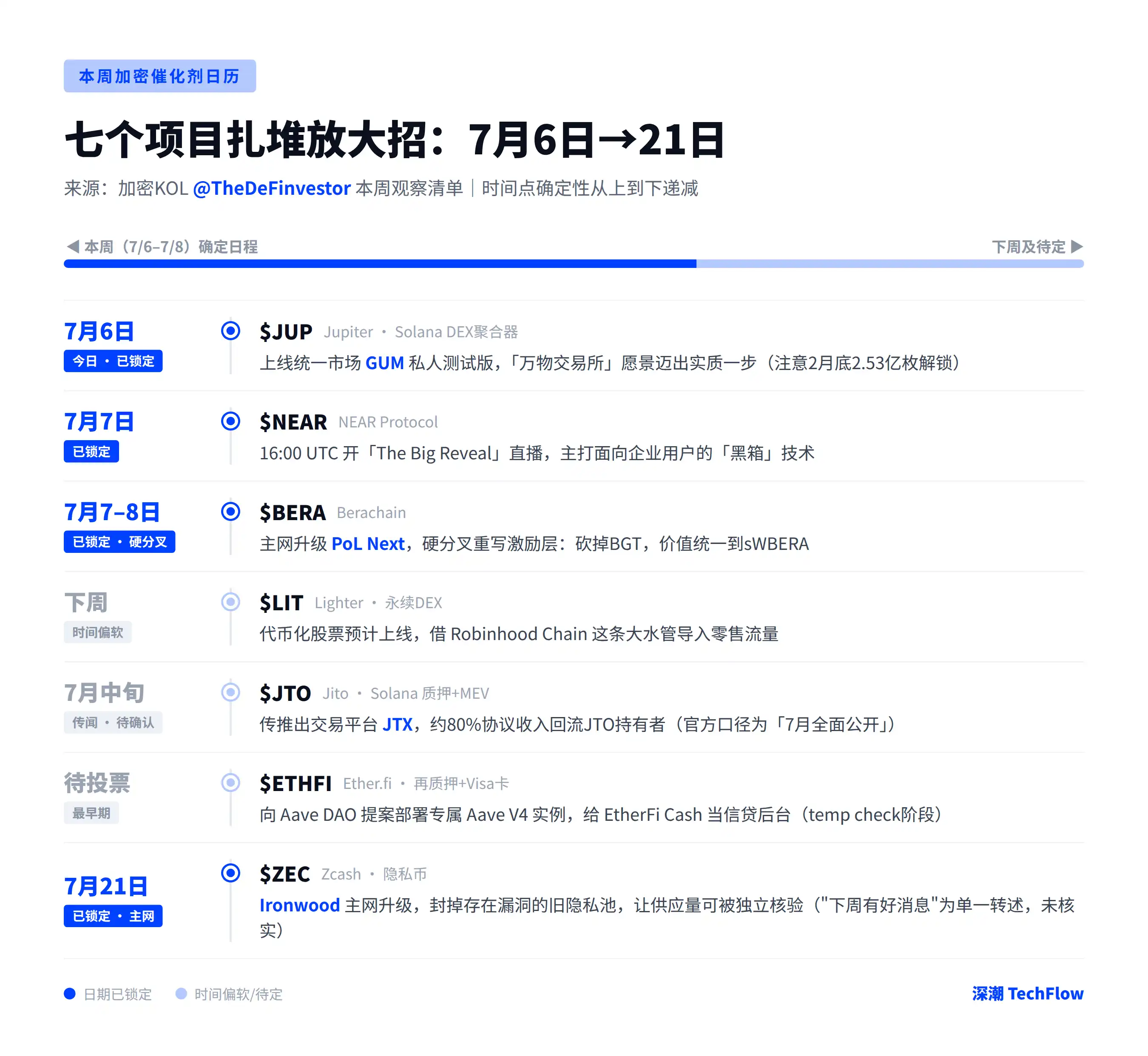
Finally, here's a one-chart summary to help you quickly grasp the related events and timelines.