STRC Trading at Significant Discount, mNAV Falls Below Break-Even, Strategy's Valuation Logic Has Been Rewritten

Foresight News發佈於 2026-06-26更新於 2026-06-26

文章摘要

Title: STRC Deeply Discounted, mNAV Falls Below Break-even, Strategy's Valuation Logic Redefined The recent volatility in MSTR and STRC highlights the need to reassess the core business model of Bitcoin reserve companies. These entities function more like leveraged, single-asset banks rather than software/tech firms. Consequently, they should be valued using banking metrics, not based on their total Bitcoin holdings. The key valuation metric is mNAV (market net asset value), akin to a price-to-book ratio. It compares the company's market capitalization to the equity value of its Bitcoin holdings after deducting all senior debt and preferred equity (like STRC). As of June 24, Strategy's mNAV was 1.10x. The focus should be on "net Bitcoin per share" (the Bitcoin claim per share after senior claims) and its growth rate, equivalent to a bank's book value and return on assets. Given STRC's 19% discount to its $100 par value (yielding 14.2%), issuing new MSTR equity at the current price to buy more Bitcoin is inefficient. It slightly dilutes the widely watched "total Bitcoin per share" metric while providing minimal improvement to the more critical "net Bitcoin per share." The article analyzes four potential uses for $1 billion in new equity: 1. **Buy Bitcoin:** Least effective. Improves net Bitcoin per share only marginally while diluting total Bitcoin per share. 2. **Repurchase STRC:** Most effective for balance sheet repair. The discount creates immediate value, increasing...


Author: Khing Oei

Compiled by: Chopper, Foresight News


Recently, the markets for MSTR and STRC have experienced significant volatility. We should look beyond short-term price fluctuations and revisit the underlying logic: Bitcoin reserve companies are essentially single-asset, leveraged holding entities, with a business model closer to that of a bank rather than a software technology company.


From a valuation perspective, the market would never price a bank based solely on its total assets. A bank's loan assets are prioritized for repayment by depositors and debt holders, with common shareholders only entitled to residual equity. Therefore, the core valuation metric for banks is the price-to-book ratio (P/B), which is the value of shareholders' equity after deducting senior debt from total assets. This is also the primary reference metric for investment bank and brokerage analysts.


For Bitcoin reserve companies, the equivalent P/B metric is mNAV: it equals the company's market capitalization divided by the equity net asset value, where equity net asset value refers to Bitcoin reserves minus debt and preferred stock senior to common shares. As of the previous close, Strategy's mNAV was 1.10x. (Translator's Note: The "previous close" data mentioned in this article refers to June 24th data.) The underlying per-share fundamental is the net Bitcoin per share—the actual amount of Bitcoin owned per share after settling priority claims. This is equivalent to the per-share book value denominated in Bitcoin. The industry-wide focus—the per-share Bitcoin growth rate—represents the return on this book value. For a capital management company, this is almost equivalent to an earnings metric.


This set of metrics is not my invention; it simply applies the traditional bank financial analysis framework to a Bitcoin balance sheet:


  • Market cap per unit of equity / Net asset value = Price-to-Book Ratio
  • Net Bitcoin holding per share = Book value per share
  • Bitcoin holding growth per share = Return on book assets


This is the valuation logic common to all leveraged financial institutions and is fully applicable to these Bitcoin reserve companies.


MSTR closed yesterday at $94.13 per share, below the total net Bitcoin value per share of $143.76, resulting in a rough total net value multiple of only 0.65x. Viewed solely through this lens, the stock trades at nearly a one-third discount to its Bitcoin asset value, making a stock issuance to buy more Bitcoin seem dilutive. However, after deducting the approximately 40% of Bitcoin equity occupied by debt and preferred stock, the current stock price represents 1.1 times the Bitcoin assets actually held by common equity. The two perspectives lead to completely opposite conclusions, and the banking valuation framework is the correct benchmark, which also determines how the company should use any new capital raised at present.


Simulating Four Use Cases for $1 Billion in New Capital


Assuming a $1 billion equity issuance at the current stock price, we simulate the effects of four potential uses for the funds: 1) Increase Bitcoin holdings; 2) Repurchase STRC; 3) Boost cash reserves; 4) A 50/50 split between repurchasing STRC and boosting cash reserves. The issuance price is $94.13 per share; yesterday's STRC closing price was $80.84, a 19% discount to its par value, translating to an actual annualized yield of 14.2%. For every $1 spent on repurchases, $1.24 of STRC at par value can be retired, simultaneously eliminating the 11.5% perpetual dividend.
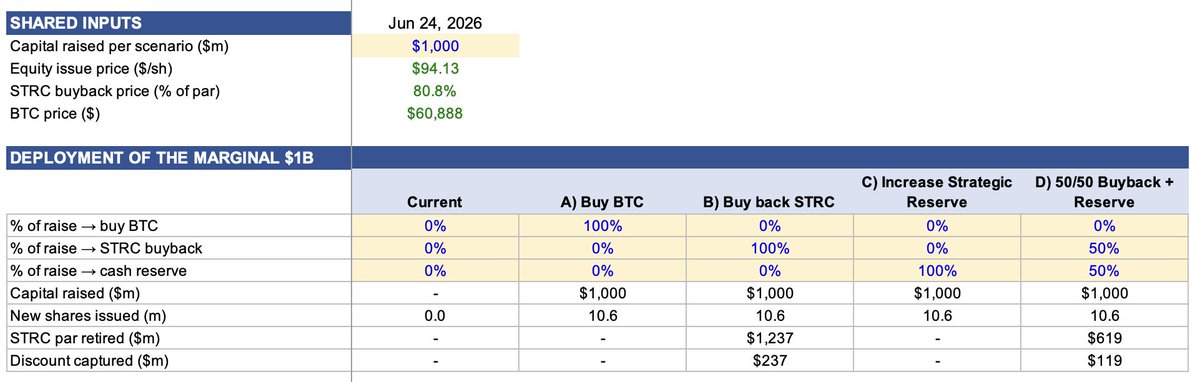


Impact of the Four Scenarios on the Balance Sheet


Three of the four scenarios do not increase Bitcoin holdings; they only adjust the structure of the senior claims layer:


Repurchase STRC: Buying back at a 19% discount, $1 billion can retire $1.24 billion of STRC at par value. Annual preferred stock dividend payments decrease from $1.711 billion to $1.569 billion.

Boost Cash Reserves: Cash reserves increase from $1.4 billion to $2.4 billion, with dividend payments unchanged.

50/50 Split Scenario: Cash increases to $1.9 billion, dividend payments decrease to $1.640 billion, and $619 million of STRC at par value is retired.

Increase Bitcoin Holdings: The only scenario that increases Bitcoin reserves, raising total holdings from 847,363 BTC to 863,787 BTC. This is also the weakest choice for improving core metrics.
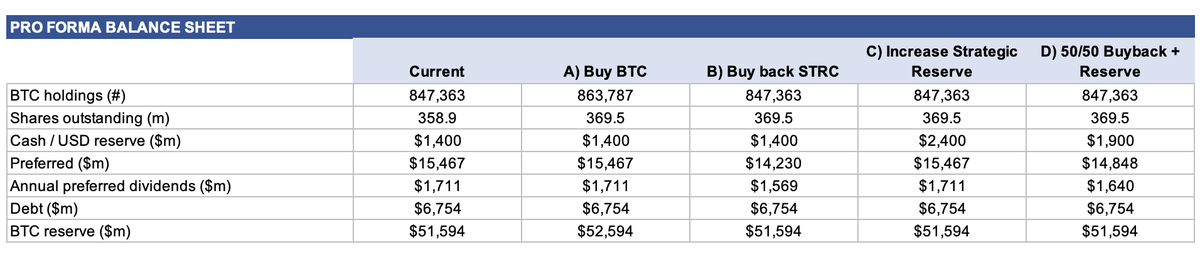


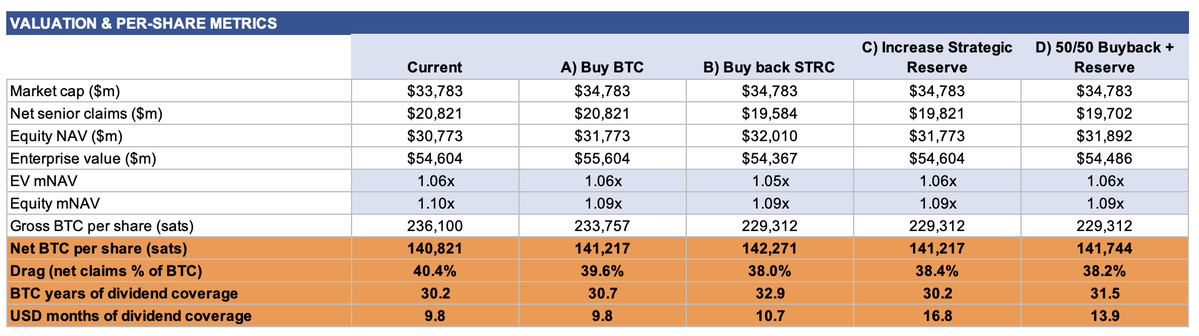
Calculating total Bitcoin value per share, all four scenarios show dilution. Even if you use the entire $1 billion to purchase Bitcoin, the per-share value decreases from 236,100 satoshis to 233,757 satoshis; in the three scenarios where stock is issued but no Bitcoin is purchased, the per-share value drops even further to 229,312 satoshis. Based on this, you would conclude: the company should do nothing.


However, in terms of net Bitcoin value per share, every option results in an increase:


  • Repurchase STRC: Net Bitcoin per share rises to 142,271 satoshis (+1.0%). Debt-to-assets ratio decreases from 40.4% to 38.0%. This provides the strongest balance sheet repair.
  • 50/50 Split Scenario: Net Bitcoin per share becomes 141,744 satoshis, with a debt-to-assets ratio of 38.2%. Cash coverage for debt service is significantly enhanced.
  • Purely Boosting Cash Reserves or Increasing Bitcoin Holdings: Both result in 141,217 satoshis per share, showing the smallest increase.


The logic for Bitcoin purchases being the least effective is clear. You are issuing stock at 1.1 times net asset value but purchasing assets at 1 times net asset value. This only slightly increases net Bitcoin per share while diluting the widely followed total Bitcoin holdings metric. In contrast, repurchasing STRC at a discount creates immediate value.


The market's current key concern is the dividend cash coverage in months. Strategy currently has $1.4 billion in cash reserves and annual STRC dividend payments of $1.711 billion, meaning cash covers only 9.8 months of dividends:


  • Increase Bitcoin Holdings: Coverage remains at 9.8 months.
  • Repurchase STRC: Improves to 10.7 months.
  • Purely Boost Cash Reserves: Significantly improves to 16.8 months.
  • 50/50 Split Scenario: Improves to 13.9 months.


This is another core banking metric: the liquidity coverage ratio. No one pays attention during loose funding cycles, but during funding contractions, it becomes crucial for corporate survival. The fact that STRC is trading below par is a direct signal of market funding channel tightening.


Company's Own Financial Data Also Confirms This Conclusion


The above analysis is not a subjective judgment; Strategy's Q1 earnings report provides the same break-even threshold. According to the company's own framework, selling MSTR to buy Bitcoin only increases Bitcoin per share when mNAV is above 1.22x. At the current multiple of 1x, such a move directly erodes value by 48 basis points. The company's current EV is 1.06x and mNAV is 1.10x, both below its internal break-even line.


The two core assumptions behind the company's conventional expansion path have now completely failed. Previously, it was assumed that STRC could be issued at par normally and that cash reserves could cover 1.5 years of dividends. Now, STRC trades at $81 and cannot be issued at par, and cash reserves cover less than 10 months of dividends.


What Should Strategy Do?


Within the current valuation range, issuing new equity and deploying the capital into channels that tangibly optimize core financial metrics is key. Both boosting cash reserves and repurchasing STRC at a discount can increase net Bitcoin per share, reduce the debt burden, and repair the market's concern over liquidity coverage. The 50/50 split scenario can achieve all these objectives simultaneously.


Continuing to add Bitcoin at present would only optimize the superficial metrics widely followed by the public, while neglecting the core balance sheet risk of the company carrying $15 billion in priority debt amidst tightening funding channels.


Investors focused solely on the total Bitcoin holdings metric miss the positive feedback loop. Repurchasing STRC directly supports token buy-side pressure and signals confidence in liquidity safety. Once market panic subsides, STRC prices should recover toward the $100 par value; price appreciation corresponds to lower yields, and the current high yield of 14.2% would continue to narrow. A complete positive cycle thus forms: repairing the balance sheet → STRC price recovery → dividend yield declines → the previously closed channel for par-value issuance reopens.


The STRC discount is not something that can only be passively waited out for repair; the current deep discount represents the lowest-cost capital the company can access and is key to restarting other funding channels.


To evaluate Bitcoin reserve companies, one should apply banking valuation standards: price-to-book ratio, per-share book value, and debt servicing capacity under stress environments.


熱門幣種推薦

相關問答

QWhat is the core valuation framework proposed by the author for Bitcoin reserve companies like Strategy, and why is it applicable?

AThe author proposes applying a traditional bank valuation framework. The core logic is that these companies are leveraged holders of a single asset (Bitcoin), similar to banks. The key valuation metric is the Price-to-Book ratio, represented as mNAV (market NAV), which is the company's market capitalization divided by its equity net asset value (Bitcoin reserves minus priority debt and preferred stock). This framework is applicable because it focuses on the residual equity value for common shareholders after satisfying priority claims, which is the standard way to value leveraged financial institutions.

QAccording to the author's analysis, what is the least effective use of $1 billion in new equity capital for Strategy at the current valuation, and why?

AUsing the new capital to buy more Bitcoin is the least effective option. The logic is that the company would be issuing equity at a price of 1.1x its net asset value (mNAV) but buying an asset (Bitcoin) priced at 1x its underlying value. This results in only a minimal increase in the key metric of 'Net Bitcoin per share' while diluting the more widely watched 'Total Bitcoin per share' metric. In contrast, using the capital to repurchase discounted STRC preferred shares creates immediate value by reducing debt burden and dividend obligations.

QWhat are the two core assumptions of Strategy's original expansion plan that the author states have now failed?

AThe two failed core assumptions are: 1) That STRC (the company's preferred shares) could be issued continuously at its $100 par value. Currently, it trades at a 19% discount ($81), closing this funding channel. 2) That the company's cash reserves would be sufficient to cover 1.5 years of dividend payments on those preferred shares. Currently, the cash covers less than 10 months of dividends, indicating a liquidity coverage problem.

QWhat positive feedback loop does the author describe as a potential outcome if Strategy uses new capital to repurchase STRC shares?

AThe positive feedback loop is: Repairing the balance sheet by repurchasing discounted STRC → This action supports STRC's market price → As STRC's price rises toward its $100 par value, its dividend yield falls → The previously closed channel for issuing new STRC at par value reopens. This cycle allows the company to improve its financial health and regain access to lower-cost capital.

QWhat key banking metric does the author highlight as crucial during periods of financing tightening, and what is Strategy's current situation regarding this metric?

AThe author highlights 'Liquidity Coverage' or specifically the 'Cash Dividend Coverage Months' as a crucial banking metric during financing tightening. It measures how many months of dividend payments (for priority securities like STRC) the company's cash reserves can cover. Strategy's current cash reserve of $1.4 billion covers only 9.8 months of its $1.711 billion annual STRC dividend, signaling potential liquidity stress in a tighter funding environment.

你可能也喜歡

交易

現貨

熱門文章

什麼是 DOGE M

Doge Matrix ($doge m):新一代社區驅動的加密貨幣 介紹 在不斷演變的加密貨幣領域中,新項目不斷湧現,每個項目都旨在吸引投資者和愛好者的興趣。最近進入這一領域的項目之一是 Doge Matrix,代碼為 $doge m。這個項目因其根植於圍繞 Dogecoin 的流行迷因文化而受到關注,並在 web3 空間中確立了自己的地位。本文旨在對 Doge Matrix 進行全面分析,涵蓋其概述、創建者、投資者、功能、時間線和顯著特點。 Doge Matrix ($doge m) 是什麼? Doge Matrix 是一個社區驅動的加密貨幣項目,似乎建立在 Dogecoin 的廣泛吸引力之上,這是一種以柴犬吉祥物和迷因起源而聞名的數字貨幣。雖然 Doge Matrix 的總體目標並未明確定義,但它的特點是致力於利用社區的參與和支持。與傳統加密貨幣通常強調通過底層技術的實用性或內在價值不同,Doge Matrix 將自己定位於擁抱加密貨幣文化現象的空間,特別吸引那些與基於迷因的資產精神共鳴的人。 Doge Matrix 利用 Dogecoin 社區的優勢,作為更廣泛生態系統的一部分,邀請對加密貨幣和數字領域感興趣的用戶參與和互動。 Doge Matrix ($doge m) 的創建者是誰? Doge Matrix 的創建者身份仍然未知。這種缺乏透明度在加密貨幣領域並不罕見,一些項目在未透露其創始人身份的情況下啟動。關於創始團隊的信息缺失可能會引發潛在投資者對項目責任和方向的質疑。 Doge Matrix ($doge m) 的投資者是誰? 目前,沒有公開的資訊詳細說明支持 Doge Matrix 的投資者或投資基金。該項目似乎主要依賴社區支持,而非機構投資。這一模式與該倡議的社區驅動特性相一致,促進了一個由參與者塑造項目方向的環境,而不是由少數財務支持者主導。 Doge Matrix ($doge m) 如何運作? 關於 Doge Matrix 的運作機制的具體細節有些模糊,反映了迷因幣空間中項目的普遍趨勢,即創新功能並不總是清晰表達。儘管如此,Doge Matrix 似乎旨在通過鼓勵用戶參與來利用現有的加密貨幣生態系統,同時利用與 Dogecoin 相關的熟悉文化參考。 其潛在的獨特特徵源於社區互動,而非技術進步,強調代幣持有者之間的共享經驗和合作。雖然具體的創新尚未明確說明,但該項目似乎創造了一個社區成員可以互動、分享想法並推動項目潛力的空間。 Doge Matrix ($doge m) 的時間線 回顧該項目的時間線,顯示出一些定義其迄今為止旅程的重要事件: 2024年11月25日:Doge Matrix 達到其歷史最高價,標誌著其早期歷史中的一個重要里程碑。 2025年1月1日:相反,Doge Matrix 達到其歷史最低價,顯示出加密貨幣通常伴隨的波動性,特別是在項目生命周期的早期階段。 持續進行中:該項目仍在積極交易並得到其社區的支持,儘管具體的未來里程碑或目標尚未披露。 關於 Doge Matrix ($doge m) 的要點 社區焦點 Doge Matrix 的核心是對社區參與的承諾。該項目基於成員之間的合作和共同目標而蓬勃發展,強調集體努力的重要性。與通常有明確領導結構的集中式項目不同,Doge Matrix 目前展示了一種更靈活的治理方式,每位社區成員的聲音都很重要。 波動性 加密貨幣市場以其波動性而聞名,Doge Matrix 也不例外。其價格歷史反映出高低價值之間的顯著波動,這是許多新加密貨幣的典型特徵,但也強調了投資新興代幣所面臨的風險。 缺乏詳細信息 Doge Matrix 最引人注目的特點之一是關於其技術基礎和運作機制的詳細信息稀缺。這種模糊性使得潛在投資者在參與該項目之前必須進行徹底的盡職調查。 結論 總之,Doge Matrix ($doge m) 展示了一波新興的加密貨幣項目,這些項目在很大程度上依賴於社區參與和文化相關性。儘管在某些具體方面(如明確的領導、定義的目標和詳細的功能)有所欠缺,但該項目成功地在加密社區中引起了興趣,利用了迷因文化的既有吸引力。與任何加密貨幣投資一樣,理解固有風險並進行全面研究對於潛在參與者至關重要。Doge Matrix 是加密行業動態且有時不可預測的本質的提醒,標誌著不斷的演變和對社區驅動倡議的熱情。

585 人學過發佈於 2025.02.03更新於 2025.02.03

什麼是 DOGE M

什麼是 $M

理解 Mantis ($M):跨鏈互操作性的新時代 在不斷演變的 Web3 和加密貨幣領域,新項目努力提供創新的解決方案,旨在提升用戶體驗並擴展去中心化金融生態系統中的功能可能性。其中一個引起關注的項目是 Mantis ($M),這是一個基於跨鏈互操作性和基於意圖的結算原則的開創性協議。本文深入探討 Mantis 的基本方面,包括其核心功能、創建者、投資支持、創新特徵和關鍵里程碑。 Mantis ($M) 是什麼? Mantis 被描述為一個 多域意圖結算協議,簡化了跨鏈互動,使得用戶能夠在各種區塊鏈平台上無縫執行複雜的金融交易。該協議通過三個主要層次運作: 意圖表達:用戶可以使用由 DISE LLM 提供的自然語言來表達其交易目標,這是一種先進的 AI 語言模型。例如,用戶可能會表達希望以 1% 的滑點容忍度將以太坊 (ETH) 交換為索拉納 (SOL)。 執行:這一層利用一個解決者網絡,競爭以滿足用戶的意圖。交易通過如需求一致 (CoWs) 和訂單流拍賣 (OFAs) 等機制執行,確保用戶需求得到最佳滿足。 結算:利用跨區塊鏈通信 (IBC) 協議,Mantis 實現原子跨鏈交易,使用戶能夠在包括以太坊、索拉納和宇宙等各種支持的鏈上操作。 Mantis 被設計為為閒置資產引入 原生收益生成,並利用加密證明來保持整個過程中交易的完整性。 創建者與開發團隊 Mantis 由 Composable Foundation 構思,這是一個以研究為驅動的組織,以其對區塊鏈互操作性解決方案的重視而聞名。該基金會與包括哈佛大學和里斯本大學在內的著名學術機構合作,為 Mantis 的架構和功能提供廣泛的研究和開發支持。 Composable Foundation 致力於促進區塊鏈領域的創新,使 Mantis 成為滿足多個區塊鏈網絡間日益增長的互操作性需求的強大解決方案。 投資者與支持 儘管有關個別投資者的具體細節尚未公開披露,但 Mantis 享有來自多個實體的實質支持,包括: 來自 IBC 支持鏈的生態系統補助金,支持協議在去中心化金融生態系統中的增長和整合。 與基礎設施提供商的戰略夥伴關係,增強 Mantis 的網絡能力和部署策略。 通過 Composable Foundation 的財庫提供的資金,確保持續的財務支持以應對持續的開發和運營成本。 這些合作努力反映了利益相關者對增強跨鏈功能和 Mantis 基礎設施創新潛在效用的重要性達成共識。 主要創新 Mantis 通過幾項開創性創新來提升其功能和效用: 鏈無關意圖:用戶可以從任何支持的鏈發起交易,同時在另一條鏈上結算。這種靈活性賦予用戶權力,促進不同平台之間的互動。 AI 驅動的界面:DISE LLM 的整合使得用戶能夠使用自然語言進行複雜的 DeFi 操作,從而簡化互動,並使區塊鏈技術對更廣泛的受眾變得可及。 跨域 MEV 捕獲:Mantis 通過解決者之間的競爭創建了一個內部市場,以獲取最大可提取價值 (MEV)。這一創新方法允許在複雜交易中實現更高的效率和價值提取。 模組化結算層:該協議支持多種驗證方法,包括零知識證明和樂觀滾動,提供一個靈活的框架,可以適應新興的區塊鏈技術。 歷史時間表 Mantis 的發展標誌著幾個關鍵里程碑,描繪了其軌跡和增長: | 年份 | 里程碑 | |————|————————————————————————-| | 2022 | 在 Composable Foundation 的研究部門內進行初步概念開發。 | | 2024 第三季 | 啟動測試網,實現索拉納和以太坊之間的橋接能力。 | | 2025 第一季 | 預計代幣生成事件 (TGE) 與主網啟動同時進行。 | | 2025 第二季 | 預期整合 DISE LLM 並擴展跨鏈能力。 | | 2025 下半年 | 計劃通過進一步的 IBC 升級支持超過 15 條鏈。 | 這個時間表概述了 Mantis 的演變,從概念討論到積極實施和未來增長階段。 生態系統增長策略 Mantis 的生態系統增長策略包括幾項旨在鼓勵用戶參與和開發者參與的舉措: 信用系統:用戶可以通過提供流動性和參加推薦計劃來獲得協議信用。這些信用可在未來兌換獎勵,促進強大的用戶社區。 模組化軟件開發工具包 (SDK):這個工具包使開發者能夠基於意圖驅動模型利用 Mantis 的基礎設施創建應用程序,從而促進其生態系統內的創新。 治理模型:隨著協議的成熟,$M 代幣持有者將在協議治理中擁有發言權,允許他們對提議的升級和變更進行投票,從而增強社區參與和去中心化。 Mantis 代表了跨鏈架構領域的一個重大進展。通過無縫整合先進的 AI 算法和強大的結算框架,Mantis 努力解決多鏈生態系統中的碎片化問題。其創新方法優先考慮改善用戶體驗,同時遵循去中心化和安全性的基本原則,為未來區塊鏈技術的互操作性設立了新標準。 隨著 Mantis 繼續其增長和實施之旅,它承諾成為 Web3 和去中心化金融競爭格局中值得密切關注的項目。憑藉其跨越界限和提升用戶參與的重點,Mantis 預計將成為未來加密貨幣領域發展的重要組成部分。

71 人學過發佈於 2025.03.18更新於 2025.03.18

什麼是 $M

如何購買M

歡迎來到HTX.com!在這裡,購買MemeCore (M)變得簡單而便捷。跟隨我們的逐步指南,放心開始您的加密貨幣之旅。第一步:創建您的HTX帳戶使用您的 Email、手機號碼在HTX註冊一個免費帳戶。體驗無憂的註冊過程並解鎖所有平台功能。立即註冊第二步:前往買幣頁面,選擇您的支付方式信用卡/金融卡購買:使用您的Visa或Mastercard即時購買MemeCore (M)。餘額購買:使用您HTX帳戶餘額中的資金進行無縫交易。第三方購買:探索諸如Google Pay或Apple Pay等流行支付方式以增加便利性。C2C購買:在HTX平台上直接與其他用戶交易。HTX 場外交易 (OTC) 購買:為大量交易者提供個性化服務和競爭性匯率。第三步:存儲您的MemeCore (M)購買MemeCore (M)後,將其存儲在您的HTX帳戶中。您也可以透過區塊鏈轉帳將其發送到其他地址或者用於交易其他加密貨幣。第四步:交易MemeCore (M)在HTX的現貨市場輕鬆交易MemeCore (M)。前往您的帳戶,選擇交易對,執行交易,並即時監控。HTX為初學者和經驗豐富的交易者提供了友好的用戶體驗。

1.2k 人學過發佈於 2025.07.02更新於 2026.06.02

如何購買M

相關討論

歡迎來到 HTX 社群。在這裡,您可以了解最新的平台發展動態並獲得專業的市場意見。 以下是用戶對 M (M)幣價的意見。

活动图片