Peter Todd Warns Zcash Tech Is Too Risky For Bitcoin Privacy Push

bitcoinist發佈於 2026-06-05更新於 2026-06-05

文章摘要

Bitcoin developer Peter Todd opposes integrating Zcash-style privacy features into Bitcoin's consensus layer, arguing the cryptographic risk is too high. His comments followed a disclosed issue in Zcash's Orchard shielded pool, sparking a debate on privacy, auditability, and Bitcoin's resistance to change (ossification). Todd distinguishes Bitcoin's transparent ledger, where bugs like the 2010 overflow were visible and reversible, from shielded systems where privacy could hide counterfeit coins or supply destruction, making detection and rollbacks difficult. While critics noted Bitcoin's own history of bugs, Todd countered that these didn't pose the same existential risk. He emphasized that with a significant portion of ZEC already shielded, a hidden bug could devastate user holdings without easy recovery. The discussion highlights the trade-off between advanced privacy and systemic risk in a base protocol.

Bitcoin developer Peter Todd has pushed back against calls to bring Zcash-style privacy into Bitcoin’s consensus layer, arguing that the cryptographic risk profile is too high for the network’s base protocol. The debate erupted after ZODL developers disclosed an issue affecting the Orchard shielded pool, briefly turning a technical incident into a broader argument over privacy, auditability, and Bitcoin ossification.

Todd’s initial post was direct: “Why adding Zcash style privacy to Bitcoin at the consensus layer is a bad idea.” He was responding to a post from Zcash Open Development Lab, which said a “coordinated Zcash network upgrade” was underway after an issue affecting the Zcash Orchard pool was identified during routine auditing and security review processes.

Why Peter Todd Sounds Alarm On Zcash-Style Privacy

The exchange quickly widened beyond ZEC itself. One user argued that Bitcoin has its own history of critical bugs, pointing to the 2010 value overflow incident and the 2013 chain split as evidence that “no protocol is exempt from tech issues.” The same post accused Bitcoin maximalists of pushing for “total ossification” while facing future threats such as quantum computing.

Todd answered by drawing a distinction between visible and hidden failures. “Exactly my point. With Bitcoin, rolling back the chain is feasible, as only a small subset of coins were affected, and the exploit was trivial to notice,” he wrote. His argument was not that Bitcoin is bug-free, but that its accounting model makes certain classes of catastrophic bugs easier to detect and unwind.

That point became the core of the disagreement. When another user argued that rejecting consensus-layer privacy on bug-risk grounds would “stop any innovation/development,” Todd responded that not all cryptography carries the same operational risk. “Different types of cryptography have different levels of risk to them. Zcash-style cryptography has a very high level of risk, much more so than Bitcoin’s cryptography. Which is reflected in how Zcash has had much more serious issues than Bitcoin.”

The counterargument was that Bitcoin itself has suffered serious early failures. One participant cited the 2010 value overflow incident and the 2018 bug, CVE-2018-17144, as examples that challenged Todd’s framing. Todd rejected the comparison, saying neither case put the currency at the same kind of existential risk.

“Neither of those exploits had any chance of destroying the currency,” Todd wrote. “Exactly what coins were counterfeit was trivially visible, allowing easy rollbacks. Not so with Zcash.”

The disagreement turns on a specific property of shielded systems: privacy can reduce the visibility that makes supply audits straightforward. In Todd’s view, this changes the risk calculation for Bitcoin. A bug in transparent accounting can be noticed because invalid outputs or counterfeit coins are visible on-chain. In a deeply shielded system, he argued, the damage may be harder to observe, harder to attribute, and harder to reverse.

Zcash defenders pushed back on that framing as well. One user told Todd that he did not understand the “turnstile construct,” arguing that “no such bug can affect the total ZEC supply.” Todd shifted the focus from total supply to shielded user balances, noting that a large share of ZEC already sits inside the shielded pool. “30% of the Zcash supply is shielded. That supply being destroyed would be a disaster, and would completely wipe out the holdings of a high % of all Zcash users. I personally have a little bit of Zcash, all of which is shielded.”

At press time, ZEC traded at $532.
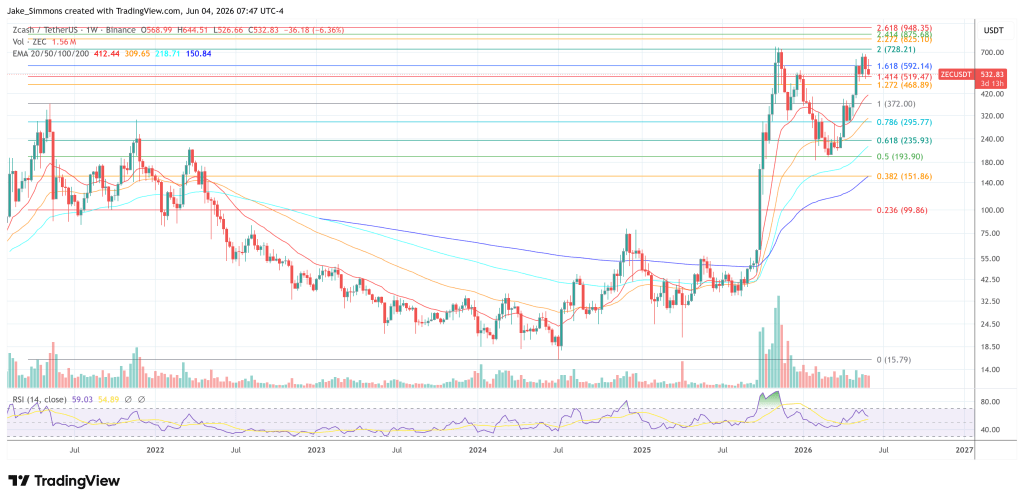
ZEC trades below the 1.618 Fib again, 1-week chart | Source: ZECUSDT on TradingView.com

相關問答

QWhat is Peter Todd's main argument against integrating Zcash-style privacy into Bitcoin at the consensus layer?

APeter Todd argues that the cryptographic risk profile of Zcash-style privacy technology is too high for Bitcoin's base protocol. He believes such shielded systems make catastrophic bugs harder to detect, attribute, and reverse compared to Bitcoin's transparent accounting model.

QAccording to Peter Todd, what key difference exists between handling bugs in Bitcoin's transparent system versus a shielded system like Zcash?

ATodd states that in Bitcoin's transparent system, bugs like counterfeit coin creation are trivially visible on-chain, making coordinated chain rollbacks feasible. In a deeply shielded system, the damage from a bug can be much harder to observe, attribute, and reverse, posing a greater existential risk.

QWhat example did critics use to challenge Todd's view that Bitcoin has a lower risk profile than Zcash?

ACritics pointed to historical Bitcoin incidents like the 2010 value overflow bug and the 2018 CVE-2018-17144 bug as evidence that 'no protocol is exempt from tech issues,' arguing these were also serious failures.

QHow did Peter Todd respond to the claim that a bug cannot affect the total ZEC supply due to its 'turnstile construct'?

ATodd shifted the focus from total supply to user balances, noting that 30% of ZEC supply is shielded. He argued that a bug destroying or compromising that shielded supply would be a disaster, wiping out the holdings of a high percentage of Zcash users.

QWhat event initially sparked the broader debate about privacy and auditability in Bitcoin, as mentioned in the article?

AThe debate was sparked after ZODL (Zcash Open Development Lab) developers disclosed an issue affecting the Zcash Orchard shielded pool during routine auditing, which led to a coordinated network upgrade and broader discussions on privacy technology risks.

你可能也喜歡

XRP Ledger 发布 3.2.0 版本升级并启用 XRPLd 新品牌名

XRP Ledger发布了3.2.0版本,这是对其底层区块链基础设施的一次重要升级。本次更新的核心是将运行网络的软件名称从“rippled”更名为“xrpld”,以更好地反映整个项目生态。 与此前侧重于前端功能的版本不同,3.2.0版本优先进行了后端升级和效率提升,旨在增强网络性能并为未来的扩展做准备。关键改进包括内存优化措施,预计可节省高达40%的服务器内存使用。 此次升级引入了名为“fixCleanup3_2_0”的修改,为单资产金库、借贷协议、权限系统、去中心化交易所、多用途代币和权限域等多个模块带来了安全性增强。开发团队还新增了不变性检查,以确保已删除账户不会在账本上留下不一致的数据,从而加强整个网络的完整性和可靠性。 对于开发者而言,新版本增加了一项重要功能:应用程序无需连接服务器即可检索XRP Ledger协议和服务器定义信息,这将极大便利钱包、区块链浏览器和API等的开发工作。 在可扩展性和稳定性方面,更新包括可配置的区块大小、通过nuDB实现的高效数据库存储,以及将gRPC服务器的TLS/双向TLS支持改为可选,以提升企业用户的性能和连接性。此外,默认对等端口从51235更改为2459,并修复了涉及自动做市商、支付、代币托管、多用途代币、订单簿和RPC等多个方面的问题。出于性能考虑,3.2.0版本暂时禁用了交易不变性检查,但开发团队表示这不会构成安全威胁。

TheNewsCrypto3 小時前

XRP Ledger 发布 3.2.0 版本升级并启用 XRPLd 新品牌名

TheNewsCrypto3 小時前

交易

現貨
合約

熱門文章

如何購買PUSH

歡迎來到HTX.com!在這裡,購買Push Protocol (PUSH)變得簡單而便捷。跟隨我們的逐步指南,放心開始您的加密貨幣之旅。第一步:創建您的HTX帳戶使用您的 Email、手機號碼在HTX註冊一個免費帳戶。體驗無憂的註冊過程並解鎖所有平台功能。立即註冊第二步:前往買幣頁面,選擇您的支付方式信用卡/金融卡購買:使用您的Visa或Mastercard即時購買Push Protocol (PUSH)。餘額購買:使用您HTX帳戶餘額中的資金進行無縫交易。第三方購買:探索諸如Google Pay或Apple Pay等流行支付方式以增加便利性。C2C購買:在HTX平台上直接與其他用戶交易。HTX 場外交易 (OTC) 購買:為大量交易者提供個性化服務和競爭性匯率。第三步:存儲您的Push Protocol (PUSH)購買Push Protocol (PUSH)後,將其存儲在您的HTX帳戶中。您也可以透過區塊鏈轉帳將其發送到其他地址或者用於交易其他加密貨幣。第四步:交易Push Protocol (PUSH)在HTX的現貨市場輕鬆交易Push Protocol (PUSH)。前往您的帳戶,選擇交易對,執行交易,並即時監控。HTX為初學者和經驗豐富的交易者提供了友好的用戶體驗。

820 人學過發佈於 2024.12.13更新於 2026.06.02

如何購買PUSH

相關討論

歡迎來到 HTX 社群。在這裡,您可以了解最新的平台發展動態並獲得專業的市場意見。 以下是用戶對 PUSH (PUSH)幣價的意見。

活动图片