OpenAI's super app has finally 'taken shape'.
It's still called ChatGPT, but its core is about to gain a new member: Codex.
And ChatGPT is essentially just a shell now.
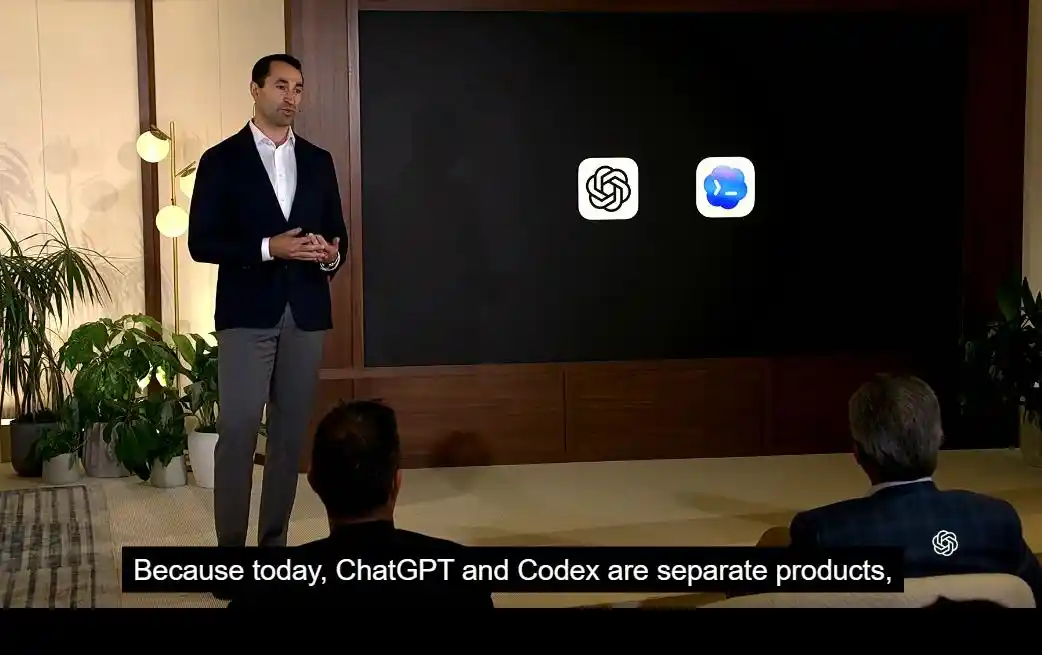
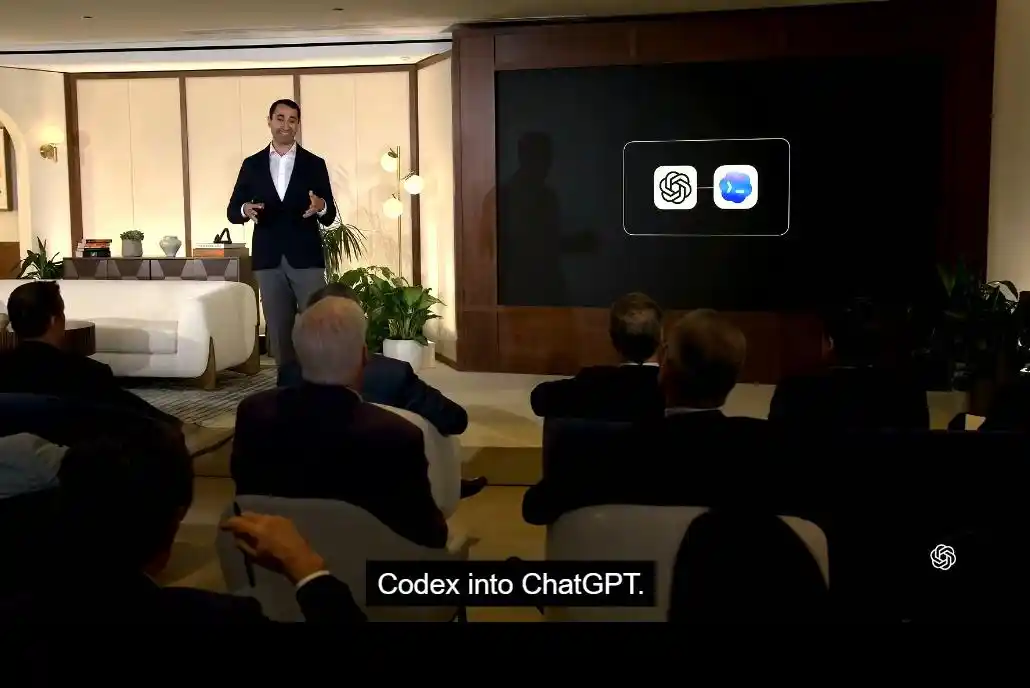
At the Intelligence at Work launch event just held by OpenAI, the company officially announced that Codex will be integrated into ChatGPT in the coming weeks.
Initially, this news was a bit confusing? Wasn't there always a Codex option in ChatGPT?
Only when I clicked on it today did I realize it was 'fake'—it prompts you to further download the Codex app, you can't use it directly within ChatGPT.
So, once the integration happens, chatting and working can be done within a single app, no need to switch between apps anymore.
But, did you think that's the end of the story?
At least from OpenAI's perspective, Codex might just be the beginning.
And through this launch event, we finally got a clear picture of the entire vision for the super app.
So Codex Was Just the First Step
The launch event lasted a full hour, packed with information, but it can be summarized into three key things.
1. ChatGPT will merge with Codex because times are changing.
2. Codex will continue to evolve, so three major updates were announced.
3. Codex is catching up to Claude Code, and GPT-5.5's 'efficiency' is a key factor.
Let's quickly go through them:
First, the somewhat surprising merger. Why is ChatGPT choosing to merge with Codex now?
One reason is that Codex, initially launched to catch up with Claude Code, can now speak for itself with results.
Codex weekly active users have surpassed 5 million, skyrocketing 6 times since the desktop version launched in February.
More crucially, 20% are not programmers at all, but knowledge workers like analysts, designers, and investment banking professionals, and this group is growing 3 times faster than developers.
This indicates Codex is achieving significant breakout momentum.
Regarding revenue, which OpenAI values highly (they followed Claude Code partly because they were envious of its revenue), OpenAI itself revealed that enterprise revenue currently accounts for 40% of OpenAI's total revenue, projected to reach 50% by year-end.
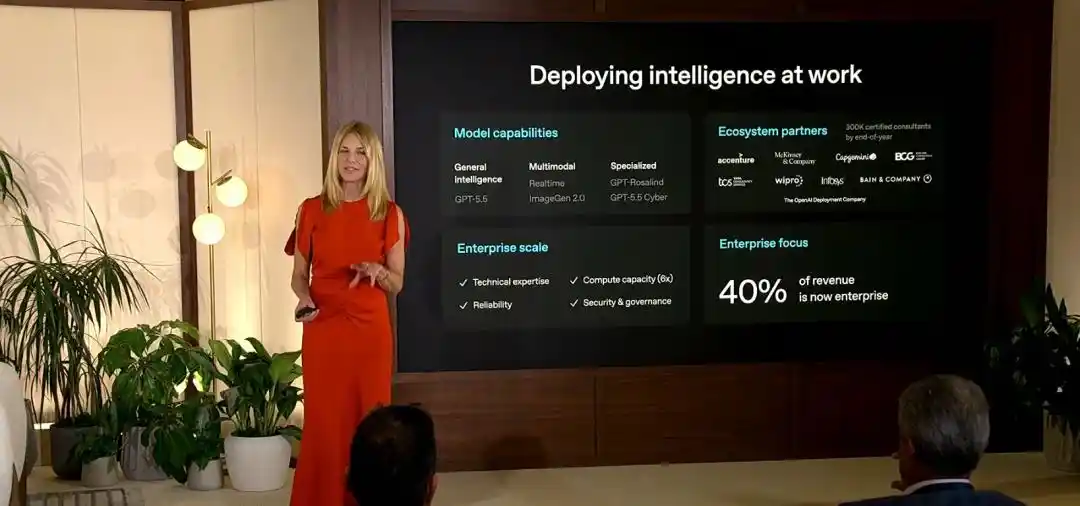
In short, Codex now has rapid user growth, broad user coverage, and is genuinely making money for OpenAI.
All signs seem to be telling OpenAI it's time to consider the next step.
And the direction of the next step, at least for now, seems very clear—from Chat to Agent, from conversation to execution.
Alexander Embiricos, OpenAI's Head of Product, said this during the launch:
You might not work 24/7, but your Agent in the cloud will.
A single line encapsulates the ultimate appeal of a super app. In the future, users truly won't need to switch between apps. You give an instruction, ChatGPT helps you understand it, and then Codex can call upon various Agents to execute for you.
So this integration is essentially OpenAI's first step toward a super app.
What's the next step? You might have guessed—Browser.
The browser is the final piece of this integration, providing the entry point for AI into the web world. It allows users to simply speak in ChatGPT, and Codex can automatically perform tasks like searching, operating backends, and handling work within the browser—everything that previously required manual clicks.
Thus, ChatGPT + Codex + Atlas browser, OpenAI finally has the potential to achieve execution across all scenarios through a single APP.
But for today, let's stick to talking about Codex.
To equip Codex with more 'soldiers' capable of doing work, OpenAI unveiled three more updates in one go:
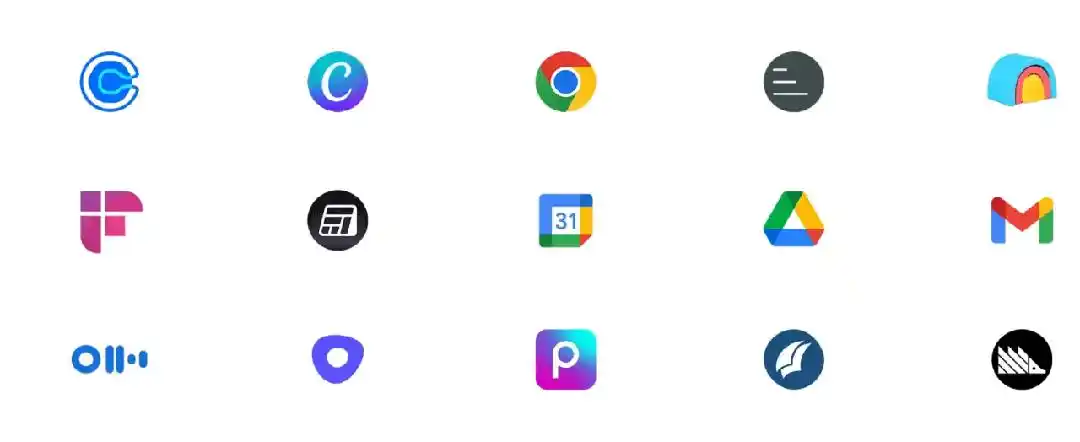
Six Professional Role Agent Plugins, covering data analysis, sales, creative production, product design, equity investment, and investment banking, directly integrating 62 enterprise apps like Snowflake, Figma, and Salesforce, and embedding 110 automation skills.
Annotations feature, allowing direct annotation and modification on the original text of documents, eliminating the need to regenerate entire pieces. Developers are already using this capability to modify code, Markdown files, and websites generated by Codex.
Now, it extends to content creation scenarios like documents, spreadsheets, and presentations.
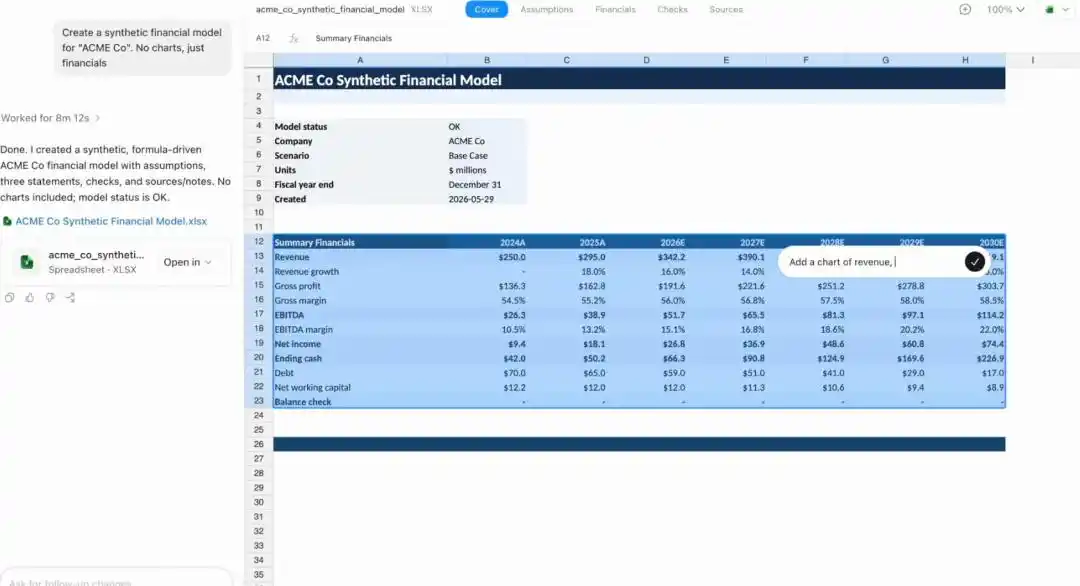
Sites feature, enabling Codex to turn your work results into interactive web applications with one click, generating URLs to share directly with teams.
This feature feels quite practical. Previously, when developing a project, non-technical people could only vaguely describe their needs. Now, anyone can generate a clear, intuitive, visualizable demo, significantly reducing team communication costs.
This feature is currently in preview for Business and Enterprise customers.
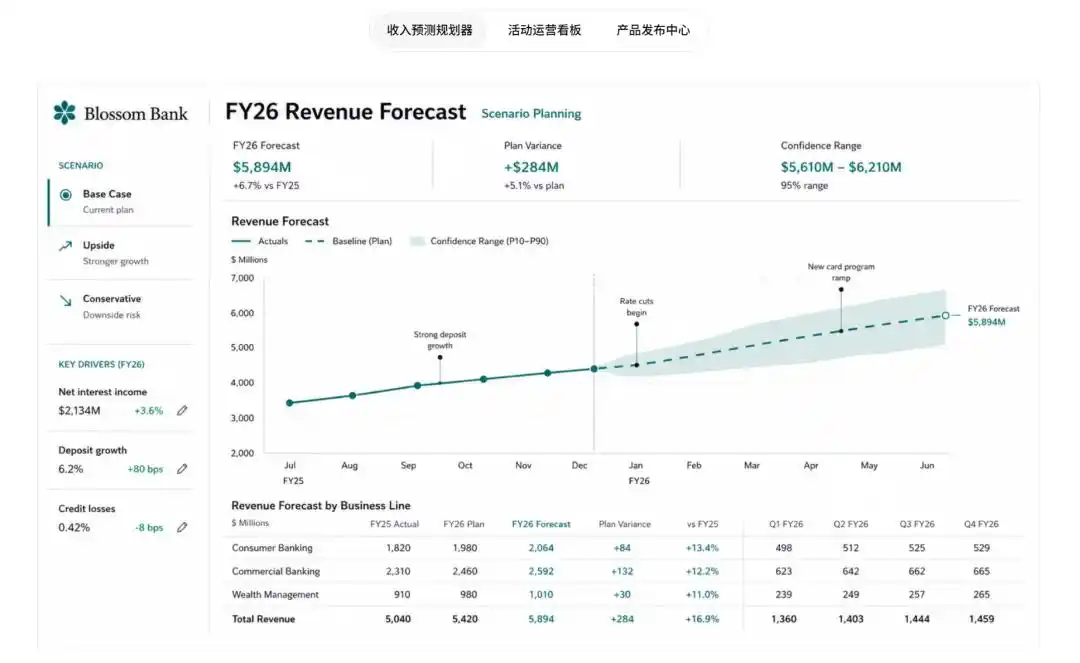
See, OpenAI is betting that in the future, more and more ordinary people will shift from conversation to execution.
Some might ask, why isn't Codex absorbing ChatGPT instead?
It can be said that, superficially, this appears to be ChatGPT absorbing Codex, but piecing together a few details, the direction might be the exact opposite.
In the May organizational restructuring, Thibault Sottiaux, who built Codex into what it is, was promoted to Head of Core Product and Platform, overseeing consumer, enterprise, and developer lines. Nick Turley, who grew ChatGPT to 900 million weekly actives, was moved to the enterprise product line.
So now, it's the Codex team managing ChatGPT, not the other way around.
Furthermore, the wording in Brockman's internal memo is worth pondering—
He didn't write 'upgrade ChatGPT,' but 'invest in a unified agentic platform.'
Therefore, this merger is less about product integration and more about a strategic shift: from conversation to execution, from chat to Agent.
ChatGPT provides the massive user base of 1 billion, Codex provides the growth engine and future narrative.
The shell belongs to ChatGPT, but the soul belongs to Codex.
However, in the end, Codex's existence was forced by competitor Anthropic.
Even the GPT-5.5 mentioned during the launch can almost be considered a product born from this pressure.
Codex Was Forced Out by Anthropic
Looking back, if it weren't for Anthropic, Codex might still just be an inconspicuous auxiliary feature in ChatGPT today.
Let's rewind to the release of Claude Code's preview version last year.
Claude Code was an immediate success upon its debut, its annualized revenue breaking $2.5 billion by February this year, reaching $1 billion in just 6 months from launch, making it one of the fastest-growing commercial software products in history.
About 4% of global GitHub public commits come from it, and users spend an average of 20 hours per week on it.
It was the explosion of Claude Code that made OpenAI realize internally: they were already falling behind in the coding domain.
How to catch up? Just chase.
The default narrative in the AI industry had always been Anthropic following in OpenAI's footsteps—GPT releases first, Claude follows; ChatGPT becomes popular first, Claude emulates.
But on the Code front, the script was completely rewritten.
Claude Code launched in February last year, and OpenAI only released the competing Codex two months later; Anthropic made a desktop version first, OpenAI chased after it; Anthropic launched Cowork for knowledge workers, OpenAI later caught up with Plugins.
This time, OpenAI was following in Anthropic's footsteps.
But the chase was indeed rapid. Looking at the timeline: 14 months, from zero to 5 million weekly actives.
Codex Cloud preview went online in April last year;
Launched desktop App and dedicated model GPT-5.3-Codex in February this year;
Announced super App merger and acquisition of Python tool company Astral in March;
Launched ChatGPT Pro at $100/month to attract developers in April;
Released mobile version in May;
Officially integrated into ChatGPT in June.
It could be said that almost every step here has the shadow of Claude Code.
But to be honest, Codex didn't stage a comeback by directly competing on code quality.
After all, blind test data shows Claude Code still has a 67% win rate, and most programmers admit its outputs are more robust.
However, Claude Code's usage limits are simply too strict, and it's more expensive than Codex.
A discussion thread on Reddit involving over 500 developers condensed into one consensus:
Claude Code is smarter, but the limits are too strict for daily use; Codex is a bit worse but actually usable.
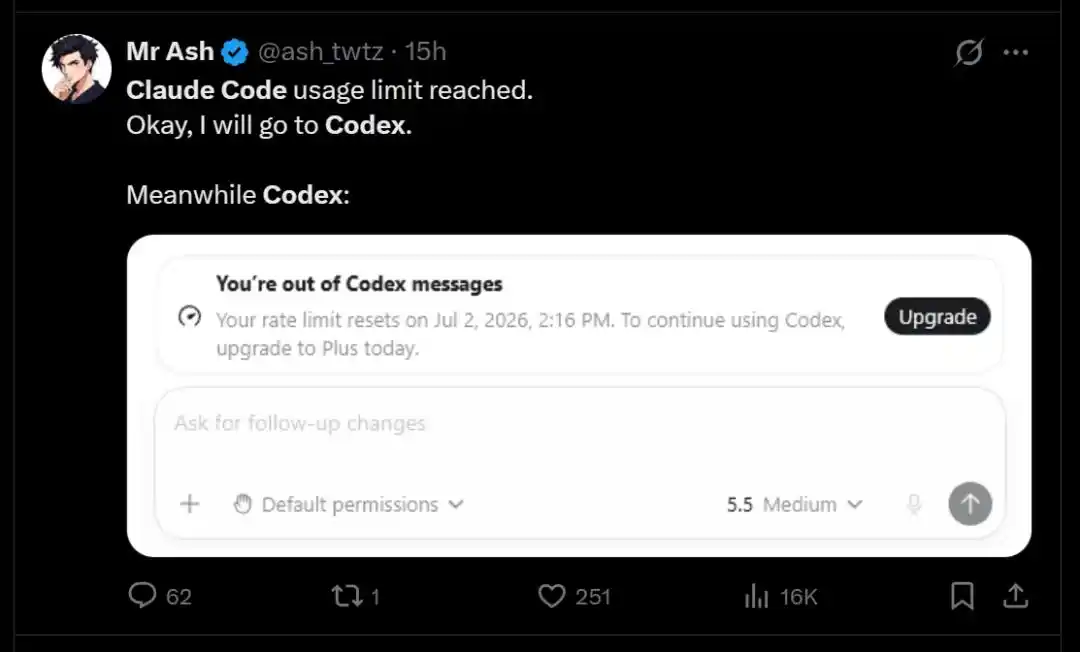
A smarter model that often gets tasks stuck midway and is more expensive, versus a slightly less intelligent but more affordable model.
Which would you choose? (doge)
Interestingly, during the launch, OpenAI's Head of Product Alexander also said this golden line:
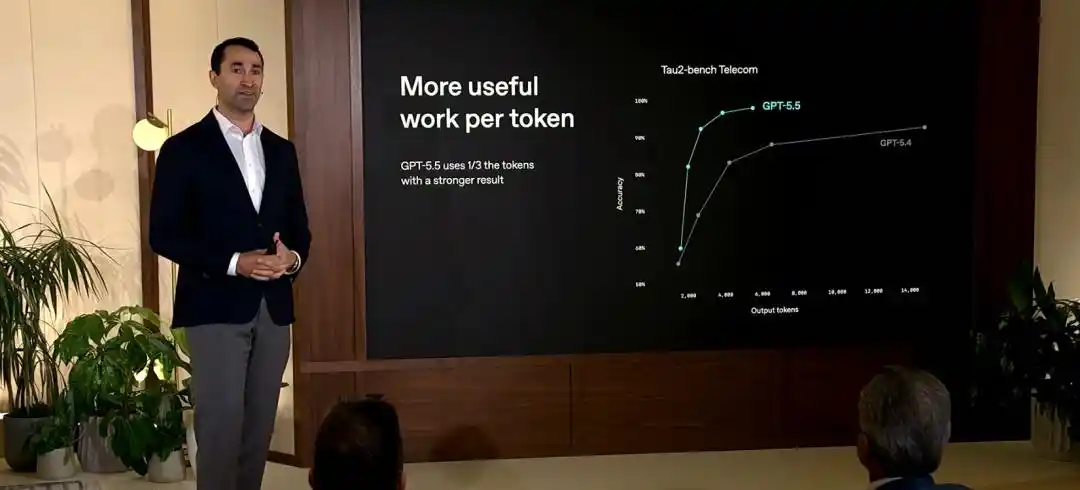
The one thing GPT-5.5 hates most is wasting tokens.
Using Codex with GPT-5.5 achieves the same quality output using only one-third of the tokens.
In short, on the path to catching up with Claude Code, Codex is making 'more intelligence with fewer tokens' its new guiding principle.
Undeniably, the AI programming field is now a duopoly.
One represents the strongest coding capability, the other the strongest productization capability.
But if we look further ahead, what Claude Code and Codex are competing for is no longer just the programming tools market.
As more and more ordinary people start using Agents as daily work partners, the entry point is actually the most important thing.
And this precisely presents a new opportunity for Chinese players—because in the Agent era, victory may not solely depend on model capability, but also on scenario, ecosystem, application connectivity, and understanding of local enterprise workflows.
In fact, major Chinese tech companies have already entered the field.
Among them, some are targeting developer entry points, some enterprise internal office entry points, and others full-process intelligent Agent platforms.
But regardless of the path, the goal is largely consistent—seize the core entry point of the Agent era.
Everyone understands clearly that how to leverage the time window of local scenarios to establish real competitive barriers at the Agent infrastructure level is the true urgent task.
So, next, let's see who will be the first to break through, running out China's versions of Claude Code and Codex?
And more crucially, who will become the new super entry point in China for the Agent era?
One More Thing
Returning to this merger event.
Considering Codex's current development momentum and the industry environment, I'm inclined to make a bold statement:
Rather than continuing to call the merged application ChatGPT, it would be better to directly call it Codex.
Think about it: ChatGPT sounds like an old relic from the 'Chat' era, but OpenAI's current bet is precisely no longer on Chat.
The people managing the product are from Codex, the internal memo mentions an agentic platform, the fastest-growing scenarios are execution-oriented, and none of the new features are related to chatting.
Is 'ChatGPT' usable? Yes. But is it accurate? No.
Of course, OpenAI likely won't rename it. After all, the three letters 'ChatGPT' have become synonymous with AI, brand assets of immeasurable value.
But not changing the name doesn't mean the essence hasn't changed.
Perhaps soon, when you open ChatGPT, what greets you won't be a dialog box waiting for your question, but an Agent that has already finished the work for you.
By then, whether it's 'Chat' or not will no longer be important.
In other words, ChatGPT might just be a spiritual symbol in the future...
References:
[1]https://www.techmeme.com/260602/p14#a260602p14
[2]https://openai.com/index/codex-for-every-role-tool-workflow/
[3]https://www.theinformation.com/articles/inside-openais-decision-combine-codex-chatgpt
This article is from the WeChat public account 'QbitAI', author: Focus on Frontier Technology




















