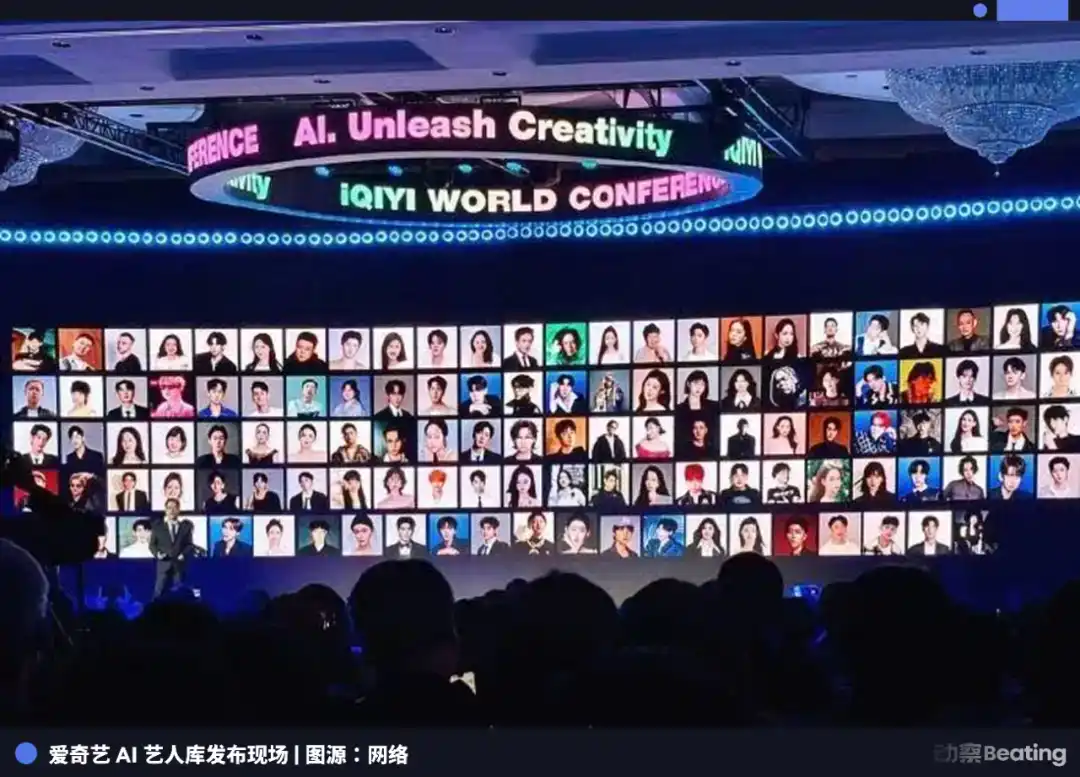
At the iQiyi World Conference in April 2026, Gong Yu stood on stage and said: "Live-action filming may become intangible cultural heritage."
The large screen on stage displayed the "AI Actor Library," with virtual humans inside tirelessly changing expressions and costumes. Gong Yu stated that iQiyi had signed over 100 AI actors, and that using AI would significantly shorten filming time, with post-production completing a large amount of work using digital doubles. He also announced the official commercial launch of "Nadou Pro," an AIGC film and television production platform for small and medium-sized creators, providing AI tools, new revenue-sharing rules, and "uncapped" profit promises.
The press conference was packaged as a technological狂欢, with music, lighting, and PPTs all配合 this narrative: the future has arrived, embrace it.
But outside this grand event, on another large screen, there was a number: $1.41.
This was iQiyi's closing price on the Nasdaq screen, with a market capitalization of only $1.361 billion, just one step away from the delisting threshold. At its IPO in 2018, iQiyi's stock price had once reached a high of $46, with a peak market cap exceeding $31.2 billion. From $31.2 billion to $1.361 billion, a drop of 97%, it took less than eight years.
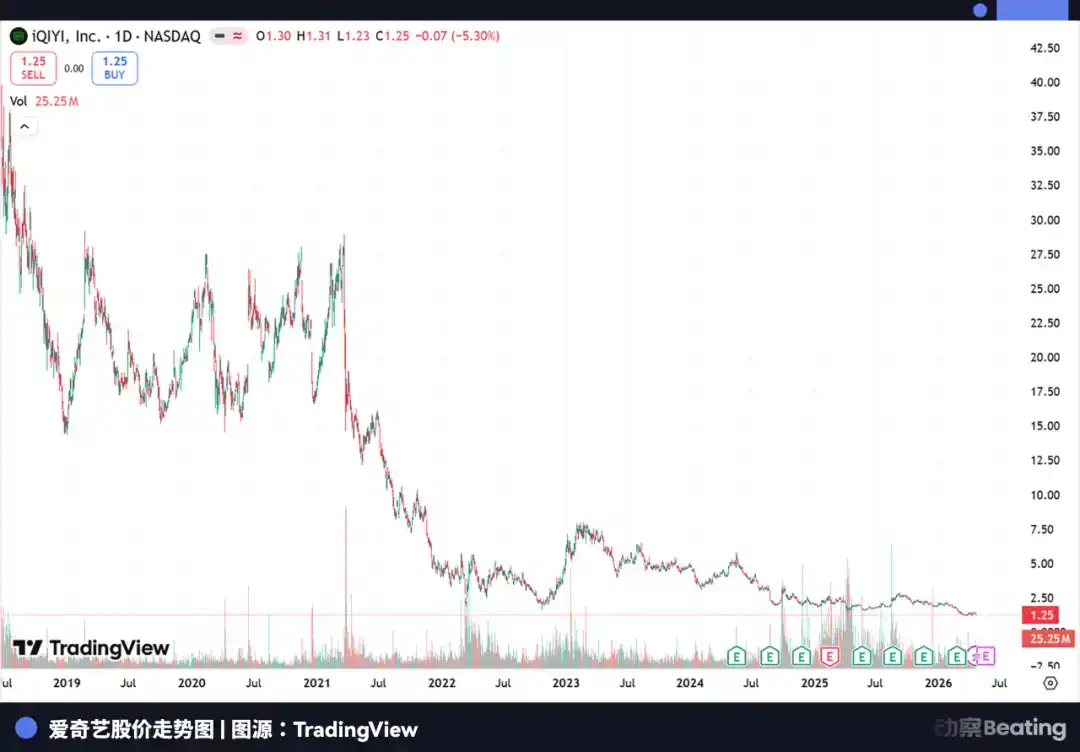
The outside world debates whether AI can act well, but the capital market only cares whether AI can tell a good story. Over the past decade, iQiyi has burned through hundreds of billions in funds but has never found a path to sustainable profitability.
In 2025, this streaming giant's content costs still reached 15.45 billion yuan, accounting for 56% of its total annual revenue; the annual net loss was 206.3 million yuan, turning from profit to loss; operating profit was only 640 million yuan, a plunge of 73% compared to 2024's 2.36 billion yuan. And just two years earlier, in 2023, iQiyi's net profit was as high as 1.93 billion yuan, the peak of profitability since the company's founding.
From peak to loss, it took only two years.
More棘手的是, iQiyi's free cash flow had plummeted from over 3.3 billion yuan in 2023 to less than 10 million yuan, its self-造血 ability rapidly deteriorating.
The company issued convertible bonds twice in 2023 and 2025, totaling nearly $1 billion, with interest burdens持续加重. After its U.S. stock financing function basically failed, iQiyi secretly submitted a listing application to the Hong Kong Stock Exchange at the end of March 2026, and in April, it rolled out the big饼 of the AI Actor Library and "Nadou Pro."
A company seeking to "replenish blood" in Hong Kong needs a new narrative that can make investors' eyes light up. "Marginal cost趋零," "AI cost reduction and efficiency increase"—these词汇 in today's capital market context are more valuable than any hit drama.
This has nothing to do with art; it's only about preserving the shell.
But when a company no longer pleases capital with content quality but with "cost reduction," who will become the first batch of fuel under this cost-cutting machine?
Hengdian
The focus of public opinion on this AI storm was soon occupied by several lawyer's letters.
Zhang Ruoyun was the first to speak out, stating that he had never authorized any platform to generate an AI double and reserved the right to pursue legal action. Yu Hewei, Chen Xiao, Wang Churan, and others followed suit,纷纷辟谣. Yi Yangqianxi's studio issued a statement pointing out that several AI short dramas had unauthorized use of his likeness and voice, with the involved short dramas reaching nearly 75 million in热度. Tan Jianci, Gong Jun, Yang Zi, and other actors also接连发声维权.
For a time, the "AI Actor Library" became a hot potato, forcing iQiyi to explain that the AI actors in the library were "authorized AI actors," not digital copies of real stars, and that "actors joining the Nadou Pro Actor Library only represents their intention to engage with AI film and television projects." Gong Yu also responded publicly multiple times, emphasizing that the platform respects actors' rights and that AI is a tool, not a replacement.
Big stars' statements can make it to热搜, but in places the camera doesn't see, there are also the 134,000 background actors in Hengdian.
In recent years, with the explosion of the short drama market, the demand for background actors in Hengdian had once rebounded. Short drama crews are numerous, cycles are short, and the pace is fast, requiring a large number of background actors. In long dramas, background actors are just set pieces, without lines or names; in short dramas, they have the opportunity to show their faces, say a few lines, even play major roles. A regular background actor's daily salary is between 150 and 300 yuan; if they work hard, they can earn four or five thousand a month. Not much, but enough to live on.
After AI arrived, this "enough to live on" began to动摇.
In the first quarter of 2026, over 85% of short drama crews in Hengdian had fully switched to using AI actors for supporting roles and background actors. The employment rate for专职 actors in live-action short dramas plummeted from 82% in 2025 to 29%. Some crews no longer recruit background actors, only needing to film the leads in front of a green screen, leaving the rest of the background crowd to be generated by algorithms with one click. AI-generated background actors don't need to eat, don't need rest, are never late, never ask for raises, and never complain.
There are about 134,000 registered background actors in Hengdian, with only about 800 effective positions available daily, making the competition more fierce than the civil service exam. Some actors used to maintain a pace of filming over 20 days a month, shooting上百部 short dramas, but for over a month after the Spring Festival, they didn't get a single day of work. After this year's Spring Festival, the production volume of live-action short dramas was directly halved by 50%.
Big stars defend their肖像权 on热搜, while small background actors disappear under the wash of AI. Top stars have agencies, lawyers, and Weibo热搜; their维权 can become news, can create舆论 pressure, can force platforms to让步. But background actors have nothing. Their disappearance won't make news; it will only become the increasingly short waiting lines outside some Hengdian crew gates.
The paeans of technological revolution are always composed with the sighs of底层劳动者. But in this cost-cutting game, what role does the platform itself play? Is it truly promoting a technological revolution, or is it using a pretty name to甩出去 its heaviest包袱?
From "Landlord" to "Pump"
At the conference, iQiyi announced its transformation into a "decentralized social media" platform, launching "Nadou Pro" and modifying its revenue-sharing rules.
"Nadou Pro" is positioned as a content platform for small and medium-sized creators, providing AI creation tools, supporting user-made short dramas, and allowing them to earn revenue through sharing. Gong Yu said this is "returning the power of content creation to the masses," a "decentralized" content revolution. The new revenue-sharing rules promise creators "uncapped" shared revenue, with additional subsidy incentives for AIGC content and medium-length drama content.
It sounds like empowering creators, handing the stage to the masses. But it's only "sounds like."
Long-form video platforms used to be "landlords" who spent money buying shows. At its peak, iQiyi spent over 20 billion yuan a year on content procurement and production, with a single S-level drama often costing hundreds of millions in investment, and the平台自负盈亏. The logic of this model was: I spend money, I buy content, I attract user subscriptions, I earn membership fees. In 2023, iQiyi's membership service revenue reached 20.3 billion yuan, with membership numbers突破 120 million, its peak moment.
But this logic has a fatal flaw: it assumes the platform can持续判断 what good content is, and that good content can持续 bring enough subscribing users.
iQiyi spent money for ten years, lost money for ten years. Membership numbers fell all the way from the peak of 120 million; in 2025, membership service revenue dropped to 16.81 billion yuan, a year-on-year decrease of about 5%. More troublesome was that one of iQiyi's cost-cutting methods was vigorously promoting a movie revenue-sharing model, where the platform no longer prepays licensing fees but shares revenue with partners based on actual播放量. This确实 reduced upfront cash支出, but the side effect was that the studios willing to accept revenue sharing were mostly mid-to-low-tier content. Truly popular IPs that could drive membership payments, copyright holders still preferred high-price buyouts. The result was that iQiyi's content library became filled with mid-to-low-tier works that "prioritized quantity over quality." Hit titles were missing, users noticed, and the platform's stickiness and willingness to pay也随之下降.

This model has reached its end.
Now, iQiyi doesn't want to lose money anymore; it wants to make稳赚不赔. The platform hands AI tools to countless retail creators, letting them卷、试错. Whoever becomes popular, the platform takes the lion's share; whoever flops, the platform remains unaffected. Just like Uber doesn't employ drivers and Airbnb doesn't buy properties, iQiyi no longer wants to buy shows.
This logic has a more academic name in the internet industry: "platform capitalism." The platform provides infrastructure, attracts a large number of suppliers to join, then through algorithm distribution and抽成 mechanisms, transfers risk to the suppliers and keeps the profits for itself. YouTube and TikTok are both successful cases of this logic. But the success of these two platforms is based on the premise that they are themselves traffic entrances and have huge user bases.
Can iQiyi replicate this logic? This is a questionable issue. iQiyi's monthly active user scale is not on the same level as TikTok's; its content consumption scenario is "sitting down to watch a show," not "scrolling." Transforming a paid subscription platform into a UGC content platform—why would users stay?
But what's more worth questioning is, when a long-form video platform starts lowering itself to become a "pump," transferring all the risks of content production to retail creators, what does this mean for the entire content industry? And what are those short-form video platforms that originally rose依靠短平快 doing?
Two Routes
Just as iQiyi bet on AI, Douyin invested 500 million yuan to support "live-action short dramas."
On April 15, 2026, at the 13th China Network Audiovisual Conference, Douyin Group released its latest live-action short drama support plan. The platform will invest 500 million yuan in special funds to持续扶持 live-action short drama content innovation and现实题材深耕. Hongguo Short Drama's总编辑乐力 clearly stated at the press conference that live-action short dramas have obvious advantages in user retention, completion rate, and long-term payment willingness.
Douyin's 500 million yuan support plan specifically targets "short dramas performed by real people," explicitly excluding AI-generated content. Douyin's logic is that AI-generated content on the platform has already泛滥, users are beginning to experience aesthetic fatigue, and real faces, real emotional expressions, and real body language have instead become scarce commodities. Live-action short dramas contribute the vast majority of the platform's播放量,收藏量, interaction volume, and payment conversion. AI anime dramas significantly lag behind live-action content in user retention and completion rates.
After short-form video platforms reached traffic peaks, the core problem they faced was user retention and payment conversion. Low-quality AI content can fill timelines but cannot build user stickiness, let alone drive payments. Real emotional resonance can achieve this. Thus, Douyin began spending big money to buy "human touch."
Meanwhile, the platform that should have represented high-quality, in-depth content—the long-form video platform—jumped into the cheapest industrial assembly line due to financial despair.
This dislocation is a rational choice under two different financial conditions. Douyin, backed by ByteDance, has sufficient cash flow and can make long-term investments in content quality; iQiyi's on-hand cash is no longer enough to support the long-term gambling of high-cost content—it must find a path of "low cost, high output."
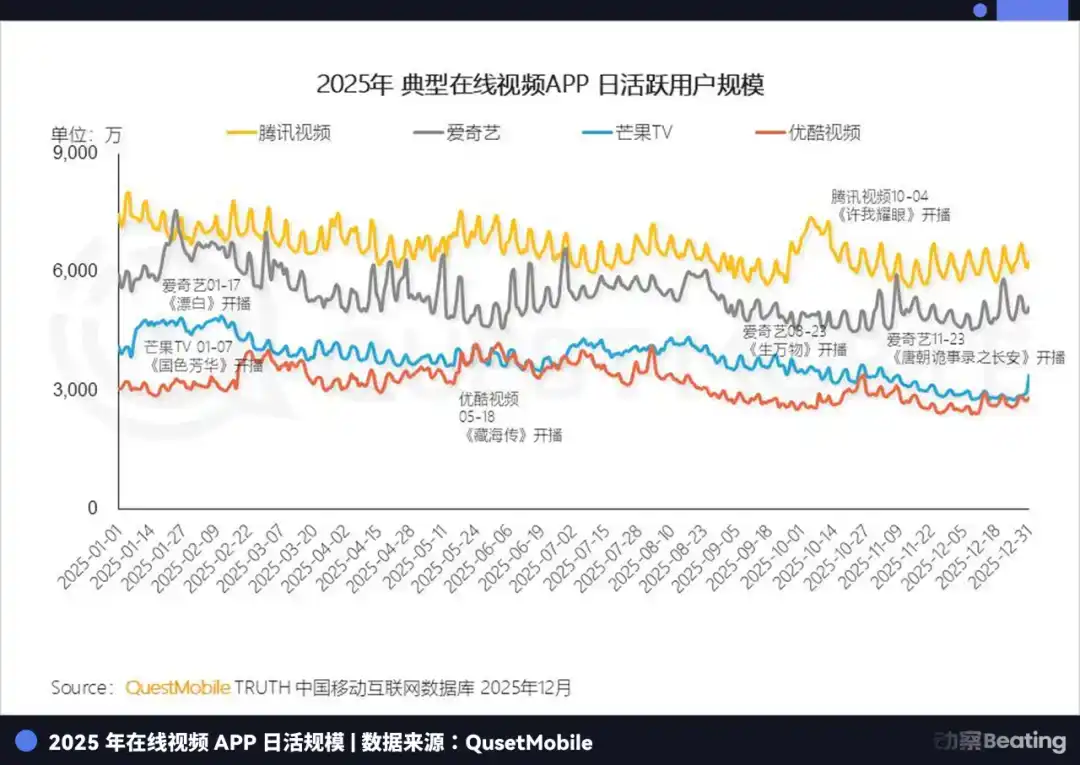
In comparison, Tencent Video is backed by Tencent Holdings. In the first three quarters of 2025, the parent company's revenue was 557.3 billion yuan, a year-on-year increase of 14%. Tencent Video maintains its lead in the long-form video market with over 340 million月活 and 114 million members. Mango TV, relying on Hunan Broadcasting System's content supply chain and low-cost self-production capability, remains stably profitable. iQiyi has neither Tencent's social ecosystem for blood transfusion nor Mango's cost advantage; its situation is the most difficult among the three major long-form video platforms.
But the path of "low cost, high output" has never been a good path in the content industry.
Data shows that the proportion of AI仿真人 short dramas in the Top 100 Anime Drama chart has surged from 7% in 2025 to 38%. The daily新增量级 of authorized AI short dramas might be in the thousands. A three-person team, a few thousand yuan in computing costs, 48 hours to produce a drama—this is the production efficiency of AI short dramas. But in this track, 90% of companies are in a loss-making state, over 60% of works have惨淡播放量, and profitability is difficult. Among tens of thousands of released works, hit titles with播放量破亿 are few and far between.
Low barriers to entry are never a competitive advantage; they only make the track excessively crowded.
The Jazz Singer
On October 6, 1927, the first talking picture, "The Jazz Singer," premiered in New York.
Before this, every movie theater had a band专门为 silent films伴奏. Large-scale theaters had bands of twenty or thirty people; small theaters had at least one pianist. They improvised演奏 based on the情节 on the silver screen—low strings for tragedies, light piano for comedies. It was a craft and a stable livelihood. There were about 22,000 theater musicians in the United States; they had their own union, their own industry standards, their own professional dignity.
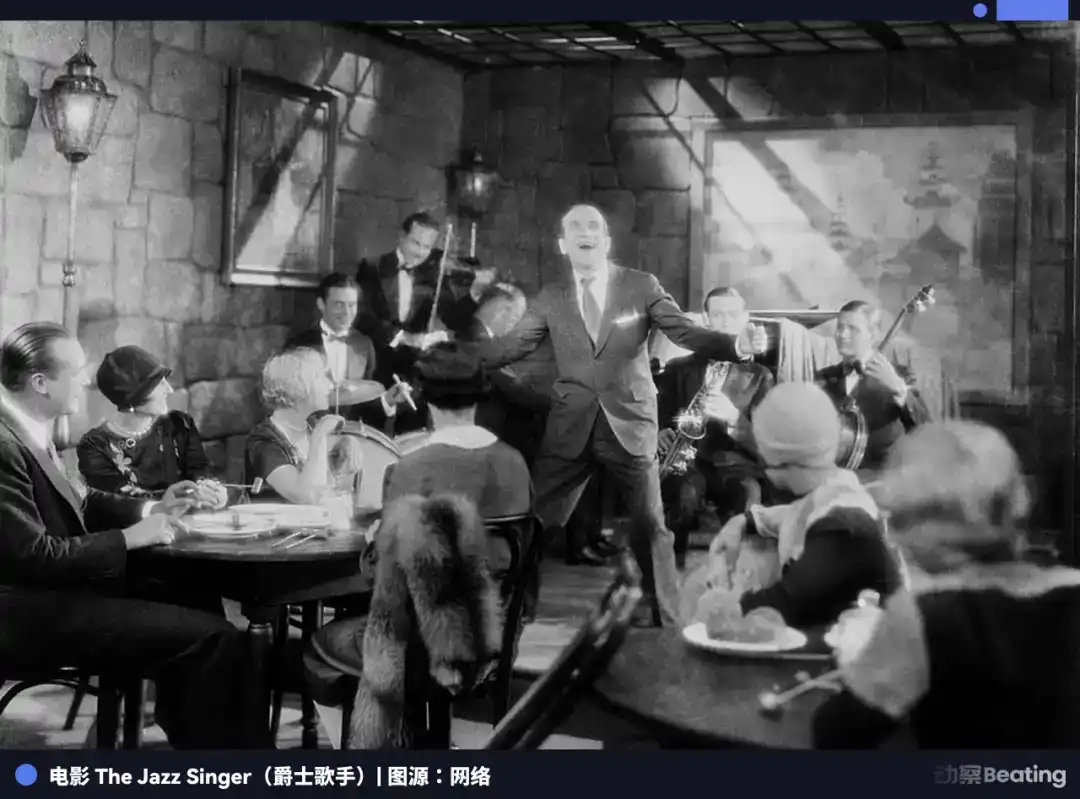
After the advent of talking pictures, these musicians were almost all unemployed within a few years. From 1927 to 1930, the number of U.S. theater musicians plummeted from about 22,000 to less than 5,000. Their union once launched boycotts, organizing musicians to refuse to play in theaters equipped with sound devices, but it was to no avail. The tide of technology does not stop because有人反对.
John Philip Sousa早在 1906 wrote "The Menace of Mechanical Music," predicting that phonographs and mechanical instruments would replace live演奏, turn music into an industrial product, and deprive musicians of their livelihoods.
Today, Gong Yu saying "live-action filming becomes intangible cultural heritage" seems, at first glance, to be the same statement that movie companies made to theater musicians back then.
Every technological revolution needs a "intangible cultural heritage" narrative to complete the handover, beautifying the淘汰的东西 as "precious tradition," then smoothly sweeping it into the museum. The term "intangible cultural heritage" itself is a form of安抚; it acknowledges that you once were, acknowledges that you once had value, but simultaneously宣告 your era is over.
Talkies and the AI Actor Library are superficially similar, but there is an essential difference.
Talkies were a new mode of expression. They allowed films to tell more complex stories, express richer emotions, and ultimately gave audiences more.
Theater musicians lost their jobs, but the art form of film itself became more complete and more powerful.
What is the AI Actor Library? It is not a new mode of expression; it is a cheaper mode of replication. It does not make film and television more complete; it only makes it cheaper. The logic of talkies was to use better technology to tell better stories, attracting more people into theaters. The logic of the AI Actor Library is to use cheaper costs to produce more content, to spend less money.
These are not the same thing.
If iQiyi's AI gamble succeeds, if it wins, then what about the audience?
Stimulation Replaces Empathy, The Folded Reality
The final outcome of the泛滥 of AI film and television is not about replacing anyone, but about quietly changing the mechanism by which humans receive stories and perceive real emotions.
Neuroscience research indicates that when humans watch live performances, mirror neurons in the brain are activated, generating emotional empathy; we feel, to some extent, the emotions the actor is experiencing. This is an ability evolved over tens of thousands of years, the foundation of our understanding of others and building social connections. This is also why a good movie or series can leave people回味 long after it ends, even changing a person's views on certain things.
AI-generated performances can be highly realistic on a technical level, but they lack real experience. An AI-generated character cries because the algorithm calculated that this scene requires crying, not because the character truly experienced something. The human brain can perceive this difference to some extent, which is why the completion rate and payment conversion rate of AI-generated content are far lower than those of live-action content, even if its visuals might be more refined and the plot more "thrilling."
But this perceptual ability is use-it-or-lose-it.
When a generation grows up accustomed to the absolute smoothness and high-frequency stimulation fed by AI, their brains will gradually adapt to this stimulation mode, and their perception threshold for complex, subtle, wrinkled real emotions will become higher and higher. Just like people who长期 eat heavily seasoned food gradually lose the ability to taste bland food.
Marshall McLuhan said "the medium is the massage," meaning that the medium is not just a pipeline for transmitting content; it itself shapes the way we perceive the world. When the logic of content production shifts from "telling a real story" to "using algorithms to calculate the stimulation the audience wants," the medium is no longer a massage but an anesthetic.
This is not singing a挽歌 for "live-action filming," nor is it saying that AI is necessarily bad. Technology itself has no good or evil; the problem lies in what it is used for and under what commercial logic it is大规模推广. A company betting on AI out of financial despair and a creator who truly believes AI can make art better use the same technology, but their motivations are completely different, and the results will be completely different.
Gong Yu said AI could allow actors to take on 4 projects a year instead of 2. The subtext of this statement is that the value of actors lies not in what they experience on set but in how many times their faces are rendered.
But real performance was never about the face. It's about a person, at a specific moment, because of some real experience, making a choice that cannot be predicted. This is something AI cannot calculate.
Only, when audiences are already accustomed to algorithm feeding, will they still need that which cannot be calculated?