A Four-Page Internal Letter: What Card Is OpenAI Playing?

marsbit發佈於 2026-04-14更新於 2026-04-14

文章摘要

OpenAI's internal memo, revealed by The Information, outlines a strategic narrative against Anthropic across three key areas: revenue accounting, enterprise competition, and compute capacity. First, OpenAI CRO Denise Dresser challenged Anthropic’s reported $30B annualized revenue, claiming the actual net figure—using OpenAI’s accounting method—is $22B. The discrepancy stems from differing GAAP interpretations: Anthropic books gross revenue (including cloud partner shares), while OpenAI records net revenue after partner deductions. Second, enterprise adoption data from Ramp shows Anthropic rapidly closing the gap with OpenAI, narrowing from an 11% to a 4.6% difference within months. Anthropic already leads in high-value sectors like tech, finance, and professional services. Dresser acknowledged Anthropic’s edge in coding capabilities but warned against being a "single-product company" in a platform war. Third, while current compute capacity is comparable (OpenAI ~1.9 GW vs. Anthropic ~1.4 GW), OpenAI’s long-term plans aim for 30 GW by 2030—four times Anthropic’s projected 7-8 GW by 2027. Anthropic’s growth depends on sustaining enterprise revenue to cover rising cloud costs, estimated to reach $6.4B by 2027. The memo also highlighted OpenAI’s strategic shift: reducing reliance on Microsoft (which “limited customer reach”) and partnering with Amazon, which invests in both OpenAI and Anthropic. This places Amazon’s Bedrock platform as a battleground where both models compet...

According to Anthropic's books, its annualized revenue is $30 billion, but by OpenAI's conversion, the same set of sales figures is only worth $22 billion. Neither number is fabricated. This is the first cut thrown by OpenAI's Chief Revenue Officer, Denise Dresser, in a four-page internal letter exposed by the media on April 13.

The starting point of the matter is an employee memo obtained by The Information. In the letter, Dresser did three things simultaneously: praised the new Amazon collaboration as having "astoundingly high demand," admitted that the Microsoft partnership "has limited our reach to customers," and spent considerable篇幅 deconstructing Anthropic's revenue figures. The timing of this letter's leak coincides with just one week after Anthropic announced breaking the $30 billion annualized revenue milestone.

Superficially an internal company memo, it is实质上 a carefully constructed information war. To understand it, it's most direct to approach it from three dimensions: revenue口径, the competitive landscape on the enterprise side, and the compute arms race路线, then place them all within the same cloud partnership structure diagram.

Where does the $8 billion accounting gap come from

Anthropic reports $30 billion in annualized revenue; OpenAI says the actual figure is $22 billion. The $8 billion difference stems from the截然不同的 choices the two companies made in revenue recognition口径.

Anthropic uses gross accounting: when a company purchases usage credits for Claude through AWS, Anthropic records the full amount of this money as top-line revenue, then treats the platform share paid to Amazon as a cost. OpenAI does the opposite: it only records the net amount it actually receives from Microsoft, Microsoft's share does not enter the top line.
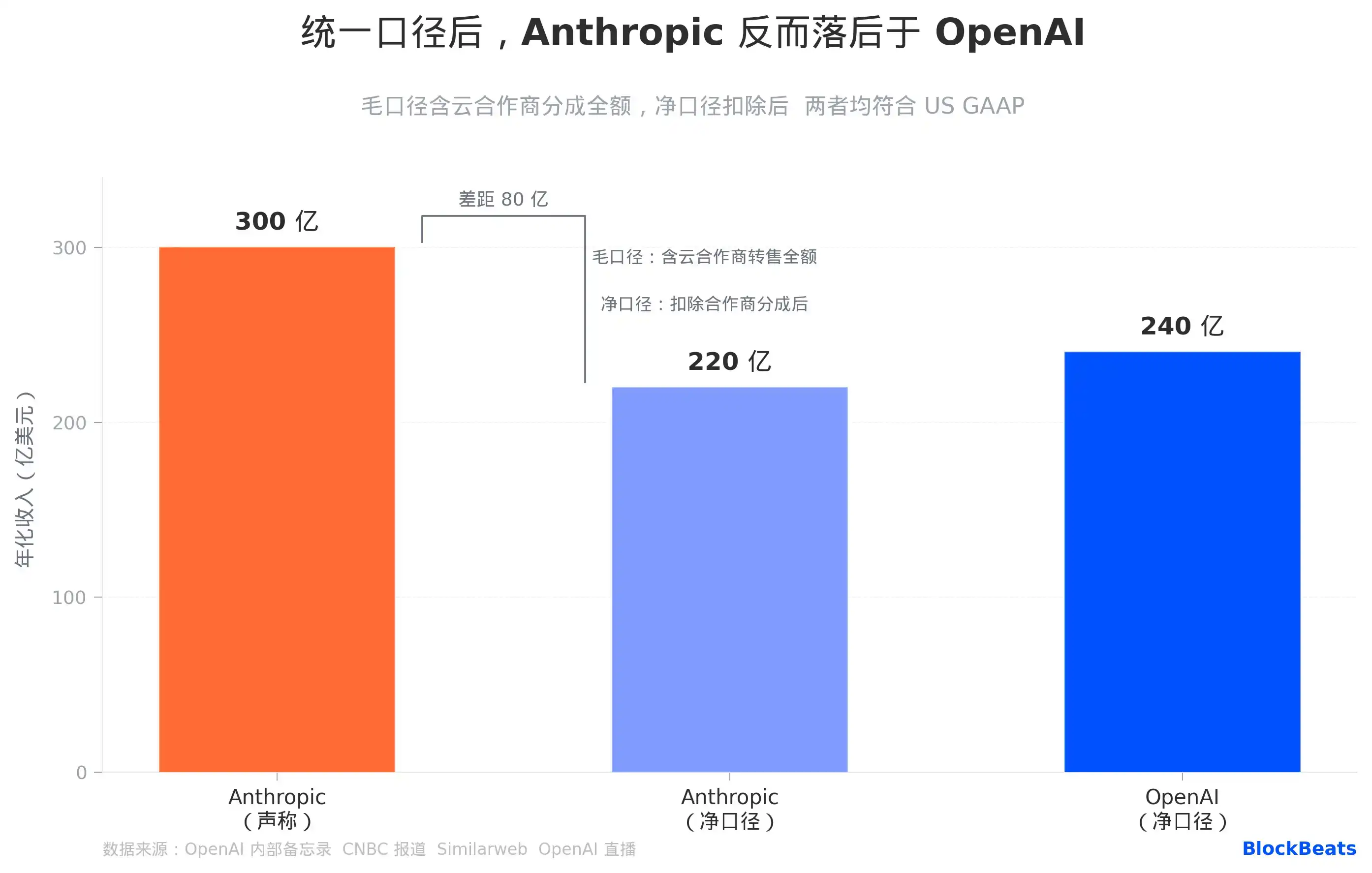
Both methods comply with U.S. Generally Accepted Accounting Principles (GAAP). Anthropic's logic is that it is the "principal" in customer transactions, with cloud vendors merely being distribution pipelines. OpenAI's logic is that it treats Microsoft as an "agent," booking only the portion that actually reaches its hands. The root of the divergence lies not in who is fabricating numbers, but in who more aggressively asserting their dominant position in the sales chain.

Dresser wrote in the memo that Anthropic "uses an accounting method that makes the revenue figure appear larger," including booking the full gross amount of shares from AWS and Google into top-line revenue. The subtext of this statement is not hard to understand: when Anthropic submits its S-1 prospectus to the SEC, auditors will rule on this口径, and届时 it may need to make adjusted disclosures using a unified口径. Converted to the same口径, Anthropic is $22 billion, OpenAI is $24 billion, and the领先方 has switched places.

It needs to be stated that Anthropic's revenue growth rate itself is already historic. According to data from Bloomberg and Sacra等 media, its annualized revenue grew from about $9 billion at the end of Q4 2025 to the current $30 billion, more than tripling in less than five months, and this is primarily driven by real customer procurement, not something explainable by accounting口径 adjustments. The core of this accounting controversy is not that Anthropic is shrinking, but that OpenAI is using the "口径" knife to redraw boundaries.

The catch-up speed on the enterprise side is faster than most people anticipated

Ramp tracks the actual AI spending behavior of thousands of companies on its platform, making it a first-hand data source for judging real choices on the enterprise side.

Ramp AI Index April data: Anthropic's share among enterprise paying customers rose to 30.6%, OpenAI's is 35.2%, the gap narrowed from 11 percentage points in February to 4.6 percentage points. Based on Anthropic's average monthly increase of +6.3 percentage points over the past two months (which itself is already the largest single-month increase record for this metric), it will overtake OpenAI on this metric in approximately two months.
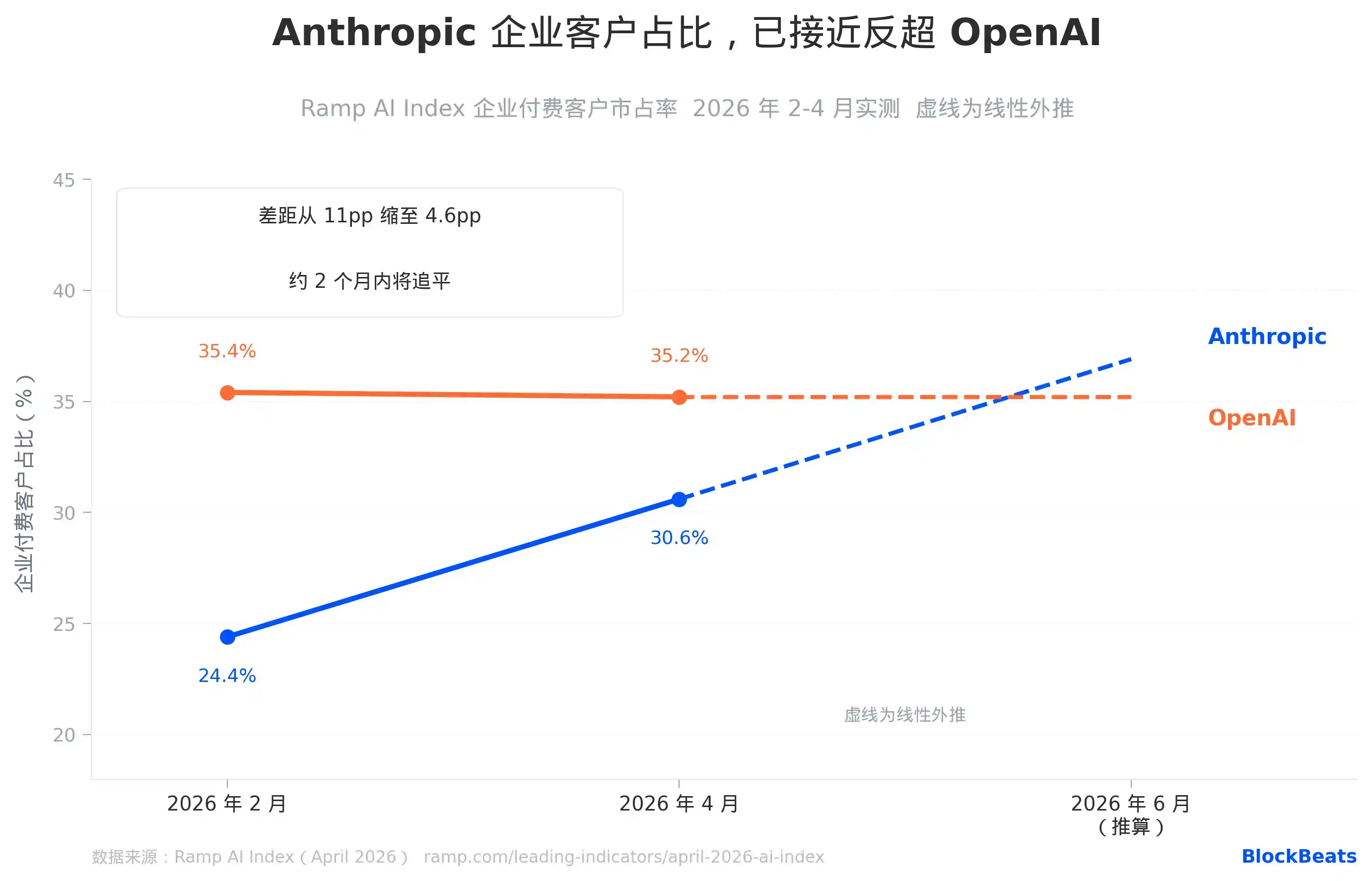
More notably are the structural signals. In three high-purchasing-power industries, Anthropic's lead has become a fact: Information Technology/Software (63% vs. 54%), Financial Services (52% vs. 46%), and Professional Services (47% vs. 44%) all exceed OpenAI. These three industries happen to be the areas where enterprise AI budgets are most concentrated and procurement decisions are most professional. This means that the companies with the most say in the AI purchasing chain have already collectively begun leaning towards Anthropic.

Dresser罕有地承认ed in the memo that Anthropic "holds a significant lead among enterprise customers," citing programming capabilities. This statement, coming from within OpenAI, carries a weight completely different from external evaluations; it is one company telling its own employees internally that the opponent has won on the core battlefield. She simultaneously added a warning: "You do not want to be a single-product company in a platform war." This is提醒ing employees that Claude's advantage in programming, if it cannot extend to the platform layer, is ultimately just a ticket, not a boarding pass.

Compute gap: Similar today, fourfold by 2030

Compute capacity is the hardest competitive dimension for AI companies to shorten in the short term because its construction cycle is measured in years, and its funding threshold is measured in tens of billions.

Current numbers seem close: OpenAI约 1.9 gigawatts (GW), Anthropic约 1.4 GW, a difference of about 35%. Dresser described Anthropic in the memo as "operating on a meaningfully smaller curve," but this statement isn't particularly exaggerated in the current capacity comparison; the gap is real, just not yet decisive.

The real fork is after 2027. OpenAI plans to reach 30 GW of compute by 2030, backed by a $30 billion five-year cloud computing contract with Oracle, the entire Stargate infrastructure project, and a total construction commitment of $1.4 trillion.

Anthropic's path relies on a Broadcom custom chip agreement with a capacity of 3.5 GW, deployed through Google Cloud, effective from 2027,加上 existing training clusters on AWS, targeting 7-8 GW by the end of 2027.
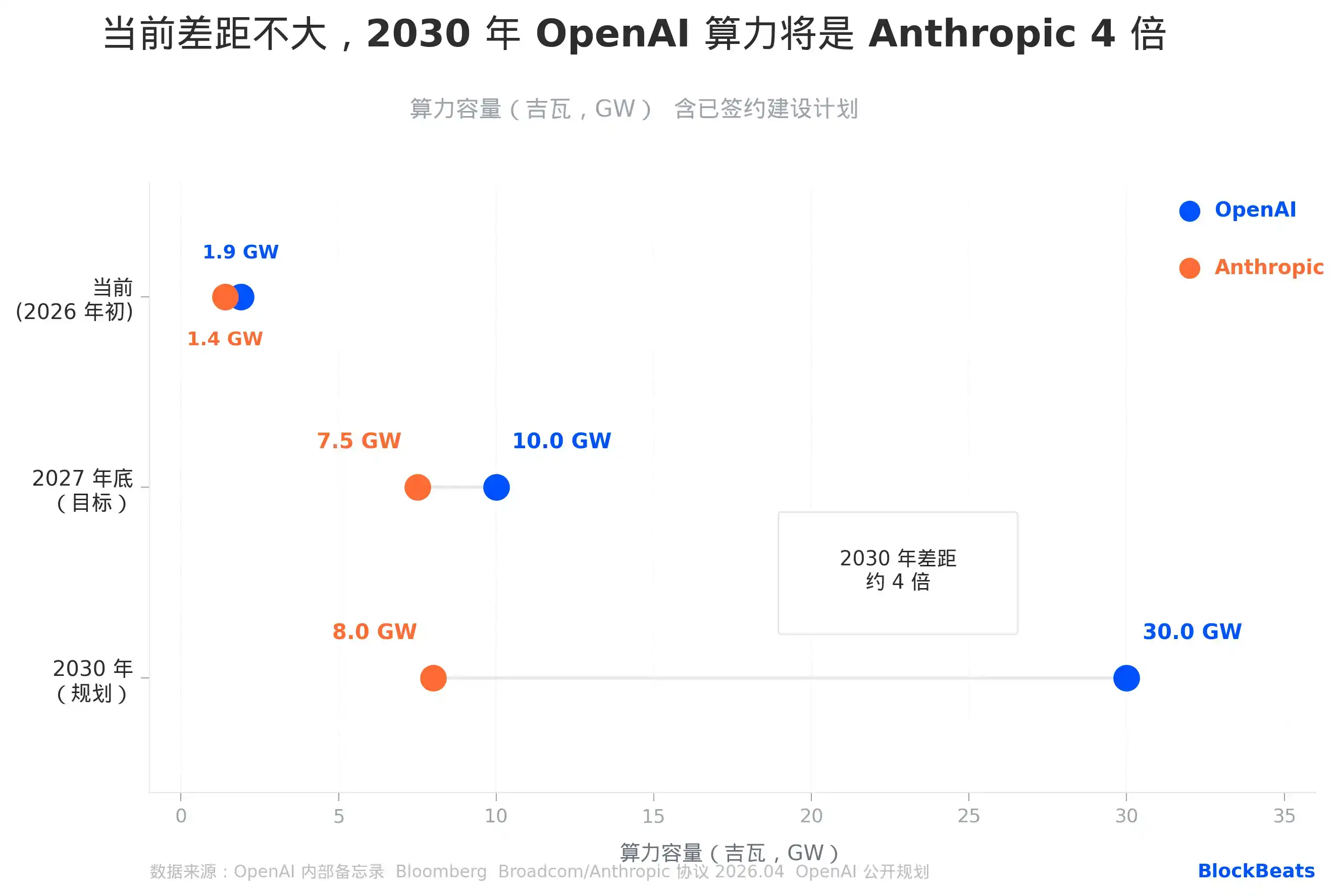
Even if Anthropic fully delivers on its 2027 target, there remains a fourfold gap between it and OpenAI's 2030 plan. This chasm is not technically insurmountable; if improvements in model efficiency can make each unit of compute yield more收益, Anthropic could make good enough products with less compute.

But it must do so under the premise that Claude's momentum on the enterprise side continues, using sustained subscription revenue to support its compute procurement costs:据 Sacra estimates, Anthropic will pay cloud partners about $1.9 billion this year, rising to about $6.4 billion in 2027.

Amazon, betting on two competitors simultaneously

The most intriguing sentence in this memo is Dresser's direct characterization of the Microsoft partnership, writing that it "has also limited our ability to reach enterprises where they are."

OpenAI's move towards Amazon is already very clear:据 CNBC reported, in February this year, Amazon announced a $50 billion investment in OpenAI,同时 obtaining the exclusive third-party cloud distribution rights for OpenAI's enterprise Agent management platform, Frontier.

This is an active switch from the Microsoft轨道 to the Amazon轨道. The logic behind it is straightforward: many enterprise customers' AI infrastructure is already built on AWS's Bedrock platform, and Microsoft's exclusivity条款 make it difficult for OpenAI to sell there directly.

But the other side of Amazon's role in this competition is equally noteworthy: it is currently Anthropic's largest cloud infrastructure partner and strategic investor, with cumulative investments of $8 billion. Their collaborative Project Rainier cluster deploys about 500,000 Trainium 2 chips. Amazon's total bet in the entire AI race amounts to $58 billion, flowing simultaneously to two opponents正在 battling head-on in the enterprise market.
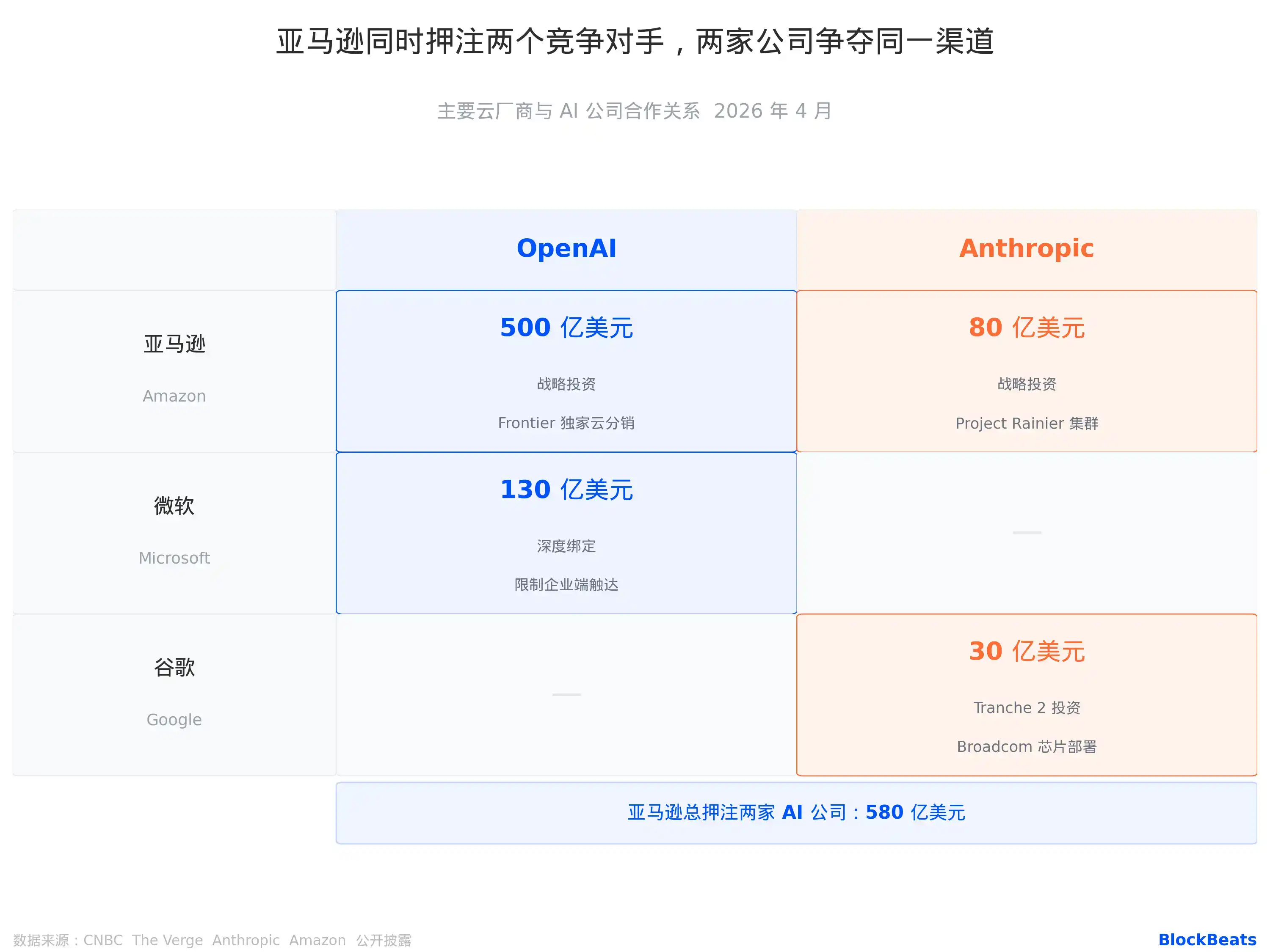
This isn't just a hyperscale cloud vendor's diversified betting; it's a more precise structure: Amazon is both Anthropic's "strategic ally and largest backer" and the new cloud foundation OpenAI is using to "replace Microsoft."

When the two companies compete for the same pool of enterprise customers, the channel they are争夺 happens to be Amazon's Bedrock platform, a platform that simultaneously distributes models from both companies. Whichever company has a higher conversion rate on Bedrock, Amazon profits, but OpenAI and Anthropic lose out to each other.

Under pressure from continuously eroding enterprise market share and structural cracks in the Microsoft partnership, OpenAI chose to rebuild the narrative with a carefully calculated numbers war, simultaneously using Amazon to re-layout its distribution管道. When the three sets of numbers are taken apart, this competition is more complex than either side wants you to see.


熱門幣種推薦

相關問答

QWhat is the key difference in revenue recognition between Anthropic and OpenAI as highlighted in the internal memo?

AAnthropic uses a gross revenue recognition method, booking the full amount a customer pays through AWS as top-line revenue and treating Amazon's platform share as a cost. OpenAI uses a net method, recording only the portion it actually receives from Microsoft, excluding Microsoft's share from its top-line revenue.

QAccording to the Ramp AI Index data mentioned, what is the current trend in enterprise market share between Anthropic and OpenAI?

AAs of April, Anthropic's share among enterprise paying customers rose to 30.6%, while OpenAI's was 35.2%. The gap has narrowed from 11 percentage points in February to just 4.6 points. At Anthropic's recent growth rate of +6.3 percentage points per month, it is projected to overtake OpenAI in this metric within approximately two months.

QWhat significant advantage does the memo concede that Anthropic has over OpenAI in the enterprise market, and what caution does it add?

AThe memo concedes that Anthropic has a 'significant lead' in enterprise customers due to its programming capabilities. However, it cautions that 'You do not want to be a single-product company in a platform war,' implying that Claude's programming advantage must extend to the platform level to be sustainable.

QWhat is the projected compute capacity gap between OpenAI and Anthropic by 2030 according to their respective plans?

AOpenAI plans to reach 30 gigawatts of compute capacity by 2030 through its Stargate project and a $300 billion cloud deal with Oracle. Anthropic's path, relying on a Broadcom custom chip deal and Google Cloud, aims for 7-8 gigawatts by the end of 2027. Even if Anthropic meets its goal, there would be a four-fold gap compared to OpenAI's 2030 target.

QHow is Amazon's role described in the competition between OpenAI and Anthropic?

AAmazon is simultaneously a strategic ally and the largest investor in Anthropic, having invested $80 billion, and is also the new cloud foundation for OpenAI, which is seeking to replace Microsoft. Amazon's Bedrock platform distributes models from both companies, meaning Amazon profits regardless of which company wins enterprise customers on its platform, while OpenAI and Anthropic directly compete against each other there.

你可能也喜歡

完整版首秀问答!美联储主席沃什:坚守2%通胀目标,成立五个特别工作组,个人未提交点阵图

美联储新任主席沃什在首次FOMC会议上宣布维持利率在3.5%-3.75%不变,并释放了强烈的政策变革信号。他强调,委员会明确且一致地承诺将实现2%的通胀目标,在重获实现该目标的能力之前,不会重新审视这一目标。 沃什宣布立即成立五个特别工作组,分别聚焦美联储沟通机制、资产负债表(包括审查其6.7万亿美元的规模及政策工具效果)、数据源使用、生产率与就业(含AI影响)以及通胀框架,旨在年底前提出改进建议。 本次会议声明大幅缩减,取消了长期沿用的“前瞻性指引”。沃什本人打破惯例,未提交个人经济预测(SEP)和“点阵图”。其他18位官员的预测显示分歧,一半人预计今年至少加息一次,另一半认为利率将维持不变或下降。市场反应剧烈,美股下跌,美债收益率飙升,美元走强。 沃什指出当前政策的限制性效果“不均衡”,例如在房地产领域有所体现,但在金融市场则不然。他批评现有经济数据存在滞后和误差,希望获取更实时的信息。此外,他意图改变市场过度依赖央行言论的“喂食”模式,希望市场更多依据经济数据本身定价。沃什还将人工智能视为成年后最重要的经济变化,认为其带来了巨大需求,同时可能促进增长、就业与低通胀的兼容。

链捕手51 分鐘前

完整版首秀问答!美联储主席沃什:坚守2%通胀目标,成立五个特别工作组,个人未提交点阵图

链捕手51 分鐘前

交易

現貨
合約

熱門文章

什麼是 $S$

理解 SPERO:全面概述 SPERO 簡介 隨著創新領域的不斷演變,web3 技術和加密貨幣項目的出現在塑造數字未來中扮演著關鍵角色。在這個動態領域中,SPERO(標記為 SPERO,$$s$)是一個引起關注的項目。本文旨在收集並呈現有關 SPERO 的詳細信息,以幫助愛好者和投資者理解其基礎、目標和在 web3 和加密領域內的創新。 SPERO,$$s$ 是什麼? SPERO,$$s$ 是加密空間中的一個獨特項目,旨在利用去中心化和區塊鏈技術的原則,創建一個促進參與、實用性和金融包容性的生態系統。該項目旨在以新的方式促進點對點互動,為用戶提供創新的金融解決方案和服務。 SPERO,$$s$ 的核心目標是通過提供增強用戶體驗的工具和平台來賦能個人。這包括使交易方式更加靈活、促進社區驅動的倡議,以及通過去中心化應用程序(dApps)創造金融機會的途徑。SPERO,$$s$ 的基本願景圍繞包容性展開,旨在彌合傳統金融中的差距,同時利用區塊鏈技術的優勢。 誰是 SPERO,$$s$ 的創建者? SPERO,$$s$ 的創建者身份仍然有些模糊,因為公開可用的資源對其創始人提供的詳細背景信息有限。這種缺乏透明度可能源於該項目對去中心化的承諾——這是一種許多 web3 項目所共享的精神,優先考慮集體貢獻而非個人認可。 通過將討論重心放在社區及其共同目標上,SPERO,$$s$ 體現了賦能的本質,而不特別突出某些個體。因此,理解 SPERO 的精神和使命比識別單一創建者更為重要。 誰是 SPERO,$$s$ 的投資者? SPERO,$$s$ 得到了來自風險投資家到天使投資者的多樣化投資者的支持,他們致力於促進加密領域的創新。這些投資者的關注點通常與 SPERO 的使命一致——優先考慮那些承諾社會技術進步、金融包容性和去中心化治理的項目。 這些投資者通常對不僅提供創新產品,還對區塊鏈社區及其生態系統做出積極貢獻的項目感興趣。這些投資者的支持強化了 SPERO,$$s$ 作為快速發展的加密項目領域中的一個重要競爭者。 SPERO,$$s$ 如何運作? SPERO,$$s$ 採用多面向的框架,使其與傳統的加密貨幣項目區別開來。以下是一些突顯其獨特性和創新的關鍵特徵: 去中心化治理:SPERO,$$s$ 整合了去中心化治理模型,賦予用戶積極參與決策過程的權力,關於項目的未來。這種方法促進了社區成員之間的擁有感和責任感。 代幣實用性:SPERO,$$s$ 使用其自己的加密貨幣代幣,旨在在生態系統內部提供多種功能。這些代幣使交易、獎勵和平台上提供的服務得以促進,增強了整體參與度和實用性。 分層架構:SPERO,$$s$ 的技術架構支持模塊化和可擴展性,允許在項目發展過程中無縫整合額外的功能和應用。這種適應性對於在不斷變化的加密環境中保持相關性至關重要。 社區參與:該項目強調社區驅動的倡議,採用激勵合作和反饋的機制。通過培養強大的社區,SPERO,$$s$ 能夠更好地滿足用戶需求並適應市場趨勢。 專注於包容性:通過提供低交易費用和用戶友好的界面,SPERO,$$s$ 旨在吸引多樣化的用戶群體,包括那些以前可能未曾參與加密領域的個體。這種對包容性的承諾與其通過可及性賦能的總體使命相一致。 SPERO,$$s$ 的時間線 理解一個項目的歷史提供了對其發展軌跡和里程碑的關鍵見解。以下是建議的時間線,映射 SPERO,$$s$ 演變中的重要事件: 概念化和構思階段:形成 SPERO,$$s$ 基礎的初步想法被提出,與區塊鏈行業內的去中心化和社區聚焦原則密切相關。 項目白皮書的發布:在概念階段之後,發布了一份全面的白皮書,詳細說明了 SPERO,$$s$ 的願景、目標和技術基礎設施,以吸引社區的興趣和反饋。 社區建設和早期參與:積極進行外展工作,建立早期採用者和潛在投資者的社區,促進圍繞項目目標的討論並獲得支持。 代幣生成事件:SPERO,$$s$ 進行了一次代幣生成事件(TGE),向早期支持者分發其原生代幣,並在生態系統內建立初步流動性。 首次 dApp 上線:與 SPERO,$$s$ 相關的第一個去中心化應用程序(dApp)上線,允許用戶參與平台的核心功能。 持續發展和夥伴關係:對項目產品的持續更新和增強,包括與區塊鏈領域其他參與者的戰略夥伴關係,使 SPERO,$$s$ 成為加密市場中一個具有競爭力和不斷演變的參與者。 結論 SPERO,$$s$ 是 web3 和加密貨幣潛力的見證,能夠徹底改變金融系統並賦能個人。憑藉對去中心化治理、社區參與和創新設計功能的承諾,它為更具包容性的金融環境鋪平了道路。 與任何在快速發展的加密領域中的投資一樣,潛在的投資者和用戶都被鼓勵進行徹底研究,並對 SPERO,$$s$ 的持續發展進行深思熟慮的參與。該項目展示了加密行業的創新精神,邀請人們進一步探索其無數可能性。儘管 SPERO,$$s$ 的旅程仍在展開,但其基礎原則確實可能影響我們在互聯網數字生態系統中如何與技術、金融和彼此互動的未來。

91 人學過發佈於 2024.12.17更新於 2024.12.17

什麼是 $S$

什麼是 AGENT S

Agent S:Web3中自主互動的未來 介紹 在不斷演變的Web3和加密貨幣領域,創新不斷重新定義個人如何與數字平台互動。Agent S是一個開創性的項目,承諾通過其開放的代理框架徹底改變人機互動。Agent S旨在簡化複雜任務,為人工智能(AI)提供變革性的應用,鋪平自主互動的道路。本詳細探索將深入研究該項目的複雜性、其獨特特徵以及對加密貨幣領域的影響。 什麼是Agent S? Agent S是一個突破性的開放代理框架,專門設計用來解決計算機任務自動化中的三個基本挑戰: 獲取特定領域知識:該框架智能地從各種外部知識來源和內部經驗中學習。這種雙重方法使其能夠建立豐富的特定領域知識庫,提升其在任務執行中的表現。 長期任務規劃:Agent S採用經驗增強的分層規劃,這是一種戰略方法,可以有效地分解和執行複雜任務。此特徵顯著提升了其高效和有效地管理多個子任務的能力。 處理動態、不均勻的界面:該項目引入了代理-計算機界面(ACI),這是一種創新的解決方案,增強了代理和用戶之間的互動。利用多模態大型語言模型(MLLMs),Agent S能夠無縫導航和操作各種圖形用戶界面。 通過這些開創性特徵,Agent S提供了一個強大的框架,解決了自動化人機互動中涉及的複雜性,為AI及其他領域的無數應用奠定了基礎。 誰是Agent S的創建者? 儘管Agent S的概念根本上是創新的,但有關其創建者的具體信息仍然難以捉摸。創建者目前尚不清楚,這突顯了該項目的初期階段或戰略選擇將創始成員保密。無論是否匿名,重點仍然在於框架的能力和潛力。 誰是Agent S的投資者? 由於Agent S在加密生態系統中相對較新,關於其投資者和財務支持者的詳細信息並未明確記錄。缺乏對支持該項目的投資基礎或組織的公開見解,引發了對其資金結構和發展路線圖的質疑。了解其支持背景對於評估該項目的可持續性和潛在市場影響至關重要。 Agent S如何運作? Agent S的核心是尖端技術,使其能夠在多種環境中有效運作。其運營模型圍繞幾個關鍵特徵構建: 類人計算機互動:該框架提供先進的AI規劃,力求使與計算機的互動更加直觀。通過模仿人類在任務執行中的行為,承諾提升用戶體驗。 敘事記憶:用於利用高級經驗,Agent S利用敘事記憶來跟蹤任務歷史,從而增強其決策過程。 情節記憶:此特徵為用戶提供逐步指導,使框架能夠在任務展開時提供上下文支持。 支持OpenACI:Agent S能夠在本地運行,使用戶能夠控制其互動和工作流程,與Web3的去中心化理念相一致。 與外部API的輕鬆集成:其多功能性和與各種AI平台的兼容性確保了Agent S能夠無縫融入現有技術生態系統,成為開發者和組織的理想選擇。 這些功能共同促成了Agent S在加密領域的獨特地位,因為它以最小的人類干預自動化複雜的多步任務。隨著項目的發展,其在Web3中的潛在應用可能重新定義數字互動的展開方式。 Agent S的時間線 Agent S的發展和里程碑可以用一個時間線來概括,突顯其重要事件: 2024年9月27日:Agent S的概念在一篇名為《一個像人類一樣使用計算機的開放代理框架》的綜合研究論文中推出,展示了該項目的基礎工作。 2024年10月10日:該研究論文在arXiv上公開,提供了對框架及其基於OSWorld基準的性能評估的深入探索。 2024年10月12日:發布了一個視頻演示,提供了對Agent S能力和特徵的視覺洞察,進一步吸引潛在用戶和投資者。 這些時間線上的標記不僅展示了Agent S的進展,還表明了其對透明度和社區參與的承諾。 有關Agent S的要點 隨著Agent S框架的持續演變,幾個關鍵特徵脫穎而出,強調其創新性和潛力: 創新框架:旨在提供類似人類互動的直觀計算機使用,Agent S為任務自動化帶來了新穎的方法。 自主互動:通過GUI自主與計算機互動的能力標誌著向更智能和高效的計算解決方案邁進了一步。 複雜任務自動化:憑藉其強大的方法論,能夠自動化複雜的多步任務,使過程更快且更少出錯。 持續改進:學習機制使Agent S能夠從過去的經驗中改進,不斷提升其性能和效率。 多功能性:其在OSWorld和WindowsAgentArena等不同操作環境中的適應性確保了它能夠服務於廣泛的應用。 隨著Agent S在Web3和加密領域中的定位,其增強互動能力和自動化過程的潛力標誌著AI技術的一次重大進步。通過其創新框架,Agent S展現了數字互動的未來,為各行各業的用戶承諾提供更無縫和高效的體驗。 結論 Agent S代表了AI與Web3結合的一次大膽飛躍,具有重新定義我們與技術互動方式的能力。儘管仍處於早期階段,但其應用的可能性廣泛且引人入勝。通過其全面的框架解決關鍵挑戰,Agent S旨在將自主互動帶到數字體驗的最前沿。隨著我們深入加密貨幣和去中心化的領域,像Agent S這樣的項目無疑將在塑造技術和人機協作的未來中發揮關鍵作用。

865 人學過發佈於 2025.01.14更新於 2025.01.14

什麼是 AGENT S

如何購買S

歡迎來到HTX.com!在這裡,購買Sonic (S)變得簡單而便捷。跟隨我們的逐步指南,放心開始您的加密貨幣之旅。第一步:創建您的HTX帳戶使用您的 Email、手機號碼在HTX註冊一個免費帳戶。體驗無憂的註冊過程並解鎖所有平台功能。立即註冊第二步:前往買幣頁面,選擇您的支付方式信用卡/金融卡購買:使用您的Visa或Mastercard即時購買Sonic (S)。餘額購買:使用您HTX帳戶餘額中的資金進行無縫交易。第三方購買:探索諸如Google Pay或Apple Pay等流行支付方式以增加便利性。C2C購買:在HTX平台上直接與其他用戶交易。HTX 場外交易 (OTC) 購買:為大量交易者提供個性化服務和競爭性匯率。第三步:存儲您的Sonic (S)購買Sonic (S)後,將其存儲在您的HTX帳戶中。您也可以透過區塊鏈轉帳將其發送到其他地址或者用於交易其他加密貨幣。第四步:交易Sonic (S)在HTX的現貨市場輕鬆交易Sonic (S)。前往您的帳戶,選擇交易對,執行交易,並即時監控。HTX為初學者和經驗豐富的交易者提供了友好的用戶體驗。

1.8k 人學過發佈於 2025.01.15更新於 2026.06.02

如何購買S

相關討論

歡迎來到 HTX 社群。在這裡,您可以了解最新的平台發展動態並獲得專業的市場意見。 以下是用戶對 S (S)幣價的意見。

活动图片













