Author: Leo Z
I. What is Circle
Circle is the issuer of USDC. USDC is the world's second-largest stablecoin, with a circulation of approximately $770 billion. Each USDC is backed by an equivalent amount of US dollar assets (primarily short-term US Treasury bonds) as reserves.
Circle's revenue source is simple: it invests these reserves in US Treasury bonds to earn an interest spread. FY2025 total revenue was $2.75 billion, with 95% coming from reserve interest. It went public in June 2025, with a current market capitalization of approximately $150-200 billion.
The market's pricing of Circle is essentially equal to "USDC circulation × interest rate × a conservative multiple." This means: if you believe Circle is merely a company that earns interest, the current pricing is roughly fair. If you believe it is transforming into a fee-based digital dollar infrastructure network, then the current price does not reflect this value at all.
This article aims to answer: Is this transformation happening? How much evidence is there? What is it worth?
II. Core Question: Is USDC Being "Held" or "Used"?
Before discussing valuation, answer a question more important than any financial model.
For the same $770 billion USDC, if it is just held by institutions to earn interest spread, then Circle is an interest rate-sensitive financial company, valued at 10-15x. If it is being frequently used for payments, settlements, cross-border transfers, and developer calls, then Circle is growing into a fee-based infrastructure network, valued at 25-30x.
Two key data points can help you judge:
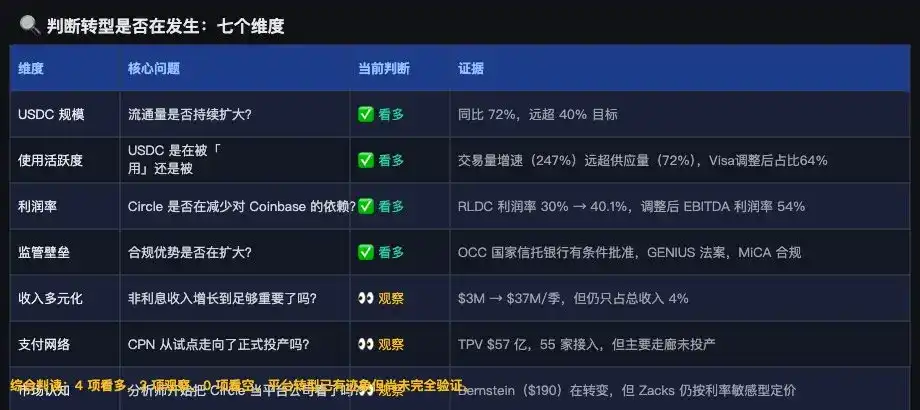
First, the growth rate of USDC's on-chain transaction volume far exceeds its circulation growth rate. In FY2025, USDC circulation grew by 72%, but on-chain transaction volume grew by 247%. This means each USDC dollar is being used more frequently. This is not "the stock is getting larger," but "the flow velocity is increasing."
Second, USDC has surpassed USDT to become the largest settlement asset. Visa Onchain Analytics filters out approximately 85% of on-chain noise (bots, internal exchange transfers, high-frequency arbitrage). After this adjustment, USDC accounts for 64% of real economic settlement volume (Mizuho, February 2026), while USDT accounts for only about 28%—even though USDT's circulation is 2.4 times that of USDC.
This gap itself is the strongest signal: USDC is transitioning from an "asset people hold" to a "network people use." But this transition is not yet complete—later we will discuss the conditions needed for it to be confirmed.
III. Three-Tier Revenue Structure
Circle's revenue is divided into three tiers. The market is almost only pricing the first tier.
Tier 1: USDC Interest Income—How Circle Makes Money Today
USDC is Circle's starting point and the source of 95% of its current revenue. As of the end of 2025, USDC circulation was $753 billion, a year-on-year increase of 72%, far exceeding Circle's own annualized growth target of 40%.
The revenue logic is simple: approximately 80% of USDC reserves are invested in short-term US Treasury bonds (via the BlackRock-managed USDXX fund), earning an interest spread.
Interest Income ≈ Average USDC Circulation × Reserve Yield
The reserve yield in Q4 2025 was 3.81%, down 68 basis points from the previous quarter. This exposes the core contradiction: circulation is growing rapidly, but interest rates are falling, and the two are offsetting each other. If the Fed's target rate drops to 3%, Circle would need USDC to grow to over $1.5 trillion to maintain its current income level.
Structural issue: Coinbase takes most of the revenue. According to the revenue-sharing agreement signed in 2023, 100% of the interest on USDC on the Coinbase platform goes to Coinbase, and Coinbase takes 50% of the interest off-platform. In FY2025, for every $1 of interest Circle earned, about 60 cents was given to distribution partners.
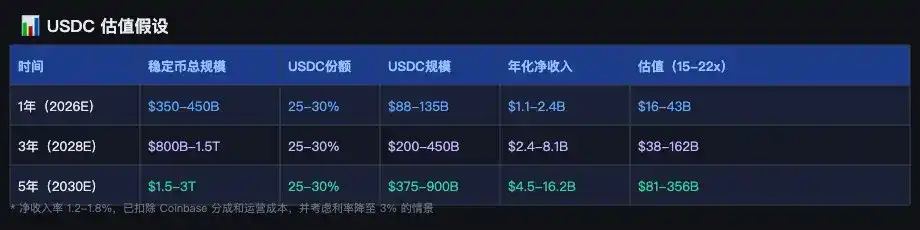
The good news is that margins are improving. The RLDC (Revenue Less Distribution Costs) margin expanded from 30.0% in Q4 2024 to 40.1% in Q4 2025. The net income rate is 1.2-1.8%, after deducting Coinbase's share and operating costs.
Tier 2: Payment & Transaction Revenue—The New Business in Development
This is the key to determining whether Circle can shed the "interest rate company" label.
CPN (Circle Payments Network) launched in May 2025, providing banks, payment companies, and enterprises with 24/7 cross-border settlement based on USDC. As of February 2026, the annualized TPV reached $5.7 billion, growing about 100-fold since launch. 55 institutions are connected, 74 are under review, and 500+ are in the pipeline. It covers 14 markets including Brazil, Canada, Hong Kong, India, Mexico, Nigeria, and the US.
But $5.7 billion compared to the global cross-border payment market of $160 trillion is still less than 0.04%. The value of CPN lies not in its current scale but in whether its growth can be sustained. If it captures 1% of the cross-border market, that would be $1.6 trillion in annualized transaction volume—the fees generated could approach or even exceed interest income and are not affected by interest rates.
CCTP (Cross-Chain Transfer Protocol) enables native cross-chain transfer of USDC through "burn-mint." It processed $41.3 billion in Q4 2025, a year-on-year increase of 3.7 times. USDC's cross-chain market share rose from 25% at the end of 2024 to 62% in January 2026, covering 30 chains. CCTP V2 introduced Fast Transfer fees—a new revenue source.
Other Revenue (non-interest income) is the most direct "evidence of transformation." In FY2025, it surged from $3 million per quarter to $37 million per quarter, including $24.7 million from subscription services, $12.2 million from transaction revenue, and $7 million from Canton Network validator node revenue. Management guidance for 2026 is $150-170 million.
This revenue is not affected by interest rates and does not require sharing with Coinbase. When it exceeds 10% of total revenue, the market may start to view Circle with a different valuation method. Currently, it is about 4%.
Tier 3: Settlement Platform—Long-Term Possibility
Arc is an institutional-grade settlement chain planned by Circle to launch its mainnet in 2026, with USDC as the native gas token. The testnet has already processed over 166 million transactions, with a confirmation time of 0.5 seconds, and 100+ institutions participating (including Goldman Sachs and Mastercard).
Arc's roadmap is divided into four phases:
M1 Public Testnet (completed) → M2 Real Funds On-Chain (2026) → M3 Margin/Collateral/Settlement Scenarios Live (2027-28) → M4 Integrated into Institutional Standard Operating Procedures (2029-30)
Before M2, Arc's value is zero. But if it eventually becomes the institutional settlement standard, Circle's value will no longer be that of a "fee company" but a "platform company." This is a necessary condition for 10x+ returns.
IV. Judging Whether the Transformation Is Happening: Seven Dimensions
Looking at any single indicator can be misleading. The key is to see if multiple dimensions are improving simultaneously—when scale, activity, margins, new revenue, and user growth all point in the same direction, the transformation is happening.
V. Three Most Important Tracking Metrics
1 USDC Circulation (Check Daily)
The base of Circle's income. Circulation × Reserve Yield = Interest Income. Track "Quarterly Average Circulation" rather than the end-of-period snapshot. Currently about $770 billion.
Data Sources: defillama.com/stablecoin/usd-coin (updated daily), circle.com/transparency (weekly reserve attestation)
2 USDC's Share of Visa-Adjusted Transaction Volume (Check Weekly)
Answers the core question: Is USDC being used or held? Supply is only 25%, but adjusted transaction volume is 64%—each USDC dollar does 2-3 times more work than a USDT dollar.
Data Source: visaonchainanalytics.com → Filter by Stablecoin → Click "Show % of Total" → Read the USDC line
3 Other Revenue, Non-Interest Income (Check Quarterly)
The only indicator that directly proves Circle is making money beyond interest. Not affected by interest rates, no sharing with Coinbase. Currently $37 million/quarter, guidance $150-170 million (2026). Valuation methods will change when it breaks through 10% of total revenue.
Data Sources: circle.com/pressroom (quarterly earnings reports), SEC EDGAR search for Circle Internet Group
VI. Near-Term Catalysts
Coinbase Revenue-Sharing Agreement Expiration (August 2026)
This is the single biggest catalyst within 24 months. Currently, Circle gives about 60% of its revenue to distribution partners. If renegotiation raises the RLDC margin from 40% to 50-55%, the effect would be equivalent to an instant 25-35% increase in profit. But Coinbase has little incentive to concede significantly—USDC distribution on the Coinbase platform remains Circle's biggest growth engine. The outcome is uncertain, but the direction is likely better than the status quo.
OCC National Trust Bank Charter
Conditionally approved in December 2025. Full approval would mean:可以直接在美联储开主账户 (earn IORB rate, eliminate counterparty risk), bypass commercial banks to handle the annual $483 billion mint/redemption flow, and build an insurmountable trust barrier for corporate and government adoption of USDC. No other stablecoin issuer has this.
x402 Foundation (Established April 2026)
Coinbase contributed the x402 payment protocol to the Linux Foundation. x402 activates the HTTP 402 status code as an internet-native payment layer, enabling AI agents, APIs, and applications to settle directly within HTTP interactions—using USDC by default.
Participants: Google, AWS, Stripe, Visa, Mastercard, Amex, Shopify, Microsoft, Cloudflare, Circle. If x402 becomes the standard for AI agent payments, every machine-to-machine microtransaction would increase USDC's usage (velocity) without needing to increase holdings (supply).
Note: x402 is led by Coinbase, not Circle. Impact on CRCL: mildly bullish, expands USDC's use cases but does not change the magnitude of the fundamentals.
VII. Conditions for 5-10x Returns
3-5x (High Confidence)—Purely from USDC Growth
USDC at a 40% CAGR reaches approximately $2-3 trillion by 2028. Even if rates drop to 3%, $2.5T × 1.5% net spread = $37.5 billion net income. At 20x, market cap is $750 billion. From the current $150-200 billion to $750 billion is about 4x. Requires no contribution from CPN or Arc.
10x (Requires Multiple Conditions to Materialize Simultaneously)
From $15-20B to $150-200B, must happen simultaneously:
1. CPN TPV breaks through $100 billion in 2-3 years, with at least one major corridor entering full production.
2. Coinbase revenue-sharing agreement improves, RLDC margin reaches 50%+.
3. Other Revenue exceeds 10% of total revenue, proving scalable non-interest income.
4. Arc reaches at least the M2 stage (real funds on-chain), starts being priced by the market.
Currently, only the second condition (margin) is clearly improving. A 10x return is a position you "earn," not one you "gamble" on.
VIII. Main Risks
Interest Rates Fall Faster Than USDC Grows
Q4 2025 already showed this signal: rates fell 68bps, partially offsetting 100% circulation growth. If the Fed drops to 2.5-3% in 2026-2027, there could be a window of 1-2 quarters of earnings below expectations.
Tether's Compliance
USDC's biggest differentiating advantage is compliance. But Tether earned $10 billion in the first three quarters of 2025 and is in talks with the Big Four accounting firms for a full audit. If Tether gains compliant status within 2-3 years, USDC's differentiated advantage could be significantly weakened. USDT currently has over 60% market share and a market cap of $1.83 trillion—it has ample resources.
Competition from New Yield-Bearing Stablecoins & Payment Giants Like Stripe
Ethena (USDe), Sky, and other new stablecoins are grabbing market share by paying yields directly to holders. Circle, bound by its regulatory compliance position, currently cannot pay interest directly to USDC holders.
Stripe is a founding member of the x402 Foundation and is also building its own stablecoin payment system. Stripe's strategy is to integrate all potential winning standards—its involvement does not represent exclusive support for USDC, nor does it preclude Stripe from launching its own stablecoin or deeply integrating USDT in the future.
IX. Conclusion
Circle is not a company that "will definitely become a trillion-dollar" company. But it might be one of the few fintech companies today that has the structural conditions to potentially reach that ceiling.
Current pricing almost only reflects USDC interest income. The market is asking: Is Circle an interest rate-driven financial company, or a fee-based digital dollar infrastructure? The answer is not yet certain—but the data is leaning towards the latter.
The core things to track are three: Is USDC circulation growing? Is each USDC dollar being used more frequently? Is non-interest income increasing? When all three improve simultaneously, the transformation is happening.
Data Sources: Circle IR, SEC EDGAR, DefiLlama, Visa Onchain Analytics, Artemis Terminal, CoinDesk, Mizuho Research
Disclaimer: This article does not constitute investment advice. All data is as of April 2026.