Solana validators have overwhelmingly approved SIMD-0326 “Alpenglow,” a sweeping consensus rewrite that aims to cut transaction finality from roughly 12.8 seconds to about 150 milliseconds—a 100x reduction that developers and observers are already calling the most consequential upgrade in the network’s history. According to the official tally shared via Solana Status, 98.27% of stake voted Yes, 1.05% voted No, and 0.69% abstained, with 52% of total stake participating.
Solana Slashes Finality By 100x
“The community governance process for SIMD-0326: Alpenglow is complete. The proposal has passed: 98.27% Yes, 1.05% No, 0.69% Abstain; 52% of stake cast a vote,” Solana Status posted on X on September 2. Anza, the Solana R&D firm that authored the proposal, added context for operators: “Mainnet-beta is in epoch 843 which concludes the voting process for SIMD-0326: Alpenglow. The proposal has passed with 98% of stake voting Yes.”
🚨JUST IN: Alpenglow, the most significant consensus upgrade proposal in @Solana‘s history, aiming for 150ms block finality, has passed governance. 98.27% voted ‘Yes’, 1.05% voted ‘No’, with 52% of the Network stake participating. pic.twitter.com/T2IbPW0UeT
— SolanaFloor (@SolanaFloor) September 2, 2025
Alpenglow replaces core elements of the existing consensus—Proof-of-History (PoH) and TowerBFT—with two new components designed for real-time performance: Votor, a direct-vote finality engine that achieves sub-second confirmations via single-round finalization in the “fast path” (when ~80% of stake is responsive) or two rounds in a 60% fallback; and Rotor, a streamlined block propagation layer intended to supplant Turbine and cut network overhead.
In practice, that architecture is what underpins the ~150–200 ms confirmation targets. Beyond raw speed, Alpenglow touches validator economics and fault tolerance. With vote transactions moving off-chain, Solana will eliminate per-slot vote fees and introduce a fixed Validator Admission Ticket (VAT)—initially 1.6 SOL per epoch—that is burned.
The model aims to preserve economic friction against spam even as vote traffic leaves the ledger, while simplifying load on the network. Separately, the design targets a “20+20” resilience envelope: safety if up to 20% of stake is adversarial and liveness if an additional, disjoint 20% is offline. These mechanics were debated in the forum during the governance window and were reiterated in technical explainers ahead of the vote.
Governance mechanics and timeline. The governance process followed the steps laid out on the Solana forum: discussion in epochs 833–838, stake weights captured in epoch 839, and voting in epochs 840–842, with passage defined as Yes ≥ two-thirds of (Yes + No) and a 33% quorum in which abstentions count toward quorum. Anza’s epoch-843 note simply marks the moment the chain passed the voting boundary on mainnet-beta.
With the validator signal secured, Alpenglow now moves from governance to engineering reality. Whether it ultimately delivers stable ~150 ms finality at scale is a question only testnet and mainnet can answer—but the 98% approval makes clear the Solana ecosystem’s directional bet: real-time blockchain. An official implementation schedule remains forthcoming.
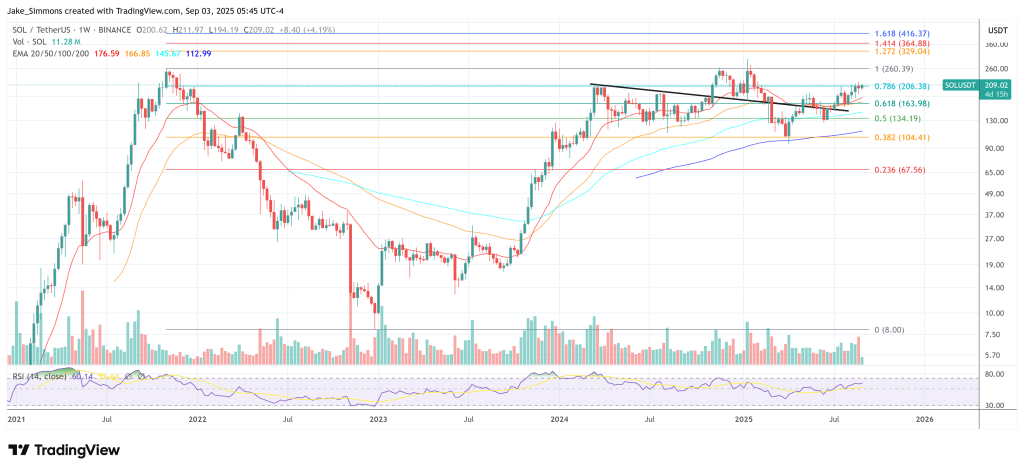
At press time, SOL traded at $209.

Related Posts