As stablecoin’s momentum continues to surge worldwide, 2014 Nobel Prize-winning economist Jean Tirole recently warned about the risks of a potential financial crisis due to the “insufficient supervision” in the sector.
Economist Warns Of Multibillion-Dollar Crisis
On Monday, Jean Tirole shared his concerns about inadequate stablecoin oversight amid the recent momentum in the sector, affirming that he was “very, very worried” about the lack of sufficient supervision and the potential hidden risks that it could entail.
In an interview with the Financial Times (FT), the professor at the Toulouse School of Economics warned of the possibility that governments could be forced into “multibillion-dollar bailouts” if the digital assets, which are considered “a perfectly safe deposit” by retail traders, unravel in a future financial crisis.
He also cautioned that backing stablecoins with US government bonds could become unpopular due to the underlying assets’ relatively low yields, noting previous cases when the returns of Treasury debt were negative for several years and payouts after inflation were even lower.
Notably, digital assets pegged to the US dollar are required to be backed on a one-to-one basis by US dollars or Treasury bills after the enactment of the Guiding and Establishing National Innovation for U.S. Stablecoins (GENIUS) Act in July.
As reported by Bitcoinist, US Treasury Secretary Scott Bessent is allegedly “betting” on the crypto industry to become a key buyer of US Treasuries in the coming years. According to a previous FT report, Bessent has signaled to Wall Street that he expects the industry to “become an important source of demand for US government bonds” as Washington seeks to bolster demand for a surge of new US government debt.
The Treasury Secretary has reportedly contacted leading stablecoin issuers, like Circle and Tether, for information, signaling the Treasury Department’s alleged plans to increase sales of short-term bills for the coming quarters. Nonetheless, the Global Chief Economist at financial services firm UBS, Paul Donovan, doesn’t believe that the sector will boost the demand for US government bonds.
Donovan considers that “stablecoins are more about redistributing the money supply,” adding that “someone selling Treasury bills to buy stablecoins, which invest the money in Treasury bills, does not change demand for U.S. debt instruments.”
Better Stablecoin Oversight Required
Following the global push for the sector, the stablecoin market has risen to over $280 billion. Last month, Goldman Sachs affirmed that the industry is “at the beginning of a stablecoin gold rush,” which could potentially bring the global market to trillions of dollars.
Tirole considers that stablecoin issuers could be “lured into the temptation” to invest in other assets that “carry higher returns and are riskier.” The higher risk would increase the chance of a potential crisis, triggering a run on the tokens.
“If it is held by retail or institutional depositors who thought it was a perfectly safe deposit, then the government will be under a lot of pressure to rescue the depositors so they don’t lose their money,” he detailed, adding that only a few uninsured depositors of traditional banks ever faced losses over the past decades.
The economist explained that the potential risks could be managed if global supervisors had enough resources and were incentivized to act carefully. However, he warned this was a “big if,” citing personal and political interests of members of “some key members of the [US] administration.”
Nonetheless, the US Treasury Secretary considers that the recent regulatory advancements are sufficient to drive the sector’s growth. “The GENIUS Act provides the fast-growing market with the regulatory clarity it needs to grow into a multitrillion-dollar industry,” Bessent said in July.
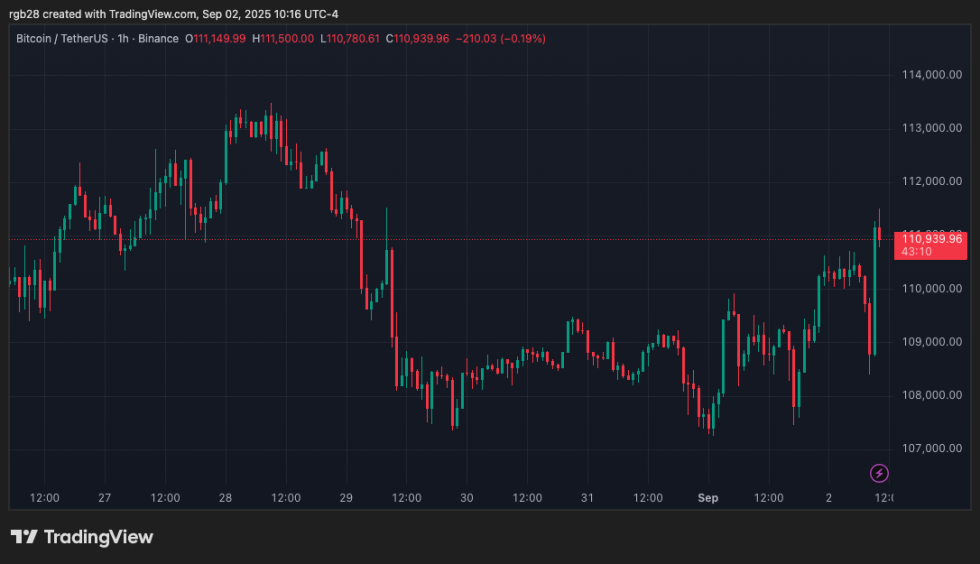
Bitcoin (BTC) trades at $110,939 in the one-week chart. Source: BTCUSDT on TradingView

Related Posts