Defi TVL Improves, Cross-Chain Bridge TVL Slips, $100 Million Stolen From Harmony’s Horizon Bridge
Decentralized finance has taken a hit from the recent crypto bloodbath following the Terra blockchain fallout, the most recent Federal Reserve rate hike, and the alleged financial issues surrounding Celsius and Three Arrows Capital (3AC). On June 17, Bitcoin.com News reported on the bear market affecting defi negatively and three days later the TVL in defi dropped to a low of $71.98 billion.
Since then, there’s been a 7.19% increase as the TVL rose from $71.98 billion to today’s $77.16 billion. The Makerdao protocol has the largest TVL out of all the defi projects and dominates by 10.37% this weekend with $8 billion TVL.
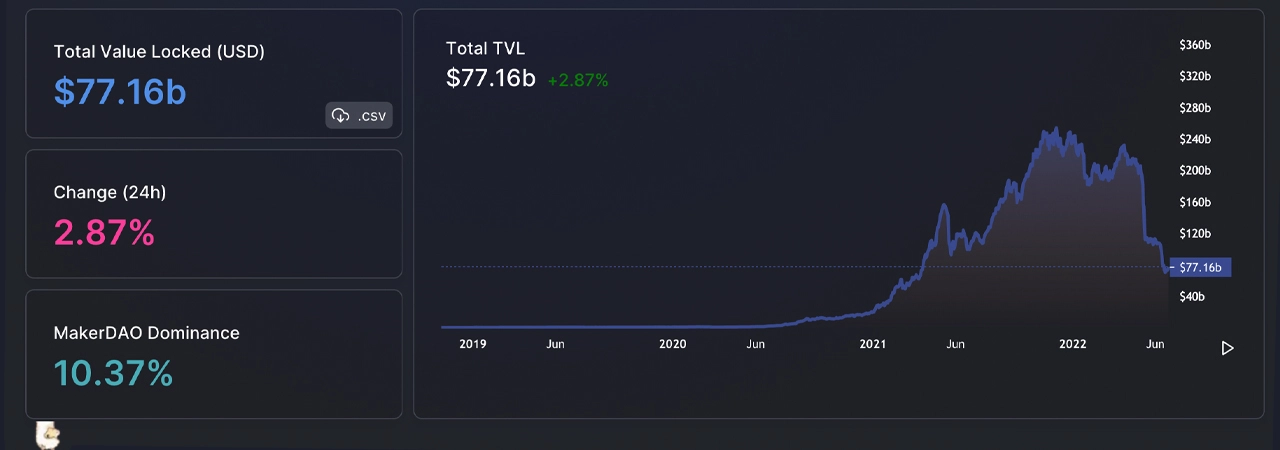
Makerdao’s TVL has increased 6.89% during the past seven days. The second largest defi protocol in terms of TVL size is Aave, with $6.59 billion, and Aave recorded a 27.13% increase during the course of the week. As far as blockchain TVL distribution is concerned, Ethereum commands 63.98% with $49 billion TVL.
Binance Smart Chain (BSC) is the second largest chain by TVL with 7.85% or $6.01 billion locked. After the market capitalization of the top smart contract tokens hit $245 billion last week, the market cap has swelled to $280 billion, up 1.4% during the last 24 hours.
Ethereum (ETH) increased 12.7% against the USD, and BSC jumped 10.5% this past week. Solana (SOL) swelled by 37.1%, avalanche (AVAX) recorded a 32.2% increase, and polygon (MATIC) rose more than 50% during the seven-day period.
The biggest gainers in the top smart contract token list during the past week were ronin (RON), zilliqa (ZIL), and polygon (MATIC), respectively. Despite smart contract tokens seeing some gains this week and the TVL in defi improving, the TVL across the cross-chain bridge sector is down 60.4% during the past 30 days.
At the time of writing, the cross-chain bridge TVL across 16 different protocols is $11.77 billion in value. Polygon commands the largest cross-chain bridge TVL with $3.6 billion locked on June 25.
Meanwhile, the defi ecosystem has seen a few hiccups over the last seven days as Convex Finance is asking users to review approvals while it evaluates a “potential front end issue.” Additionally, Harmony’s cross-chain bridge lost $100 million in a theft that took place on June 23.
“Note this does not impact the trustless [bitcoin] bridge; its funds and assets stored on decentralized vaults are safe at this time,” the Harmony team wrote about the situation. “We have also notified exchanges and stopped the Horizon bridge to prevent further transactions. The team is all hands on deck as investigations continue.”