Abstract
stETH is a token offered by the biggest Ethereum 2.0 liquid staking protocol Lido. stETH represents an ownership of ETH staked on Lido. By holding stETH, users gain staking rewards on a daily basis. The price of stETH has been trading close to the price of ETH for the majority of its lifetime. However, its price has been trading below the price of ETH recently, and liquidity is becoming scarce across its second-hand markets. There are worries concerning the depeg.
This report delves into the major factors causing the declining price of stETH:
1) FUD generated by the collapse of Luna and UST;
2) Celsius selling their stETH (Lido) positions on Curve to supply the withdrawals of their users;
3) Alamenda Research dumping stETH on Curve;
4) Liquidations on AAVE against undercollateralized as stETH price declines;
5) Increased probability of postponing the “Difficulty Bomb” in ETH 2.0 transition.
In the end of this report, we will discuss the likelihood of stETH price and market behavior in the short-term and long-term and highlight potential opportunity of stETH amidst FUD and bear market sentiment.
1. Much attention has been drawn to the stETH/ETH “depeg”
The stETH/ETH "depeg" has triggered worries in the market, especially around how the devaluing of stETH might cause subsequent liquidations across the lending market. stETH has been trading at approximately 1:1 with ETH most of the time. However, recently, its price dropped and liquidity has been depleted out as liquidity providers are withdrawing their funds. stETH/ETH is now trading at 0.94 at the time of writing.
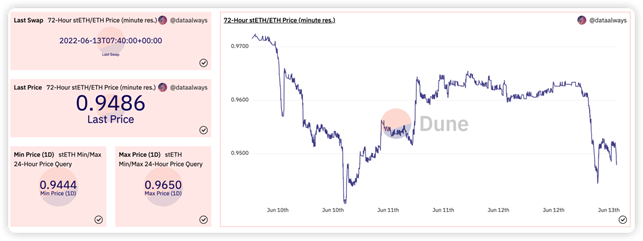
Figure 1: stETH/ETH ratio
Source: Dune@dataalways
There are worries that a further decline in stETH price will cause a chain of serious consequences. In the following, we will delve into:
1) the reasons why stETH has been trading below ETH, why its liquidity is being drained and the current unpegging scenario of stETH/ETH (Chapter 2);
2) stETH market behavior in the short-term and long-term (Chapter 3).
2. Causes behind decline of stETH price
There are possibly five major factors contributing to the declining price of stETH.
2.1 Luna and Terra Collapse
The collapse of Luna and UST certainly posed fear and incited selling pressure across the market. People lost confidence and the price of stETH was driven down to 0.96 ETH as a result of the Luna and UST collapse.
However, the collapse of UST alone would only have limited effect on stETH prices, because UST and stETH are underpinned by different mechanisms and are fundamentally unrelated. The initial correlation for price decreases can be explained by the bear market sentiment as well as diminishing confidence among investors.
stETH is backed by ETH and it does not require being traded at 1:1 to ETH to work. stETH represents the stake in staking ETH 2.0, and trades at market price based on the demand/supply on its second-hand markets. If we look at other stETH tokens (offered by other protocols for liquid ETH 2.0 staking), we can conclude that a 1:1 stETH to ETH price is not a guarantee (see Figure below for BETH).
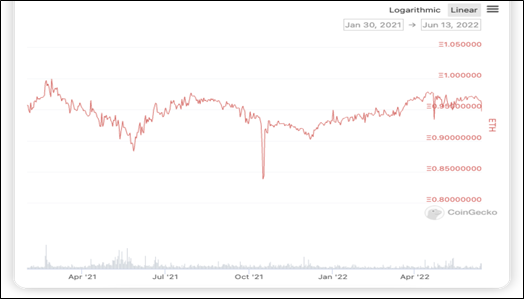
Figure 2: BETH/ETH
Source: Coingecko.com
2.2 Celsius Incident
Celsius took a huge loss from staking stETH on Stakehound as Stakehound had misplaced the keys to over 38,000 Ethereum tokens that they had deposited on behalf of clients. Celsius and other customers are now stuck with the Stakehound stETH token, which is currently nearly worthless. Celsius wallets have at least 42,306 Stakehound staked Ethereum (0xdfe66b14d37c77f4e9b180ceb433d1b164f0281d). This equates to a loss of almost US$71 million according to Ethereum prices as of today (14 June 2022).
This incident was revealed in the news one week ago, and upon knowing their investment was in a precarious position, users on Celsius rushed to redeem their positions. The withdrawal rate was rapid, at around 50,000 ETH per week, which forced Celsius to sell other assets like stETH (staked on Lido) for ETH on stETH second-hand markets like Curve to acquire more liquidity, take out loans against stETH to support withdrawal and temporarily pause withdrawals and transfers in the worst-case scenario.
Today, Celsius has paused all withdrawals, transfers and swaps due to extreme market conditions.

Figure 3: Celsius pauses withdrawals
Source: Celsius Twitter
The decision by Celsius was probably caused by insufficient liquidity. In fact, only 27% of Celsius' ETH holdings is liquid, the rest is either staked in ETH 2.0 or stETH. Celsius had no choice but to sell their stETH staked on Lido(0xae7ab96520DE3A18E5e111B5EaAb095312D7fE84).
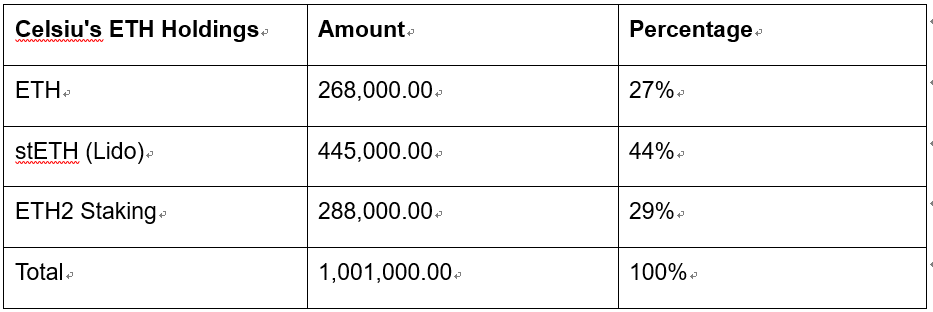
From the table above, we know that Celsius previously held about 445,000 stETH (staked on Lido) worth US$1.4 billion. Currently there is only around 132,000 stETH in the liquidity pool on Curve. (recorded on 11 June 2022)
It is difficult for Celsius to sell their stETH for ETH as the depth of liquidity is insufficient to support their selling.
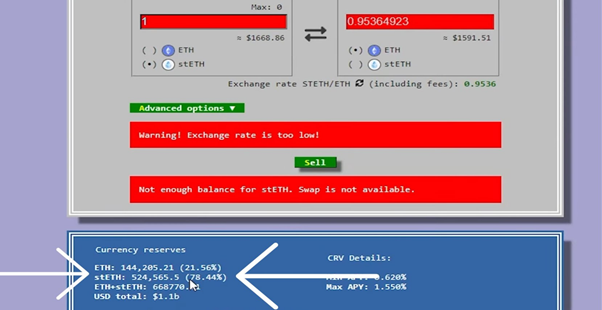
Figure 4: Curve
Source: curve.finance
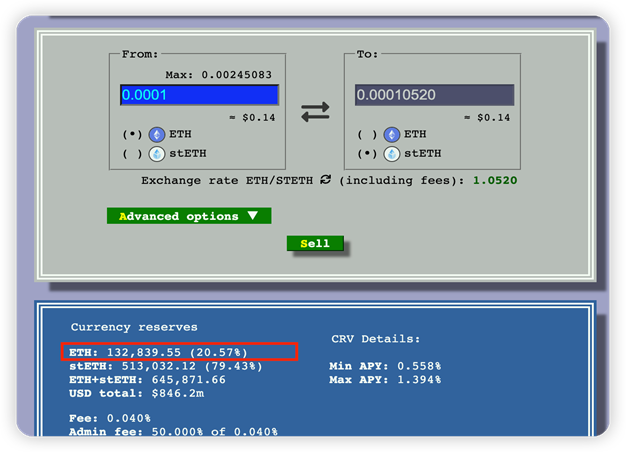
Figure 5: Curve
Source: curve.finance
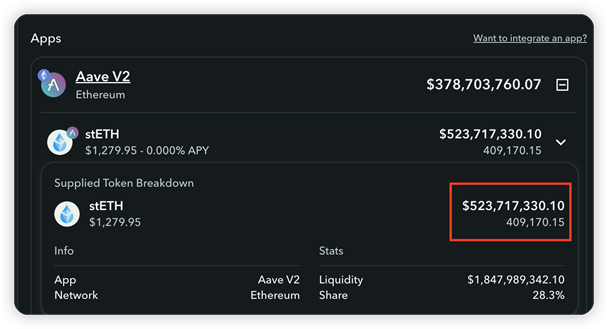
Figure 6: Celsius wallet portfolio at AAVE
Source: https://zapper.fi
Upon checking Celsius's account (0x8aceab8167c80cb8b3de7fa6228b889bb1130ee8), the stETH in Celsius's account is only about 409,00, compared to the 445,000 two days ago. Celsius, under financial pressure, has already started selling stETH on Curve to meet customer redemption demands.
2.3 Alamenda Research selling stETH
A report showed that Alamenda Research, one of the biggest crypto investment firms, sold around 50,000 stETH on 8 June. The following is a screenshot from Etherscan recording the selling activities.
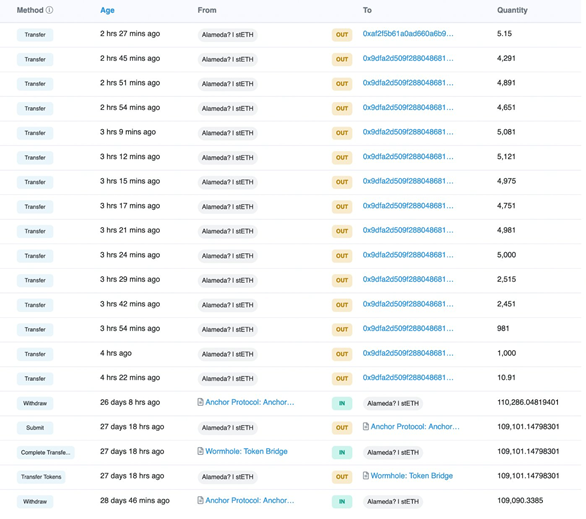
Figure 7: Alamenda Research selling stETH transactions
Source: https://etherscan.io/
The selling from Alamenda Research posed further supply pressure on stETH second-hand markets, pushing down the price of stETH. This might trigger further selling from other big holders. Yet, the selling pressure does not end here. Let's us look into the problems we discovered on AAVE with stETH.
2.4 stETH in AAVE lending protocol
As we can see from the chart below, the staking pool of AAVE got the largest stETH percentage with a total of 1.4 million ETH, worth about US$1.7 billion.
Users stake their stETH into AAVE to take out ETH loans, then stake ETH on Lido to take out stETH again to achieve a leveraged staking position. This is also called a revolving loan. The following are the steps for taking out a revolving loan:
‒ get back stETH by staking ETH at LIDO;
‒ deposit stETH in Aave and borrow ETH;
‒ repeat steps above;
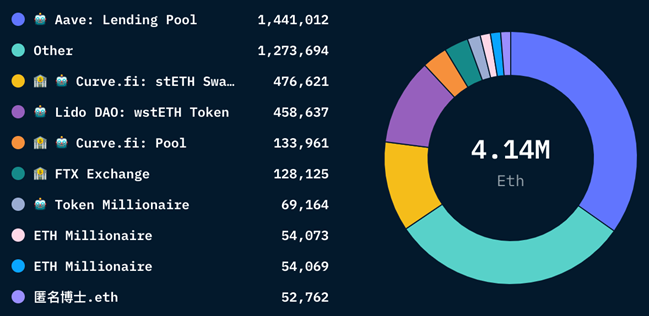
Figure 7: Top stETH holders balance
Source: nansen.ai
However, unlike other st-Tokens at Lido, stETH cannot be unstaked before the completion of ETH 2.0. We don't know how big the leverage is with stETH/ETH, and how many times the revolving loans repeated. This is a big risk to both stETH and ETH. A further decrease in stETH price will cause a chain of liquidations on their leveraged position.
The following figure shows the liquidation price of stETH.
‒ stETH/ETH = 0.925, 17M will be liquidated;
‒ stETH/ETH =0.860, 41M will be liquidated;
‒ stETH/ETH =0.680, 81.3M will be liquidated;
‒ stETH/ETH =0.450, 149M will be liquidated;
‒ stETH/ETH =0.410, 180M will be liquidated.
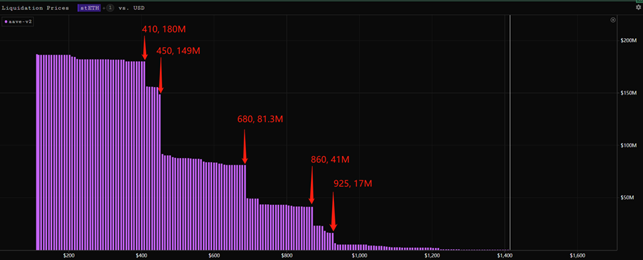
Figure 8: stETH liquidation prices
Source: Twitter
There is 1.44 million of ETH locked on AAVE. Users use stETH as collateral and take out loans of ETH on AAVE to stake on Lido and get stETH again. This process can be repeated multiple times to achieve a leveraged staking position. It can get very dangerous when the price of stETH decreases (caused by Celsius selling their huge position and subsequent selling pressure from other big holders and retailers) and stETH (collateral) is being liquidated and resold on the second-hand market, further pushing the price of stETH down.
2.5 The rising concerns around Etherum2.0
The prospect of ETH 2.0 lingers and recent reports have shown that Ethereum developers will likely delay what’s called the “difficulty bomb”, where a sudden increase in mining difficulty is foreseen, in order to discourage miners from opting to stay with the proof-of-work mechanism after Ethereum’s transition to proof-of-stake. Difficulty refers to the time and computational power needed to verify a cryptocurrency's transactions within a blockchain. This will trigger market concern about the transition. As such, the price of the backed asset (ETH) will go down due to this delay and also cause the price of stETH to drop and worsen the degree of depeg for stETH. Although the team has said “It does not impact the merge at all”, some have been a bit skeptical on the merge of ETH 2.0. Afterall, a delay would certainly lead to a detrimental effect on investor confidence.
3.Conclusion
3.1 In the short-term, stETH will face tremendous selling pressure, turbulence is expected in the near future
Supply of stETH is dominant in the short term as Celsius is forced to sell their stETH position, triggering a subsequent chain of selling events. Second-hand stETH markets have become the exit channel for stakers, because there is no way for ETH 2.0 staking participants to redeem their ETH except through the second-hand markets. The stETH/ETH second-hand market structure is inclined toward the stETH supply side.
3.2 New demand will step into stETH second-hand markets and drive up its price
It is reasonable to think that this price discount will introduce new demand into the second-market which will eventually drive up the price of stETH price so it creeps closer to the price ETH. We should consider that the lower price of stETH will also induce new demand (the cheaper the stETH price, the more profit can one take from redeeming ETH upon ETH 2.0 merging).
3.3 Long-term prospects, risks and opportunities
Risks represent potential returns in the future, and as we get closer to ETH 2.0 merging, risks become lower and the price is likely to recover. In short term, the price of stETH is like to decrease further due to 1) Celsius selling their stETH for ETH to get liquidity for their users; and 2) subsequent selling from whales to mitigate risk from Celsius' selling, but as price is driven down to certain level, arbitragers will step in and seize the attractive opportunity and provide support to the price. The Celsius Incident and stETH whales dumping their stETH would cause short-term turbulence, but stETH will show resilience against the short-term supply when ETH 2.0 merging draws closer.
Nevertheless, we should always consider the risks associated with ETH 2.0 merging, and some risks are not negligible. For example, if the Ethereum transition encounters technical problems that might cause another long delay, such that investors get impatient and lose their conviction, or that the liquid staking protocols could have critical protocol bugs or face slashing risks where its validators for some reason fail to operate properly. All these risks have been factored into stETH price. In addition, the price of ETH also affects the stETH price. If ETH price declines, stETH will also decline. The biggest problem lies with stETH leveraged and collateralised on AAVE. Declining stETH price will cause a chain of liquidations across the lending platform, and the consequences will be severe.
About Huobi Research Institute
Huobi Blockchain Application Research Institute (referred to as "Huobi Research Institute") was established in April 2016. Since March 2018, it has been committed to comprehensively expanding the research and exploration of various fields of blockchain. As the research object, the research goal is to accelerate the research and development of blockchain technology, promote the application of blockchain industry, and promote the ecological optimization of the blockchain industry. The main research content includes industry trends, technology paths, application innovations in the blockchain field, Model exploration, etc. Based on the principles of public welfare, rigor and innovation, Huobi Research Institute will carry out extensive and in-depth cooperation with governments, enterprises, universities and other institutions through various forms to build a research platform covering the complete industrial chain of the blockchain. Industry professionals provide a solid theoretical basis and trend judgments to promote the healthy and sustainable development of the entire blockchain industry.
Official website:
https://research.huobi.com/
Consulting email:
research@huobi.com
Twitter: @Huobi_Research
https://twitter.com/Huobi_Research
Medium: Huobi Research
https://medium.com/huobi-research
Disclaimer
1. The author of this report and his organization do not have any relationship that affects the objectivity, independence, and fairness of the report with other third parties involved in this report.
2. The information and data cited in this report are from compliance channels. The sources of the information and data are considered reliable by the author, and necessary verifications have been made for their authenticity, accuracy and completeness, but the author makes no guarantee for their authenticity, accuracy or completeness.
3. The content of the report is for reference only, and the facts and opinions in the report do not constitute business, investment and other related recommendations. The author does not assume any responsibility for the losses caused by the use of the contents of this report, unless clearly stipulated by laws and regulations. Readers should not only make business and investment decisions based on this report, nor should they lose their ability to make independent judgments based on this report.
4. The information, opinions and inferences contained in this report only reflect the judgments of the researchers on the date of finalizing this report. In the future, based on industry changes and data and information updates, there is the possibility of updates of opinions and judgments.
5. The copyright of this report is only owned by Huobi Blockchain Research Institute. If you need to quote the content of this report, please indicate the source. If you need a large amount of reference, please inform in advance (see "About Huobi Blockchain Research Institute" for contact information) and use it within the allowed scope. Under no circumstances shall this report be quoted, deleted or modified contrary to the original intent.