The digital asset ecosystem is increasingly being evaluated not as a collection of speculative assets, but as an emerging financial system with its own infrastructure, economic inputs, and market structure.
In our joint analysis with Wisdom Tree, we reframe blockchain networks and digital assets as a multi-layered economic system that increasingly mirrors traditional markets in structure, incentives, and economic function.
For financial professionals, this framing demonstrates how digital assets can be analyzed through observable data and compared against traditional macroeconomic benchmarks, offering a more robust foundation for valuation and risk assessment than a price-centric analysis alone.
Key Takeaways
- Transaction fees provide a direct, price-independent measure of a blockchain's growth, health and maturity. The transparency of blockchain data allows analysts to quantify economic activity with a level of fidelity that is difficult to achieve in other financial systems.
- In blockchain systems, transaction security and settlement finality are enforced through economic incentives built into the protocol. Bitcoin represents an energy-backed security model, while Ethereum is an example of a capital-backed security model.
- Mining has evolved into an industrialized commodity business: Cost structures, margin dispersion, and consolidation dynamics increasingly resemble traditional energy and extractive industries.
- Crypto exchanges and custodians have become systemically relevant: they function as the primary financial gateways, linking on-chain activity to traditional capital markets, and driving the transition from retail-dominated ownership to institutional participation through regulated channels.
- Stablecoins underpin settlement and liquidity across the ecosystem. Acting as the primary unit of account, stablecoins enable real-time clearing and continuous capital mobility across global markets.
- DeFi and tokenization extend financial functionality on-chain. Trading, lending, and capital deployment are increasingly executed via rules-based systems, with growing integration into traditional finance.
The full report is freely available for download in PDF format.
Quantifying Network Demand
At the foundation of the blockchain economy is blockspace, a scarce digital resource consumed by every transaction, smart contract execution, and settlement event, and priced dynamically through transaction fees.
Transaction fees, in this context, are not incidental costs but market-based pricing for network usage, offering a direct lens into network demand. Unlike traditional economic data, this activity is observable in near real time, enabling a high-fidelity view of system utilization.
While fee levels remain cyclical and sensitive to market conditions, the longer-term trend in the data points toward sustained growth in infrastructure-level demand. This dynamic positions blockspace as a core economic primitive for evaluating the ecosystem.
Security as an Economic Input
Blockchain networks replace institutional trust with explicitly funded security models, where participants are economically incentivized to validate transactions and maintain system integrity.
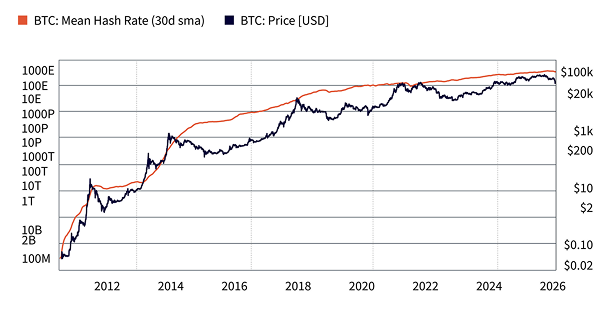
In Bitcoin’s Proof-of-Work model, this relationship is observable through hashrate, or the total computational power securing the network, which reflects the aggregate energy and capital deployed to maintain transaction finality. As the economic value of the network grows, so too does the incentive to invest in this security layer.
In practice, this has given rise to increasingly industrialised operations (most notably in Bitcoin mining), where cost efficiency, scale, and capital access shape competitive positioning.
Financial Gateways and Institutional Integration
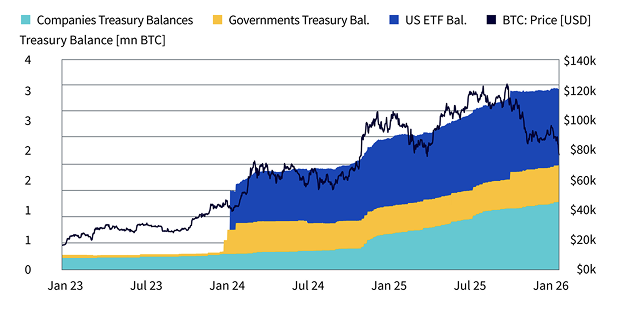
If blockchain networks form the economic substrate, then exchanges and custodians operate as the primary and systemically important financial gateways to traditional capital markets.
As infrastructure has matured, so too has the investor base. Ownership is increasingly shifting toward institutional and regulated capital, marking a transition from early adopters toward participants operating within formal mandates, governance frameworks, and risk constraints.
The System’s Monetary Layer
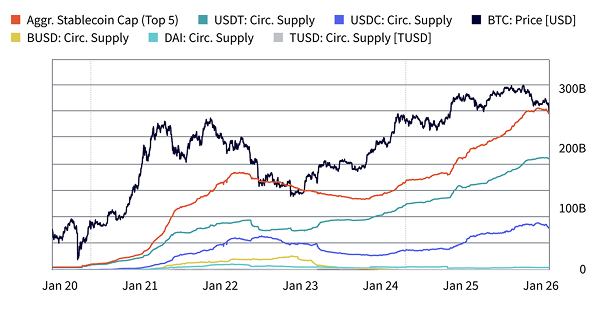
Stablecoins have emerged as the core liquidity and settlement instrument within the blockchain economy. Functionally, they operate as the primary unit of account, medium of exchange, and collateral asset across both centralized and decentralized venues. Their ability to enable instant, final settlement makes them a growing rail for cross-border value transfer.
Growth in stablecoin supply reflects a broader structural shift: capital migrating from traditional banking infrastructure onto blockchain rails to support trading, settlement, and financial activity.
Extending Markets Beyond Traditional Rails
DeFi today represents an alternative financial system, where trading, lending, and capital deployment are executed through rules-based protocols rather than intermediaries.
This architecture enables continuous, transparent market activity, with mechanisms such as automated market making and on-chain credit replacing traditional structures.
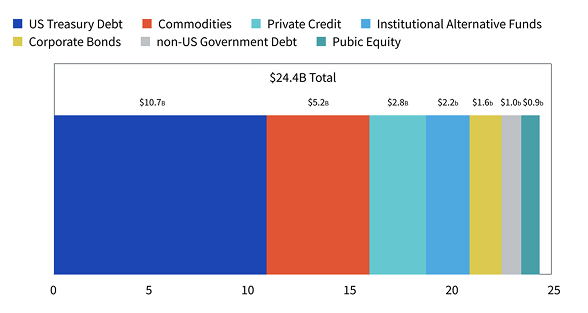
At the same time, tokenization is extending this system outward: bringing traditional financial assets on-chain and deepening the integration between blockchain infrastructure and global capital markets.
To read the full analysis, download the report in PDF format.
Disclaimer: This report does not provide any investment advice. All data is provided for information and educational purposes only. No investment decision shall be based on the information provided here and you are solely responsible for your own investment decisions. We urge users to exercise caution and discretion when utilizing these metrics. Glassnode shall not be held responsible for any discrepancies or potential inaccuracies.
- Follow us on X for timely market updates and analysis
- Join our Telegram channel
- For on-chain metrics, dashboards, and alerts, visit Glassnode Studio