US Calls for Restrictions on Sports Prediction Markets

cryptonews.ru发布于2026-07-28更新于2026-07-28

文章摘要

The National Football League (NFL) has urged the U.S. Commodity Futures Trading Commission (CFTC) to tighten rules for prediction markets on sports events. In a July letter, the NFL argued that current proposals fail to adequately protect the integrity of games and market participants. Key demands include banning contracts on events easily manipulated by individuals (e.g., a kicker missing a field goal), clarifying definitions to prevent gambling-like contracts, and explicitly prohibiting trading based on non-public insider information. The league also called for restricted person lists, a ban on margin trading, advertising limits, stronger user protections, and a minimum age of 21. This push coincides with an ongoing jurisdictional dispute between the CFTC and several states. The CFTC claims exclusive federal oversight, classifying event contracts as swaps, while states argue these platforms violate local gambling laws. Recent legal actions in Michigan and Minnesota highlight the conflict, with a federal court temporarily blocking Minnesota from applying a new law to CFTC-registered platforms like Kalshi and Polymarket. Meanwhile, prediction markets are experiencing significant growth. In June, driven by events like the World Cup, Kalshi's trading volume exceeded $31 billion (85% from sports contracts), while Polymarket's global platform hit a monthly record of $10.8 billion. However, platforms face legal challenges, such as lawsuits from Kentucky accusing them of operatin...

The National Football League (NFL) has called on the U.S. Commodity Futures Trading Commission (CFTC) to tighten regulations for prediction markets on sporting events. This was stated in a letter dated July 27.

The NFL noted that maintaining the integrity of the games is its top priority. In the league's opinion, the rules proposed by the regulator do not provide sufficient protection for competitions and market participants.

Manipulation

The NFL proposed restricting contracts on events that could be manipulated by one person or a small group of individuals. Examples cited included bets on a kicker missing a field goal or a quarterback throwing an inaccurate first pass.

Separately, the league asked the CFTC to clarify the definition of contracts that cannot be meaningfully distinguished from gambling.

NFL representatives also criticized the possibility of an exemption for markets on awards and voting. They believe this could allow platforms to circumvent restrictions by adding a formal voting or award-granting element to sports contracts.

As a controversial example, The Block cited a market on the winner of the Offensive Player of the Year award. The outcome of such a contract depends on a voting panel, but the subject itself is related to player performance.

Insider Information

Another set of proposals concerns material non-public information. The NFL urged the CFTC to explicitly state that trading sports contracts based on confidential league, team, or related-party information should be considered a manipulative or deceptive practice.

The letter's authors also proposed introducing mandatory lists of individuals prohibited from trading contracts for specific competitions. The NFL believes platforms should not rely solely on their own controls.

Furthermore, the league reiterated previous demands: a ban on margin trading, advertising restrictions, additional user protection measures, and an age threshold of 21.

The CFTC and States Dispute Continues

Meanwhile, questions remain regarding the regulation of prediction markets at the federal and local levels. CFTC Chairman Michael Selig insists that the agency has "exclusive jurisdiction" over the sector, as event contracts fall under the category of swaps. States object, arguing that platforms violate local gambling laws.

In July, this dispute put Kalshi in a difficult position. The CFTC demanded that the platform settle transactions for Michigan residents normally, even though a state court ordered it to annul the same operations in late June.

At the end of the month, a U.S. Federal Court temporarily prohibited Minnesota from applying a new law to platforms registered with the Commodity Futures Trading Commission. Kalshi and Polymarket US will continue operating in the state until the dispute is resolved. The judge considered that some contracts on event outcomes might fall under the exclusive jurisdiction of the CFTC.

Industry organizations are also dissatisfied. For example, American gambling associations have called on the U.S. Senate to ban prediction markets related to sports and gambling.

Premudrye Kity

Amid the FIFA World Cup, Kalshi and Polymarket surpassed traditional U.S. bookmakers. In June, Kalshi's trading volume exceeded $31 billion — 70% higher than May's figure. According to Dune, sports contracts accounted for 85% of the platform's turnover.

The international platform Polymarket updated its monthly record to $10.8 billion. Its regulated U.S. version collected $3.5 billion.
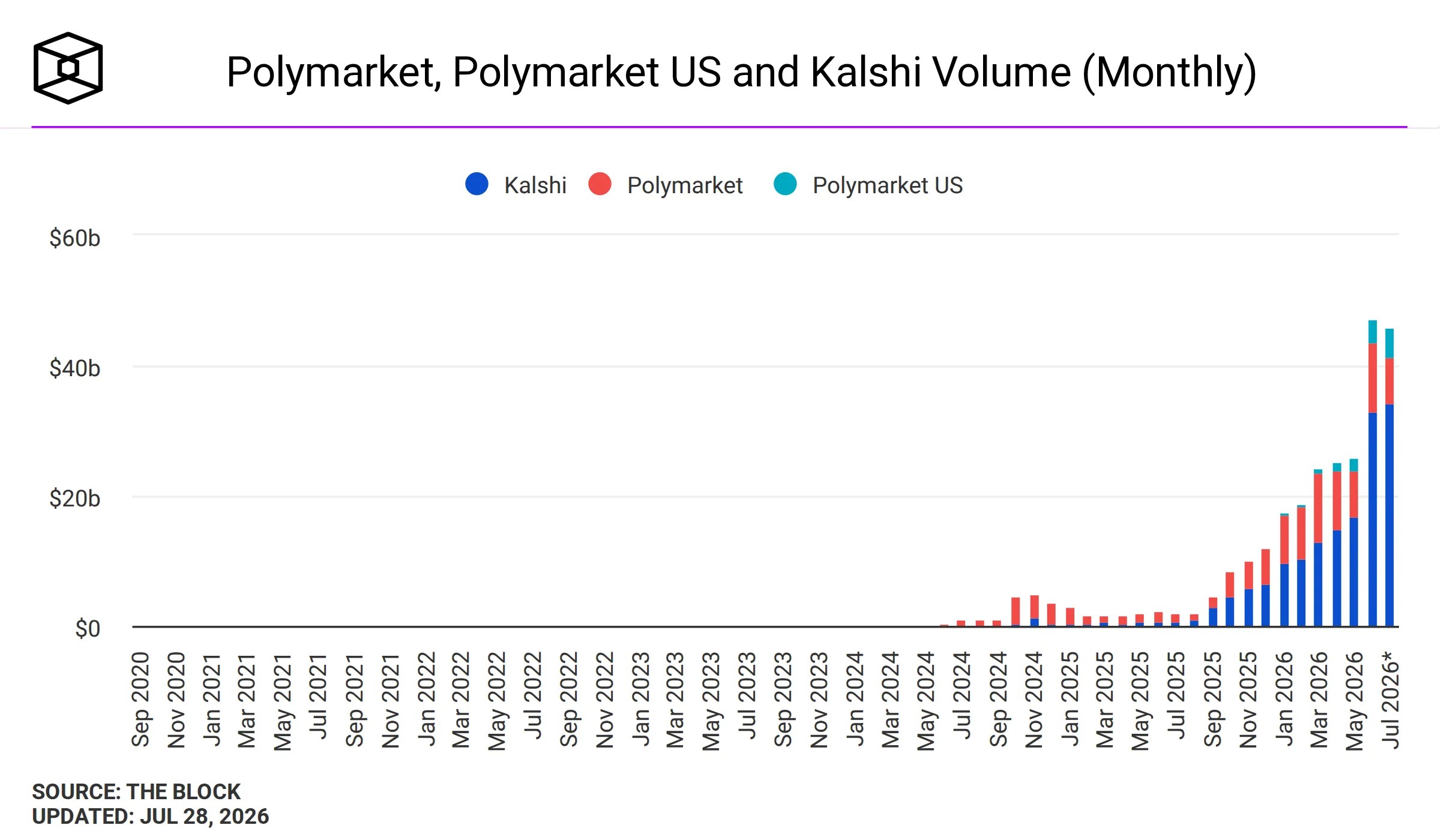
Source: The Block.

Recall that in June, Kentucky authorities filed lawsuits against Kalshi and Polymarket. The state accused the platforms of operating unlicensed sports betting under the guise of prediction markets.


相关问答

QWhich U.S. sports league has called on the CFTC to tighten rules for sports prediction markets, and what is their main stated priority?

AThe National Football League (NFL) has called on the U.S. Commodity Futures Trading Commission (CFTC) to tighten the rules. Their main stated priority is the preservation of game integrity.

QWhat specific examples did the NFL provide of event contracts that could be manipulated by a small group of people?

AThe NFL provided examples such as contracts based on whether a kicker misses a field goal or whether a quarterback's first pass is incomplete.

QAccording to the article, what is the core of the jurisdictional dispute between the CFTC and U.S. states regarding prediction markets?

AThe CFTC chairman insists the agency has 'exclusive jurisdiction' over the sector because event contracts fall under the category of swaps, while states argue that the platforms violate local gambling laws.

QWhat recent legal action caused difficulty for the prediction market platform Kalshi in July?

AIn July, Kalshi was put in a difficult position when the CFTC demanded it settle trades for Michigan residents as usual, while a Michigan state court had ordered it to cancel those same operations in late June.

QWhich two prediction market platforms reportedly surpassed traditional U.S. sportsbooks in trading volume during the World Cup, and what were their approximate June trading volumes?

AKalshi and Polymarket reportedly surpassed traditional sportsbooks. In June, Kalshi's trading volume exceeded $31 billion, and Polymarket's international platform set a monthly record of $10.8 billion, with its regulated U.S. version at $3.5 billion.

你可能也喜欢

如何让自己变得让人工智能永远也无法取代

面对人工智能的冲击,许多人担心工作被取代。然而,真正的威胁在于个人对他人和系统的依赖,以及由此产生的“薪资奴役”——即为生存而从事无意义、枯燥的工作。摆脱这种困境的关键,不是抵制技术,而是成为拥有高自主性的“不可受雇”个体。 文章提出了成功抵御AI替代的五个核心要素:自主性(主动行动的能力)、品味(判断事物价值的经验)、说服力(让他人关注你工作的能力)、毅力(坚持并从错误中学习)和迭代(根据反馈持续改进)。这些能力无法仅通过理论学习获得,必须通过实践来培养。 要启动转变,首先要彻底改变环境,重塑身份认同。其次,应选择一个能获得真实、快速反馈的实践领域,例如创业。在众多技能中,内容创作(媒体)比编写代码更具优势,因为其价值是主观的,需要独特的审美和判断力,这正是AI目前难以完全复制的。 具体行动上,可以从三个步骤开始: 1. **挖掘原始素材**:反思自己长期痴迷的知识领域、轻松解决的难题或童年被压抑的兴趣,找到独特的个人经验。 2. **确立反向思考主轴**:找出你坚信但主流观点错误的地方,或行业内普遍忽视的“皇帝新衣”,形成独特的批判性视角。 3. **立即发布**:将前两步的思考融合,撰写并发布第一个核心内容(如帖子、视频),勇敢接受真实世界的反馈,并在此基础上持续学习和迭代。 最终,抵御AI的关键在于构建一份与自身身份深度契合的毕生事业,通过持续的内容创作和真实互动,建立无法被自动化取代的独特价值和影响力。行动,从今天发布第一个想法开始。

marsbit4小时前

如何让自己变得让人工智能永远也无法取代

marsbit4小时前

通过掷骰子离线保管比特币密钥:并非人人愿意为之

文章探讨了通过投掷骰子生成比特币钱包种子短语的安全方法及其现实挑战。核心观点如下: **1. 骰子提供物理熵源** 骰子结果由众多微小变量决定,理论上虽可预测,但实践中无法被攻击者复制或计算,从而提供高质量的随机性。每个六面骰子投掷约产生2.585比特熵,50次投掷即可满足典型12词助记词(128比特熵)的安全需求。 **2. Coldcard漏洞事件凸显手工熵源的价值** 近期Coldcard硬件钱包因固件漏洞导致其内部随机数生成器存在缺陷,致使约1128枚比特币被盗。但那些**完全**通过足量骰子投掷生成种子短语的用户未受此漏洞影响,因为他们的主密钥未使用有缺陷的生成器。 **3. 重要警示:手工种子并非万能保护** 安全研究员指出,即使用户使用骰子生成了安全的种子,若他们使用了Coldcard的其他功能(如生成纸钱包、克隆密钥、共享签名密钥、密码等),这些**衍生密钥**仍可能调用有漏洞的随机数生成器,从而存在风险。安全种子不保证设备生成的所有秘密都安全。 **4. 手工生成熵源的现实局限性** 尽管数学上可靠,但该方法对大多数用户并不友好: * **过程繁琐易错**:需投掷50-99次,精确记录,任何输入错误都会导致钱包完全不同。 * **引入新风险**:用户可能在记录、转换过程中泄露信息,或使用有偏的骰子/投掷方式。 * **用户体验差**:难以想象大规模推广需要用户手动投掷近百次骰子。安全措施需适应现实生活场景和普通用户的知识水平。 **5. 给用户的建议** 受影响的Coldcard用户应: * 更新固件至最新版。 * 检查是否使用过有漏洞的功能生成了次级密钥或密码,如有则需立即更换。 * 考虑采用多签方案,使用不同厂商的设备分散风险。 **结论**:手工投掷骰子生成熵源是技术娴熟用户的一个有效安全选项,但其过程复杂、容易出错,不适合作为主流用户的默认方法。长远目标是依赖安全、透明且无需专业知识的硬件/软件随机数生成方案。

cryptonews.ru7小时前

通过掷骰子离线保管比特币密钥:并非人人愿意为之

cryptonews.ru7小时前

交易

现货
活动图片




