Tokens, Models, and Bubbles: The Crypto × AI Game in the Primary Market

比推发布于2026-02-12更新于2026-02-12

文章摘要

Based on a two-year retrospective, this article analyzes the convergence of Crypto and AI from a primary market perspective. Initially, the crypto space heavily promoted "Crypto Helps AI" through three main narratives: computation power tokenization, data tokenization, and model tokenization. However, these efforts largely resulted in what the author calls a "tokenization illusion"—projects that issued tokens but lacked real product-market fit or sustainable business models. The piece critiques these approaches: decentralized compute networks often fail to meet enterprise reliability standards; tokenized data struggles with supply-demand alignment due to low user motivation and high professional requirements; and model tokenization is fundamentally flawed since AI models are non-scarce, easily replicable, and depreciate quickly. Additionally, projects focusing on verifiable inference (like ZKML or OPML) are solutions in search of a problem, as real-world AI failures are rarely due to malicious tampering but rather design errors or misconfigurations. The author references Vitalik Buterin’s updated views, which now present a more balanced perspective compared to two years ago. Buterin outlines four quadrants of Crypto × AI integration: two where crypto (especially Ethereum) provides trustless, economic layers for AI agents and private interactions, and two where AI enhances crypto—through local LLMs acting as user shields for security and AI improving market efficiency and DA...

Author: Lao Bai

Original Title: Crypto × AI from the Primary Market Perspective: An Experiment in Tokenized Illusion


After two years, V God has tweeted again, and I’ll follow up on the research report from two years ago, even the timing is exactly the same, February 10th. (Related reading: ABCDE: Sorting Out AI+Crypto from a Primary Market Perspective)

Two years ago, V God actually implicitly expressed that he wasn’t very optimistic about the various Crypto Helps AI trends that were popular at the time. The three popular narratives in the circle back then were computing power assetization, data assetization, and model assetization. My research report two years ago mainly discussed these three narratives and some observations and doubts about them from the primary market. From V God’s perspective, he was more optimistic about AI Helps Crypto.

The examples he gave at the time were:

  • AI as a participant in the game;

  • AI as the game interface;

  • AI as the game rules;

  • AI as the game objective;

Over the past two years, we have made many attempts in Crypto Helps AI, but the results have been minimal. Many sectors and projects ended up – issuing a token and that’s it, without real commercial PMF (Product-Market Fit), which I call the "Tokenized Illusion".

1. Computing Power Assetization – Most cannot provide commercial-grade SLA, are unreliable, and frequently go offline. They can only handle simple small and medium model inference tasks, mostly serving niche markets. Revenue is not linked to the token......

2. Data Assetization – High friction, low willingness, and high uncertainty on the supply side (retail users). The demand side (enterprises) needs structured, context-dependent, professional data suppliers with trust and legal liability. DAO-based Web3 project parties find it difficult to provide this.

3. Model Assetization – Models themselves are non-scarce, replicable, fine-tunable, and rapidly depreciating process assets, not final-state assets. Hugging Face itself is a collaboration and dissemination platform, more like GitHub for ML, not an App Store for models. Therefore, so-called "decentralized Hugging Face" projects aiming to tokenize models have mostly ended in failure.

Additionally, over these two years, we have tried various forms of "Verifiable Inference," which is a typical story of looking for a nail to hit with a hammer. From ZKML to OPML to Gaming Theory, etc., even EigenLayer shifted its Restaking narrative to Verifiable AI.

But it's basically similar to what happened in the Restaking sector – few AVSs (Actively Validated Services) are willing to pay continuously for extra verifiable security.

Similarly, verifiable inference is mostly verifying "things that no one really needs to be verified." The threat model on the demand side is extremely vague – who exactly are we protecting against?

AI output errors (model capability issues) far outnumber maliciously tampered AI outputs (adversarial problems). The various security incidents on OpenClaw and Moltbook some time ago showed that the real problems come from:

  • Wrong strategy design

  • Excessive permissions granted

  • Unclear boundaries

  • Unexpected interactions between tool combinations

  • ...

Almost none of the imagined nails like "model being tampered with" or "inference process being maliciously rewritten" exist.

Last year I posted this picture, I wonder if any old-timers remember.
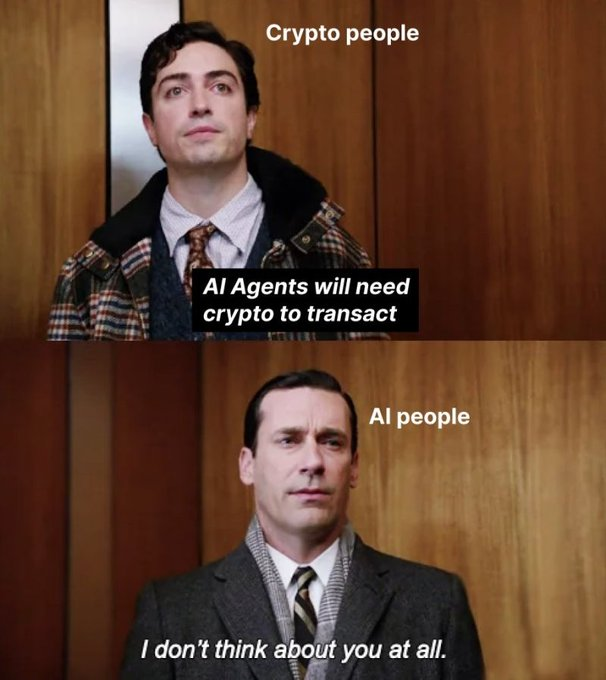
The ideas V God presented this time are clearly more mature than two years ago, also due to the progress we've made in privacy, X402, ERC8004, prediction markets, and other directions.

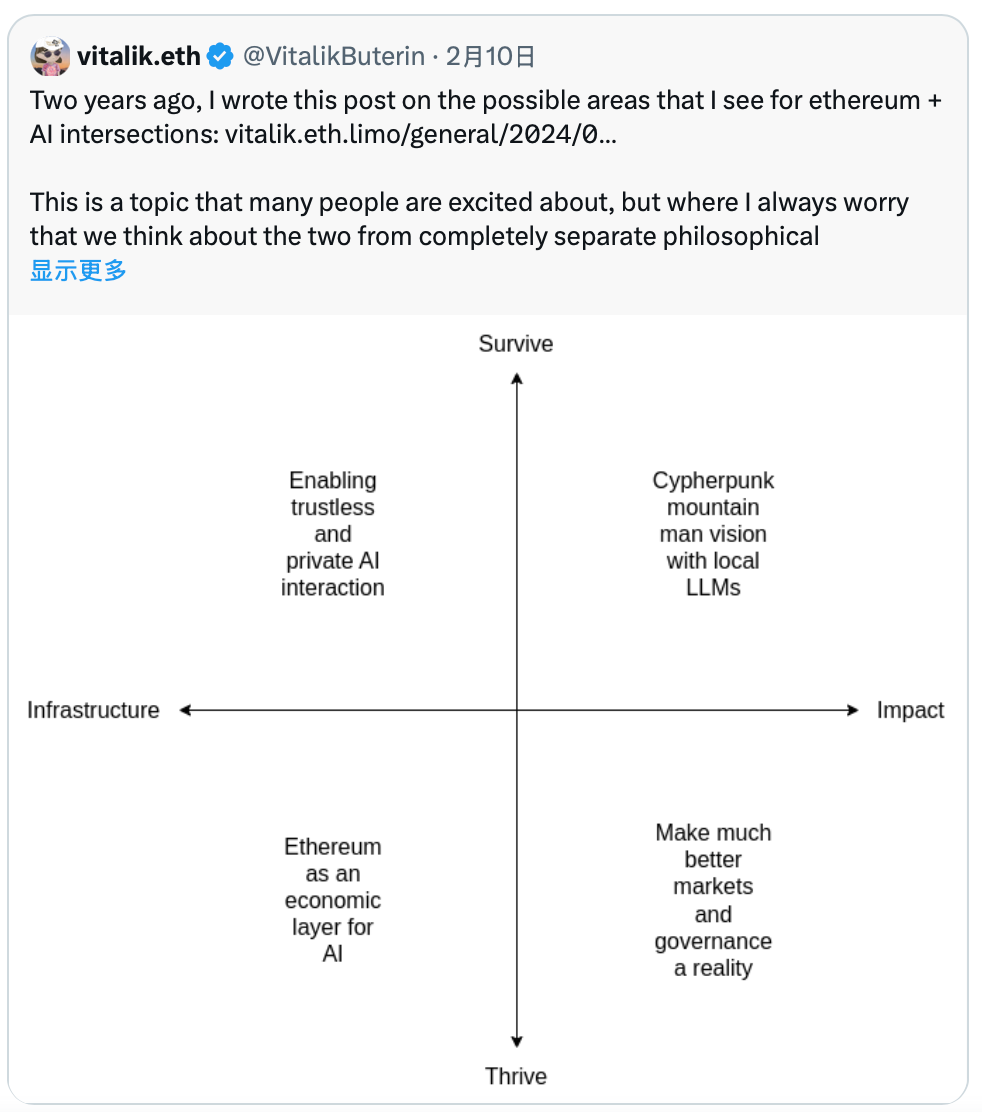
It can be seen that the four quadrants he divided this time, half belong to AI Helps Crypto, and the other half belong to Crypto Helps AI, no longer being clearly biased towards the former as it was two years ago.

Top left and bottom left – Utilizing Ethereum's decentralization and transparency to solve AI's trust and economic collaboration problems

1.Enabling trustless and private AI interaction (Infrastructure + Survival): Using technologies like ZK, FHE, etc., to ensure the privacy and verifiability of AI interactions (not sure if the verifiable inference I mentioned earlier counts).

2. Ethereum as an economic layer for AI (Infrastructure + Prosperity): Enabling AI agents to conduct economic payments, recruit other robots, pay deposits, or establish reputation systems through Ethereum, thereby building a decentralized AI architecture instead of being limited to a single giant platform.

Top right and bottom right – Utilizing AI's intelligent capabilities to optimize the user experience, efficiency, and governance of the crypto ecosystem:

3. Cypherpunk mountain man vision with local LLMs (Impact + Survival): AI as the user's "shield" and interface. For example, local LLMs (Large Language Models) can automatically audit smart contracts, verify transactions, reduce reliance on centralized front-end pages, and safeguard individual digital sovereignty.

4. Make much better markets and governance a reality (Impact + Prosperity): AI deeply participates in Prediction Markets and DAO governance. AI can act as an efficient participant, amplifying human judgment by processing information on a large scale, solving various market and governance problems such as insufficient human attention, high decision-making costs, information overload, and voter apathy.

Previously, we were desperately trying to make Crypto Help AI, while V God stood on the other side. Now we finally meet in the middle, though it seems unrelated to various XX tokenizations or some AI Layer1. I hope that looking back at today's post in two years, there will be some new directions and surprises.

Twitter:https://twitter.com/BitpushNewsCN

Bitpush TG Discussion Group:https://t.me/BitPushCommunity

Bitpush TG Subscription: https://t.me/bitpush

Original link:https://www.bitpush.news/articles/7611374

热门币种推荐

相关问答

QWhat are the three main areas of 'Crypto Helps AI' that the author identified as largely ineffective over the past two years?

AThe three main areas are: 1) Compute Power Assetization (unstable, cannot provide commercial SLA, serves only edge markets), 2) Data Assetization (high friction for suppliers, demand for structured data from professional suppliers), and 3) Model Assetization (models are non-scarce, replicable, and rapidly depreciating assets, making tokenization attempts largely fail).

QAccording to the author, what is the fundamental issue with 'Verifiable Inference' projects like ZKML and OPML?

AThe fundamental issue is that they are a solution in search of a problem ('a typical story of using a hammer to find a nail'). The demand-side threat model is extremely vague, as there is little need to verify things that no one actually needs verified. Problems like AI output errors (model capability issues) are far more common than malicious tampering of AI output (adversarial problems).

QHow did Vitalik Buterin's (V神) perspective on the Crypto x AI intersection evolve from two years ago to the present, as described in the article?

ATwo years ago, Vitalik was more skeptical of 'Crypto Helps AI' and was more optimistic about 'AI Helps Crypto'. His current perspective, as outlined in a new quadrant model, is more balanced. It includes two quadrants for 'AI Helps Crypto' (using AI to optimize crypto UX, efficiency, and governance) and two for 'Crypto Helps AI' (using Ethereum's decentralization and transparency to solve AI's trust and economic collaboration issues).

QWhat are the two specific use cases mentioned under the 'Crypto Helps AI' quadrant in Vitalik's new framework?

AThe two use cases are: 1) Enabling trustless and private AI interaction using technologies like ZK and FHE for privacy and verifiability, and 2) Using Ethereum as an economic layer for AI, allowing AI agents to conduct economic transactions, hire other bots, post bonds, or build a reputation system to create a decentralized AI architecture.

QWhat does the author mean by the term 'Tokenization Illusion' in the context of Crypto x AI projects?

AThe term 'Tokenization Illusion' refers to the phenomenon where many projects in the Crypto x AI space simply launch a token without achieving real Product-Market Fit (PMF) or creating a sustainable business model. The author argues that these projects often lack genuine commercial viability and substance beyond the token issuance itself.

你可能也喜欢

Visa 躬身入局稳定币:不消灭稳定币,而是要向它们「收租」

Visa宣布推出稳定币平台,旨在帮助银行、金融机构和金融科技公司更便捷地发行、管理稳定币,并将其无缝集成到Visa现有的庞大支付生态中。该平台计划覆盖超过2亿商户和1.5万家金融机构。 作为传统支付巨头,Visa此举被视为“躬身入局”,其策略并非消灭现有稳定币,而是拥抱并升级该生态。稳定币市场规模越大,Visa网络处理的交易就越多,从而获得更多收入。这有利于稳定币的进一步采用和整个市场的扩大,但可能导致顶级发行商的市场集中度下降,竞争将转向分发能力、商户接入和合规性。 对主流稳定币的影响方面:USDC短期将受益于通过Visa平台获得直接结算与集成支持,具备先发优势,但中长期将面临更激烈竞争。USDT由于其在新兴市场和加密交易场景的优势,受冲击可能相对更大,在商户支付和机构结算领域的份额或被蚕食。 总体而言,Visa的目标是为稳定币生态“收租”并做大蛋糕,对长期生态发展是利好,但单纯依赖发行赚取利息的模式将面临挑战。 对以太坊的影响为中性偏利好。Visa与以太坊生态合作紧密,其平台有望引导更多传统资金以稳定币形式流入,提升以太坊作为结算层的需求与链上活动。虽然Visa平台会支持多链,但以太坊凭借其成熟度与去中心化程度,在合规稳定币领域仍是机构首选。

marsbit9分钟前

Visa 躬身入局稳定币:不消灭稳定币,而是要向它们「收租」

marsbit9分钟前

XRP未平仓合约达26亿美元,衍生品需求激增

XRP期货未平仓合约总额已飙升至26亿美元,24小时内增幅超过10%,使其成为按该指标计算的第四大加密货币资产。 未平仓合约增长表明衍生品市场对XRP的兴趣显著升温,更多资本正在进入。但这本身并不等同于现货买入,可能反映多头、空头、对冲或杠杆投机等多种策略。因此,单纯这一数据无法判断市场看涨或看跌。 XRP衍生品活动激增可能源于对市场结构、ETF相关猜测或瑞波公司动态的预期,但现有信息不支持将此直接解读为机构在积累现货。 高杠杆是一把双刃剑。未平仓合约的增加既能助推价格大幅波动,也可能在市场反转时引发连锁清算,增加市场脆弱性。关键在于后续走势:若价格上涨伴随稳定的衍生品条件,则新增头寸可能被健康吸收;若价格突然逆转,则可能转化为强平压力。 对于看涨者而言,最有力的确认信号将来自现货市场的配合。如果未平仓合约增长的同时,现货交易量、交易所需求和市场广度也同步走强,则更具建设性;反之,若现货需求疲软,则本轮活动可能更偏向投机。 总之,26亿美元的里程碑标志着XRP重新吸引了大量衍生品市场的关注,但并未预示明确方向。下一步的关键是观察这些资本是能支撑起更强劲的趋势,还是仅仅为这个本就活跃的市场增添了更多波动性。

bitcoinist2小时前

XRP未平仓合约达26亿美元,衍生品需求激增

bitcoinist2小时前

交易

现货

热门文章

从H2A到A2A:AI Agent经济体与Crypto新机遇

6月17日,哈佛大学独立研究员、美国AI科学院(NAAI)通讯院士、比特币基金会终身会员韩锋做客火币HTX《大咖讲堂》第三期,以《从H2A到A2A》为主题,分享了其对Agent经济、Crypto基础设施及数字社会未来发展的思考。

342人学过发布于 2026.07.01更新于 2026.07.01

从H2A到A2A:AI Agent经济体与Crypto新机遇

美股TradFi:传统金融在AI IPO浪潮下的稳健锚点

2026年,美股IPO市场重回高热度。本文梳理即将上线或受关注的热门赛道龙头,分析具备投资潜力的交易标的及其逻辑,并探讨宏观趋势与相关风险。

2.1k人学过发布于 2026.07.08更新于 2026.07.08

美股TradFi:传统金融在AI IPO浪潮下的稳健锚点

相关讨论

欢迎来到HTX社区。在这里,您可以了解最新的平台发展动态并获得专业的市场意见。以下是用户对AI(AI)币价的意见。

活动图片