ING Germany Integrates Bitwise and VanEck ETPs as LiquidChain Unifies Cross-Chain Liquidity

bitcoinist发布于2026-02-03更新于2026-02-03

文章摘要

ING Germany, serving over 9 million customers, has integrated crypto ETPs from Bitwise and VanEck into its retail banking platform, allowing users direct access to Bitcoin and Ethereum through their banking app. This move signals a major shift toward mainstream crypto adoption in Europe’s largest economy. However, the underlying blockchain infrastructure remains fragmented, isolating liquidity across chains like Bitcoin, Ethereum, and Solana. LiquidChain ($LIQUID) aims to solve this fragmentation with a Layer 3 protocol that unifies liquidity and enables seamless cross-chain transactions. The project has raised over $500K in its presale and offers high staking rewards, targeting the growing need for interconnected DeFi infrastructure as institutional interest increases.

The barrier between traditional finance and digital assets in Europe’s largest economy isn’t just crumbling, it’s gone.

ING Germany, catering to over 9M customers, quietly integrated crypto ETPs (Exchange Traded Products) and ETNs (Exchange Traded Notes) into its retail banking interface. The partners? Asset management heavyweights Bitwise and VanEck.

This collaboration is more than a vendor agreement; it’s a merging of DNA. Bitwise brings the deep-rooted crypto native expertise and research-heavy approach, while VanEck provides the institutional pedigree of a firm that has pioneered ETFs for nearly 70 years.

Together with ING, they’ve created a ‘regulated wrapper’ that satisfies the stringent compliance demands of the German BaFin while offering investors the precise price tracking they expect from high-tier financial instruments.

This matters. Not just for the immediate volume, but for the signal it blasts to risk departments globally. When a conservative institution like ING opens crypto rails to German retail savers, the asset class graduates from ‘speculative fringe’ to ‘portfolio standard.’

Users can now access Bitcoin and Ethereum directly through their banking app. No external exchanges, no friction. Just access.

But there’s a catch. While giants like ING solve the financial exposure problem, the underlying tech is still a mess. It’s fragmented. A user holding a Solana ETP has zero interaction with Ethereum; liquidity is trapped in silos.

As institutional capital pours in, the race is on to build a backend that actually connects Bitcoin, Ethereum, and Solana. That’s the precise gap LiquidChain ($LIQUID) aims to fill.

LiquidChain ($LIQUID) Ends Asset Isolation With Unified L3 Architecture

Right now, DeFi looks a lot like the pre-Internet era of local intranets: disconnected islands of value. To move capital from Ethereum to Solana, you’re forced to navigate complex bridges, wrap assets (risky business), and juggle multiple gas tokens.

LiquidChain fixes this. It positions itself as a Layer 3 (L3) protocol that fuses liquidity from Bitcoin, Ethereum, and Solana into one execution environment. An L3 is a highly specialized, application-specific blockchain built on top of a Layer 2 to provide hyper-scalability, lower gas fees, and custom environments for specific use cases like gaming or high-frequency trading.
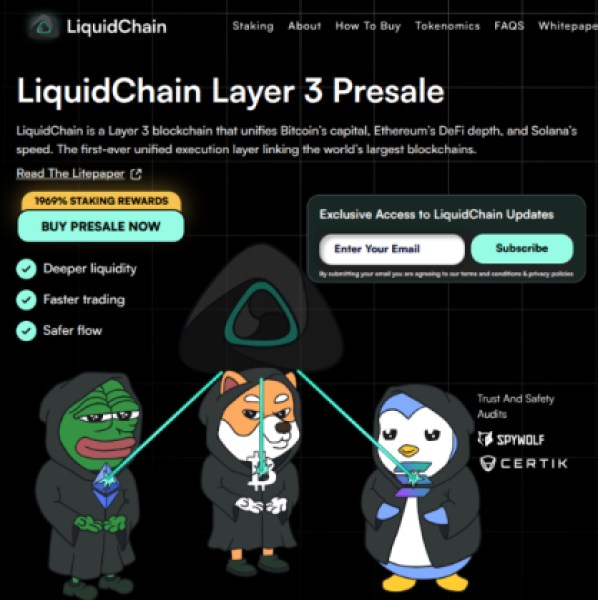
Source: LiquidChain

For developers, it’s a ‘Deploy-Once’ setup. Instead of rewriting code for the Ethereum Virtual Machine (EVM) and then doing it all over again for Solana’s Virtual Machine (SVM), they launch on LiquidChain L3 once. That app then accesses liquidity across all connected chains naturally. For the end-user? It’s seamless.

A transaction can source liquidity from a Uniswap pool on Ethereum and settle on Solana without the user ever touching a bridge.

It solves the primary bottleneck preventing true institutional adoption: fragmentation. The protocol’s ‘Cross-Chain VM’ acts as a translation layer for the industry’s three largest ecosystems, allowing verifiable settlement across networks.

BUY LIQUIDCHAIN ($LIQUID) HERE.

Why Smart Money Is Watching Cross-Chain Aggregation Protocols

Banks integrating crypto products signal ubiquity, sure. But it also highlights how limited the current infrastructure really is. Institutions need deep liquidity to execute large orders without slippage. Right now? That liquidity is shattered across dozens of Layer 1 and Layer 2 chains.

This sets the stage for aggregation layers. LiquidChain ($LIQUID) isn’t just a bridge; it’s a unification layer. By enabling Liquidity Staking and using $LIQUID as transaction fuel, the protocol captures value from the velocity of money moving between chains.

The project’s already raised over $500K, and tokens are priced at $0.0135. As it’s early in the presale, staking rewards are also high, currently sitting at 1968%. But this is dynamic and subject to change.

History shows the market rewards infrastructure that simplifies UX. Arbitrum and Optimism thrived by making Ethereum cheaper. LiquidChain targets the next evolution: making the multi-chain world invisible.

For investors looking beyond major caps like $BTC, projects solving this ‘liquidity fracture’ represent a sector with serious potential as the cycle matures.

VISIT THE OFFICIAL LIQUIDCHAIN ($LIQUID) PRESALE SITE.

This article is for informational purposes only and does not constitute financial or investment advice. Cryptocurrencies are volatile assets; always conduct your own research before making investment decisions.


热门币种推荐

相关问答

QWhat major step has ING Germany taken regarding digital assets for its retail customers?

AING Germany has integrated crypto Exchange Traded Products (ETPs) and Exchange Traded Notes (ETNs) from Bitwise and VanEck into its retail banking interface, allowing its over 9 million customers to access Bitcoin and Ethereum directly through their banking app.

QWhat is the primary problem that LiquidChain ($LIQUID) aims to solve in the current DeFi landscape?

ALiquidChain aims to solve the problem of fragmented liquidity and asset isolation between different blockchains, such as Bitcoin, Ethereum, and Solana, by providing a unified Layer 3 (L3) protocol that fuses liquidity from these chains into a single execution environment.

QHow does LiquidChain's L3 architecture benefit developers building decentralized applications?

ALiquidChain's L3 architecture offers a 'Deploy-Once' setup, allowing developers to launch their application on the protocol once and have it natively access liquidity across all connected chains without needing to rewrite code for different virtual machines like the EVM and SVM.

QWhat is the significance of ING's integration of crypto ETPs for the broader perception of cryptocurrency?

AING's integration signals a major shift in perception, moving the cryptocurrency asset class from a 'speculative fringe' to a 'portfolio standard' for conservative institutions and their retail customers, demonstrating increased legitimacy and acceptance within traditional finance.

QWhat are some key features or mechanisms that LiquidChain uses to capture value and facilitate cross-chain transactions?

ALiquidChain uses its 'Cross-Chain VM' as a translation layer for settlement, enables Liquidity Staking, and uses its native $LIQUID token as transaction fuel, capturing value from the velocity of money moving between different blockchains.

你可能也喜欢

如何让自己变得让人工智能永远也无法取代

面对人工智能的冲击,许多人担心工作被取代。然而,真正的威胁在于个人对他人和系统的依赖,以及由此产生的“薪资奴役”——即为生存而从事无意义、枯燥的工作。摆脱这种困境的关键,不是抵制技术,而是成为拥有高自主性的“不可受雇”个体。 文章提出了成功抵御AI替代的五个核心要素:自主性(主动行动的能力)、品味(判断事物价值的经验)、说服力(让他人关注你工作的能力)、毅力(坚持并从错误中学习)和迭代(根据反馈持续改进)。这些能力无法仅通过理论学习获得,必须通过实践来培养。 要启动转变,首先要彻底改变环境,重塑身份认同。其次,应选择一个能获得真实、快速反馈的实践领域,例如创业。在众多技能中,内容创作(媒体)比编写代码更具优势,因为其价值是主观的,需要独特的审美和判断力,这正是AI目前难以完全复制的。 具体行动上,可以从三个步骤开始: 1. **挖掘原始素材**:反思自己长期痴迷的知识领域、轻松解决的难题或童年被压抑的兴趣,找到独特的个人经验。 2. **确立反向思考主轴**:找出你坚信但主流观点错误的地方,或行业内普遍忽视的“皇帝新衣”,形成独特的批判性视角。 3. **立即发布**:将前两步的思考融合,撰写并发布第一个核心内容(如帖子、视频),勇敢接受真实世界的反馈,并在此基础上持续学习和迭代。 最终,抵御AI的关键在于构建一份与自身身份深度契合的毕生事业,通过持续的内容创作和真实互动,建立无法被自动化取代的独特价值和影响力。行动,从今天发布第一个想法开始。

marsbit5小时前

如何让自己变得让人工智能永远也无法取代

marsbit5小时前

通过掷骰子离线保管比特币密钥:并非人人愿意为之

文章探讨了通过投掷骰子生成比特币钱包种子短语的安全方法及其现实挑战。核心观点如下: **1. 骰子提供物理熵源** 骰子结果由众多微小变量决定,理论上虽可预测,但实践中无法被攻击者复制或计算,从而提供高质量的随机性。每个六面骰子投掷约产生2.585比特熵,50次投掷即可满足典型12词助记词(128比特熵)的安全需求。 **2. Coldcard漏洞事件凸显手工熵源的价值** 近期Coldcard硬件钱包因固件漏洞导致其内部随机数生成器存在缺陷,致使约1128枚比特币被盗。但那些**完全**通过足量骰子投掷生成种子短语的用户未受此漏洞影响,因为他们的主密钥未使用有缺陷的生成器。 **3. 重要警示:手工种子并非万能保护** 安全研究员指出,即使用户使用骰子生成了安全的种子,若他们使用了Coldcard的其他功能(如生成纸钱包、克隆密钥、共享签名密钥、密码等),这些**衍生密钥**仍可能调用有漏洞的随机数生成器,从而存在风险。安全种子不保证设备生成的所有秘密都安全。 **4. 手工生成熵源的现实局限性** 尽管数学上可靠,但该方法对大多数用户并不友好: * **过程繁琐易错**:需投掷50-99次,精确记录,任何输入错误都会导致钱包完全不同。 * **引入新风险**:用户可能在记录、转换过程中泄露信息,或使用有偏的骰子/投掷方式。 * **用户体验差**:难以想象大规模推广需要用户手动投掷近百次骰子。安全措施需适应现实生活场景和普通用户的知识水平。 **5. 给用户的建议** 受影响的Coldcard用户应: * 更新固件至最新版。 * 检查是否使用过有漏洞的功能生成了次级密钥或密码,如有则需立即更换。 * 考虑采用多签方案,使用不同厂商的设备分散风险。 **结论**:手工投掷骰子生成熵源是技术娴熟用户的一个有效安全选项,但其过程复杂、容易出错,不适合作为主流用户的默认方法。长远目标是依赖安全、透明且无需专业知识的硬件/软件随机数生成方案。

cryptonews.ru8小时前

通过掷骰子离线保管比特币密钥:并非人人愿意为之

cryptonews.ru8小时前

交易

现货

热门文章

如何购买S

欢迎来到HTX.com!我们已经让购买Sonic(S)变得简单而便捷。跟随我们的逐步指南,放心开始您的加密货币之旅。第一步:创建您的HTX账户使用您的电子邮件、手机号码注册一个免费账户在HTX上。体验无忧的注册过程并解锁所有平台功能。立即注册第二步:前往买币页面,选择您的支付方式信用卡/借记卡购买:使用您的Visa或Mastercard即时购买Sonic(S)。余额购买:使用您HTX账户余额中的资金进行无缝交易。第三方购买:探索诸如Google Pay或Apple Pay等流行支付方法以增加便利性。C2C购买:在HTX平台上直接与其他用户交易。HTX场外交易台(OTC)购买:为大量交易者提供个性化服务和竞争性汇率。第三步:存储您的Sonic(S)购买完您的Sonic(S)后,将其存储在您的HTX账户钱包中。您也可以通过区块链转账将其发送到其他地方或者用于交易其他加密货币。第四步:交易Sonic(S)在HTX的现货市场轻松交易Sonic(S)。访问您的账户,选择您的交易对,执行您的交易,并实时监控。HTX为初学者和经验丰富的交易者提供了友好的用户体验。

3.3k人学过发布于 2025.01.15更新于 2026.06.02

如何购买S

相关讨论

欢迎来到HTX社区。在这里,您可以了解最新的平台发展动态并获得专业的市场意见。以下是用户对S(S)币价的意见。

活动图片