Author: Artemis Analytics
Compiled by: Deep Tide TechFlow
Deep Tide Introduction: The market views Circle as merely a stablecoin issuer, but the potential of its payment network and full-stack currency platform is far from being priced in. This article deconstructs Circle's moat and the scenario for a $50 billion market capitalization, serving as a key reference for investors focused on the stablecoin and payment sectors.
Last week, we invited ARK Invest's Lorenzo Valente on our podcast to discuss why Circle is undervalued by the market. This week's Thesis continues this line of thought.
Argument: The market believes Circle's moat is weak, stablecoins are homogeneous commodities, and consortia like Open Standard will capture the majority share. We believe Circle's moat is deeper and harder to breach than the market perceives, and its first-mover advantage is undervalued.
Core drivers:
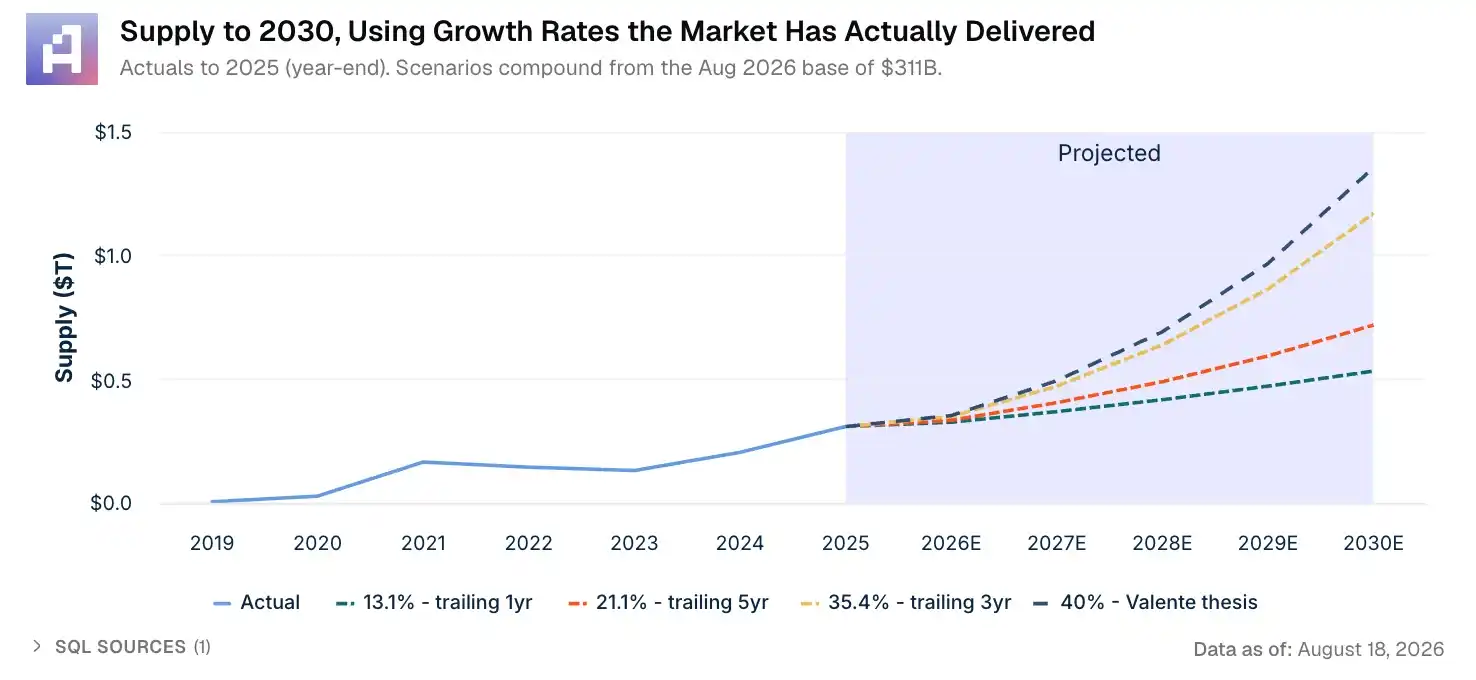
Stablecoins will grow at a 40% CAGR, exceeding $1 trillion by 2030.
The market shows a winner-take-all dynamic in terms of liquidity and network effects, making it difficult for alliances like OUSD to steal share.
The market prices Circle as a stablecoin issuer, not a full-stack currency platform.
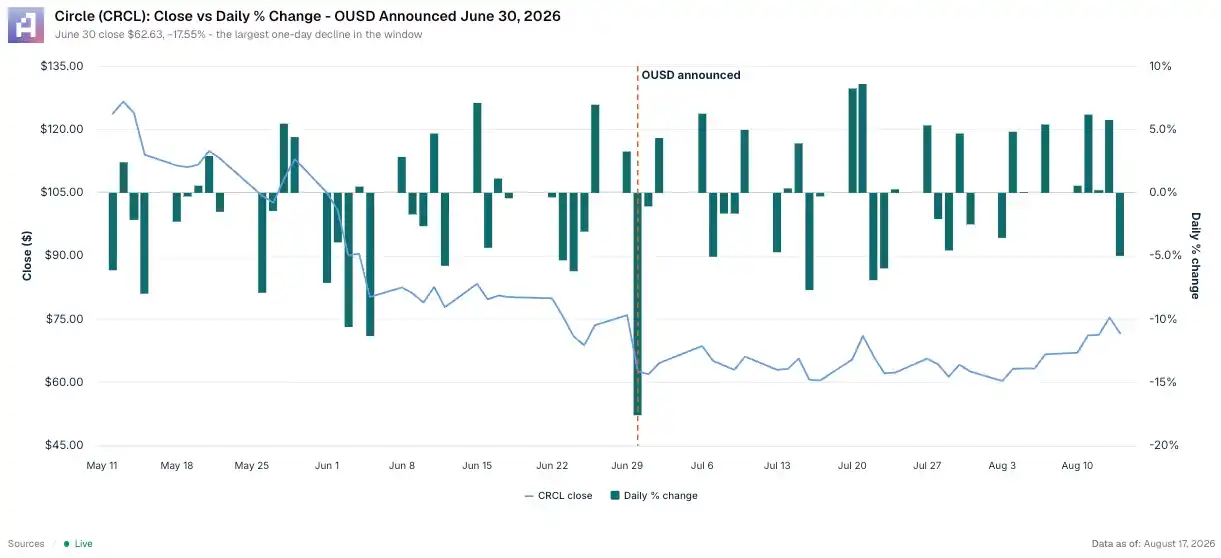
Circle's second-worst trading day in history occurred when Open Standard was announced. This is a consortium-backed stablecoin supported by over 140 companies, including Stripe, Visa, Mastercard, and Google, among others. The stock fell 17% after the news. The market's reaction is telling: Stripe will rally the troops, overthrow the Circle/Tether duopoly, and distribute stablecoin revenue proportionally to consortium members. This news drove CRCL's price near its all-time low.
Stablecoin Growth
We believe many investors don't think stablecoins will reach $1 trillion by 2030. They might point to stagnant growth. However, stablecoin supply has decoupled from crypto prices for the first time ever. Despite crypto prices falling 50-70% from recent highs, stablecoin supply has remained flat, indicating it has become its own category. If stablecoin supply continues to grow at the rate of the past 3 years, global supply will exceed $1 trillion by 2030.
Winner-Take-All Stablecoin Market, Liquidity and Network Effects are Crucial
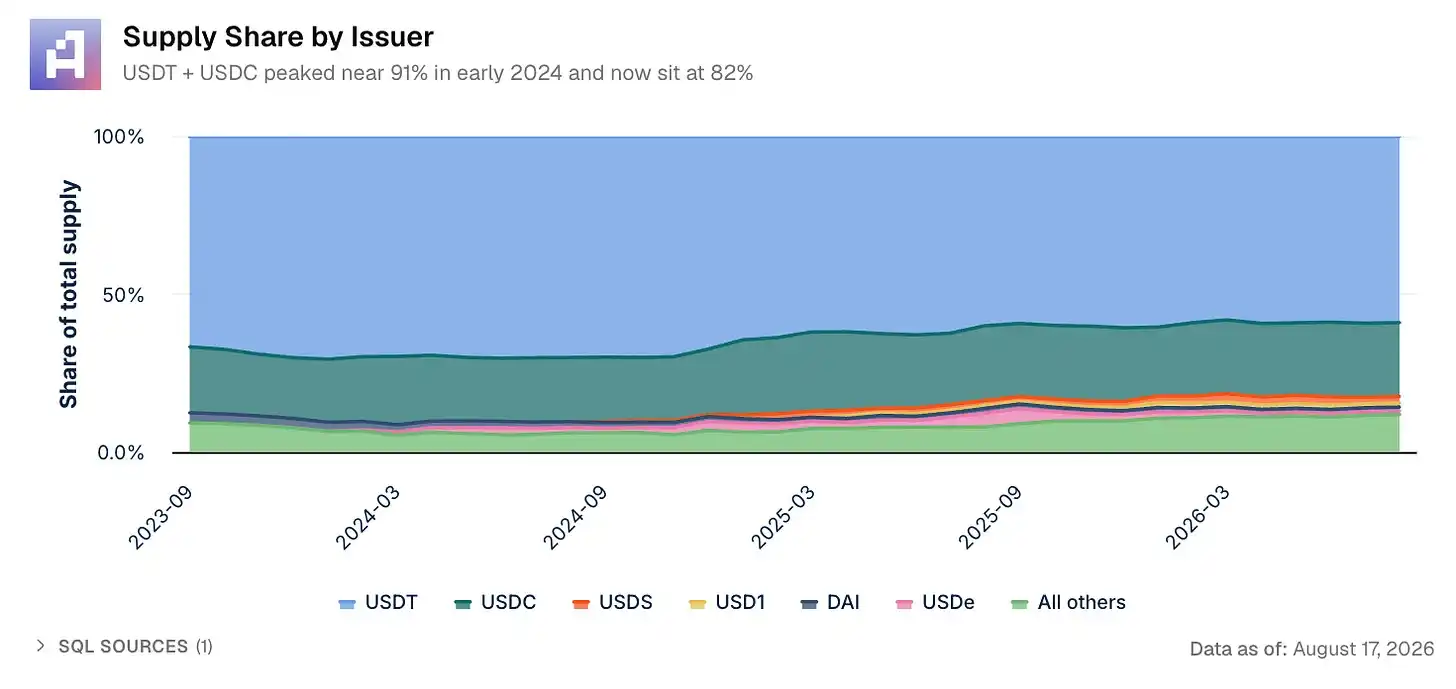
Over the past few years, dozens of issuers have tried to dismantle the Circle/Tether duopoly. Despite hundreds of stablecoins being issued now, these two giants still command over 80% of the supply share. The first-mover advantage gained by these players is extremely difficult to overcome. Building liquidity from scratch across chains, applications, and exchanges is hard, and Circle is far ahead of challengers.
Looking Specifically at OUSD
The market clearly views OUSD as a significant threat to Circle's business. However, history shows that consortia rarely succeed. A successful consortium requires:
Aligned incentives among members – OUSD achieves this to some extent through interest income distribution.
Clear governance – Open Standard appears weak here, with several announced "partners" revealing they were not consulted and have not yet made commitments.
Existential pressure – I don't think most institutions yet see stablecoins as a matter of survival, though Stripe may be the exception.
Therefore, based on current information, Open Standard meets roughly only one-third of the necessary conditions.
Circle is Priced as a Stablecoin Issuer, Not a Full-Stack Currency Platform
The market views Circle merely as the issuer of USDC. It underestimates Circle's revenue, which is almost entirely interest income subject to Federal Reserve policy.
In reality, Circle is building a full-stack currency product for the future of the internet. At its core, it's a technology company.
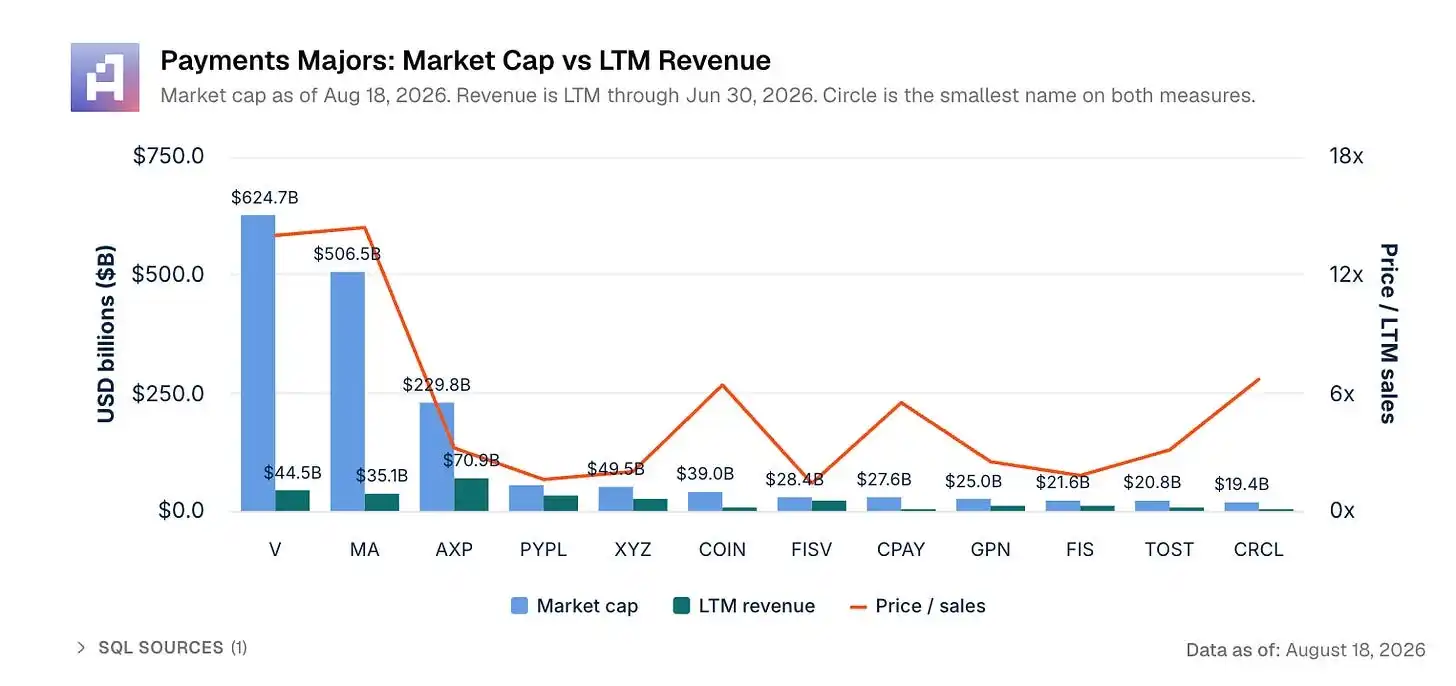
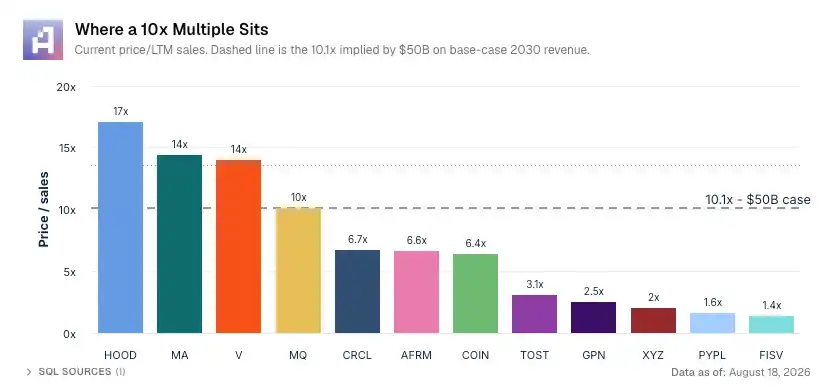
Circle's valuation compared to payment peers. There is a clear gap between credit card networks and other companies. If Circle builds the next-generation, full-stack payment system, its market cap and valuation would be closer to credit card networks, charging basis points on transaction volume, rather than relying on float.
Envisioning a $50 Billion Circle
Today, Circle's annualized revenue is approximately $2.8 billion, with a valuation of $18 billion, a P/S ratio of 6.7x—far below payment networks (14x) and high-growth fintechs like HOOD (17x). Its valuation multiple is almost identical to COIN's, which is primarily viewed as a crypto exchange.
The market sees Circle as a company tied to the crypto cycle, with rate-sensitive revenue. Circle will shed this label and its fragile revenue structure, allowing for a higher valuation multiple—10x is conservative and reasonable.
If our prediction is correct and, as we assume, liquidity and network effects create a strong moat, with stablecoin supply reaching $1 trillion by 2030, USDC share at 20%, and interest rates at 2%, CRCL could generate $4 billion in interest income.
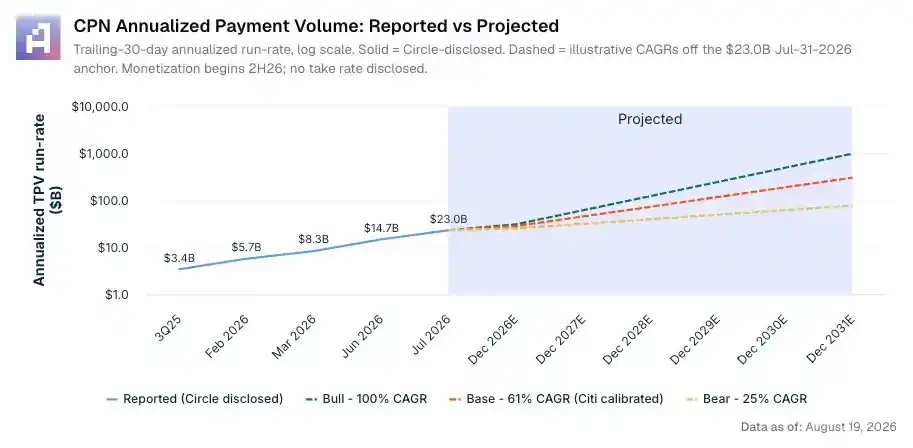
In terms of revenue diversification, Circle's key growth products are gaining momentum, such as the Circle Payments Network. Despite persistent low crypto prices and flat stablecoin supply, transaction volume on the Circle Payments Network is growing at an explosive pace, with the latest disclosed annualized volume as of July 2026 reaching $23 billion—up 6.8x year-over-year (admittedly from a small base) and 70% quarter-over-quarter. If growth stays at a 60-65% CAGR, transaction volume would reach approximately $200 billion by 2030. At a 20 basis point take rate, this would generate an additional $400 million in revenue.
Looking at the Arc chain, if it reaches the scale of Tron (another stablecoin-focused chain), Arc would generate $500 million in fees.
The above estimates bring CRCL's revenue close to $5 billion, with 20% coming from the rapidly growing payment/settlement-related business lines. This mix gives investors reason to assign a higher valuation multiple. Combining the above revenue growth and multiple expansion, we get $5 billion multiplied by 10 equals $50 billion. A $50 billion market cap for CRCL is not a fantasy.