Bitcoin, XRP left out – The S&P Digital Asset Index shows crypto’s biggest shift yet

ambcrypto发布于2026-07-22更新于2026-07-22

文章摘要

Pantera Capital and S&P Dow Jones Indices have launched the S&P Digital Asset Index, a basket of 18 cryptocurrencies focused on fundamental strength. Notably, Bitcoin and XRP are excluded from the initial confirmed assets, which include Ethereum, BNB, Solana, Hyperliquid, and Tron. This selection highlights a potential market shift, prioritizing Layer-1 networks with proven scalability, utility, and sustainable on-chain revenue—reportedly $3 billion annualized in the past six months—over mere market capitalization. Analysts suggest this "fundamental index for crypto" could guide institutional capital toward assets with real economic activity, possibly leading to a significant divergence in the next market cycle where fundamentals, not just price momentum, drive investment.

The market could be on the verge of its biggest divergence this cycle.

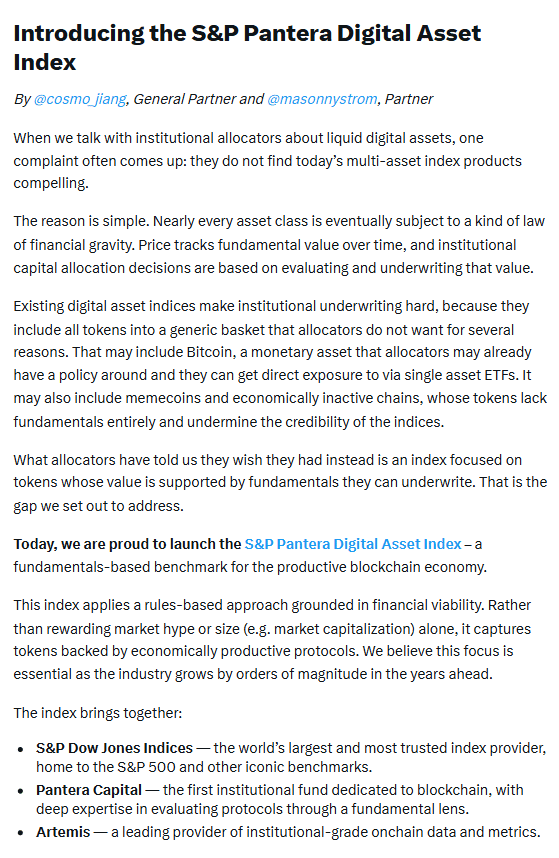
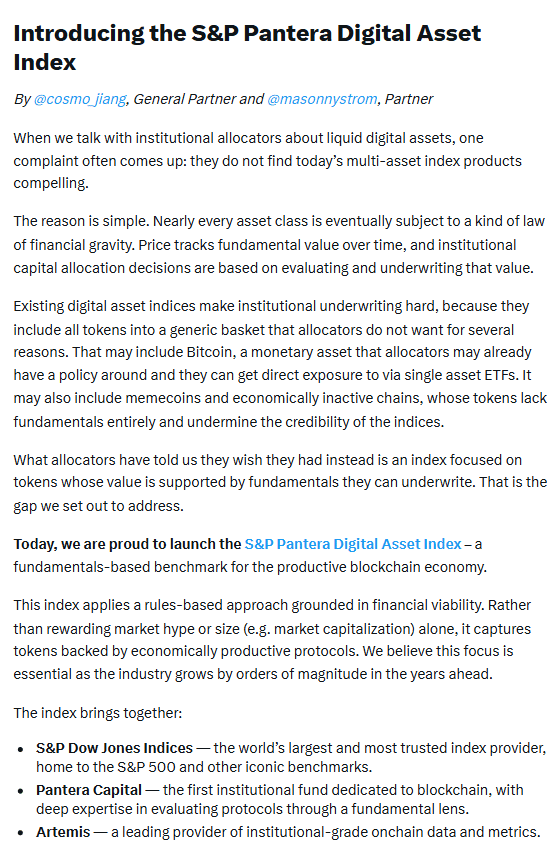
Pantera Capital, in partnership with S&P Dow Jones Indices, has launched the first-ever S&P Digital Asset Index, featuring a basket of 18 cryptocurrencies.

Naturally, the announcement sparked a market frenzy. It spread like wildfire across social media, and the timing couldn’t have been better. Bitcoin had just broken above $66,000, flipping the market back into risk-on mode.

Against this backdrop, Pantera’s announcement added another layer to the bullish narrative.
Source: X

However, the real discussion wasn’t about what made the S&P Digital Asset Index. It was about what didn’t.

For context, the index will hold 18 cryptocurrencies, but only the first five have been confirmed so far: Ethereum, BNB, Solana, Hyperliquid, and Tron. That’s where the market frenzy began.

Despite being the two biggest names in crypto, Bitcoin and XRP were left out. That immediately caught the market’s attention, sparking a broader debate over what the index is actually trying to capture.

According to AMBCrypto, this is exactly what could be setting up one of the biggest divergences in crypto’s next cycle. Until now, digital assets have largely traded as one high-beta risk trade, with Bitcoin leading the narrative.

But the exclusion of Bitcoin and XRP suggests the market may be underestimating a much bigger shift. If this is the direction institutional products are heading, the next cycle could look very different.

S&P Digital Asset Index puts fundamentals first

After years of scaling and network upgrades, it looks like those efforts are finally paying off.

Notably, all the confirmed assets in the S&P Digital Asset Index share one key trait – They are fundamentally strong networks.

Over the years, these Layer-1 ecosystems have scaled, upgraded, and hard-forked to improve throughput, utility, and on-chain activity, moving beyond the “speculative asset” narrative.

That shift is already showing up in the data. One analyst noted on X that the tokens included in the index generated $3 billion in annualized revenue over the past six months despite a bear market.

In other words, the index appears to reward networks generating real economic activity, not just the largest market caps.


Source: X

With most of the market focused on BTC and XRP, this may be the bigger takeaway that’s being overlooked.

Interestingly, Jon Ma, who worked with Pantera Capital and S&P Dow Jones Indices to build the S&P Digital Asset Index, called it the “fundamental index for crypto.”

His thesis is simple: The next $10 trillion entering crypto is more likely to flow toward networks with strong fundamentals, sustainable revenue, and real-world utility than toward assets driven by market cap alone.

In this context, the S&P Digital Asset Index launch could mark a major turning point for the broader crypto market.

As institutional capital gains exposure through these benchmarks, the gap between price-driven momentum and fundamental strength could become one of the biggest themes shaping future crypto cycles.


Final Summary

  • The S&P Digital Asset Index favors strong crypto projects: It focuses on networks with real growth, usage, and value.
  • Crypto’s next cycle could change as institutions may start choosing assets based on fundamentals, not just market trends.


热门币种推荐

相关问答

QWhat is the main focus of the newly launched S&P Digital Asset Index, and which two major cryptocurrencies were excluded from it?

AThe main focus of the S&P Digital Asset Index is on fundamentally strong cryptocurrency networks that demonstrate real economic activity, utility, and revenue. The two major cryptocurrencies excluded from the index are Bitcoin and XRP.

QAccording to the article, what key trait do all the confirmed assets in the S&P Digital Asset Index share?

AAll the confirmed assets in the S&P Digital Asset Index share the key trait of being fundamentally strong networks. They have scaled, upgraded, and improved throughput and on-chain activity, moving beyond being purely speculative assets.

QWhat potential shift in the crypto market does the article suggest the launch of this index might signal?

AThe article suggests the launch of this index might signal a major shift where institutional capital starts to prioritize and flow towards crypto networks with strong fundamentals, sustainable revenue, and real-world utility, rather than just following market cap or price-driven momentum. This could lead to a significant divergence in the next market cycle.

QWhat does the data mentioned in the article show about the tokens included in the index during the past six months?

AData mentioned in the article shows that the tokens included in the index generated $3 billion in annualized revenue over the past six months, despite being in a bear market. This highlights their ability to generate real economic activity.

QHow does Jon Ma describe the S&P Digital Asset Index, and what is his thesis for its importance?

AJon Ma describes the S&P Digital Asset Index as the 'fundamental index for crypto.' His thesis is that the next $10 trillion entering the crypto market is more likely to flow towards networks with strong fundamentals, sustainable revenue, and real utility, rather than assets driven primarily by market cap.

你可能也喜欢

SpaceX交易权限现已开放:WEEX上线SPCXON交易对

2026年6月,SpaceX完成了史上最大规模的IPO,但大量投资者因券商限制、开户障碍和地域壁垒而无法参与。加密货币交易所WEEX推出了解决方案SPCXON/USDT现货交易对。SPCXON是一种基于Ondo代币化股票框架构建的产品,旨在为美国以外的合格交易者提供追踪SpaceX经济收益的途径,以USDT结算,交易便捷,无传统券商门槛。 SpaceX IPO定价为135美元,首日收盘接近161美元,随后一度冲高至225美元,公司估值约1.75万亿美元。看涨理由基于星链收入增长、无可匹敌的发射频率以及星舰里程碑。看跌观点则认为,其估值已达营收的90-110倍,且存在流通股稀少和即将到来的内部持股解锁等风险。 需注意,SPCXON提供的是价格敞口,而非股票所有权,不包含投票权和直接股息。其价格可能相对净资产价值出现溢价或折价,交易者需关注价差。 WEEX平台整合了包括SpaceX、MicroStrategy和Micron在内的多种代币化股权产品,用户可在统一账户内交易加密货币和股权敞口。平台还提供高达400倍杠杆的加密货币期货交易。 WEEX成立于2018年,全球用户超过620万,提供超过1200个现货交易对,并设有1000 BTC保护基金。平台亦提供跟单交易和AI工具等功能。 免责声明:本文内容不构成投资建议。

TheNewsCrypto15小时前

SpaceX交易权限现已开放:WEEX上线SPCXON交易对

TheNewsCrypto15小时前

Gate 研究院:加密金融产品掀起“华尔街化”浪潮,是竞争还是融合?

2009年比特币的创世区块暗含对传统金融体系的批判,其理想是建立去中心化、去中介、去银行的点对点金融系统。然而十七年后,比特币现货ETF获批、贝莱德等巨头发行相关产品、CME推出受监管衍生品、RWA(真实世界资产)和代币化国债市场快速增长等现象,显示传统金融正系统性地介入加密资产的发行、定价、托管和分销环节,引发了加密市场是否“华尔街化”的讨论。 文章认为,这并非单方面的吞并,而是加密体系与传统金融的双向融合与互补。加密领域提供无许可开放性、24小时交易和可编程结算,但缺乏合规通道、机构级托管和主流分销网络;传统金融则拥有牌照、信任、资金和渠道,但受限于交易时间、跨境门槛和结算效率。双方正朝彼此的核心优势靠拢。 这种融合体现为两条路径:一是以Gate为代表的加密交易所,逐步从提供代币化美股、CFD差价合约,发展到接入真实股票、港股、韩股交易,成为连接加密账户与传统券商基础设施的前端入口;二是以Robinhood为代表的传统券商,通过收购加密交易所、推出股票代币和建设自有Layer 2,将加密资产和链上代币化产品整合进其平台。两者的共同目标是争夺下一代综合金融账户的入口,让用户在一个界面内交易多种资产。 同时,RWA和链上国债作为资产层的融合正在加速。尽管规模尚小,但代币化国债等产品为链上提供了低波动收益资产,并吸引JP摩根、贝莱德等传统机构参与,测试未来资本市场的底层结算方式。 最终,加密与华尔街并非谁征服谁,而是在共同塑造一个更高效、全球化的统一资本市场。用户未来或将在同一个账户中自由交易比特币、股票、ETF、链上国债等多种资产,体验无缝的跨资产配置。去中心化的理想仍在底层协议中延续,而在应用层,一个融合了双方优势的新金融形态正在形成。

marsbit16小时前

Gate 研究院:加密金融产品掀起“华尔街化”浪潮,是竞争还是融合?

marsbit16小时前

交易

现货

热门文章

相关讨论

欢迎来到HTX社区。在这里,您可以了解最新的平台发展动态并获得专业的市场意见。以下是用户对S(S)币价的意见。

活动图片