Unlocking $100 Million in Liquidity? Pump.fun's New Policy Tests the 5-Minute Pump Technique

Foresight News发布于2026-07-22更新于2026-07-22

文章摘要

Foresight News, July 21 – Pump.fun has launched its new "BOOST" mode as the standard launch mechanism for new tokens. The core of BOOST is to address the issue of "dead liquidity." Historically, when a token migrates from its bonding curve to a liquidity pool, roughly 20% of its liquidity becomes permanently locked and unusable, a problem the platform estimates costs over $100 million annually. The new mechanism redirects this 20% of funds, which would have been locked, to instead be used for a 5-minute Time-Weighted Average Price (TWAP) buyback of the token immediately after migration. The purchased tokens are then permanently burned. For example, this means reserving 17.6 SOL for SOL pairs or about $2516 for USDC pairs at migration. This creates a short-term buying pressure and reduces the token's supply. The goal is to improve the immediate post-launch performance of memecoins, potentially increasing trader retention and transaction volume on the platform. However, critics warn this could lower the bar for token launches, encouraging low-quality projects, and that the brief 5-minute buy pressure might lead to sharper price crashes once it ends if followed by large sell-offs.


Author: Ma He, Foresight News


On July 21, Pump.fun officially announced the launch of BOOST mode, setting it as the new standard default launch mechanism for tokens. After the announcement, PUMP's price continued to fluctuate around $0.002.


According to official explanations, historical data shows that whenever a token graduates from the bonding curve and migrates to a liquidity pool, approximately 20% of the liquidity becomes "dead liquidity." Even if all holders sell, these funds remain permanently locked in the LP, becoming unusable. The platform estimates this mechanism causes over $100 million in liquidity to be permanently lost annually.
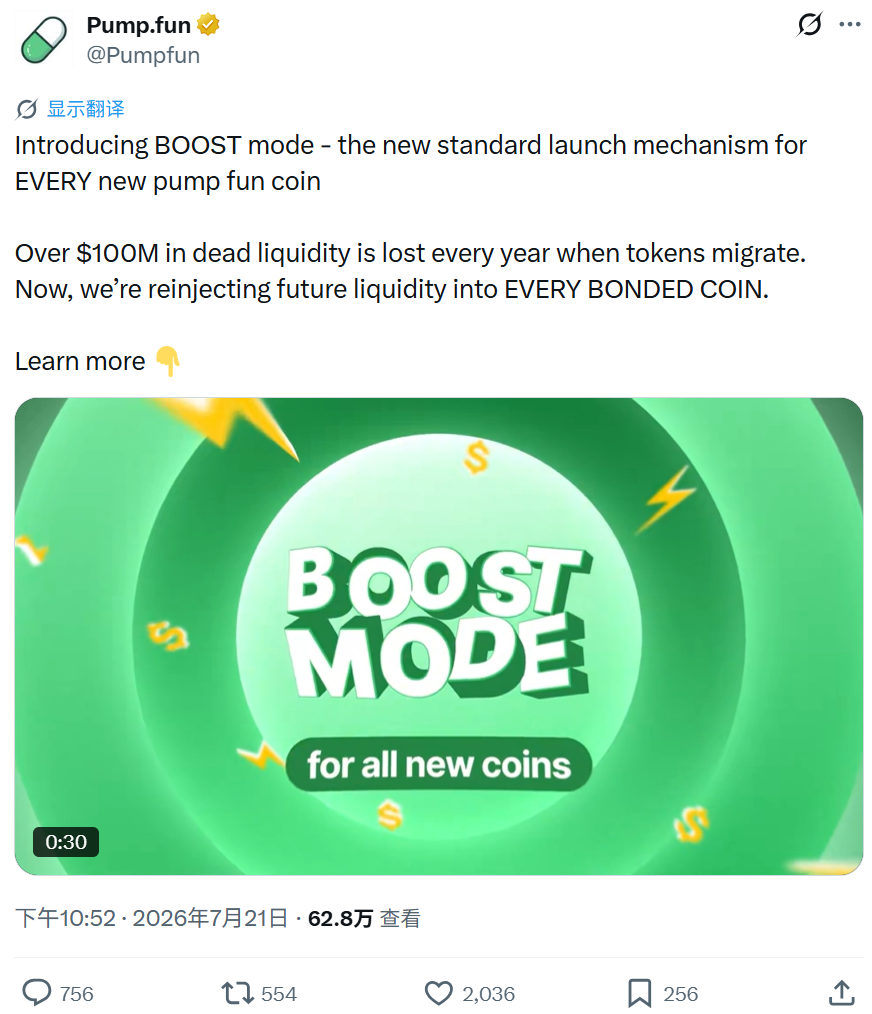


The core action of BOOST mode is straightforward: use these funds, which would otherwise be wasted, to continuously buy the token via TWAP (Time Weighted Average Price) during the first 5 minutes after migration, and immediately burn all purchased tokens. When a token graduates, Pump.fun will forcibly withhold about 20% of the funds. Calculated based on fixed migration rules, this amounts to withholding 17.6 SOL for SOL pairs and about $2516 for USDC pairs.


These funds entirely come from the "sacrificed" portion of liquidity during previous migrations, not from new platform subsidies. After the purchase is completed, the corresponding tokens are directly burned, creating short-term buying pressure while permanently reducing circulating supply.


Using Reserve Funds to Provide a 5-Minute Buy Pressure for Tokens


Pump.fun's classic process is: users create a token with one click, then trade on the bonding curve. When the token reaches a certain market cap threshold, it automatically migrates to the PumpSwap liquidity pool. During migration, the platform locks a portion of the liquidity into the LP at a set ratio to ensure subsequent trading depth.


The problem lies in the high proportion of these locked funds. Even if the token's price later goes to zero and everyone sells out, a sum of "dead money" remains in the LP. This money can neither be withdrawn nor redeployed to other active assets, resulting in systemic capital waste. The official estimate is "over $100 million annually."


BOOST mode does not change the bonding curve trading experience or adjust the graduation threshold itself. It does not arbitrarily add or release any external liquidity. Its essence is to extract the 20% of settlement funds originally intended for the LP and use them to buy and directly burn tokens on the secondary market via TWAP over 5 minutes.


The official explicitly stated that tokens migrated after 22:23 (Beijing Time) on July 21 automatically have BOOST enabled. Tokens migrated before this time, as well as those launched via the Mayhem (AI Agent Lab) mode, do not benefit from this mechanism.


A 5-Minute Fireworks Show


As of July 22, Pump.fun's current annualized revenue is approximately $342.54 million, with total token buyback value around $411.27 million. However, its token price remains far from its all-time high of $0.008. Relying solely on large-scale buybacks can hardly effectively boost price expectations anymore.
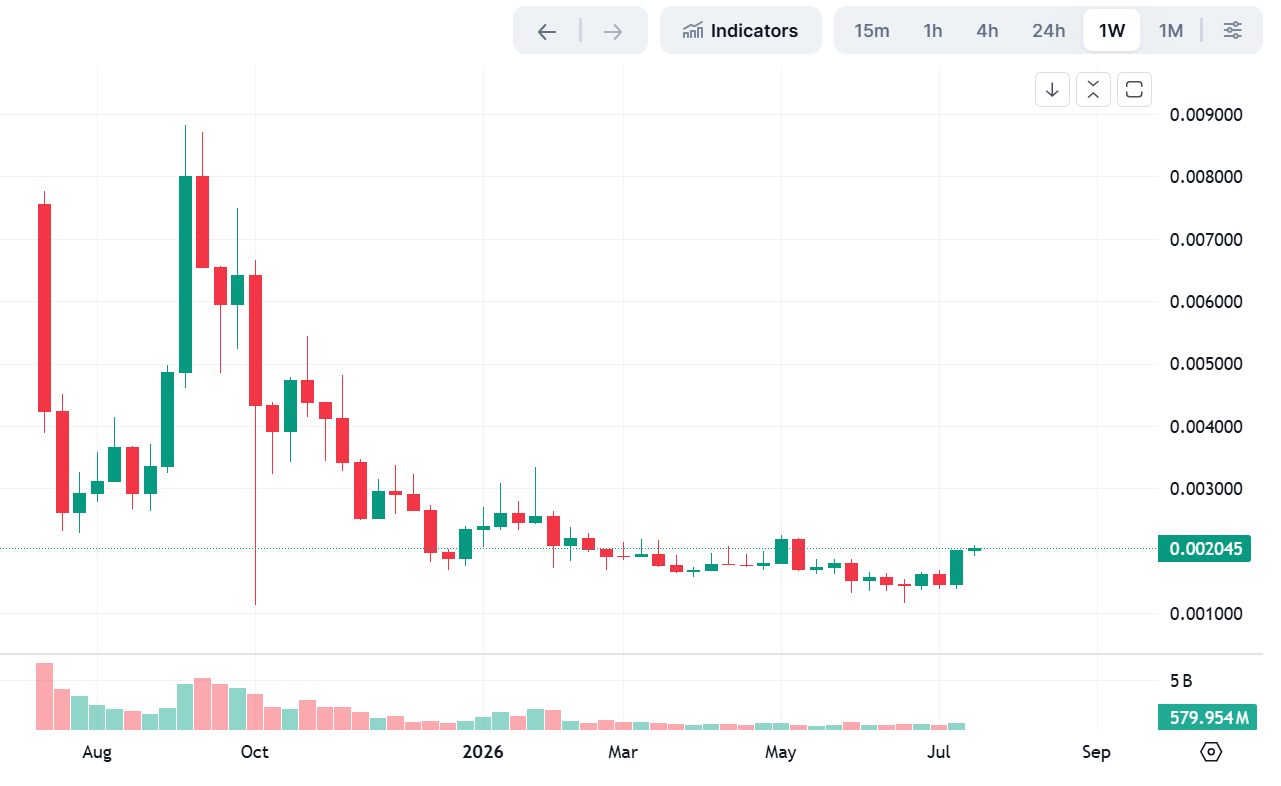


The essence of BOOST is not to add another round of buybacks for PUMP, but to attempt to solve the product issues of the launchpad itself.


The logic behind this might be: if meme coins after graduation have slightly thicker order books and better short-term performance, trader retention and repeat purchase intentions would be higher. Most PVP (Player vs. Player) players don't care about a meme coin's fate three days later; they care about whether it can "pump" at the moment of graduation. The Pump.fun team likely sees through this. Instead of locking 20% of funds defensively in the LP pool, it's better to turn that money into a 5-minute "fireworks show."


The platform's real moat isn't "high token launch volume," but "a certain proportion of launched tokens can continuously generate trading volume." Only when the latter stabilizes can protocol revenue truly be sustainable. Stable or growing revenue provides continuous ammunition for buybacks, rather than appearing like "using存量 revenue to barely support the price."


Of course, many traders are concerned that the additional buying pressure could lower the actual difficulty of project launches, potentially making more low-quality tokens appear "successful," thereby encouraging more aggressive launch behavior. Others point out that the 5-minute TWAP buying window is still short. Once buying stops after 5 minutes and faces large sell orders, the token price could crash with even more exaggerated slippage than before. This essentially trades extremely high post-pump dump risk for a 5-minute pumping illusion.


热门币种推荐

相关问答

QWhat is the core mechanism of Pump.fun's new BOOST mode, and what problem does it aim to solve?

AThe core mechanism of the BOOST mode is to use the approximately 20% of liquidity that would normally be permanently locked as 'dead liquidity' when a token graduates to a liquidity pool. Instead of locking it, this capital is used to buy the token via TWAP (Time-Weighted Average Price) over the first 5 minutes after graduation and then immediately burn the purchased tokens. It aims to solve the problem of systemic capital waste, estimated by the platform to be over $100 million annually, where funds become unusable even if a token's price goes to zero.

QAccording to the article, what are the potential benefits of the BOOST mechanism for the Pump.fun platform?

AThe potential benefits are: 1) Creating a short-term buying pressure and a 'fireworks' effect in the first 5 minutes after a token's graduation, which could improve trader retention and repurchase intention. 2) Permanently reducing the token's circulating supply through burning, potentially supporting its price. 3) Strengthening the platform's moat by increasing the proportion of launched tokens that generate sustained trading volume, which is crucial for sustainable protocol revenue and, consequently, for funding ongoing token buybacks.

QWhat are the main concerns or criticisms raised about the BOOST mechanism in the article?

AThe main concerns are: 1) It might lower the actual difficulty for a project to launch successfully, making it easier for low-quality tokens to create an illusion of success and encouraging more aggressive token launches. 2) The 5-minute TWAP buying window is short. Once it stops and if faced with large sell-offs, the token price could crash with even worse slippage than before. This essentially trades a high risk of a post-buyback crash for a 5-minute pump illusion.

QWhat is the estimated annual value of 'dead liquidity' that the BOOST mode seeks to repurpose, and where does this capital come from?

AThe platform estimates that over $100 million worth of liquidity is permanently lost ('dead') each year. This capital comes from the portion of funds (about 20%) that is automatically locked into the liquidity pool (LP) when a token graduates from the bonding curve. It is not new platform subsidy but repurposed existing capital that would otherwise be trapped forever.

QWhich tokens on Pump.fun are eligible for the new BOOST mechanism, and which are not?

ATokens that graduate (migrate from bonding curve to liquidity pool) after 22:23 Beijing Time on July 21st automatically have the BOOST configuration enabled. Tokens that migrated before this time, as well as tokens launched through the Mayhem (AI Agent Lab) mode, are not eligible for this mechanism.

你可能也喜欢

崔泰源离婚案落槌:揭秘SK海力士万亿帝国背后的继承暗线

2024年底,SK集团会长崔泰源在家族活动上向子女强调“饮水思源”与继承责任。此时,旗下SK海力士市值已突破1000万亿韩元,成为韩国最值钱资产,但集团第三代接班格局却与传统财阀剧本迥异。 崔泰源与前总统卢泰愚之女卢素英育有三名子女。长女崔允贞被视为最明显接班候选,她拥有生物学背景和咨询经历,现任SK生物制药高管及集团“成长支援部”主管,主导精准医疗等新业务,其婚姻也联姻AI领域创业者。 次女崔敏贞路径独特,曾自愿服役韩国海军并参与亚丁湾护航,退役后曾在SK海力士美国部门处理国际政策,后离职在硅谷创立AI医疗公司。她与曾服役美国海军陆战队的华裔企业家结婚,连接军旅与地缘政治网络。 长子崔仁根最符合传统继承人形象,毕业于布朗大学物理系,曾任职SK旗下能源公司,后转入麦肯锡首尔办公室。他公开表现极为低调,未持有集团股份,也未公开表态。 子女们的成长与父母旷日持久的离婚诉讼交织。2025年,最高法院将涉及1.38万亿韩元财产分割的判决发回重审,期间三名子女曾向法院递交未公开内容的请愿书。 随着SK海力士在AI时代成为全球核心地缘政治资产,崔家第三代继承的已非简单的企业控制权。他们被置于AI科研、华盛顿政策圈与全球投资前沿,必须证明自己有能力应对新时代的产业博弈,而非自动承接旧式家族剧本。

marsbit昨天 09:06

崔泰源离婚案落槌:揭秘SK海力士万亿帝国背后的继承暗线

marsbit昨天 09:06

交易

现货

热门文章

相关讨论

欢迎来到HTX社区。在这里,您可以了解最新的平台发展动态并获得专业的市场意见。以下是用户对PUMP(PUMP)币价的意见。

活动图片