According to Citi's latest Emerging Markets Strategy report, the bank has upgraded its stance on China equities from Neutral to Overweight, while tactically downgrading South Korea from Overweight to Neutral. It maintains an Overweight on Taiwan-China markets and sets target levels for the MSCI EM Index at 1870 by the end of 2026 and 2050 by mid-2027.
The most immediate market hook of this report is that despite the MSCI EM Index rising approximately 20% year-to-date, Citi still sees room for further upside. From the current level of around 1664 points, 1870 points implies about 12% upside, while the 2050 point target suggests around 20% potential gains by mid-2027.
However, Citi is not betting on a broad-based emerging markets bull run. Gains in EM have been highly concentrated in South Korea, Taiwan-China tech, and the AI hardware supply chain recently, with other countries and sectors not keeping pace. China's upgrade to Overweight stems from Citi beginning to look for 'broadening' candidates beyond the AI chain.
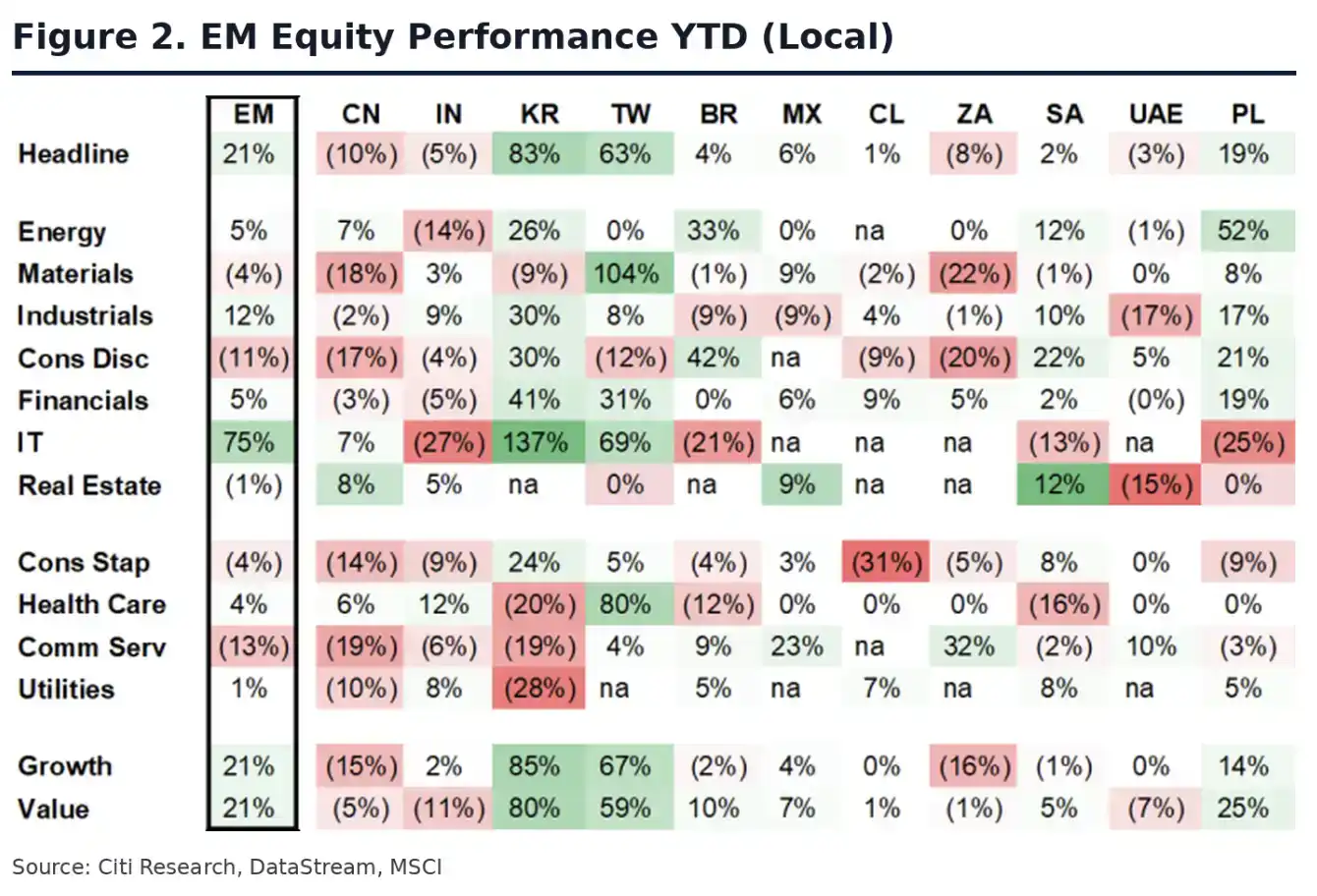
South Korea has delivered nearly 40% positive returns, and Taiwan-China markets over 30%, highlighting the high concentration of this year's EM rally.
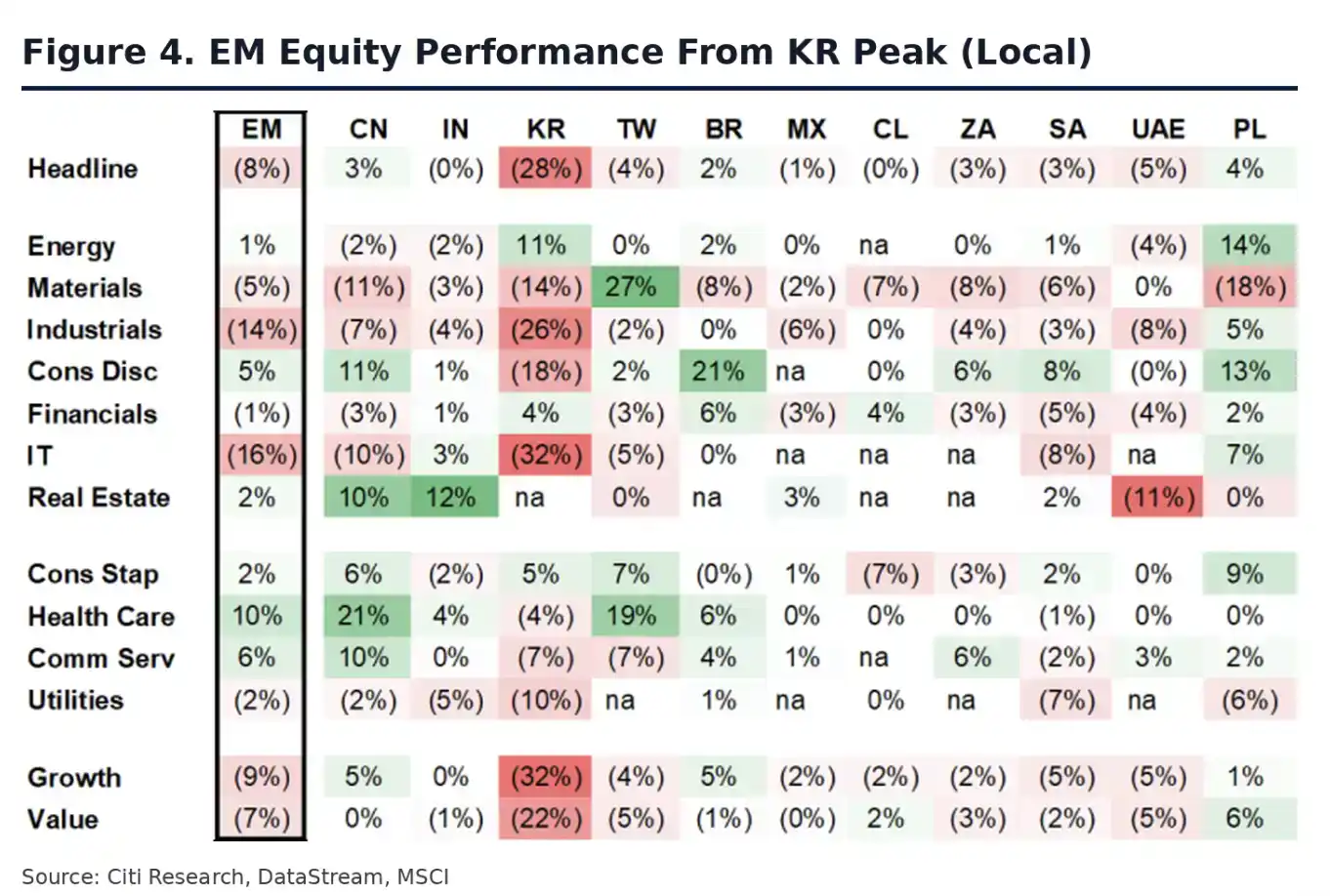
South Korea's pullback and the lack of comprehensive follow-through from other markets.
China Upgraded to Overweight, South Korea Cools Off First
In this round of allocation adjustments, China was upgraded from Neutral to Overweight, and Mexico was raised to Neutral. South Korea was downgraded from Overweight to Neutral, while Taiwan-China markets remain on the Overweight list.
China's appeal primarily stems from three factors. Global investors remain underweight on Chinese stocks, leaving significant room for capital inflows if global risk appetite improves. Falling oil prices benefit energy-importing markets like China. As global growth data improves, some cyclical assets regain support, with China ranking relatively high among macro-sensitive markets in this cycle.
This contrasts with the dominant theme in emerging markets over the past two years. The strongest trades were previously concentrated in the AI hardware supply chain, with South Korea and Taiwan-China markets being the biggest winners due to demand for semiconductors, memory, and AI servers. However, for the index to continue rising, relying solely on a few tech stocks becomes increasingly difficult, requiring funds to find more markets capable of sustaining the rally.
South Korea's downgrade does not equate to a weakening fundamental outlook. Public reports indicate that Citi retains a relatively strong long-term view on the South Korean equity market, with local strategists having previously set a KOSPI target of 10,000 points. According to the source report, the logic includes the potential for memory shortages to persist into 2027, and continued demand growth from AI tokens and customization supporting the memory upcycle. The near-term issue lies in South Korea's outsized prior gains, elevated implied volatility, and the amplification of fluctuations by retail leveraged products.
Taiwan-China markets remain one of the most direct beneficiaries within the AI hardware chain. According to the source report, local strategists have set a mid-2027 target for the Taiwan Weighted Index at 53,500 points. However, this market faces similar issues – trading has become crowded, and volatility often manifests first in these prior winners if greater skepticism emerges regarding the returns on AI capital expenditure.
EM Has Room to Run, Yet Earnings Revisions Remain Narrow
The two specific index targets set by Citi for MSCI EM are the clearest numerical calls in this report: 1870 by end-2026 and 2050 by mid-2027.
The support does not come from significant valuation expansion. The current 12-month forward P/E for MSCI EM is around 11.5x, roughly in line with its long-term average. Following this year's rally in emerging markets, valuations have not been pushed into a clear bubble zone; index gains have come more from improved earnings expectations.
The earnings numbers appear robust. The 2026 EPS growth forecast for MSCI EM reaches 63%, revised up by 28 percentage points cumulatively since late February. Growth is expected to moderate to 24% in 2027, but still remains above comparable assets in developed markets.
The issue is that the source of earnings improvement remains narrow. The Information Technology sector contributed about 85% of the 2026 EPS upward revisions, with South Korean and Taiwan-China AI supply chains still being the primary sources. Revisions for most non-tech sectors like Consumer, Real Estate, and Utilities remain weak. In other words, while the EM index appears supported by earnings on the surface, the upward earnings revisions have not yet broadened out to more industries.
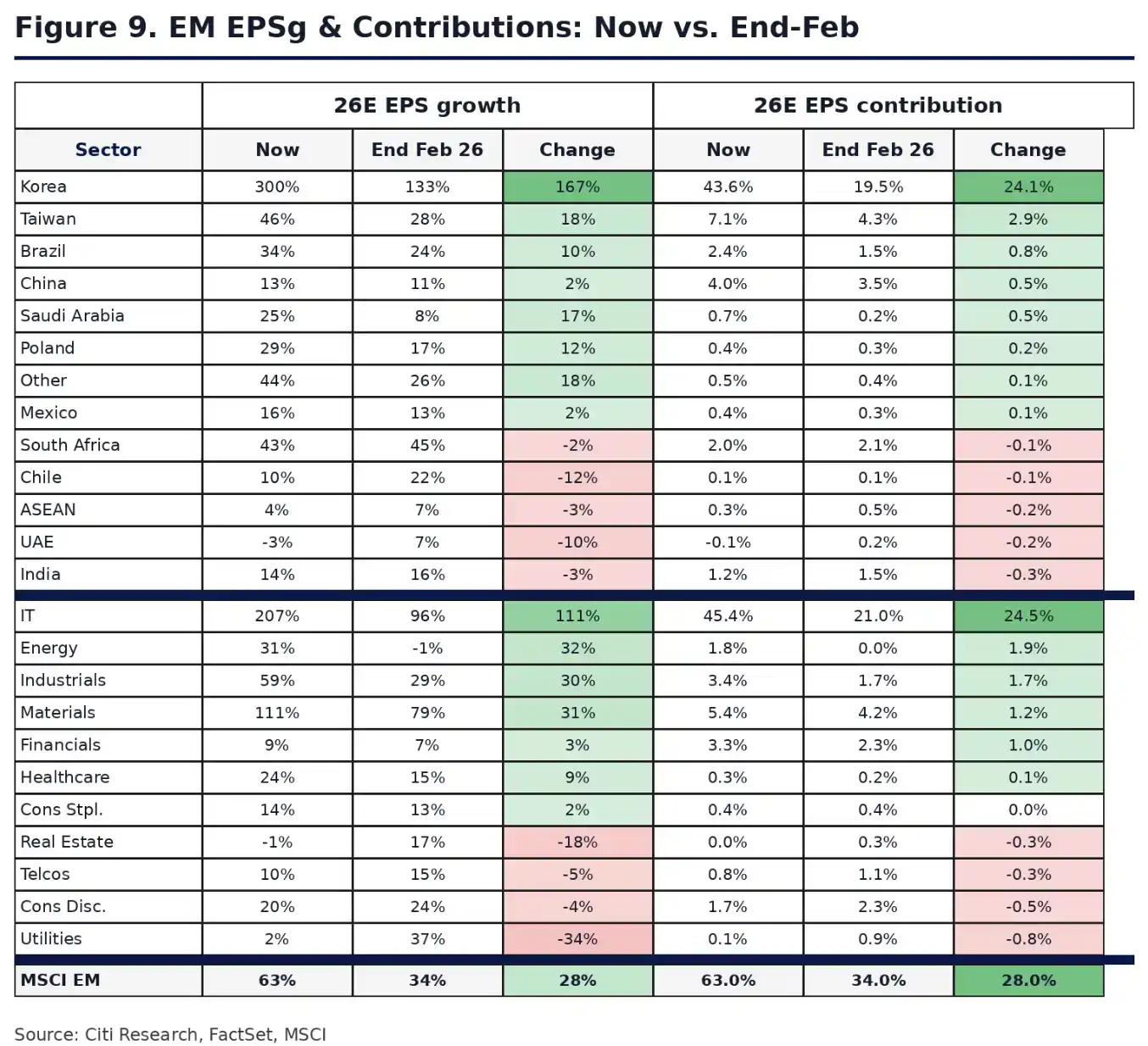
MSCI EM 2026E EPS growth of 63%, with the IT sector contributing roughly 85% of the upward revision magnitude.
This is also why Citi has not upgraded Emerging Markets to an Overweight stance within its global asset allocation framework. It can increase weights to markets like China within the region, but at the global asset allocation level, Emerging Markets remains Neutral. Citi's stance is closer to 'selectively adding exposure to broadening beneficiaries' rather than confirming a full-blown bull market.
The So-Called 'Broadening' Means Momentum Needs to Move Beyond a Few AI Winners
In plain terms, what Citi refers to as 'broadening trades' means this year's emerging market rally cannot continue to rely solely on gains in South Korea, Taiwan-China markets, and the AI chain. Funds either need to find new countries and sectors, or the index's further upside will be constrained.
This screening framework primarily looks at several conditions: whether a market benefits from a weaker US Dollar and declining US Treasury yields, whether it benefits from falling oil prices, its historical performance during improvements in global economic data, whether its near-term earnings revisions are turning positive, and whether its current trading is already too crowded.
Under this framework, China, South Africa, and Mexico rank high. According to the source report, their composite scores in the 'broadening candidate' screen are 4.2, 5.0, and 5.3 respectively. While South Korea and Taiwan-China markets remain recent winners, they face more pronounced issues of near-term crowding and volatility.
Oil prices present a real-world condition. Citi's baseline assumption is that oil averages around $75/barrel in Q3 2026, declining to around $65/barrel by early 2027. Falling oil prices typically benefit energy-importing markets like South Korea, Taiwan-China, India, and China, while posing challenges for some resource-heavy and oil-sensitive markets.
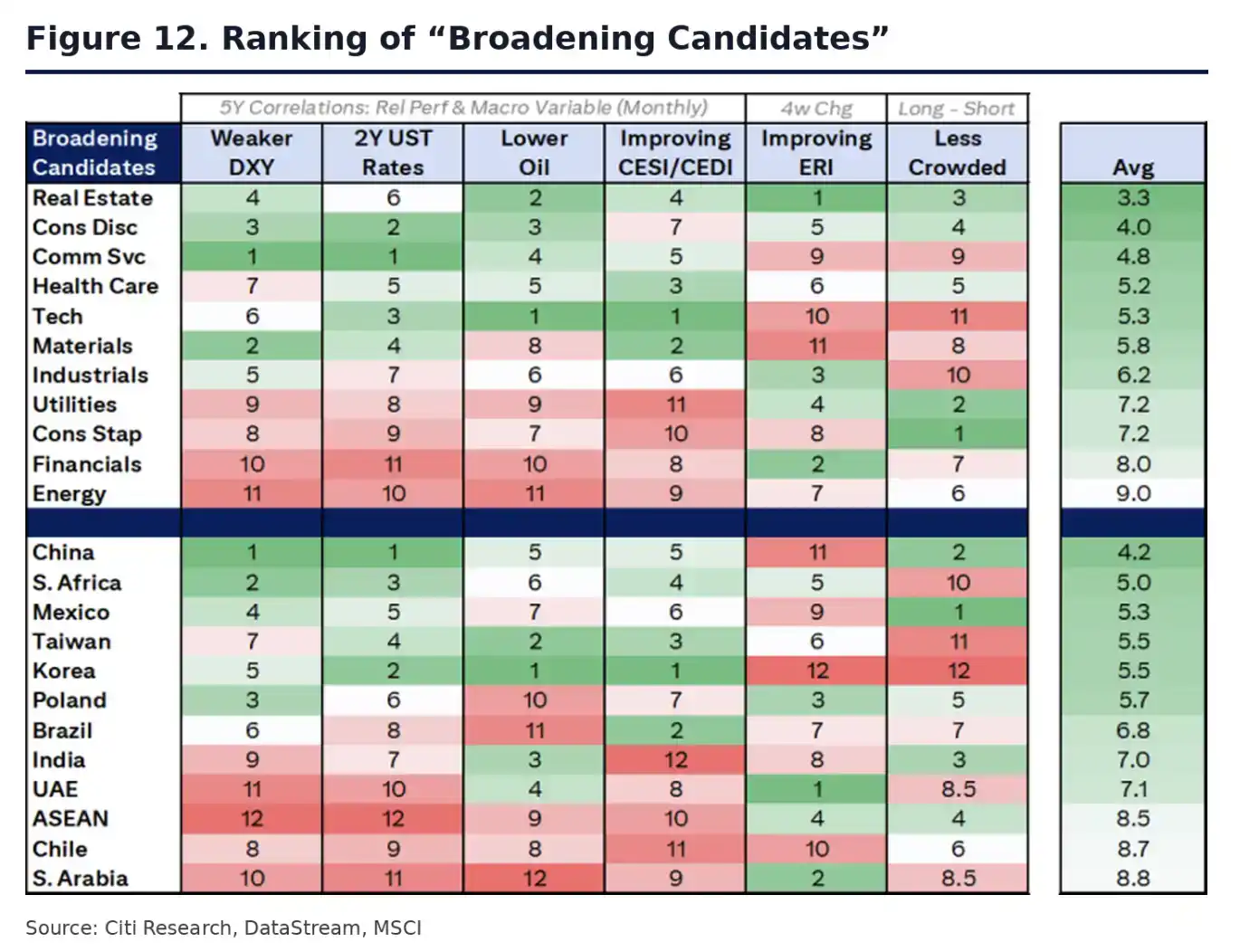
The 'Broadening Candidates' table shows China, South Africa, and Mexico ranking high across dimensions including weak USD, US Treasury yields, oil prices, and crowding.
This context is key to China's upgrade. It is neither this year's strongest performer nor the most crowded trade within the AI hardware chain. However, under the combination of improving global growth, declining oil prices, and room for positioning catch-up, it possesses the conditions to attract rotational flows.
Broadening Not Yet Complete; AI Chain Remains the Biggest Divergence
The cautious aspect of this report is that Citi does not present 'broadening' as an accomplished fact.
This year's EM gains are highly concentrated, with cross-market return dispersion reaching levels among the highest in the past 25 years. South Korean and Taiwan-China tech/AI sectors have contributed almost all the index-level returns. If future earnings revisions remain confined to the IT sector, the so-called broadening looks more like a short-term portfolio rotation rather than a broad-based fundamental improvement.
AI capital expenditure remains the greatest uncertainty. Previously, the market was willing to assign higher expectations to memory, semiconductors, and AI infrastructure due to sustained demand for training and inference pushing compute investment. However, if investors begin to question the returns on this capital expenditure, the prior winners like South Korea and Taiwan-China could face greater pressure.
Macro risks have not disappeared. Renewed geopolitical escalation could push oil prices away from the downward scenario. Fed policy remains a point of divergence; if rate cuts fall short of expectations, the US Dollar and Treasury yields could pressure emerging markets. A potential super El Niño could also bring new inflationary pressures.
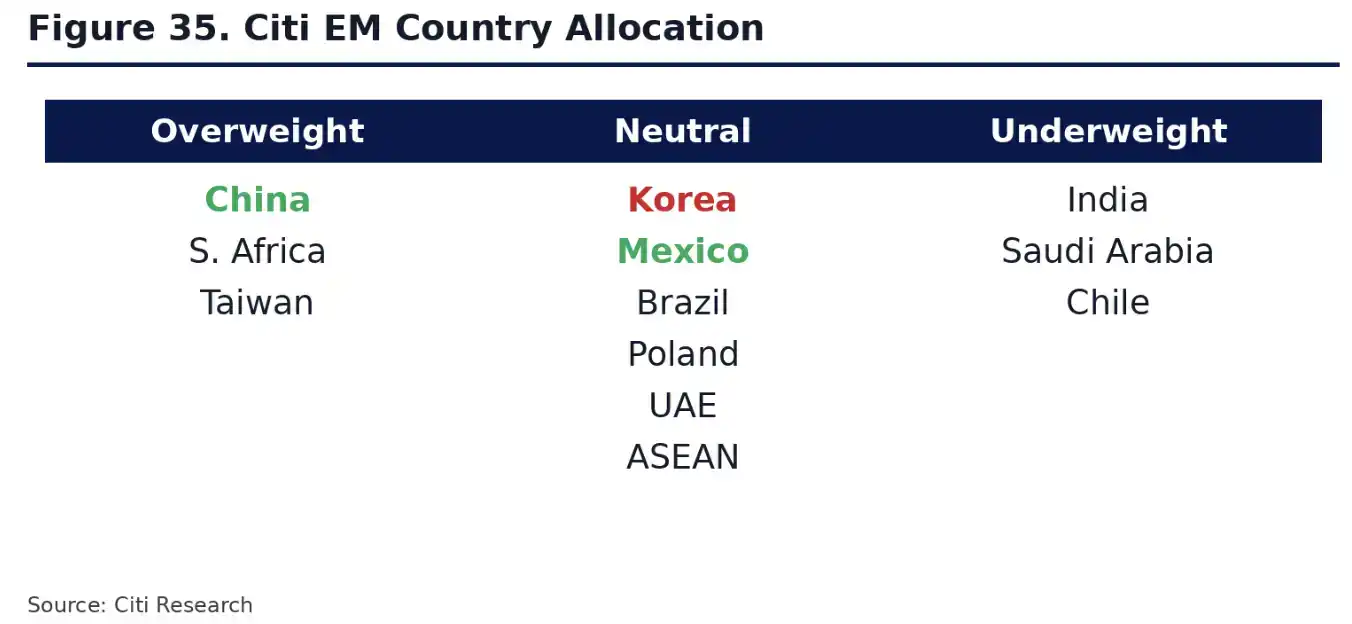
Citi's EM country allocation table shows Overweight positions in China, South Africa, and Taiwan-China markets, with South Korea downgraded to Neutral.
Citi's judgment on emerging markets is more akin to 'the rally has the potential to broaden' rather than 'a full-blown bull market is already confirmed.' China was upgraded because it offers better risk-reward in this potential broadening trade. South Korea was cooled off, indicating that prior winners are not necessarily incapable of further gains, but that their short-term gains and volatility have diminished their near-term appeal.
Whether MSCI EM can reach 1870 or even 2050 points depends not only on how much further the AI chain can rise but also on whether non-tech sector earnings can halt their downward revisions, whether the global cyclical improvement can be sustained, and whether funds are genuinely willing to flow from the few winners to a wider range of markets.