Robinhood Chain's First Breakout Hit Is a Meme Cat: Retail Investors Dig Out CashCat's 'Original Name,' CEO Jumps on the Trend

marsbit发布于2026-07-08更新于2026-07-08

文章摘要

Robinhood Chain launched its mainnet on July 1st, promoting tokenized U.S. stocks as its core feature. However, the first asset to gain significant traction was a meme token called CASHCAT, which surged over 1700% in 24 hours, reaching a market cap of $120 million. The token's narrative stems from Robinhood's early history: CEO Vlad Tenev revealed the company's initial working name was "CashCat." CASHCAT has no official ties to Robinhood and declares itself as "pure cat" with zero utility. Tenev added fuel by tweeting on July 8th that the chain is "great for memes," which the community saw as implicit approval. The hype has attracted copycat tokens on other chains like Solana and impersonator accounts promoting scams. The article highlights the extreme volatility and risks associated with this new, illiquid meme token on a fledgling blockchain, cautioning investors to verify contracts and treat any investment as high-risk speculation.

Author: Claude, Shenchao TechFlow

Shenchao Introduction: One week after the Robinhood Chain mainnet launch, while the officially promoted stock token hasn't gone viral yet, a Meme cat called CASHCAT has taken off first, with its price surging over 1700% in 24 hours at one point and its market cap exceeding $120M. Its entire narrative boils down to one sentence: the working name for Robinhood during its startup phase was CashCat. CEO Tenev himself shared this history and even tweeted a meme on the day of the surge. Meanwhile, copycat tokens and fake 'Roaring Kitty' shilling accounts are already in position.
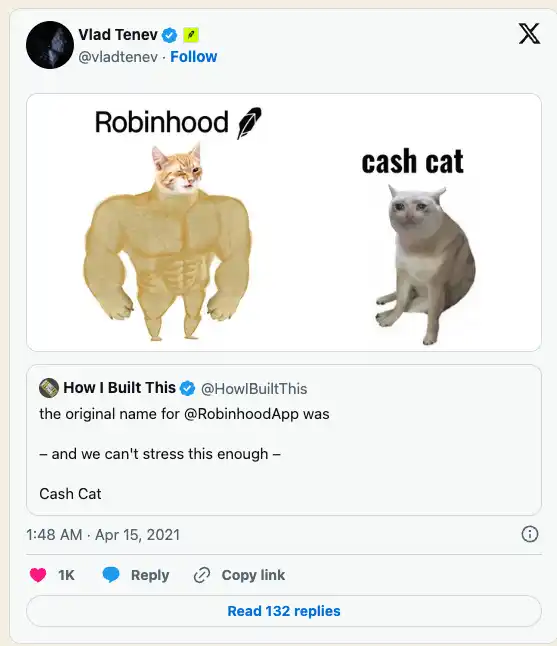
Attracting traffic and retail investor attention still depends on Memes.

Robinhood spent a year paving the way for its own blockchain, pitching tokenized stocks as the core story. However, the first truly viral asset on the chain turned out to be a cartoon cat holding cash.

According to GMGN monitoring, on July 8th, the market capitalization of the Meme token CASHCAT on Robinhood Chain exceeded $120 million, with a 24-hour increase of over 1700%. In the following hours, readings from different data platforms continued to rise. According to CoinGecko data, CASHCAT primarily trades on the Uniswap V3 deployed on Robinhood Chain, with the CASHCAT/WETH pair seeing a 24-hour trading volume of approximately $28 million. For a new chain that has only been live for a week and has very few ecosystem applications, this cat is the current traffic itself.

Seventh Day Post-Mainnet Launch, The First Viral Asset Is a Meme

First, some background.

On July 1st, Robinhood officially launched the public mainnet for Robinhood Chain at an event in London. This is an Ethereum Layer 2 based on Arbitrum technology, unveiled by CEO Vlad Tenev and crypto business head Johann Kerbrat. The official positioning of this chain is quite 'serious'. Its core product, Stock Tokens, tracks the price performance of over 200 US stocks and ETFs and is open to users in over 120 jurisdictions (excluding US users). DeFi protocols like Uniswap and 1inch were deployed on day one, and Robinhood pledged to cover all Gas fees for the first 90 days.

According to the official script, the protagonists of this chain should have been tokenized stocks and RWA (Real World Assets). However, the script didn't follow the plan. In the first week after the mainnet launch, the most actively traded pair on the chain wasn't any stock token, but CASHCAT. Retail investors set the tone for this 'retail broker's chain' first.

A clear warning for holders: CASHCAT's current trading depth is concentrated on a single trading pair within a single DEX. Liquidity is thin on a new chain, price readings vary significantly across platforms, and both slippage and wick risk upon entry/exit are far higher than for Memes on mature chains.

Archaeology of the 'Original Name', Tenev Himself Told the CashCat Story

CASHCAT's success relies on a real piece of company history.

In early interviews, Tenev recalled the company naming process: "The original working name was actually CashCat, but everyone felt it wasn't powerful enough. My wife would introduce me to her friends by saying, 'They're the Robin Hoods of finance, doing things for the little guy.' That's how the name Robinhood stuck." This account has been cited in numerous company retrospectives after the GameStop saga, making it verifiable 'archaeological material.' This is the biggest difference between CASHCAT and other cat/dog coins built on fabricated stories.

The token's structure is as simple as it gets. According to the project's website, the total supply is 1 billion tokens, with zero buy/sell taxes. The liquidity pool tokens have been fully burned, and it self-identifies as "zero utility, one hundred percent cat." The website also explicitly states that the project has no affiliation with Robinhood, calling it "fan fiction with a ticker."

The narrative is real, the product is unrelated. Readers need to distinguish these two facts: Robinhood's history provides this cat with viral material, but the company does not endorse it. The token's value is built entirely on attention, with no safety net when that attention fades.
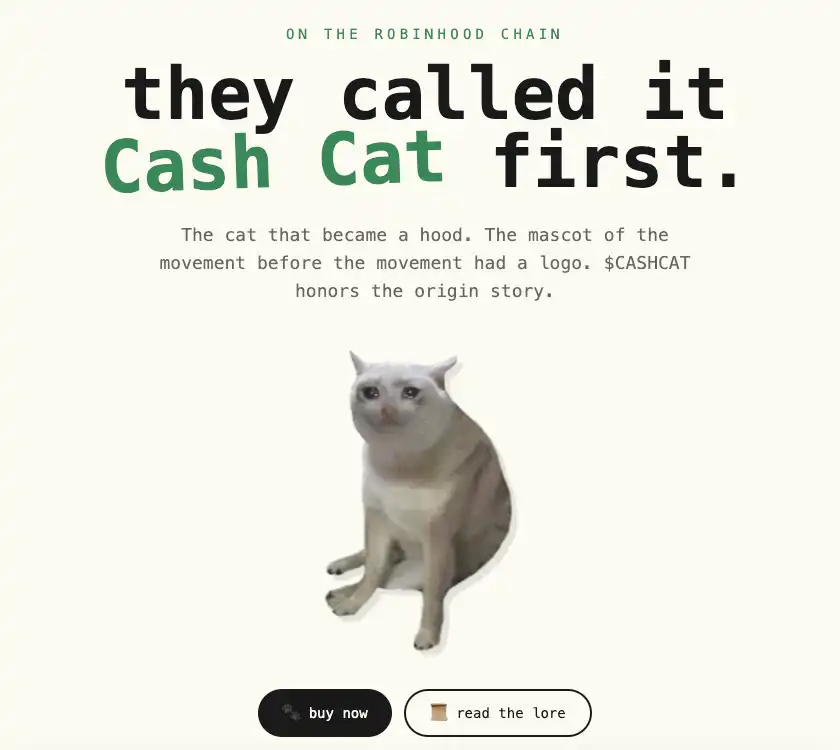
Tenev Tweets Meme, Market Interprets It as Semi-Endorsement

What truly pushed the frenzy to its peak was Tenev himself.

On July 8th, Tenev posted on X (formerly Twitter): "We're making Robinhood Chain the best RWA public chain... but it runs Memes really well too." The post garnered over 500,000 views within hours. While he didn't mention CASHCAT by name, the timing coincided with the day of the massive surge. The community interpreted it as implicit approval, if not an assist, for the Meme frenzy on the chain.

There's a layer of historical irony here. During the 2021 GameStop short squeeze, Robinhood was thrust into Congressional hearings for restricting retail buys of GME, becoming the 'villain' in the retail narrative. Five years later, this company's blockchain completes its cold start, precisely relying on the Meme culture that retail investors excel at, with the object of speculation being the name the company itself discarded. The CASHCAT website even specifically plays on this irony: "Cash Cat doesn't do options, and it doesn't do PFOF (Payment for Order Flow)."
For traders, it's necessary to heavily discount the actual value of this tweet. A playful tweet from Tenev and an official Robinhood endorsement are separated by an entire compliance department. The company has no commitments regarding custody, listing, or providing liquidity for the Meme token. The effectiveness of such sentiment catalysts typically lasts only hours.

Copycat Tokens and Fake 'Roaring Kitty' Accounts Are Already in Position

Once the heat arrived, the tools to hunt retail investors followed.

First, cross-chain copycat tokens. According to aggregated monitoring information from CoinGecko, an identically named CASHCAT has already been deployed on the Solana chain. The original contract is deployed on Robinhood Chain with an address starting with 0x020b and ending with 18b4; identically named tokens on other chains are unrelated to the original.

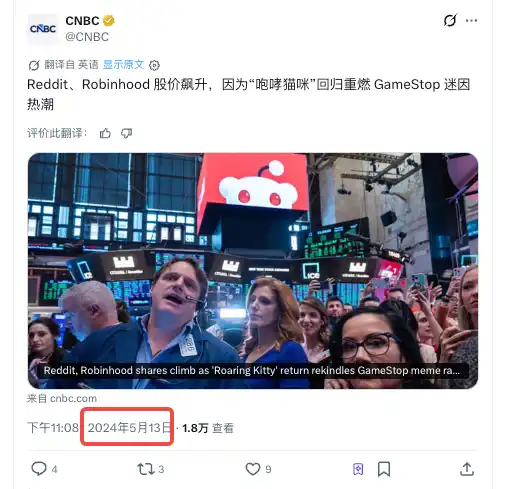
Second, impersonator accounts shilling. For example, an X account with the handle "RK" and a username highly similar to GameStop saga protagonist 'Roaring Kitty' Keith Gill tweeted, "CASHCAT is the first major Meme on Robinhood chain," and included a Solana contract address in the post.

New chain, new Meme, fake accounts, cross-chain copycats—this combination has claimed victims in every past Meme cycle. If you still decide to participate now, at least do these three things: verify the contract address, use only official or reputable cross-chain bridges, and keep your position size to lottery-ticket levels.

CASHCAT's current total value is just a good story plus a wave of attention, neither of which has a retention mechanism.


热门币种推荐

相关问答

QWhat is CASHCAT, and why did it become the first viral asset on Robinhood Chain after its mainnet launch?

ACASHCAT is a meme token featuring a cartoon cat holding cash. It became the first viral asset on Robinhood Chain, launched on July 1, due to its connection to Robinhood's early history. The name 'CashCat' was Robinhood's original working name before it adopted 'Robinhood,' a fact shared by CEO Vlad Tenev. The token's price surged over 1700% in 24 hours, capturing significant market attention and liquidity on the new chain.

QWhat historical anecdote about Robinhood gives CASHCAT its narrative foundation?

AThe narrative foundation for CASHCAT comes from an anecdote shared by Robinhood CEO Vlad Tenev. He revealed that the company's original working name during its early days was 'CashCat,' but it was changed to 'Robinhood' because the latter was perceived as more powerful and aligned with the idea of 'stealing from the rich to give to the poor.' This true piece of company history differentiates CASHCAT from other meme tokens with fabricated backstories.

QHow did Robinhood CEO Vlad Tenev's actions on social media contribute to the hype around CASHCAT?

AOn July 8, Vlad Tenev posted on X, stating, 'We're building Robinhood Chain to be the best RWA public chain... but it runs Memes pretty well too.' Although he didn't mention CASHCAT by name, the timing coincided with the token's massive price surge. The community interpreted the post as a tacit endorsement or acknowledgment of the meme token activity on the chain, significantly fueling the hype and market speculation.

QWhat are the key risks associated with trading CASHCAT as highlighted in the article?

AThe article highlights several key risks: 1) The token's trading is concentrated on a single DEX (Uniswap V3) and a single trading pair (CASHCAT/WETH) on the new Robinhood Chain, leading to thin liquidity. 2) This results in high slippage, price volatility, and significant differences in price readings across data platforms. 3) The token's value is based solely on a historical narrative and market attention, with no underlying utility or backing from Robinhood, making it highly susceptible to rapid value loss when hype fades.

QWhat fraudulent activities emerged following CASHCAT's price surge, and what precautions should investors take?

AFollowing the surge, fraudulent activities included: 1) The deployment of fake 'CASHCAT' tokens on other blockchains like Solana, which are unrelated to the original Robinhood Chain token. 2) Impersonator accounts on social media, such as one mimicking 'Roaring Kitty' (Keith Gill), promoting these fake tokens. Investors are advised to: verify the correct contract address (the original starts with 0x020b and ends with 18b4), use only official or reputable cross-chain bridges, and limit their investment to an amount they are prepared to lose ('lottery ticket' sized positions).

你可能也喜欢

崔泰源离婚案落槌:揭秘SK海力士万亿帝国背后的继承暗线

2024年底,SK集团会长崔泰源在家族活动上向子女强调“饮水思源”与继承责任。此时,旗下SK海力士市值已突破1000万亿韩元,成为韩国最值钱资产,但集团第三代接班格局却与传统财阀剧本迥异。 崔泰源与前总统卢泰愚之女卢素英育有三名子女。长女崔允贞被视为最明显接班候选,她拥有生物学背景和咨询经历,现任SK生物制药高管及集团“成长支援部”主管,主导精准医疗等新业务,其婚姻也联姻AI领域创业者。 次女崔敏贞路径独特,曾自愿服役韩国海军并参与亚丁湾护航,退役后曾在SK海力士美国部门处理国际政策,后离职在硅谷创立AI医疗公司。她与曾服役美国海军陆战队的华裔企业家结婚,连接军旅与地缘政治网络。 长子崔仁根最符合传统继承人形象,毕业于布朗大学物理系,曾任职SK旗下能源公司,后转入麦肯锡首尔办公室。他公开表现极为低调,未持有集团股份,也未公开表态。 子女们的成长与父母旷日持久的离婚诉讼交织。2025年,最高法院将涉及1.38万亿韩元财产分割的判决发回重审,期间三名子女曾向法院递交未公开内容的请愿书。 随着SK海力士在AI时代成为全球核心地缘政治资产,崔家第三代继承的已非简单的企业控制权。他们被置于AI科研、华盛顿政策圈与全球投资前沿,必须证明自己有能力应对新时代的产业博弈,而非自动承接旧式家族剧本。

marsbit昨天 09:06

崔泰源离婚案落槌:揭秘SK海力士万亿帝国背后的继承暗线

marsbit昨天 09:06

交易

现货

热门文章

如何购买CAT

欢迎来到HTX.com!我们已经让购买Simon's Cat(CAT)变得简单而便捷。跟随我们的逐步指南,放心开始您的加密货币之旅。第一步:创建您的HTX账户使用您的电子邮件、手机号码注册一个免费账户在HTX上。体验无忧的注册过程并解锁所有平台功能。立即注册第二步:前往买币页面,选择您的支付方式信用卡/借记卡购买:使用您的Visa或Mastercard即时购买Simon's Cat(CAT)。余额购买:使用您HTX账户余额中的资金进行无缝交易。第三方购买:探索诸如Google Pay或Apple Pay等流行支付方法以增加便利性。C2C购买:在HTX平台上直接与其他用户交易。HTX场外交易台(OTC)购买:为大量交易者提供个性化服务和竞争性汇率。第三步:存储您的Simon's Cat(CAT)购买完您的Simon's Cat(CAT)后,将其存储在您的HTX账户钱包中。您也可以通过区块链转账将其发送到其他地方或者用于交易其他加密货币。第四步:交易Simon's Cat(CAT)在HTX的现货市场轻松交易Simon's Cat(CAT)。访问您的账户,选择您的交易对,执行您的交易,并实时监控。HTX为初学者和经验丰富的交易者提供了友好的用户体验。

585人学过发布于 2024.08.26更新于 2026.06.02

如何购买CAT

什么是 TRUMP CAT

特朗普猫家族,$特朗普猫:一个解开的谜团 介绍 在不断发展的加密项目和Web3创新的背景下,一个好奇的现象出现了——它似乎在加密货币和互联网 meme 文化之间游走。这就是神秘的“特朗普猫家族”,也称为“$特朗普猫”。尽管它可能引起加密爱好者的好奇,但现实似乎远离了加密项目的标准定义。本文旨在探讨特朗普猫家族的概念,揭示其背景,并澄清其在加密领域的地位。 什么是特朗普猫家族,$特朗普猫? 乍一看,人们可能会认为“特朗普猫家族”指的是一个合法的加密货币或Web3项目。然而,经过深入调查,显然这个术语缺乏传统加密企业的特征。相反,“特朗普猫”似乎主要与在前美国总统唐纳德·特朗普关于海地移民的争议性言论后迅速传播的病毒性 meme 文化相关联。 媒体的报道引发了无数的 meme、幽默解读和一波社会评论。这些 meme 描绘了围绕特朗普对话的各种讽刺形式,通常利用猫咪在喜剧和有时荒谬的场景中进行表现。与其说这是一个旨在解决技术进步或金融交易的结构化项目,不如说“特朗普猫家族”概念主要存在于互联网幽默的领域。 特朗普猫家族,$特朗普猫的创作者是谁? 在调查“特朗普猫家族”的背后,显然没有可识别的创作者或创始人物。这个现象似乎源于集体的互联网表达,而不是来自一个具有明确项目目标的单一愿景者。这种匿名性进一步强调了它作为 meme 的地位,而不是类似于大多数已知加密项目的结构化倡议。 特朗普猫家族,$特朗普猫的投资者是谁? 鉴于“特朗普猫家族”不符合一个信誉良好的加密项目的特征,投资的问题变得无关紧要。没有任何已建立的基金会或组织表示支持这个名称的项目。相反,存在的是对 meme 文化的个体贡献者——爱好者、艺术家和社交媒体用户,他们共同在互联网上填充了他们对“特朗普猫”这一术语的解读和幽默。这种在数字人际沟通中的有机增长更多地反映了一种社会评论,而不是一个金融投资的景观。 特朗普猫家族,$特朗普猫是如何运作的? 如果有人想要了解“特朗普猫家族”的运作方式,答案与标准加密项目的预期大相径庭。没有操作机制、技术创新或固有的独特特征。相反,它通过在线的病毒传播而存在,依赖社交媒体平台进行扩散。“如何”在文化和沟通的领域中——其本质源于社会互动的动态,而不是来自已建立的加密协议或区块链功能。 如果说“特朗普猫”有什么独特之处,那就是它通过幽默戏剧化了政治对话。人们利用引人入胜的视觉效果、内部笑话和富有创意的叙事来表达对政治人物和社会问题的情感。meme 的力量超越了传统的沟通方式,以一种广泛共鸣的形式封装复杂的思想,但在可量化的成功或结构化目标方面仍然难以捉摸。 特朗普猫家族,$特朗普猫的时间线 2024年9月:围绕唐纳德·特朗普关于海地移民“吃宠物”的言论的讨论在网上引发关注,导致各种平台上 meme 和讽刺解读的蓬勃发展。 持续影响:在此之后,“特朗普猫”现象继续存在,社交媒体用户利用幽默来处理、批评或简单庆祝政治对话和事件的荒谬性。 需要注意的是,由于“特朗普猫家族”缺乏传统项目的正式结构,时间线主要由轶事观察组成,而不是在公认的加密企业中常见的显著里程碑。 关键点 meme文化:与其说是一个结构化的加密倡议,不如说“特朗普猫”更符合不断演变的互联网 meme 领域。 术语的起源: “特朗普猫”的起源直接与对特朗普总统关于海地移民言论的评论相关,激发了广泛的幽默表现。 缺乏项目框架:该术语未能与任何明确的项目目标、创作者或投资者对接,标志着它作为一种新颖的文化体验,而非加密项目。 结论 总之,对“特朗普猫家族,$特朗普猫”的调查揭示了一个根植于互联网 meme 文化的现象,而不是在加密货币或Web3领域内的一个公认项目。围绕该术语的病毒性传播源于用户的集体参与,反映了现代数字话语,而不是一个具有结构或战略前瞻性的正式倡议。尽管它可能引发那些寻求下一个大加密项目的人的好奇,“特朗普猫家族”却是人类创造力、幽默感以及在数字时代与政治之间常常荒谬关系的见证。

659人学过发布于 2025.01.22更新于 2025.01.22

什么是 TRUMP CAT

相关讨论

欢迎来到HTX社区。在这里,您可以了解最新的平台发展动态并获得专业的市场意见。以下是用户对CAT(CAT)币价的意见。

活动图片














