While the cryptocurrency sector expands and evolves, Ethereum continues to see a growing wave of institutional interest, underscoring its role beyond just a digital asset. Amid this heightened institutional interest, a new narrative regarding Ethereum is now being pushed across the sector by a prominent crypto figure, capturing the attention of market players and investors alike.
Another Key Asset For Institutions Is Ethereum
Vivek Raman, the Chief Executive Officer (CEO) of Etherealize, has placed Ethereum on the same level as Bitcoin, the largest crypto asset, on the institutional stage. Raman argues that ETH is on track to become a core holding in institutional portfolios, positioning it as a foundational layer for the next generation of financial infrastructure.
According to the CEO, institutional allocations to ETH are inevitable as the asset grows, drawing attention to the University of Harvard’s shift from Bitcoin Spot ETFs to Ethereum Spot ETFs. ETH is being backed by its proof of stake, which is capable of generating massive yields. As Raman believes, these factors, which allow ETH to become the next store of value, are key drivers for price appreciation for the asset.
In the interview, the CEO also talked about the substantial growth of tokenized assets and stablecoins on the Ethereum network. He argues that most highly valued tokenized assets and stablecoins are going to be launched on the network.
Typically, both these assets are rooted in real-world trust assumptions with off-chain records, and ETH is the leading network to build on because it is not linked to off-chain operations. “You need a neutral asset where the United States can trade with anyone, and ETH is that asset,” Raman stated. This makes Ethereum more valuable as tokenized assets on the blockchain grow.
Raman highlighted that if everything is going to be tokenized, ETH is the primary blockchain for this shift. Ethereum is still early, and as tokenization grows, the network reprices into a multi-trillion dollar asset because it is trustless collateral that no one can censor. In the broader financial sector, this is considered a valuable move.
ETH’s Long-Term Projections
Ethereum may be bearish, but its long-term outlook remains significantly bullish. Julien CryptoBoost, an ETH holder since $80, shared that key model points to price targets between $12,000 and $38,000 for ETH by 2033. The projection aligns with Bitmine Immersion chairman Tom Lee’s forecast of $60,000 by 2030.
However, none of these predictions is priced in yet. Currently, ETH’s price is trading around $2,300, which represents roughly its fair short-term value, and the near-term growth is already in the price as per the models.
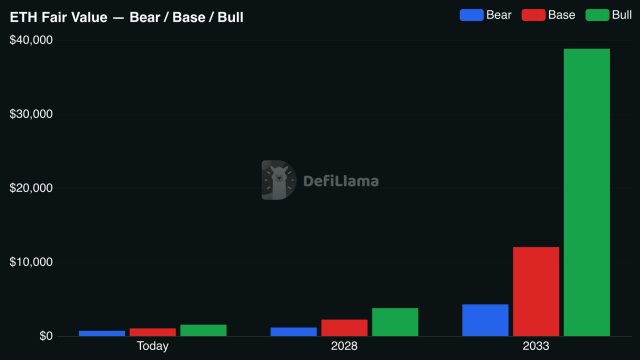
While these predictions may seem too ambitious, the expert has drawn investors’ attention to the doubling of stablecoins on ETH to $240 billion, the Glamsterdam upgrade in S1 2026, and rising institutional adoption each quarter as key drivers. “People selling ETH today are selling tomorrow’s finance infrastructure at a bargain price,” he added.
Furthermore, Julien noted that the Ethereum ecosystem generates $3.82 billion in fees every year, with layer 1 capturing $332 million and layer 2 networks handling the rest since the EIP-4844 launch. Given the accelerated growth, Julien believes that ETH is undervalued compared to what it’s going to become in the future.