The Myth Of USD Weakness Boosting Bitcoin: Inflation, Liquidity, Or Fear Changes The Outcome

bitcoinist发布于2026-01-27更新于2026-01-27

文章摘要

Bitcoin has declined below $87,000 amid ongoing selling pressure and macroeconomic uncertainty, raising questions about whether this is a temporary pullback or the beginning of a deeper correction. Concurrent US dollar weakness has revived the debate over whether a softer dollar inherently benefits Bitcoin. However, the relationship is not straightforward—it depends on the underlying cause of the dollar's decline. A weak dollar can support Bitcoin if it stems from inflationary pressures (promoting Bitcoin as "digital gold") or excess liquidity from rate cuts (driving capital into risk assets like crypto). But if the dollar weakens due to fear, risk aversion, or market stress—as seen recently with rumors of yen intervention—investors tend to flee to traditional safe havens like gold rather than Bitcoin. In such cases, Bitcoin behaves like a risk asset and falls alongside equities. Current outflows from Bitcoin ETFs reinforce that, in times of panic, investors still favor conventional refuges. For Bitcoin to rise, dollar weakness must coincide with risk appetite, not fear.

Bitcoin has slipped below the $87,000 level, extending its pullback as selling pressure and macro uncertainty keep traders on the defensive. After multiple failed attempts to regain key resistance zones, BTC is now trading in a fragile range where momentum remains weak, and liquidity conditions can amplify short-term moves. With risk appetite fading, the market is once again questioning whether this decline is a temporary shakeout or the start of a deeper corrective phase.

At the same time, the US dollar has been weakening, reigniting a familiar debate across financial markets: Does a softer dollar automatically lift Bitcoin? The answer is not that simple. A falling dollar can support BTC, but only under the right macro conditions. The driver is not the dollar itself, but why it is falling, and how investors interpret that shift in terms of risk.

In inflation-driven environments, dollar weakness can push capital toward hard assets, allowing Bitcoin to behave more like a “digital gold” narrative. In liquidity-driven cycles, rate cuts and easier financial conditions can also push investors into higher-beta assets like crypto.

But when the dollar declines due to stress, intervention fears, or escalating uncertainty, capital often rotates into traditional safe havens instead—leaving Bitcoin to trade like a risk asset alongside equities.

A Weak Dollar Isn’t Automatically Bullish For Bitcoin

A CryptoQuant report argues that the relationship between a falling US dollar and Bitcoin is indirect and conditional, not mechanical. In other words, a weaker dollar can support BTC, but only under specific macro regimes. The key variable is not the dollar move itself, but the underlying driver behind that devaluation and the broader risk environment investors are reacting to.
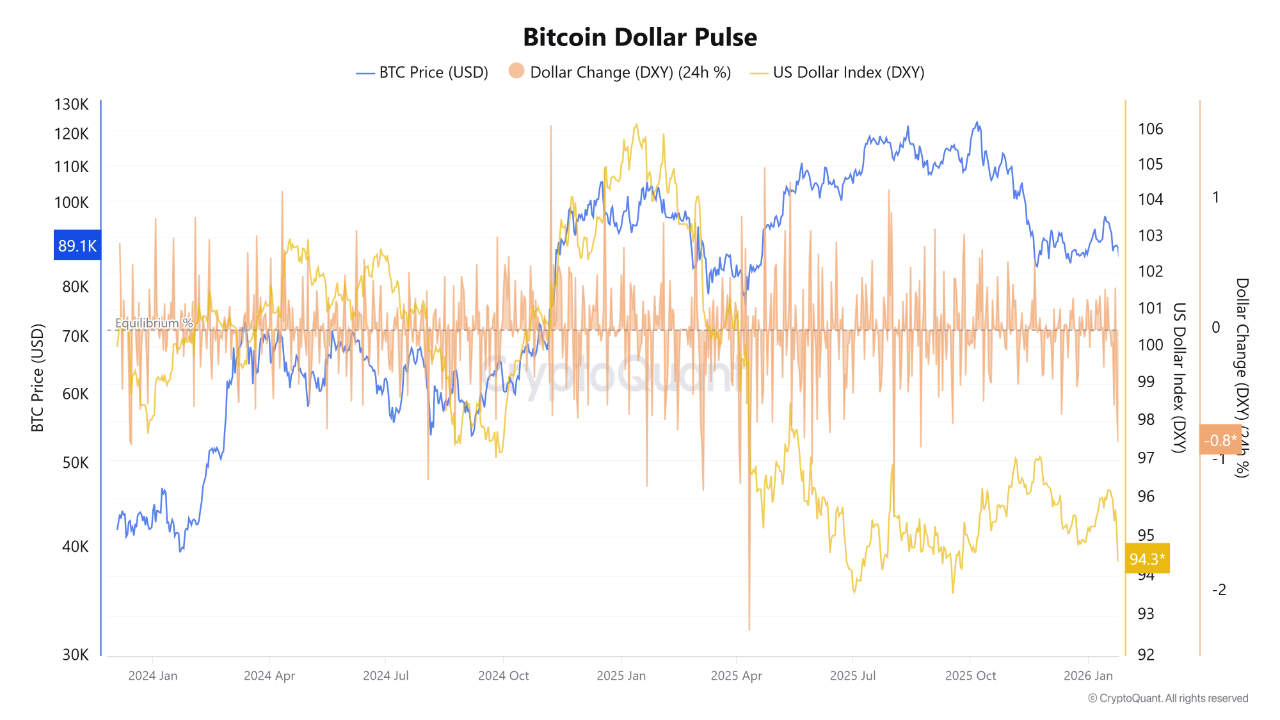
Bitcoin Dollar Pulse | Source: CryptoQuant

CryptoQuant outlines three scenarios. First, if dollar weakness reflects persistent inflation and a growing search for protection, Bitcoin can benefit as investors treat it like a form of “digital gold.” Second, if the decline is driven by rate cuts and excess liquidity, risk assets typically outperform, and cheaper capital can rotate into crypto as investors seek upside in higher-beta markets. In both cases, the dollar weakness aligns with conditions that can lift Bitcoin.

The third scenario, however, is the most important for the current market. If the dollar is weakening due to a confidence shock and extreme risk aversion—such as the present episode tied to rumors of yen intervention—crypto tends to fall alongside equities. In that environment, the weak dollar is only a backdrop, not a bullish engine.

The conclusion is clear: the market is rotating from the dollar into gold, while Bitcoin ETFs see heavy outflows, showing that in panic, investors still choose the traditional refuge. For Bitcoin to thrive, dollar weakness must come from risk appetite, not fear.


热门币种推荐

相关问答

QAccording to the article, what are the three scenarios in which the relationship between a weak US dollar and Bitcoin is analyzed?

AThe three scenarios are: 1) Dollar weakness driven by persistent inflation, which can benefit Bitcoin as a 'digital gold'. 2) A decline driven by rate cuts and excess liquidity, which helps risk assets like crypto. 3) A weakening due to a confidence shock and extreme risk aversion, where crypto falls alongside equities.

QWhy does a falling dollar not automatically lead to a rise in Bitcoin's price?

AA falling dollar does not automatically lift Bitcoin because the relationship is indirect and conditional. The key factor is not the dollar's move itself, but the underlying driver behind its devaluation and the broader risk environment. If the decline is due to fear or uncertainty, capital flows into traditional safe havens, not Bitcoin.

QWhat current market behavior shows that investors are choosing traditional safe havens over Bitcoin during a period of dollar weakness?

AThe article states that the market is rotating from the dollar into gold, while Bitcoin ETFs are seeing heavy outflows. This indicates that in a panic, investors still prefer the traditional refuge of gold over Bitcoin.

QIn what type of macro environment does Bitcoin behave more like 'digital gold' according to the article?

ABitcoin behaves more like 'digital gold' in an inflation-driven environment, where dollar weakness pushes capital toward hard assets as investors search for protection from inflation.

QWhat is the main conclusion of the CryptoQuant report mentioned in the article regarding the dollar-Bitcoin relationship?

AThe main conclusion of the CryptoQuant report is that the relationship between a falling US dollar and Bitcoin is indirect and conditional, not mechanical. For Bitcoin to thrive, dollar weakness must come from factors that boost risk appetite, such as inflation or excess liquidity, not from fear or uncertainty.

你可能也喜欢

SpaceX交易权限现已开放:WEEX上线SPCXON交易对

2026年6月,SpaceX完成了史上最大规模的IPO,但大量投资者因券商限制、开户障碍和地域壁垒而无法参与。加密货币交易所WEEX推出了解决方案SPCXON/USDT现货交易对。SPCXON是一种基于Ondo代币化股票框架构建的产品,旨在为美国以外的合格交易者提供追踪SpaceX经济收益的途径,以USDT结算,交易便捷,无传统券商门槛。 SpaceX IPO定价为135美元,首日收盘接近161美元,随后一度冲高至225美元,公司估值约1.75万亿美元。看涨理由基于星链收入增长、无可匹敌的发射频率以及星舰里程碑。看跌观点则认为,其估值已达营收的90-110倍,且存在流通股稀少和即将到来的内部持股解锁等风险。 需注意,SPCXON提供的是价格敞口,而非股票所有权,不包含投票权和直接股息。其价格可能相对净资产价值出现溢价或折价,交易者需关注价差。 WEEX平台整合了包括SpaceX、MicroStrategy和Micron在内的多种代币化股权产品,用户可在统一账户内交易加密货币和股权敞口。平台还提供高达400倍杠杆的加密货币期货交易。 WEEX成立于2018年,全球用户超过620万,提供超过1200个现货交易对,并设有1000 BTC保护基金。平台亦提供跟单交易和AI工具等功能。 免责声明:本文内容不构成投资建议。

TheNewsCrypto20小时前

SpaceX交易权限现已开放:WEEX上线SPCXON交易对

TheNewsCrypto20小时前

Gate 研究院:加密金融产品掀起“华尔街化”浪潮,是竞争还是融合?

2009年比特币的创世区块暗含对传统金融体系的批判,其理想是建立去中心化、去中介、去银行的点对点金融系统。然而十七年后,比特币现货ETF获批、贝莱德等巨头发行相关产品、CME推出受监管衍生品、RWA(真实世界资产)和代币化国债市场快速增长等现象,显示传统金融正系统性地介入加密资产的发行、定价、托管和分销环节,引发了加密市场是否“华尔街化”的讨论。 文章认为,这并非单方面的吞并,而是加密体系与传统金融的双向融合与互补。加密领域提供无许可开放性、24小时交易和可编程结算,但缺乏合规通道、机构级托管和主流分销网络;传统金融则拥有牌照、信任、资金和渠道,但受限于交易时间、跨境门槛和结算效率。双方正朝彼此的核心优势靠拢。 这种融合体现为两条路径:一是以Gate为代表的加密交易所,逐步从提供代币化美股、CFD差价合约,发展到接入真实股票、港股、韩股交易,成为连接加密账户与传统券商基础设施的前端入口;二是以Robinhood为代表的传统券商,通过收购加密交易所、推出股票代币和建设自有Layer 2,将加密资产和链上代币化产品整合进其平台。两者的共同目标是争夺下一代综合金融账户的入口,让用户在一个界面内交易多种资产。 同时,RWA和链上国债作为资产层的融合正在加速。尽管规模尚小,但代币化国债等产品为链上提供了低波动收益资产,并吸引JP摩根、贝莱德等传统机构参与,测试未来资本市场的底层结算方式。 最终,加密与华尔街并非谁征服谁,而是在共同塑造一个更高效、全球化的统一资本市场。用户未来或将在同一个账户中自由交易比特币、股票、ETF、链上国债等多种资产,体验无缝的跨资产配置。去中心化的理想仍在底层协议中延续,而在应用层,一个融合了双方优势的新金融形态正在形成。

marsbit20小时前

Gate 研究院:加密金融产品掀起“华尔街化”浪潮,是竞争还是融合?

marsbit20小时前

交易

现货

热门文章

加密市场宏观研报:《GENIUS Act》法案取得重大进展,BTC突破历史新高,后市全新展望

2025年5月22日,比特币价格正式突破11万美元大关,创下历史新高。在政策面、宏观经济、资金面与投资者结构共同作用下,一场结构性牛市浪潮正在展开。而此轮上涨背后的核心驱动,是美国《GENIUS稳定币法案》的实质性进展以及多项利好的叠加。本文将从政策端突破、宏观环境转向、链上与ETF资金结构、交易行为演化,以及重点受益赛道五大维度,全面解析此轮BTC再创新高的深层逻辑,并前瞻下半年市场的潜在趋势。

1.8k人学过发布于 2025.05.22更新于 2025.05.22

加密市场宏观研报:《GENIUS Act》法案取得重大进展,BTC突破历史新高,后市全新展望

相关讨论

欢迎来到HTX社区。在这里,您可以了解最新的平台发展动态并获得专业的市场意见。以下是用户对BTC(BTC)币价的意见。

活动图片