Speaking in a public X Spaces session on September 17, Cardano founder Charles Hoskinson outlined a set of behind-the-scenes discussions and integration pathways aimed at bringing XRP and Ripple USD closer to Cardano’s stack, describing a “package for XRP” that spans wallet support, a DeFi execution layer, and a standards-based route for Ripple’s stablecoin to deploy across multiple ecosystems.
“We’ve had a few calls with the Ripple USD team. We’ve talked to Flair, we’ve talked to John Deaton, you know, we’ve talked to Brad [Garlinghouse], and we’ve definitely had discussions with a variety of people from the XRP ecosystem. And we want to build a package for XRP,” Hoskinson said, framing the outreach as part of a broader cross-ecosystem strategy rather than a single bilateral tie-up.
Cardano Founder Unveils Plans For XRP And RLUSD
On the product side, Hoskinson said the plan begins with user-level access and extends into application deployment and liquidity. “Lace [wallet] will support XRP as one of the improved emergency support,” he noted, adding that “we have a DeFi layer for XRP that uses Midnight Cardano. So it’s very easy to use XRP smart contracts and deploy XRP applications without requiring foundation changes to XRP’s design.” He positioned that approach as a way to let XRP developers ship without altering the XRP Ledger’s base-layer architecture.
The Cardano founder also described exploratory workstreams with projects adjacent to the XRP ecosystem. “As certain XRP projects like Flair, we’d like to find a path to get them into the Cardano banking system,” he said, indicating that teams building on or around XRP could be onboarded to Cardano infrastructure if technical and commercial conditions are met.
A separate through-line in the discussion was Ripple USD’s go-to-market design and its sensitivity to the policy environment around stablecoin yields. “With the Ripple USD, we talked to them starting last year right when they announced,” Hoskinson said.
“They said, look, we just got out. We just got our prices. It’s been a long road. There’s a lot going on. Come back in a little bit and talk more deeply. And now we’re on the other side of it. And I think there’s definitely a path to have that conversation.”
He added that the team wanted clarity on “where Genius was going to go, because that would have a huge impact on the overall landscape of stablecoins in general. The reason being is that, you know, can you offer a yielder with your stablecoin? And the answer is currently no from the Genius side. So that had to get passed. And now that that’s passed, we’re starting to think about their longer term commercialization plans.”
From an integration-architecture perspective, Hoskinson advocated that Ripple USD avoid bespoke, one-off listings and instead adopt a standardized, market-driven onboarding model. “What we’ve advocated for with Ripple USD is for XRP, for Ripple to push for a self-serve listing model, like Coinbase has with Rosetta,” he said.
“So they basically create a framework. And then if an ecosystem is interested in supporting Ripple USD, basically what they do is they certify against that standard and they do all the implementation work. And as long as that work is done correctly, then they get preferential consideration for where Ripple USD gets deployed.”
The rationale, according to Hoskinson, is to keep Ripple USD’s expansion neutral and scalable across chains while lowering coordination overhead. “After Ethereum and whatever, you have to kind of think, okay, well, what’s next? And there’s 14,000 options and they don’t really want to be in the business of picking winners and losers a lot. You want to go where the demand is, the desire is, and you also want to have a lot of moving pieces for—you want to remove a lot of the moving pieces from the integration complexity,” he said.
He added that neither side is natively expert in the other’s architecture, underscoring the need for open standards: “The XRP team is by far not an expert on our architecture. Why would they be? We’re very bespoke and exotic. And similarly, we’re not experts in XRP architecture. So we need to open standards and basically help people sort that out.”
Charles Hoskinson yesterday on behind the scenes plans for $XRP and Ripples $RLUSD.
> XRP yield opportunities on Cardano with various integrations e.g Flare.
> Talks with RLUSD Team to get it on Cardano.Interestingly he mentions a self service framework he wants for RLUSD,… pic.twitter.com/t0jiuw9KKf
— Vet 🏴☠️ (@Vet_X0) September 18, 2025
In the process, Hoskinson hinted that Cardano would make the first technical moves where appropriate and only then discuss commercial terms. “If an ecosystem is interested, we have to make the first move. We make that first move and then after doing it, enter commercial negotiations to figure out the next step after that,” he said.
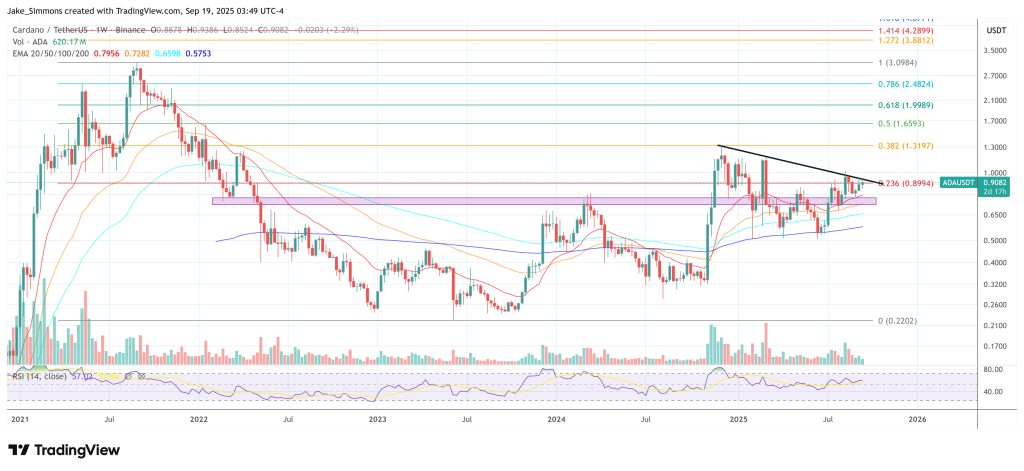
At press time, ADA traded at $0.90.

Related Posts