What is DOP?
DOP (Data Ownership Protocol) is a data ownership protocol based on the Ethereum blockchain. It aims to empower users with the ability to selectively disclose their on-chain data through encryption technologies. DOP utilizes Zero-Knowledge Proofs (ZK-SNARKs) and Elliptic Curve Digital Signature Algorithm (ECDSA) to ensure that users can independently choose which transaction and asset holding information to disclose without revealing sensitive information.
The core goal of DOP is to address the issue of complete transparency of user data in Web3 and blockchain systems, providing a new way to protect privacy while maintaining the auditability and immutability of on-chain activities. Through the DOP platform, users can selectively showcase their NFT collections while keeping their account balances and transaction patterns private. Additionally, DOP supports ERC20, and ERC721, and ERC1155 token standards, allowing users to selectively disclose their token holdings and transaction histories.
DOP also emphasizes decentralized governance. It monitors platform risks through a DAO-elected node operators' committee and maintains a shared wallet blacklist to prevent misconduct and money laundering activities. The internal ecosystem of the DOP platform encourages developers to build decentralized applications (dApps) that support user-controlled selective disclosure functions.
Overall, DOP is a protocol dedicated to enhancing blockchain user privacy protection and data ownership. It provides users with more control and a better user experience through advanced encryption technologies and decentralized governance mechanisms.
Utility Functions of DOP
The DOP token plays a vital role in the entire Data Ownership Protocol. Here are its primary functions:
Fee Payments
• Internal Transaction Fees: Users of the DOP protocol need to pay fees when conducting internal transactions. These fees include:
○ 10 DOP tokens per internal transaction.
○ 0.1% of the transaction amount for encryption and decryption as native token fees.
• Automatic Conversion: The DOP protocol automatically converts transaction asset fees into DOP tokens, where :
○ 75% of the converted DOP tokens are permanently burned.
○ 25% of the converted DOP tokens are distributed to DOP token stakers.
This fee payment mechanism simplifies the user experience and reduces the circulating supply in the market through token burning, thereby incentivizing users to participate in and support the network's development.
Governance
• Community Proposals and Voting: DOP token holders can participate in community governance by proposing new features or changes to protocol parameters and voting through a UI dashboard.
○ Voting Weight: Voting weight is calculated based on the total amount of DOP tokens held by the user. Users with more tokens have a greater influence in decision-making, encouraging them to hold more tokens to increase their voice in protocol governance.
This governance mechanism ensures that the protocol's development and adjustments reflect the collective wisdom and values of the community. The decentralized governance model also enhances the transparency and fairness of the protocol.
Incentives and Rewards
• Staking Rewards: Users who participate in staking within the DOP protocol can earn rewards by staking DOP tokens. These rewards come from the remaining 25% of the conversion transaction fees and are distributed to stakers who support the network's operation.
• DAO Incentives: DAO members earn DOP token rewards by reviewing proposals, conducting investigations, and maintaining blacklists. This incentivizes the community to actively participate in governance and risk monitoring.
The DOP token serves multiple roles within the protocol. It is not only used for paying transaction fees and participating in governance but also as part of the incentive mechanism, rewarding users who support and contribute to the protocol's development. This multi-functional token design ensures the long-term stability and sustainability of the DOP protocol, providing users with flexible and powerful tools to manage their digital assets and participate in community governance.
Token Distribution
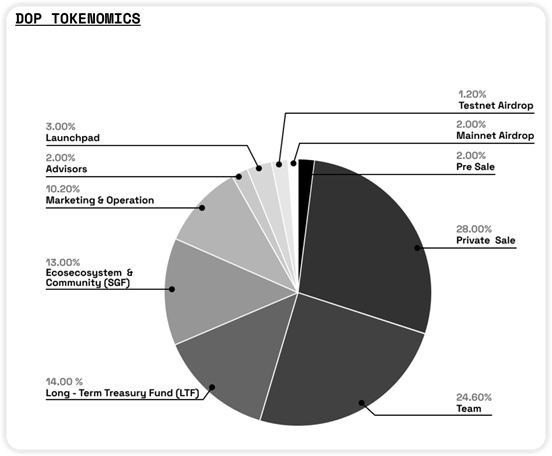
The token distribution plan for DOP is as follows:
Pre Sale
• Allocation: 2.00% of total supply
• Quantity: 467,403,737 DOP tokens
• Purpose: Distributed to early supporters
• Release Schedule: Linearly released over 5 months after a 5-month cliff
Private Sale
• Allocation: 28.00% of total supply
• Quantity: 6,543,652,319 DOP tokens
• Purpose: Open to private community participation
• Release Schedule: Fully released at Token Generation Event (TGE)
Team
• Allocation: 24.60% of total supply
• Quantity: 5,749,065,966 DOP tokens
• Purpose: Rewards for core contributors to support long-term vision and capability growth
• Release Schedule: Linearly released over 24 months after a 12-month cliff
Long-Term Treasury Fund (LTF)
• Allocation: 14.00% of total supply
• Quantity: 3,271,826,159 DOP tokens
• Purpose: Used for long-term strategic purposes such as supporting DOP development, security bounties, staking rewards, community initiatives, and strategic partnerships
• Release Schedule: Linearly released over 24 months after a 6-month cliff
Ecosystem and Community (SGF)
• Allocation: 13.00% of total supply
• Quantity: 3,038,124,291 DOP tokens
• Purpose: Incentives for third-party developers, integration efforts, and grassroots enthusiasm to drive adoption
• Release Schedule: Linearly released over 36 months
Marketing and Operations
• Allocation: 10.20% of total supply
• Quantity: 2,383,759,059 DOP tokens
• Purpose: Resources for coordinated awareness, education, and partnerships
• Release Schedule: Linearly released over 36 months
Advisors
• Allocation: 2.00% of total supply
• Quantity: 467,403,737 DOP tokens
• Purpose: Compensation to external experts providing indispensable growth and strategy guidance
• Release Schedule: Linearly released over 24 months after an 8-month cliff
Others (Launchpad and Airdrop)
• Allocation: Approximately 6.2%
• Purpose: Includes various allocations for Launchpad listing support and user participation incentives
Total Supply
• Effective Total Supply: 100.00% of total supply, i.e., 23,370,186,853 DOP tokens
• Minted Total Supply: 23,447,160,768 DOP tokens
A 0.33% adjustment in the team token allocation is expected to be burned upon team token unlocking to account for testnet sales and other adjustments.
Why Choose DOP?
The reasons for choosing DOP (Data Ownership Protocol) are primarily focused on its unique features and advantages, which address several key issues in the current blockchain and Web3 ecosystem. Here’s a detailed analysis:
User Privacy and Data Control
• Selective Disclosure: DOP allows users to selectively disclose or hide on-chain data. This means users can publicly display the content they want (such as NFT holdings) while hiding other sensitive information (such as account balances and transaction details).
• Zero-Knowledge Proofs (ZK-SNARKS): By utilizing ZK-SNARKS, users can verify the correctness of data without revealing the data itself, ensuring privacy while maintaining data integrity.
Seamless Integration with the Ethereum Ecosystem
• dApp Interoperability: DOP can seamlessly integrate with decentralized applications on Ethereum, enabling users to leverage DOP's privacy features while using various Ethereum dApps, such as decentralized exchanges (DEXs), prediction markets, and DeFi protocols.
Flexible Token Economics
• Fee Payments and Rewards: Users pay fees for using the protocol’s features with DOP tokens. Most of these tokens are permanently burned, with a portion rewarded to stakers. This mechanism not only reduces the token supply but also encourages user participation and network support.
• Multiple Payment Options: Users can directly pay fees with the assets they are transacting. The DOP protocol automatically converts these fees into DOP tokens, simplifying the user experience.
Diverse Token Support
• Broad Token Compatibility: DOP supports ERC20 and, ERC721, and ERC1155 token standards, allowing users to selectively disclose their token holdings and transaction histories. Users can flexibly display partial holdings, such as publicly showing ownership of over 2 ETH without revealing the exact amount.
Robust Internal Ecosystem
• Developer-Friendly: The features provided by DOP enable developers to build decentralized exchanges, NFT marketplaces, prediction markets, and liquidity pools within its ecosystem, embedding user-controlled selective disclosure functions and fostering the growth of the decentralized finance (DeFi) ecosystem.
• Third-Party Wallet Compatibility: DOP seamlessly integrates with various external wallets, ensuring that users can interact with DOP using their preferred wallets, enhancing user experience and convenience.
Summary
DOP offers an innovative blockchain solution that addresses user privacy and data control through selective disclosure, privacy protection, decentralized governance, and flexible token economics. These features give DOP a significant competitive edge in the current blockchain and Web3 ecosystem, making it a worthy choice for users.
Appendix
• Official Website: https://dop.org/
• Twitter: https://x.com/dop_org
• Start Trading: https://www.htx.com/zh-cn/trade/dop_usdt?type=spot