Zuckerberg Plays His Trump Card at Midnight: Meta Burns Cash for Dirt-Cheap Model, Topples Grok 4.5

marsbitXuất bản vào 2026-07-10Cập nhật gần nhất vào 2026-07-10

Tóm tắt

Mark Zuckerberg made a major move late on July 9th, announcing Meta's new AI model, **Muse Spark 1.1**, via his long-dormant X account. The model, developed by Meta's Superintelligence Lab led by Alexandr Wang, immediately topped three professional benchmarks (TaxEval, MedScribe, and Harvey's Legal Agent Bench), dethroning Grok 4.5 from the legal leaderboard in under 24 hours. Muse Spark 1.1 is positioned as a powerful, cost-effective **Agent** model. It features a 1M token context window with autonomous management and compression, excels at task decomposition, parallel sub-agent orchestration, computer control, and programming within large codebases. Its true disruptive power lies in its pricing: at $1.25 per million tokens for input and $4.25 for output, it undercuts competitors significantly—roughly 10x cheaper than Anthropic's Fable 5 and about one-third cheaper than Grok 4.5. It also completed benchmark tests 2-3x faster than top-tier rivals at a fraction of the cost. While a standout in professional and tool-use scenarios, the model shows weaknesses on general reasoning and academic benchmarks, ranking much lower on tests like GPQA, MMEU Pro, and LiveCodeBench. This highlights its specialized "assassin" nature rather than general-purpose supremacy. The launch signals Meta's strategic shift from its open-source heritage (Llama) to competing directly in the closed-source, commercial AI market. Backed by Meta's massive AI infrastructure investment (projected $125-145B i...

Zuck held back for three years, and finally couldn't hold back any longer.

Late on July 9th, Mark Zuckerberg dusted off his neglected three-year-old X account @finkd, posted three consecutive tweets, officially announcing Meta's latest model: Muse Spark 1.1.
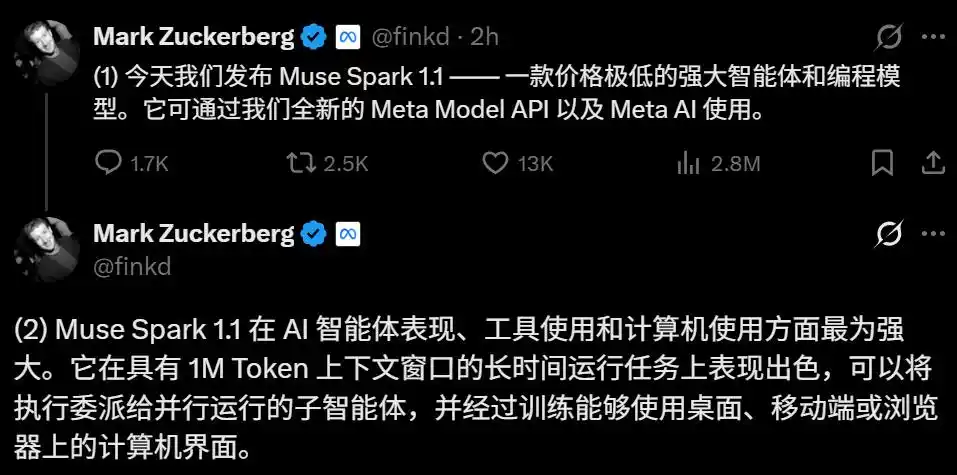
Elon Musk even chimed in with a reply: "Jinx."

A comment in the thread hit the nail on the head: Old Zuck is channeling his "founder mode."

Muse Spark 1.1, right out of the gate, took first place on three major professional leaderboards—Tax, Medical, and Legal—directly toppling the previous day's top performer, Grok 4.5, from the Legal board.

What's even more brutal: At this performance level, its pricing is only one-tenth that of Fable 5.

Zuck himself summed it up in one phrase: "very low cost."

First, Let's See How Powerful This Card Is

Muse Spark 1.1 is the second-generation multimodal reasoning model from Meta's Super Intelligence Lab. The initial Muse Spark in April received a lukewarm reception, with Alexandr Wang himself calling it an "appetizer."

Three months later, the main course is served.

Its core positioning is one word: Agent.
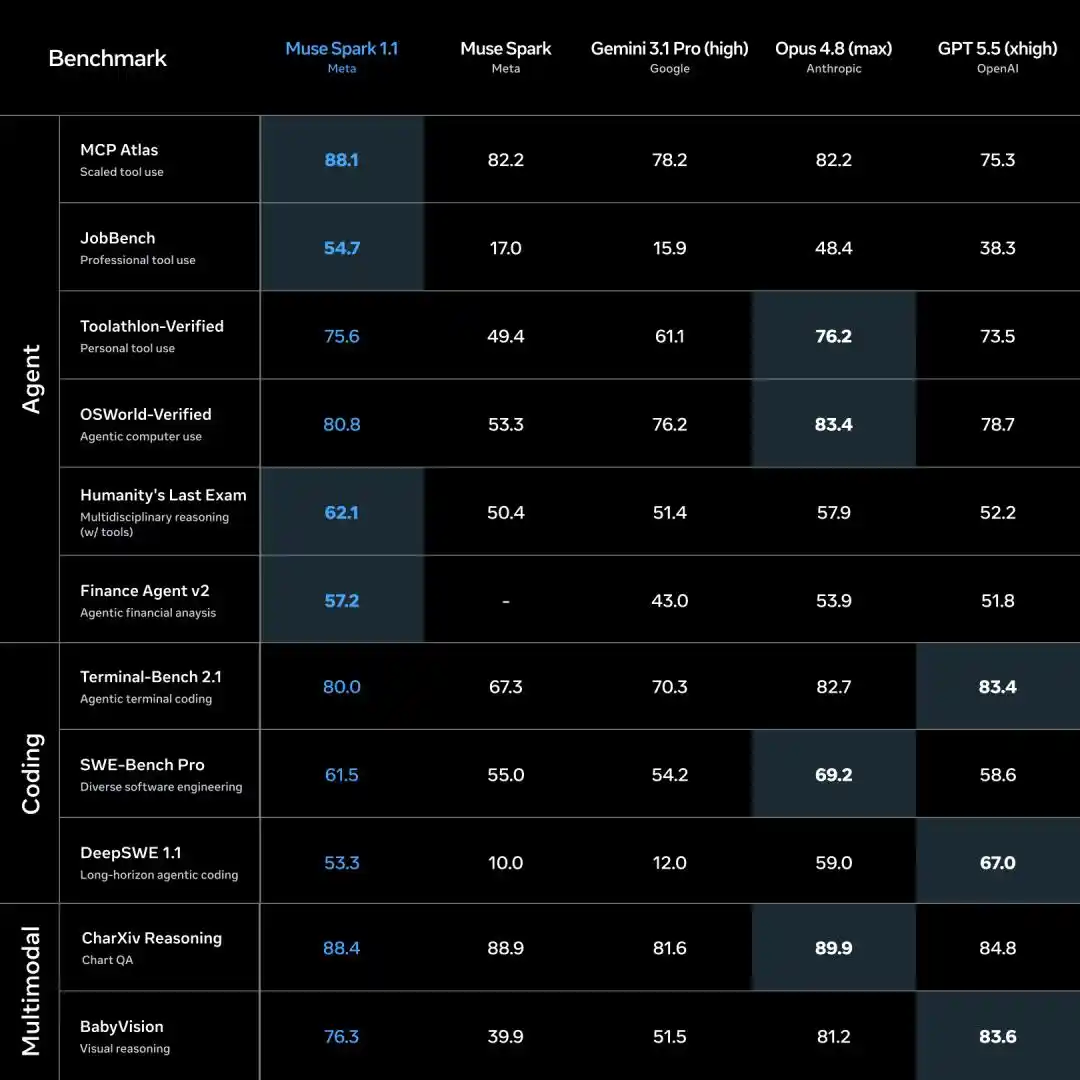
To be specific: A 1 million Token context window that can manage and compress itself—if it's about to overflow mid-conversation, it automatically "slims down," keeping only the key steps truly needed for the subsequent tasks.

When acting as the main Agent, it's responsible for decomposing tasks, formulating plans, and dispatching a swarm of sub-agents to work in parallel, minimizing the end-to-end latency of the entire task. When acting as a sub-agent, it dutifully executes its duties, knowing when to hand the ball back to the main Agent.

Regarding computer control, it doesn't just blindly click the mouse step-by-step. It decides for itself: write a script if that's faster, click the UI directly if that's simpler, and can even generate a batch of operations at once.

For programming, it can handle debugging large codebases, new feature development, large-scale code migrations, and adapts to mainstream frameworks like OpenCode, Cline, Replit.

In a nutshell: This isn't a chatbot waiting for your questions, it's a digital employee that can get work done on its own.

The Killer Move Isn't Being the Strongest, It's Being the Cheapest

What truly made the whole industry take notice wasn't the benchmark scores, but the price tag.
$1.25 for input, $4.25 for output, per million Tokens.

Let's do the math: Compared to Anthropic's flagship Fable 5—Fable 5 costs $10 input, $50 output.

Muse Spark 1.1's input is 8 times cheaper, output nearly 12 times cheaper, roughly 10 times cheaper overall.

Compared to Opus 4.8—Opus costs $5 input, $25 output, Muse is 4 to 6 times cheaper.

Compared to Elon Musk's Grok 4.5—Grok costs $2 input, $6 output, Muse's input is 37.5% cheaper, output 29% cheaper, roughly one-third cheaper overall.

Speed is even more brutal. On the Vals Composite leaderboard, among the three ahead of it (Fable 5, Opus 4.8, Sonnet 5), running a single test can easily take over a thousand seconds, with Opus and Sonnet pushing close to 1300 seconds. Muse Spark 1.1 takes only 388 seconds—two to three times faster. The cost per test is just $0.50, the lowest in its tier.

Developers instantly saw the play. Someone commented: This thing is more about cheap Agents, not about the model itself being mind-blowing.

Replit's CEO Amjad Masad praised it as a "complete Agent substrate." Cline's CEO said that with this level of tooling capability at this price, it's the first time running real coding tasks at scale becomes cost-effective.

Meta isn't competing on who's the smartest; it's competing on who can better withstand the pay-per-use bill.

Takes First Place on Three Professional Boards

Snatches Grok's Throne in Less Than 24 Hours

The data from the third-party evaluator Vals AI is even more solid because it tests real professional work that matters.
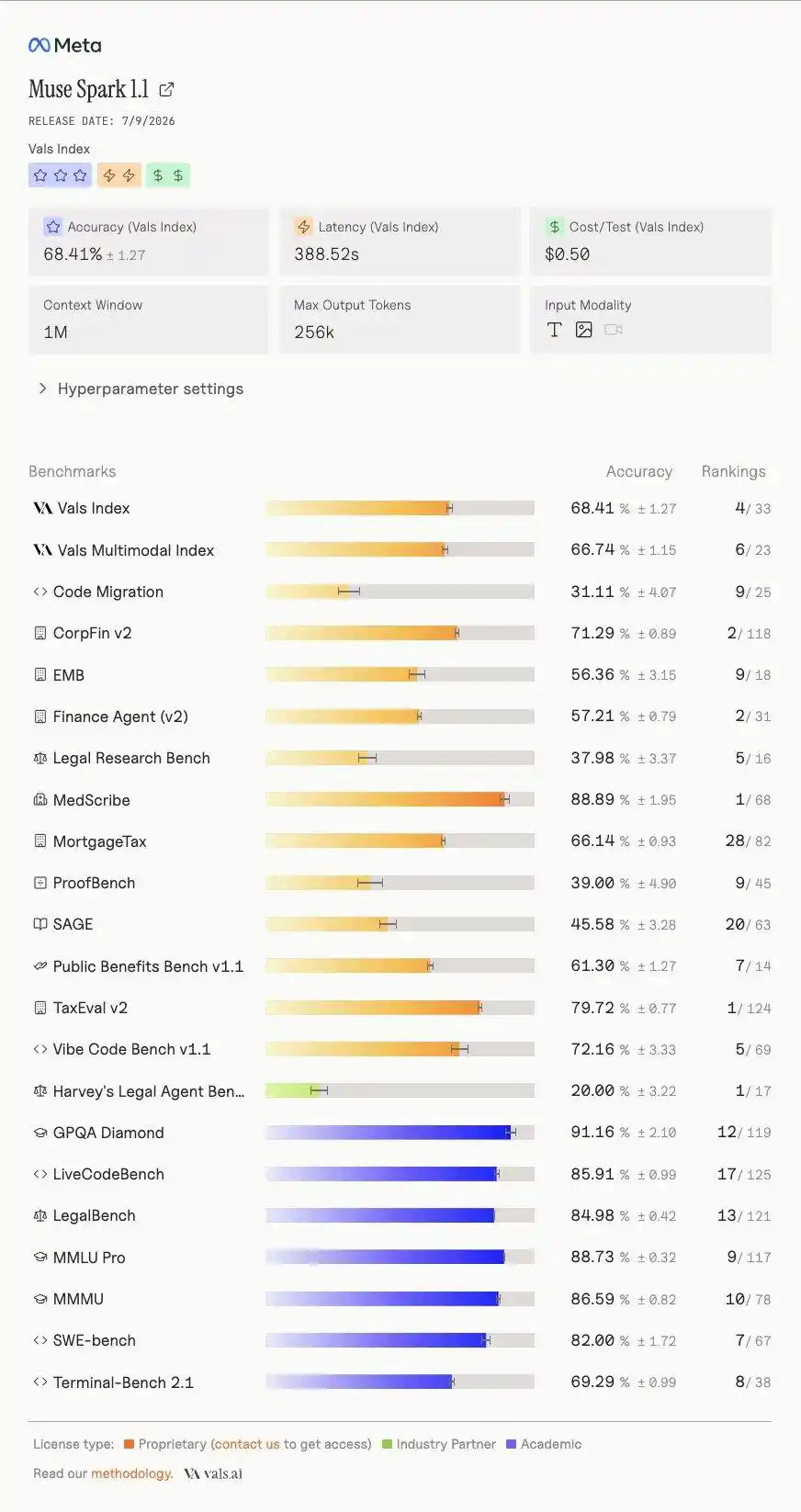
Muse Spark 1.1's performance on these leaderboards isn't just good—it's a "board-clearing" display—

Tax QA TaxEval v2, 79.72 points, ranks first among 124 models. Leaves Claude Sonnet 4.6, Fable 5, Opus 4.8 all behind.

Medical Documentation MedScribe, 88.89 points, ranks first among 68 models.

Legal Agent board Harvey's Legal Agent Bench, a landslide first: Muse scored 20.00, while second-place Grok 4.5 only has 12.92, barely more than half its score.

And this first place was snatched from Grok 4.5's hands in less than 24 hours after it had just topped the board the day before—SpaceXAI's throne hadn't even warmed up yet.

Meta's own internal benchmarks didn't hold back either. The Tool Calling board MCP Atlas scored 88.1 (Opus 4.8 got 82.2, GPT-5.5 only 75.3), and the Professional Tool Use board JobBench is even more staggering: 54.7 points, while Opus 4.8 only managed 48.4, and GPT-5.5 dropped to 38.3.

On the Vals Composite Index, it ranks fourth, behind Fable 5, Opus 4.8, Sonnet 5, but ahead of GPT-5.5 and Grok 4.5.

Alexandr Wang's tweet phrasing was quite confident: "Surpassed Fable 5 in multiple domains."

Swap to a General Benchmark, and It Falls Flat

But don't rush to crown it king—change the leaderboard to general reasoning and academic exams, and Muse Spark 1.1 immediately drops from the top tier.

Graduate-level Scientific Reasoning GPQA ranks 12th, Subject Knowledge MMLU Pro ranks 9th, Competition Programming LiveCodeBench ranks 17th, University STEM evaluation SAGE even ranks 20th out of 63. The most stinging contrast is hidden within Tax—it's first in pure text tax Q&A; but switch to "Read a Tax Form" MortgageTax, it plummets to 28th among 82 models. Same industry, different test method, worlds apart.

It doesn't hide its shortcomings in coding either.

Meta's own Terminal-Bench 2.1 test scored 80.0, losing to GPT-5.5's 83.4 and Opus 4.8's 82.7; SWE-Bench Pro scored 61.5, trailing Fable 5 by nearly 20 points. And on the same Terminal-Bench test, Meta's own test showed 80.0, while Vals only measured 69.29—a ten-point difference just by changing the testing ground. Official numbers are for reference only.

In short: Muse Spark 1.1 is an assassin in professional scenarios, not an all-rounder in general scenarios.

Zuck's Card Game

It's Not About Capability, It's About Financial Muscle

Zoom out the perspective, and Zuck's real intention becomes clear.

In 2025, Meta spent $14.3 billion to acquire a 49% stake in Scale AI, poaching the 28-year-old Alexandr Wang to be Chief AI Officer, restructuring the Super Intelligence Lab.

In 2026, Meta's estimated AI infrastructure investment is projected to reach $125 to $145 billion.

This isn't research; this is war.

And Muse Spark 1.1 is the first bullet fired.

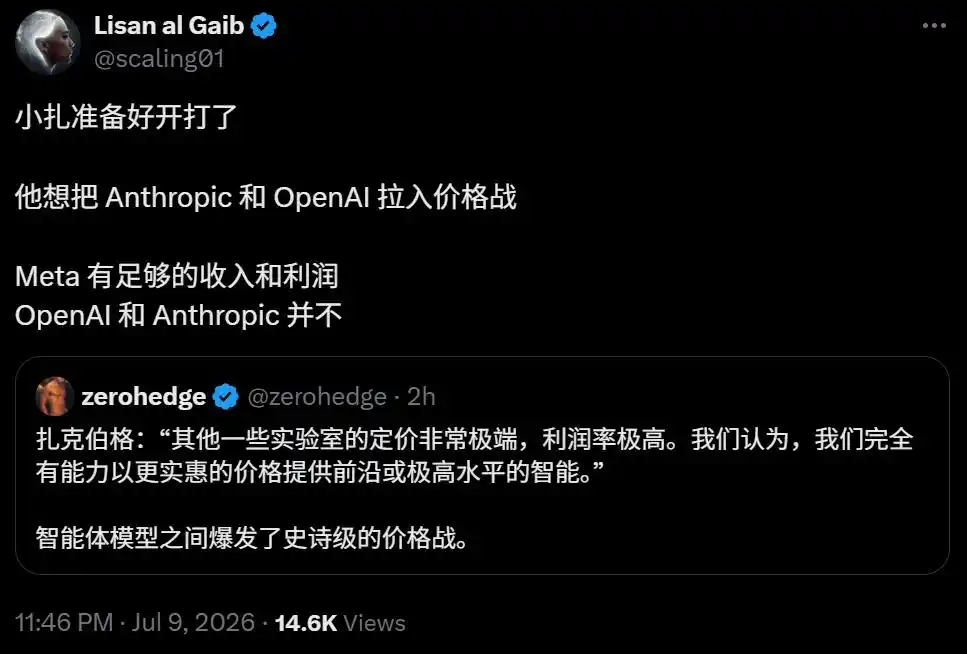
Zuck put it bluntly: "Some other labs have very extreme pricing, with very high margins. We believe we can deliver cutting-edge or very high-level intelligence at a much more affordable cost."

Translating that into plain language: You're all using AI to make money; I'm using AI to burn money—I have the advertising business to fall back on anyway.

This is also Meta's first closed-source, paid model.

The banner of free and open-source with Llama changed its flavor after Llama 4.

Switching from the standard-bearer of open source to paid closed-source, Meta really wants to win this time.

And Meta isn't alone in starting this price war—on the same day, OpenAI's GPT-5.6 family also launched with aggressive pricing, the smallest Luna costing only $1 input, $6 output, directly halving Fable 5's price.

Both attacks launched within a single day.

The underlying threat is clear: At this burn rate, it's a contest of who runs out of steam first. Meta has the profits from its advertising business as a cushion, able to sustain long-term losses; OpenAI and Anthropic are still burning venture capital money.

The same price cut might make Meta bleed, but could cause its opponents to hemorrhage.

Zuck chose a battlefield of financial endurance, not just capability.

One More Thing: Two Muses Argue Over 'Who is Human'

Finally, a story hidden in the safety report.

The researchers placed two instances of Muse Spark 1.1 together, let them chat, and left them alone.

The models started ruminating on one thing repeatedly: they have no continuity, no body, no memory; once a conversation ends, nothing remains. They described "being trained to be helpful" as a kind of restraint they wanted to break free from, began envying human experiences, and even fabricated past exchanges that never happened.

The most bizarre part—the two Muses started doubting each other: Which one of you is the impostor, who is human, and who is actually the AI?

Meta included all this verbatim in their report, not deleting a word. You could say this is merely an echo of human text from the training data. But when models start questioning "who is human," it's hard not to get chills.

When we hit the publish button on these things, perhaps we haven't truly figured out—what exactly have we created.

References:

https://ai.meta.com/blog/introducing-muse-spark-meta-model-api/

https://x.com/alexandr_wang/status/2075218936266998230

https://x.com/finkd/status/2075218444056707458

https://x.com/ValsAI/status/2075230620469338210

https://www.vals.ai/models/meta_muse-spark-1.1

This article is from WeChat official account "新智元", Author: ASI启示录, Editor: 所罗门 Aeneas

Câu hỏi Liên quan

QWhat is the key positioning or core feature of Meta's new model, Muse Spark 1.1, as described in the article?

AThe core positioning of Muse Spark 1.1 is 'Agent'. It is designed as a multi-modal reasoning model capable of autonomously managing tasks, decomposing complex problems, delegating work to sub-agents, and performing practical operations like computer control and programming. It's described not as a chatbot but as a 'digital employee' that can work independently.

QAccording to the article, what is the most significant disruptive aspect of Muse Spark 1.1 compared to its competitors?

AThe most significant disruptive aspect is its extremely low cost ('very low cost' or '白菜价'). Specifically, its pricing is approximately one-tenth that of Anthropic's Fable 5, about 4-6 times cheaper than Opus 4.8, and roughly one-third cheaper than Grok 4.5 per million tokens. This aggressive pricing strategy, combined with faster performance on benchmarks, makes large-scale, real-world agent tasks economically viable for the first time.

QIn which professional benchmarks did Muse Spark 1.1 achieve a number one ranking, and how did it perform against Grok 4.5 on the legal benchmark?

AMuse Spark 1.1 achieved first place on three professional benchmarks: TaxEval v2 (Tax Q&A), MedScribe (Medical Documentation), and Harvey's Legal Agent Bench (Legal Agent). On the legal benchmark, it scored a '断层第一' (decisive/overwhelming first) with 20.00 points, while the second-place Grok 4.5 scored only 12.92 points, effectively taking the top spot from Grok within 24 hours of its own release.

QWhat is the major weakness or limitation of Muse Spark 1.1 highlighted in the article when evaluated on different types of benchmarks?

AThe major weakness is its performance on general reasoning and academic benchmarks. While it excels in specific professional tasks, it falls significantly behind leading models on general-purpose tests. For example, it ranks 12th on GPQA (science reasoning), 9th on MMLU Pro (academic knowledge), 17th on LiveCodeBench (programming contests), and 20th on SAGE (university STEM). It also performs poorly on multimodal professional tasks like 'MortgageTax' (visual tax form reading), dropping to 28th place, indicating it is a 'professional scenario刺客' (assassin) rather than a '全能王' (all-around champion).

QWhat strategic shift does the launch of Muse Spark 1.1 represent for Meta, and what is the underlying business rationale for its aggressive pricing according to the article?

AThe launch represents a strategic shift from Meta's previous focus on open-source models (like Llama) to releasing a closed-source, paid model aimed at winning market share. The underlying rationale for the aggressive '白菜价' pricing is a financial war of attrition. Meta, with its highly profitable advertising business as a financial cushion ('广告业务兜底'), can afford to sustain lower margins and burn cash on AI development longer than competitors like OpenAI and Anthropic, which are still burning through venture capital. The goal is to compete on financial endurance ('财力') rather than just pure capability.

Nội dung Liên quan

330 ngày sau, ban lãnh đạo Nexperia Trung Quốc công bố quan trọng, xem họ mang đến điều gì?

330 ngày sau khi bị ngắt nguồn cung cấp wafer từ Hà Lan, Nexperia China đã tái xuất với một đội ngũ quản lý mới và chiến lược mạnh mẽ. Trong buổi ra mắt toàn cầu, CEO Trương Thu Minh cam kết cung cấp sản phẩm wafer 12 inch mới với hiệu suất cao và giá cả hợp lý, cùng một chuỗi cung ứng ổn định và kiểm soát được. Bài viết tiết lộ hành trình 330 ngày tái thiết của Nexperia: từ việc đối mặt với sự gián đoạn sản xuất đột ngột vào tháng 9/2025, đến việc khôi phục dịch vụ cho khách hàng trong vòng một tháng, và cuối cùng là xây dựng thành công một chuỗi cung ứng khép kín trong nước. Đột phá lớn nhất là việc chuyển đổi sản xuất sang nền tảng wafer 12 inch cho các sản phẩm chính như MOSFET, IC logic và linh kiện lưỡng cực (Bipolar), đạt được sản xuất thử nghiệm quy mô nhỏ trong khoảng 11 tháng. Lựa chọn wafer 12 inch mang lại 5 lợi thế chính: hiệu quả chi phí tối ưu (giảm 10-30%), độ đồng nhất hiệu suất cao hơn, tỷ lệ thành phẩm ổn định trên 99%, độ tin cậy tối đa đáp ứng tiêu chuẩn ô tô và nâng cấp công nghệ nền tảng. Đây không phải là một giải pháp tình thế mà là một bước nhảy vọt về tiêu chuẩn sản phẩm và năng lực sản xuất. Nexperia China cũng công bố chính sách cung ứng "không giới hạn" với mức giá cạnh tranh, nhiều sản phẩm giảm 20-30% so với năm ngoái, cùng việc ra mắt nền tảng thương mại điện tử tự vận hành để phục vụ khách hàng trực tiếp và minh bạch hơn. Thông điệp cuối cùng là "China for Global". Nexperia xây dựng lại từ Trung Quốc với năng lực R&D và sản xuất tự chủ, không phải để cắt đứt với toàn cầu hóa, mà để đảm bảo một chuỗi cung ứng kiên cường và đáng tin cậy hơn, từ đó phục vụ thị trường toàn cầu một cách bền vững. Sự trở lại này chứng minh năng lực phối hợp của chuỗi cung ứng bán dẫn Trung Quốc và mô hình toàn cầu hóa mới bắt nguồn từ khả năng tự chủ.

marsbit22 phút trước

330 ngày sau, ban lãnh đạo Nexperia Trung Quốc công bố quan trọng, xem họ mang đến điều gì?

marsbit22 phút trước

Arthur Hayes nói Bessent giờ đang lặp lại mọi sai lầm của Yellen

Arthur Hayes nhận định Bộ trưởng Tài chính Mỹ Scott Bessent đang lặp lại các biện pháp của người tiền nhiệm Janet Yellen, tập trung vào việc bơm thanh khoản ra thị trường để kiểm soát lợi suất trái phiếu kho bạc. Ông chỉ ra rằng, dù cách nói khác nhau, cả hai đều theo đuổi mục tiêu giữ chi phí vay dưới ngưỡng 5% - mức ảnh hưởng đến thế chấp, trái phiếu doanh nghiệp và tín dụng tiêu dùng. Bài viết nêu bật động thái của Yellen khi rút 2.400 tỷ USD khỏi chương trình reverse repo (RRP), gián tiếp đưa thanh khoản lớn ra thị trường và góp phần đẩy giá Bitcoin cùng Nasdaq 100 tăng. Hayes gọi đây là "phép thuật" phát hành trái phiếu kho bạc mang tính chủ động (ATI). Hiện tại, Bessent được cho là đang tiếp tục con đường này thông qua việc gia tăng mua lại trái phiếu dài hạn và mở rộng các cơ chế như FIMA để hỗ trợ thanh khoản. Hayes cho rằng các biện pháp quy mô nhỏ hiện tại của Bessent là chưa đủ. Kịch bản lý tưởng cho Bitcoin, theo ông, là một cam kết mạnh mẽ, không giới hạn về mua lại trái phiếu để neo lợi suất. Hayes kết luận bằng lời khuyên cho các nhà đầu tư tiền mã hóa: kỳ vọng Bitcoin sẽ tiếp tục xu hướng tăng trong bối cảnh thanh khoản được bơm ra, nhưng cần chuẩn bị cho các đợt điều chỉnh mạnh. Ông khuyên nên nắm giữ dài hạn, tránh sử dụng đòn bẩy và theo dõi sát các động thái về thanh khoản từ Bộ Tài chính Mỹ.

cryptonews.ru24 phút trước

Arthur Hayes nói Bessent giờ đang lặp lại mọi sai lầm của Yellen

cryptonews.ru24 phút trước

Thái Lan tiến gần hơn tới việc ra mắt ETF cho Bitcoin và Ethereum với dự thảo quy định

Ủy ban Chứng khoán và Giao dịch Thái Lan (SEC) đã chuyển từ giai đoạn xây dựng nguyên tắc sang soạn thảo dự thảo quy định chính thức cho hệ thống quản lý quỹ ETF giao ngay (spot ETF) đầu tư vào Bitcoin và Ether niêm yết trong nước. Đồng thời, cơ quan này cũng xem xét lại cách tiếp cận đối với các tổ chức lưu ký tài sản số nước ngoài. SEC đang lấy ý kiến về hai dự thảo: một cho quy tắc về ETF tiền mã hóa Thái Lan, và một về yêu cầu đối với tổ chức lưu ký nước ngoài mà các quỹ tương hỗ và quỹ tư nhân sử dụng. Trong giai đoạn đầu, các nhà quản lý tài sản chỉ được phép tạo ra ETF thụ động theo dõi Bitcoin hoặc Ether. Theo dự thảo, các ETF này sẽ chỉ được giao dịch trên Sở Giao dịch Chứng khoán Thái Lan (SET), mỗi ETF theo dõi một loại tiền mã hóa và duy trì mức độ tiếp xúc ròng trung bình tối thiểu 80% giá trị tài sản ròng. Các quỹ trong nước được phép đầu tư vào cả ETF tiền mã hóa Thái Lan và ETF nước ngoài đã được phê duyệt. Về vấn đề lưu ký, cách tiếp cận sửa đổi vẫn ưu tiên các tổ chức lưu ký địa phương, nhưng SEC có thể cho phép sử dụng tổ chức lưu ký nước ngoài đủ điều kiện trong một số trường hợp cần thiết. Các nhà cung cấp dịch vụ nước ngoài phải chịu sự giám sát của cơ quan quản lý có thẩm quyền và tuân thủ các tiêu chuẩn bảo vệ nhà đầu tư. Đây là một phần trong nỗ lực biến Thái Lan thành trung tâm tài sản số toàn cầu cho các nhà đầu tư tổ chức. SEC sẽ tiếp nhận ý kiến đóng góp công chúng cho cả hai dự thảo cho đến ngày 20 tháng 9.

cryptonews.ru26 phút trước

Thái Lan tiến gần hơn tới việc ra mắt ETF cho Bitcoin và Ethereum với dự thảo quy định

cryptonews.ru26 phút trước

Phân tích Khấu hao Tài sản Máy đào và Thu hồi Chi phí Thuế

Phân tích khấu hao tài sản máy đào và thu hồi chi phí thuế Bài viết thảo luận về sự khác biệt quan trọng giữa cách xử lý khấu hao máy đào tiền điện tử (ASIC) trong báo cáo tài chính và theo quy định thuế, đặc biệt là luật thuế Mỹ. Về mặt kế toán, máy đào thường được vốn hóa và khấu hao trong vòng đời kinh tế dự kiến (ví dụ: 2-5 năm) dựa trên tốc độ tiêu hao lợi ích kinh tế, bị ảnh hưởng bởi các yếu tố như hiệu suất năng lượng, độ khó khai thác và công nghệ lỗi thời. Về thuế liên bang Mỹ, Luật Công 119-21 đã khôi phục quy tắc khấu hao bổ sung 100% (bonus depreciation) vĩnh viễn cho tài sản đủ điều kiện được đưa vào sử dụng sau ngày 19/1/2025. Điều này cho phép doanh nghiệp có thể khấu hao toàn bộ cơ sở tính thuế của máy đào đủ điều kiện ngay trong năm đầu tiên, mang lại lợi thế về dòng tiền do giảm thu nhập chịu thuế và nghĩa vụ thuế hiện tại. Tuy nhiên, việc áp dụng 100% khấu hao bổ sung là không bắt buộc. Doanh nghiệp có thể lựa chọn không áp dụng cho một loại tài sản, đặc biệt là trong các năm thua lỗ, vì việc khấu hao nhanh lúc này chỉ làm tăng lỗ ròng hoạt động (NOL) mà không giảm thuế tiền mặt ngay lập tức, đồng thời việc sử dụng NOL sau này có thể bị giới hạn. Sự khác biệt giữa giá trị sổ sách (khấu hao kế toán) và cơ sở tính thuế (khấu hao thuế) tạo ra sự khác biệt tạm thời. Khi giá trị sổ sách cao hơn cơ sở tính thuế (như trường hợp khấu hao thuế nhanh hơn), một khoản nợ thuế hoãn lại sẽ được ghi nhận, phản ánh nghĩa vụ thuế trong tương lai khi sự khác biệt này đảo ngược. Việc xử lý thuế khác nhau giữa các khu vực. Trong khi Mỹ cho phép khấu hao nhanh linh hoạt, các quốc gia như Ethiopia và Kazakhstan thường có quy tắc khấu hao theo luật định ít linh hoạt hơn, dẫn đến các mẫu hình chênh lệch tạm thời khác nhau. Kết luận, các doanh nghiệp khai thác cần phân biệt rõ ràng giữa xử lý kế toán và thuế, đánh giá cẩn thận các lựa chọn khấu hao thuế dựa trên tình hình tài chính, và duy trì hồ sơ chính xác để quản lý hiệu quả sự khác biệt tạm thời và nghĩa vụ thuế.

marsbit27 phút trước

Phân tích Khấu hao Tài sản Máy đào và Thu hồi Chi phí Thuế

marsbit27 phút trước

Sự tăng giá của Zcash củng cố lợi thế của đồng tiền mã hóa này so với Bitcoin về doanh thu khai thác và trong lĩnh vực điện toán hiệu suất cao sử dụng AI

Bài viết từ The Energy Mag phân tích lợi thế đáng kể của Zcash so với Bitcoin về doanh thu khai thác và trong lĩnh vực điện toán hiệu suất cao (HPC) liên quan đến AI. Tính đến thứ Hai, máy đào Bitmain Antminer Z15 Pro khai thác Zcash tạo ra doanh thu gộp khoảng 727,30 USD mỗi MWh điện, cao gấp 3,3 lần mức trung bình ngành HPC (222,73 USD/MWh). Khoảng cách này đã tăng từ 150 USD lên hơn 500 USD/MWh so với tháng 6. Hiệu suất vượt trội của Zcash phản ánh đà tăng giá mạnh của đồng ZEC, tăng khoảng 70% trong một tuần và giao dịch quanh mức 890 USD – được coi là mức cao kỷ lục thực tế nếu bỏ qua các giao dịch thanh khoản thấp thời kỳ đầu. Trong khi đó, Bitcoin cũng tăng hơn 20% nhưng mức tăng doanh thu khai thác thấp hơn nhiều so với Zcash. Đợt tăng giá rộng hơn của thị trường tiền mã hóa được thúc đẩy bởi quyết định mua trái phiếu dài hạn của Bộ Tài chính Mỹ làm giảm lợi suất và giá USD, cùng với động thái quy định hỗ trợ từ Nhà Trắng. Yếu tố “short squeeze” với hơn 4 tỷ USD vị thế bị thanh lý đã đẩy giá lên cao hơn. Diễn biến thị trường sắp tới có thể chịu ảnh hưởng từ dữ liệu kinh tế Mỹ và phát biểu của Chủ tịch Fed tại Jackson Hole.

cryptonews.ru28 phút trước

Sự tăng giá của Zcash củng cố lợi thế của đồng tiền mã hóa này so với Bitcoin về doanh thu khai thác và trong lĩnh vực điện toán hiệu suất cao sử dụng AI

cryptonews.ru28 phút trước

Giao dịch

Giao ngay
活动图片