‘Withdraw Insurance to Buy Stocks’: South Koreans Over 60 Are Borrowing to Bet on Samsung

marsbitXuất bản vào 2026-05-21Cập nhật gần nhất vào 2026-05-21

Tóm tắt

South Korea's stock market has seen a frenzy, with the KOSPI nearly doubling in six months. This boom is fueled by a surge in retail investors borrowing to buy stocks, with outstanding margin loans hitting a record high. A significant portion of this debt is held by people over 50, with the 60+ age group seeing the fastest growth. Many are reportedly cashing out savings-type life insurance policies—even at a loss—to fund their stock investments. They are heavily concentrated in major semiconductor stocks like Samsung Electronics and SK Hynix, which have driven most of the market's gains. This trend is particularly risky for older investors, who are leveraging their limited retirement savings. While a market correction in March caused significant losses for leveraged accounts, the swift recovery and continued rally have reinforced risky behavior. Stories of quick profits on platforms like Blind further fuel the speculative rush. The phenomenon is partly driven by economic anxiety. With South Korea having a high elderly poverty rate and a low public pension replacement rate, some seniors see the booming market as a last chance to improve their finances. This "FOMO" (fear of missing out) sentiment is palpable, even in public parks where retirees gather and now discuss stock tips alongside their usual activities. Despite regulatory warnings and the inherent risks of leverage—especially for those with little time to recover from losses—the borrowing binge continues. The market...

Author: Curry, Deep Tide TechFlow

How frenzied has the South Korean stock market become recently?

The KOSPI rose from around 4,000 points to nearly 8,000 points in six months. According to a report in the "JoongAng Ilbo," the employee restrooms in a department store in Seoul's Gangnam District are completely full every day at 3:30 p.m., the market close time, with employees hiding inside to check stock prices.

By mid-May, the balance of loans taken by Korean retail investors from securities firms for stock trading had surged to a historic high of 36.47 trillion won (approximately 170 billion yuan), doubling within a year.

But in this carnival, the source of the money is a bit odd.

According to a report in the "Korea Herald," the three major life insurance companies in South Korea saw policy surrenders totaling 4.9 trillion won (approximately 230 billion yuan) in the first quarter, a year-on-year increase of 16.3%. Savings-type life insurance policies were surrendered the most aggressively, up 23.2%.

Savings-type life insurance is inherently a product for leaving money to family. Surrendering a policy guarantees a loss, as the surrender value is lower than the premiums paid. Yet, more and more people are choosing to take a loss and surrender their policies.

Where does the withdrawn money go? Most likely, into another stock trading account.

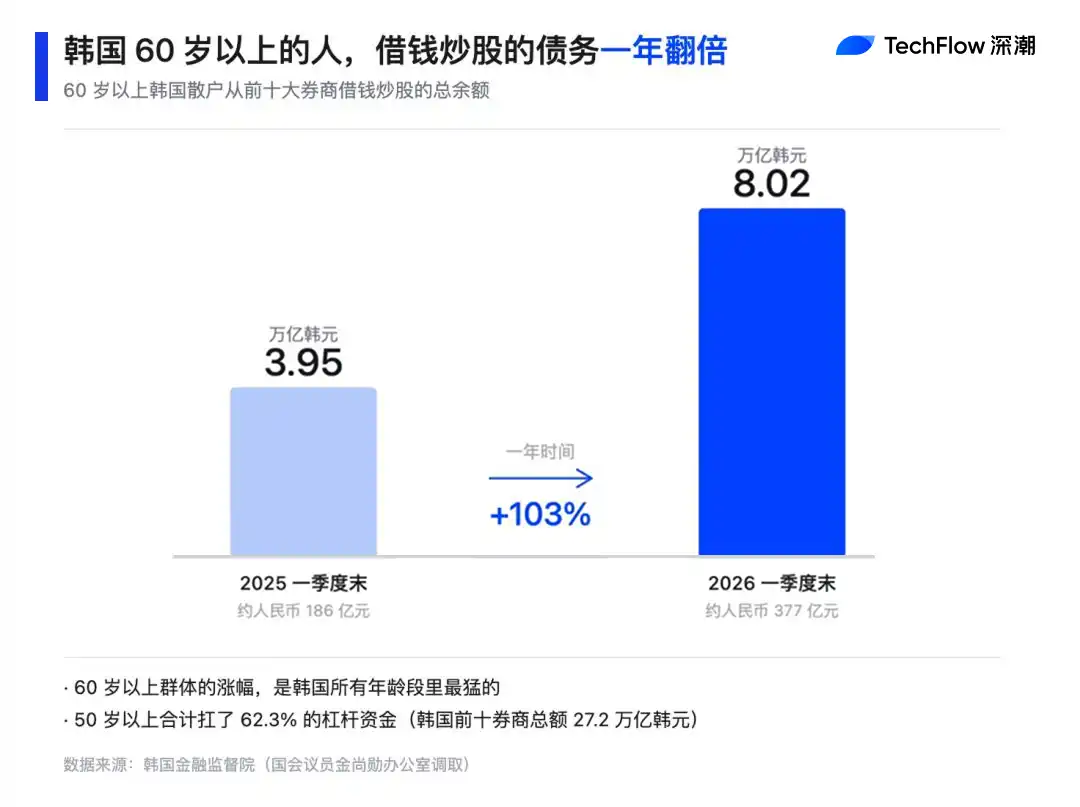
Data obtained by a South Korean lawmaker from the Financial Supervisory Service shows that as of the end of the first quarter, retail investors borrowed 27 trillion won from the top ten securities firms for stock trading. Of this amount, over sixty percent (62.3%) was borrowed by people aged 50 and above.

The debt of the group aged 60 and above doubled in one year, from 3.95 trillion won to 8.02 trillion won, the sharpest increase among all age groups.

Withdrawing insurance to buy stocks—an entire generation of South Koreans is using future money to chase the current bottom.
Borrowing Because of the Crazy Bull Market?

Adding leverage in a bull market is called "amplifying returns"; adding leverage in a bear market is called "accelerating to zero." Korean seniors have already experienced this roller coaster once.

In early March of this year, joint U.S.-Israel airstrikes on Iran caused panic in global capital markets. The South Korean stock market triggered circuit breakers for two consecutive trading days, with the KOSPI plunging nearly 13%.

According to a late March report by the Financial Supervisory Service of South Korea, during that downturn, among the nation's 4.6 million retail investor accounts, those who used margin loans lost an average of 19%, while those who didn't lost 8.2%. Those who borrowed to trade stocks lost 2.3 times more than those who didn't borrow.

Breaking it down by age group, the leveraged account holders aged 60 and above suffered the worst, with an average return rate of -19.8%, the lowest among all age groups.

What's even harsher is what comes next: forced liquidation.

Leveraged accounts have a liquidation line. If the market value of the stocks in the account falls below this line, the securities firm won't consult with you; they will directly sell your positions. The Financial Supervisory Service received numerous complaints from retail investors at the time, such as "My stocks were sold without my knowledge" and "I was charged exorbitant interest rates."

A significant portion of these complaints came from the elderly, who were already unfamiliar with trading rules. However, it must be said, the retail investors who held on during the March circuit breakers ultimately won.

The Korean stock market recovered all those losses in just over two months and has been rising ever since. Those who held on through March have seen their accounts fully recover, with some possibly even making money.

There was volatility, there was room for an uptrend, so this became a successful experience of "getting on board," even if it meant getting on board with borrowed money.

Thus, this success story becomes the excuse for the next, bolder move. After the March circuit breakers, margin lending to South Korean retail investors not only didn't shrink but kept rising. Public data shows that the total margin loan balance hit a record high of 25 trillion won by the end of April; by mid-May, it had surged further to 36.47 trillion won.

In just a month and a half, South Korean retail investors collectively borrowed an additional 11 trillion won (approximately 52 billion yuan).

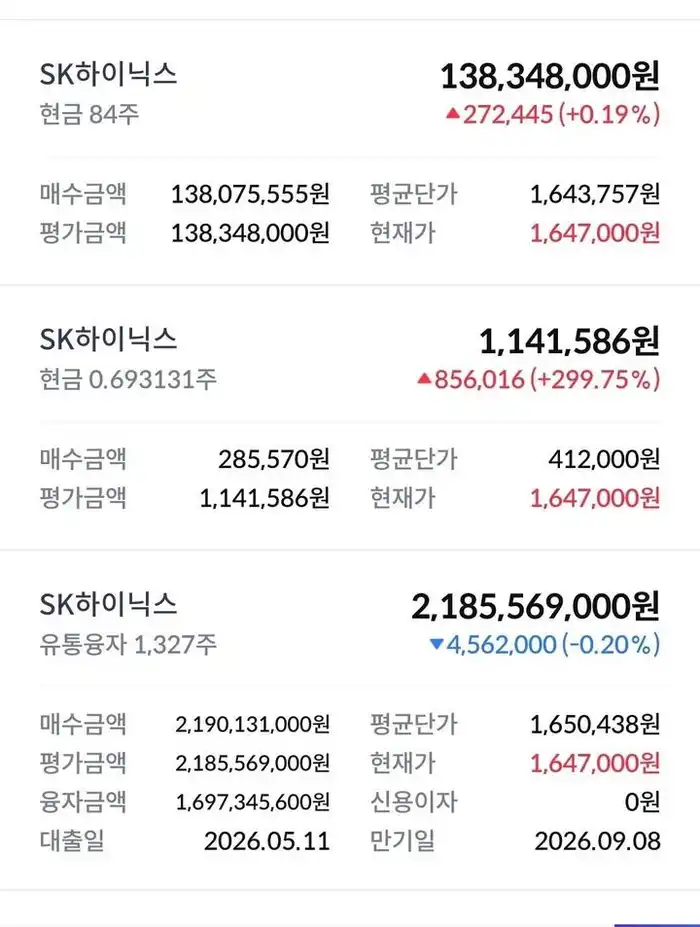
Looking at individual cases. In early May, a South Korean civil servant posted a screenshot on the Korean workplace community Blind:

Their account showed 2.3 billion won (approximately $1.7 million) all-in on SK Hynix, with 1.7 billion of that borrowed from a securities firm. In other words, their own capital was 600 million won, leveraged by 1.7 billion in borrowed funds.

Four days later, they updated that they had already made 267 million won.
On the same day, another post from a woman in her 20s working for Seoul Metro said she would rather "go completely bust" than miss this wave, going all-in on SK Hynix with 150% margin financing. Borrowed money was used as principal to borrow yet again.

Such posts are discussed daily on the Korean Blind community.

The regulators are not unaware of this FOMO frenzy. At the end of March, the Financial Supervisory Service summoned major securities firms to strengthen risk controls, and some brokerages temporarily restricted new margin loans for overheated stocks. But the money already lent out remains there, accruing interest daily at annual rates ranging from 7% to 9%.

Calculating at an 8% interest rate, South Korean retail investors collectively pay nearly 3 trillion won (approximately 14 billion yuan) in interest to securities firms annually.

However, leveraging at 60 is a different matter from leveraging at 30. A 30-year-old who gets wiped out still has decades of salary to slowly recover. A 60-year-old who gets wiped out potentially loses their entire pension, with only exhausted physical strength and the reality of being unable to earn more left.

If another circuit breaker hits, the outcome might not be "a full recovery in just over two months."

In Tapgol Park, the Flowing Intelligence Among the Elderly

Like all Korean retail investors, the elderly in Korea are borrowing and betting on Samsung Electronics and SK Hynix.

Samsung Electronics is up 138% year-to-date, SK Hynix is up 189%. The KOSPI as a whole is up about 80%, but excluding these two companies, the remaining stocks have gained only about 30%.

These two companies together account for over 43% of the weighting in the KOSPI index. This means that as long as these two rise, the entire Korean stock market rises.

Most of the money borrowed by the elderly flows here. A quarter of the net purchases by Korean retail investors this year went into these two companies. The remaining three-quarters are scattered across other stocks, but the overall gain for those other stocks this year is only 30%.

There's Tapgol Park in Jongno District, Seoul, one of the city's oldest public parks. Young people rarely visit. Its regulars are a group of retired seniors who come to the park every morning, drink free coffee, chat, play board games—time seems to flow as slowly as if it were standing still.

According to a report by the "Kyunghyang Shinmun," the topics of conversation in Tapgol Park have changed this year.

Amidst coffee drinking, someone might say, "My Samsung stocks went up again." During a board game, someone might ask, "Did you buy Hynix?" A 77-year-old gentleman told his middle school classmates that Samsung and Hynix have been performing well lately and that he had made a bit in his account.

A corner of Tapgol Park, gathering many elderly people playing board games

Source: Seoul News

However, he didn't mention whether he borrowed money or how much he borrowed.

Topics popular among seniors in the park don't come out of thin air; they resemble intelligence exchanged at the village entrance station. For instance, an elderly person hears another senior made money in the park and checks their own account the next day. Then they start trying to borrow a little. And then potentially borrow more and more.

But if you ask why South Korean seniors are appearing in leveraged stock trading accounts, this is actually related to their retirement security.

According to OECD data, the relative poverty rate among South Korea's population aged 65 and above is about 40%, the highest among OECD member countries. The replacement rate of the National Pension (South Korea's version of a pension) has long been low. The OECD average is around 50%, while South Korea's is only about 31%.

Conversely, the labor force participation rate of those aged 65 and above is the highest among OECD countries, meaning a significant portion of South Korean seniors have to continue working after retirement.

Therefore, the availability of free coffee in places like Tapgol Park is essentially a form of social relief in South Korea. A cup of coffee costs less than 500 won. For seniors with a monthly pension of less than a thousand dollars, this is part of daily life.

But the elderly in Tapgol Park are no longer just there for free coffee and board games. They might also have the KOSPI行情 open on their phones.

After taking office, South Korean President Lee Jae-myung has been vigorously promoting全民炒股 (全民炒股 - mass participation in stock trading). He has publicly called himself the "Great Ant," where "ant" is a common nickname for retail investors in Korea. He set a KOSPI突破 5000点 as an administrative goal.

In other words, to some extent, the elderly borrowing to buy stocks is officially encouraged in South Korea.

What the elderly are truly betting on is an anxiety. If they don't get on board now, they will miss out.

This is their last chance before retirement. The South Korean semiconductor industry is cyclical, having experienced more than one boom-to-bust roller coaster over the past three decades.

SK Hynix reported a loss of 4.26 trillion won in 2023, its worst performance in a decade. Switching from massive losses one year to an operating profit margin of 72% in a single quarter two years later (surpassing Nvidia)—the speed of this cyclical shift itself serves as a reminder that the cycle might switch back again.

And time, perhaps, is the most precious thing for these elderly individuals borrowing to trade stocks.

The elderly in Tapgol Park are striving to seize the红利 of this era. The coffee is still free. The行情 on their phones hasn't stopped for a moment.


Câu hỏi Liên quan

QAccording to the article, what drastic financial action are some elderly Koreans taking to invest in the stock market?

ASome elderly Koreans are surrendering their savings-type life insurance policies, even at a loss (as the surrender value is often lower than the premiums paid), and using the proceeds, along with borrowed money from brokerages (margin loans), to invest in stocks like Samsung and SK Hynix.

QWhat was the performance of leveraged versus non-leveraged散户 investors during the market crash in March mentioned in the article?

ADuring the market crash in March,散户 investors who used margin loans (leveraged) experienced an average loss of 19%, which was 2.3 times the average 8.2% loss suffered by those who did not use borrowed money.

QWhy are Korean senior citizens particularly vulnerable when using leverage to invest in the stock market?

AKorean senior citizens are particularly vulnerable because if they experience a significant loss or a margin call, they risk losing their entire pension savings. Unlike younger individuals who have decades of earning potential to recover, older individuals may lack the physical capacity and opportunity to earn back the money.

QHow does the article describe the role of Samsung and SK Hynix in the current Korean stock market rally?

AThe article describes Samsung and SK Hynix as the primary drivers of the KOSPI rally. Together, they account for over 43% of the KOSPI index's weight. While KOSPI rose 80% overall, removing these two companies reduces the remaining market's gain to only about 30%. A significant portion of散户 investment, including from seniors, has flowed into these two stocks.

QWhat underlying socio-economic factors, according to the article, are driving elderly Koreans to take on risky investments?

AKey factors include a high relative poverty rate among those over 65 (around 40%, the highest in the OECD), a low pension replacement rate (about 31%, compared to the OECD average of 50%), and a high labor participation rate among seniors, indicating financial pressure. This creates anxiety and a sense that investing in the current stock market rally is a 'last chance' to improve their financial security before it's too late.

Nội dung Liên quan

Blockmaze Định Nghĩa Tương Lai của Sự Token Hóa RWA với Cơ Sở Hạ Tầng Ưu Tiên Tuân Thủ Cho Một Thế Giới Trên Chuỗi Trị Giá 500 Ngàn Tỷ Đô La

Blockmaze, một nền tảng cơ sở hạ tầng tài sản được mã hóa có quy định, được hậu thuẫn bởi Tập đoàn Finvasia, đang định hình tương lai của mã hóa tài sản trong thế giới thực (RWA) bằng cách xây dựng cầu nối giữa tài chính truyền thống và công nghệ blockchain với trọng tâm là tuân thủ. Được thiết kế để giải quyết thách thức lớn về niềm tin và quyền sở hữu hợp pháp, Blockmaze kết nối tài sản kỹ thuật số với các khuôn khổ pháp lý thông qua hơn 45 giấy phép và đăng ký quy định tại 8 khu vực pháp lý, bao gồm châu Âu, GCC và châu Á. Mục tiêu là đưa thị trường tài sản toàn cầu trị giá 500 nghìn tỷ USD lên blockchain một cách an toàn và được công nhận hợp pháp. Blockmaze cung cấp giải pháp sẵn sàng triển khai cho các tổ chức phát hành, tổ chức tài chính và nền tảng, cho phép chuyển đổi tài sản truyền thống như bất động sản, cổ phiếu, vàng thành các sản phẩm đầu tư kỹ thuật số tuân thủ. Theo Tajinder Virk, Đồng sáng lập & CEO, tương lai của mã hóa sẽ được định nghĩa bởi sự tin cậy và công nhận pháp lý, không chỉ bởi công nghệ. Là một blockchain Lớp 1 được xây dựng đặc biệt cho RWA, Blockmaze nhấn mạnh tính minh bạch, giao dịch thời gian thực và hiệu quả của blockchain, hướng tới việc thúc đẩy việc áp dụng tài sản mã hóa một cách bền vững và an toàn ở quy mô lớn.

TheNewsCrypto12 phút trước

Blockmaze Định Nghĩa Tương Lai của Sự Token Hóa RWA với Cơ Sở Hạ Tầng Ưu Tiên Tuân Thủ Cho Một Thế Giới Trên Chuỗi Trị Giá 500 Ngàn Tỷ Đô La

TheNewsCrypto12 phút trước

Tổng hợp quan điểm về tăng/giảm giá ETH: Liệu giá trị của Ethereum có thể quay về với ETH?

Thị trường hiện tại đang có sự phân hóa sâu sắc về quan điểm đối với ETH. Một bên, nhà đồng sáng lập Bankless David Hoffman đã công khai bán toàn bộ ETH, cho rằng câu chuyện "ETH là tiền" đã đóng lại, và giá trị từ sự phát triển của hệ sinh thái Ethereum không chắc chảy đủ về token ETH. Bên kia, các tổ chức như BitMine của Tom Lee lại tiếp tục mua vào mạnh mẽ, tin tưởng vào vai trò nền tảng của Ethereum trong tài chính chuỗi khối, token hóa tài sản và AI, kỳ vọng giá ETH sẽ tăng mạnh vào năm 2026. **Quan điểm lạc quan** nhấn mạnh Ethereum vẫn là mạng lưới cơ sở an toàn, trung lập và có thể kết hợp quan trọng nhất cho các hoạt động tài chính mới như stablecoin, RWA, DeFi. Họ cho rằng ETH đang bị định giá thấp và giá trị sẽ được tích lũy dần theo sự mở rộng của nền kinh tế trên chuỗi. **Quan điểm bi quan** chỉ ra ETH thiếu dòng tiền truyền thống rõ ràng, việc mở rộng L2 làm suy yếu khả năng nắm bắt giá trị của L1, và áp lực bán từ những người nắm giữ sớm vẫn còn. Một số quỹ tổ chức cũng đã giảm hoặc thoát hoàn toàn khỏi các vị thế liên quan đến ETH. Cuộc tranh luận này cho thấy ETH không còn chỉ là tài sản niềm tin trong cộng đồng tiền mã hóa. Câu hỏi cốt lõi hiện nay là: liệu ETH có thể chuyển đổi từ "cơ sở hạ tầng bị sử dụng" thành "tài sản cốt lõi được mua và nắm giữ liên tục" khi nhiều tổ chức và tài sản hơn gia nhập mạng lưới hay không.

marsbit43 phút trước

Tổng hợp quan điểm về tăng/giảm giá ETH: Liệu giá trị của Ethereum có thể quay về với ETH?

marsbit43 phút trước

Thế Giới Crypto Đã Chết, Hợp Đồng Perp Là Vĩnh Cửu

Cộng đồng tiền mã hóa đang trải qua một sự chuyển dịch cốt lõi: từ một "nhà máy phát hành tài sản gốc" (như các altcoin, token) trở thành một "kênh dẫn tài sản toàn cầu". Các tài sản truyền thống như cổ phiếu Mỹ, trái phiếu, vàng, dầu thô đang thu hút dòng tiền và sự chú ý trên chain, trong khi nhu cầu với các tài sản gốc của crypto (trừ Bitcoin) đang suy giảm. Nguyên nhân sâu xa là blockchain đã chứng minh giá trị thực tế lớn nhất của nó không phải là lưu trữ giá trị hay tạo ra hệ thống tài chính mới, mà là khả năng chuyển tiền, thanh toán xuyên biên giới và giải quyết giao dịch toàn cầu một cách hiệu quả. Điều này được minh họa rõ nhất bởi sự thành công của stablecoin (USDT, USDC) – về cơ bản là việc đưa đồng đô la Mỹ lên blockchain. Trong bối cảnh này, hợp đồng vĩnh viễn (Perpetual Contract - Perp) nổi lên như sản phẩm tài chính thành công và có sức sống nhất của ngành. Nó không cố gắng tái tạo hay "token hóa" quyền sở hữu tài sản thực (như cổ phiếu), mà đơn giản hóa chúng thành một "cái giá" có thể giao dịch 24/7, toàn cầu, với đòn bẩy. Perp đáp ứng nhu cầu cơ bản: giao dịch biến động giá của mọi loại tài sản (từ crypto đến cổ phiếu Mỹ, vàng...), mà không cần quan tâm đến việc nắm giữ tài sản cơ sở. Sự trỗi dậy của các sàn giao dịch Perp phi tập trung như Hyperliquid minh chứng cho xu hướng này. Họ thành công nhờ thời điểm (timing) phù hợp: kết hợp trải nghiệm giao dịch giống CEX, làn sóng dịch chuyển niềm tin sau các sự kiện như FTX, và nhu cầu giao dịch liên tục các tài sản vĩ mô trong bối cảnh địa chính trị biến động. Tóm lại, kỷ nguyên dựa vào việc phát hành và thổi giá các tài sản gốc đã kết thúc. Tương lai của crypto nằm ở việc trở thành lớp hạ tầng (API) giúp các tài sản truyền thống được giao dịch tự do, hiệu quả và liên tục hơn thông qua công cụ tài chính mạnh mẽ nhất của nó: Hợp đồng vĩnh viễn.

marsbit48 phút trước

Thế Giới Crypto Đã Chết, Hợp Đồng Perp Là Vĩnh Cửu

marsbit48 phút trước

Tencent, Alibaba, ByteDance Tranh giành Cửa hàng Skill

Skill đang trở thành một trong những từ khóa nóng nhất trong lĩnh vực AI. Các ông lớn như Tencent, Alibaba, ByteDance, Zhipu AI, Meituan và Xiaohongshu đều đã tham gia vào cuộc chiến phân phối Skill thông qua các "cửa hàng Skill" của riêng họ. Mục tiêu của họ không phải để kiếm tiền trực tiếp từ việc bán Skill (hiện chủ yếu miễn phí, trừ thử nghiệm của ByteDance), mà là tranh giành lưu lượng truy cập và giữ chân người dùng trong hệ sinh thái của mình. Từ đó, họ kiếm tiền thông qua các dịch vụ đi kèm như điện toán đám mây, tiêu thụ năng lực tính toán, giao dịch hoặc quảng cáo. Tuy nhiên, việc kinh doanh Skill Store vấp phải nhiều thách thức: Skill khó định giá do hiệu quả không ổn định trên các nền tảng và mô hình khác nhau; chi phí tiêu thụ token không minh bạch; rủi ro bảo mật từ Skill độc hại; và thiếu giao thức chuẩn hóa để đảm bảo chất lượng và khả năng tương thích. Khác với App Store - nơi người dùng trả tiền cho tính năng xác định, Skill bán khả năng tùy chỉnh và phương pháp luận có thể tái sử dụng. Các kịch bản có tiềm năng thanh toán bao gồm nhu cầu công việc cố định (như kiểm tra hợp đồng) và công cụ cá nhân (như tối ưu hóa sơ yếu lý lịch). Dù vậy, việc thiếu hệ thống đánh giá chuẩn hóa khiến việc lựa chọn Skill trở nên khó khăn, và khoảng cách để Skill Store trở thành một nền tảng thương mại thực thụ như App Store vẫn còn khá xa.

marsbit49 phút trước

Tencent, Alibaba, ByteDance Tranh giành Cửa hàng Skill

marsbit49 phút trước

Thị trường tiền số đã chết, Hợp đồng Vĩnh viễn (Perp) trường tồn

Cộng đồng tiền mã hóa đang ở một bước ngoặt. Thập kỷ trước, ngành công nghiệp tập trung vào phát hành tài sản gốc (altcoin) với các câu chuyện kể và mô hình kinh tế phức tạp. Tuy nhiên, hiện tại, sự chú ý và thanh khoản đang dồn về các tài sản truyền thống như cổ phiếu Mỹ, trái phiếu, vàng, dầu thô được mã hóa trên chuỗi. Lĩnh vực này đang chuyển đổi từ "nhà máy tạo tài sản mới" sang "kênh dẫn tài sản toàn cầu". Stablecoin là minh chứng thành công đầu tiên, không phải vì tiền mã hóa đánh bại USD, mà vì nó cung cấp một cách thức lưu thông USD hiệu quả hơn trên blockchain. Năng lực cốt lõi được chứng minh là chuyển tiền, thanh toán xuyên biên giới và giao dịch, chứ không phải lưu trữ giá trị hay quản trị phức tạp. Altcoin đang gặp khó khăn khi phải cạnh tranh với hai đối thủ: tài sản truyền thống có dòng tiền thực và chu kỳ công nghệ AI với sản phẩm hữu hình. Ngay cả Ethereum và DeFi cũng mất dần sức hút khi "thế giới quan tài sản gốc" bị thu hẹp. Người dùng có thể sử dụng nhiều rollup mà không cần nắm giữ ETH. Vai trò chính giờ đây là chính các tài sản. Ngành công nghiệp không cố gắng tái tạo các tài sản cũ, mà đang xây dựng một "lớp truyền tải mới" hay "API mới" cho tài chính truyền thống, cho phép giao dịch 24/7, toàn cầu, không cần sự cho phép. Sự bùng nổ của Hợp đồng Vĩnh cửu (Perpetual Contract - Perp) là minh họa rõ nhất. Các nền tảng như Hyperliquid thành công nhờ thời điểm đúng đắn, kết hợp xu hướng Perp hóa CEX, nhu cầu phi tập trung sau sự cố FTX, biến động tài sản vĩ mô và làn sóng giao dịch cổ phiếu Mỹ. Perp tinh gọn nhu cầu giao dịch bằng cách biến mọi tài sản thành một "cái giá" có thể đặt cược, cung cấp sự tiếp xúc rủi ro mà không cần sở hữu tài sản cơ bản, vượt qua các rào cản về thời gian và địa lý. Tóm lại, kỷ nguyên phụ thuộc vào sự bùng nổ của tài sản gốc đã kết thúc. Thành tựu lớn nhất của tiền mã hóa có thể là Bitcoin, stablecoin, và đặc biệt là Hợp đồng Vĩnh cửu - thứ biến mọi thứ thành một thị trường giao dịch toàn cầu, không ngừng nghỉ. "Tiền mã hóa đã chết, Perp tồn tại mãi mãi."

Odaily星球日报57 phút trước

Thị trường tiền số đã chết, Hợp đồng Vĩnh viễn (Perp) trường tồn

Odaily星球日报57 phút trước

Giao dịch

Giao ngay
Hợp đồng Tương lai
活动图片




