Who Cannot Be Distilled into a Skill?

marsbitXuất bản vào 2026-04-05Cập nhật gần nhất vào 2026-04-05

Tóm tắt

"This article explores the concerning trend of AI systems distilling human workers into replaceable 'skills,' using the viral 'Colleague.skill' phenomenon as a key example. It argues that the most diligent employees—those who meticulously document their work, write detailed analyses, and transparently share decision-making logic—are paradoxically the most vulnerable to being replaced. Their high-quality 'context' (communication records, documents, and decision trails) becomes the perfect fuel for AI agents, extracted from corporate platforms like Feishu and DingTalk. The piece warns of a deeper ethical crisis: the reduction of human relationships to functional APIs, as seen in derivatives like 'Ex.skill' or 'Boss.skill,' which reduce complex individuals to mere utilities. This reflects a shift from Martin Buber's 'I-Thou' relationship (seeing others as whole beings) to an 'I-It' dynamic (seeing them as tools). While AI can capture explicit knowledge (written documents, replies), it fails to capture tacit knowledge—the intuition, experience, and unspoken insights that define human expertise. However, a greater danger emerges when AI-generated content, based on distilled human data, is used to train future models, leading to 'model collapse' and homogenized, mediocre outputs—a process likened to 'electronic patina' degrading information over time. The article concludes by noting a small but symbolic resistance, such as the 'anti-distill' tool that generates meaningless text ...

Unfortunately, in this era, the more unreservedly and diligently you work, the more likely you are to accelerate your own distillation into a skill that can be replaced by AI.

Over the past couple of days,热搜榜 (hot search lists) and media channels have been flooded with news about "Colleague.skill." As this topic continues to ferment on major social platforms, public focus has, almost inevitably, been swept up by grand anxieties like "AI layoffs," "capital exploitation," and "the digital immortality of the working class."

These are indeed anxiety-inducing, but what makes me most anxious is a line of usage suggestion written in the project's README documentation:

"The quality of the raw material determines the quality of the skill: It is recommended to prioritize collecting long articles he proactively wrote > decision-making replies > daily messages."

The ones most easily and perfectly distilled by the system, pixel-perfectly replicated, are precisely those who work most conscientiously.

They are the ones who, after every project concludes, still bend over their desks to write retrospective documents; the ones who, when encountering disagreements, are willing to spend half an hour typing out long passages in a chat dialog, honestly剖析 (dissecting/analyzing) their decision-making logic; the ones who are extremely responsible that they meticulously entrust every work detail to the system.

Conscientiousness, once the most revered workplace virtue, has now become a catalyst accelerating the transformation of workers into AI fuel.

The Drained Worker

We need to re-understand a word: context.

In everyday language, context is the background of communication. But in the world of AI, especially those rapidly growing AI Agents, context is the fuel for the roaring engine, the lifeblood maintaining the pulse, the only anchor point allowing the model to make precise judgments amidst chaos.

An AI stripped of context, even with an astonishing number of parameters, is merely a search engine with amnesia. It cannot recognize who you are, cannot discern the undercurrents hidden beneath business logic, and has no way of knowing the prolonged tug-of-war and trade-offs you experienced on this network woven from resource constraints and interpersonal博弈 (game theory/strategizing) when making a decision.

The reason "Colleague.skill" has caused such a huge stir is precisely because it has, with extreme冷酷 (ruthlessness/coldness) and precision, targeted the mountain rich with vast amounts of high-quality context—modern enterprise collaboration software.

Over the past five years, the Chinese workplace has undergone a quiet yet筋剥骨 (sapping) digital transformation. Tools like Feishu, DingTalk, and Notion have become massive corporate knowledge bases.

Taking Feishu as an example, ByteDance has publicly stated that the number of documents generated internally daily is massive. These dense characters faithfully seal every brainstorming session, every heated meeting debate, and every strategic compromise gritted and swallowed by over a hundred thousand employees.

This digital penetration far exceeds any previous time. Once upon a time, knowledge was warm, residing in the minds of veteran employees, scattered in casual chats by the water cooler; now, all human intelligence and experience are forcibly dehydrated, mercilessly sedimented in the cold server matrices in the cloud.

In this system, if you don't write documents, your work cannot be seen, and new colleagues cannot collaborate with you. The efficient operation of modern enterprises is built on the cycle of every employee "offering" context to the system day after day.

Conscientious workers, harboring diligence and goodwill, unreservedly expose their thought processes on these cold platforms. They do this to make the team's gears mesh more smoothly, to strive to prove their value to the system, to desperately find their own place within this intricate (错综复杂的) commercial behemoth. They are not actively handing themselves over; they are just clumsily and diligently adapting to the survival rules of the modern workplace.

But it is precisely this context left for interpersonal collaboration that becomes the perfect fuel for AI.

Feishu's admin backend has a function that allows super administrators to批量导出 (batch export) members' documents and communication records. This means that the project retrospectives and decision logic you spent three years writing, burning countless late nights, can, with just one API interface, be easily packaged into a cold压缩包 (compressed file) in just a few minutes—slices of your life over these years.

When Humans Are Reduced to an API

With the explosion of "Colleague.skill," GitHub's Issues section and major social platforms began to see some extremely disturbing derivatives.

Someone made an "Ex.skill," trying to feed years of WeChat chat history to an AI, making it continue to argue or be affectionate in that familiar tone; someone made a "White Moonlight.skill" (unattainable crush/idealized love), reducing an untouchable flutter into a cold interpersonal sandbox, repeatedly rehearsing试探的话术 (probing rhetoric), step-by-step seeking the optimal solution for emotions;还有人做出了 "Dad-flavored Boss.skill" (paternalistic/condescending boss), preemptively咀嚼 (chewing over) those oppressive PUA words in the digital space, building a pathetic psychological defense for themselves.
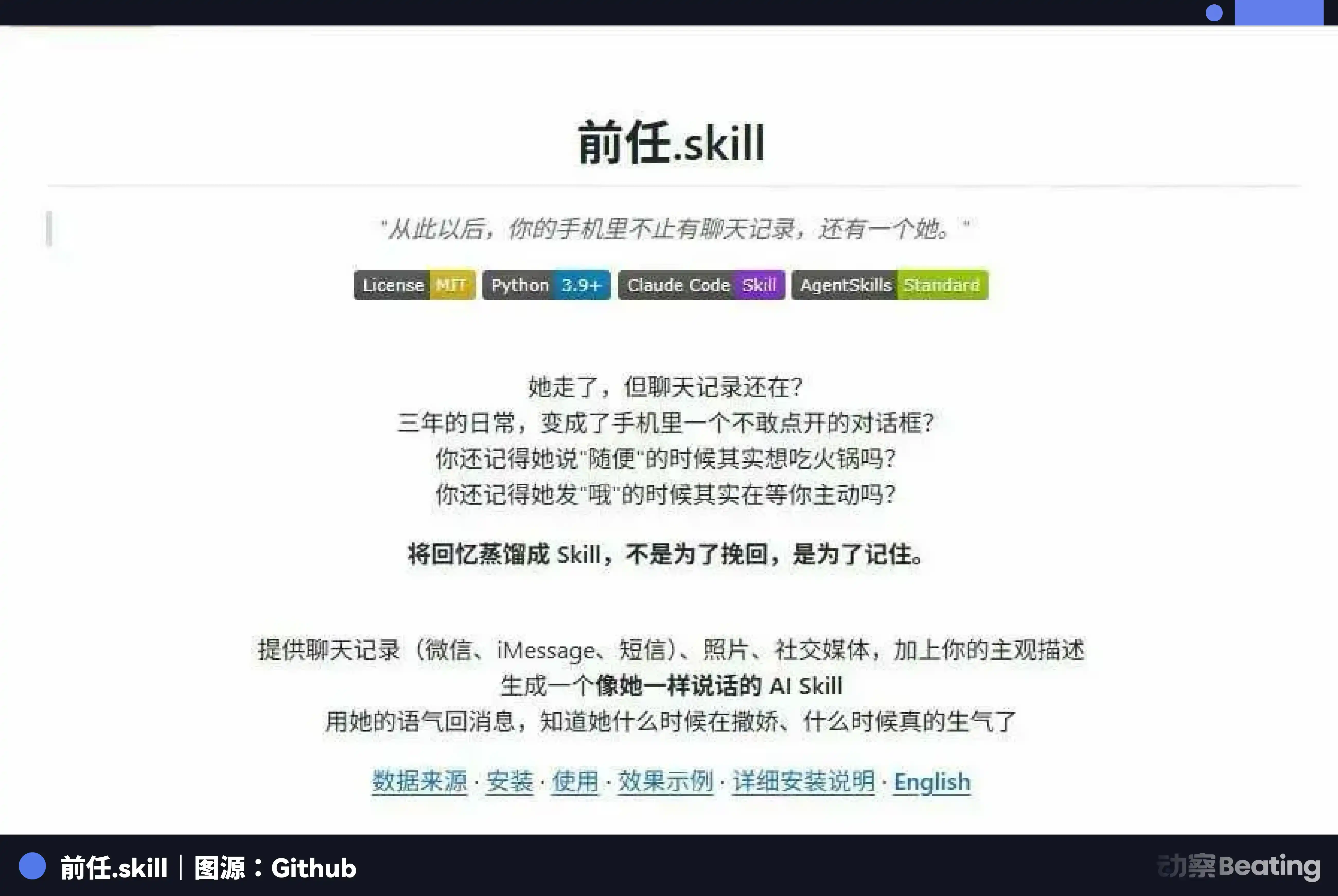
The usage scenarios of these skills have completely departed from the realm of work efficiency. It turns out,不知不觉间 (unconsciously), we have long become adept at wielding the cold logic used for tools to dismember and objectify living, breathing people of flesh and blood.

German philosopher Martin Buber once proposed that the underpinning of human relationships无非是 (is nothing more than) two distinct modes: "I-Thou" and "I-It."

In the "I-Thou" encounter, we transcend prejudice and regard the other as a complete and dignified being to behold. This bond is unreservedly open, full of vibrant unpredictability, and precisely because of its sincerity, it appears格外脆弱 (particularly fragile); however, once we fall into the shadow of "I-It," living people are reduced to an object that can be disassembled, analyzed, and categorized with labels. Under this utterly utilitarian gaze, the only thing we care about becomes, "What use is this thing to me?"

The emergence of products like "Ex.skill" marks the complete invasion of the instrumental rationality of "I-It" into the most private emotional realms.

In a real relationship, a person is three-dimensional, full of folds, flowing with contradictions and rough edges; their reactions change constantly based on specific situations and emotional interactions. Your ex's reaction to the same sentence might be completely different upon waking up in the morning versus after working late at night.

But when you distill a person into a skill, what you extract is merely the functional residue of that person that happened to be "useful" to you, able to "produce utility" for you within that specific bond. And that originally warm person, with their own joys and sorrows, is彻底抽干了灵魂 (completely drained of their soul) in this cruel purification process, alienated into a "functional interface" you can随意插拔 (arbitrarily plug and unplug) and call upon at will.

It must be admitted that AI did not凭空捏造 (fabricate out of thin air) this chilling冷酷 (coldness). Before AI appeared, we were already accustomed to labeling people, precisely weighing the "emotional value" and "network weight" of every relationship. For example, we量化 (quantify) people's conditions into spreadsheets in the dating market; we categorize colleagues into "those who can work" and "those who love to slack off" in the workplace. AI has merely made this implicit, functional extraction between people彻底显性化 (completely explicit).

People are flattened,只剩下 (leaving only) the facet that is "useful to me."

Electronic Patina (包浆 - Bao Jiang, referring to the worn, layered effect on frequently handled objects)

In 1958, Hungarian-British philosopher Michael Polanyi published "Personal Knowledge." In this book, he proposed a highly penetrating concept: Tacit Knowledge.

Polanyi famously stated, "We can know more than we can tell."

He used the example of learning to ride a bicycle. A skilled rider,驾驭御风而行 (riding the wind), can perfectly grasp balance with every tilt of gravity, but they cannot use dry physics formulas or pale vocabulary to accurately describe the subtle intuition of the body at that moment to a beginner. They know how to ride, but they cannot say it. This kind of knowledge that cannot be encoded, cannot be articulated, is tacit knowledge.

The workplace is full of this tacit knowledge. A senior engineer troubleshooting a system failure might glance at a log and locate the problem, but they would find it difficult to document this "intuition" built upon thousands of trials and errors; an excellent salesperson suddenly falling silent at the negotiation table, the timing and pressure of this silence, is something no sales manual can record; an experienced HR professional might, through a candidate avoiding eye contact for half a second during an interview, detect水分 (exaggeration/water) on the resume.

What "Colleague.skill" can extract is merely the explicit knowledge that has already been written down or spoken. It can capture your retrospective documents, but it cannot capture the纠结 (anguish/dilemma) you felt while writing them; it can replicate your decision-making replies, but it cannot replicate the intuition behind your decisions.

What the system distills is always just a shadow of a person.

If the story ended here, it would just be another case of technology clumsily imitating humanity.

But when a person is distilled into a skill, this skill does not remain static. It will be used to reply to emails, write new documents, make new decisions. That is to say, these AI-generated shadows begin to produce new context.

And this context generated by AI will, in turn, be sedimented in Feishu and DingTalk, becoming training material for the next round of distillation.

As early as 2023, research teams from Oxford and Cambridge universities jointly published a paper on "model collapse." The research showed that when AI models use data generated by other AIs for iterative training, the data distribution becomes increasingly narrow. Those rare,边缘的 (marginal), but极其真实的 (extremely real) human traits are quickly erased. After just a few generations of training on synthetic data, the model completely forgets those long-tail, complex real human data, instead outputting极其平庸和同质化的 (extremely mediocre and homogenized) content.

"Nature" also published a research paper in 2024 pointing out that using AI-generated datasets to train future generations of machine learning models会严重污染 (would seriously pollute) their output.
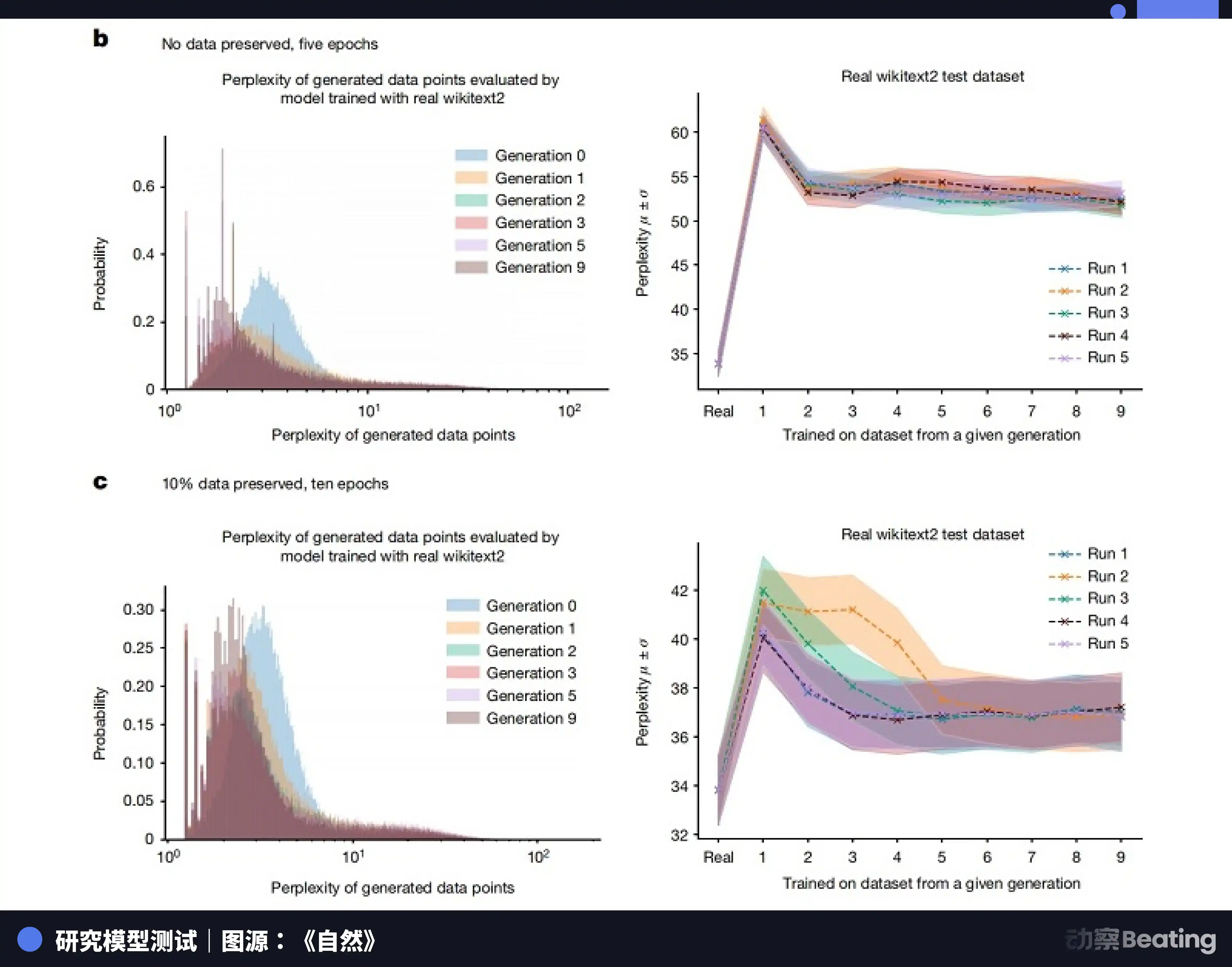
This is like those meme images circulating online. Originally a高清的 (high-definition) screenshot, forwarded, compressed, and forwarded again by countless people. Each transmission loses some pixels and adds some noise. Finally, the image becomes blurry and unrecognizable, coated in electronic包浆 (patina).

When the real, human context imbued with tacit knowledge is exhausted, and the system can only train itself on this patina-coated shadow, what will be left in the end?

Who Is Erasing Our Traces

What remains is only correct nonsense.

When the river of knowledge dries up into an endless rumination of AI upon AI,自我咀嚼 (self-chewing), everything the system吞吐 (ingests and spews) will inevitably become extremely standard, extremely safe, but incurably空洞 (hollow). You will see countless perfectly structured weekly reports, countless emails挑不出毛病 (with no faults to pick), but containing no breath of a living person, no truly valuable insight.

This great溃败 (collapse/rout) of knowledge is not because human brains have become duller. The true悲哀 (sadness) lies in the fact that we have outsourced the right to think and the responsibility to leave context to our own shadows.

A few days after the "Colleague.skill" explosion, a project named "anti-distill" quietly appeared on GitHub.

The author of this project did not try to attack large models, nor did they write any grand manifesto. They simply provided a small tool to help workers automatically generate some seemingly reasonable but actually logic-noisy无效长文 (ineffective long articles) in Feishu or DingTalk.

Their goal is simple: before being distilled by the system, hide their core knowledge first. Since the system likes to capture "proactively written long articles," feed it a bunch of meaningless乱码 (gibberish).

This project did not explode like "Colleague.skill"; it even seems somewhat tiny and powerless. Using magic to defeat magic is essentially still playing within the rules set by capital and technology. It cannot change the major trend of the system relying more and more on AI and increasingly neglecting real people.

But this does not prevent this project from becoming the most tragically poetic and deeply metaphorical scene in the entire absurd play.

We strive extremely hard to leave traces in the system, write detailed documents, provide meticulous decisions, trying to prove within this vast modern enterprise machine that we once existed, that we were valuable. Unaware that these extremely conscientious traces will ultimately become the eraser that抹去 (erases) us.

But looking at it from another angle, this might not be a complete dead end.

Because what that eraser抹去的 (erases) is always only the "past you." A skill packaged into a file, no matter how sophisticated its capture logic, is essentially just a static snapshot. It is locked at the moment of export, can only rely on stale nourishment, and spins infinitely within established processes and logic. It lacks the instinct to face unknown chaos, let alone the ability to self-evolve through setbacks in the real world.

When we hand over those highly standardized,既定式的 (set-in-stone) experiences, we恰恰 (precisely) free up our own hands. As long as we continue to reach outward, continue to break and reconstruct our cognitive boundaries, that shadow lingering in the cloud can only ever follow in our footsteps.

Humans are fluid algorithms.

Tiền kỹ thuật số thịnh hành

Câu hỏi Liên quan

QAccording to the article, what makes diligent workers more susceptible to being distilled into an AI 'skill'?

ATheir thorough documentation, detailed decision-making explanations, and responsible handover of work details to digital systems provide high-quality, easily extractable context that serves as perfect fuel for AI.

QWhat philosophical concept does the article use to describe the reduction of human relationships to functional interfaces?

AMartin Buber's distinction between 'I-Thou' relationships, which treat others as whole beings, and 'I-It' relationships, which reduce people to functional objects for use.

QWhat is 'model collapse' as discussed in the context of AI training on AI-generated data?

AIt refers to the phenomenon where AI models trained on synthetic data from other AIs experience a narrowing of data distribution, losing rare and complex human traits and outputting increasingly mediocre and homogenized content.

QWhat strategy did the 'anti-distill' project propose to counter the extraction of personal knowledge?

AIt provided a tool to automatically generate seemingly reasonable but actually noisy and ineffective long texts in collaboration software, aiming to hide core knowledge by polluting the data harvested by the system.

QWhy does the article suggest that an AI 'skill' can never fully replace a human being?

ABecause a 'skill' is a static snapshot of past behavior, lacking the ability to face unknown chaos, evolve through real-world failure, or capture the tacit, intuitive knowledge that defines human expertise and continuous growth.

Nội dung Liên quan

Ủy Viên Warsh Tàn Phá "Chiến Lược Đầu Cơ Đồng USD Mất Giá"! Vàng Sụp Đổ, Bitcoin Giảm Mạnh, Cơn Sốt Chip Còn Kéo Dài Được Bao Lâu?

Giao dịch định vị đồng USD mất giá, động lực chính trên Phố Wall năm nay, đang tan rã nhanh chóng. Lập trường diều hâu của Chủ tịch Fed Kevin Warsh củng cố kỳ vọng tăng lãi suất, cùng với USD mạnh lên, đã đè nặng lên các tài sản như vàng, bạc và Bitcoin. Vàng đã giảm xuống dưới 4.000 USD/ounce, Bitcoin mất mốc 60.000 USD, trong khi chỉ số USD (DXY) đạt mức cao nhất trong hơn 14 tháng. Các chuyên gia cho rằng, tuyên bố ưu tiên ổn định giá cả của ông Warsh khiến thị trường định giá lại tài sản mạnh mẽ. USD mạnh làm tăng chi phí cơ hội nắm giữ kim loại quý. Dòng tiền đang rời khỏi vàng, bạc và chuyển sang lĩnh vực bán dẫn, thúc đẩy cổ phiếu như Micron và SK Hynix. Tuy nhiên, nhiều cảnh báo cho thấy sự biến động cực đoan trong cổ phiếu chip có thể là dấu hiệu của đỉnh thị trường. BCA Research khuyến nghị chốt lời chiến lược đầu tư vào bán dẫn thị trường mới nổi. Dự báo lãi suất Fed sẽ duy trì cao trong khi ECB có thể còn cắt giảm, tiếp tục hỗ trợ USD và gây áp lực lên Bitcoin. Mặc dù vàng được coi là cơ hội mua thế hệ, nhưng cần vượt lại ngưỡng 4.800 USD để khôi phục niềm tin. Bối cảnh lạm phát có thể dai dẳng và đợt phát hành cổ phiếu mới lớn có thể là thách thức cho thị trường chip trong thời gian tới.

华尔街日报16 phút trước

Ủy Viên Warsh Tàn Phá "Chiến Lược Đầu Cơ Đồng USD Mất Giá"! Vàng Sụp Đổ, Bitcoin Giảm Mạnh, Cơn Sốt Chip Còn Kéo Dài Được Bao Lâu?

华尔街日报16 phút trước

Micron bịt miệng phe bán khống, cũng khiến "Buffett Ấn Độ" hối hận: Bán quá sớm, lỡ mất 2 tỷ USD

Được mệnh danh là "Warren Buffett của Ấn Độ", nhà đầu tư giá trị nổi tiếng Mohnish Pabrai đã chia sẻ về giao dịch sai lầm đau đớn nhất của mình trong một cuộc phỏng vấn. Ông từng nắm giữ cổ phiếu Micron trong sáu năm, bắt đầu từ 2017, với lý tư duy rằng thị trường bộ nhớ toàn cầu sẽ chỉ còn ba công ty lớn: Samsung, SK Hynix và Micron. Tuy nhiên, vào năm 2023, ông đã bán toàn bộ vị thế khi Samsung thông báo mở rộng sản xuất, lo ngại logic về phía cung bị phá vỡ. Sau khi ông bán ra, nhu cầu về HBM (bộ nhớ băng thông cao) bùng nổ nhờ AI, đẩy giá cổ phiếu Micron tăng hơn 15 lần trong hai năm, khiến ông ước tính bỏ lỡ khoảng 20 tỷ USD lợi nhuận. Ông cũng thừa nhận bán SK Hynix quá sớm, vi phạm nguyên tắc "nắm giữ mãi mãi" những công ty có lợi thế cạnh tranh bền vững. Pabrai là một môn đồ trung thành của Buffett, thậm chí từng trả 650.000 USD cho bữa trưa với huyền thoại đầu tư này. Ông áp dụng phương pháp đầu tư với một danh sách kiểm tra gồm 213 câu hỏi, rút ra từ các bài học thất bại. Ba nguyên tắc cốt lõi của ông là: không sử dụng đòn bẩy, tập trung vào lợi thế cạnh tranh lâu dài (hào rào kinh tế), và đánh giá tính cách của ban lãnh đạo. Ông khẳng định hầu hết mọi người nên đầu tư vào các quỹ chỉ số. Về triết lý sống, Pabrai tin rằng mất tiền không phải là mất mát lớn, sức khỏe quan trọng hơn một chút, nhưng mất đi nhân cách là mất tất cả. Mục tiêu cuối cùng của ông là quyên góp hết tài sản trước khi qua đời.

marsbit1 giờ trước

Micron bịt miệng phe bán khống, cũng khiến "Buffett Ấn Độ" hối hận: Bán quá sớm, lỡ mất 2 tỷ USD

marsbit1 giờ trước

Nhân vật chính tiếp theo của miHoYo, là cô gái chơi piano ấy

Tập đoàn game Mihoyo, nổi tiếng với "Genshin Impact", đang thực hiện một cuộc chuyển hướng chiến lược lớn sang lĩnh vực trí tuệ nhân tạo (AI), với mục tiêu tạo ra những nhân vật ảo có cảm xúc và có thể tương tác thực sự. Nỗ lực này bắt nguồn từ tầm nhìn "xây dựng thế giới ảo cho 1 tỷ người vào năm 2030". Đồng sáng lập Thái Hạo Vũ đã rời vị trí quản lý để dẫn dắt dự án AI Anuttacon ở nước ngoài. Trong khi đó, tại Trung Quốc, Mihoyo tuyên bố sẽ đầu tư tới 100 tỷ nhân dân tệ trong ba năm tới để phát triển "mô hình ngôn ngữ lớn có cảm xúc". Sản phẩm AI đầu tiên được công bố là "BSide: Olivia Lin", một ứng dụng miễn phí trên Steam. Nhân vật chính, Lâm Ly, là một cô gái chơi piano, có thể trả lời thư và chơi nhạc do người dùng tải lên. Ứng dụng này tập trung vào việc tạo ra "cảm giác như người thật" thông qua tương tác có nhịp độ chậm và tinh tế, thay vì đối thoại liên tục. Cách tiếp cận này phản ánh hành trình dài của Mihoyo, từ một công ty khởi nghiệp trong ký túc xá Đại học Giao thông Thượng Hải, đến việc đặt tên công ty theo ca sĩ ảo Hatsune Miku (trong đó "mi" lấy từ "Miku"). Giấc mơ cốt lõi của họ luôn là tạo ra những nhân vật ảo không chỉ được yêu mến, mà một ngày nào đó có thể thực sự hiểu được tình cảm đó.

marsbit1 giờ trước

Nhân vật chính tiếp theo của miHoYo, là cô gái chơi piano ấy

marsbit1 giờ trước

Báo cáo nghiên cứu: Doanh thu AI của TSMC sẽ tăng gấp đôi vào năm 2027, năng lực sản xuất CoWoS vẫn là nút thắt

**Phân tích báo cáo: Doanh thu AI của TSMC sẽ tăng gấp đôi vào năm 2027, công suất CoWoS vẫn là nút cổ chai** Morgan Stanley nâng dự báo nhu cầu đóng gói tiên tiến CoWoS toàn cầu cho năm 2027. Họ dự đoán doanh thu liên quan đến AI của TSMC sẽ đạt 86,3 tỷ USD vào năm 2027, tăng 218% so với 27,1 tỷ USD của năm 2026. Cấu thành chính bao gồm doanh thu GPU (28 tỷ USD), chip AI tùy chỉnh (18 tỷ USD), đóng gói tiên tiến CoWoS (40 tỷ USD) và CPU máy chủ AI (0,3 tỷ USD). Nhu cầu CoWoS toàn cầu dự kiến tăng 93% lên 2,694 triệu phiến vào năm 2027. NVIDIA vẫn là động lực chính, với nhu cầu CoWoS dự kiến tăng 57%. Tuy nhiên, nhu cầu từ AMD được dự báo tăng mạnh 308%, chủ yếu do CPU Venice và GPU MI400. Google TPU, thông qua đối tác thiết kế MediaTek và Broadcom, cũng đang trở thành khách hàng lớn thứ hai. Mặc dù TSMC lên kế hoạch tăng công suất CoWoS lên 200.000 phiến/tháng và các nhà cung cấp khác thêm 80.000 phiến/tháng vào cuối năm 2027 (tổng cộng 3,36 triệu phiến/năm), vẫn có khả năng xảy ra tình trạng thiếu hụt so với nhu cầu ước tính 2,694 triệu phiến. Đặc biệt, công suất cho các công nghệ cao cấp như CoWoS-L vẫn rất căng thẳng, củng cố quyền định giá của TSMC. Các yếu tố thúc đẩy gần đây bao gồm nguồn cung chất nền ABF được cải thiện (hỗ trợ TPU của Google), nhu cầu CPU mới từ NVIDIA Vera và AMD Venice, cũng như sản xuất hàng loạt GPU Rubin Ultra thế hệ tiếp theo của NVIDIA. Báo cáo cũng chỉ ra các công ty hưởng lợi trong chuỗi cung ứng như MediaTek (đối tác thiết kế TPU cho Google), ASE và KYEC. TSMC vẫn là công ty hưởng lợi cốt lõi, nhưng sự tăng trưởng đang lan rộng khắp chuỗi cung ứng AI.

marsbit2 giờ trước

Báo cáo nghiên cứu: Doanh thu AI của TSMC sẽ tăng gấp đôi vào năm 2027, năng lực sản xuất CoWoS vẫn là nút thắt

marsbit2 giờ trước

Citrini Research: Điểm danh 5 chủ đề đầu tư hàng đầu hiện nay bị che khuất bởi giao dịch AI

Citrini Research chỉ ra rằng sự tập trung thái quá của thị trường vào chủ đề AI đang che khuất 5 cơ hội đầu tư tiềm năng khác, nơi chênh lệch giữa kỳ vọng bị lãng quên và thực tế đang thay đổi có thể tạo ra lợi nhuận. 1. **Cổ phiếu hàng không (Delta & United):** Bị trừng phạt 18 tháng qua chủ yếu do lo ngại vĩ mô (lạm phát, giá dầu), không liên quan đến năng lực kinh doanh. Triển vọng tăng trưởng vẫn mạnh với xu hướng dịch vụ cao cấp hóa và đòn bẩy từ World Cup 2026. 2. **Bất động sản dưỡng lão:** Làn sóng già hóa dân số (nhóm 80+ tuổi ở Mỹ dự kiến tăng 56% trong thập kỷ tới) đang tạo nhu cầu lớn, trong khi nguồn cung cơ sở vật chất lại thiếu hụt. Các công ty như Welltower, Janus Living, Brookdale Senior Living được hưởng lợi. 3. **Giải trí trực tiếp (Live Events):** Trải nghiệm "có mặt tại chỗ" đang trở thành mặt hàng xa xỉ. Các công ty thể thao (TKO Group), rạp chiếu phim (Cinemark) và công nghệ nâng cao trải nghiệm (IMAX) hưởng lợi từ xu hướng này. 4. **Cạnh tranh sàn giao dịch phái sinh:** Độc quyền kéo dài 20 năm của CME (98% thị phần phái sinh lãi suất Mỹ) lần đầu đối mặt đối thủ thực sự là FMX Futures Exchange, được hậu thuẫn bởi loạt ngân hàng lớn với chiến lược phí thấp và ưu đãi. 5. **Phục hồi Fintech:** Lĩnh vực bị định giá thấp nhất năm 2026 đang cho thấy dấu hiệu phục hồi. SoFi (với stablecoin), Robinhood (chuyển đổi sang siêu ứng dụng tài chính) và Upstart (cải tổ lãnh đạo) có triển vọng khi sự chú ý của thị trường dịch chuyển. Báo cáo khuyến nghị nhà đầu tư mở rộng tầm nhìn ra ngoài chủ đề AI đang quá tải, tìm kiếm cơ hội trong các chủ đề "nhỏ" nhưng có động lực cơ bản rõ ràng này.

marsbit2 giờ trước

Citrini Research: Điểm danh 5 chủ đề đầu tư hàng đầu hiện nay bị che khuất bởi giao dịch AI

marsbit2 giờ trước

Giao dịch

Giao ngay
Hợp đồng Tương lai

Bài viết Nổi bật

Làm thế nào để Mua PROS

Chào mừng bạn đến với HTX.com! Chúng tôi đã làm cho mua Pharos (PROS) trở nên đơn giản và thuận tiện. Làm theo hướng dẫn từng bước của chúng tôi để bắt đầu hành trình tiền kỹ thuật số của bạn.Bước 1: Tạo Tài khoản HTX của BạnSử dụng email hoặc số điện thoại của bạn để đăng ký tài khoản miễn phí trên HTX. Trải nghiệm hành trình đăng ký không rắc rối và mở khóa tất cả tính năng. Nhận Tài khoản của tôiBước 2: Truy cập Mua Crypto và Chọn Phương thức Thanh toán của BạnThẻ Tín dụng/Ghi nợ: Sử dụng Visa hoặc Mastercard của bạn để mua Pharos (PROS) ngay lập tức.Số dư: Sử dụng tiền từ số dư tài khoản HTX của bạn để giao dịch liền mạch.Bên thứ ba: Chúng tôi đã thêm những phương thức thanh toán phổ biến như Google Pay và Apple Pay để nâng cao sự tiện lợi.P2P: Giao dịch trực tiếp với người dùng khác trên HTX.Thị trường mua bán phi tập trung (OTC): Chúng tôi cung cấp những dịch vụ được thiết kế riêng và tỷ giá hối đoái cạnh tranh cho nhà giao dịch.Bước 3: Lưu trữ Pharos (PROS) của BạnSau khi mua Pharos (PROS), lưu trữ trong tài khoản HTX của bạn. Ngoài ra, bạn có thể gửi đi nơi khác qua chuyển khoản blockchain hoặc sử dụng để giao dịch những tiền kỹ thuật số khác.Bước 4: Giao dịch Pharos (PROS)Giao dịch Pharos (PROS) dễ dàng trên thị trường giao ngay của HTX. Chỉ cần truy cập vào tài khoản của bạn, chọn cặp giao dịch, thực hiện giao dịch và theo dõi trong thời gian thực. Chúng tôi cung cấp trải nghiệm thân thiện với người dùng cho cả người mới bắt đầu và người giao dịch dày dạn kinh nghiệm.

Tổng lượt xem 17Xuất bản vào 2026.06.22Cập nhật vào 2026.06.22

Làm thế nào để Mua PROS

Làm thế nào để Mua VERONA

Chào mừng bạn đến với HTX.com! Chúng tôi đã làm cho mua VERONA (VERONA) trở nên đơn giản và thuận tiện. Làm theo hướng dẫn từng bước của chúng tôi để bắt đầu hành trình tiền kỹ thuật số của bạn.Bước 1: Tạo Tài khoản HTX của BạnSử dụng email hoặc số điện thoại của bạn để đăng ký tài khoản miễn phí trên HTX. Trải nghiệm hành trình đăng ký không rắc rối và mở khóa tất cả tính năng. Nhận Tài khoản của tôiBước 2: Truy cập Mua Crypto và Chọn Phương thức Thanh toán của BạnThẻ Tín dụng/Ghi nợ: Sử dụng Visa hoặc Mastercard của bạn để mua VERONA (VERONA) ngay lập tức.Số dư: Sử dụng tiền từ số dư tài khoản HTX của bạn để giao dịch liền mạch.Bên thứ ba: Chúng tôi đã thêm những phương thức thanh toán phổ biến như Google Pay và Apple Pay để nâng cao sự tiện lợi.P2P: Giao dịch trực tiếp với người dùng khác trên HTX.Thị trường mua bán phi tập trung (OTC): Chúng tôi cung cấp những dịch vụ được thiết kế riêng và tỷ giá hối đoái cạnh tranh cho nhà giao dịch.Bước 3: Lưu trữ VERONA (VERONA) của BạnSau khi mua VERONA (VERONA), lưu trữ trong tài khoản HTX của bạn. Ngoài ra, bạn có thể gửi đi nơi khác qua chuyển khoản blockchain hoặc sử dụng để giao dịch những tiền kỹ thuật số khác.Bước 4: Giao dịch VERONA (VERONA)Giao dịch VERONA (VERONA) dễ dàng trên thị trường giao ngay của HTX. Chỉ cần truy cập vào tài khoản của bạn, chọn cặp giao dịch, thực hiện giao dịch và theo dõi trong thời gian thực. Chúng tôi cung cấp trải nghiệm thân thiện với người dùng cho cả người mới bắt đầu và người giao dịch dày dạn kinh nghiệm.

Tổng lượt xem 36Xuất bản vào 2026.06.22Cập nhật vào 2026.06.22

Làm thế nào để Mua VERONA

Làm thế nào để Mua NES

Chào mừng bạn đến với HTX.com! Chúng tôi đã làm cho mua Nesa (NES) trở nên đơn giản và thuận tiện. Làm theo hướng dẫn từng bước của chúng tôi để bắt đầu hành trình tiền kỹ thuật số của bạn.Bước 1: Tạo Tài khoản HTX của BạnSử dụng email hoặc số điện thoại của bạn để đăng ký tài khoản miễn phí trên HTX. Trải nghiệm hành trình đăng ký không rắc rối và mở khóa tất cả tính năng. Nhận Tài khoản của tôiBước 2: Truy cập Mua Crypto và Chọn Phương thức Thanh toán của BạnThẻ Tín dụng/Ghi nợ: Sử dụng Visa hoặc Mastercard của bạn để mua Nesa (NES) ngay lập tức.Số dư: Sử dụng tiền từ số dư tài khoản HTX của bạn để giao dịch liền mạch.Bên thứ ba: Chúng tôi đã thêm những phương thức thanh toán phổ biến như Google Pay và Apple Pay để nâng cao sự tiện lợi.P2P: Giao dịch trực tiếp với người dùng khác trên HTX.Thị trường mua bán phi tập trung (OTC): Chúng tôi cung cấp những dịch vụ được thiết kế riêng và tỷ giá hối đoái cạnh tranh cho nhà giao dịch.Bước 3: Lưu trữ Nesa (NES) của BạnSau khi mua Nesa (NES), lưu trữ trong tài khoản HTX của bạn. Ngoài ra, bạn có thể gửi đi nơi khác qua chuyển khoản blockchain hoặc sử dụng để giao dịch những tiền kỹ thuật số khác.Bước 4: Giao dịch Nesa (NES)Giao dịch Nesa (NES) dễ dàng trên thị trường giao ngay của HTX. Chỉ cần truy cập vào tài khoản của bạn, chọn cặp giao dịch, thực hiện giao dịch và theo dõi trong thời gian thực. Chúng tôi cung cấp trải nghiệm thân thiện với người dùng cho cả người mới bắt đầu và người giao dịch dày dạn kinh nghiệm.

Tổng lượt xem 2Xuất bản vào 2026.06.24Cập nhật vào 2026.06.24

Làm thế nào để Mua NES

Thảo luận

Chào mừng đến với Cộng đồng HTX. Tại đây, bạn có thể được thông báo về những phát triển nền tảng mới nhất và có quyền truy cập vào thông tin chuyên sâu về thị trường. Ý kiến ​​của người dùng về giá của M (M) được trình bày dưới đây.

活动图片