Which Companies Has NVIDIA's "Three-Track Investment Architecture" Invested In?

marsbitXuất bản vào 2026-06-04Cập nhật gần nhất vào 2026-06-04

Tóm tắt

NVIDIA's investment strategy operates through a "three-track architecture," not just its NVentures venture arm. Corporate Development handles massive strategic bets (e.g., $30B in OpenAI, $10B in Anthropic, $20B in Synopsys). NVentures, a small team, focuses on early-stage, financial investments across sectors like quantum computing (Alice & Bob, PsiQuantum), AI infrastructure (OpenRouter, Tensormesh), and biotech. The NVIDIA Inception accelerator provides non-monetary support. This system allows NVIDIA to nurture startups and lock in strategic partners, creating a vast AI ecosystem. This aggressive capital deployment has drawn scrutiny. Critics like Michael Burry and EU regulators question potential "circular financing," where NVIDIA's equity investments in companies (e.g., CoreWeave, OpenAI) facilitate those companies' purchases of NVIDIA hardware, potentially inflating revenue. Supporters view it as a necessary "virtuous cycle" to secure supply and demand in a compute-scarce market. While NVentures' smaller deals appear like traditional VC, its role within the larger, controversial investment framework remains a point of debate.

Author: Ada, Deep Tide TechFlow

Recently, NVentures, NVIDIA's venture capital arm, made a new investment in the French quantum computing company Alice & Bob, focusing on fault-tolerant quantum computing.

It is a common misconception to attribute all of NVIDIA's external investments under the name NVentures. In fact, the collective scale of this venture division's approximately 30 annual investments, established in 2021, pales in comparison to a single investment made casually by the Corporate Development team. The latter's $2 billion equity investment in Synopsys at the end of 2025 alone is several times larger than NVentures' cumulative investment amount over nearly three years.

To understand how NVIDIA uses capital to weave the AI ecosystem, one must start with the "Three-Track Architecture" of its investment system. The Corporate Development team handles strategic large-scale investments and mergers & acquisitions ranging from billions to hundreds of billions of dollars. NVentures is responsible for early-stage, broadly scoped financial investments across industries. NVIDIA Inception is a startup accelerator that provides resource connections without direct capital investment. These three parts work in synergy, forming the largest and fastest-paced capital deployment machine in Silicon Valley's history, and also becoming the core target of "circular financing" allegations in the eyes of short-sellers.

The True Face of NVentures: 2-Person Team, 79 Companies, 20 Unicorns

Although bearing NVIDIA's brand, NVentures' internal size is surprisingly small. According to private equity data firm Tracxn, as of May 2026, the entire team consists of only 2 people, having cumulatively invested in 79 companies, fostering 20 unicorns, including AI video generation platform Synthesia, clinical AI company Abridge, quantum computing company PsiQuantum, and others. In the past 12 months, the team completed 43 new investments, with 20 deals in the first five months of 2026 alone, indicating a significantly accelerated pace.

Leading NVentures is Mohamed "Sid" Siddeek, corporate vice president and head of NVentures. Siddeek's resume itself reflects NVIDIA's positioning for this division. He worked at Morgan Stanley in the late 1990s, accompanying Jensen Huang during NVIDIA's IPO roadshow; then served for nearly a decade as head of TMT & Telecom investments at the UAE sovereign wealth fund Mubadala; later managed enterprise software and healthcare investments at SoftBank's Vision Fund; and finally returned to NVIDIA in 2021 to establish NVentures.

Siddeek's own description of the investment scope is: "The real screening criteria are only two layers: the first is anywhere NVIDIA can reach, the second is which areas are investable." In an interview with Global Corporate Venturing, he revealed this means horizontal coverage across almost all industries AI can transform—healthcare, manufacturing, robotics, autonomous driving, quantum, etc.—and vertical coverage from underlying tools to the application layer, all within NVentures' investment scope.

Three-Track Architecture: Corp Dev for Strategy, NVentures for Early-Stage, Inception for Ecosystem

NVIDIA's external investment system consists of three distinct parts with clear division of labor.
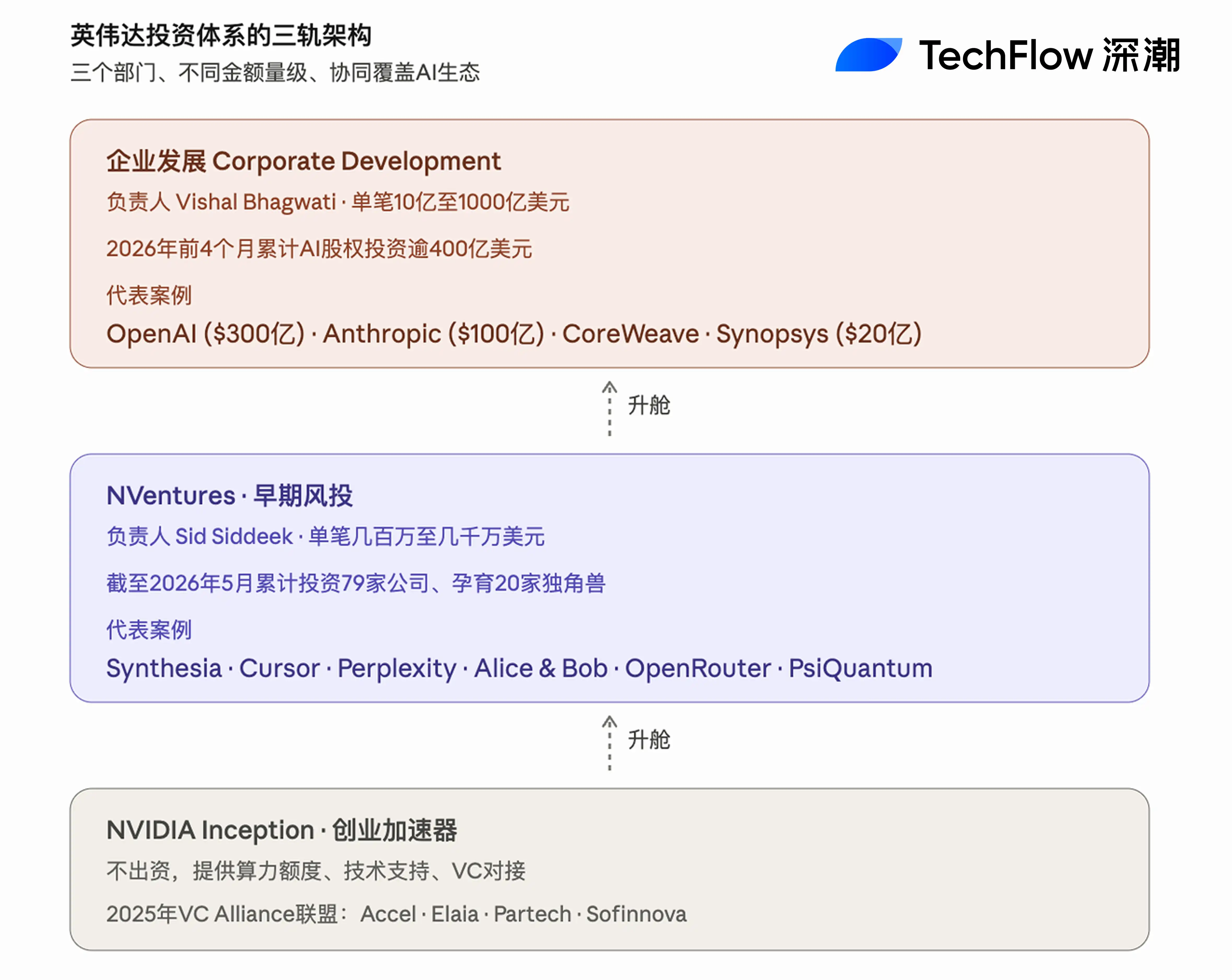
The first layer is the Corporate Development team, led by Vishal Bhagwati, responsible for all strategic-level large-scale investments, joint ventures, and M&A. The magnitude of deals on this track is completely different from NVentures. Representative moves from the second half of 2025 to the first half of 2026 include leading a $30 billion investment in OpenAI in February 2026 (as part of a roughly $110 billion funding round), with a commitment to potentially increase to $100 billion in the future; a $10 billion commitment to Anthropic in November 2025; a $2 billion injection into Synopsys at the end of 2025; a $2 billion follow-on investment in CoreWeave in early 2026, accompanied by a $6.3 billion cloud capacity purchase agreement; a $2 billion investment in Nebius in March 2026; and an equity commitment of up to $2 billion in xAI.

According to CNBC, in just the first four months of 2026, AI-related equity investments led by the Corporate Development team exceeded $40 billion. NVIDIA invested a total of $17.5 billion in private companies and infrastructure funds during fiscal year 2025.

The second layer is NVentures, led by Sid Siddeek, positioned as a traditional venture capital firm pursuing financial returns. Individual deal sizes range from a few million to tens of millions of dollars, primarily investing at Seed to Series B stages. Siddeek explicitly told Global Venturing that NVentures "primarily focuses on early-stage investments, while the Corporate Development team handles larger, more directly strategic investments." Behaviorally, NVentures predominantly participates as a co-investor, leading only about one-eighth of its investments, more often joining rounds led by top VCs like Accel, a16z, and Sequoia, leveraging the NVIDIA endorsement.

The third layer is NVIDIA Inception, essentially a startup accelerator program that does not directly invest capital but provides startups with NVIDIA hardware credits, technical support, market promotion, and VC connection channels. NVIDIA's upgraded "VC Alliance" launched in 2025, partnering with institutions like Accel, Elaia, Partech, and Sofinnova, distributes NVIDIA DGX Cloud Lepton compute credits to their portfolio companies, representing an extension of Inception in Europe.

There is a clear "funnel" relationship among the three. Inception discovers early-stage projects and integrates them into the NVIDIA ecosystem. Those with investment potential come into NVentures' view and may receive early-stage checks from a few million to tens of millions of dollars. When a company grows to a size significant enough to impact NVIDIA's strategic landscape (becoming a major customer, key supplier, or potential acquisition target), it "upgrades" to the Corporate Development team, entering cooperation frameworks worth billions or even hundreds of billions of dollars.

NVentures' Recent Moves: Quantum, Inference Routing, AI Security

NVentures' activity in May 2026 was notable. Just within the recent month, there have been four publicly disclosed deals. On May 22, French quantum computing company Alice & Bob announced NVentures participated in the extension of its €100 million Series B round. Alice & Bob's core technology is a fault-tolerant quantum computing architecture based on "cat qubits," deeply collaborating with NVIDIA's hybrid quantum-classical computing stack like CUDA-Q, cuQuantum, Dynamiqs, and NVQLink. On May 26, AI model routing platform OpenRouter completed a $113 million Series B round, with NVentures co-investing alongside Google CapitalG, Snowflake, and others. OpenRouter's business provides developers a unified interface to access APIs from dozens of different model providers globally. On May 28, AI inference infrastructure startup Tensormesh completed a $20 million seed extension round, with NVentures co-investing alongside CoreWeave, AMD, and others. On May 6, AI cybersecurity company Xbow completed a $35 million Series C extension, with NVentures participating.

Judging by the investment targets, NVentures' recent tilt clearly leans toward three directions: quantum computing (Alice & Bob, Quantinuum, PsiQuantum), AI biopharma (Relation Therapeutics, Genesis Therapeutics), and AI Agent & inference layer (OpenRouter, Tensormesh, etc.). This aligns with Siddeek's statement "anywhere NVIDIA can reach" and also corresponds precisely to the directions NVIDIA is investing in for its next-generation software stacks like CUDA-Q, CUDA-X, and Triton.

Geographically, NVentures' European deployment has notably accelerated. It completed 14 European investments in 2025, double the 7 investments in 2024.

Panoramic View of the Three-Tier Investment Portfolio

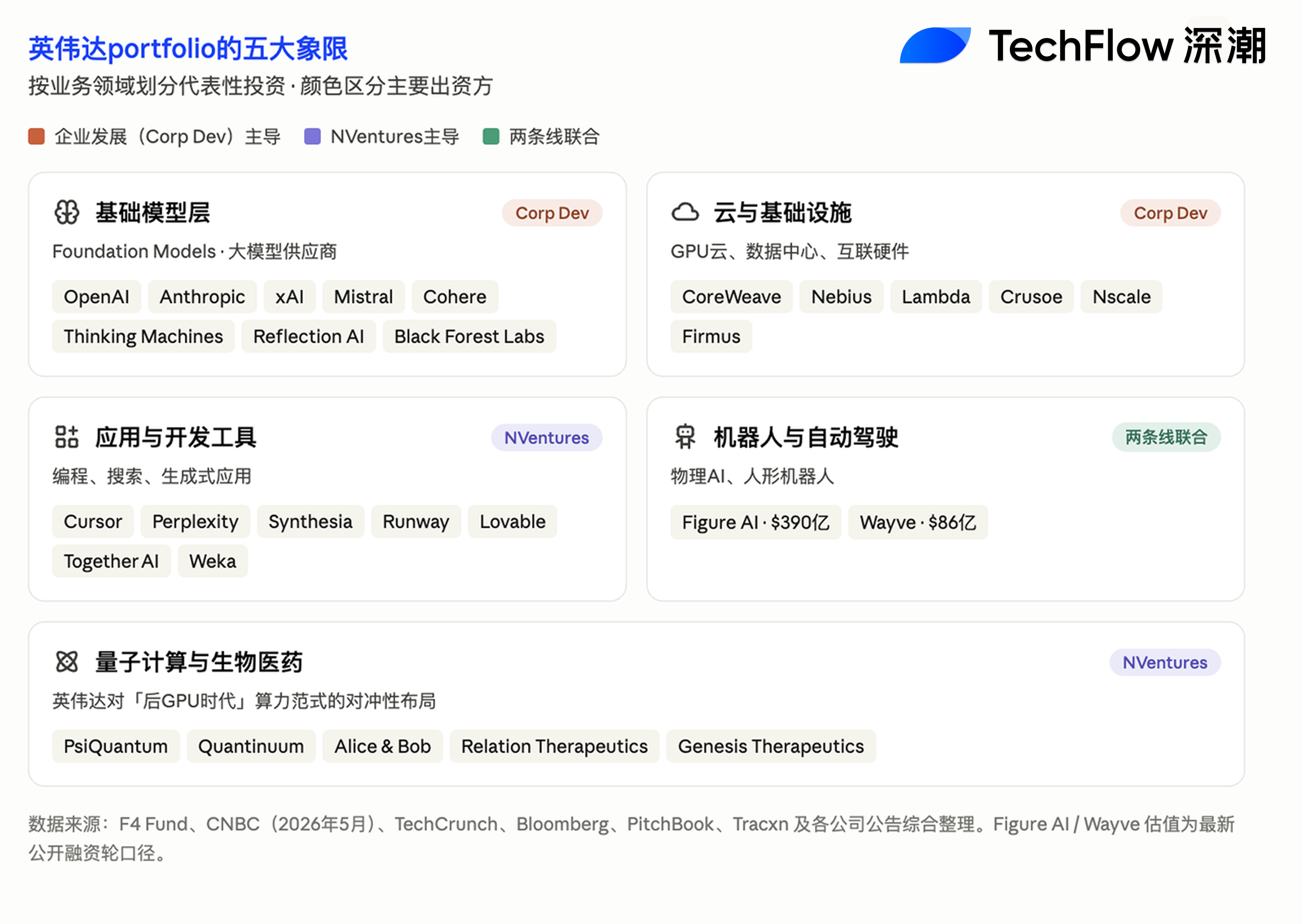
If we overlay the portfolios of the three investment tiers on the same map, NVIDIA's "capital radiation" on the AI ecosystem can be summarized into five main quadrants.

The foundation model layer includes OpenAI, Anthropic, xAI, Mistral, Cohere, Thinking Machines Lab, Reflection AI, Black Forest Labs. This layer is primarily funded by the Corporate Development team, with NVentures participating in smaller shares.

The cloud & infrastructure layer includes CoreWeave, Nebius, Lambda, Crusoe, Nscale, Firmus Technologies. This layer is also dominated by the Corporate Development team, with individual investments often reaching billions of dollars, accompanied by long-term compute purchase contracts.

The application & developer tools layer includes Cursor, Perplexity, Synthesia, Runway, Lovable, Together AI, Weka. NVentures has higher participation in this layer, with relatively smaller amounts.

The robotics & autonomous driving layer includes Figure AI (latest valuation $39 billion) and Wayve (valuation $8.6 billion). This involves combined efforts from both Corporate Development and NVentures.

The quantum computing & biopharma layer includes PsiQuantum, Quantinuum, Alice & Bob, Relation Therapeutics. This consists mainly of early-stage investments led by NVentures, serving as NVIDIA's hedging bets on post-GPU-era computing paradigms.

According to venture capital research firm F4 Fund, from 2025 to early 2026, in the investment rounds participated in by NVIDIA (Corporate Development + NVentures), at least 10 companies crossed the $1 billion valuation threshold, including OpenAI, Anthropic, xAI, Mistral, Figure AI, Cursor, Perplexity, Scale AI, Wayve, and others.
Controversy: Burry's Shorts and the Question of "Circular Financing"

However, NVIDIA's massive external investment landscape is attracting increasing scrutiny. The most representative criticism comes from hedge fund manager Michael Burry, famous from the movie "The Big Short."

According to Scion Asset Management's Q3 2025 13F filing, Burry established short positions against NVIDIA and Palantir before September 30, 2025, including put options for approximately 1 million NVIDIA shares, representing a nominal exposure of about $187 million based on the stock price at the time; and 50,000 put option contracts (each for 100 shares) on Palantir, with actual premium payments of about $9.2 million. Burry posted on his X account "Cassandra Unchained" with a screenshot from "The Big Short," captioning "Sometimes, we can see bubbles," and later retweeted a Bloomberg chart about NVIDIA's circular financing, directly pointing the finger at NVIDIA's capital deployment model.

Burry's specific accusations are technical. He estimated in a Substack post that between 2026 and 2028, cloud providers including Microsoft, Google, Oracle, and Meta would cumulatively understate depreciation by about $176 billion by extending the accounting depreciation period for NVIDIA GPUs, thereby inflating profits during that period. This accounting adjustment resonates with NVIDIA's equity investments in customers. The former gives buyers higher "paper profits" to absorb larger capital expenditures, while the latter directly provides buyers with funds to purchase NVIDIA hardware.

At the institutional level, similar suspicions are accumulating. The EU competition regulator explicitly included the "risk of circular spending" within NVIDIA's investment system in its review scope in March 2026. Seaport Research estimates that for every $1 of equity NVIDIA invests, it corresponds to about $3.5 in downstream chip purchase revenue. Bloomberg's March 2026 feature on "AI Circular Trades" mapped the dense web of fund flows among NVIDIA, CoreWeave, OpenAI, Oracle, and Anthropic. NVIDIA holds about a 7% stake in CoreWeave, CoreWeave uses NVIDIA GPUs as collateral for financing, in turn uses cash to purchase more GPUs from NVIDIA, and NVIDIA then signs a $6.3 billion cloud capacity purchase agreement, committing to absorb CoreWeave's excess capacity through 2032. NVIDIA committed up to $100 billion in investment to OpenAI, OpenAI commits to purchasing NVIDIA hardware and building a $300 billion data center via Oracle, and Oracle then purchases GPUs from NVIDIA. NVIDIA invests $10 billion in Anthropic, Anthropic commits to deploying Claude on Microsoft Azure, and Azure purchases NVIDIA Grace Blackwell and Vera Rubin systems.

Counterarguments from supporters also exist. Asset manager Janus Henderson characterized this model as a "virtuous cycle," arguing that in an era of extreme compute scarcity, binding supply and demand through "equity + long-term purchase contracts" is a reasonable commercial arrangement. Morningstar's analysis pointed out that NVIDIA's arrangement with CoreWeave to "commit to purchasing excess capacity" actually makes NVIDIA bear CoreWeave's inventory risk, thus constituting a constraint on the impulse to push hardware sales in the short term.

In this controversy, NVentures' position is rather delicate. Its early-stage, small-scale, co-investment-focused, and industry-dispersed investment style forms a stark contrast to the "circular trade" model of the Corporate Development team. Companies like Alice & Bob, Tensormesh, and OpenRouter, which NVentures invests in, are not large enough to form the "both NVIDIA customer and NVIDIA investee" cycle; their investment behavior is closer to the financial investment logic of a traditional CVC. However, from the perspective of NVIDIA's overall investment system, whether NVentures, to some extent, acts as the "compliant venture capital facade" in external disclosures, making it easier for outsiders to interpret NVIDIA's investment activities as normal venture capital behavior rather than systematic seller financing, is the unspoken but implied question from Burry and EU regulators.

NVIDIA's consistent official stance is that all investments are based on independent business judgment and are not linked to hardware sales. But market observers are increasingly quoting a phrase: in an era of compute shortage, whether to believe "the entanglement of equity and purchase contracts is coincidental" is itself a question of trust.


Tiền kỹ thuật số thịnh hành

Câu hỏi Liên quan

QWhat are the three parts of NVIDIA's investment system as described in the article?

AThe three-part system consists of: 1) The Corporate Development team, which handles strategic, large-scale investments and acquisitions worth billions to hundreds of billions of dollars. 2) NVentures, the venture capital arm that makes early-stage, financially-focused investments ranging from millions to tens of millions of dollars. 3) NVIDIA Inception, a startup accelerator program that provides resources and connections but does not make direct investments.

QWho leads the NVentures team and what is its typical investment role?

ANVentures is led by Mohamed 'Sid' Siddeek. Its typical investment role is that of a traditional VC seeking financial returns, primarily participating in early-stage rounds (Seed to Series B). It mostly acts as a co-investor in rounds led by top VCs like Accel or Sequoia, with only about one-eighth of its investments being lead roles.

QWhat are some recent investment areas for NVentures as of May 2026?

AAs of May 2026, NVentures's recent investments show a clear tilt towards three areas: Quantum Computing (e.g., Alice & Bob, Quantinuum, PsiQuantum), AI Biopharma (e.g., Relation Therapeutics, Genesis Therapeutics), and AI Agent & Inference Layer (e.g., OpenRouter, Tensormesh).

QWhat is the core criticism from Michael Burry regarding NVIDIA's investment activities?

AMichael Burry's core criticism revolves around the concept of 'circular financing.' He alleges that NVIDIA's equity investments in its customers (like AI companies and cloud providers) effectively provide them with funds to purchase NVIDIA hardware. This, combined with accounting practices that extend GPU depreciation periods for buyers, creates a loop that inflates reported profits and sustains demand for NVIDIA's products.

QAccording to the article, what is the "funnel" relationship between the three parts of NVIDIA's investment system?

AThere is a clear 'funnel' relationship: NVIDIA Inception discovers early-stage projects and brings them into the NVIDIA ecosystem. Promising companies from this pool may then attract NVentures for an early-stage investment. Finally, if a company grows to a size significant enough to impact NVIDIA's strategic landscape (as a key customer, supplier, or potential acquisition target), it 'graduates' to the Corporate Development team for multi-billion dollar strategic partnerships or investments.

Nội dung Liên quan

Nhân viên "đắc dụng" của Nhà Trắng kiếm hơn 100.000 USD nhờ dự đoán dựa trên thông tin nội bộ

Mới đây, một nhân viên Nhà Trắng đã bị phát hiện sử dụng thông tin nội bộ để giao dịch kiếm lời trên thị trường dự đoán. Nhân vật chính là Gabriel Perez, người phụ trách vận hành máy nhắc lời cho các bài phát biểu của cựu Tổng thống Trump từ năm 2016. Với quyền tiếp cận bản thảo bài nói trước, Perez đã đặt cược vào các từ khóa cụ thể mà Trump sẽ "đề cập" trong hơn chục bài phát biểu, thu lợi hơn 100.000 USD chỉ trong khoảng ba tháng. Sàn giao dịch dự đoán Kalshi, nơi Perez thực hiện giao dịch, đã phát hiện hoạt động bất thường, đóng băng tài khoản của anh ta và báo cáo lên Ủy ban Giao dịch Hàng hóa Tương lai Mỹ (CFTC). Perez hiện đã bị đình chỉ công tác không lương. Tuy nhiên, khác với hai vụ buộc tội hình sự trước đó liên quan đến một binh sĩ đặc nhiệm và một kỹ sư Google, Perez chỉ phải đối mặt với hành động dân sự của CFTC, chủ yếu là hoàn trả lợi nhuận và cam kết không tái phạm. Vụ việc làm nổi bật tính dễ bị thao túng của các thị trường dự đoán thể loại "đề cập", nơi người có thông tin nội bộ hoặc chính người phát biểu có thể dễ dàng kiểm soát kết quả. Đây là trường hợp nội gián thứ ba bị công bố trong lĩnh vực này. Để ứng phó, các nền tảng như Kalshi đang siết chặt quy định, yêu cầu người dùng tiết lộ thông tin công việc nhằm hạn chế giao dịch nội gián. Sự kiện này đặt ra câu hỏi về tính toàn vẹn của thị trường dự đoán, vốn được kỳ vọng phản ánh trí tuệ đám đông, nhưng thực tế có thể trở thành công cụ kiếm lời cho số ít người nắm thông tin đặc quyền.

marsbit33 phút trước

Nhân viên "đắc dụng" của Nhà Trắng kiếm hơn 100.000 USD nhờ dự đoán dựa trên thông tin nội bộ

marsbit33 phút trước

Nhân viên sử dụng teleprompter cho Nhà Trắng kiếm hơn 100,000 USD nhờ dự đoán bằng nội bất.

Bài viết tiết lộ vụ bê bối giao dịch nội gián liên quan đến một nhân viên Nhà Trắng. Gabriel Perez, người phụ trách điều khiển máy nhắc lời cho các bài phát biểu của cựu Tổng thống Trump, đã lợi dụng thông tin nội bộ về nội dung bài diễn văn để đặt cược trên thị trường dự đoán Kalshi, kiếm lời hơn 100.000 USD trong ba tháng. Anh ta có thể biết trước các từ khóa cụ thể sẽ được nhắc đến. Tuy nhiên, không phải lần nào cũng thành công vì Trump thường nói ngoài kịch bản. Hành vi của Perez bị phát hiện nhờ hệ thống giám sát của Kalshi, dẫn đến việc tài khoản bị đóng băng và anh ta bị đình chỉ công việc. Mặc dù phải hoàn trả lợi nhuận, Perez không phải đối mặt với truy tố hình sự vì cơ quan chức năng cho rằng hành động này không gây hại cho an ninh quốc gia mà chỉ là vấn đề đạo đức. Bài viết cũng chỉ ra rằng thị trường dự đoán loại "đề cập" rất dễ bị thao túng, với chi phí gian lận thấp và lợi nhuận tiềm năng cao, và dẫn thêm các ví dụ khác như CEO Coinbase Brian Armstrong. Để tăng cường tuân thủ, Kalshi đã yêu cầu người dùng tiết lộ nơi làm việc. Vụ việc của Perez cho thấy nỗ lực thanh lọc giao dịch nội gián trong lĩnh vực thị trường dự đoán, nhưng đồng thời cũng làm dấy lên câu hỏi về tính chính xác và bản chất của các nền tảng này.

Odaily星球日报37 phút trước

Nhân viên sử dụng teleprompter cho Nhà Trắng kiếm hơn 100,000 USD nhờ dự đoán bằng nội bất.

Odaily星球日报37 phút trước

Các trang trại khai thác Bitcoin đang biến thành nhà máy AI

Bài báo phân tích xu hướng chuyển đổi từ lĩnh vực tiền điện tử (Crypto) sang trí tuệ nhân tạo (AI), tập trung vào ba loại tài sản chính được kế thừa từ chu kỳ Crypto trước. **1. Cơ sở hạ tầng từ các trang trại khai thác Bitcoin:** Các công ty khai thác như Crusoe, CoreWeave, TeraWulf và nhiều công ty khác đang chuyển đổi trung tâm dữ liệu của họ để phục vụ AI. Giá trị cốt lõi không nằm ở phần cứng cũ (máy đào ASIC khó tái sử dụng cho AI), mà ở các tài sản như nguồn điện ổn định, đất đai, giấy phép kết nối lưới điện và kinh nghiệm vận hành. Khi lợi nhuận từ khai thác Bitcoin giảm và nhu cầu điện cho AI tăng, những cơ sở hạ tầng này trở thành tài sản chiến lược, với nhiều hợp đồng cho thuê dài hạn trị giá hàng tỷ USD được ký kết với các tập đoàn AI lớn. **2. Con người và kỹ năng từ hệ sinh thái Crypto:** Các kỹ sư và doanh nhân từng làm việc trong lĩnh vực Crypto đang áp dụng kinh nghiệm của họ vào AI. Ví dụ điển hình là Alex Atallah (đồng sáng lập OpenSea) với OpenRouter - một nền tảng tổng hợp API cho hàng trăm mô hình AI, tương tự cách OpenSea kết nối người mua và bán NFT. Một ví dụ khác là Fal.ai (người sáng lập từng làm tại Coinbase), chuyên tối ưu hóa việc triển khai các mô hình sinh ra hình ảnh/video. **3. Vốn từ chu kỳ Crypto trước:** Các khoản lợi nhuận khổng lồ từ Crypto đang được tái đầu tư vào AI. Jed McCaleb (người sáng lập Mt.Gox, Ripple) đã dùng 5 tỷ USD để mua GPU và thành lập Voltage Park. Các quỹ đầu tư mạo hiểm (VC) Crypto như Paradigm cũng đang rót vốn vào các công ty AI như Nous Research. Một trường hợp đặc biệt là khoản đầu tư từ FTX (sàn giao dịch đã phá sản) vào Anthropic và Cursor, sau này tăng giá trị lên rất nhiều lần. Bài báo kết luận rằng bản thân Crypto không "biến thành" AI, mà các nguồn lực (cơ sở hạ tầng, con người, vốn) tích lũy được từ thời kỳ bùng nổ trước đang được chuyển dịch một cách tự nhiên sang lĩnh vực mới đang cần chúng nhất - trí tuệ nhân tạo.

链捕手48 phút trước

Các trang trại khai thác Bitcoin đang biến thành nhà máy AI

链捕手48 phút trước

Morpho Ra Mắt Sản Phẩm Lãi Suất Cố Định Midnight: Người Vay Và Cho Vay Tự Định Giá, Chấm Dứt Thời Đại Mô Hình Lãi Suất

Morpho đã ra mắt sản phẩm lãi suất cố định Midnight, cho phép người cho vay và đi vay tự định giá, tự đặt lãi suất và kỳ hạn, thay vì phụ thuộc vào các mô hình thuật toán lãi suất thả nổi. Bài viết cho rằng thiếu lãi suất cố định và ngày đáo hạn là điểm nghẽn chính hạn chế sự tăng trưởng của thị trường cho vay trên chuỗi, đặc biệt đối với các tổ chức cần sự dự đoán được. Midnight được xây dựng như một nguyên thủy độc lập trên lớp cốt lõi, kế thừa hệ sinh thái từ Morpho Blue - một trong những nền tảng có cơ sở người dùng hoạt động lớn nhất DeFi. Nó giải quyết những hạn chế của các nỗ lực trước đây bằng cách không xây dựng trên các pool lãi suất thả nổi và tận dụng cơ sở người dùng sẵn có để đảm bảo tính thanh khoản. Sản phẩm mang lại giá trị khác nhau cho từng nhóm người tham gia: các tổ chức có được cấu trúc kỳ hạn dự đoán được và toàn quyền kiểm soát; các công ty fintech có thể cung cấp sản phẩm tín dụng được tùy chỉnh; người dùng cá nhân được hưởng lợi từ tính dự đoán và hiệu quả; trong khi các curator có thêm chiều kích mới (kỳ hạn) để phân biệt hóa. Mạng lưới Morpho giờ đây sẽ tồn tại song song hai cấu trúc thị trường: Morpho Blue cho lãi suất thả nổi (linh hoạt) và Morpho Midnight cho lãi suất cố định (dự đoán được), bổ trợ cho nhau. Kế hoạch ra mắt được thực hiện từng bước, bắt đầu với các hợp đồng cốt lõi trên mạng Base với một cặp giao dịch giới hạn (cbBTC/USDC) để đảm bảo an toàn và cho phép thị trường thích nghi.

marsbit52 phút trước

Morpho Ra Mắt Sản Phẩm Lãi Suất Cố Định Midnight: Người Vay Và Cho Vay Tự Định Giá, Chấm Dứt Thời Đại Mô Hình Lãi Suất

marsbit52 phút trước

Thanh toán bằng tiền mã hóa cho peptide thị trường xám tăng 700% trong một năm – Chi tiết

Theo tiết lộ gần đây, Hoa Kỳ đang chứng kiến sự gia tăng đáng kể trong việc sử dụng tiền điện tử, chủ yếu là Bitcoin (BTC) và stablecoin, để mua các peptide thị trường xám. Các peptide này thường được quảng cáo với công dụng chống lão hóa, tăng cơ, giảm cân và kéo dài tuổi thọ, nhưng tồn tại trong khu vực pháp lý mờ ám. Do các ngân hàng và mạng lưới thẻ tín dụng siết chặt hạn chế giao dịch, nhiều nhà cung cấp, đặc biệt từ Trung Quốc, đã chuyển sang chỉ chấp nhận thanh toán bằng tiền điện tử. Điều này thu hút cả những người tiêu dùng chính thống quan tâm đến sức khỏe, vì giá rẻ hơn và dễ tiếp cận hơn, dù họ có thể chưa từng sở hữu Bitcoin trước đây. Số liệu từ Chainalysis cho thấy, trong quý I/2026, các nhà bán lẻ peptide thị trường xám đã nhận được 32 triệu USD tiền điện tử, tăng 700% so với năm trước và đưa thị trường này vào quỹ đạo hơn 100 triệu USD mỗi năm. TRM Labs cũng ghi nhận xu hướng tương tự, với dòng tiền điện tử vào các nhà sản xuất hóa chất Trung Quốc bán peptide đạt 41,4 triệu USD trong năm 2025. Các chuyên gia nhận định đây là thị trường có nhiều người mua lần đầu sử dụng tiền điện tử, khác với thời kỳ chợ đen Silk Road. Sự bùng nổ này diễn ra song song với việc tổng khối lượng giao dịch tiền điện tử toàn cầu trong quý I/2026 giảm 23% so với quý trước, cho thấy một xu hướng sử dụng cụ thể đang nổi lên bên cạnh hoạt động đầu tư tổng thể.

ambcrypto1 giờ trước

Thanh toán bằng tiền mã hóa cho peptide thị trường xám tăng 700% trong một năm – Chi tiết

ambcrypto1 giờ trước

Giao dịch

Giao ngay

Bài viết Nổi bật

Làm thế nào để Mua AR

Chào mừng bạn đến với HTX.com! Chúng tôi đã làm cho mua Arweave (AR) trở nên đơn giản và thuận tiện. Làm theo hướng dẫn từng bước của chúng tôi để bắt đầu hành trình tiền kỹ thuật số của bạn.Bước 1: Tạo Tài khoản HTX của BạnSử dụng email hoặc số điện thoại của bạn để đăng ký tài khoản miễn phí trên HTX. Trải nghiệm hành trình đăng ký không rắc rối và mở khóa tất cả tính năng. Nhận Tài khoản của tôiBước 2: Truy cập Mua Crypto và Chọn Phương thức Thanh toán của BạnThẻ Tín dụng/Ghi nợ: Sử dụng Visa hoặc Mastercard của bạn để mua Arweave (AR) ngay lập tức.Số dư: Sử dụng tiền từ số dư tài khoản HTX của bạn để giao dịch liền mạch.Bên thứ ba: Chúng tôi đã thêm những phương thức thanh toán phổ biến như Google Pay và Apple Pay để nâng cao sự tiện lợi.P2P: Giao dịch trực tiếp với người dùng khác trên HTX.Thị trường mua bán phi tập trung (OTC): Chúng tôi cung cấp những dịch vụ được thiết kế riêng và tỷ giá hối đoái cạnh tranh cho nhà giao dịch.Bước 3: Lưu trữ Arweave (AR) của BạnSau khi mua Arweave (AR), lưu trữ trong tài khoản HTX của bạn. Ngoài ra, bạn có thể gửi đi nơi khác qua chuyển khoản blockchain hoặc sử dụng để giao dịch những tiền kỹ thuật số khác.Bước 4: Giao dịch Arweave (AR)Giao dịch Arweave (AR) dễ dàng trên thị trường giao ngay của HTX. Chỉ cần truy cập vào tài khoản của bạn, chọn cặp giao dịch, thực hiện giao dịch và theo dõi trong thời gian thực. Chúng tôi cung cấp trải nghiệm thân thiện với người dùng cho cả người mới bắt đầu và người giao dịch dày dạn kinh nghiệm.

Tổng lượt xem 686Xuất bản vào 2024.12.11Cập nhật vào 2026.06.02

Làm thế nào để Mua AR

Thảo luận

Chào mừng đến với Cộng đồng HTX. Tại đây, bạn có thể được thông báo về những phát triển nền tảng mới nhất và có quyền truy cập vào thông tin chuyên sâu về thị trường. Ý kiến ​​của người dùng về giá của AR (AR) được trình bày dưới đây.

活动图片












