Token Going Global: Selling China's Electricity to the World

marsbitXuất bản vào 2026-02-26Cập nhật gần nhất vào 2026-02-26

Tóm tắt

The article "Token Goes Global: Selling Chinese Electricity to the World" draws a parallel between the 19th-century British Empire's control over global telegraph networks and China's emerging dominance in AI model-based token consumption. By 2026, data from OpenRouter shows Chinese models (like MiniMax M2.5, Kimi K2.5, and GLM-5) account for 61% of the top ten models’ token usage, driven by significantly lower costs—sometimes 17 times cheaper than Western alternatives. This shift accelerated with tools like OpenClaw, which increased token consumption exponentially, leading developers to seek affordable alternatives. Chinese models offer competitive performance at a fraction of the price, thanks to lower electricity costs, efficient MoE architectures, and intense domestic competition. The core idea is that token consumption represents a new form of “electricity export.” While physical electricity remains in China, its value is delivered globally via tokens—avoiding traditional trade barriers. This mirrors China’s earlier role in Bitcoin mining, but tokens now offer more practical, embedded value in developer workflows. However, challenges like data sovereignty and U.S. chip restrictions remain. The situation is framed as a new strategic competition between the U.S. and China, akin to the space race, where control over AI infrastructure could shape global digital influence. The token-driven battle is ongoing, silent, and fought on every developer’s machine.

Author:Black Lobster, Deep Tide TechFlow

In the summer of 1858, a copper-core cable was laid across the Atlantic seabed, connecting London and New York.

The significance of this event was never about transmission speed, but about the power structure. Whoever laid the submarine cable could extract value from the flow of information. The British Empire, with this global telegraph network, held in its grasp intelligence from its colonies, cotton prices, and news of wars.

The empire's strength lay not only in its fleet but also in that cable.

Over 160 years later, this logic is replaying itself in an unexpected way.

In 2026, Chinese large language models are quietly devouring the global developer market. The latest data from OpenRouter shows that among the top ten models on the platform by Token consumption, Chinese models account for 61%, with the top three all来自中国。来自中国。Developers in San Francisco, Berlin, and Singapore send API requests daily that traverse Pacific submarine cables to data centers in China, where computing power is consumed, electricity flows, and results are sent back.

The electricity never leaves China's power grid, but its value is delivered cross-border through Tokens.

The Great AI Model Migration

On February 24, 2026, OpenRouter released weekly data: the total Token consumption of the top ten models on the platform was about 8.7 trillion, with Chinese models独占 5.3 trillion, accounting for 61%. MiniMax M2.5 topped the list with 2.45 trillion Tokens, followed by Kimi K2.5 and Zhipu GLM-5, the top three all来自中国。来自中国。
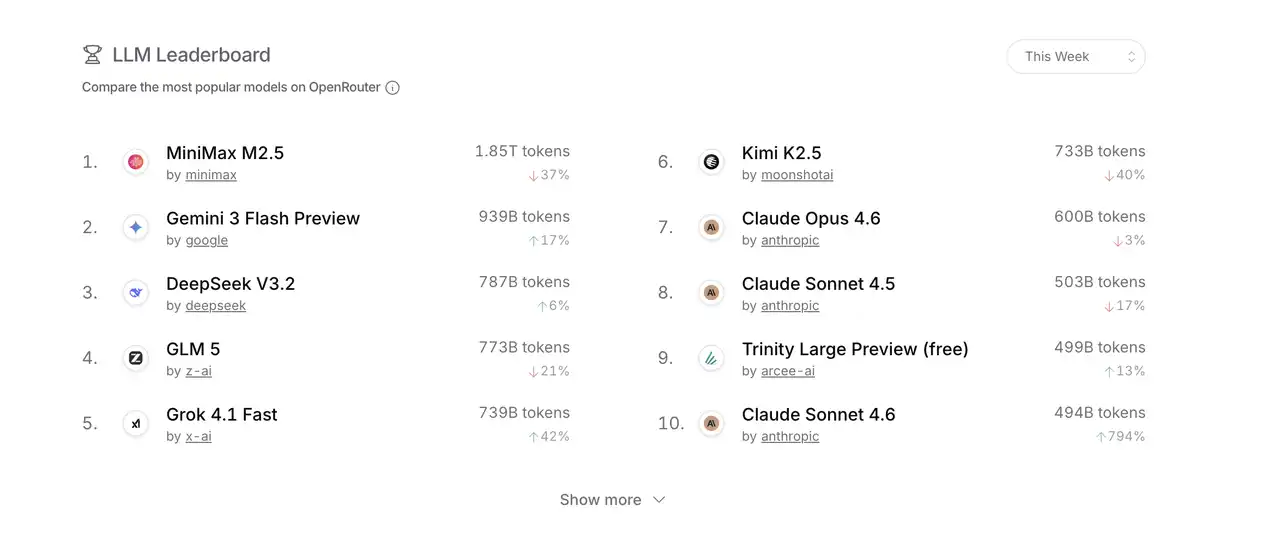
Latest data on February 26

This is no accident; a fuse has been lit.

Earlier this year, OpenClaw emerged, an open-source tool that truly allows AI to "work," capable of directly controlling computers, executing commands, and并行完成复杂工作流。Its GitHub stars surpassed 210,000 within weeks.

John, a finance professional, installed OpenClaw immediately and connected it to the Anthropic API to automatically monitor stock market information and provide trading signals. A few hours later, he stared at his account balance in disbelief: dozens of dollars, gone.

This is the new reality brought by OpenClaw. In the past, chatting with AI consumed a few thousand Tokens per conversation, with negligible cost. After integrating OpenClaw, the AI runs dozens of subtasks in the background, repeatedly calling context and iterating循环。Token consumption isn't linear; it's exponential. The bill is like a car accelerating with the hood open, the fuel gauge dropping, unstoppable.

A "clever trick"随即流传在 developer communities: use OAuth tokens to directly connect Anthropic or Google subscription accounts into OpenClaw, turning the monthly "unlimited" quota into free fuel for AI Agents. This is the method many developers adopted.

Official countermeasures随即到来。

On February 19, Anthropic updated its agreement, explicitly prohibiting the use of Claude subscription credentials for third-party tools like OpenClaw. To access Claude's functionality, one must use the API billing channel. Google更是大面积封禁了 subscription accounts connected to Antigravity and Gemini AI Ultra via OpenClaw.

"The world has long suffered under Qin," John随即投入了国产大模型的怀抱。

On OpenRouter, the国产大模型 MiniMax M2.5 scores 80.2% on software engineering tasks, while Claude Opus 4.6 scores 80.8%, a negligible difference. But the prices are worlds apart: the former costs $0.3 per million input Tokens, the latter $5, a difference of about 17 times.

John switched over. The workflow still ran, but the bill shrunk by an order of magnitude. This migration is happening simultaneously worldwide.

OpenRouter's COO, Chris Clark, put it bluntly: Chinese open-source models have captured a large market share because they account for an unusually high proportion of the agent workflows run by US developers.

Electricity Going Global

To understand the essence of Token出海, one must first understand the cost structure of a Token.

It seems light; one Token is roughly equal to 0.75 English words. An ordinary conversation with AI consumes only a few thousand Tokens. But when these Tokens stack up in trillions, the underlying physical reality becomes heavy.

Breaking down the cost of a Token, there are only two core components: computing power and electricity.

Computing power is the depreciation of GPUs. You buy an NVIDIA H100 for about thirty thousand dollars; its lifespan amortized over each inference is the depreciation cost. Electricity is the fuel for the continuous operation of data centers. A GPU at full load consumes about 700 watts, and加上冷却系统的开销, the annual electricity bill for a large AI data center can easily exceed hundreds of millions of dollars.

Now, map this physical process.

A US developer in San Francisco sends an API request. The data travels from California, via Pacific submarine cables, to a data center somewhere in China. The GPU cluster starts working; electricity flows from China's power grid to those chips. The inference is completed, and the results are sent back. The entire process也许只用了一两秒。

The electricity never leaves China's power grid, but the value of the electricity is delivered cross-border through Tokens.

There is something magical here that ordinary trade cannot achieve: Tokens have no physical form, do not need to go through customs, are not subject to tariffs, and are almost invisible in any current trade statistics. China exports a large amount of computing power and electricity services, but it is almost隐形 on official merchandise trade data.

Tokens have become derivatives of electricity. Token出海 is essentially electricity出海。

This also benefits from China's relatively low electricity prices, about 40% lower than the US on average. This is a physical cost difference that competitors cannot easily replicate.

Additionally, Chinese AI models have algorithmic and "involution" advantages.

DeepSeek V3's MoE architecture activates only a portion of parameters during inference. Independent tests show its inference cost is about 36 times lower than GPT-4o. MiniMax M2.5 similarly activates only 10B out of 229B total parameters.

On top of this is involution: Alibaba, ByteDance, Baidu, Tencent, Moonshot AI, Zhipu, MiniMax... over a dozen companies are trampling on each other on the same track. Prices have long fallen below reasonable profit margins; losing money to gain market share is already the industry norm.

Look closely, this is just like Chinese manufacturing going global, utilizing supply chain advantages and industry involution to drive down Token prices hard.

From Bitcoin to Token

Before Tokens, there was another form of electricity出海。

Around 2015, power station managers in Sichuan, Yunnan, and Xinjiang began to receive some strange visitors.

These people rented abandoned factory buildings, filled them with dense rows of machines, and powered them 24/7. The machines produced nothing but continuously solved a mathematical problem, occasionally calculating a Bitcoin from this endless equation.

This was the first-generation form of electricity出海: converting cheap hydropower and wind power, via the hash calculations of mining rigs, into globally circulating digital assets, which were then cashed out into dollars on exchanges.

The electricity never crossed any border, but the value of the electricity, embodied in Bitcoin, flowed to the global market.

During those years, Chinese computing power once accounted for over 70% of global Bitcoin mining算力。China's hydropower and coal power, in this roundabout way, participated in a global redistribution of capital.

In 2021, this came to an abrupt halt. Regulatory hammers fell, miners scattered, and算力 migrated to Kazakhstan, Texas, USA, and Canada.

But the logic itself never disappeared; it was just waiting for a new shell. Until ChatGPT emerged, large models became the new battlefield, the former Bitcoin mining farms transformed into AI data centers, mining rigs became computing GPUs, the once-produced Bitcoin became Tokens. The only constant is the electricity.

Bitcoin出海 and Token出海 are isomorphic in their underlying logic, but Tokens have more commercial value today.

Mining with rigs is pure mathematical calculation; the output, Bitcoin, is a financial asset whose value comes from scarcity and market consensus, having nothing to do with "what was calculated." The computing power itself is not productive; it's more like a byproduct of a trust mechanism.

Large model inference is different. GPUs consume electricity and output real cognitive services: code, analysis, translation, creativity. The value of a Token comes directly from its utility to the user. This is a deeper embedding. Once a developer's workflow relies on a certain model, the cost of switching increases over time.

Of course, there is another key difference: Bitcoin mining was驱逐出去的 by China, while Token出海 is being主动选择的 by global developers.

Token War

The submarine cable laid in 1858 represented the British Empire's sovereignty over the information highway. Whoever owned the infrastructure could define the rules of the game.

Token出海 is also an undeclared war, fraught with resistance.

Data sovereignty is the first wall. An API request from a US developer is processed by a Chinese data center; the data physically flows through China. For individual developers and small applications, this is not a problem. But for scenarios involving sensitive corporate data, financial information, or government compliance, this is a hard stop. This is why the penetration rate of Chinese models is highest in development tools and personal applications, with almost no presence in core enterprise systems.

The chip ban is the second wall. China's AI development faces export controls on NVIDIA's high-end GPUs. MoE architecture and algorithm optimization can only partially offset this disadvantage; the ceiling still exists.

But the current resistance is just the prologue. A larger battlefield is taking shape.

Tokens and AI models have become a new strategic dimension of博弈 between China and the US, no less important than semiconductors and the internet in the 20th century, or even closer to an older analogy: the space race.

In 1957, the Soviet Union launched Sputnik 1, shocking the United States, which随即启动 the Apollo program, pouring resources equivalent to hundreds of billions of dollars today to绝不落败 in the space race.

The logic of the AI hegemony race is strikingly similar, but its intensity will far exceed the space race. Space is, after all, physical; ordinary people don't feel it. AI渗透的是经济的毛细血管; behind every line of code, every contract, every government decision-making system, a certain country's large model could be running. Whose model becomes the default infrastructure option for global developers gains structural influence over the global digital economy无形中。

This is what truly makes Washington uneasy about China's Token出海。

When a developer's codebase, Agent workflow, and product logic are all built around the API of a certain Chinese model, the migration cost increases exponentially over time. By then, even if the US legislates restrictions, developers will resist with their feet, just as no programmer can abandon GitHub today.

Today's Token出海 might just be the opening chapter of this long game. Chinese large models don't claim to颠覆什么; they simply deliver services to every global developer with an API Key at a lower price.

This time, those laying the cables are the engineering teams writing code in Hangzhou, Beijing, and Shanghai, and the GPU clusters operating day and night in some southern province.

This hegemony has no countdown; it happens 24 hours a day, measured in Tokens, on the battlefield of every developer's terminal.


Câu hỏi Liên quan

QWhat is the core concept behind 'Token出海' (Token going global) as described in the article?

AThe core concept is that Chinese AI models are exporting computational power and electricity globally through the delivery of AI-generated tokens. The physical electricity never leaves China's grid, but its value is transmitted internationally via tokens, which represent AI inference services consumed by global developers.

QWhat key event in 2026 triggered a massive shift of global developers to Chinese AI models according to the article?

AThe release of OpenClaw, an open-source tool that allows AI to perform complex workflows and control computers, led to exponentially higher token consumption. When Western providers like Anthropic and Google banned its use with their subscription services, developers switched to cheaper, similarly capable Chinese models on platforms like OpenRouter.

QWhat are the two main physical cost components that determine the price of a token?

AThe two main cost components are computational power (the depreciation cost of GPUs like the H100 used for inference) and electricity (the power required to run the data centers and their cooling systems).

QHow does the article draw a parallel between the historical 'Bitcoin出海' (Bitcoin going global) and the current 'Token出海'?

AThe article states that both are forms of 'power export' where China's cheap electricity is converted into a globally traded digital asset (first Bitcoin, now AI tokens). However, Token出海 is seen as more valuable because the computation produces useful cognitive services (code, analysis) that create user dependency, unlike Bitcoin mining which was a purely mathematical process producing a financial asset.

QWhat does the article identify as the major potential obstacles or 'walls' for the continued expansion of Chinese AI token exports?

AThe major obstacles are data sovereignty concerns (sensitive foreign data physically flowing through Chinese data centers) and the chip ban (export controls on high-end NVIDIA GPUs limiting China's AI development ceiling).

Nội dung Liên quan

Định luật Thao (τ), đưa EDA “nổ” ra khỏi vòng tròn

Tháng 5/2026, tại IEEE ISCAS, bà Hà Đình Ba, Chủ tịch bộ phận kinh doanh bán dẫn của Huawei, đã giới thiệu khái niệm "Định luật Thao (τ)". Khác với Định luật Moore tập trung vào thu nhỏ hình học, định luật τ hướng tới "thu nhỏ thời gian", tối ưu hóa hằng số thời gian τ xuyên suốt các cấp độ linh kiện, mạch, chip và hệ thống để tăng hiệu suất xử lý thông tin. Huawei cho biết đã sản xuất 381 chip dựa trên nguyên tắc này và dự kiến đạt trình độ tương đương 1.4nm vào năm 2031. Định luật τ đặt ra yêu cầu mới cho công cụ EDA, đẩy nó từ công cụ thiết kế hỗ trợ lên thành nền tảng tối ưu hóa hiệu suất hệ thống trọng yếu. Các thách thức chính bao gồm: thiếu khả năng thiết kế "3D thực sự" bản địa và tối ưu hóa xuyên tầng (STCO), cũng như thiếu công cụ phân tích đa trường vật lý (điện, nhiệt, cơ) kết hợp hiệu quả cho các cấu trúc xếp chồng 3D và Chiplet. Định luật này có thể thúc đẩy EDA trong nước Trung Quốc chuyển từ các công cụ điểm sang xây dựng nền tảng phần mềm công nghiệp "toàn quy trình, xuyên tầng, hợp tác mạnh". Các công ty như Hoa Đại Cửu Thiên đã bắt đầu phát triển các giải pháp toàn quy trình cho thiết kế 3DIC. Đại học Bắc Kinh cũng công bố nguyên mẫu công cụ EDA "3D thực sự" cho nhu cầu gấp logic, cho thấy sự tiến bộ trong việc lấp đầy khoảng trống then chốt, hướng tới mục tiêu không chỉ "có thể dùng" mà còn "dùng tốt" toàn diện.

marsbit15 phút trước

Định luật Thao (τ), đưa EDA “nổ” ra khỏi vòng tròn

marsbit15 phút trước

BingX Giới Thiệu Tính Năng Tự Động Kiếm Lãi Cho Tài Sản Hợp Đồng Tương Lai Đầu Tiên Trong Ngành Dành Cho Thành Viên VIP BingX

BingX, một sàn giao dịch tiền mã hóa và công ty Web3-AI hàng đầu, đã chính thức ra mắt sự kiện Futures Asset Auto Earn dành riêng cho người dùng VIP từ cấp 3 trở lên. Chương trình đầu tiên trong ngành này cho phép các nhà giao dịch đủ điều kiện kiếm thu nhập thụ động từ các vị thế hợp đồng vĩnh viễn USDT-M mà không ảnh hưởng đến giao dịch, với thao tác kích hoạt tức thì chỉ bằng một cú nhấp chuột. Cơ chế mới, có hiệu lực từ ngày 12/6 đến ngày 12/8/2026, biến số tiền ký quỹ hợp đồng nhàn rỗi thành nguồn thu lãi hàng ngày mà không yêu cầu người dùng khóa vốn, thay đổi chiến lược hoặc bỏ lỡ cơ hội thị trường. Với Futures Asset Auto Earn, người dùng VIP được chọn của BingX được hưởng các lợi ích: Kích hoạt một lần nhấp, lãi suất được tính toán và tín dụng tự động hàng ngày vào tài khoản hợp đồng, không có thời gian khóa vốn và mức thưởng lãi suất phân cấp theo cấp VIP (lên tới 4%). Sự kiện này bổ sung vào bộ đặc quyền BingX VIP, khẳng định cam kết của sàn trong việc mang lại giá trị và đổi mới hàng đầu cho cộng đồng giao dịch. BingX, được thành lập năm 2018, phục vụ hơn 40 triệu người dùng toàn cầu và là đối tác chính thức của Chelsea FC (từ 2024) và Scuderia Ferrari HP (từ 2026).

TheNewsCrypto2 giờ trước

BingX Giới Thiệu Tính Năng Tự Động Kiếm Lãi Cho Tài Sản Hợp Đồng Tương Lai Đầu Tiên Trong Ngành Dành Cho Thành Viên VIP BingX

TheNewsCrypto2 giờ trước

SEC Mỹ muốn bãi bỏ một quy định cũ năm 2005, cổ phiếu token hóa nhìn thấy điều gì

Ngày 11/6, Ủy ban Chứng khoán và Giao dịch Mỹ (SEC) đã đề xuất bãi bỏ Quy tắc 611 và 610(e) thuộc Quy định Hệ thống Thị trường Quốc gia (Regulation NMS). Động thái này thu hút sự chú ý của cộng đồng Web3 vì trong bối cảnh đề xuất, SEC đề cập cụ thể đến công nghệ sổ cái phân tán (DLT), tài sản mã hóa và các phương thức giao dịch mới như hợp đồng thông minh và AMM. Quy tắc 611 (quy tắc "không bỏ qua giá tốt hơn") yêu cầu các trung tâm giao dịch phải ưu tiên thực hiện lệnh tại mức giá mua/bán tốt nhất hiện có trên toàn thị trường. SEC nhận định quy tắc năm 2005 này nay đã làm tăng chi phí tuân thủ, hạn chế lựa chọn xử lý lệnh, góp phần chia cắt thị trường và thúc đẩy việc theo đuổi tốc độ khớp lệnh cực nhanh. Quy tắc 610(e) hạn chế việc hiển thị "giá chốt" (giá mua bằng giá bán) và "giá chéo" (giá mua cao hơn giá bán). SEC cho rằng việc bãi bỏ nó có thể thu hẹp chênh lệch giá, giảm chi phí giao dịch và giảm độ phức tạp của hệ thống. Tuy nhiên, nó cũng có thể gây nhầm lẫn cho nhà đầu tư. Liên quan đến cổ phiếu mã hóa, đề xuất này được xem như một bước nới lỏng khả năng có thể xảy ra đối với cấu trúc thị trường chứng khoán tập trung truyền thống. Nó mở ra không gian thử nghiệm lớn hơn cho các cơ chế khớp lệnh mới (như AMM, đấu giá) tại các sàn giao dịch hoặc hệ thống giao dịch thay thế (ATS), vốn có thể tương thích hơn với đặc điểm giao dịch 24/7 và trên chuỗi của tài sản mã hóa. Tuy nhiên, đề xuất chưa giải quyết các vấn đề cốt lõi khác như đăng ký phát hành, lưu ký, quyền cổ đông hay tuân thủ. SEC ước tính việc bãi bỏ hai quy tắc này có thể giúp các bên tham gia thị trường tiết kiệm từ 54,2 đến 77 triệu USD chi phí tuân thủ hàng năm. Mục tiêu cuối cùng là giảm bớt sự phức tạp do quy định mang lại, thúc đẩy cạnh tranh thông qua chất lượng khớp lệnh và thiết kế cơ chế, từ đó tạo điều kiện cho các hình thức giao dịch sáng tạo hơn phát triển.

Foresight News4 giờ trước

SEC Mỹ muốn bãi bỏ một quy định cũ năm 2005, cổ phiếu token hóa nhìn thấy điều gì

Foresight News4 giờ trước

Sự Chuyển Đổi Của Ethena Và Nỗi Lo Của Phố Wall

Đồng tiền ổn định Ethena (USDe) đã có bước chuyển mình lớn khi công bố hợp tác chiến lược với gã khổng lồ quản lý tài sản truyền thống Janus Henderson (4800 tỷ USD) vào tháng 6/2026. Thỏa thuận bao gồm bốn tầng: Janus Henderson cung cấp tài sản RWA (quỹ CLO) cho dự trữ của USDe, đầu tư vào token quản trị ENA, sử dụng USDe làm công cụ quản lý tiền mặt và lên kế hoạch phát hành sản phẩm ETP để phân phối USDe cho khách hàng tổ chức. Đây là bước đi quan trọng trong quá trình chuyển đổi của Ethena từ một giao thức DeFi thuần túy sang mô hình ổn định lai. Sau khi gặp khủng hoảng vì phụ thuộc vào cơ chế Delta-neutral (lệnh vĩnh viễn) trong đợt sụt giảm thị trường 2025, Ethena đã đa dạng hóa tài sản dự trữ cho USDe, bổ sung trái phiếu kho bạc, tín dụng doanh nghiệp và RWA, giảm tỷ trọng lệnh phái sinh xuống chỉ còn khoảng 20%. Hợp tác này phản ánh sự lo ngại mang tính cấu trúc từ phố Wall. Sau khi khung pháp lý rõ ràng (đạo luật GENIUS 2025), cạnh tranh trong lĩnh vực stablecoin chuyển sang việc xây dựng mạng lưới phân phối. Các định chế tài chính truyền thống như Janus Henderson lo sợ bị đứng ngoài cuộc trong nền tảng hạ tầng tài chính mới, nơi stablecoin đang trở thành tầng thanh toán cốt lõi với khối lượng giao dịch khổng lồ. Bằng cách hợp tác với Ethena, họ chấp nhận vai trò "phân phối" để đổi lấy vị thế và chia sẻ lợi nhuận, đảm bảo mình không bị bỏ lại phía sau trong xu hướng tích hợp giữa tài chính truyền thống (TradFi) và tài chính phi tập trung (DeFi).

Foresight News4 giờ trước

Sự Chuyển Đổi Của Ethena Và Nỗi Lo Của Phố Wall

Foresight News4 giờ trước

Giao dịch

Giao ngay
Hợp đồng Tương lai

Bài viết Nổi bật

Làm thế nào để Mua CORE

Chào mừng bạn đến với HTX.com! Chúng tôi đã làm cho mua CORE (CORE) trở nên đơn giản và thuận tiện. Làm theo hướng dẫn từng bước của chúng tôi để bắt đầu hành trình tiền kỹ thuật số của bạn.Bước 1: Tạo Tài khoản HTX của BạnSử dụng email hoặc số điện thoại của bạn để đăng ký tài khoản miễn phí trên HTX. Trải nghiệm hành trình đăng ký không rắc rối và mở khóa tất cả tính năng. Nhận Tài khoản của tôiBước 2: Truy cập Mua Crypto và Chọn Phương thức Thanh toán của BạnThẻ Tín dụng/Ghi nợ: Sử dụng Visa hoặc Mastercard của bạn để mua CORE (CORE) ngay lập tức.Số dư: Sử dụng tiền từ số dư tài khoản HTX của bạn để giao dịch liền mạch.Bên thứ ba: Chúng tôi đã thêm những phương thức thanh toán phổ biến như Google Pay và Apple Pay để nâng cao sự tiện lợi.P2P: Giao dịch trực tiếp với người dùng khác trên HTX.Thị trường mua bán phi tập trung (OTC): Chúng tôi cung cấp những dịch vụ được thiết kế riêng và tỷ giá hối đoái cạnh tranh cho nhà giao dịch.Bước 3: Lưu trữ CORE (CORE) của BạnSau khi mua CORE (CORE), lưu trữ trong tài khoản HTX của bạn. Ngoài ra, bạn có thể gửi đi nơi khác qua chuyển khoản blockchain hoặc sử dụng để giao dịch những tiền kỹ thuật số khác.Bước 4: Giao dịch CORE (CORE)Giao dịch CORE (CORE) dễ dàng trên thị trường giao ngay của HTX. Chỉ cần truy cập vào tài khoản của bạn, chọn cặp giao dịch, thực hiện giao dịch và theo dõi trong thời gian thực. Chúng tôi cung cấp trải nghiệm thân thiện với người dùng cho cả người mới bắt đầu và người giao dịch dày dạn kinh nghiệm.

Tổng lượt xem 421Xuất bản vào 2024.12.13Cập nhật vào 2026.06.02

Làm thế nào để Mua CORE

Thảo luận

Chào mừng đến với Cộng đồng HTX. Tại đây, bạn có thể được thông báo về những phát triển nền tảng mới nhất và có quyền truy cập vào thông tin chuyên sâu về thị trường. Ý kiến ​​của người dùng về giá của CORE (CORE) được trình bày dưới đây.

活动图片