Three Weeks into the US-Iran War: Who is Profiting and Who is Paying?

marsbitXuất bản vào 2026-03-24Cập nhật gần nhất vào 2026-03-24

Tóm tắt

Three weeks after the U.S. and Israel launched military strikes against Iran, the conflict has severely disrupted global energy markets. The blockade of the Strait of Hormuz cut off 20 million barrels of daily oil transit, with IEA reporting a net loss of 11 million barrels per day—exceeding the combined impact of the 1973 oil embargo and 1979 Iranian revolution. Over 40 energy facilities across the Middle East were damaged, and global gas supply fell by 140 billion cubic meters. Russia emerged as a key beneficiary: its Urals crude price surged nearly 80% from under $60 to around $90 per barrel, narrowing the discount to Brent. Sanctions-era price caps effectively collapsed as India increased fossil fuel purchases from Russia by 48% in early March. Russia earned an additional €672 million in oil revenue in just two weeks. U.S. consumers faced a 33% spike in gasoline prices, with jet fuel costs rising over 60%. United Airlines cut flights, warning of potential $110 billion in added annual costs if oil hits $175/barrel. Global airlines from Delta to Qantas raised fares or reduced capacity. Even gig economy platforms like DoorDash began offering fuel subsidies to drivers. With a U.S. sanctions exemption on Russian oil set to expire April 11, further market volatility is expected.

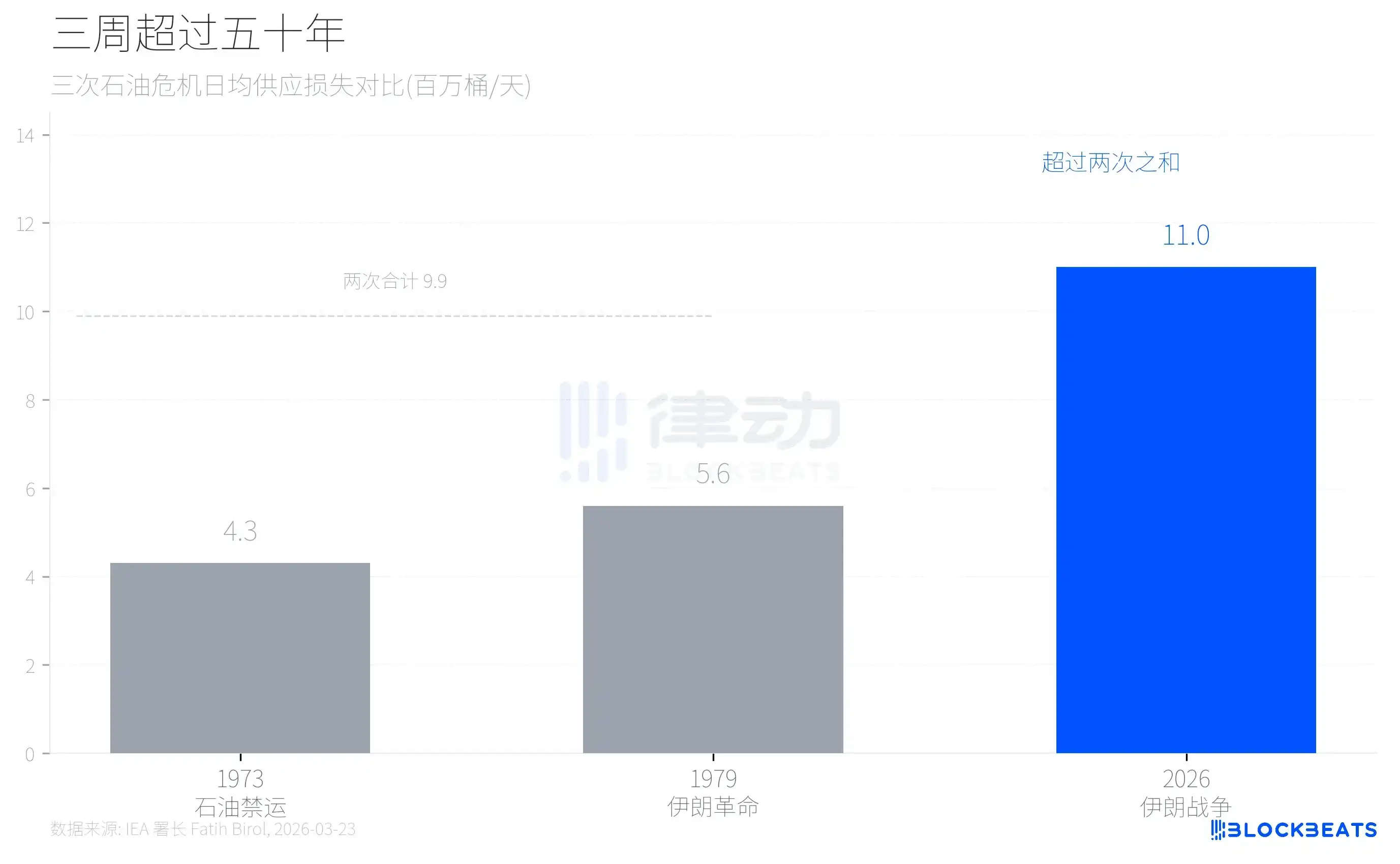
On February 28, the United States and Israel launched a military strike against Iran. Iran immediately blockaded the Strait of Hormuz, cutting off the global daily transit of 20 million barrels of oil. Three weeks later, on March 23, IEA Director Fatih Birol provided a figure at the National Press Club of Australia: the global daily oil supply loss caused by this war is 11 million barrels.

This figure exceeds the combined losses of the 1973 oil embargo and the 1979 Iranian Revolution crises.

Energy infrastructure at over 40 sites across 9 Middle Eastern countries suffered varying degrees of damage. Concurrent IEA data shows that the global natural gas supply loss reached 140 billion cubic meters, nearly double the European gas loss during the Russia-Ukraine conflict (75 billion cubic meters). In just three weeks, the quantitative shock this conflict inflicted on the energy market has surpassed that of the entire 1970s.
But the supply loss is only half the story. The other half is that there are clear beneficiaries of this crisis.

Putin's Windfall

Before the Iran war began, Urals crude was trading at less than $60 per barrel. This price had been locked in for nearly three years, a direct result of Western sanctions. After the Russia-Ukraine war broke out, Europe and the US imposed a price cap on Russian oil, maintaining a long-term discount of $30 to $40 between Urals crude and the international benchmark Brent. This discount was the most直观 signal of the sanctions working.

The Iran war changed all that. Following the blockade of the Strait of Hormuz, a huge gap appeared in the global oil market, forcing buyers to seek alternative supplies. According to data from the Centre for Research on Energy and Clean Air (CREA), Russia's total fossil fuel export revenue reached 7.7 billion euros in the first two weeks of March, averaging 513 million euros per day, an 8.7% increase from February's 472 million euros per day. Daily oil export revenue averaged 372 million euros, earning an extra 672 million euros (approximately $777 million) over those two weeks.

Urals crude rose from under $60 to around $90 within three weeks, a surge of nearly 80%. As reported by Al Jazeera, energy analyst George Voloshin pointed out that Brent also rose from around $65 to over $110 during the same period, but the key is not the absolute price, but the spread between them. The discount of Urals to Brent narrowed significantly from the pre-war level of about $40. The Moscow Times reported on March 16 that Urals crude delivered to India briefly traded at a premium to Brent, something that had not happened since the sanctions took effect.
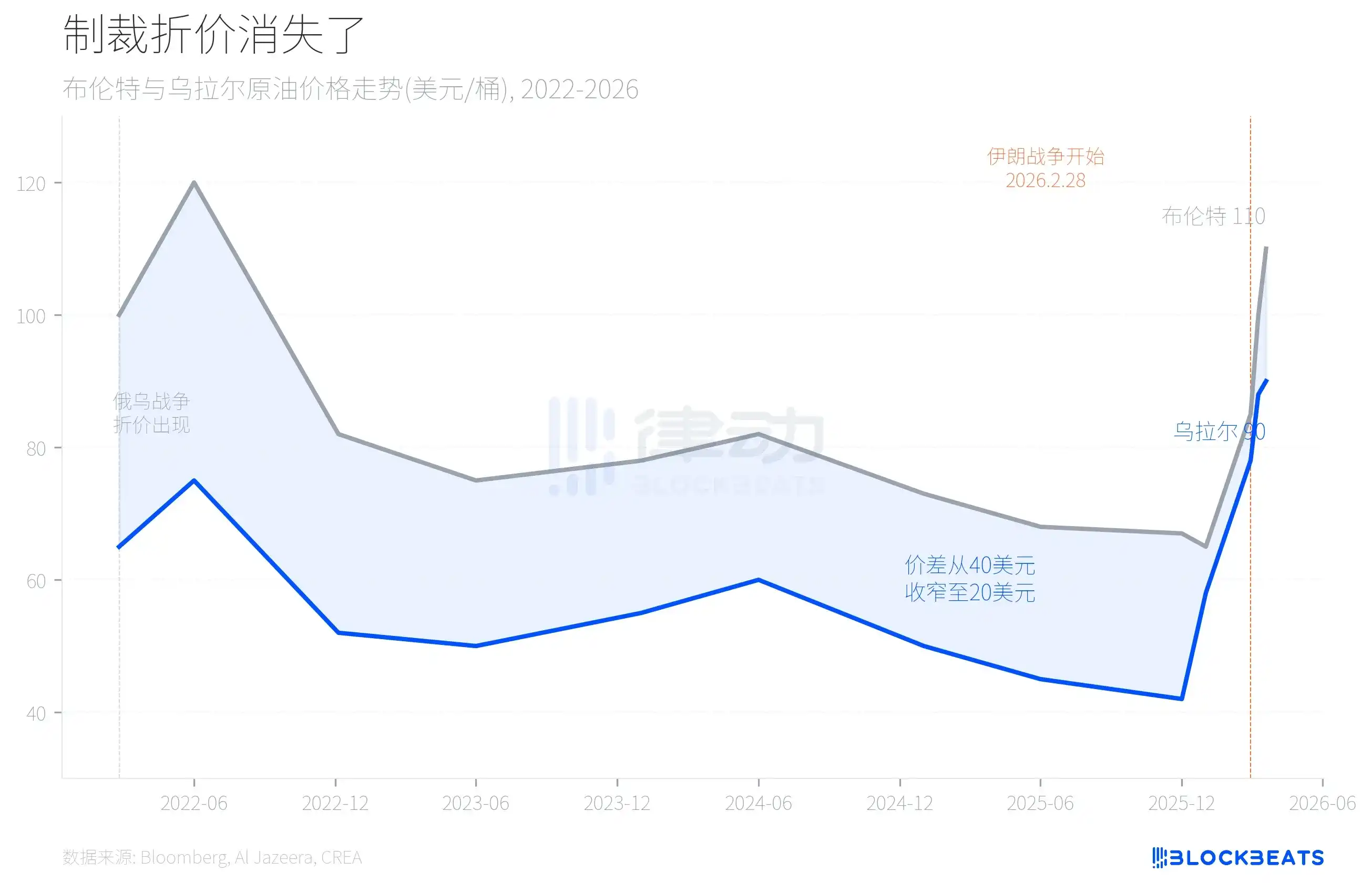
In other words, a significant part of the economic wall built by three years of Western sanctions was dismantled by three weeks of war in Iran.

The Trump administration announced a 30-day sanctions waiver on March 12, allowing countries to purchase Russian oil en route, with Treasury Secretary Scott Bessent stating it would release about 140 million barrels of supply. However, analysts widely believe the waiver's condition of "not generating significant financial benefit" is nearly impossible to enforce. Concurrently, the IEA announced the release of 400 million barrels from strategic petroleum reserves, the largest such release in history. This waiver is set to expire on April 11, at which point the market will face a new round of uncertainty.

India is the most direct actor. CREA data shows that India's purchases of Russian fossil fuels totaled 1.3 billion euros in the first two weeks of March, averaging 89 million euros per day, a 48% increase from February's daily average of 60 million euros. Al Jazeera confirmed that at least 7 tankers originally bound for China changed course to India mid-voyage, with one ship named Aqua Titan arriving at an Indian port on March 21. While the world worries about oil prices, oil trade between Moscow and New Delhi is accelerating.

Who is Paying?

Losses on the supply side and gains on the beneficiary side ultimately get passed on to the consumer. American consumers are bearing the most direct burden.

AAA data shows the US national average price for gasoline rose from $2.98 before the war to $3.96 on March 23, a 33% increase. The average price in California reached $5.56, while the lowest, in Kansas, was $3.23. The average diesel price hit $5.07, the highest since 2022.

Fortune reported that this round of oil price increases has effectively swallowed up the tax refunds American families just received.

The aviation industry was among the first to feel the impact. Platts assessment data shows US jet fuel prices rose over 60% in three weeks, doubling in some regions. United Airlines became the first major US carrier to officially announce capacity cuts. CEO Scott Kirby stated in an internal memo that the company is preparing for oil prices to probe $175 per barrel, which would mean an annual fuel cost increase of about $11 billion, more than double the company's "best annual profit in history." United will cut 5% of its flights in the second and third quarters.

The effects are spreading globally. According to a CNBC report on March 21, Delta Air Lines also warned it might reduce capacity. Euronews reports show that Qantas, SAS, and Thai Airways have already raised prices, and Air New Zealand has canceled over 1,000 flights.
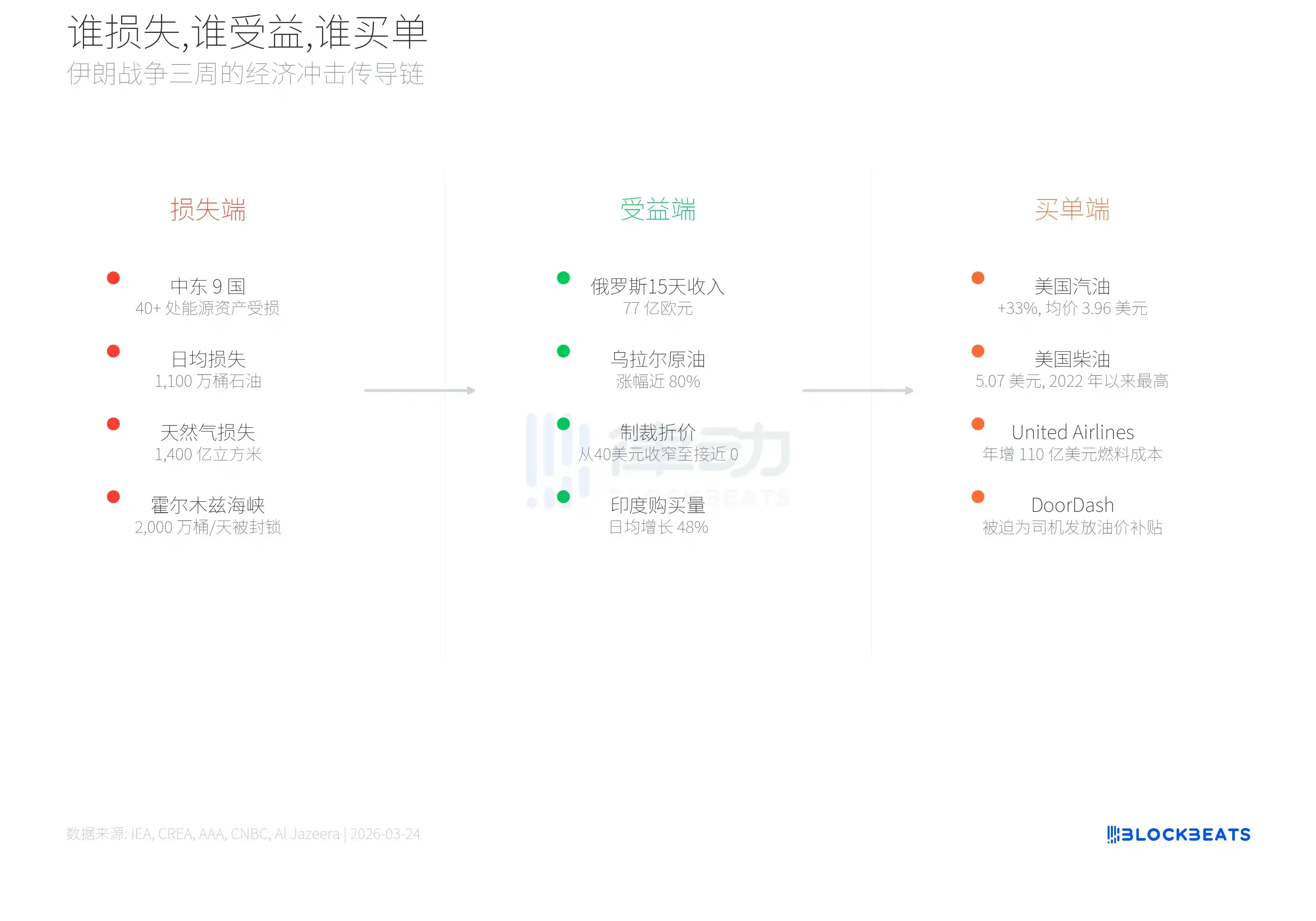
Even the gig economy is affected. According to a Philadelphia Inquirer report on March 23, DoorDash began issuing weekly gas subsidies of $5 to $15 and 10% cash back on gas to drivers, in response to reduced order acceptance due to rising fuel costs. When a food delivery platform has to pay for a war in the Middle East, the length of the shock transmission chain needs no further explanation.

Three weeks into the Iran war, the world loses 11 million barrels of oil daily, Russia made nearly $800 million extra in 15 days, American consumers are paying a third more for gas, and this transmission chain will continue to lengthen after the sanctions waiver expires on April 11.


Tiền kỹ thuật số thịnh hành

Câu hỏi Liên quan

QAccording to the IEA, what was the daily global oil supply loss caused by the Iran war after three weeks?

AThe daily global oil supply loss was 11 million barrels of oil per day.

QWhich country's fossil fuel exports saw a significant financial gain, and what was the increase in its daily export revenue in the first two weeks of March?

ARussia's fossil fuel exports saw significant gains. Its daily export revenue increased to 513 million euros per day in the first two weeks of March, up 8.7% from 472 million euros in February.

QHow did the price of U.S. gasoline change from pre-war levels to March 23rd, and what was the national average price on that date?

AThe U.S. national average gasoline price rose 33% from the pre-war price of $2.98 to $3.96 on March 23rd.

QWhat action did United Airlines take in response to the surge in jet fuel prices, and what was the cited potential annual cost increase?

AUnited Airlines announced it would cut its capacity by 5% in the second and third quarters. The company stated that if oil prices reached $175 a barrel, its annual fuel cost would increase by approximately $11 billion.

QWhat major sanction policy change did the Trump administration announce on March 12th regarding Russian oil, and when was it set to expire?

AThe Trump administration announced a 30-day sanctions exemption allowing countries to purchase Russian oil that was already in transit. This exemption was set to expire on April 11th.

Nội dung Liên quan

Phúc Kiến Tấn Giang, một kỳ lân công nghệ lưu trữ siêu cấp im lặng vươn lên

Những ngày này, khi Trường Tân Công nghệ Hợp Phì lên sàn A, và Trường Giang Tích Trữ Vũ Hán đang trong giai đoạn chuẩn bị IPO, một "kỳ lân siêu cấp" trong lĩnh vực bộ nhớ vẫn lặng lẽ hoạt động tại Tấn Giang, Phúc Kiến - Công ty TNHH Mạch tích hợp Tấn Hoa Phúc Kiến (Phúc Kiến Tấn Hoa). Từng là một trong ba trụ cột sản xuất chip bộ nhớ trong nước cùng với Trường Giang Tích Trữ và Trường Tân Công nghệ, thậm chí có thời điểm được đánh giá cao hơn, nhưng số phận của Tấn Hoa lại không suôn sẻ. Ngay trước khi sản phẩm ra đời, công ty đã bị Bộ Thương mại Mỹ đưa vào danh sách đen và đối mặt với cáo trạng hình sự từ Bộ Tư pháp Mỹ vào năm 2018, khiến dây chuyền sản xuất đình trệ. Phải đến tháng 2/2024, tòa án liên bang Mỹ mới tuyên án vô tội, kết thúc 6 năm vướng vào tranh chấp. Nhân vật then chốt đằng sau Tấn Hoa là Trần Chính Khôn, cựu kỹ sư của Micron. Với khát vọng phát triển công nghệ DRAM tự chủ, ông đã dẫn dắt đội ngũ hợp tác với United Microelectronics Corporation (UMC) của Đài Loan. Dù vấp phải lệnh trừng phạt nghiêm trọng, nhóm của ông vẫn kiên trì tái thiết dây chuyền sản xuất, tối ưu hóa thiết bị trong nước để giảm thiểu sự phụ thuộc vào công nghệ Mỹ. Hiện tại, Tấn Hoa tập trung vào thị trường DRAM chuyên biệt (niche DRAM), với sản phẩm ứng dụng trong TV thông minh, thiết bị mạng và công nghiệp. Năng lực sản xuất ổn định ở mức khoảng 40.000 tấm wafer 12-inch mỗi tháng, dự kiến mở rộng lên 60.000 vào năm 2026. Dù vậy, công ty vẫn nằm trong danh sách đen của Mỹ. Sự tồn tại và phục hồi của Tấn Hoa có sự hậu thuẫn mạnh mẽ từ chính quyền địa phương Tấn Giang - một thành phố vốn nổi tiếng với giày thể thao và thực phẩm. Thành phố này đã mạnh dạn đầu tư vào ngành công nghiệp bán dẫn, coi Tấn Hoa là hạt nhân để xây dựng cụm công nghiệp mạch tích hợp hoàn chỉnh, với tổng vốn đầu tư hàng trăm tỷ nhân dân tệ. Sự kiên định của chính quyền trong việc hỗ trợ Tấn Hoa vượt qua khủng hoảng là minh chứng cho chiến lược phát triển công nghiệp mới đầy tham vọng của Tấn Giang. Dù quy mô và doanh thu hiện tại (khoảng 2 tỷ nhân dân tệ/năm) còn cách xa các đối thủ trong nước, Tấn Hoa đại diện cho một thực tế: một doanh nghiệp từng bị siết chặt vẫn có thể đứng dậy. Trong chu kỳ siêu tăng trưởng mới của ngành bộ nhớ được AI thúc đẩy, Tấn Hoa vẫn giữ được vị trí trên bàn chơi.

marsbit2 phút trước

Phúc Kiến Tấn Giang, một kỳ lân công nghệ lưu trữ siêu cấp im lặng vươn lên

marsbit2 phút trước

«Cưa mùa hè» tiếp tục: Phá vỡ $67,000 sẽ là khởi đầu cho đà tăng của Bitcoin

Giá Bitcoin giảm xuống 62.217 USD vào ngày 1/8, tiếp tục giai đoạn củng cố trong phạm vi 58.000 - 67.000 USD kể từ đầu tháng 6. Thị trường đang chia rẽ về hướng đi tiếp theo. Các nhà phân tích kỹ thuật chỉ ra hai kịch bản chính. Một số, như Crypto Candy và Jelle, dự báo khả năng giảm về vùng 60.000 USD nếu giá không vượt lên trên 66.000 USD, đồng thời mô tả thị trường đang trong giai đoạn "củng cát mùa hè" kéo dài. Ngược lại, những người khác như Daan Crypto Trades và Roman nhấn mạnh rằng việc phá vỡ mốc 67.000 USD với khối lượng giao dịch đủ mạnh có thể mở đường cho đợt tăng mạnh lên vùng 70.000 - 80.000 USD. Về góc nhìn dài hạn, nhà phân tích Gert van Lagen xem đây là giai đoạn tích lũy, với Bitcoin đang thử nghiệm đường viền cổ của mô hình "cốc và tay cầm" hình thành suốt 7 năm. Ông cũng lưu ý rằng các nhà đầu tư nắm giữ dài hạn vẫn kiên định, không chịu bán tháo. Tóm lại, thị trường Bitcoin đang trong thời kỳ tích lũy quan trọng, với hai mức giá then chốt là 60.000 USD và 67.000 USD. Việc phá vỡ một trong hai mức này sẽ định hình xu hướng chính tiếp theo.

cryptonews.ru1 giờ trước

«Cưa mùa hè» tiếp tục: Phá vỡ $67,000 sẽ là khởi đầu cho đà tăng của Bitcoin

cryptonews.ru1 giờ trước

Tuần tới cần chú ý|Đạo luật CLARITY dự kiến được biểu quyết tại Thượng viện; SpaceX, Circle công bố báo cáo tài chính (3.8-9.8)

**Tóm tắt các sự kiện quan trọng từ ngày 3 đến 9 tháng 8:** **Tuần tới sẽ có nhiều sự kiện đáng chú ý trong lĩnh vực tiền điện tử và công nghệ:** * **Pháp luật & Quy định:** Dự luật CLARITY Act, nhằm thiết lập khung quy định liên bang cho tiền điện tử, có khả năng được đưa ra biểu quyết toàn thể tại Thượng viện Mỹ vào tuần tới. Các nhà đàm phán cần đạt được 60 phiếu ủng hộ trước ngày 7/8. * **Báo cáo tài chính:** Nhiều công ty lớn sẽ công bố báo cáo tài chính quý II/2026, bao gồm **SpaceX (ngày 4/8)**, công ty khai thác Bitcoin **Hut 8 (ngày 4/8)**, **Circle (ngày 5/8)** và công ty khai thác liên quan đến gia đình Trump là **American Bitcoin (ngày 3/8)**. * **Sự kiện SpaceX:** Bên cạnh báo cáo tài chính, cổ phiếu của SpaceX sẽ bắt đầu được mở khóa từ ngày 6/8, với đợt đầu tiên có thể lên tới 12% tổng số cổ phiếu. * **Dữ liệu kinh tế:** Báo cáo việc làm phi nông nghiệp (Non-Farm) quan trọng của Mỹ cho tháng 7 sẽ được công bố vào ngày 7/8. * **Cập nhật công nghệ:** * **XRP Ledger:** Phiên bản mới xrpld 3.3.0 với 5 tính năng mới dự kiến phát hành vào tuần tới. * **Grok:** Elon Musk thông báo Grok 4.6 dự kiến ra mắt vào khoảng ngày 7/8. * **Bitcoin:** Việc gửi tín hiệu bắt buộc cho BIP-110 sẽ bắt đầu vào khoảng ngày 8/8. * **Ngừng hoạt động:** Một số dịch vụ tiền điện tử sẽ ngừng hoạt động vào ngày 3/8, bao gồm công cụ theo dõi danh mục DeFi **Zapper** và ví **Ctrl Wallet**. * **Niêm yết & Hủy niêm yết:** Sàn Upbit Hàn Quốc sẽ hủy niêm yết token AQT và AERGO từ ngày 3/8. Trong khi đó, công ty robot **宇树科技 (Unitree Robotics)** sẽ tiến hành thăm dò giá ban đầu cho đợt IPO trên STAR Market vào ngày 5/8.

marsbit2 giờ trước

Tuần tới cần chú ý|Đạo luật CLARITY dự kiến được biểu quyết tại Thượng viện; SpaceX, Circle công bố báo cáo tài chính (3.8-9.8)

marsbit2 giờ trước

Giao dịch

Giao ngay

Bài viết Nổi bật

Làm thế nào để Mua WAR

Chào mừng bạn đến với HTX.com! Chúng tôi đã làm cho mua WAR (WAR) trở nên đơn giản và thuận tiện. Làm theo hướng dẫn từng bước của chúng tôi để bắt đầu hành trình tiền kỹ thuật số của bạn.Bước 1: Tạo Tài khoản HTX của BạnSử dụng email hoặc số điện thoại của bạn để đăng ký tài khoản miễn phí trên HTX. Trải nghiệm hành trình đăng ký không rắc rối và mở khóa tất cả tính năng. Nhận Tài khoản của tôiBước 2: Truy cập Mua Crypto và Chọn Phương thức Thanh toán của BạnThẻ Tín dụng/Ghi nợ: Sử dụng Visa hoặc Mastercard của bạn để mua WAR (WAR) ngay lập tức.Số dư: Sử dụng tiền từ số dư tài khoản HTX của bạn để giao dịch liền mạch.Bên thứ ba: Chúng tôi đã thêm những phương thức thanh toán phổ biến như Google Pay và Apple Pay để nâng cao sự tiện lợi.P2P: Giao dịch trực tiếp với người dùng khác trên HTX.Thị trường mua bán phi tập trung (OTC): Chúng tôi cung cấp những dịch vụ được thiết kế riêng và tỷ giá hối đoái cạnh tranh cho nhà giao dịch.Bước 3: Lưu trữ WAR (WAR) của BạnSau khi mua WAR (WAR), lưu trữ trong tài khoản HTX của bạn. Ngoài ra, bạn có thể gửi đi nơi khác qua chuyển khoản blockchain hoặc sử dụng để giao dịch những tiền kỹ thuật số khác.Bước 4: Giao dịch WAR (WAR)Giao dịch WAR (WAR) dễ dàng trên thị trường giao ngay của HTX. Chỉ cần truy cập vào tài khoản của bạn, chọn cặp giao dịch, thực hiện giao dịch và theo dõi trong thời gian thực. Chúng tôi cung cấp trải nghiệm thân thiện với người dùng cho cả người mới bắt đầu và người giao dịch dày dạn kinh nghiệm.

Tổng lượt xem 1.1kXuất bản vào 2024.12.11Cập nhật vào 2026.06.02

Làm thế nào để Mua WAR

Thảo luận

Chào mừng đến với Cộng đồng HTX. Tại đây, bạn có thể được thông báo về những phát triển nền tảng mới nhất và có quyền truy cập vào thông tin chuyên sâu về thị trường. Ý kiến ​​của người dùng về giá của WAR (WAR) được trình bày dưới đây.

活动图片












