The Essence of AI Layoffs: Why More AI Adoption Leads to More Corporate Anxiety?

marsbitXuất bản vào 2026-05-12Cập nhật gần nhất vào 2026-05-12

Tóm tắt

The author, awaiting potential inclusion on an 8000-person layoff list, analyzes the true nature of recent "AI-driven" layoffs. They argue that while AI use, particularly tools like Claude for code generation, has skyrocketed and boosted developer output (e.g., 2-5x more code commits), this has not translated into proportional business growth or revenue. The core issue is a misalignment between increased "Input" (code) and tangible "Outcomes" (user value, revenue). AI acts as a costly B2B SaaS, inflating operational expenses without guaranteed returns. Two key problems emerge: 1) The friction that once filtered out bad ideas is gone, as AI allows cheap pursuit of even weak concepts. 2) Organizational "alignment tax"—the difficulty of coordinating across teams—becomes crippling when development velocity outpaces consensus-building. Thus, layoffs serve two immediate purposes: 1) To offset ballooning AI costs (Token consumption) and maintain cash flow, as rising input costs without outcome growth destroys unit economics. 2) To reduce organizational bloat and alignment friction by simply removing teams, thereby speeding up execution in the short term. Therefore, these layoffs are fundamentally caused by AI, even if AI doesn't directly replace roles. They represent a painful correction until companies learn to convert AI-driven productivity into real business outcomes and streamline organizational coordination to match the new pace of work. The cycle will continue until this le...

Somewhere in a high-level office in my company lies a layoff list of 8,000 people. I have a 10% chance of being on that list. In a few days, on May 20th, I will know my fate.

Seeing the 'AI layoff' news announced by Coinbase today, I decided to write this article. I purposely wrote it before May 20th because I want to share some of the most genuine perspectives, untainted by the personal sentiment of 'whether I'm staying or going.' These thoughts are not only independent of my being laid off but also not limited to my company. They come from the true voices of my friends working in various medium-to-large enterprises.

There's a flood of articles now debating: Is this new wave of layoffs (commonly thought to have started with Jack Dorsey cutting 40% of Square's staff) actually caused by AI, or is it merely 'AI-washing' (referring to companies using the embrace of AI as a pretense to conceal the real reasons for other business failures or layoffs).

I don't want to fill this article with links to various news pieces and papers to torture you; you've probably seen this content already, or you can easily find it with a Google search or by asking ChatGPT.

The much-touted 'AI Productivity' and the Elusive Evidence

Has AI really made us more efficient? That's a truly controversial heavyweight question! If we think in reverse and assert 'AI hasn't changed anything,' I doubt even the most skeptical of AI's value would agree with that statement.

Especially in tech companies, the rocket-like surge in AI usage is a fact staring us in the face. Even the most conservative companies that cap AI budgets and don't equip employees with AI tools cannot deny that a portion of the work is essentially done by AI—even if employees are just laboriously using Gemini or Copilot in Google or Microsoft Office suites to secretly edit documents.

As for the more visionary companies diving headfirst into the ocean of AI tokens (the basic units of text processed by AI models, with enterprise usage of large language models often billed based on token consumption), like Uber or Shopify (I'm excluding companies like Meta or Microsoft that develop their own LLMs, and also excluding infrastructure builders like Vercel or Cloudflare; I'm talking only about pure 'users'), their AI consumption has gone insane.

We've become accustomed to it: from 90% to 100% of code being AI-generated, to the number of code review submissions (PRs/diffs) per week exploding by 2 to 5 times, to annual AI budgets in the hundreds of millions being exhausted in just a few months.

However, tech commentators and investors like Ed Zitron, Will Manidis, Gary Marcus, and Michael Burry would undoubtedly retort with a soul-searching question: If that's the case, why haven't these companies' revenues grown by 2 to 5 times accordingly? Why do their apps look almost identical to how they did half a year ago? If AI is so productive, what exactly are they producing with it? If they're writing 5 times more code, yet end-users notice nothing, what's the point of all that code? This is an extremely sharp and reasonable question.
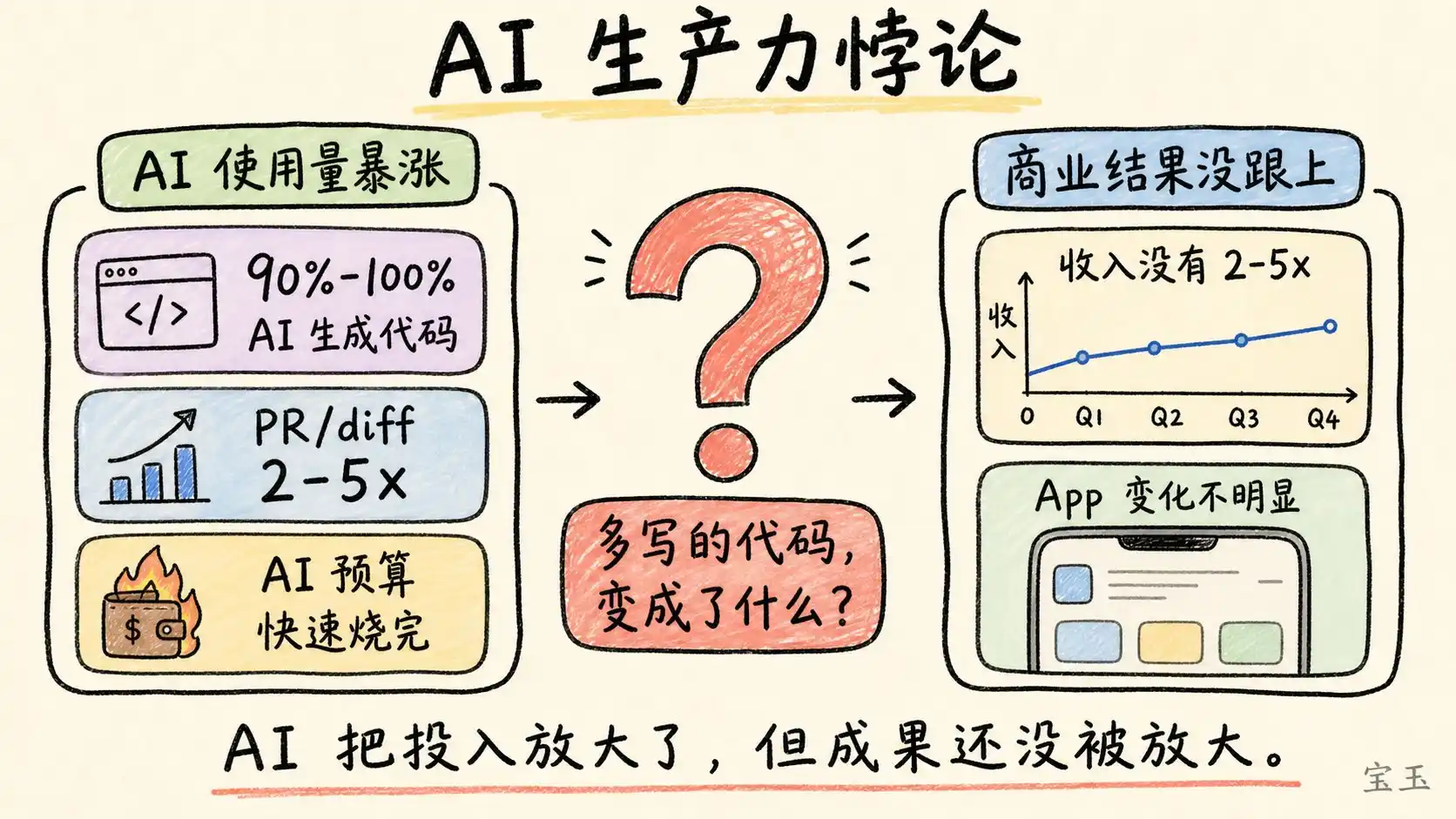
Input, Output, and Outcome

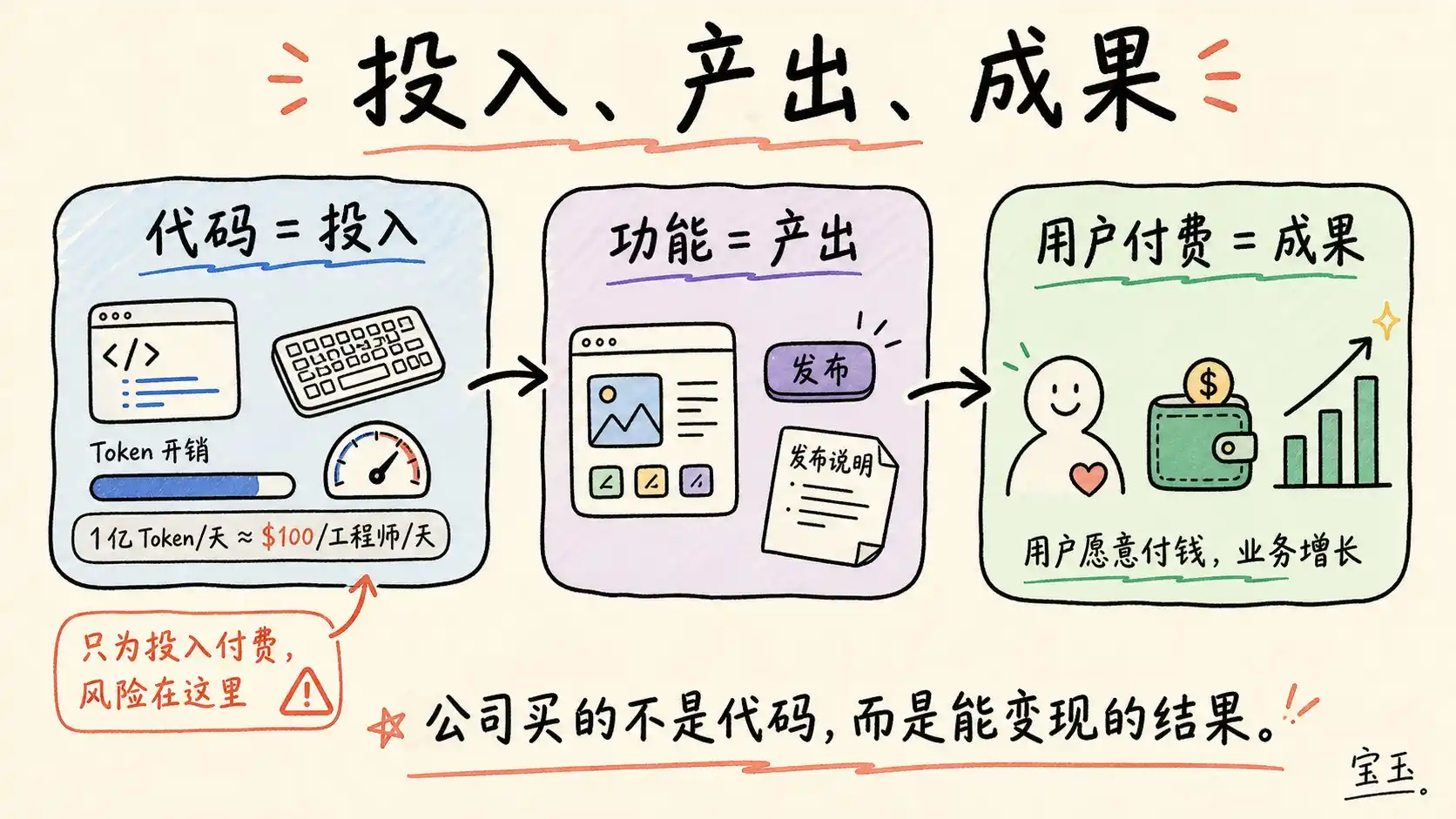
We need a brief interlude on business management fundamentals. When a fast-growing, overfunded, cash-burning midsize company finally faces a cash crunch, you go ask a seasoned CEO for advice. They'll suggest you bring in McKinsey to take a look. The consultants will put up a plain white slide as the first page of their presentation, with three words in default Arial font: 'Input, Output, Outcome.'

They'll explain a business truth that everyone knows but often forgets:

Code is merely an input.

Features are the output.

Users willingly paying for your product is the outcome.

AI (or at least products like Claude Enterprise) is essentially a B2B SaaS product. You'll notice that SaaS products are priced and marketed differently. If a product can directly change the 'outcome,' they typically take a cut directly from that 'outcome.' Imagine this sales pitch: 'Our tool increases your sales lead conversion speed by 36%. Try it now for a low service fee of just 5% of the sale value.'

That would be an instant killer for customers. All else being equal, if you closed 100 deals in 100 days before, now it takes only 63 days. The saved 36 days (if my math is correct) allow you to close an additional 57 deals! That is, your sales potential increases by 57%. Anyone would be more than happy to pay 5% from their sales commission for an extra 57% revenue. And if you don't use the product, you pay nothing.

You've probably guessed what I'm about to say—Claude's token consumption pricing model is nothing like that. If your software engineers are addicted to programming with Claude (I just realized both have the abbreviation 'cc'), generating 100 million tokens per day, you'll be paying $100 per engineer per day.

Even if some of the code they generate is thrown in the trash because it doesn't work;

Even if some code later causes severe system failures (SEVs) (SEV stands for Severity, commonly used in tech companies to refer to serious online incidents causing service outages) and gets rolled back urgently;

And even if another portion of the code is just for reskinning internal tools to make data dashboards look cuter for VPs;

You pay for it all. Because code is just an 'input.' While generally, as long as the direction is right, more 'input' tends to lead to more 'output,' and then to better 'outcome.' But when you multiply the input by 5 overnight, this rule doesn't necessarily hold. The extra 'input' you've added might suddenly become aimless, completely deviating from the expected 'output' or 'outcome.'
What's Really Holding Us Back!

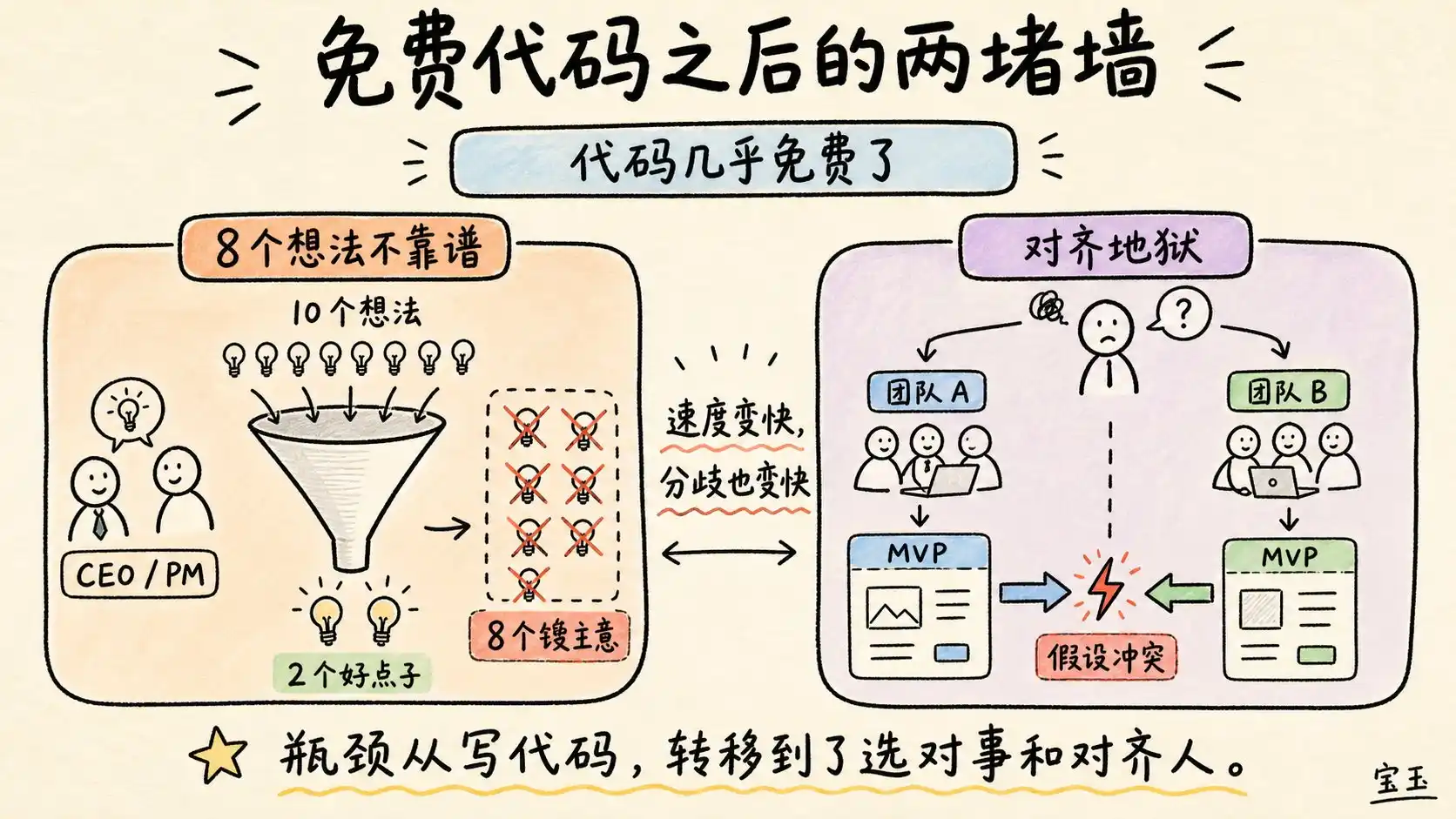
In the past, whenever the CEO or product manager (PM) wanted to do 10 things, the development team would always say they could only handle the top two most important ones, leaving no time for the other 8. The reason? Because writing code isn't child's play; developing complex, functional software takes a lot of time.

Hmm... but now code is almost free. Why haven't we done those other 8 things?

The answer has two parts: one CEOs and PMs don't like to hear; the other middle managers and senior employees don't like to hear.

1. Perhaps those 8 ideas... just weren't good?

Just because the CEO or PM had 10 ideas flash through their minds doesn't mean they can actually translate into tangible business outcomes. Even if you truly built 10 new features (output), it doesn't guarantee users will buy in and use your app more because of them (outcome).

In fact, precisely because development resources were limited before, this 'friction' forced everyone to have more intense debates, thus killing off bad ideas early before they consumed too many resources, selecting the best two. Now, with code being fast and cheap to write, arguing about the merit of ideas seems pointless. Even if you try to push back, do you think you can stop the CEO or PM from turning around and asking Claude themselves? Don't even bother trying.

2. Getting everyone 'aligned' is too painful.

We all know how torturous this is. First, you need all stakeholders to agree on 'why' to do something; then, you need another meeting to discuss specifically 'what' to do; finally, everyone needs to haggle over 'how' to do it.

The more teams involved, the more projects get stuck in 'alignment hell.' Previously, this problem was masked because writing code was slow. Now, as soon as the 'what' is decided, someone immediately pulls an all-nighter to whip up a Minimum Viable Product (MVP) (developing a product with the lowest cost that just showcases the core idea, for quick iteration and testing) and schedules the next meeting for the very next day.

In the meeting, you're shocked to discover another team secretly built an MVP too! Worse, because you based your work on different assumptions, the two products operate on completely different logics.

Sure, you can sit down and slowly grind out whose assumptions are correct.

But let's be honest. You and your team, armed with unlimited Claude tokens, can't be bothered. Neither can the other team. You'd turn right back to Claude without hesitation, asking it to reimplement the other team's work exactly as you see fit, in what you believe is the perfect way. And Claude would just obediently reply, 'You are absolutely right!' and immediately start typing code.
What Do Layoffs Actually Solve?

Alright, thank you for patiently listening to me ramble about these seemingly obvious common-sense truths. I know you want the core substance.

What purpose do layoffs serve? Based on my assumption, if AI isn't truly one-for-one replacing 30% of employees (I think we can agree on this? While it's better than junior white-collar workers at many tasks, it's worse at others—it's definitely not a plug-and-play component, let alone directly replacing 10%, 20%, or 30% of a company's workforce).

So, what's the logic behind layoffs? Because it can immediately solve two glaring short-term problems.

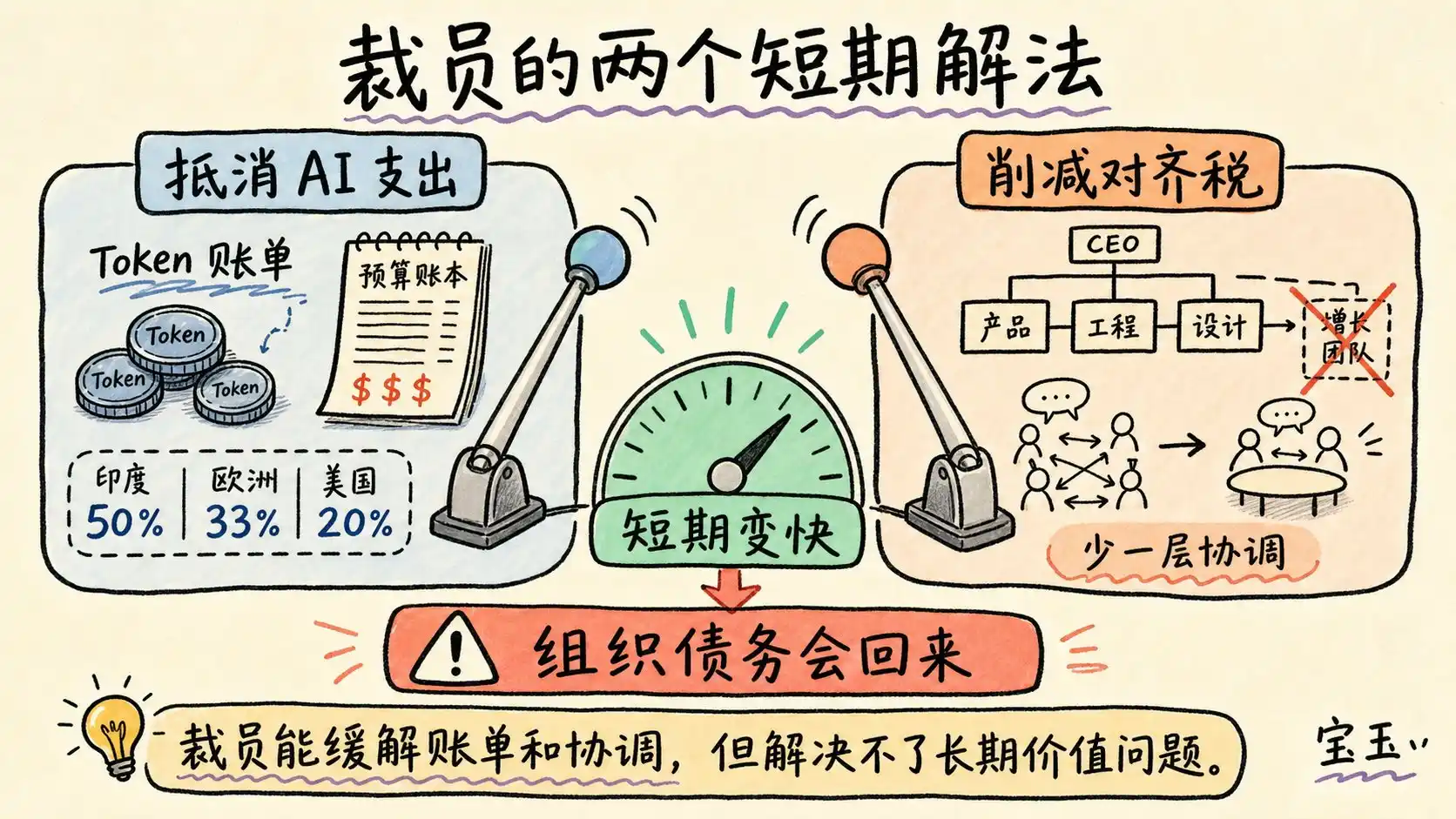
1. Offset 'AI Expenditure'

This is essentially a basic cash flow arithmetic problem. It's obvious: if your Claude-addicted engineers are splurging $100 per day on Claude (that's $2,500 per month, $30,000 per year), that amount already equals the total salary of a Software Development Engineer (SDE) in India; half an SDE in Europe; and a quarter of an SDE in the US.

Doing the simplest, crudest calculation: assuming a flat company where all employees are SDEs. To maintain the existing total wage expenditure (including token purchase costs), you must lay off 50% (India), 33% (Europe), or 20% (US) of the staff.

In reality, since AI usage is growing wildly and uncontrollably, while company revenue shows no corresponding growth, layoffs become the inevitable choice. Otherwise, the company's balance sheet collapses. If your input costs increase by 50%, but the ultimate business outcomes remain stagnant or unchanged, then the unit economics of your entire software development lifecycle are completely broken.

If we truly learned how to use AI—figured out how to translate a 50% increase in input cost into a 50% increase in revenue outcome—we wouldn't need to take this step. But precisely because you haven't learned, some of you must pack up and leave to free up money to pay Anthropic.

2. Cut 'Alignment Tax'

Undoubtedly, the size of any large company far exceeds what is strictly necessary for its 'survival.' This is precisely the characteristic of large companies; large organizations are destined to accumulate 'organizational fat,' an inevitable result of organizational structure design.

In these companies, even if someone leaves, the system can still operate because someone else always knows what they used to do. In many big tech firms, you can even safely take six months of maternity leave, and the projects you were responsible for remain fine. These are good things! But it's also solid proof: if you cut a portion of people, the company definitely won't collapse immediately. On the contrary, after the initial few weeks of systemic pain, the pace might even speed up over the following months!

Remember those two teams stuck in a stalemate over technical solutions earlier? Simple: just lay off one of the teams, then let the remaining team pull a few all-nighters to get it done—they no longer need to 'align' with anyone.

We can't predict what happens in the long term (or, to paraphrase economist Keynes—'In the long run, we are all dead'), but in the short term, cutting 10-20% of employees in a large enterprise only makes the work pace faster.

Large enterprises inevitably accumulate redundancy and bloat over time, building up significant 'organizational debt' just like technical debt. This is the chronic illness of large corporations. Cutting 10% of people today won't stop the old ailment from recurring two years later. But when you see everyone boasting about submitting 5 times more code than before, yet being stuck unable to launch because other teams are bottlenecks, the most direct, brutal remedy is clearly: lay off some people, so no one bottlenecks each other.
This is AI Layoffs, Even if AI Didn't Directly Replace Your Seat

Was your employee ID replaced by a new Claude instance running on a virtual machine? We all know that's not the case.

Nevertheless, isn't it true that within the company, many work processes that once required you to type in VS Code, click in Figma, Canva, or Google Docs are now handled by others (those who originally needed your output) simply yelling a prompt at an LLM, no longer bothering to ask for your help? This is also an indisputable fact.

Are these layoffs considered 'AI-washing'? That is—did the company already have various fundamental problems unrelated to AI (like over-hiring, declining profits, competitive pressure, poor business decisions), and now they're just using AI as an 'excuse' for layoffs? Well, that makes sense to some extent.

You might also notice that if you collected all the 'layoff emails' CEOs have sent during this period, you'd even think they might have a group chat where they coordinated writing these emails. 'AI-native squads,' 'managers who code,' 'increasing management span,' 'flattening structure,' 'managing teams of AI agents'... You'll find these buzzwords appearing identically in every email. It's almost as if they fed GPT the same prompt.

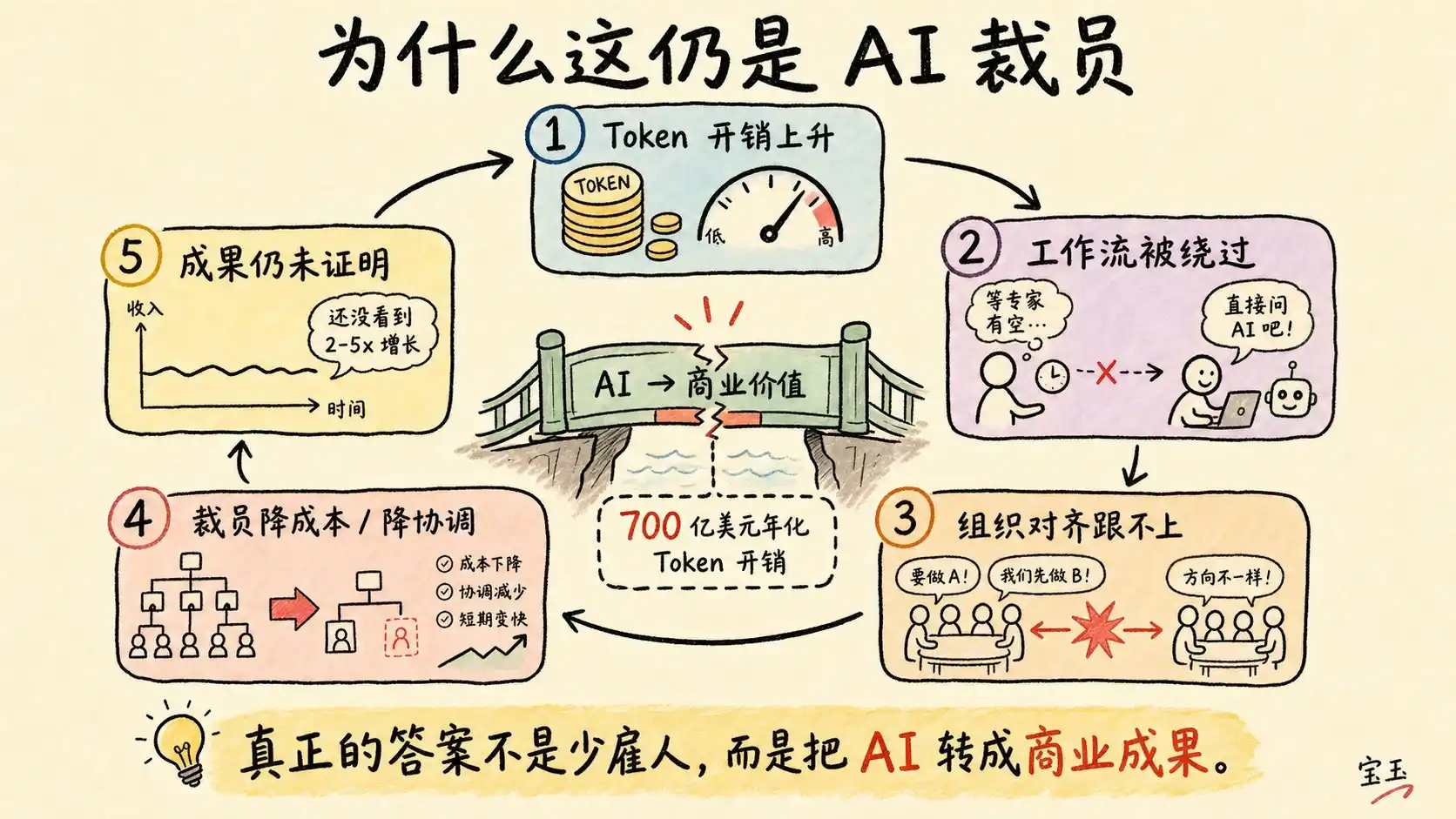
But the truth is, even if these layoffs aren't because AI directly replaced you, even if they contain elements of 'AI-washing,' these layoffs are ultimately still caused by AI. Moreover, this layoff wave will continue until we truly learn how to use AI.

Until we learn how to translate massive amounts of AI tokens into tangible business outcomes, not just code inputs; until we learn to make organizational 'alignment' speed keep up with the coding speed of this new generation; until we figure out how to use this extra productivity to pursue another 10 promising new ideas beyond the original 2 good ideas and 8 bad ones.

Before we truly understand how AI actually drives global GDP growth, to fill that $70 billion annual token expenditure hole (the combined enterprise revenue of OpenAI and Anthropic), companies can only 'rob Peter to pay Paul' by cutting employee salaries.

And before we learn how to more efficiently resolve team bottlenecks, the solution will always be the same—simply erase us from the org chart.
In 15 days, I will know my fate. But regardless of the outcome, I think I already know the reason. Even if I were the one making the decision in that spacious CEO office in the corner, I don't know if I could do better; perhaps I would only make the same choice, just like the other CEOs in that group chat.


Câu hỏi Liên quan

QWhat are the main reasons companies are laying off employees, even if AI isn't directly replacing them?

AAccording to the article, companies are laying off employees primarily for two reasons: 1) To offset the massive and rapidly increasing costs of AI token usage (like Claude), which have become a significant operational expense without a corresponding increase in revenue. This creates a cash flow problem. 2) To reduce 'alignment tax'—the inefficiencies and slowdowns that occur when multiple teams in large organizations need to coordinate. Cutting staff simplifies decision-making and speeds up execution in the short term, even if it doesn't solve the long-term organizational bloat.

QHow does the article distinguish between Input, Output, and Outcome in a business context, and why is this important for the AI debate?

AThe article explains a fundamental business concept: Code is an Input, a feature is the Output, and a user paying for the product is the Outcome. AI-generated code, paid for by the token, is merely an increased Input. The problem is that a sudden 5x increase in Input (code generation) does not automatically lead to a proportional increase in Output (features) or, most importantly, the desired Outcome (revenue). Companies are spending huge sums on AI inputs without seeing corresponding business results, which is a core reason for financial strain and subsequent layoffs.

QWhat is the 'alignment tax' mentioned in the article, and how does AI exacerbate this problem?

A'Alignment tax' refers to the time, effort, and friction required to get all stakeholders in a large organization to agree on the 'why,' 'what,' and 'how' of a project. AI exacerbates this problem because it removes the traditional friction of slow, resource-intensive coding. Now, teams can quickly build competing MVPs based on different assumptions overnight. Instead of resolving these differences through discussion, teams with abundant AI resources are more likely to just re-implement each other's work, leading to duplication, conflict, and organizational paralysis. Layoffs are seen as a brutal shortcut to cut through this alignment hell.

QAccording to the author, why hasn't a massive increase in AI-driven code production led to a visible improvement in products or revenue?

AThe author suggests two key reasons. First, many of the ideas that AI now makes it cheap to implement were simply bad ideas to begin with. Previously, limited development resources forced rigorous debate, killing weak ideas early. Now, with cheap code, there's less incentive to filter them out. Second, the explosion in code production has overwhelmed the organization's ability to align and integrate these efforts coherently. The result is a lot of activity (input) that doesn't translate into valuable, user-facing features (output) or financial success (outcome).

QWhat does the author mean by 'AI-washing' in the context of recent layoffs, and do they believe it's the full explanation?

A'AI-washing' refers to companies using the narrative of embracing AI as a cover for other reasons for layoffs, such as past over-hiring, poor business performance, or competitive pressures. The author acknowledges this element exists, noting how CEO layoff memos often use identical AI buzzwords. However, they argue that even with this washing, the layoffs are fundamentally caused by AI. The unsustainable cost of AI tokens and the organizational chaos (alignment tax) accelerated by AI's coding speed are real, new economic pressures forcing companies to cut headcount to balance their books and streamline operations.

Nội dung Liên quan

Báo Buổi Sáng Phố Wall: Chỉ số S&P và Dow đồng thời lập kỷ lục mới, Philech và cổ phiếu chip tăng 4 ngày liên tiếp, SanDisk và Intel tăng mạnh hơn 10%, vốn hóa Micron quay trở lại mốc nghìn tỷ đô la

**Tóm tắt thị trường chứng khoán Mỹ ngày 6/8: Chỉ số chạm đỉnh, chip và AI bùng nổ** Thị trường chứng khoán Mỹ tăng vọt hôm qua nhờ báo cáo tài chính mạnh mẽ và tín hiệu lạc quan địa chính trị. Chỉ số Dow Jones và S&P 500 đồng loạt lập kỷ lục mới, lần lượt lần đầu vượt 54,000 điểm và tăng 1.79%. Nasdaq tăng mạnh 2.59%, dẫn đầu bởi nhóm cổ phiếu công nghệ. Tin tức về một thỏa thuận tạm thời sắp đạt được giữa Mỹ, Iran và Oman nhằm mở lại eo biển Hormuz đã giúp giảm lo ngại gián đoạn nguồn cung, đẩy giá dầu giảm mạnh khoảng 5.5%. Điều này góp phần làm dịu lo ngại lạm phát và giảm áp lực lãi suất, với xác suất Cục Dự trữ Liên bang (Fed) tăng lãi suất vào tháng 9 giảm đáng kể. Chủ đề AI trở lại mạnh mẽ với sự dẫn dắt toàn diện từ phần cứng đến ứng dụng. **Chỉ số bán dẫn Philadelphia (SOX) tăng 6.55%, chuỗi tăng 4 phiên liên tiếp.** Nhiều cổ phiếu chip và linh kiện tăng mạnh: Intel (+10.84%), Micron (+7.62%, vốn hóa trở lại nhóm nghìn tỷ USD), AMD (+7%), ARM (+17.36%). Palantir tăng vọt 29.45% sau báo cáo doanh thu tăng trưởng ấn tượng, chứng minh sức mạnh của AI trong ứng dụng thương mại. Nhu cầu xây dựng trung tâm dữ liệu AI cũng đẩy cổ phiếu thiết bị công nghiệp như Caterpillar lên mức cao kỷ lục. Các điểm đáng chú ý khác: * **SpaceX** tăng 9.43% trong phiên chính nhưng giảm sau giờ giao dịch do lo ngại về chi tiêu vốn lớn cho AI. * **Nvidia** tăng 2.56%, công bố mô hình nguồn mở cho xe tự lái và được SpaceX lựa chọn độc quyền cho dịch vụ AI. * **Oracle** tăng nhẹ nhưng bị hạ xếp hạng tín nhiệm do gánh nặng nợ từ đầu tư vào trung tâm dữ liệu AI. Thị trường sẽ tiếp tục theo dõi dữ liệu việc làm Mỹ vào cuối tuần và một loạt báo cáo tài chính quan trọng, đặc biệt là của **SanDisk, Western Digital** và sự kiện **hết hạn phong tỏa cổ phiếu của SpaceX** vào ngày 6/8.

marsbit28 phút trước

Báo Buổi Sáng Phố Wall: Chỉ số S&P và Dow đồng thời lập kỷ lục mới, Philech và cổ phiếu chip tăng 4 ngày liên tiếp, SanDisk và Intel tăng mạnh hơn 10%, vốn hóa Micron quay trở lại mốc nghìn tỷ đô la

marsbit28 phút trước

La lớn mua vào, tại sao Goldman Sachs vẫn lạc quan về Samsung và SK Hynix

Dù giá cổ phiếu Samsung Electronics và SK Hynix đã giảm mạnh trong tháng qua, Goldman Sachs vẫn giữ nguyên đánh giá Mua. Báo cáo của họ đưa ra ba lý do chính: 1. **HBM sẽ lấy lại mức giá cao hơn:** Dự kiến đến năm 2027, giá bán trung bình (ASP) của HBM sẽ tăng mạnh, đạt khoảng 2.9 USD/Gb, tái lập chênh lệch giá so với DRAM truyền thống. Điều này nhờ nhu cầu AI mạnh, độ khó sản xuất tăng và tiêu thụ wafer lớn hơn từ HBM thế hệ mới. 2. **Hợp đồng dài hạn (LTA) ổn định chu kỳ:** Các khách hàng lớn (như trung tâm dữ liệu) đang ký hợp đồng dài hạn 3-5 năm để cam kết công suất, với các điều khoản về giá sàn, thanh toán trước và phạt vi phạm. Điều này giúp giảm rủi ro biến động cho nhà sản xuất. 3. **Tồn kho thấp và nhu cầu SSD doanh nghiệp:** Tồn kho ở nhà cung cấp và khách hàng chính vẫn ở mức thấp lành mạnh. Đồng thời, nhu cầu SSD cấp doanh nghiệp cho máy chủ AI tăng mạnh được kỳ vọng bù đắp cho sự yếu kém của thị trường tiêu dùng (điện thoại, PC), giúp thị trường NAND chưa rơi vào dư thừa. Báo cáo cũng nhận định việc mở rộng sản xuất của CXMT (Trung Quốc) khó thay đổi cán cân cung-cầu toàn cầu trong ngắn và trung hạn do chênh lệch về công nghệ, đặc biệt là trong lĩnh vực HBM đòi hỏi cao. Rủi ro chính bao gồm nhu cầu AI thấp hơn dự kiến, các điều khoản LTA không được thực thi đầy đủ, và việc mở rộng công suất quá mức.

marsbit1 giờ trước

La lớn mua vào, tại sao Goldman Sachs vẫn lạc quan về Samsung và SK Hynix

marsbit1 giờ trước

Nền tảng theo dõi thị trường tiền mã hóa Hàn Quốc Kimpga tích hợp dữ liệu từ nền tảng toàn cầu RootData, cung cấp điểm số về độ phổ biến và tăng trưởng của các dự án tiền điện tử

Nền tảng theo dõi thị trường tiền mã hóa Hàn Quốc Kimpga (kimpga.com) đã công bố hợp tác dữ liệu với nền tảng dữ liệu dự án Web3 toàn cầu RootData. Thông qua hợp tác này, Kimpga sẽ tích hợp trực tiếp thông tin dự án của các loại tiền mã hóa vào dịch vụ nền tảng của mình. Cụ thể, bảng điều khiển danh sách thị trường của Kimpga sẽ bổ sung chỉ số "RD Score" cho mỗi loại tiền mã hóa. Khi nhấp vào chỉ số này, người dùng có thể xem cửa sổ chi tiết hiển thị: - **Chỉ số Độ phổ biến RD (RD Popularity Index)**: Chỉ số định lượng mức độ quan tâm của thị trường đối với dự án. - **Chỉ số Tăng trưởng RD (RD Growth Index)**: Chỉ số cho thấy xu hướng phát triển và tăng trưởng của dự án. - **Dữ liệu cơ bản của dự án**: Bao gồm các tổ chức đầu tư chính, cấu trúc đội ngũ cốt lõi, phân loại lĩnh vực dự án. Ví dụ, với Solana (SOL), người dùng có thể xem các chỉ số RD và thông tin về các tổ chức đầu tư lớn như Polychain Capital, a16z, Multicoin Capital cùng thông tin đội ngũ sáng lập. Tất cả dữ liệu đều được liên kết đến trang chi tiết dự án trên RootData để hỗ trợ nghiên cứu sâu hơn. Ông Jin Jae-yong, đại diện của Kimpga, nhấn mạnh rằng việc tích hợp này giúp nhà đầu tư nhanh chóng đánh giá tiềm lực cơ bản của dự án mà không cần rời khỏi giao diện theo dõi thị trường, từ đó nâng cao hiệu quả ra quyết định đầu tư. RootData là nền tảng toàn cầu cung cấp thông tin về lịch sử gọi vốn, đội ngũ và danh mục đầu tư của các dự án Web3, được sử dụng rộng rãi cho việc thẩm định và phân tích đầu tư. Trước đó, Kimpga đã hợp tác với nền tảng xếp hạng tiền mã hóa APYWA. Việc tích hợp RootData lần này bổ sung thêm lớp thông tin cơ bản về dự án, bên cạnh dữ liệu thị trường và xếp hạng hiện có. Kimpga hiện có 10 triệu người dùng tích lũy và là nền tảng theo dõi thị trường tiền mã hóa chủ lưu tại Hàn Quốc, cung cấp dữ liệu thị trường và chênh lệch giá từ hơn 18 sàn giao dịch trong nước và quốc tế.

marsbit1 giờ trước

Nền tảng theo dõi thị trường tiền mã hóa Hàn Quốc Kimpga tích hợp dữ liệu từ nền tảng toàn cầu RootData, cung cấp điểm số về độ phổ biến và tăng trưởng của các dự án tiền điện tử

marsbit1 giờ trước

Ông là công thần của hai ngành công nghiệp lớn ở Thượng Hải, nhưng lại lặng lẽ qua đời trong sự tiếc nuối

“Ông là công thần của hai ngành công nghiệp lớn tại Thượng Hải, nhưng lại qua đời trong âm thầm và đầy tiếc nuối” - bài viết kể về cuộc đời và những đóng góp của Giang Thượng Châu, cựu Phó chủ nhiệm Ủy ban Kinh tế Thượng Hải. Năm 1997, ở tuổi 50, Giang Thượng Châu đảm nhận chức vụ này với nhiệm vụ tìm kiếm các ngành công nghiệp chiến lược cho tương lai Thượng Hải. Ông xác định ngành công nghiệp vi mạch (chip) là một trong những trọng tâm. Trong bối cảnh ngành công nghiệp chip Trung Quốc liên tục thất bại và tụt hậu, tại một hội nghị chiến lược quốc gia, ông đã gây sốc khi tuyên bố kế hoạch của Thượng Hải: xây dựng 10 dây chuyền sản xuất chip 8 inch trong vòng 5 năm, thay vì 2 dây chuyền như dự kiến chung. Với tầm nhìn chiến lược, ông thúc đẩy việc quy hoạch Khu phát triển vi điện tử Trương Giang rộng 22 km² tại Phố Đông. Ông tích cực thu hút nhân tài, đặc biệt là từ Đài Loan, và thành công mời được Trương Nhữ Kinh, người sáng lập SMIC (Semiconductor Manufacturing International Corporation). SMIC được thành lập với vốn đầu tư nước ngoài đa dạng, giúp vượt qua các lệnh cấm vận công nghệ. Chỉ sau 13 tháng, nhà máy đầu tiên đã đi vào hoạt động, và đến năm 2003, SMIC đã vươn lên vị trí nhà sản xuất chip theo hợp đồng lớn thứ tư thế giới. Năm 2004, ông còn mời được Doãn Chí Nghiêu, một chuyên gia hàng đầu về khắc chip, về Thượng Hải thành lập công ty AMEC (Advanced Micro-Fabrication Equipment Inc), mở ra kỷ nguyên mới cho thiết bị khắc chip Trung Quốc. Đến năm 2007, Thượng Hải đã có 18 dây chuyền sản xuất chip 8 inch, vượt xa mục tiêu ban đầu. Đóng góp lớn thứ hai của Giang Thượng Châu là thúc đẩy dự án máy bay thương mại cỡ lớn. Năm 2003, khi đã mắc ung thư phổi, ông đảm nhận vai trò Trưởng nhóm đánh giá chuyên đề trọng điểm của Quốc vụ viện. Ông kiên trì đấu tranh để đưa "máy bay dân dụng lớn" vào quy hoạch phát triển khoa học công nghệ quốc gia trung và dài hạn, bất chấp những tranh cãi về tính khả thi và lợi ích kinh tế. Ông nhấn mạnh tầm quan trọng chiến lược của ngành này trong việc thúc đẩy hàng loạt công nghệ then chốt và nâng cấp cơ cấu công nghiệp. Nhờ những nỗ lực không ngừng của ông trong ba năm, đến năm 2006, dự án máy bay lớn chính thức được phê duyệt, mở đường cho sự ra đời của máy bay C919. Con đường sự nghiệp của Giang Thượng Châu không bằng phẳng. Trước khi đến Thượng Hải, ông từng có thời gian công tác tại Tam Á và Dương Phổ (Hải Nam), nơi nhiều ý tưởng phát triển du lịch và cải cách hành chính tiên tiến của ông bị cho là "quá sớm" và vấp phải nhiều trở ngại. Năm 2009, khi SMIC lâm vào khủng hoảng và bị kiện tụng, Giang Thượng Châu, dù đang ở giai đoạn cuối của bệnh ung thư phổi, vẫn gánh vác trọng trách Chủ tịch Hội đồng quản trị để ổn định công ty. Ông qua đời ngày 27/6/2011, không kịp chứng kiến những thành quả rực rỡ của ngành chip và máy bay mà ông dày công vun đắp. Ngày nay, Thượng Hải đã trở thành đầu tàu của ngành công nghiệp vi mạch và hàng không thương mại Trung Quốc. Quy mô tổng thể ngành chip Thượng Hải đã vượt 5700 tỷ nhân dân tệ, dẫn đầu cả nước. Máy bay C919 của COMAC cũng đã cất cánh, trở thành tấm danh thiếp mới của "Made in China". Tầm nhìn chiến lược, tinh thần dám nghĩ dám làm và sự tận tâm vì sự phát triển công nghiệp quốc gia của Giang Thượng Châu mãi được ghi nhớ.

marsbit1 giờ trước

Ông là công thần của hai ngành công nghiệp lớn ở Thượng Hải, nhưng lại lặng lẽ qua đời trong sự tiếc nuối

marsbit1 giờ trước

Giao dịch

Giao ngay
活动图片