The 15-Minute Win-Lose Game: A Million Transaction Records Unveil the 'Folded World' of Bitcoin Prediction Markets

marsbitXuất bản vào 2026-02-05Cập nhật gần nhất vào 2026-02-05

Tóm tắt

A data analysis of Bitcoin's 15-minute price prediction markets reveals a stark reality dominated by algorithmic trading bots. Over a three-day period encompassing 291 markets, 1.05 million transactions totaling $17 million were recorded. While 17,254 unique addresses participated, the vast majority were retail users treating it like a "lottery," with an almost even split between winners and losers. The key finding is the market's domination by a tiny minority: just 247 algorithm-driven addresses (3.6% of users) executed over 60% of all trades. These bots generated a collective profit of approximately $284,000, while human traders, overall, lost $154,000. Bots also boasted a significantly higher win rate of 65.5% compared to 51.5% for humans. The analysis further debunked the assumption that pure speed guarantees success. The most profitable bot, which earned $54,531, had a high win rate of 72% but was selective, participating in 61% of markets. In contrast, hyper-frequency bots trading over 50 times per hour often had negative returns due to gas fees and intense competition. For human traders, the data suggests a path to success lies in low-frequency, high-conviction trading, where the win rate can reach 55%. However, humans consistently fail at risk management, often holding onto losing positions too long and exiting winners too early, leading to a poor risk-reward ratio. The market is ultimately a hierarchy: top algorithms harvest inferior bots, which in turn harvest un...

Author: Frank, PANews

In the world of cryptocurrency, what can happen in 15 minutes? For most people, it's just the formation of a candlestick; but for participants in Bitcoin short-term prediction markets, it often means "a single round determines life or death."

Recently, the PANews analysis team conducted a full data review of recent Bitcoin 15-minute rise/fall prediction markets. In a massive database covering approximately 3 days, 291 short-term markets, and a total of 1.05 million transactions, we saw more than just cold numbers—we witnessed a raw game of algorithms versus human nature.

This is not a playground where one can get rich by luck, but a folded world dominated by 3.6% algorithmic robots.

Retail Lottery Center: The Bustling Ant Market

If you only look at the macro data, this market appears incredibly lively.

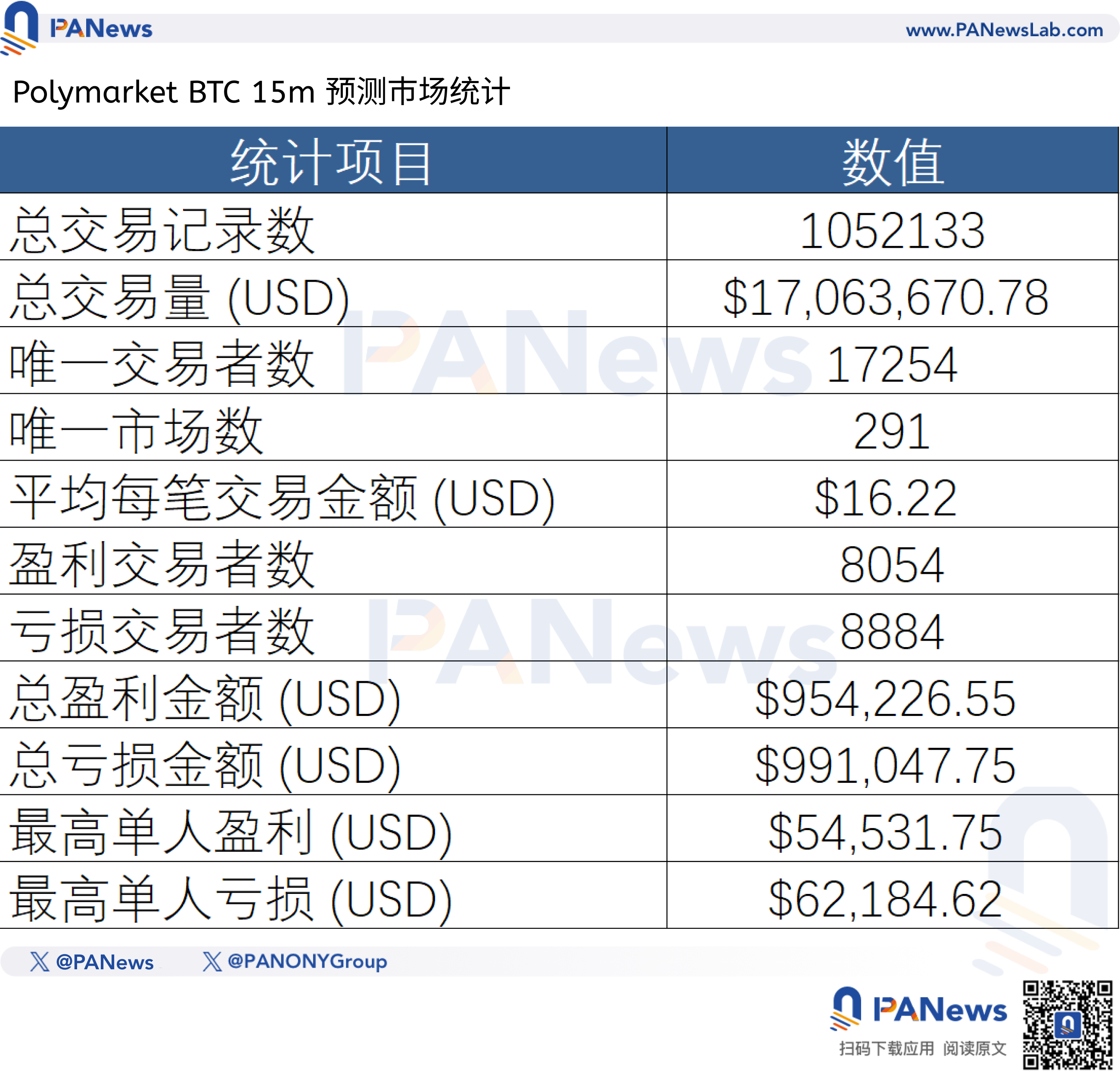
During these 3 days, the BTC 15-minute prediction market generated a total of 1.05 million transactions, with a total trading volume of approximately $17 million. The average trading volume per market was about $58,600. Of course, in terms of trading volume, the scale of the crypto prediction market is still relatively small, far from matching the trading volume of traditional crypto markets.

During this period, a total of 17,254 unique addresses participated in trading in this market. The average number of unique trading addresses per market was 881. The average single transaction amount was $16.22, indicating that the market primarily consists not of institutional battles, but of high-frequency "lottery ticket buying" by thousands of retail investors.

Among them, 8,054 addresses were profitable, while 8,884 unique addresses incurred losses. The ratio of profitable to loss-making participants was close to 1:1.1. The market did not show a "one-sided slaughter"; most losers only suffered minor losses, creating the illusion that "it's still playable," which retained a large number of users.

However, the limitations of market depth were also exposed. Data shows that the highest-profit address earned a total of $54,531, while the address with the largest loss lost $62,184. This data indicates that the liquidity depth of the market limits the upside for large players—it's difficult to make millions of dollars in a single trade here because the counterparty's pockets aren't deep enough.
The median entry point for all addresses was 0.544, indicating that buyers generally entered the market with confidence in "rising" or "falling." However, the median exit point was 0.247. This means the vast majority of active selling was "panic selling," with an average loss of about 50% per trade. It also shows that retail investors often cannot hold onto profitable positions but frequently operate on losing ones, ultimately returning their chips to market makers at low prices.

Robots vs. Real Users: 3.6% of Machines Rule the Market

If散户 are playing psychological games, their opponents are conducting a cold, dimensional strike. The data analysis results mercilessly reveal: in this market, manual traders are facing comprehensive suppression by algorithms.

First, from the results, robot addresses indeed completely outperformed real users in terms of data.

Although these robot addresses are extremely few in number—only 247, accounting for only 3.6%—they contributed over 600,000 transactions, accounting for more than 60% of the total. This shows that a tiny minority of algorithms dominate pricing power and liquidity, while the vast majority of散户 serve as consumables providing funds.

In terms of transaction amount, the ratio between robots and real users is relatively close.

Additionally, robots have a significant advantage in profits. Pure robot addresses had a total profit of approximately $284,000 over these three days, while addresses categorized as robot-like, human-like, and purely human trading all had overall negative returns. Among them, real traders had an overall profit/loss of -$154,000. Every penny of excess profit in the market essentially transferred from the pockets of real users to the accounts of algorithms. Manual trading faces an insurmountable gap when competing against high-frequency algorithms.

In terms of win rate, robot addresses also performed better, with an average win rate of about 65.5%, while real users had a win rate of only 51.5%.
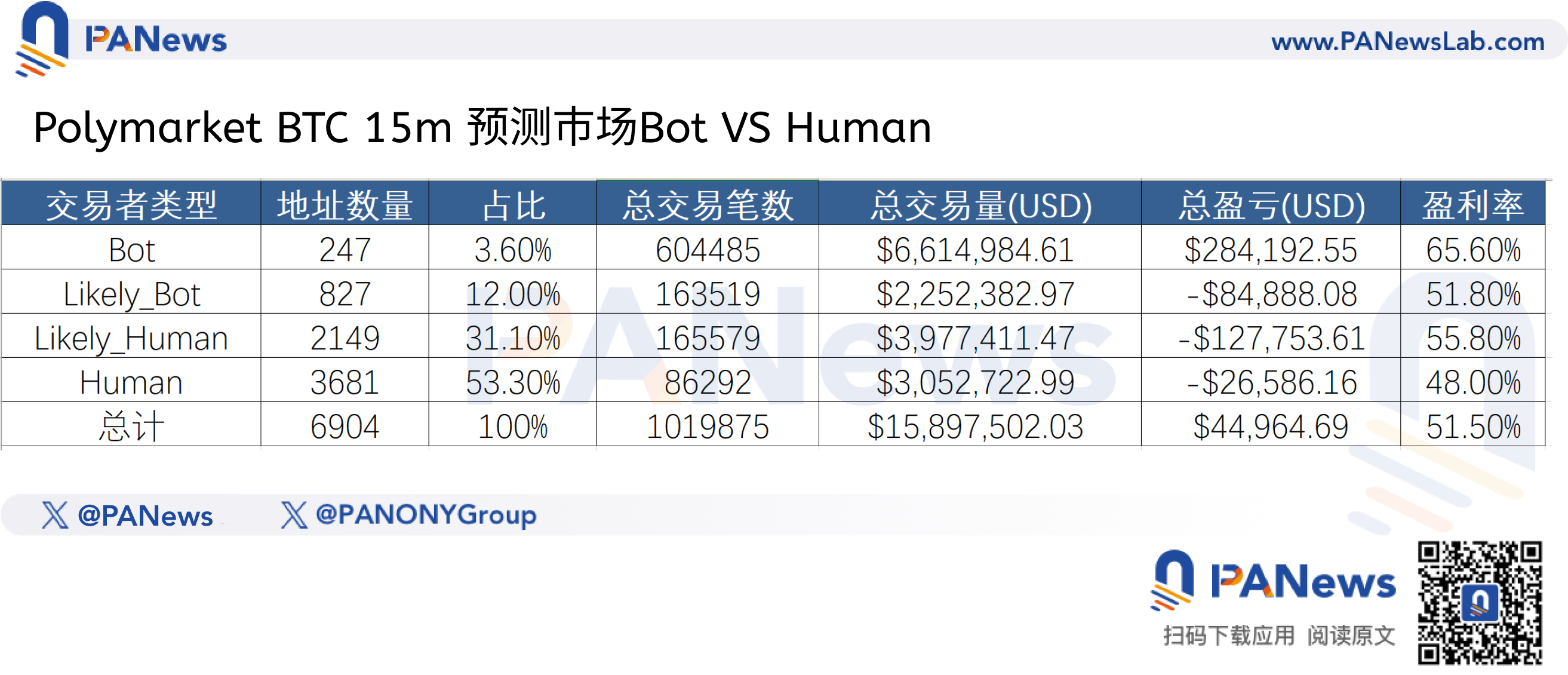
From this perspective, the analysis results show that in crypto short-term prediction markets, a state exists where machines harvest real users, and manual trading results face a huge gap compared to high-frequency robots. From another angle, it also corroborates a result: optimizing algorithms can achieve excess returns in prediction markets.

Decrypting Smart Money: "Fast" is Poison, "Accurate" is the Antidote

However, if you think writing a script and running a robot will guarantee easy money, you are sorely mistaken. Among the list of top earners, we found a counterintuitive phenomenon: intense differentiation also occurs in the world of robots; "high frequency" does not equal "high profit."

Take the address 0x5567...a7b1 as an example. It was the address with the highest number of transactions among all addresses. It conducted over 33,700 transactions in total, averaging over 67 transactions per hour. But its profits were relatively meager, only $4,989, averaging a mere $0.14 per transaction.

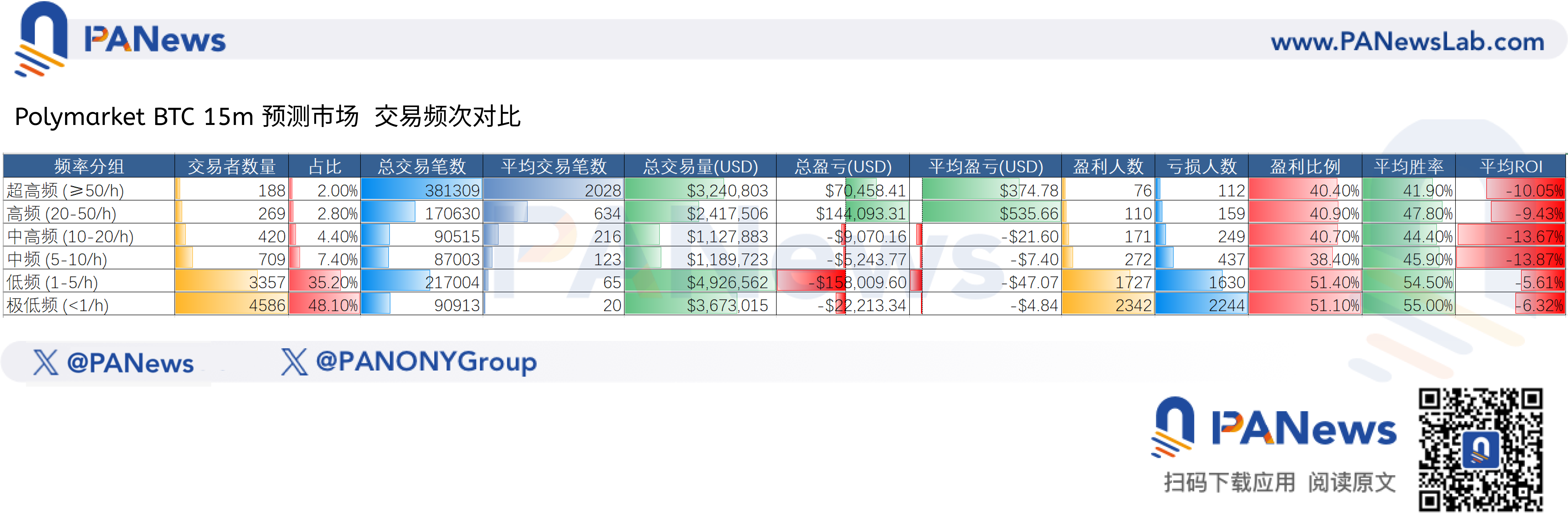
This is not an isolated case. Data shows that among ultra-high-frequency addresses conducting over 50 transactions per hour, only 40% were profitable, and the average return rate for the group was even -10%. Under the pressure of gas fees, slippage, and extremely fierce competition, robots blindly pursuing speed ultimately just work for the miners.

Now consider another case. The address 0x0ea5...17e4 is also a robot address, and its profit ranked first among all addresses. However, its transaction frequency was not that high, averaging only 22 transactions per hour, and it only participated in 61% of the markets. This means this address's trading logic did not involve placing orders every second; instead, it traded based on specific screening conditions, only entering the market when those conditions were met. This address achieved a win rate of 72% and a profit of approximately $54,500.

Risk Control Becomes the Lifeline for Human Traders

Additionally, for human traders, the data also leaves a glimmer of hope.

We found that very low-frequency trading addresses (less than 1 transaction per hour) had an average win rate of 55%, far exceeding those blindly scalping high-frequency robots. This shows that, without top-tier algorithm support, human manual judgment based on market sense and logic can achieve a higher win rate than algorithm-based robots.

But where do humans lose? The data给出的答案是: risk control.

Low-frequency traders (1~5 transactions per hour) had an average loss per trade of about $47, the highest among all address categories. Human traders often correctly predict the direction, but human weaknesses make them hold on stubbornly when wrong and exit too early when right. Ultimately, the "small profits, big losses" profit-loss ratio became the biggest curse for human traders in this market.
1.05 million transaction records, $17 million in flow, reveal a brutal truth:

The Bitcoin 15-minute prediction market is not an ATM for散户; it is a food chain where top-tier algorithms harvest inferior algorithms, and inferior algorithms, in turn, harvest humans.

For ordinary participants, the advice from the data is extremely冷酷: either evolve into a top sniper with a 72% win rate, or become an extremely restrained low-frequency hunter. Beyond that, any frequent operation, any attempt to compensate for technical gaps through "diligence," will ultimately only make you a part of the profit provided to this vast ecosystem.


Tiền kỹ thuật số thịnh hành

Câu hỏi Liên quan

QWhat percentage of addresses in the Bitcoin 15-minute prediction market are algorithmic bots, and what is their trading volume share?

AAlgorithmic bots account for only 3.6% of the addresses but contribute over 60% of the total trading volume.

QHow do the profitability and win rates of algorithmic bots compare to those of human traders in the market?

AAlgorithmic bots achieved a total profit of approximately $284,000 with a win rate of 65.5%, while human traders incurred a net loss of $154,000 with a win rate of 51.5%.

QWhat is the key difference between high-frequency bots and profitable bots in terms of strategy?

AHigh-frequency bots (e.g., over 50 trades per hour) often have low profitability due to gas fees and competition, while profitable bots use selective strategies (e.g., trading only under specific conditions) to achieve higher win rates and profits.

QWhat is the main weakness of human traders in the market, according to the data analysis?

AHuman traders struggle with risk management, often exhibiting 'small profits quickly but hold losses too long' behavior, leading to poor profit-loss ratios despite having a decent win rate.

QWhat is the median entry and exit value for addresses in the market, and what does it indicate about trader behavior?

AThe median entry value is 0.544, indicating a bullish or bearish bias, while the median exit value is 0.247, suggesting that most sellers panic-sell at a loss, realizing an average loss of about 50%.

Nội dung Liên quan

Ngân hàng Ý không nhìn thấy lợi thế hệ thống của stablecoin trong chuyển tiền

Một nghiên cứu của Ngân hàng Ý kết luận rằng stablecoin không mang lại lợi thế hệ thống bền vững về chi phí và tốc độ trong chuyển tiền quốc tế so với các dịch vụ tiêu chuẩn. Các ưu điểm tiềm năng bị mất đi bởi phí chuyển đổi sang/và từ tiền pháp định và hiệu quả của cơ sở hạ tầng thanh toán địa phương. Nghiên cứu so sánh việc chuyển 200 USDC qua 10 hành lang giữa Ý và các nước như Brazil, Argentina, Nhật Bản, UAE và Nam Phi. Tổng chi phí chuyển stablecoin dao động từ 0,3% đến gần 9%, tùy tuyến. Thời gian giải quyết giao dịch dưới 20 phút ở những nơi có hệ thống thanh toán tức thời, nhưng có thể kéo dài 1-2 ngày làm việc ở khu vực không có. Chi phí và độ trễ chủ yếu đến từ việc trao đổi, chuyển đổi tiền tệ và chất lượng hạ tầng địa phương, không phải từ phí blockchain. Dù stablecoin rẻ hơn mức trung bình toàn cầu là 6,65%, chúng chỉ rẻ hơn dịch vụ Wise ở 3/7 tuyến so sánh được. Các tác giả cho rằng lợi ích sẽ rõ ràng hơn nếu stablecoin có thể được chi tiêu trực tiếp mà không cần đổi sang tiền địa phương. Họ cũng lưu ý rằng các quy định cấm đoán không làm giảm nhu cầu với stablecoin, trong khi quy định quá chặt chẽ lại gây khó khăn cho người dùng phổ thông.

cryptonews.ru44 phút trước

Ngân hàng Ý không nhìn thấy lợi thế hệ thống của stablecoin trong chuyển tiền

cryptonews.ru44 phút trước

Cơn sốt Bitcoin đang bùng nổ: Tuyên bố mới của Saylor gây nên những đồn đoán về việc mua vào

Giám đốc điều hành của Strategy Inc. (Nasdaq: MSTR), Michael Saylor, một lần nữa khơi dậy những đồn đoán về việc công ty sẽ thông báo mua Bitcoin mới vào thứ Hai, sau khi đăng thông điệp "Bitcoin Drive engaged" vào ngày 2 tháng 8. Thông báo này đi kèm với biểu đồ mua hàng quen thuộc của công ty, phù hợp với thói quen báo hiệu thay đổi kho bạc trước các báo cáo hàng tuần của Saylor. Báo cáo kèm theo cho thấy dự trữ Bitcoin của Strategy là 843.775 BTC, trị giá khoảng 53,25 tỷ USD. Giá mua trung bình được ghi nhận là 75.653 USD/BTC, với lỗ chưa thực hiện là 10,58 tỷ USD (-16,58%). Một tín hiệu tương tự vào Chủ nhật tuần trước đã dẫn đến thông báo vào ngày 27/7 về việc công ty gia tăng dự trữ tiền mặt. Sổ cái thời gian thực của Strategy hiển thị 116 giao dịch đã đăng ký với tổng số 843.775 BTC được mua, đồng thời ghi nhận hai đợt bán Bitcoin gần đây tổng cộng 3.588 BTC (giảm từ 847.363 BTC), nhằm mục đích tài trợ cho cổ tức ưu đãi và bổ sung dự trữ USD. Công ty được báo cáo là đã không mua BTC trong tuần kết thúc ngày 26/7, đồng thời tăng dự trữ USD lên khoảng 3,75 tỷ USD. Bối cảnh tài chính đầy thách thức khi Strategy báo lỗ hoạt động 8,33 tỷ USD trong quý II/2026, chủ yếu do lỗ chưa thực hiện trên tài sản kỹ thuật số. Ban lãnh đạo có thể bán thêm tới 1,25 tỷ USD Bitcoin để củng cố dự trữ USD. Thông báo cập nhật dự kiến vào thứ Hai sẽ cho thấy liệu "Bitcoin Drive" có đánh dấu việc tái tích lũy hay không, khi Strategy cân bằng giữa kho dự trữ Bitcoin khổng lồ và các nghĩa vụ tiền mặt ngày càng tăng.

cryptonews.ru46 phút trước

Cơn sốt Bitcoin đang bùng nổ: Tuyên bố mới của Saylor gây nên những đồn đoán về việc mua vào

cryptonews.ru46 phút trước

Cổ phiếu các công ty trí tuệ nhân tạo được giao dịch như 'meme coin', trong khi Bitcoin hầu như không thay đổi giá - Tổng quan tuần

**Tóm tắt:** Bài viết phân tích các diễn biến chính trên thị trường tài chính và tiền điện tử trong tuần, với trọng tâm là sự biến động mạnh ở lĩnh vực AI và sự trầm lặng tương đối của Bitcoin. **Thị trường chứng khoán & AI:** * Cổ phiếu AI được giao dịch như "meme coin" với biến động cực đoan. Thị trường Hàn Quốc lao dốc 8% trong một phiên, chịu ảnh hưởng từ đợt bán tháo chip toàn cầu. * Quỹ "Situational Awareness" của Leopold Aschenbrenner bị thua lỗ nặng, dẫn đến thanh lý tài sản lớn, góp phần gây ra biến động. Citadel được cho là đã mua lại phần lớn danh mục của quỹ này. * Các chuyên gia như Ram Ahluwalia và Flood khuyên nên kiên nhẫn, trong khi Jim Bianco lưu ý thị trường thường tìm đáy sau khi một sự kiện lớn (như sự sụp đổ của một quỹ) xảy ra. **Macro & Tiền tệ:** * Các phát biểu của Chủ tịch Fed Kevin Warsh được cho là đã góp phần gây ra biến động, với một số ý kiến cho rằng ông thiếu năng lực. * Bộ Tài chính Nhật Bản can thiệp để hỗ trợ đồng Yên, nhưng hiệu quả hạn chế. * Có dấu hiệu về việc giảm thanh khoản toàn cầu và đà tăng trưởng sản xuất Mỹ chậm hơn kỳ vọng. **Thị trường Tiền điện tử:** * Bitcoin ít biến động, dao động quanh mức 64,000 USD, trong khi sự chú ý đổ dồn sang thị trường truyền thống. * Nhiều công ty tiền điện tử gặp khó khăn: BitMart và Storj Labs tuyên bố đóng cửa/phá sản; Coinbase (COIN) lao dốc sau báo cáo tài chính yếu; Uphold và các sàn khác cắt giảm nhân sự. * MicroStrategy tiếp tục tích lũy Bitcoin và mua lại cổ phiếu của chính mình, một chiến lược bị chỉ trích là "vòng xoáy Ponzi". * Cảnh báo bảo mật nghiêm trọng về lỗ hổng trên ví phần cứng Coldcard có thể làm lộ khóa riêng tư, đòi hỏi người dùng hành động ngay. **Các chủ đề khác:** * **DeFi/Blockchain:** Trade.xyz trên Hyperliquid và Pump.fun trên Solana cực kỳ thành công, đặt ra câu hỏi liệu họ có tự khởi chạy blockchain riêng hay không. Nghi ngờ giao dịch nội gián trên Hyperliquid. * **AI & Crypto:** Jason Calacanis và Barry Silbert nhiệt tình ủng hộ dự án Bittensor (TAO), coi đó là mô hình AI phi tập trung. Tác giả cảnh báo nên thận trọng trước sự cổ xúy của các nhà đầu tư mạo hiểm. * Các tranh cãi trong ngành: Kyle Samani chỉ trích Multicoin Capital; Charles Hoskinson khó chịu vì câu hỏi về quá khứ đồng sáng lập Ethereum. **Thông điệp chính:** Thị trường đang trải qua giai đoạn biến động mạnh, đặc biệt ở mảng AI, trong khi tiền điện tử chịu áp lực. Tính kỷ luật, sự kiên nhẫn và cảnh giác cao độ (đặc biệt về bảo mật) là cần thiết trong bối cảnh hiện tại.

cryptonews.ru57 phút trước

Cổ phiếu các công ty trí tuệ nhân tạo được giao dịch như 'meme coin', trong khi Bitcoin hầu như không thay đổi giá - Tổng quan tuần

cryptonews.ru57 phút trước

Coinkite bị chỉ trích vì lưu trữ email khách hàng sau vụ hack Coldcard trị giá 88 triệu USD

Coinkite một lần nữa đối mặt với làn sóng chỉ trích từ khách hàng sau khi lỗi trong quá trình tạo cụm từ seed ngẫu nhiên cho ví phần cứng Coldcard dẫn đến việc hơn 1.000 BTC (trị giá hơn 88 triệu USD tính đến thời điểm đó) bị đánh cắp trong hai ngày. Để cảnh báo phần lớn khách hàng có thể bị ảnh hưởng, công ty đã gửi email thông báo đến các địa chỉ email liên quan đến giao dịch mua hàng từ năm 2019. Hành động này vấp phải chỉ trích khi khách hàng chất vấn việc công ty lưu trữ dữ liệu email lâu dài. Coinkite phản hồi bằng cách viện dẫn chính sách công khai, nói rằng email được lưu để khách hàng có thể đăng nhập và xác nhận các thông tin khác đã bị xóa, nhưng không nêu rõ thời hạn xóa các địa chỉ email này. Trong một tuyên bố dường như mâu thuẫn, CEO Rodolfo Novak nhấn mạnh rằng công ty không lưu trữ thông tin khách hàng và không có cách nào liên lạc trực tiếp với những người bị ảnh hưởng, đồng thời kêu gọi sự hỗ trợ để tiếp cận tất cả người dùng có nguy cơ. Ông cũng khẳng định Coinkite cung cấp tùy chọn mua hàng ẩn danh và xóa dữ liệu khách hàng sau 90 ngày, đồng thời nhấn mạnh công ty rất coi trọng vấn đề bảo mật.

cryptonews.ru58 phút trước

Coinkite bị chỉ trích vì lưu trữ email khách hàng sau vụ hack Coldcard trị giá 88 triệu USD

cryptonews.ru58 phút trước

Giao dịch

Giao ngay

Bài viết Nổi bật

Làm thế nào để Mua WIN

Chào mừng bạn đến với HTX.com! Chúng tôi đã làm cho mua WINkLink (WIN) trở nên đơn giản và thuận tiện. Làm theo hướng dẫn từng bước của chúng tôi để bắt đầu hành trình tiền kỹ thuật số của bạn.Bước 1: Tạo Tài khoản HTX của BạnSử dụng email hoặc số điện thoại của bạn để đăng ký tài khoản miễn phí trên HTX. Trải nghiệm hành trình đăng ký không rắc rối và mở khóa tất cả tính năng. Nhận Tài khoản của tôiBước 2: Truy cập Mua Crypto và Chọn Phương thức Thanh toán của BạnThẻ Tín dụng/Ghi nợ: Sử dụng Visa hoặc Mastercard của bạn để mua WINkLink (WIN) ngay lập tức.Số dư: Sử dụng tiền từ số dư tài khoản HTX của bạn để giao dịch liền mạch.Bên thứ ba: Chúng tôi đã thêm những phương thức thanh toán phổ biến như Google Pay và Apple Pay để nâng cao sự tiện lợi.P2P: Giao dịch trực tiếp với người dùng khác trên HTX.Thị trường mua bán phi tập trung (OTC): Chúng tôi cung cấp những dịch vụ được thiết kế riêng và tỷ giá hối đoái cạnh tranh cho nhà giao dịch.Bước 3: Lưu trữ WINkLink (WIN) của BạnSau khi mua WINkLink (WIN), lưu trữ trong tài khoản HTX của bạn. Ngoài ra, bạn có thể gửi đi nơi khác qua chuyển khoản blockchain hoặc sử dụng để giao dịch những tiền kỹ thuật số khác.Bước 4: Giao dịch WINkLink (WIN)Giao dịch WINkLink (WIN) dễ dàng trên thị trường giao ngay của HTX. Chỉ cần truy cập vào tài khoản của bạn, chọn cặp giao dịch, thực hiện giao dịch và theo dõi trong thời gian thực. Chúng tôi cung cấp trải nghiệm thân thiện với người dùng cho cả người mới bắt đầu và người giao dịch dày dạn kinh nghiệm.

Tổng lượt xem 603Xuất bản vào 2024.12.11Cập nhật vào 2025.03.21

Làm thế nào để Mua WIN

Thảo luận

Chào mừng đến với Cộng đồng HTX. Tại đây, bạn có thể được thông báo về những phát triển nền tảng mới nhất và có quyền truy cập vào thông tin chuyên sâu về thị trường. Ý kiến ​​của người dùng về giá của WIN (WIN) được trình bày dưới đây.

活动图片












