Stop Paying Attention to These Zombie Projects

marsbitXuất bản vào 2026-02-11Cập nhật gần nhất vào 2026-02-11

Tóm tắt

The crypto market in 2025 is marked by extreme contradictions: while over 20 million tokens have been launched, more than 57% have failed. A new wave of "zombie projects"—backed by top VCs and listed on major exchanges—continues to operate with minimal product development or real-world utility. This analysis highlights several疑似僵尸化 projects: - **Sleepless AI**: Once a Binance Labs incubator star, its token fell 99% from its peak. It promises AI-driven emotional companions but shows no substantial technical updates or iOS/Android app launches, raising suspicions of being a repackaged Web2 product. - **Hooked Protocol**: Its Learn-to-Earn model initially attracted users through subsidies, but token value collapsed 99% after incentives faded. Its shift to "AI-powered education" appears more like marketing than tangible tech progress. - **Saga**: Positioned as a "one-click chain launch" solution, it pivoted repeatedly between gaming and AI narratives due to lack of adoption. A $7M security breach and 99% token drop further eroded trust. - **Dymension**: Despite claiming 10,000+ RollApps, most show no activity. TVL remains low at $1.3M, and the token price dropped 99%, reflecting a ghost ecosystem. Zombie projects persist due to: 1. Capital-driven listings prioritizing narrative over substance. 2. Opaque team backgrounds enabling low-exit accountability. 3. "Narrative parasitism"—rebranding to chase trends without real development. In 2026, investors must pr...

Author: Chloe, ChainCatcher

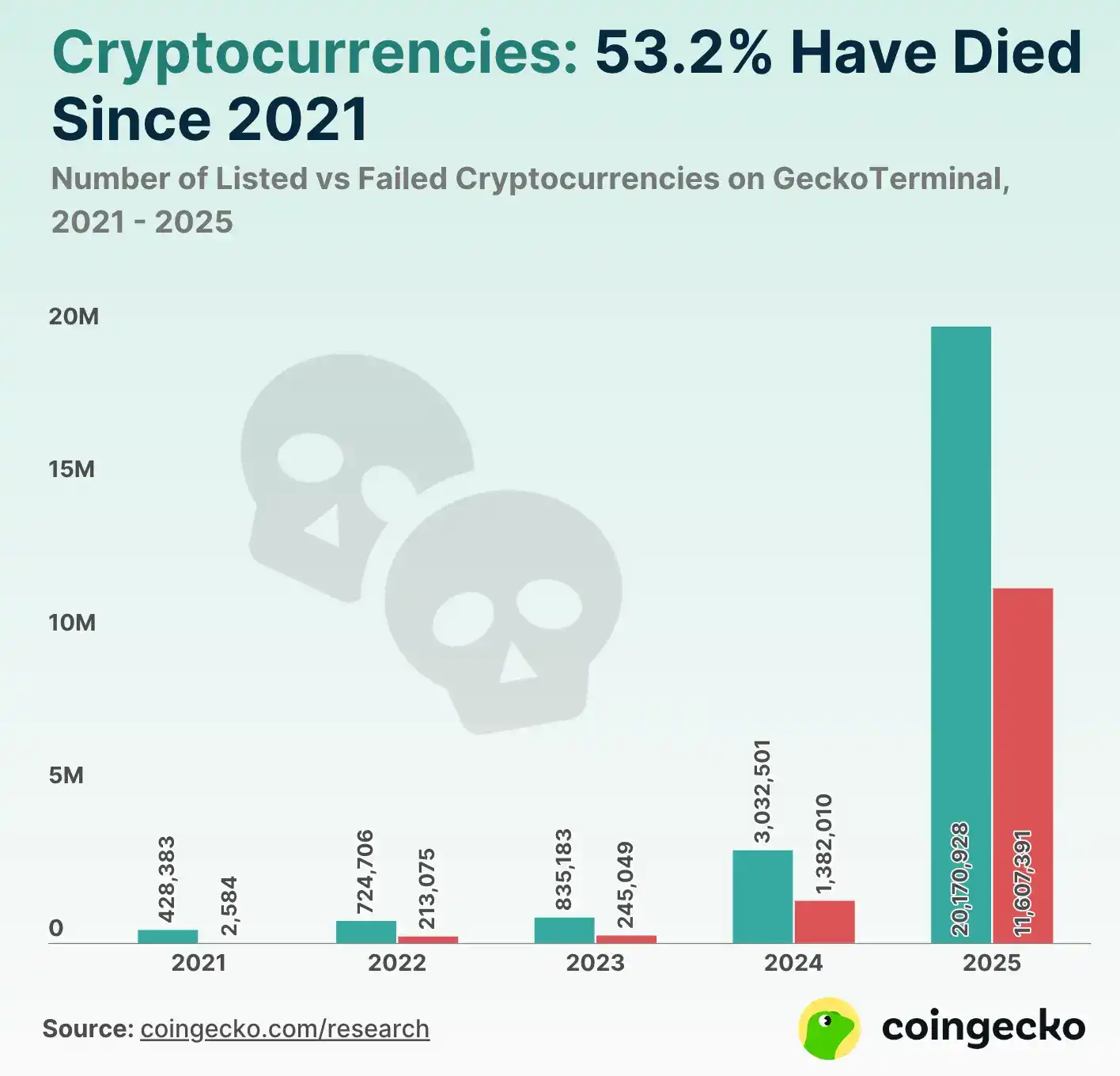
The crypto market in 2025 witnessed an extreme industry contradiction: according to GeckoTerminal statistics, while the total number of token-launching projects surpassed the 20 million mark, over 57% of them met their demise. Amid this brutal elimination race, a more insidious type of "zombie project" is spreading. They boast backing from top-tier capital and leading exchanges, frequently pivot their narratives to chase hot trends, yet are nearly stagnant in terms of actual product delivery, technological development, and ecosystem building.

This article will deeply analyze疑似 zombie-fying projects like Sleepless AI, Hooked Protocol, Saga, and Dymension, examining their operational characteristics. In 2026, the ability to see through narrative fog and identify signs of zombification has become a essential survival skill for investors.

Launching a Token Means "Job Done"? Project Decline and Zombification Phenomenon

In the early stages of blockchain development, the definition of "Zombie Coins" was relatively straightforward: long-term dormancy, loss of trading liquidity, vanished development teams, lack of community participation, etc. However, with the maturation of capital markets and the deep involvement of venture capital, a more隐蔽 absurd phenomenon has emerged in recent years.

Data shows that in 2021, the number of token-launching projects on GeckoTerminal was only 428,000, but by the end of 2025, this number had skyrocketed to 20.17 million. Behind this explosive growth, a staggering 53% of projects met their end. Simultaneously, hidden within this high turnover, high淘汰 rate are大量 "zombified" projects. They trade on exchanges, post social media announcements daily, but there exists a huge gap in actual product delivery, on-chain activity, and ecosystem development.
Sleepless AI: Parasitizing the AI Narrative? R&D and Delivery Disconnect

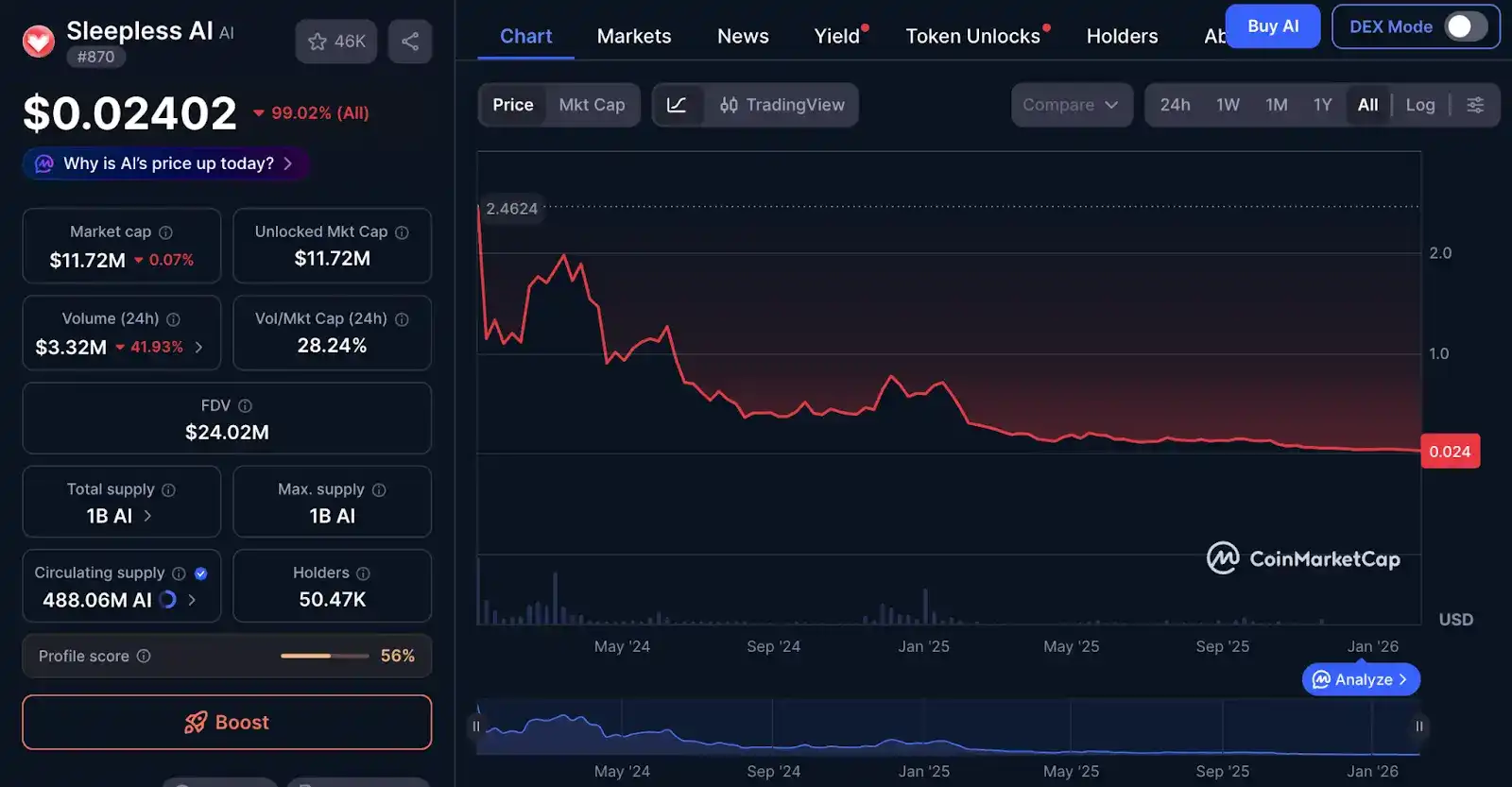
Sleepless AI was once a market darling, not only selected as a standout in Binance Labs' sixth season incubation program but also debuted gloriously on Binance Launchpool's 42nd edition under the光环 of "Web3+AI Virtual Companion." However, entering 2026, its market performance has diverged sharply from its initial热度: the token price has retreated from its historical high of $2.46 to around $0.024, a drop of 99%.
1. Technical Transparency and R&D Progress Disconnect: Although the project touts the use of AIGC and large language models (LLM) to create a deep emotional support experience, its technical transparency is lacking. Observing through public channels, the project almost lacks trackable code update records or iterative versions of core algorithms. More concerning for investors is that the Web Dapp originally scheduled for Q2 2025 has an unclear progress status至今.

2. Inefficient Execution of Mobile Strategy: In the "mobile-first" application era, Sleepless AI's product落地 process appears relatively lagging. Its flagship product "HIM" as of early 2026 still hasn't successfully launched on the iOS App Store or Google Play Store; the official website still only offers Android APK downloads. For a project aiming for mass adoption, this development efficiency severely limits user growth and market trust.

3. Narrative Rebranding and Insider Doubts: Accompanying the product stagnation are deep market doubts about the project's本质. Market observers have put forward the view that the project is疑似 a "narrative rebranding" of an old Web2 game, meaning it repackaged itself with AI concepts and leveraged capital connections to强行 latch onto the AI trend's热度 to secure Binance Labs' investment and Launchpool's流量红利. Although such claims are often anonymous, combined with its weak technical delivery and token price collapse, this phenomenon of "narrative parasitism" has become an important reference indicator for investors in 2026 to identify疑似 zombie projects.

Hooked Protocol: Ecological Dilemma After Incentives Dry Up

Hooked Protocol once emerged rapidly in the Web3 social learning track with its Learn-to-Earn model, securing investment from Binance Labs and Sequoia China, and launching as Binance's 29th Launchpad project. However, as token distribution entered its mid-to-late stages and subsidy红利 gradually faded, the project now faces severe tests of "real user retention" and "ecological substance".

1. From Learn-to-Earn to Incentive Dependency Dilemma: Hooked Protocol's initial success relied heavily on the流量 effect of Binance Launchpad and a strong token subsidy mechanism. This model can quickly换取 huge user numbers initially, but when the HOOK token price fell nearly 99% from its high, the growth game sustained by subsidies loses its appeal. History has repeatedly shown: after TGE, when incentives disappear, "massive user numbers" lacking rigid demand often rapidly shrink.

2. "Marketing-Oriented" Tendency in Narrative Transformation: Entering 2025, Hooked attempted to transform into an "AI-driven learning ecosystem" and "educational infrastructure." Although officially stated to be co-developing courses with 3-7 top universities and launching the Hooked Coursera Hub in August 2025 in collaboration with over 74 Web3 projects, these moves seem more like "brand endorsements" at the marketing level. Compared to the impressive list of partners, its substantive breakthroughs at the technical底层 appear lackluster.

Hooked Protocol's current state reveals a core challenge for Web3 application projects to a certain extent: if a project's vitality relies on token incentives and cannot transform into原生 demand with business resilience, it will struggle to escape the fate of大幅 token price decline, even zombification. The current low币价 and potentially shrinking ecological activity are the negative feedback after subsidy-driven prosperity.

Saga: Dual Blows of Lack of Market Demand and Security Vulnerabilities

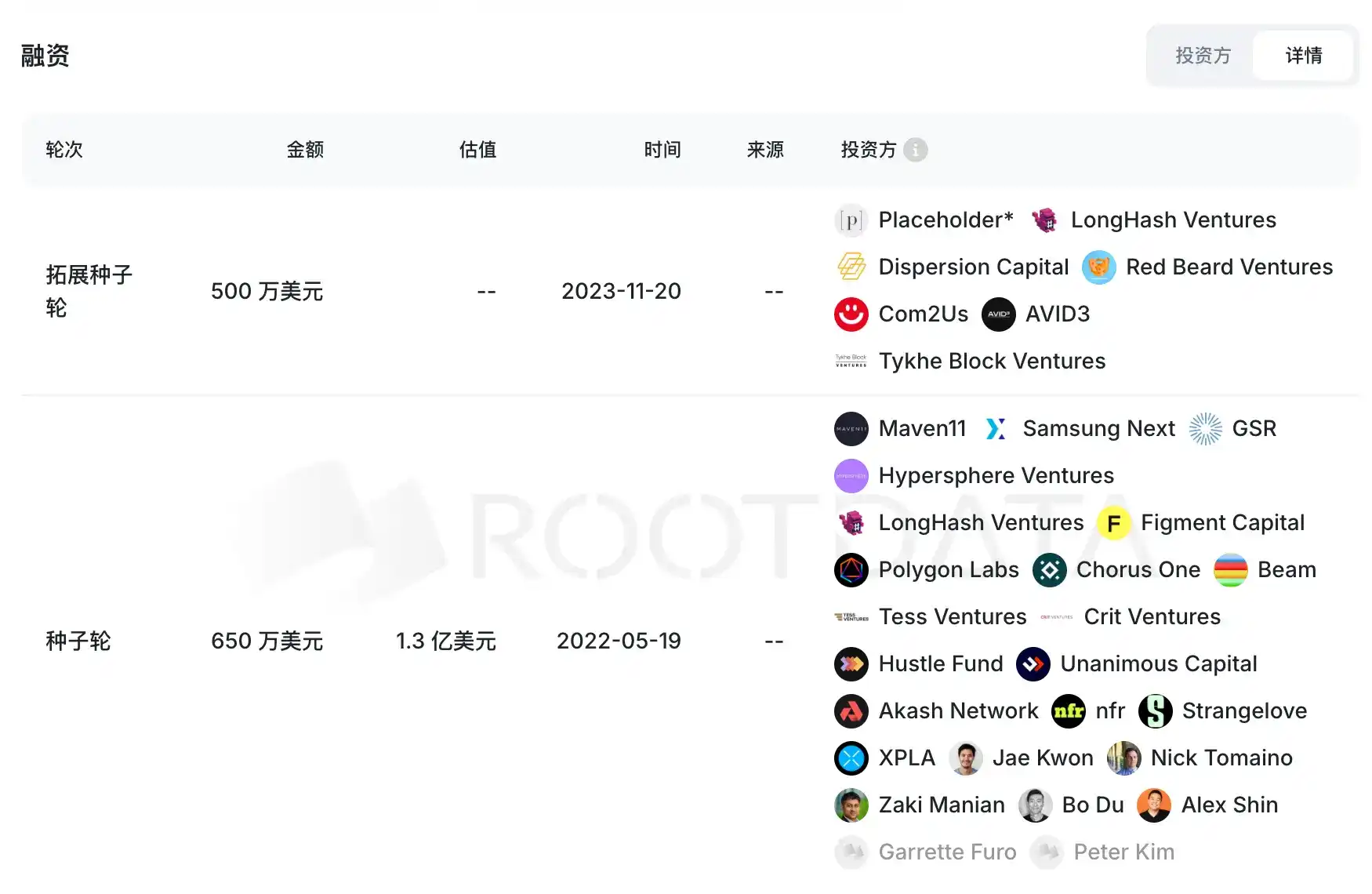
Saga represents another path to zombification: the shovel seller can't find miners. With the grand vision of "one-click chain launch," Saga successfully attracted over $1000 in financing from top institutions like Placeholder, GSR, and Samsung Next, and also successfully launched as the 51st project on Binance Launchpool. However, this powerful automated chain-launching tool seems somewhat misplaced when tested against real market demand.
1. Frequent "Pivoting" Exposes Ecological Anxiety: Over the past two years, Saga has shown极高的 narrative flexibility, but also暴露出其生态核心缺陷. From initially promoting itself as a gaming-specific chain with over 350 partner projects, to later pivoting to an AI infrastructure narrative, this frequent narrative shifting essentially reflects the growth anxiety arising from the lack of落地 applications in its old ecosystem.

If its core technology "Chainlet" had genuine market demand, it should theoretically drive token buybacks through developers' continuous renewals. However, the reality is that Saga's partner list, though long,始终 lacks blockbuster project support. Most partners remain in the early exploration stage, unable to contribute substantial economic driving force to the protocol.

2. Fatal Blow to Security Credibility: For infrastructure, technical security is its bottom line. SagaEVM suffered a $7 million vulnerability attack in January this year, with the stablecoin $D depegging to $0.75, and TVL evaporating from approximately $37 million to $12 million. This is undoubtedly a severe blow for a project positioning itself as infrastructure.

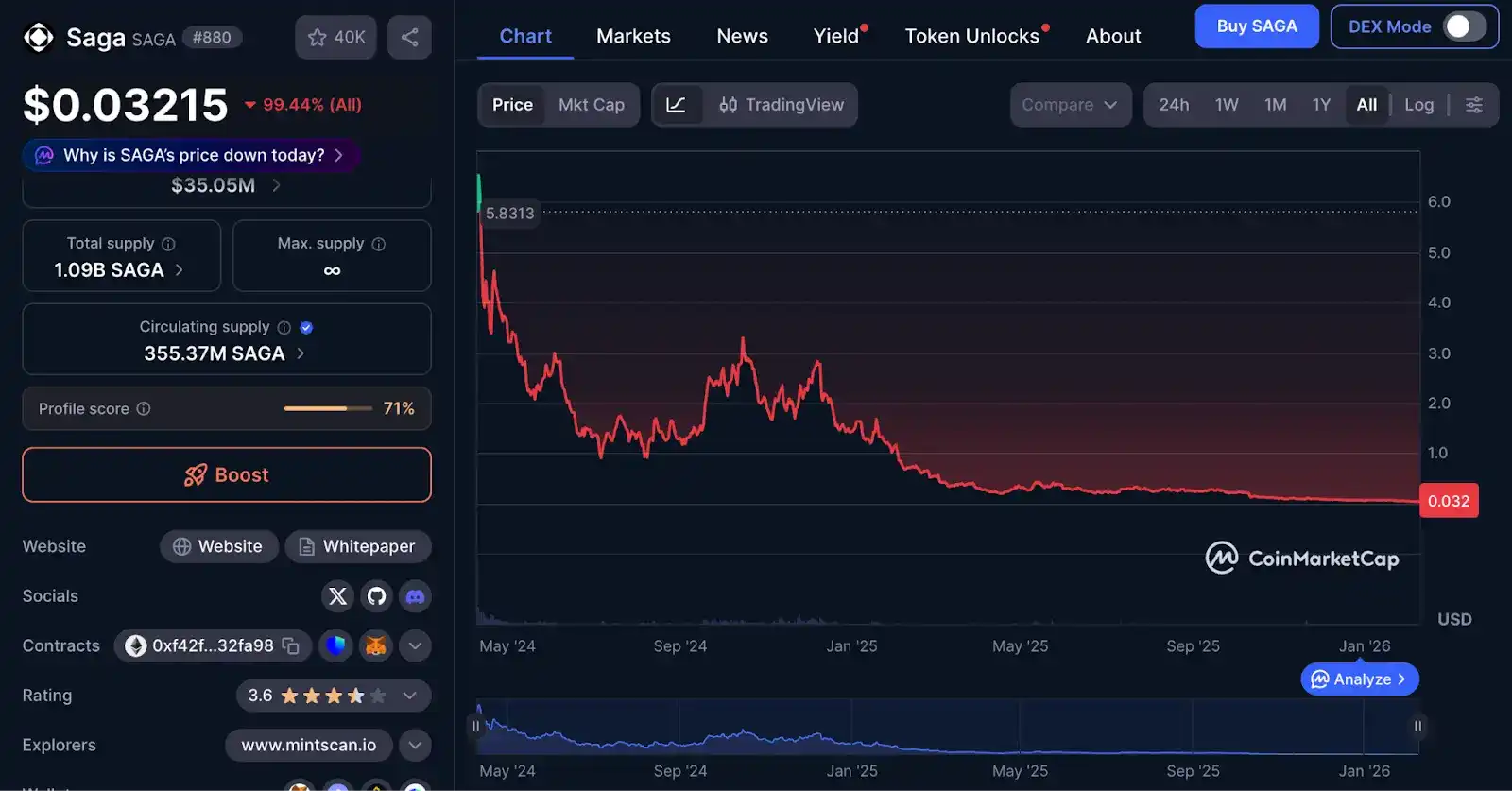
When grand narratives fail to translate into ecological data, and technical security is flawed, the market's feedback is often merciless. The native token SAGA price has fallen from its 2024 high of $6 to around $0.032 currently.
Dymension: Data Ghost Town Under a Grand Architecture

Dymension's script is highly similar to Saga's. Its proposed RollApp concept is quite attractive in theoretical architecture, but in the face of actual data in 2026, it更像是一座宏伟的鬼城 (a grand ghost town). Although Dymension attempts to establish a benchmark for a modular settlement layer, the real vitality of its ecosystem falls far short of expectations.

1. RollApp Network Activity Disconnect: Dymension once claimed to have deployed over 10,000 RollApps within its ecosystem. However, this data prosperity essentially stems from the lowered barriers to "issuing tokens and launching chains." The vast majority of deployed RollApps have no sustained on-chain transactions or substantial output beyond the initial token issuance, and many have even disappeared.
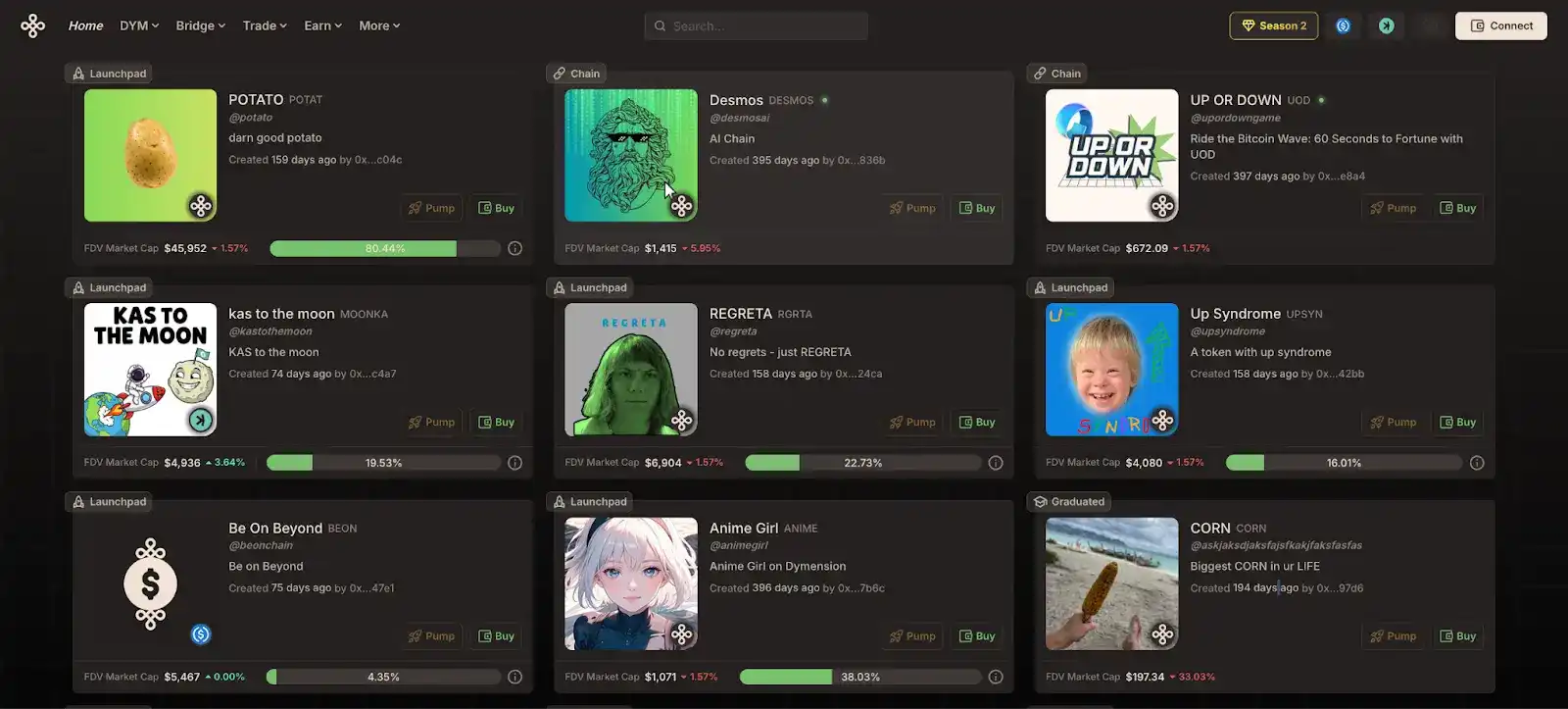
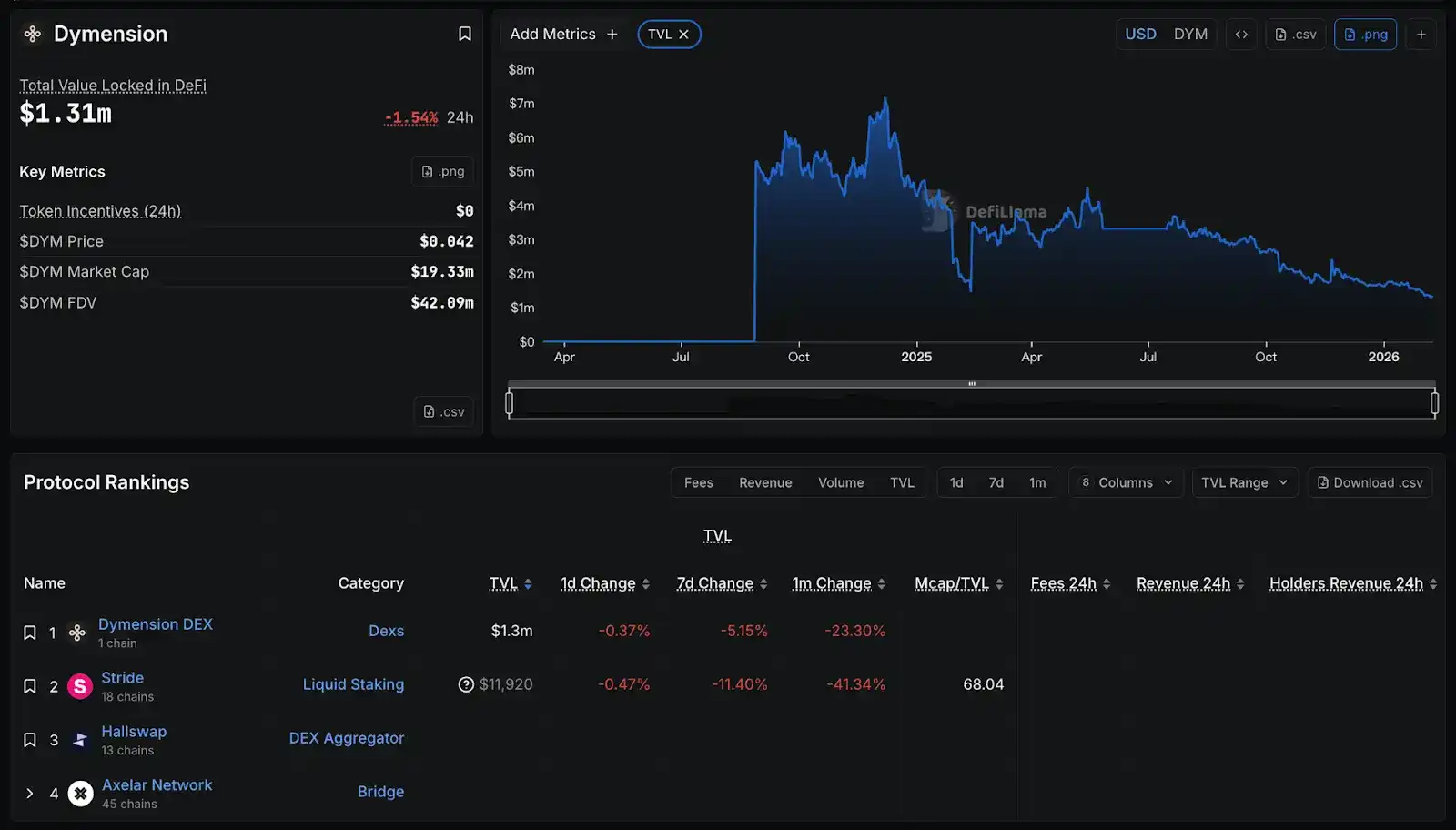
2. Dysfunctional Economic Function of Infrastructure: When Launchpad and development kits fail to transform into a thriving digital economy, the infrastructure itself falls into value exhaustion. Dymension's main DEX projects and ecosystem TVL performance are both unsatisfactory. The current overall TVL is only $1.3M, forming a stark contrast with the market's initial expectation of it being a "modular leader" at token launch.
极

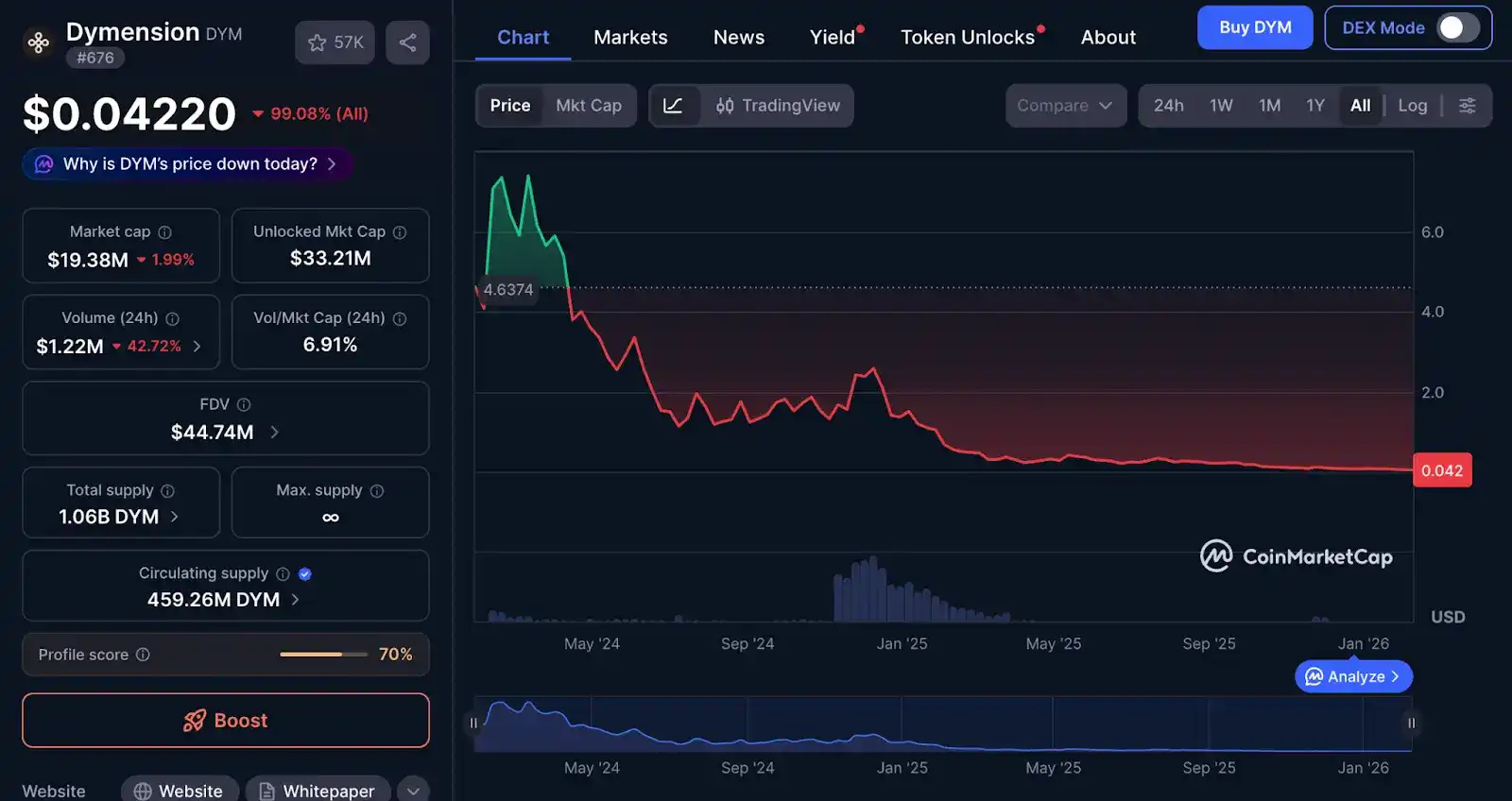
When the infrastructure primarily runs zombie applications and the overall ecosystem performance is拉垮 (lacking), the native token DYM price is inevitably corrected by the market. The current FDV is $45M, and the token price has fallen 99% from its high of $6, now只剩 (only remaining at) $0.042.
Why Are "Zombie" Projects Proliferating?

The reason these projects can maintain a superficial "vitality" stems from deep-seated structural issues within the Web3 industry.

1. Capitalized Listing Power Structure: In recent years, the listing path for many projects has not originated from substantial technological breakthroughs but has highly relied on "capital, vested interests, and narrative packaging." Pushed forward by the combined force of VCs and internal executives, these projects enter top exchanges through精美 packaging and刷出来的 (fabricated) testnet data. Once the token unlock is complete, teams often lose motivation for further development.

2.模糊的团队背景 (Ambiguous Team Backgrounds): A common characteristic among some zombie projects is that the background of the core operators and technical leaders is extremely模糊 (ambiguous). This "black box" operational model not only allows the project team to avoid credible accountability when encountering technical bottlenecks or security vulnerabilities but also provides them with very low exit costs. It enables the operating team to quickly rebrand, discreetly reposition in a new narrative after one project stalls, and repeatedly消耗 (consume) market credit.

3. Narrative Parasitism Capability: Zombie projects often possess a strong ability for "narrative parasitism." Whenever market热点 (hot topics) shift, these projects with little substantive progress often conduct "announcement-style pivots" to align with the new narrative. This not only increases the identification cost for investors but also分散 (disperses) scarce liquidity into unproductive shells, from which they can蹭热度 (ride the hype) and attract speculative capital.

Conclusion: Investors Should Seek the True Bottom Line of Value in 2026

Facing a prosperous market woven from twenty million token-launching projects, investors' core logic must change. In 2026, identifying zombie projects is no longer just a bonus skill but a defensive necessity. Below are three core indicators to help readers identify them:

First, the verifiability of the team and technical delivery: Avoid projects with unclear team information, no GitHub commit history, low roadmap fulfillment rates, and slow product distribution. Second, the substance of the data: Distinguish between "subsidy-driven activity" and "organic demand." Check if users show retention willingness after token subsidies are removed. Finally, be wary of projects that change their core focus every three months. Genuine innovation requires deep cultivation; frequent narrative switches usually掩盖 (mask) the failure of the old business.

As the crypto market matures, the industry needs projects that consistently deliver both before and after token launches, genuinely bring value to the industry, and solve market pain points.


Câu hỏi Liên quan

QWhat is the main contradiction observed in the 2025 crypto market according to the article?

AThe main contradiction is that while the total number of token issuance projects exceeded 20 million, over 57% of them failed, and a more insidious type of 'zombie project' is emerging, which has backing from top-tier capital and major exchanges but shows near stagnation in actual product delivery, technology development, and ecosystem building.

QWhat are the three key indicators the article suggests for investors to identify zombie projects in 2026?

AThe three key indicators are: 1. Verifiability of the team and technical delivery—avoid projects with unclear team backgrounds, no GitHub commit history, low roadmap fulfillment, and slow product distribution. 2. The substance—distinguish between 'subsidy-driven activity' and 'native demand' by checking if retention persists after token incentives end. 3. Be wary of projects that frequently change their core narrative every few months, as this often masks the failure of previous ventures.

QWhy did Sleepless AI's market performance decline significantly, as per the analysis?

ASleepless AI's market performance declined by 99% from its all-time high due to a lack of technical transparency and development progress (e.g., no trackable code updates or delayed Web Dapp launch), inefficient execution of its mobile strategy (failure to launch on major app stores), and market skepticism about its narrative, with allegations that it was a repackaged Web2 project leveraging AI hype for capital and exchange benefits.

QWhat core challenge does Hooked Protocol's situation reveal about Web3 application projects?

AHooked Protocol's situation reveals the core challenge that if a project's viability relies solely on token incentives rather than transforming into a business with resilient native demand, it is likely to suffer from token price collapse and zombification once subsidies diminish, as seen with its 99% price drop and potentially shrinking ecosystem activity.

QWhat structural problems in the Web3 industry contribute to the proliferation of zombie projects?

AThe proliferation of zombie projects is fueled by structural problems such as: 1. Capital-driven listing power structures, where projects rely on VC backing and narrative packaging rather than technical merit to get listed on exchanges. 2. Opaque team backgrounds, allowing low exit costs and rebranding opportunities. 3. Narrative parasitism, where projects frequently pivot to new hot topics without substantive progress, increasing investor identification costs and dispersing liquidity.

Nội dung Liên quan

Sau ba quý liên tiếp suy giảm, thị trường tiền điện tử có thể đón cửa sổ ổn định trong quý III?

Thị trường tiền mã hóa vừa trải qua quý tồi tệ nhất kể từ năm 2022, với vốn hóa giảm 12.6% xuống 2.1 nghìn tỷ USD, khối lượng giao dịch sụt giảm và dòng tiền rút mạnh khỏi các quỹ ETF Bitcoin. Bitcoin và Ethereum lần lượt giảm 14.2% và 25.4% trong quý, đánh dấu sự đảo ngược so với mối tương quan trước đây với các tài sản rủi ro như Nasdaq. Dòng vốn ETF chứng khoán Mỹ ghi nhận dòng ròng rút khoảng 46.7 tỷ USD trong quý II, báo hiệu áp lực bán. Tuy nhiên, dấu hiệu tích cực ban đầu xuất hiện khi các nhà đầu tư dài hạn bắt đầu tích lũy trở lại và dòng ETF có đợt thu hút ngắn hạn. Toàn bộ thị trường hiện tập trung vào cuộc họp của Cục Dự trữ Liên bang Mỹ (FOMC) vào cuối tháng 7. Các tín hiệu chính sách tiền tệ sẽ quyết định xu hướng: tín hiệu ôn hòa có thể đẩy Bitcoin lên vùng 68,000-84,000 USD, trong khi lập trường cứng rắn có thể kéo giá về vùng 50,000-56,000 USD. Tiến trình pháp lý của Đạo luật CLARITY gần như đình trệ, làm giảm kỳ vọng và gia tăng phí rủi ro cho toàn ngành. Trong bối cảnh ảm đạm, hai lĩnh vực nổi bật là thị trường dự đoán (tăng trưởng 48.7%) và bộ sưu tập kỹ thuật số được mã hóa (tăng ~143%), cho thấy sự chuyển dịch nhu cầu thực tế. Nhìn chung, thị trường thiếu động lực cho một đợt tăng trưởng mạnh dựa trên tâm lý. Các quyết định giao dịch trong quý III sẽ chủ yếu xoay quanh diễn biến giá, lựa chọn chính sách và kỳ vọng lãi suất.

marsbit1 giờ trước

Sau ba quý liên tiếp suy giảm, thị trường tiền điện tử có thể đón cửa sổ ổn định trong quý III?

marsbit1 giờ trước

Giao Dịch SpaceX, Đã Mở Khóa: SPCXON Được Giao Dịch Trên WEEX

SpaceX đã thực hiện đợt IPO lớn nhất lịch sử vào tháng 6/2026, nhưng nhiều nhà giao dịch không thể tiếp cận do các rào cản như hạn chế môi giới và khu vực. Sàn giao dịch tiền điện tử WEEX đã giới thiệu SPCXON/USDT, một công cụ token hóa cho phép tiếp cận biến động giá của SpaceX thông qua tài khoản crypto được quyết toán bằng USDT, mà không cần môi giới Mỹ hay tài khoản ngân hàng. Sản phẩm này, xây dựng trên nền tảng cổ phiếu token hóa của Ondo, dành cho các nhà giao dịch bên ngoài Hoa Kỳ. Trường hợp đầu tư dựa trên đà tăng doanh thu Starlink và các cột mốc Starship, trong khi các yếu tố cần thận trọng bao gồm định giá cao, lượng cổ phiếu lưu hành công chúng ít và sự kiện mở khóa cổ phiếu nội bộ sắp tới. Lưu ý quan trọng: SPCXON cung cấp mức tiếp xúc với hiệu quả kinh tế, không phải quyền sở hữu cổ phiếu trực tiếp, và có thể giao dịch ở mức cao hơn hoặc thấp hơn giá trị tài sản ròng. WEEX tích hợp SPCXON cùng các sản phẩm TradFi token hóa khác như MicroStrategy (MSTRON) và Micron (MUON) vào một tài khoản thống nhất, cho phép luân chuyển giữa crypto và cổ phiếu dễ dàng. Sàn cũng đang chạy chiến dịch TradFi Trading Challenge với quỹ thưởng $50,000.

TheNewsCrypto1 giờ trước

Giao Dịch SpaceX, Đã Mở Khóa: SPCXON Được Giao Dịch Trên WEEX

TheNewsCrypto1 giờ trước

BIT Trading Hours: BTC Vẫn Chịu Áp Lực Từ Đường MA 200 Tuần, Bị Từ Chối Có Thể Tái Khởi Động Đợt Giảm, Ngành Lưu Trữ và Bán Dẫn Tăng Mạnh Đêm Qua Bắt Đầu Giảm Trong Khung Giờ Giao Dịch Ban Đêm

Bitcoin (BTC) hiện giao dịch quanh mức $66,000, đối mặt với vùng kháng cự mạnh gần $68,000 - nơi tập trung nhiều lệnh mua trước đó có thể chốt lời. Về mặt kỹ thuật, BTC đang nằm giữa đường trung bình động 200 tuần (MA ~$63,333) và đường trung bình động hàm mũ 200 tuần (EMA ~$68,328). Việc không thể vượt qua mức $68,000 có thể kéo giá về kiểm tra lại vùng hỗ trợ $63,000. Thị trường hiện có tính thanh khoản thấp và được xem là đang trong đợt phục hồi nhẹ. Trên thị trường chứng khoán Mỹ, các chỉ số tương lai giảm nhẹ. Nhóm cổ phiếu bán dẫn và lưu trữ, vốn tăng mạnh vào đêm trước, đã điều chỉnh giảm trong phiên giao dịch ngoài giờ. Tuy nhiên, Super Micro Computer (SMCI) tăng mạnh sau báo cáo doanh thu và đơn đặt hàng tích cực. Dầu thô tăng (trên $91) và lợi suất trái phiếu kho bạc Mỹ tăng cao tiếp tục gây áp lực lên thị trường cổ phiếu và làm dấy lên lo ngại lạm phát. Tại châu Á, thị trường Hàn Quốc phục hồi nhẹ cùng với cổ phiếu công nghệ, trong khi Nhật Bản thận trọng do đồng Yên yếu kỷ lục. Các sự kiện quan trọng sắp tới bao gồm báo cáo thu nhập từ các gã khổng lồ công nghệ như Alphabet, Tesla, IBM; sự kiện AI của AMD; và cuộc họp chính sách tiền tệ của Ngân hàng Trung ương châu Âu.

marsbit1 giờ trước

BIT Trading Hours: BTC Vẫn Chịu Áp Lực Từ Đường MA 200 Tuần, Bị Từ Chối Có Thể Tái Khởi Động Đợt Giảm, Ngành Lưu Trữ và Bán Dẫn Tăng Mạnh Đêm Qua Bắt Đầu Giảm Trong Khung Giờ Giao Dịch Ban Đêm

marsbit1 giờ trước

Chủ tịch CFTC cũ, Chủ tịch Circle Tarbert: Một mặt khuyên bạn chủ nghĩa dài hạn, mặt kia tự mình thoái vốn 30 triệu USD

Tác giả: Zen, PANews Trước tình cảnh cổ phiếu Circle (CRCL) giảm 70% so với đỉnh và bị hạ xếp hạng, Chủ tịch Heath Tarbert - cựu Chủ tịch CFTC - trong một cuộc phỏng vấn ngày 14/7 đã kêu gọi các nhà đầu tư kiên nhẫn và tập trung vào tầm nhìn dài hạn của công ty. Tuy nhiên, hành động của ông lại trái ngược hoàn toàn. Kể từ khi Circle IPO, Tarbert đã không ngừng bán cổ phiếu CRCL thông qua kế hoạch giao dịch 10b5-1 được lập trước, thu về tổng cộng khoảng 30 triệu USD. Ông chưa từng mua lại cổ phiếu trên thị trường mở, ngay cả khi giá cổ phiếu lao dốc. Bài viết nêu bật sự mâu thuẫn giữa lời nói "chủ nghĩa dài hạn" và hành động "thoái vốn" mạnh tay của Tarbert. Sự nghiệp của ông được mô tả là điển hình của "cánh cửa xoay" chính trị-thương mại Mỹ: từ các vị trí cấp cao tại Bộ Tài chính và CFTC, ông nghỉ hưu chỉ 27 ngày trước khi gia nhập Citadel Securities - một nhà tạo lập thị trường lớn - vào thời điểm công ty này đang đối mặt với cuộc điều tra của Quốc hội sau sự kiện GameStop. Sau đó, ông chuyển sang Circle, nơi ông được cho là đã sử dụng kinh nghiệm và quan hệ quản lý để giúp công ty vượt qua các rào cản pháp lý và niêm yết thành công. Bài báo đặt câu hỏi liệu Tarbert có thực sự tin vào tương lai dài hạn của Circle hay không, khi mà ông liên tục chốt lời trong khi lại khuyên các cổ đông nhỏ lẻ giữ vị thế. Nó gợi ý rằng mô hình của ông là tận dụng tối đa kiến thức về chu kỳ chính sách và cơ hội thị trường để biến các nguồn lực và uy tín tích lũy được thành lợi thế nghề nghiệp và tài chính cá nhân, trong khi rủi ro dài hạn được chuyển sang cho các nhà đầu tư tin tưởng vào những tường thuật công khai của ông.

marsbit1 giờ trước

Chủ tịch CFTC cũ, Chủ tịch Circle Tarbert: Một mặt khuyên bạn chủ nghĩa dài hạn, mặt kia tự mình thoái vốn 30 triệu USD

marsbit1 giờ trước

Gate Research: Làn sóng "phố Wall hóa" trong các sản phẩm tài chính tiền điện tử - Cạnh tranh hay Hội tụ?

Gate Research Institute: Sự hòa hợp hay cạnh tranh trong làn sóng "phố Wall hóa" các sản phẩm tài chính tiền mã hóa? Từ tầm nhìn ban đầu về một hệ thống tài chính phi tập trung, loại bỏ trung gian của Bitcoin, thị trường tiền mã hóa đang chứng kiến sự hội tụ mạnh mẽ với tài chính truyền thống (TradFi). Các quỹ ETF Bitcoin, tài sản thế giới thực được mã hóa (RWA) và trái phiếu chính phủ trên chuỗi cho thấy các tổ chức như BlackRock, Fidelity đang đưa tài sản mã hóa vào hệ thống phát hành, định giá, lưu ký và phân phối truyền thống. Tuy nhiên, đây không phải là một trò chơi tổng bằng không. Xu hướng này thể hiện sự bổ sung lẫn nhau: TradFi cung cấp khung pháp lý, mạng lưới phân phối rộng và sự tin cậy, trong khi Crypto mang lại tính mở, thanh khoản toàn cầu 24/7 và khả năng thanh toán lập trình được. Hai hướng đi tiêu biểu minh chứng cho sự hội tụ hai chiều: các sàn giao dịch tiền mã hóa (CEX) như Gate mở rộng sang giao dịch cổ phiếu thực, ETF thông qua cơ sở hạ tầng môi giới truyền thống; trong khi các công ty môi giới truyền thống như Robinhood tích hợp tài sản mã hóa và phát triển tài sản mã hóa (như cổ phiếu mã hóa) để thu hút người dùng. Mục tiêu chung của cả hai hướng là tranh giành "tài khoản tài chính tổng hợp" thế hệ tiếp theo - một điểm vào duy nhất nơi người dùng có thể giao dịch đa dạng tài sản từ cổ phiếu, tiền mã hóa đến RWA. Sự tăng trưởng mạnh mẽ của thị trường RWA, đặc biệt là cổ phiếu mã hóa, bất chấp xu hướng thị trường giảm, cho thấy đây là một xu hướng cấu trúc thực sự. Kết luận, "phố Wall hóa" không có nghĩa là thị trường tiền mã hóa bị TradFi thôn tính. Thay vào đó, đây là một sự chuyển đổi hai chiều, nơi cả hai hệ thống đang cùng nhau định hình lại thị trường vốn thành một cấu trúc hỗn hợp hiệu quả và toàn cầu hơn, với trải nghiệm người dùng liền mạch cho nhiều loại tài sản khác nhau.

marsbit1 giờ trước

Gate Research: Làn sóng "phố Wall hóa" trong các sản phẩm tài chính tiền điện tử - Cạnh tranh hay Hội tụ?

marsbit1 giờ trước

Giao dịch

Giao ngay
活动图片




