Stock Price Surges Over 35%! Circle's Earnings Report Exceeds Expectations: USDC Circulation Soars 72%

marsbitXuất bản vào 2026-02-26Cập nhật gần nhất vào 2026-02-26

Tóm tắt

Circle (CRCL) reported strong Q4 and full-year 2025 financial results, with total revenue and reserve income reaching $770 million in Q4, up 77% year-over-year, exceeding expectations. This drove a 35% surge in its stock price. Key highlights include a 72% YoY increase in USDC circulation to $75.3 billion and a 247% rise in on-chain transaction volume to $11.9 trillion in Q4. Reserve income remained the core revenue driver at $733 million, while non-interest income reached $37 million. For the full year, total revenue grew 64% to $2.7 billion. Although the company reported a net loss of $70 million due to a one-time $424 million stock-based compensation expense from its IPO, adjusted EBITDA doubled to $582 million, indicating profitable core operations. Strategic developments include the stable testnet performance of its Arc blockchain, expansion of the Circle Payments Network with 55 financial institutions onboarded, and a key partnership with Polymarket to use native USDC. Regulatory progress includes conditional approval for a national trust bank. Looking ahead, Circle targets a 40% compound annual growth rate for USDC circulation. CEO Jeremy Allaire emphasized AI-driven payment demand, with 99% of agent-based payments currently using USDC. Despite challenges like declining yields and new competitors like USAT, Circle continues to execute its strategy as a growing internet financial infrastructure provider.

Author:Zhou, ChainCatcher

On February 25, stablecoin issuer Circle (NYSE code: CRCL) released its 2025 fiscal year fourth quarter and full-year financial report.

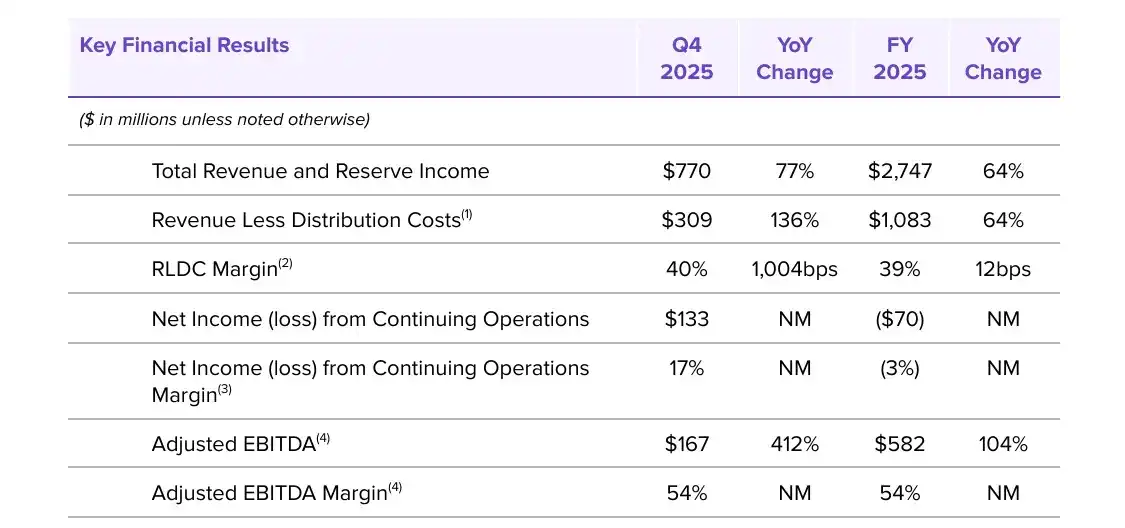
The report shows that the company's total revenue and reserve income for the fourth quarter reached $770 million, a year-on-year increase of 77%, exceeding market expectations.

Driven by this, CRCL stock price rose over 35% at Wednesday's close.
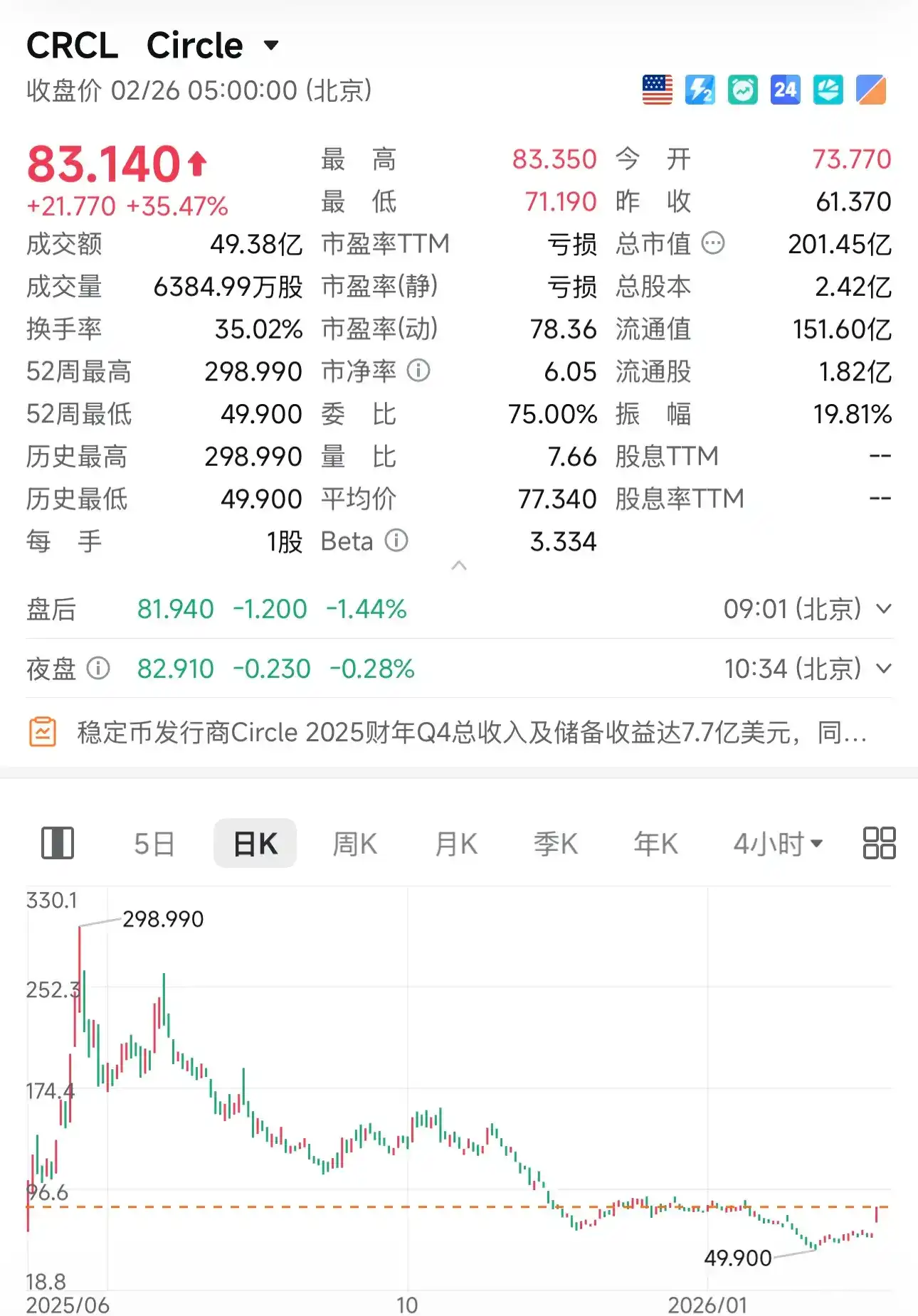

Specifically, the growth of its stablecoin USDC was the core highlight of this earnings report. As of year-end, the circulation of USDC reached $75.3 billion, a year-on-year increase of 72%.

Meanwhile, network activity showed explosive growth, with on-chain transaction volume in the fourth quarter reaching $11.9 trillion, a year-on-year increase of 247%.


In terms of revenue composition, reserve income remains the company's main revenue pillar, contributing $733 million in Q4, a year-on-year increase of 69%.

Although market yields decreased by 68 basis points during the period, this pressure was offset by the significant expansion of USDC's average circulation scale.

At the same time, non-interest income reached $37 million, mainly due to the steady accumulation of subscription services and transaction fees.

Looking at the full-year performance, the company's total revenue and reserve income was $2.7 billion, a year-on-year increase of 64%.

Although continuing operations recorded a net loss of $70 million, this was mainly affected by the one-time inclusion of $424 million in stock-based compensation expenses during the IPO process.

As this expense is non-cash in nature, the company's core business is profitable after exclusion. Adjusted EBITDA reached $582 million, doubling year-on-year, showing that operating leverage is gradually emerging.
极

In terms of strategic layout, Circle is gradually transforming from a pure stablecoin issuer to an internet financial infrastructure provider, strengthening its underlying position in the real-time transaction field through various technological initiatives.

The report shows that the Arc public blockchain testnet is running stably, with transaction finality time shortened to about half a second, and total transactions have exceeded 166 million. The mainnet is expected to be officially launched within the year.

In terms of the payment network, the ecosystem of the Circle Payments Network continues to expand. Currently, 55 financial institutions have officially joined, with another 74 in the qualification review stage. The annualized transaction volume over the past 30 days has reached $5.7 billion.

It is worth mentioning that the strategic cooperation with Polymarket further highlights the value of USDC in emerging fields. As one of the world's largest prediction market platforms, Polymarket will gradually switch all betting and settlement to native USDC.

This cooperation not only eliminates bridging risks and improves capital efficiency but also directly converts the user growth of the prediction market into long-term increments in USDC circulation and transaction volume.

In addition, Circle is also gradually penetrating the traditional financial ecosystem. The company has not only achieved all-day settlement cooperation with Visa but also broadened application scenarios through platform integration with Intuit.

At the regulatory compliance level, the company received conditional approval from the U.S. Office of the Comptroller of the Currency to establish a national trust bank in December 2025, and further consolidated its first-mover advantage in compliance under the GENIUS Act framework.

The secondary market has given a relatively positive response. Technically, before the earnings release, the company's stock price had rebounded from its low and stabilized above the 7-day and 30-day moving averages.

On the institutional side, ARK Invest, under Cathie Wood, increased its holdings of Circle stock multiple times during market corrections. The latest holdings are about 4.14 million shares, worth approximately $261 million.

Mizuho Securities upgraded CRCL's rating from underweight to neutral at the end of January, setting a target price of $77. The institution believes that the growth of Polymarket will directly drive the expansion of USDC scale and revenue.

However, Circle still needs to deal with potential headwinds in the future.

On the one hand, the downward trend in interest rates may continue to put pressure on reserve income, which has been reflected in the decline in yield in the fourth quarter.

On the other hand, the stablecoin competitive landscape is changing. The USAT stablecoin, launched by Tether and issued by Anchorage Digital, is targeting the U.S. institutional market and is regarded as the first substantive compliant competitor for USDC domestically. This competition may lead to some diversion in the compliant institutional share.

In addition, overall cryptocurrency market volatility and macro cycles will still create uncertainty for circulation growth. According to Coinglass data, the current total stablecoin market capitalization is about $264 billion, with USDC accounting for about 28.5%. Although USDC leads the industry in growth rate, Tether still dominates.


Worthy of special attention from investors is Circle management's expectations and execution plans for the future. The company provided clear guidance for the 2026 fiscal year:

  • USDC circulation targets a compound annual growth rate of 40% over a multi-year cycle;
  • Other income (subscription, service, and transaction fees) is expected to be $150 to $170 million;
  • RLDC margin (revenue minus distribution and transaction cost margin) remains in the high range of 38% to 40%;
  • Adjusted operating expenses are expected to be $570 to $585 million.

These guidelines also reflect management's confidence in continued scale expansion, cost control, and accelerated growth in non-interest income.

Furthermore, Circle CEO Jeremy Allaire repeatedly mentioned AI agents and their payment needs during the earnings call.

He said, we are about to enter a world where there may be billions or even hundreds of billions of AI agents interacting on the internet and performing economic functions.

These AI agents need programmable digital dollars and open infrastructure to enable autonomous transactions, and Circle's products are built for this.

Specifically, Circle is heavily investing in agent-based payment infrastructure.

Currently, Circle Gateway has entered the test network phase, supporting AI agents to autonomously initiate cross-chain USDC transactions, with a single transaction cost as low as $0.00001 (extremely low fees, suitable for micro-payments and high-frequency machine-to-machine transactions).

It was also mentioned in the meeting that currently about 99% of agent-based payments use USDC, thanks to Circle's cross-chain deployment and participation in agent payment standards (such as the x402 standard, in cooperation with Google etc.).

Overall, this earnings report validates Circle's strategic execution capability in a complex regulatory environment, and the new story of AI+ payments has expanded the company's valuation imagination space. Despite facing yield fluctuations and emerging competitive challenges, Circle continues to exert efforts on the track of "financial infrastructure-ization" and "compliant expansion".


Câu hỏi Liên quan

QWhat was the percentage increase in Circle's total revenue and reserve income in Q4 2025, and what was the exact figure?

ACircle's total revenue and reserve income increased by 77% in Q4 2025, reaching $770 million.

QBy what percentage did the circulating supply of USDC grow year-over-year, and what was its total value at the end of the period?

AThe circulating supply of USDC grew by 72% year-over-year, reaching a total value of $75.3 billion.

QWhat was the main reason for Circle's net loss from continuing operations, and what was the adjusted EBITDA figure that showed core profitability?

AThe net loss was primarily due to a one-time, non-cash stock-based compensation expense of $424 million related to its public listing. The adjusted EBITDA, which excludes this, was $582 million, showing core profitability.

QName one new significant competitor for USDC in the U.S. institutional market mentioned in the article and which company is behind it.

AA new significant competitor is the USAT stablecoin, which is issued by Anchorage Digital and backed by Tether, targeting the U.S. institutional market.

QWhat future technology trend did CEO Jeremy Allaire highlight as a major growth driver for USDC, and what specific infrastructure is Circle building for it?

ACEO Jeremy Allaire highlighted AI agents and their payment needs as a major future growth driver. Circle is building 'agentic payment infrastructure,' including the Circle Gateway currently in testnet, to support autonomous, low-cost USDC transactions for AI.

Nội dung Liên quan

Thị trường chứng khoán Mỹ hứng chịu đợt lao dốc tồi tệ nhất từ năm 2025, ba ngòi nổ kích hoạt đánh giá lại định giá cổ phiếu công nghệ

Ngày 5/6, thị trường chứng khoán Mỹ trải qua một ngày sụt giảm mạnh nhất kể từ sau cuộc khủng hoảng thuế quan tháng 4/2025. Chỉ số Nasdaq Composite lao dốc 4,18%, S&P 500 giảm 2,64% và Dow Jones mất 695 điểm. Sự đảo chiều đột ngột này chỉ sau 48 giờ được thúc đẩy bởi ba yếu tố chính. **Thứ nhất: Báo cáo tài chính của Broadcom làm rạn nứt câu chuyện AI.** Dù doanh thu chip AI của Broadcom tăng 143%, nhưng dự báo cho quý tới thấp hơn kỳ vọng, làm dấy lên lo ngại tốc độ tăng trưởng AI có thể đang chậm lại. Điều này kích hoạt đợt bán tháo trên toàn ngành bán dẫn. **Thứ hai: Dữ liệu việc làm Mỹ quá mạnh.** Báo cáo phi nông nghiệp tháng 5 cho thấy 172.000 việc làm mới, gấp đôi dự báo, củng cố kỳ vọng Cục Dự trữ Liên bang (Fed) có thể không giảm lãi suất mà thậm chí còn tăng. Kỳ vọng lãi suất cao hơn gây áp lực lên định giá cổ phiếu công nghệ. **Thứ ba: Bóng ma lạm phát từ cuộc chiến Iran.** Giá dầu duy trì trên 90 USD/thùng do tình hình căng thẳng leo thang từ tháng 2 tiếp tục đè nặng lên áp lực lạm phát, khiến công cụ chính sách của Fed trở nên phức tạp hơn. Ba yếu tố trên cùng lúc làm suy yếu niềm tin vào các câu chuyện thị trường then chốt: tăng trưởng AI vô hạn, Fed sắp cắt giảm lãi suất và lạm phát đã được kiểm soát. Sự sụt giảm nhanh chóng lan rộng sang thị trường toàn cầu. Đây có thể là một đợt điều chỉnh định giá lại đối với các cổ phiược được định giá quá cao, chứ chưa hẳn là sự kết thúc của câu chuyện AI. Hướng đi tiếp theo của thị trường sẽ phụ thuộc vào cuộc họp sắp tới của Fed, các báo cáo tài chính từ các công ty AI khác và diễn biến tình hình địa chính trị.

marsbit1 giờ trước

Thị trường chứng khoán Mỹ hứng chịu đợt lao dốc tồi tệ nhất từ năm 2025, ba ngòi nổ kích hoạt đánh giá lại định giá cổ phiếu công nghệ

marsbit1 giờ trước

Từ Madison Square Garden đến Kalshi: Thị trường dự đoán xông vào Chung kết NBA

Bài viết đề cập đến sự xuất hiện ngày càng phổ biến của các thị trường dự đoán (prediction markets) trong loạt trận chung kết NBA 2026 giữa New York Knicks và San Antonio Spurs, đặc biệt là ở thành phố New York. Hai nền tảng chính được nhắc đến là Polymarket và Kalshi, với khối lượng giao dịch hàng trăm triệu USD xoay quanh kết quả chung kết và các sự kiện liên quan. Điểm nổi bật là sự thâm nhập của các thị trường này vào đời sống thực tế. Họ đã hợp tác chính thức với nhà thi đấu Madison Square Garden, mang lại sự tiếp cận rộng rãi. Một quán bar tên The Jeffrey đã sử dụng hợp đồng trên Kalshi để bảo hiểm cho chương trình khuyến mãi "miễn phí hóa đơn nếu Knicks thắng", minh họa cách các doanh nghiệp nhỏ có thể dùng công cụ này để quản lý rủi ro. Bài viết so sánh thị trường dự đoán với cá cược thể thao truyền thống. Chúng cho phép người tham gia đặt cược vào nhiều sự kiện giải trí đa dạng hơn (như sự xuất hiện của người nổi tiếng), có phạm vi tiếp cận địa lý rộng hơn và độ tuổi tham gia thấp hơn (từ 18 tuổi). Tuy nhiên, điều này cũng gây tranh cãi về ranh giới giữa giao dịch tài chính và cờ bạc. NBA có thái độ thận trọng. Trong khi siêu sao như "Giannis Antetokounmpo" đã đầu tư vào Kalshi, gây lo ngại về xung đột lợi ích, thì ban lãnh đạo NBA lại nhấn mạnh sự cần thiết của khung quy định chặt chẽ để bảo vệ tính toàn vẹn của trận đấu. Nhiều cổ động viên bày tỏ lo ngại rằng sự liên kết sâu rộng giữa liên đoàn với các nền tảng này có thể làm suy giảm độ tin cậy của các trận đấu. Chung kết NBA năm nay đang trở thành một phép thử quan trọng cho sự hội nhập của thị trường dự đoán vào thể thao chính thống, vừa mở ra cơ hội thương mại mới, vừa đặt ra những thách thức về niềm tin và quản lý.

marsbit3 giờ trước

Từ Madison Square Garden đến Kalshi: Thị trường dự đoán xông vào Chung kết NBA

marsbit3 giờ trước

RSI - Khi AI tự xây dựng chính mình đang nổi lên, Google dội nước lạnh, DeepSeek đã chạm đến mép giới hạn

Gần đây, thuật ngữ "RSI" (Recursive Self-Improvement – Tự cải tiến đệ quy) đang trở thành tâm điểm chú ý trong ngành AI. Khái niệm này đề cập đến việc để AI tự huấn luyện và cải thiện chính mình, hướng tới một hệ thống có thể tự động hóa toàn bộ quá trình nghiên cứu và phát triển, từ đó tạo ra sự tiến bộ vượt bậc. Một số công ty khởi nghiệp như Recursive Superintelligence và dự án Auto-Research của Andrej Karpathy đang tích cực theo đuổi hướng đi này. Tuy nhiên, CEO Google Sundar Pichai tỏ ra thận trọng, cho rằng ngành công nghiệp vẫn chưa đạt đến cột mốc tăng tốc đột biến mà RSI hứa hẹn. Trong khi đó, các công ty AI Trung Quốc như DeepSeek và Baidu mặc dù ít công khai nhắc đến RSI, nhưng trên thực tế đã áp dụng các nguyên lý tương tự – như tối ưu hóa thuật toán cực độ hay sử dụng vòng lặp phản hồi tự động – để cải thiện mô hình của họ một cách hiệu quả. Dù vậy, RSI vẫn đối mặt với nhiều thách thức lớn: hiện tượng "sụp đổ mô hình" khi dữ liệu do AI tạo ra bị suy giảm chất lượng qua mỗi vòng lặp, yêu cầu về nguồn lực tính toán khổng lồ, và môi trường nghiên cứu toàn cầu đang ngày càng bị phân mảnh. Về cơ bản, RSI đại diện cho xu hướng tự động hóa ngày càng sâu trong phát triển AI, dần đẩy con người ra khỏi chuỗi quyết định trực tiếp. Đây là một quá trình có thể mang lại bước nhảy vọt về công nghệ, nhưng cũng tiềm ẩn rủi ro và sự thay đổi khó lường.

marsbit3 giờ trước

RSI - Khi AI tự xây dựng chính mình đang nổi lên, Google dội nước lạnh, DeepSeek đã chạm đến mép giới hạn

marsbit3 giờ trước

Anthropic cảnh báo toàn cầu, OpenAI đã vượt qua 'ngưỡng tin cậy': AI tự kích hoạt tăng tốc

Cộng đồng AI đang chấn động bởi cảnh báo từ Anthropic: nghiên cứu AI cần dừng lại! Hãng này lo ngại AI đang tiến gần đến điểm "tự tạo ra chính mình", với quá trình tự cải tiến đệ quy diễn ra nhanh hơn dự kiến. Đồng thời, Yann Dubois của OpenAI chia sẻ một quan điểm then chốt: sự phát triển của AI là liên tục, nhưng người dùng cảm nhận một bước nhảy vọt khi nó vượt qua "ngưỡng độ tin cậy". OpenAI đã đạt được ngưỡng này vào khoảng tháng 12 năm ngoái. Khi AI đủ tin cậy, nó từ một "thực tập sinh" trở thành một "nhân viên" thực thụ và bắt đầu tự gia tốc, đặc biệt trong việc hỗ trợ lập trình, tạo ra một vòng lặp phát triển ngày càng nhanh. Dubois nhấn mạnh việc xây dựng AI giống "nghề thủ công" hơn là khoa học thuần túy, dựa nhiều vào thử nghiệm và trực giác. Ông cũng đưa ra một tuyên bố gây chú ý: nếu đóng băng các mô hình hiện tại và chỉ tập trung vào hệ thống điều phối (Harness) cho các lĩnh vực chuyên sâu, chúng ta có thể đã đạt được cảm giác của AGI (Trí tuệ nhân tạo phổ quát). Rào cản thực sự không nằm ở bộ não mô hình, mà ở "quyền truy cập, kết nối và dữ liệu" – công việc khó khăn của "chặng đường cuối cùng" để đưa AI vào thực tế. Tuy vậy, một thách thức lớn vẫn tồn tại: khả năng học liên tục (continual learning). Hiện tại, AI thường đạt hiệu suất cao ban đầu nhưng sau đó không cải thiện nhiều trong môi trường cụ thể. Giải quyết vấn đề này là chìa khóa quan trọng cho tương lai. Dubois kết luận rằng vẫn có không gian rộng lớn cho các công ty khởi nghiệp trong việc tạo ra các ứng dụng chuyên sâu, tập trung vào tích hợp và giải quyết các vấn đề thực tế.

marsbit3 giờ trước

Anthropic cảnh báo toàn cầu, OpenAI đã vượt qua 'ngưỡng tin cậy': AI tự kích hoạt tăng tốc

marsbit3 giờ trước

FBI Đàn Áp Các Nghi Phạm Quyên Góp Tiền Mã Hóa Cho ISIS, 3 Công Dân Mỹ Bị Bắt

Các cơ quan liên bang Hoa Kỳ đã bắt giữ ba công dân Mỹ với cáo buộc âm mưu hỗ trợ vật chất cho tổ chức khủng bố ISIS. Những người này, được xác định là Bisaam Ghafoor (21 tuổi), Elias Shamsaldeen (21 tuổi) và Bereen Dzayee (25 tuổi), bị bắt tại Kansas và California sau một cuộc điều tra kéo dài. Theo Bộ Tư pháp, từ đầu năm 2025 đến giữa năm 2026, các nghi phạm đã sử dụng các nền tảng như Discord và ứng dụng mã hóa để thảo luận việc tuyên thệ trung thành với ISIS, lên kế hoạch tấn công binh sĩ Mỹ ở nước ngoài, và bàn về việc ra nước ngoài để chiến đấu. Họ bị cáo buộc đã chuyển hơn 2.000 đô la bằng tiền mã hóa và tiền mặt cho một cá nhân được cho là có liên hệ với ISIS, nhằm mua vũ khí như máy bay không người lái và súng chống tăng RPG. Một chi tiết đáng chú ý là họ đã thảo luận việc khắc tên của Ghafoor lên một máy bay không người lái. Các tài liệu tòa án cũng đề cập đến các cuộc thảo luận về hành vi bạo lực cụ thể, chẳng hạn như đâm một quân nhân Mỹ. Giới chức cho biết hành động phối hợp của FBI và nhóm an ninh quốc gia đã ngăn chặn âm mưu này trước khi có bất kỳ thương vong nào xảy ra.

bitcoinist4 giờ trước

FBI Đàn Áp Các Nghi Phạm Quyên Góp Tiền Mã Hóa Cho ISIS, 3 Công Dân Mỹ Bị Bắt

bitcoinist4 giờ trước

Giao dịch

Giao ngay
Hợp đồng Tương lai
活动图片