This weekly report covers the period from January 31, 2026, to February 1, 2026.
This week, the total on-chain RWA market capitalization continued to grow rapidly, reaching $24.4 billion, while the number of holders surged to 833,900, indicating a shift in growth drivers towards user base expansion. In contrast, the total stablecoin market capitalization slightly decreased, yet monthly transfer volume soared to $9.82 trillion, with the turnover rate climbing to 32.7 times. This "high turnover, low growth" pattern highlights intensified idle circulation of existing funds, showing that capital is not effectively fueling ecosystem expansion.
Regulatory developments continued to refine but disagreements persist: The White House meeting did not reach an agreement on stablecoin yield issues; the Hong Kong Monetary Authority is evaluating the first batch of license applications and aims to issue licenses by March; UK experts raised doubts about the monetary potential of stablecoins; Brazil is advancing a ban on algorithmic stablecoins.
Traditional financial institutions and ecosystem development are accelerating integration: CME is exploring the launch of its own token and partnering with Google to pilot tokenized cash; Fidelity's stablecoin FIDD officially launched; Spain's BBVA bank joined the EU stablecoin project; MetaMask integrated with Ondo to allow users to directly trade tokenized U.S. stocks and ETFs.
Meanwhile, payment and financing scenarios continue to penetrate: Y Combinator allows entrepreneurs to receive funding in stablecoins; OSL Global launched a stablecoin trading hub.
Overall, the RWA sector is moving towards scale driven by user growth, while stablecoins, amid regulatory debates and institutional participation, present a complex landscape of deepening application scenarios coexisting with inefficient capital circulation.
Data Overview
RWA Sector Overview
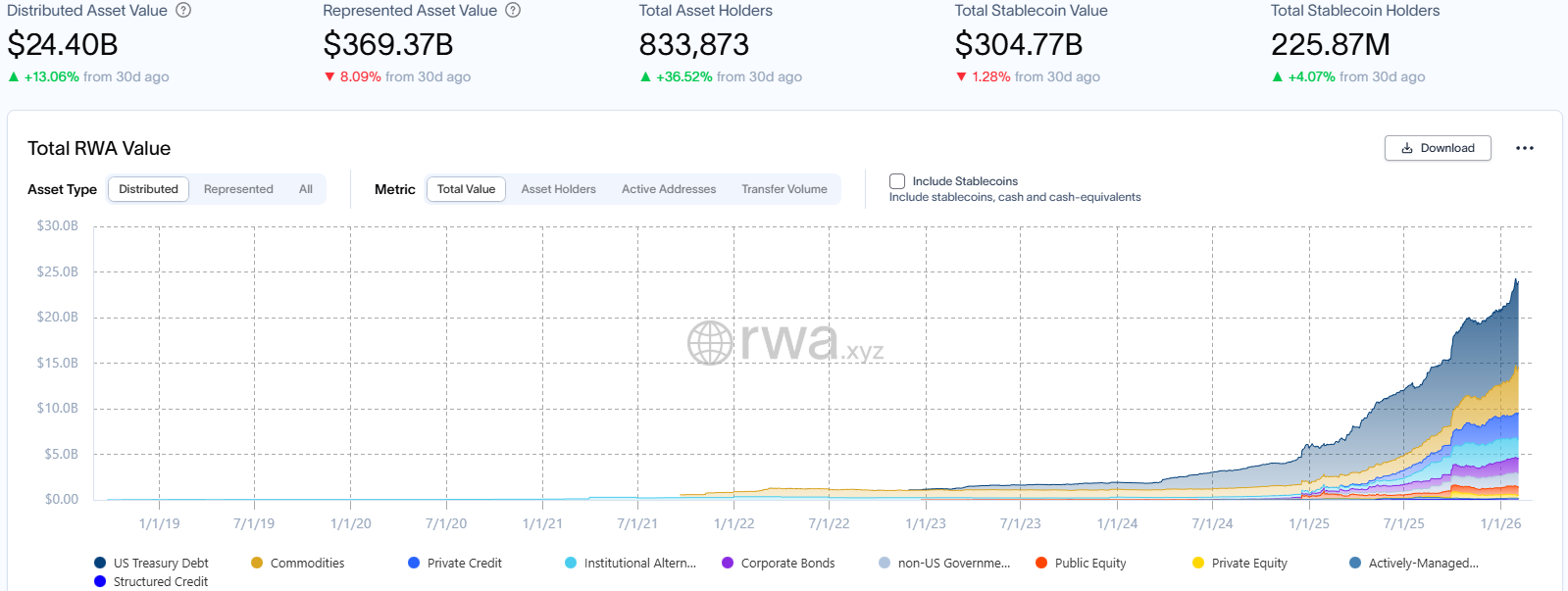
Latest data from RWA.xyz reveals that as of February 6, 2026, the total on-chain RWA market capitalization reached $24.4 billion, up 13.06% month-on-month, maintaining rapid growth. The total number of asset holders increased to approximately 833,900, a significant 36.52% rise month-on-month, indicating that market growth is now driven more by user base expansion than capital scale growth.
Stablecoin Market
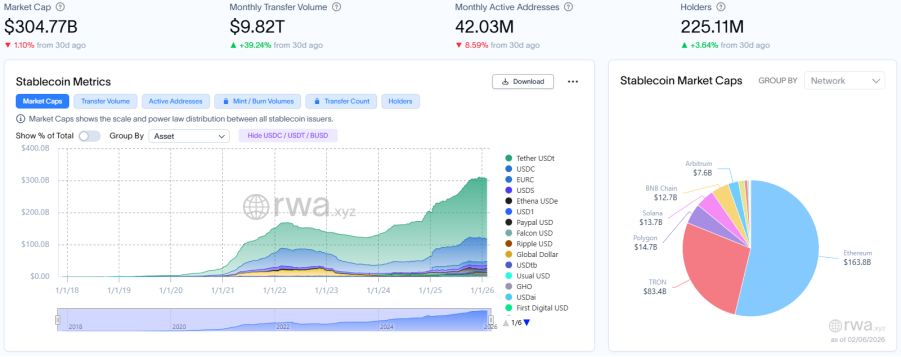
The total stablecoin market capitalization decreased to $3,047.7 billion, down 1.1% month-on-month, continuing a contraction trend. Monthly transfer volume surged to $9.82 trillion, a sharp 39.24% increase month-on-month, with the存量资金周转率 (transfer volume/market capitalization) rising to 32.7 times.
The total number of monthly active addresses significantly dropped to 42.03 million, down 8.59% month-on-month, while the total number of holders steadily increased to 225 million, up 3.64% month-on-month.
The data indicates that the continued contraction in market capitalization reflects an overall liquidity shrinkage, while high transfer volume relies on frequent trading turnover.
The top stablecoins are USDT, USDC, and EURC. Among them, USDT's market capitalization slightly decreased by 0.51% month-on-month; USDC's market capitalization fell by 6.85% month-on-month; EURC's market capitalization slightly increased by 1.24% month-on-month, overtaking USDS to become the third-largest stablecoin.
Regulatory News
White House Meeting Fails to Reach Agreement on Stablecoin Yield Issues, Divergence Between Crypto Industry and Banks Remains
The White House convened representatives from the crypto industry and Wall Street banks to discuss the Senate's crypto market structure bill, but the two sides failed to reach an agreement on clauses related to stablecoin yields. The meeting was chaired by President Trump's crypto advisor, Patrick Witt, aiming to advance the legislative process of the bill.
The discussion primarily revolved around whether stablecoins should be linked to yields and rewards. Although crypto industry representatives expressed optimism about the meeting's progress, bank representatives did not propose specific compromise solutions. The White House has requested all sides to achieve substantive progress on technical clauses within this month to push the bill through the Senate Banking Committee.
Banking representatives stated that any legislation must ensure support for loans to local households and small businesses while safeguarding the safety and soundness of the financial system. Crypto industry representatives emphasized that legislation should not punish innovators and consumers who view digital assets as the future foundation of finance.
Currently, the bill has passed the House of Representatives and the Senate Agriculture Committee. Next, it needs to pass the Senate Banking Committee but still faces obstacles in multi-party negotiations among Republicans, Democrats, the crypto industry, banks, and the White House, including issues like stablecoin yields, anti-corruption clauses, and protections against illicit finance.
HKMA Chief: Evaluating 36 Stablecoin License Applications, Aiming to Issue First Batch of Licenses by March
According to Ta Kung Pao, Hong Kong Monetary Authority (HKMA) Chief Executive Eddie Yue stated that Hong Kong's "Stablecoin Ordinance" officially took effect on August 1 last year. The first round received 36 stablecoin license applications from institutions, which are currently under continuous assessment. He hopes to make decisions as soon as possible and aims to issue the first batch of licenses by March.
Yue mentioned that additional information has been requested from some applicants. Since the first-round submissions were mostly basic information required for licensing, after review, follow-up questions on key elements such as specific application scenarios, risk management measures, and the composition of reserve assets are still necessary. If all required information is received, the first batch of licenses will be issued by March. The number of licenses in the first batch will certainly be small, with prudence and stability as the goal.
Brazilian Congressional Committee Advances Bill to Ban Algorithmic Stablecoins
According to CoinDesk, the Brazilian Congress's Committee on Science, Technology, and Innovation has approved a bill report aimed at prohibiting algorithmic stablecoins. The bill would ban the issuance or trading of stablecoins like Ethena's USDe and Frax, which maintain value through algorithms rather than full collateral assets, requiring all stablecoins issued in Brazil to be fully backed by segregated reserve assets.
The bill also increases transparency requirements and classifies the issuance of unbacked stablecoins as a new criminal offense, with violators facing up to eight years in prison. For stablecoins issued overseas (such as USDT and USDC), the new rules stipulate that only companies approved to operate in Brazil can provide such assets, and exchanges are responsible for confirming that their issuers comply with regulatory standards similar to Brazil's; otherwise, they must bear the relevant risk management responsibilities. The bill still needs to be reviewed by the Brazilian Finance and Taxation Committee and the Constitution, Justice, and Citizenship Committee before being submitted to the Senate to become formal law.
Project Developments
Manta Network Partners with Pruv Finance to Launch Tokenized Sports Infrastructure RWA
Manta Network announced a partnership with Indonesian compliant RWA infrastructure provider Pruv Finance to bring real-world asset investment opportunities onto the chain. Their first product, Garuda Sports Fund ($GSP), focuses on investing in Indonesian padel courts and sports fitness facilities, with an annual recurring APY of about 30%. The asset will be introduced to Manta Pacific via a cross-chain bridge, with plans to open token subscriptions to the community in the future, providing ordinary investors with opportunities to participate in yield-generating RWA investments.
Multiliquid and Metalayer Launch Instant Redemption Guarantee Mechanism for RWA on Solana
According to Cointelegraph, liquidity protocol Multiliquid and investment institution Metalayer Ventures have collaborated to launch an institutional liquidity support tool on Solana, providing instant redemption services for tokenized real-world assets. This facility allows holders to instantly convert tokenized asset positions into stablecoins, aiming to solve the long-standing liquidity bottleneck in on-chain markets. The tool will act as a standing buyer for tokenized RWA, purchasing assets at dynamic discount prices. The initial phase will support tokenized treasury funds and some alternative investment products issued by institutions including VanEck, Janus Henderson, and Fasanara.
MetaMask Integrates with Ondo Finance to Support Trading of Tokenized U.S. Stocks, ETFs, and Commodities
According to an official announcement, Consensys' non-custodial wallet MetaMask has completed integration with tokenized real asset platform Ondo Finance. Through this collaboration, eligible non-U.S. mobile users can now directly purchase, hold, and trade over 200 tokenized U.S. stocks, ETFs, and commodities within the MetaMask wallet via Ondo Global Markets.
The first batch of supported assets includes stocks like Tesla, Nvidia, Apple, Microsoft, and Amazon, as well as ETFs like SLV (silver), IAU (gold), and QQQ. Users do not need to open traditional retail brokerage accounts; all transactions are conducted via crypto channels. Users can use the MetaMask Swaps function on the Ethereum mainnet to exchange USDC for Ondo's Global Markets tokens (GM tokens), which are designed to track the market value of their underlying securities. Trading hours are from Sunday 20:05 to Friday 19:59 EST, supporting 24/7 trading five days a week, and tokens can be transferred around the clock.
Ondo Finance Launches "Global Listing" Service, Enabling Tokenization of Stocks on IPO Day
Tokenized real asset platform Ondo Finance announced the launch of the "Ondo Global Listing" service, which can introduce U.S. stocks to the chain in near real-time simultaneously with their IPO listing. Through the Ondo Global Markets platform, these stocks will be available for trading on major blockchains from the first day of listing.
Ondo stated that historically, millions of global investors have been restricted from participating in U.S. IPOs. This new service will enable wallets, exchanges, and blockchains to provide their global millions of users with on-chain IPO exposure from the listing day. These tokenized stocks are permissionless, transferable, and designed to achieve stablecoin-like composability in the most widely used blockchain ecosystems.
CME Group Explores Launching "CME Coin," Partners with Google to Pilot Tokenized Cash
According to CME Group CEO Terry Duffy's remarks in the company's latest earnings call, the company is exploring the launch of its own cryptocurrency, "CME Coin," and plans to deploy it on a decentralized network for use by industry participants. This is the first time CME has explicitly mentioned the possibility of issuing its own token.
Duffy stated that this plan is part of CME's exploration in the tokenized collateral field. The company is also partnering with Google to develop a "tokenized cash" solution, expected to launch later this year. This solution will involve banks as custodians to facilitate transactions.
Currently, CME has not clarified whether "CME Coin" will be used as a stablecoin, settlement token, or for other purposes. Duffy added that market trust in it might be higher compared to tokens issued by systemically important financial institutions.
Additionally, CME plans to launch 24/7 trading for cryptocurrency futures in the second quarter of this year and add futures contracts for Cardano, Chainlink, and Stellar. In 2025, CME's average daily cryptocurrency trading volume reached $12 billion, with micro Ethereum and Bitcoin futures performing particularly well.
Ethereum Treasury Company ETHZilla Shifts to Real Estate Tokenization, Completes $4.7 Million Housing Loan Deal
According to CoinDesk, Ethereum treasury company ETHZilla is deepening its tokenization strategy by acquiring a portfolio of prefabricated and modular housing loans worth $4.7 million. The company plans to tokenize these 95 loans on an Ethereum Layer 2 network, turning them into yield-generating digital assets tradable through regulated broker-dealer Liquidity.io. These loans, secured by first-lien mortgages, are expected to yield an annualized return of about 10%. This move marks the company's shift from its core cryptocurrency holdings to a broader tokenized asset strategy.
SBI Holdings and Startale Group Collaborate to Launch Strium Blockchain, Focused On-Chain Securities Market
Japanese financial giant SBI Holdings, in collaboration with blockchain R&D company Startale Group (the team behind Sony's Layer 2), has co-developed a Layer 1 blockchain network named Strium. This network is specifically designed to support on-chain securities trading, aiming to become the "foundational trading layer" for Asia's on-chain securities market, offering 24/7 trading capability and DeFi composability.
Previously, SBI and Startale announced in August 2025 their collaboration to develop a yen-based stablecoin and RWA trading platform, targeting cross-border instant settlement, fractional ownership, and compliant on-chain trading. The proof-of-concept for Strium was released today, demonstrating key technical capabilities such as settlement efficiency, resilience under high load, and interoperability with traditional financial systems and blockchain networks.
Additionally, Startale recently received a $13 million investment from Sony to develop the Ethereum Layer 2 project Soneium and operates Japan's largest public chain, Astar Network. SBI Holdings has increased its investment in the crypto space, including investing in Circle's IPO and developing crypto ETFs potentially listed on the Tokyo Stock Exchange.
Tether Invests $150 Million to Acquire 12% Stake in Gold.com to Expand Gold Token XAUT Issuance
According to CoinDesk, Tether has invested $150 million to acquire a minority stake in Gold.com (GOLD), holding 12% of the company. This further deepens its布局 in the gold market. Gold.com is a platform offering physical gold and tokenized gold trading. As part of the collaboration, Tether will integrate its gold-backed token XAUT into Gold.com's infrastructure.
Amboss Launches Lightning Network-Based P2P Platform RailsX for Bitcoin and Stablecoin Trading
According to The Block, Amboss Technologies has launched a P2P trading platform based on the Lightning Network called RailsX. This is a peer-to-peer trading platform built on native FPGA for Bitcoin and stablecoin transactions. RailsX enables cross-asset atomic swaps through circular self-payments on Lightning Network channels, allowing Bitcoin and stablecoin holders to trade directly while retaining custody. Additionally, Rails partners with Magnolia and Bringin to connect with traditional banking systems in the U.S. and Europe for fiat currency exchange.
Fidelity's Stablecoin FIDD Officially Launches, Open to Retail and Institutional Investors
According to The Block, Fidelity Investments' dollar stablecoin, Fidelity Digital Dollar (FIDD), has officially launched and is open to retail and institutional investors. The stablecoin is issued by the Fidelity Digital Assets Association on Ethereum. Users can subscribe or redeem directly at $1 through Fidelity Digital Assets, Fidelity Crypto, and Fidelity Crypto Services for wealth management platforms.
Spanish Bank BBVA Joins EU Bank Stablecoin Project Qivalis
According to CoinDesk, Spain's second-largest bank, BBVA, has announced its加入由欧盟多家银行组成联盟Qivalis. This alliance aims to launch a regulated euro stablecoin to challenge the dominance of dollar stablecoins. Qivalis has now gathered 12 major EU banks, including BNP Paribas, ING, and UniCredit. Qivalis plans to apply for an electronic money institution authorization from the Dutch central bank under the EU's Markets in Crypto-Assets (MiCA) regulatory framework and aims to launch its euro stablecoin in the second half of 2026.
Y Combinator to Allow Spring Batch Entrepreneurs to Receive Funding in Stablecoins
According to Fortune magazine, Silicon Valley's renowned startup incubator Y Combinator has announced that founders of startups in its Spring 2026 batch can choose to receive funding in the stablecoin USDC, typically around $500,000. Nemil Dalal, Crypto Visiting Partner at Y Combinator, stated that founders choosing stablecoins can receive tokens on multiple blockchains like Ethereum and Solana, with potential expansion to other stablecoins based on demand. He noted that stablecoins are a key area where the institution hopes to see more startup ideas, hence the desire to practice this direction firsthand.
Dalal mentioned that Y Combinator looks forward to more startups raising funds on-chain in the future. He believes that despite the current低迷 sentiment in the crypto market, enthusiasm for stablecoins continues to grow, unrelated to crypto asset price volatility.
Korean Internet Bank KBank Submits 13 Trademark Applications Related to Stablecoin Wallet Services
According to Cryptopolitan, Korean internet bank KBank has submitted 13 trademark applications related to stablecoin wallet services, including names like KSC Wallet and KSTA Wallet, in preparation for its planned listing on the main board of the Korea Exchange (KOSPI) on March 5, 2026. According to information from the Korean Intellectual Property Information Service website, these trademark applications are classified under categories supporting digital currency, cryptocurrency, stablecoin, crypto mining, and NFT-related software. In its registration filing, KBank stated that funds raised from the stock issuance will be used to promote its digital asset business and other blockchain-based initiatives. This is the bank's third attempt at an IPO, with previous plans in 2023 and 2024搁置 due to tough market conditions and valuation issues.
OSL Global Launches StableHub, Offering 1:1 Exchange of Mainstream Stablecoins to USD
Stablecoin trading and payment platform OSL Group announced that its international trading platform, OSL Global, officially launched the stablecoin trading hub StableHub on February 6.
As a compliant stablecoin trading infrastructure for global users, StableHub supports zero-slippage 1:1 exchange between various mainstream stablecoins and the U.S. dollar. It will陆续推出 fee waivers and incentive activities围绕 user assets and usage scenarios. In the first phase, OSL Global partnered with Ripple to launch a deposit reward activity for RLUSD with up to 18% rewards.
Jason Liu, Head of Global Exchange Business at OSL, stated that StableHub is an important part of OSL's strategy to build a global compliant stablecoin ecosystem and advance stablecoin trading and payment. By providing one-stop, low-cost cross-stablecoin exchange and fiat on/off-ramp services, StableHub aims to solve core issues in the current market, such as complex stablecoin exchange processes, high transaction costs, and dispersed liquidity. It offers a more efficient and sustainable path for stablecoin use to institutional investors, DeFi users, and enterprises and individuals needing cross-border payments.
The first batch of stablecoins supported by StableHub includes RLUSD, USDGO, USDC, and USDT. In the future, the platform will continue to expand the variety of supported stablecoins and further improve stablecoin trading and application scenarios under a compliant, secure, and liquid framework.
RWA Trading Platform MSX Lists Spot and Contract Products Across Multiple Sectors
According to official news, MSX simultaneously listed spot products for optical substrate supplier $AXTI.M, as well as spot and contract trading for automatic test equipment manufacturer $TER.M and optical communication device and module leader $LITE.M.
Insights Collection
S&P Predicts: Euro Stablecoin Issuance to Grow 1,600-Fold by 2030, Reaching $1.3 Trillion
According to The Block, S&P Global Ratings predicted in its latest report that the euro stablecoin market size could reach €1.1 trillion (approximately $1.3 trillion) by 2030, a growth of about 1,600 times from the base of €650 million (approximately $767 million) at the end of 2025. Under the baseline scenario, S&P expects the market to reach €570 billion (approximately $672 billion) by 2030, accounting for 2.2% of total bank deposits in the eurozone. The report attributes growth mainly to demand for tokenized asset investments and notes that the EU's Markets in Crypto-Assets Regulation (MiCA) came into effect on January 1, 2025, providing a clear regulatory framework for issuers. S&P believes that stablecoins' application in the real world, compared to their primary use in crypto asset trading currently, will support this rapid growth.
True On-Chain Finance: How to Quantitatively Model the Risks of RWA Assets
PANews Summary: The key to successfully bringing real-world assets (RWA) on-chain and making them truly tradable financial products lies in establishing a rigorous, quantifiable risk pricing and management system, much like traditional finance. Five real cases from different fields in 2024-2025 (such as BlackRock's treasury funds, Dubai real estate, Swiss corporate bonds, etc.) illustrate that the success of RWA projects depends on forming closed loops in several critical areas.
First is risk quantification, requiring precise measurement of asset risks using models like PD (Probability of Default) and LGD (Loss Given Default). Second is structural design: bankruptcy isolation must be achieved through SPVs (Special Purpose Vehicles); stable收益 ensured through clear cash flow distribution sequences (Waterfall); and reasonable credit enhancement measures set to buffer risks. Finally, regulatory compliance: legal structures must be designed according to rules in different jurisdictions (e.g., Hong Kong, Singapore), and technical means (e.g., oracles, on-chain monitoring) used to ensure asset authenticity, transparency, and data auditability.
Only when the technical "on-chaining" is closely integrated with the financial essence of "controllable risks" can RWA truly move from concept to large-scale, sustainable financial practice.
Primitive Ventures: Why Are We Bullish On On-Chain Perpetual U.S. Stocks?
PANews Summary: On-chain perpetual U.S. stock contracts are becoming a key entry point for the crypto market to absorb traditional finance (especially U.S. stock) liquidity. They meet the urgent needs of global traders for 24/7 uninterrupted trading, high leverage, cross-asset unified margin, and integration into DeFi strategies, hence their rapid development.
The logic behind this is similar to "onshore issuance, offshore distribution," where compliant institutions complete the tokenization of underlying stocks, while trading volume and product innovation are led by offshore crypto trading platforms. This allows global users who cannot easily access the U.S. brokerage system to gain exposure to U.S. stocks.
Although the entire tech stack (from infrastructure to trading front-ends) has quickly taken shape and shows the potential to reshape the global asset trading landscape, this trend is facing a critical window of opportunity in a race against time. The biggest threat is not insufficient demand but the possibility that traditional regulators may soon standardize such products and incorporate them into the existing brokerage system, thereby taking away the first-mover advantage.
Therefore, the key to success lies in quickly locking in users, establishing liquidity, and participating in shaping future rules before regulatory rules are clarified. Essentially, on-chain perpetual contracts are not对抗 traditional finance but are rewriting the way global assets are traded and utilized with higher capital efficiency and faster speed.
Tether's "Gold Standard" Ambition: Deconstructing XAUt, How the Stablecoin Giant is Scooping Up Gold?
PANews Summary: Tether (the issuer of USDT) has become one of the largest gold-holding entities globally, owning approximately 140 tons of gold worth $23 billion, with over 70 tons purchased last year, a scale comparable to many national central banks. Its massive "scooping up" is not merely an investment but aims to provide physical reserve backing for its gold stablecoin product, XAUt.
XAUt is a token where each one corresponds to one ounce of physical gold stored in high-standard vaults in Switzerland; holders can even query the serial numbers of the specific gold bars behind them. Tether plans to allocate 10%-15% of its company assets to gold, meaning its gold-buying actions will continue.
This move makes Tether a new force to be reckoned with in the gold market, and its purchasing节奏 even coincides with periods of rising gold prices. Essentially, Tether is leveraging its massive influence and profits in the crypto world to digitize and tokenize the ancient asset of gold, making it easier to分割 and circulate on the blockchain.
However, this also raises new considerations: Does this "digital gold," closely linked to crypto market volatility, inject new vitality into gold, or does it bring additional risks and volatility?







