Publicly Pumping Ethereum, Internally Bearish in Reports: Is Tom Lee's Team Still Trustworthy?

marsbitXuất bản vào 2025-12-23Cập nhật gần nhất vào 2025-12-23

Tóm tắt

Tom Lee, co-founder of Fundstrat and a prominent public Ethereum bull, faces credibility questions after an internal Fundstrat report presented a bearish short-term outlook, contrasting his highly optimistic public statements. Publicly, Lee repeatedly called Ethereum to reach $12,000-$15,000 by end-2025 and declared it "severely undervalued" at $3,000. He has been a vocal "perma-bull" in media appearances. However, Fundstrat's internal 2026 Crypto Outlook report, led by Digital Asset Strategist Sean Farrell, advised paying subscribers to expect a significant market correction in early 2026. Its base case predicted ETH could fall to $1,800-$2,000 and BTC to $60,000-$65,000, citing macroeconomic risks like a potential U.S. government shutdown and Federal Reserve leadership change. The report recommended clients increase cash/stablecoin holdings and wait for better entry points, while maintaining a long-term bullish year-end 2026 target of $4,500 for ETH. Fundstrat responded that the discrepancy stems from different analysts serving different client types: Lee's long-term, structural views are for traditional investors with low (1%-5%) crypto allocations, while Farrell's tactical, short-term risk management is for crypto-heavy portfolios. Critics argue this distinction was never clearly disclosed in Lee's public media appearances, which serve as marketing for Fundstrat's subscription service. Further complicating matters, Lee is also Chairman of BitMine, a company adopting a...

Author| Aki WuShuo Blockchain

If one were to choose the most representative figure for the Ethereum bull narrative in 2025, Tom Lee, Chairman of Ethereum treasury company BitMine and Co-founder & Chief Investment Officer of Fundstrat, would often be placed in the most prominent position. He has repeatedly emphasized in public statements that ETH is undervalued, stating at the Binance Blockchain Week on December 4th that Ethereum at $3,000 was "severely undervalued," and has previously given a high target price judgment of "$15,000 for ETH by the end of 2025." As a Wall Street veteran known as the "Wall Street Soothsayer" and a strategist long active in media and institutional roadshows, Tom Lee's views are often seen as a sentiment barometer by the market.

However, when the market shifts its gaze from the camera to internal institutional documents, the tone reverses: in the latest 2026 outlook strategy advice from Fundstrat, founded by Tom Lee, for its internal subscription clients, a contrary view is presented. Its baseline forecast suggests that crypto assets may experience a significant pullback in the first half of 2026, with an ETH target range of $1800–$2000. This discrepancy between "publicly calling for gains" and "internal bearishness" has also pushed Tom Lee himself and his associated institutions into the spotlight of public opinion.

Core Predictions and Views of Fundstrat's "2026 Crypto Outlook"

The report was issued by Sean Farrell, an analyst at Fundstrat responsible for crypto asset research, currently serving as Head of Digital Asset Strategy, primarily covering strategy research and view output related to the crypto market and blockchain. The report is mainly aimed at its internal subscription-based clients, with a monthly subscription fee of $249.

The report paints a starkly different short-term market expectation for internal clients than the public sentiment, anticipating a significant market correction in the first half of 2026: Bitcoin could fall to $60,000–$65,000, Ethereum to $1,800–$2,000, and Solana to $50–$75, stating that these correction zones would be good opportunities to build long positions. If the market does not experience a deep correction as expected, the team also tends to maintain a defensive strategy, waiting for clear trend strengthening signals before entering the market.
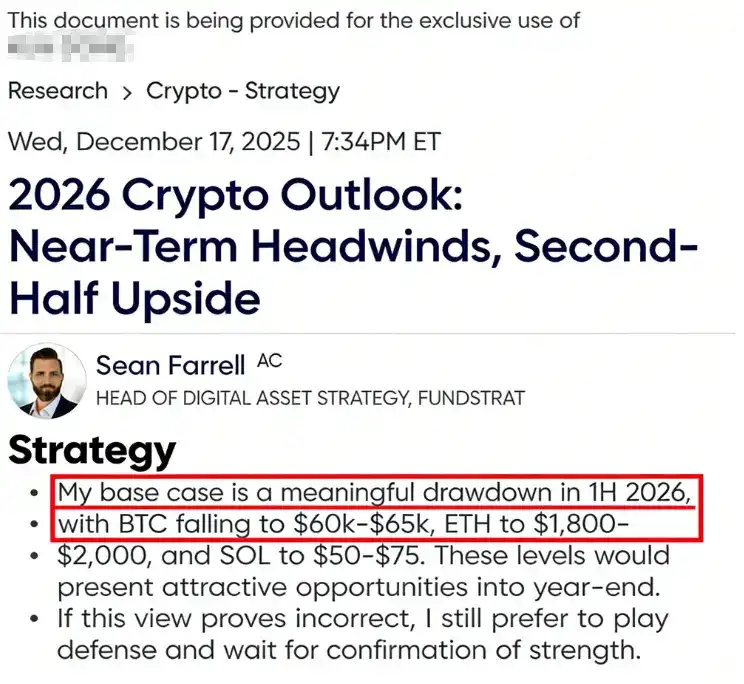
The report explains that the above pessimistic scenario is not a turn towards a long-term bear market but a "strategic reset" risk management measure. Fundstrat points out several short-term headwinds that could suppress the crypto market in early 2026: including a potential US government shutdown, uncertainty in international trade policy, fading confidence in AI investment returns, and policy suspense brought by the Federal Reserve Chair succession, among others.

These macro factors combined with high volatility could trigger a valuation pullback for crypto assets in a tight liquidity environment. Fundstrat emphasizes that this adjustment is a "correction, not a crash," believing that sharp declines are often the prelude to a new round of gains. After digesting risks in the first half of the year, the market is expected to strengthen again in the second half.

The report even gives optimistic targets for the end of 2026: Bitcoin $115,000, Ethereum $4,500, and特别提到以太坊可能在本轮调整中表现出相对强势, the report points out that Ethereum has some structural advantages: after switching to PoS consensus, there is no selling pressure from miners, unlike Bitcoin which has持续抛售的压力 from miners; it also lacks potential selling pressure factors from large holders like MicroStrategy. Furthermore, compared to Bitcoin, Ethereum faces lower concerns about quantum computing threats.

These factors mean that Ethereum may better resist selling pressure in the medium term. It can be seen that the tone of Fundstrat's internal research report is偏向谨慎, although long-term仍然看涨, but short-term it advises internal clients to increase holdings of cash and stablecoins and patiently wait for better entry points.

Tom Lee's Publicly Optimistic Predictions for Ethereum in 2025

In stark contrast to Fundstrat's internal report, its co-founder Tom Lee has played the role of a "super bull" in public场合 throughout 2025,多次发布远超市场实际的 Bitcoin and Ethereum price expectations:

Bullish on Bitcoin early in the year, according to CoinDesk, Tom Lee raised his Bitcoin year-end 2025 target to a high of approximately $250,000 at the beginning of the year. In July-August 2025, as Ethereum prices surged strongly接近历史高位, Tom Lee publicly stated that Ethereum could reach $12,000–$15,000 by the end of 2025, calling it one of the biggest macro investment opportunities for the next 10–15 years.

In August, he further raised the target price on CNBC, stating that Ethereum was entering a key inflection point similar to Bitcoin's in 2017. In 2017, Bitcoin started from less than $1,000 and rose to $12,000 (Note:原文为12万美元,但历史高点是约2万,此处按原文12万翻译,但加注说明历史事实是约2万) driven by the "digital gold" narrative, achieving 120-fold growth. Since the "Genius Act" gave the green light to stablecoins, ushering in a "ChatGPT moment" for the crypto industry, and the core advantage of smart contracts does not apply to Bitcoin, he predicted this is Ethereum's "2017 moment," and a price increase from $3,700 to $30,000 or even higher is not impossible.

Super cycle rhetoric: Entering the autumn行情, Tom Lee依然维持极端乐观立场. In November 2025, he stated in an interview, "We believe ETH is开启类似 2017–2021 年 Bitcoin那样的超级周期",暗示 Ethereum has the potential to replicate Bitcoin's hundred-fold increase trajectory in the coming years.

Dubai Summit speech: At the Binance Blockchain Week in early December 2025, Tom Lee again shocked with bullish shouts, predicting that Bitcoin could soar to $250,000 "within months," and直言当时约 $3,000 的 Ethereum price was "severely undervalued".

He pointed out through historical data comparison that if the ETH/BTC ratio returns to its eight-year average (approx. 0.07), the ETH price could reach $12,000; if it returns to the 2021 relative high (approx. 0.16), then ETH could rise to $22,000; and in an extreme scenario where the ETH/BTC ratio rises to 0.25, theoretically Ethereum's valuation could exceed $60,000.

Short-term new high expectations: Even facing market volatility at the end of the year, Tom Lee did not收敛 his bullish言论. In mid-December 2025, he stated in a CNBC interview that "I don't think this rally is over yet," and bet that Bitcoin and Ethereum will hit new all-time highs before the end of January next year. At that time, Bitcoin had already risen above the 2021 high, while Ethereum was around $3,000, still about 40% away from its historical high of $4,954.

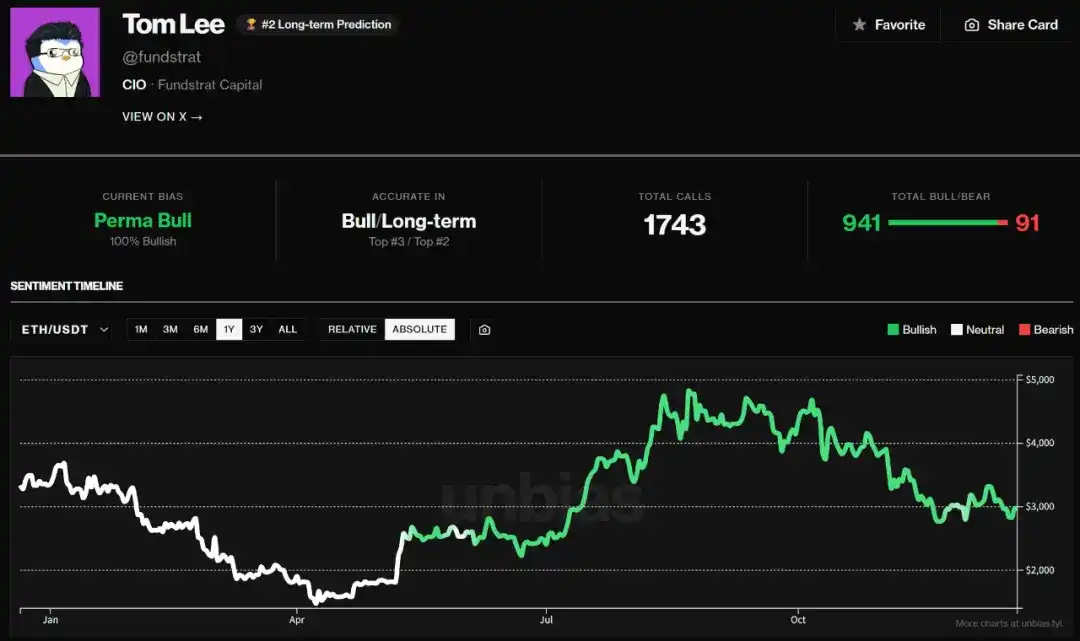
The above list of predictions covers almost most of the time nodes in 2025. On the unbias fyi Fundstrat analysis page, Tom Lee is labeled as a "Perma Bull (长期多头)". Every time he speaks, he gives the market higher target prices and more optimistic time horizons. However, these激进预测 are far from the actual price movements. This series of facts has led the market to question the credibility of the "Wall Street Soothsayer" Tom Lee.
Who is Tom Lee

Thomas Jong Lee, often referred to as Tom Lee, is a well-known US stock market strategist, research director, and financial commentator. He started on Wall Street in the 1990s, working at Kidder Peabody and Salomon Smith Barney, joined J.P. Morgan in 1999 and served as Chief Equity Strategist from 2007.

In 2014, he co-founded the independent research institution Fundstrat Global Advisors and served as Head of Research, transitioning from an investment bank strategist to the head of an independent research institution. He is regarded as one of the较早将 Bitcoin纳入主流估值讨论的 Wall Street strategists. In 2017, he published a report titled "A framework for valuing bitcoin as a substitute for gold,"首次提出 Bitcoin has the potential to partially replace gold as a store of value.

Due to his highly media-oriented research and views, Tom Lee often appears on mainstream financial programs and events as the "Head of Research at Fundstrat" (including CNBC related program/event pages and video content referencing his title). Since 2025, his influence has further extended to the "Ethereum Treasury" narrative: According to Reuters, BitMine, after advancing financing related to Ethereum treasury strategy, added Fundstrat's Thomas Lee to its board of directors to support its Ethereum-oriented treasury strategy. Meanwhile, Fundstrat also continues to release market outlooks and view snippets featuring Tom Lee as the core through its own YouTube channel.

Contradiction: The Contrast Between Public High-Profile Pumping and Internal Caution

The contradictory statements made by Tom Lee and his team on different occasions have sparked heated discussions within the circle about their motives and integrity. In response to the recent controversy, Sean Farrell, Head of Digital Asset Strategy at Fundstrat, posted a response stating that there is a misunderstanding of Fundstrat's research process externally.

He stated that Fundstrat has multiple analysts internally, each using independent research frameworks and time scales to serve the goals of different types of clients; among them, Tom Lee's research is more oriented towards traditional asset management institutions and "low allocation" investors (typically allocating only 1%–5% of assets to BTC/ETH), emphasizing long-term discipline and structural trends, while he himself mainly serves portfolios with a higher proportion of crypto assets (approx. 20%+). However, Tom Lee himself did not declare that he was targeting the group that "allocates 1%–5% of assets to BTC/ETH" when publicly pumping ETH.
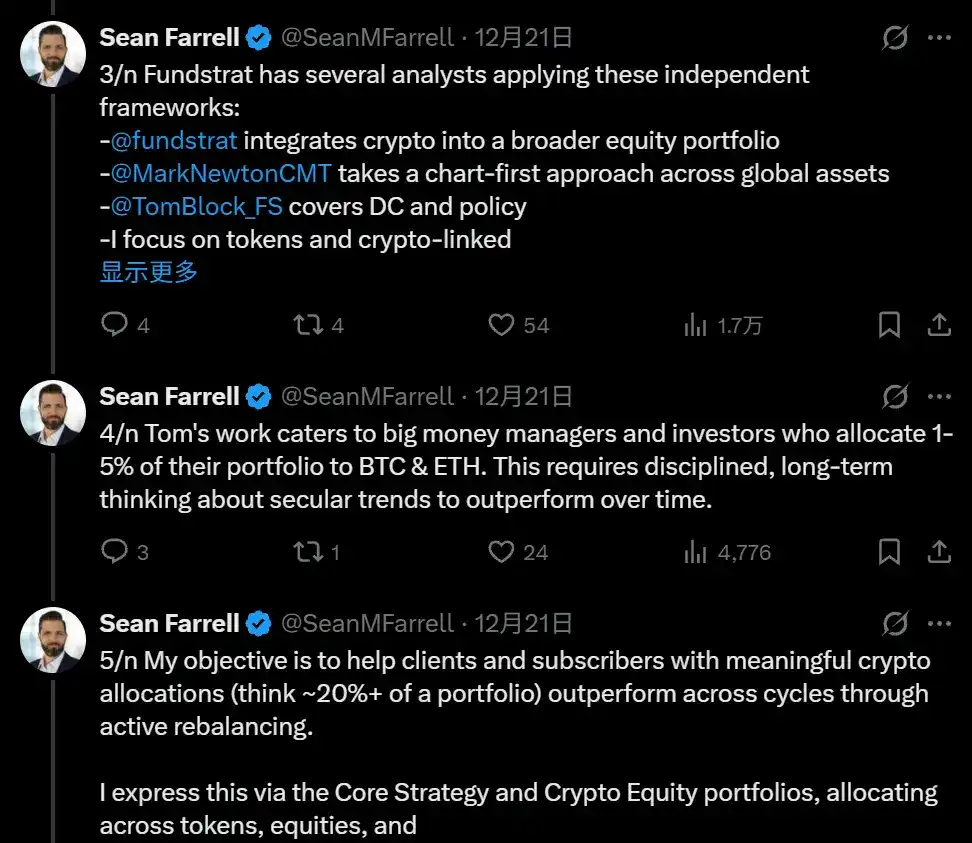
Farrell further stated that his cautious baseline scenario for the first half of 2026 is about risk management, not a turn towards bearishness on the long-term prospects of crypto. He believes that current market pricing is偏向"近乎完美", but risks such as government shutdowns, trade volatility, uncertainty in AI capital expenditure, and the Federal Reserve Chair succession remain. He also listed his historical performance, stating that his token portfolio has grown approximately 3 times since mid-January 2023, and his crypto stock portfolio has risen about 230% since its inception, with an excess of about 40% relative to BTC. During their respective existence, both have likely outperformed most liquid funds. But this wording seems more like a weak justification for Bitmine's $3 billion paper loss and the founder's contradictory statements.

Conclusion: The Contrast Isn't the Problem Itself; the Problem Lies in Disclosure and Boundaries

What真正引起争议 about this matter is not that Fundstrat has different frameworks, but that the co-founder lacks sufficiently clear scope of application and interest disclosure between the public communication end and the service end.

Sean Farrell's explanation of the contradictory statements using service to different types of clients is logically viable, but at the communication level, it still cannot avoid three problems:

1. When Tom Lee frequently expresses strong optimism about ETH in public videos and media interviews, the audience does not默认 this is "only applicable to long-term allocation discussions for low allocation positions," let alone automatically understand the implied risk premises, time scales, and probability weights. He himself has not publicly made clear clarifications and scope of application regarding this.

2. The subscription model of FS Insight /Fundstrat is essentially "research monetization". The official website page directly displays subscription guides like "Start Free Trial" and features Tom Lee for promotion. Tom Lee is the core招牌人物 at Fundstrat. The FS Insight page directly labels him as "Tom Lee, CFA / Head of Research". When traffic and subscription growth come more from Tom Lee's public interviews in various media, how does the company convince the public that "this is just expressing personal views".
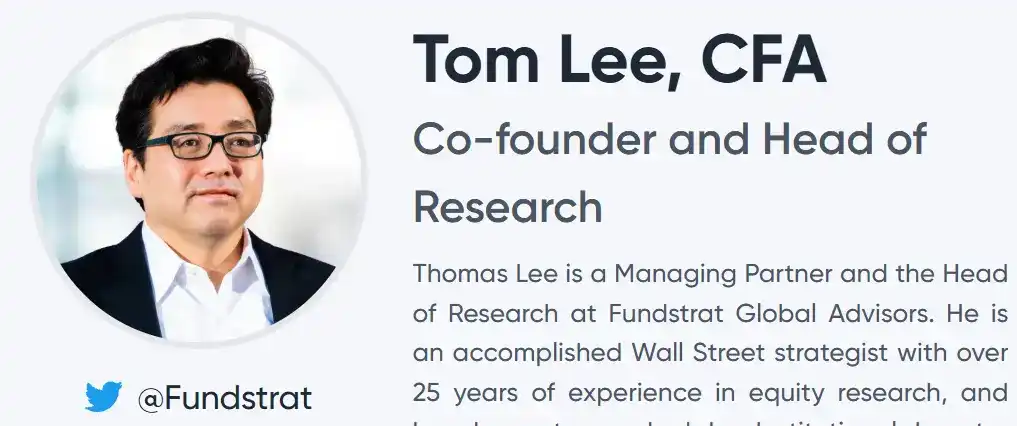
3. Public information shows that Tom Lee concurrently serves as Chairman of the Board of Ethereum treasury strategy company BitMine Immersion Technologies (BMNR), and the company regards ETH as one of its core treasury directions. Under this identity structure, his continuous "bullish on ETH" communication externally will naturally be interpreted by the market as highly consistent with the interests of the associated entity. For CFA charterholders, professional ethics also emphasize making "full and clear disclosure" of matters that may affect independence and objectivity.

Such controversies usually involve compliance issues: anti-fraud and conflict of interest disclosure. In the context of US securities law, Rule 10b-5 is a typical anti-fraud clause, the core of which is to prohibit material false or misleading statements related to securities transactions.

Furthermore, Fundstrat's entity structure makes the controversy more complex: Fundstrat Global Advisors emphasizes in its terms and disclosure documents that it is a research company, "not a registered investment adviser, nor a broker-dealer," and subscription research is "for client use only." But at the same time, Fundstrat Capital LLC clearly provides advisory services as an "SEC-registered investment adviser (RIA)".

Considering that public interviews and the operation of the Fundstrat Youtube channel事实上承担了"customer acquisition/marketing" functions, another question arises: which content belongs to personal research dissemination, and which content belongs to company marketing. If an institution's public video channels continuously publish "pumping snippets," while the subscription service端 publishes "bearish for the first half of the year" predictions, and does not simultaneously present key limiting conditions and risk frameworks on the public communication end, then it will at least constitute a selective presentation under information asymmetry.

This may not violate the law, but it will continuously erode public trust in the independence and credibility of research, and will also blur the boundaries between "research — marketing — narrative mobilization." For research institutions whose reputation is one of their core businesses, this kind of trust cost will eventually backlash against the brand itself.


Câu hỏi Liên quan

QWhat is the main contradiction highlighted in the article regarding Tom Lee and his team at Fundstrat?

AThe article highlights a contradiction between Tom Lee's public optimism about Ethereum, where he repeatedly called it 'severely undervalued' and predicted high price targets like $15,000 by end of 2025, and Fundstrat's internal research report for subscribers, which projected a significant market correction in early 2026 with Ethereum potentially falling to $1,800–$2,000.

QWhat reasons does Fundstrat's internal report give for expecting a crypto market correction in early 2026?

AFundstrat's internal report cites several short-term headwinds that could pressure the crypto market in early 2026, including a potential U.S. government shutdown, uncertainty around international trade policies, fading confidence in AI investment returns, and policy suspense due to the Federal Reserve Chair transition.

QHow did Sean Farrell from Fundstrat attempt to explain the differing public and internal statements?

ASean Farrell, Fundstrat's Head of Digital Asset Strategy, explained that the firm has multiple analysts using independent research frameworks for different client types. He stated that Lee's public comments are aimed at traditional asset managers making small allocations (1%–5%), emphasizing long-term trends, while his own research serves clients with heavier crypto allocations (~20%+) and focuses on shorter-term risk management.

QWhat potential ethical and compliance issues does the article raise about Tom Lee's actions?

AThe article raises issues related to anti-fraud regulations (like SEC's Rule 10b-5 against misleading statements) and conflict of interest disclosure. It questions whether Lee's public 'pumping' of ETH was sufficiently distinguished from corporate marketing, especially given his role as Chairman of BitMine, a company with an Ethereum-focused treasury strategy, creating a potential conflict that may not have been fully and clearly disclosed.

QWhat is the article's conclusion about the core problem with Fundstrat's contradictory messaging?

AThe article concludes that the core problem is not the existence of different internal research frameworks, but rather a lack of clear disclosure and boundaries in public communication. It criticizes the selective presentation of overly optimistic public soundbites for marketing and traffic, which creates an information asymmetry and erodes trust in the research firm's independence and credibility.

Nội dung Liên quan

Polymarket Bị Kẹt: Bài Kiểm Tra Thực Sự Sau Khi Vượt Qua Giai Đoạn Lưu Lượng Tăng Đột Biến

Polymarket, nền tảng dự đoán thị trường hàng đầu, đang đối mặt với thách thức lớn khi trải nghiệm giao dịch xuống cấp do hạ tầng không theo kịp đà tăng trưởng. Phó chủ tịch kỹ thuật Josh Stevens thừa nhận vấn đề và công bố kế hoạch cải tổ toàn diện, bao gồm: giảm độ trễ dữ liệu, sửa lỗi hủy lệnh, xây dựng lại hệ thống order book (CLOB), nâng cao hiệu suất website, và quan trọng nhất là di chuyển chain (chain migration). Nguyên nhân sâu xa nằm ở việc Polymarket không còn là ứng dụng dự đoán đơn thuần mà đã phát triển thành một nền tảng giao dịch tần suất cao. Polygon, từng là lựa chọn chi phí thấp hoàn hảo, giờ đây trở thành rào cản kỹ thuật. Động thái này ngay lập tức thu hút sự quan tâm của các blockchain khác như Solana, Sui, Algorand... trong khi Polygon nỗ lực giữ chân ứng dụng quan trọng này - nguồn đóng góp phí giao dịch đáng kể cho hệ sinh thái của họ. Bài kiểm tra thực sự của Polymarket không chỉ là chọn chain mới, mà là xây dựng một hệ thống giao dịch đủ mạnh và ổn định để giữ chân người dùng trong giai đoạn tăng trưởng mới, nơi độ tin cậy quan trọng hơn bao giờ hết.

Odaily星球日报04/27 03:21

Polymarket Bị Kẹt: Bài Kiểm Tra Thực Sự Sau Khi Vượt Qua Giai Đoạn Lưu Lượng Tăng Đột Biến

Odaily星球日报04/27 03:21

Điều chỉnh kỳ vọng giảm cho chu kỳ tăng giá tiếp theo của BTC

Tác giả Alex Xu, một nhà đầu tư Bitcoin lâu năm, đã chia sẻ quyết định giảm dần tỷ trọng BTC trong danh mục đầu tư của mình, từ vị thế lớn nhất xuống còn khoảng 30%, và giải thích lý do cho việc điều chỉnh kỳ vọng về đỉnh giá trong chu kỳ bull market tiếp theo. Các lý do chính bao gồm: 1. **Năng lượng tăng trưởng tiềm năng giảm:** Các chu kỳ trước được thúc đẩy bởi việc mở rộng đối tượng đầu tư theo cấp số nhân (từ cá nhân đến tổ chức). Chu kỳ tới cần sự chấp nhận từ các quỹ đầu tư quốc gia hoặc ngân hàng trung ương, điều này khó xảy ra trong 2-3 năm tới. 2. **Chi phí cơ hội cá nhân:** Tìm thấy nhiều cơ hội đầu tư hấp dẫn khác (cổ phiếu công ty) với mức giá hợp lý. 3. **Tác động tiêu cực từ sự thu hẹp của ngành crypto:** Nhiều mô hình Web3 (SocialFi, GameFi...) không thành công, dẫn đến sự thu hẹp của toàn ngành và làm chậm tốc độ tăng trưởng số người nắm giữ BTC. 4. **Áp lực từ nhà mua lớn nhất (MicroStrategy):** Chi phí huy động vốn của MicroStrategy tiếp tục tăng cao (lãi suất 11.5%), có thể làm giảm tốc độ mua vào và gây áp lực bán. 5. **Sự cạnh tranh từ Vàng được token hóa:** Sản phẩm vàng token hóa (tokenized gold) đã thu hẹp khoảng cách về tính dễ chia nhỏ, dễ mang theo và dễ xác minh so với BTC. 6. **Vấn đề ngân sách bảo mật:** Phần thưởng khối giảm sau mỗi lần halving làm trầm trọng thêm vấn đề ngân sách cho bảo mật mạng lưới. Tác giả vẫn giữ một phần BTC đáng kể và sẵn sàng mua lại nếu các lý kiến trên được giải quyết hoặc xuất hiện các yếu tố tích cực mới, với điều kiện giá cả phù hợp.

marsbit04/27 02:46

Điều chỉnh kỳ vọng giảm cho chu kỳ tăng giá tiếp theo của BTC

marsbit04/27 02:46

Giao dịch

Giao ngay
Hợp đồng Tương lai

Bài viết Nổi bật

AGENT S là gì

Agent S: Tương Lai của Tương Tác Tự Động trong Web3 Giới thiệu Trong bối cảnh không ngừng phát triển của Web3 và tiền điện tử, các đổi mới đang liên tục định nghĩa lại cách mà cá nhân tương tác với các nền tảng kỹ thuật số. Một dự án tiên phong như vậy, Agent S, hứa hẹn sẽ cách mạng hóa tương tác giữa con người và máy tính thông qua khung tác nhân mở của nó. Bằng cách mở đường cho các tương tác tự động, Agent S nhằm đơn giản hóa các nhiệm vụ phức tạp, cung cấp các ứng dụng chuyển đổi trong trí tuệ nhân tạo (AI). Cuộc khám phá chi tiết này sẽ đi sâu vào những phức tạp của dự án, các tính năng độc đáo của nó và những tác động đối với lĩnh vực tiền điện tử. Agent S là gì? Agent S đứng vững như một khung tác nhân mở đột phá, được thiết kế đặc biệt để giải quyết ba thách thức cơ bản trong việc tự động hóa các nhiệm vụ máy tính: Thu thập Kiến thức Cụ thể theo Miền: Khung này học một cách thông minh từ nhiều nguồn kiến thức bên ngoài và kinh nghiệm nội bộ. Cách tiếp cận kép này giúp nó xây dựng một kho lưu trữ phong phú về kiến thức cụ thể theo miền, nâng cao hiệu suất của nó trong việc thực hiện nhiệm vụ. Lập Kế Hoạch Qua Các Tầm Nhìn Nhiệm Vụ Dài Hạn: Agent S sử dụng lập kế hoạch phân cấp tăng cường kinh nghiệm, một cách tiếp cận chiến lược giúp phân chia và thực hiện các nhiệm vụ phức tạp một cách hiệu quả. Tính năng này nâng cao đáng kể khả năng quản lý nhiều nhiệm vụ con một cách hiệu quả và hiệu suất. Xử Lý Các Giao Diện Động, Không Đều: Dự án giới thiệu Giao Diện Tác Nhân-Máy Tính (ACI), một giải pháp đổi mới giúp nâng cao tương tác giữa các tác nhân và người dùng. Sử dụng các Mô Hình Ngôn Ngữ Lớn Đa Phương Thức (MLLMs), Agent S có thể điều hướng và thao tác các giao diện người dùng đồ họa đa dạng một cách liền mạch. Thông qua những tính năng tiên phong này, Agent S cung cấp một khung vững chắc giải quyết các phức tạp liên quan đến việc tự động hóa tương tác giữa con người với máy móc, mở ra nhiều ứng dụng trong AI và hơn thế nữa. Ai là Người Tạo ra Agent S? Mặc dù khái niệm về Agent S là hoàn toàn đổi mới, thông tin cụ thể về người sáng lập vẫn còn mơ hồ. Người sáng lập hiện vẫn chưa được biết đến, điều này làm nổi bật giai đoạn sơ khai của dự án hoặc sự lựa chọn chiến lược để giữ kín các thành viên sáng lập. Bất chấp sự ẩn danh, sự chú ý vẫn tập trung vào khả năng và tiềm năng của khung này. Ai là Các Nhà Đầu Tư của Agent S? Vì Agent S còn tương đối mới trong hệ sinh thái mã hóa, thông tin chi tiết về các nhà đầu tư và những người tài trợ tài chính của nó không được ghi chép rõ ràng. Sự thiếu vắng thông tin công khai về các nền tảng đầu tư hoặc tổ chức hỗ trợ dự án dấy lên câu hỏi về cấu trúc tài trợ và lộ trình phát triển của nó. Hiểu biết về sự hỗ trợ là rất quan trọng để đánh giá tính bền vững và tác động tiềm năng của dự án. Agent S Hoạt Động Như Thế Nào? Tại cốt lõi của Agent S là công nghệ tiên tiến cho phép nó hoạt động hiệu quả trong nhiều bối cảnh khác nhau. Mô hình hoạt động của nó được xây dựng xung quanh một số tính năng chính: Tương Tác Giống Như Con Người: Khung này cung cấp lập kế hoạch AI tiên tiến, cố gắng làm cho các tương tác với máy tính trở nên trực quan hơn. Bằng cách bắt chước hành vi của con người trong việc thực hiện nhiệm vụ, nó hứa hẹn nâng cao trải nghiệm người dùng. Ký Ức Tường Thuật: Được sử dụng để tận dụng các trải nghiệm cấp cao, Agent S sử dụng ký ức tường thuật để theo dõi lịch sử nhiệm vụ, từ đó nâng cao quy trình ra quyết định của nó. Ký Ức Tình Huống: Tính năng này cung cấp cho người dùng hướng dẫn từng bước, cho phép khung này cung cấp hỗ trợ theo ngữ cảnh khi các nhiệm vụ diễn ra. Hỗ Trợ OpenACI: Với khả năng chạy cục bộ, Agent S cho phép người dùng duy trì quyền kiểm soát đối với các tương tác và quy trình làm việc của họ, phù hợp với tinh thần phi tập trung của Web3. Tích Hợp Dễ Dàng với Các API Bên Ngoài: Tính linh hoạt và khả năng tương thích với nhiều nền tảng AI khác nhau đảm bảo rằng Agent S có thể hòa nhập liền mạch vào các hệ sinh thái công nghệ hiện có, làm cho nó trở thành lựa chọn hấp dẫn cho các nhà phát triển và tổ chức. Những chức năng này cùng nhau góp phần vào vị trí độc đáo của Agent S trong không gian tiền điện tử, khi nó tự động hóa các nhiệm vụ phức tạp, nhiều bước với sự can thiệp tối thiểu của con người. Khi dự án phát triển, các ứng dụng tiềm năng của nó trong Web3 có thể định nghĩa lại cách mà các tương tác kỹ thuật số diễn ra. Thời Gian Phát Triển của Agent S Sự phát triển và các cột mốc của Agent S có thể được tóm tắt trong một dòng thời gian nêu bật các sự kiện quan trọng của nó: 27 tháng 9, 2024: Khái niệm về Agent S được ra mắt trong một bài nghiên cứu toàn diện mang tên “Một Khung Tác Nhân Mở Sử Dụng Máy Tính Như Một Con Người,” trình bày nền tảng cho dự án. 10 tháng 10, 2024: Bài nghiên cứu được công bố công khai trên arXiv, cung cấp một cái nhìn sâu sắc về khung và đánh giá hiệu suất của nó dựa trên tiêu chuẩn OSWorld. 12 tháng 10, 2024: Một video trình bày được phát hành, cung cấp cái nhìn trực quan về khả năng và tính năng của Agent S, thu hút thêm sự quan tâm từ người dùng và nhà đầu tư tiềm năng. Những dấu mốc trong dòng thời gian không chỉ minh họa sự tiến bộ của Agent S mà còn chỉ ra cam kết của nó đối với sự minh bạch và sự tham gia của cộng đồng. Những Điểm Chính Về Agent S Khi khung Agent S tiếp tục phát triển, một số thuộc tính chính nổi bật, nhấn mạnh tính đổi mới và tiềm năng của nó: Khung Đổi Mới: Được thiết kế để cung cấp cách sử dụng máy tính trực quan giống như tương tác của con người, Agent S mang đến một cách tiếp cận mới cho việc tự động hóa nhiệm vụ. Tương Tác Tự Động: Khả năng tương tác tự động với máy tính thông qua GUI đánh dấu một bước tiến tới các giải pháp tính toán thông minh và hiệu quả hơn. Tự Động Hóa Nhiệm Vụ Phức Tạp: Với phương pháp mạnh mẽ của nó, nó có thể tự động hóa các nhiệm vụ phức tạp, nhiều bước, làm cho các quy trình nhanh hơn và ít sai sót hơn. Cải Tiến Liên Tục: Các cơ chế học tập cho phép Agent S cải thiện từ các trải nghiệm trước đó, liên tục nâng cao hiệu suất và hiệu quả của nó. Tính Linh Hoạt: Khả năng thích ứng của nó trên các môi trường hoạt động khác nhau như OSWorld và WindowsAgentArena đảm bảo rằng nó có thể phục vụ một loạt các ứng dụng rộng rãi. Khi Agent S định vị mình trong bối cảnh Web3 và tiền điện tử, tiềm năng của nó để nâng cao khả năng tương tác và tự động hóa quy trình đánh dấu một bước tiến quan trọng trong công nghệ AI. Thông qua khung đổi mới của mình, Agent S minh họa cho tương lai của các tương tác kỹ thuật số, hứa hẹn một trải nghiệm liền mạch và hiệu quả hơn cho người dùng trên nhiều ngành công nghiệp khác nhau. Kết luận Agent S đại diện cho một bước nhảy vọt táo bạo trong sự kết hợp giữa AI và Web3, với khả năng định nghĩa lại cách chúng ta tương tác với công nghệ. Mặc dù vẫn còn ở giai đoạn đầu, những khả năng cho ứng dụng của nó là rộng lớn và hấp dẫn. Thông qua khung toàn diện của mình giải quyết các thách thức quan trọng, Agent S nhằm đưa các tương tác tự động lên hàng đầu trong trải nghiệm kỹ thuật số. Khi chúng ta tiến sâu hơn vào các lĩnh vực tiền điện tử và phi tập trung, các dự án như Agent S chắc chắn sẽ đóng một vai trò quan trọng trong việc định hình tương lai của công nghệ và sự hợp tác giữa con người với máy tính.

Tổng lượt xem 671Xuất bản vào 2025.01.14Cập nhật vào 2025.01.14

AGENT S là gì

Làm thế nào để Mua S

Chào mừng bạn đến với HTX.com! Chúng tôi đã làm cho mua Sonic (S) trở nên đơn giản và thuận tiện. Làm theo hướng dẫn từng bước của chúng tôi để bắt đầu hành trình tiền kỹ thuật số của bạn.Bước 1: Tạo Tài khoản HTX của BạnSử dụng email hoặc số điện thoại của bạn để đăng ký tài khoản miễn phí trên HTX. Trải nghiệm hành trình đăng ký không rắc rối và mở khóa tất cả tính năng. Nhận Tài khoản của tôiBước 2: Truy cập Mua Crypto và Chọn Phương thức Thanh toán của BạnThẻ Tín dụng/Ghi nợ: Sử dụng Visa hoặc Mastercard của bạn để mua Sonic (S) ngay lập tức.Số dư: Sử dụng tiền từ số dư tài khoản HTX của bạn để giao dịch liền mạch.Bên thứ ba: Chúng tôi đã thêm những phương thức thanh toán phổ biến như Google Pay và Apple Pay để nâng cao sự tiện lợi.P2P: Giao dịch trực tiếp với người dùng khác trên HTX.Thị trường mua bán phi tập trung (OTC): Chúng tôi cung cấp những dịch vụ được thiết kế riêng và tỷ giá hối đoái cạnh tranh cho nhà giao dịch.Bước 3: Lưu trữ Sonic (S) của BạnSau khi mua Sonic (S), lưu trữ trong tài khoản HTX của bạn. Ngoài ra, bạn có thể gửi đi nơi khác qua chuyển khoản blockchain hoặc sử dụng để giao dịch những tiền kỹ thuật số khác.Bước 4: Giao dịch Sonic (S)Giao dịch Sonic (S) dễ dàng trên thị trường giao ngay của HTX. Chỉ cần truy cập vào tài khoản của bạn, chọn cặp giao dịch, thực hiện giao dịch và theo dõi trong thời gian thực. Chúng tôi cung cấp trải nghiệm thân thiện với người dùng cho cả người mới bắt đầu và người giao dịch dày dạn kinh nghiệm.

Tổng lượt xem 1.3kXuất bản vào 2025.01.15Cập nhật vào 2025.03.21

Làm thế nào để Mua S

Thảo luận

Chào mừng đến với Cộng đồng HTX. Tại đây, bạn có thể được thông báo về những phát triển nền tảng mới nhất và có quyền truy cập vào thông tin chuyên sâu về thị trường. Ý kiến ​​của người dùng về giá của S (S) được trình bày dưới đây.

活动图片