Musk Poaches the Web3 Prodigy Who Laid the Foundation for the Aave App

marsbitXuất bản vào 2026-03-26Cập nhật gần nhất vào 2026-03-26

Tóm tắt

Elon Musk has recruited Benji Taylor, a 26-year-old design prodigy and former design lead at Base, to lead design at X (formerly Twitter). Taylor, who began his career at 16 and gained early recognition for his creative work, is known for his groundbreaking contributions to Web3 and consumer app design. He founded Los Feliz Engineering (LFE), where he created Honk—a real-time chat app with no send button or message history—which gained a cult following before shutting down due to product-market fit challenges. Later, he developed Family, a highly praised self-custody crypto wallet often regarded as one of the best-designed in the industry. LFE was acquired by Aave Labs in 2023, and Taylor’s work became foundational to the Aave App’s user experience. His recruitment signals Musk’s continued interest in integrating crypto and payment features into X, leveraging Taylor’s rare expertise in social apps, crypto UX, and minimalist design. Taylor has expressed that his motivation lies in building at scale and reaching billions of users—a goal now within reach at X.

At 1:00 AM Beijing time on March 26, former Base Design Lead Benji Taylor announced that he is joining Musk's X and will lead design efforts.
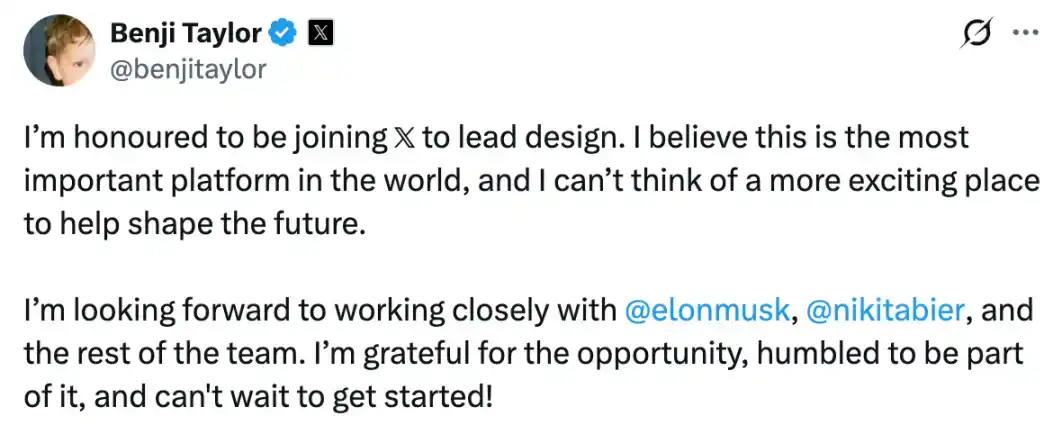
Personnel changes are never big news in the Web3 industry, but this post reaching nearly 15 million reads tells me things are not that simple.

After a deeper look, I realized this person is far from just the Base Design Lead.

Rebellion and Talent

Benji Taylor is only about 26 years old, likely a standard "Gen Z".

Unlike most conventional life paths, Benji Taylor was already somewhat famous by the age of 16. In 2016, this 16-year-old "Creative Director" from London, UK, was interviewed by the renowned British fashion and culture magazine 《Dazed》.

At an age when many are still studying hard in high school classrooms, Benji Taylor was already making huge waves across the Atlantic. Numerous artists, including Ram Riddlz and A$AP Ant, had collaborated with him. Not only that, he also found time to develop apps, design his own playing cards, and start his own design company, Next Exit.

These weren't things he *started* doing at 16; they were things he had already *done*. According to the interview, Next Exit had been operating for at least a year.

"To be honest, I'm not great at art, I just have a lot of ideas and decide to put them into practice."

In Benji Taylor's view, homogeneous design styles disgusted him. As someone who considered himself not great at art, he still felt his work surpassed that of many others.

In this interview from a decade ago, Benji Taylor displayed a maturity beyond his years. Besides expressing dissatisfaction with homogenized education, when asked for advice for other young creatives, he said:

"Be more self-aware and understand that things don't just happen by themselves. School doesn't guarantee you a job, nor does it guarantee a happy and stable life. You're young, maybe still living with your parents, not paying rent—take advantage of that. Every penny you earn is profit, why wait until real life knocks you down?"

From Honk to Aave

Around 2020, Benji Taylor came to the US. Soon after, a company named Los Feliz Engineering (LFE), after the first community he lived in upon arriving, was established.

The first product launched by this company was a blockbuster.

In December 2020, Honk burst onto the scene. The app was initially promoted on TikTok, where a single video garnered over 140k likes.

Honk's design was ingenious: the app had no send button; inputted chat content was displayed to the other party character by character. You could see the person you were chatting with modifying and deleting content, like a "live chat." Additionally, the app had no chat history; once you left the chatroom, all historical content was permanently deleted.

If you wanted to pull someone into a chatroom, you could send a "Honk"; the other person would receive a prominent notification that someone was "calling" them. This method of translating the experience of offline, face-to-face chatting into an online format through mechanism design was very novel.

In 2021, Honk expanded from熟人社交 (acquaintance social) to陌生人社交 (stranger social). Users could randomly match with strangers using a function similar to WeChat's "Shake." At its peak, Honk's open rate even surpassed Instagram's. By the time it was shut down, Honk had accumulated 2.6 billion characters input, 170 million "Honks" sent, and hundreds of millions of image, audio, and video exchanges. It gained a loyal user base in fields like fashion and tech.

That's right, this app was shut down years ago. Although highly praised by its users, and even today many product managers and designers miss this "honkish" style, the product's PMF (Product-Market Fit) was genuinely challenged.

The core reason was that the app required both parties to be online simultaneously. Furthermore, Honk had no group chat and never launched an Android version.

Perhaps this app was god-like in certain niche circles, but a social app seems destined to fail without enough people.

In 2022, the LFE team began developing Family, a self-custody cryptocurrency wallet focused on design.
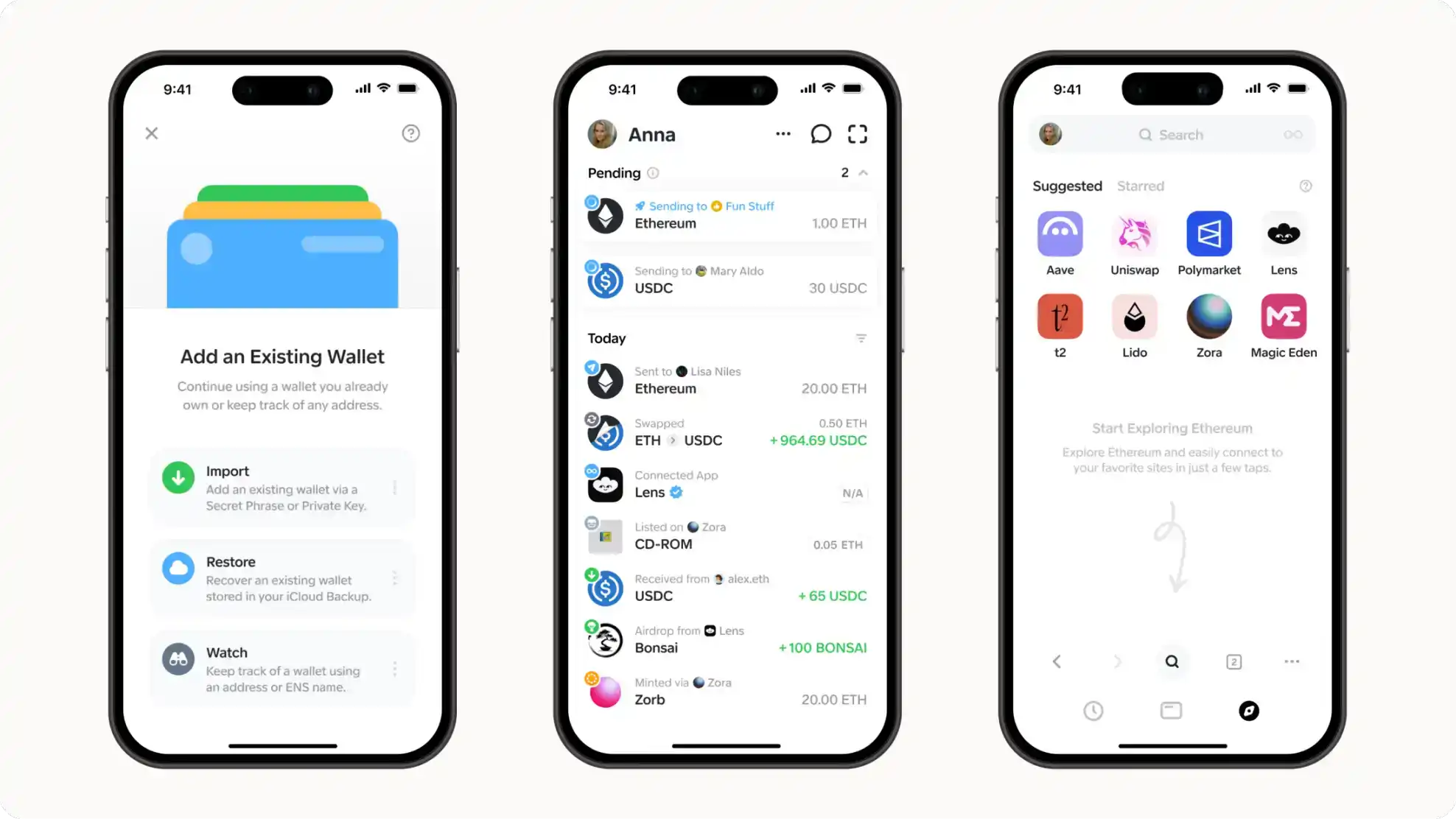
If you've seen wallet apps with interfaces resembling the one in the image above, they might have been inspired by Benji Taylor's design. This wallet product was also highly praised within the industry, with many users calling it the "best体验 (experience)加密钱包 (crypto wallet)." Of course, you might not have heard of this wallet because they really didn't do well in market promotion.

Perhaps frustrated that good products weren't gaining market recognition, Benji Taylor decided to leverage a platform. In 2023, LFE was acquired by Aave Labs. Concurrently, Honk was shut down, while the Family wallet continued operating. Unfortunately, this wallet was also abandoned in February this year. Aave's explanation was a focus on DeFi business, believing that attracting users to Web3 requires designing for specific purposes, not a通用型 (general-purpose) wallet.

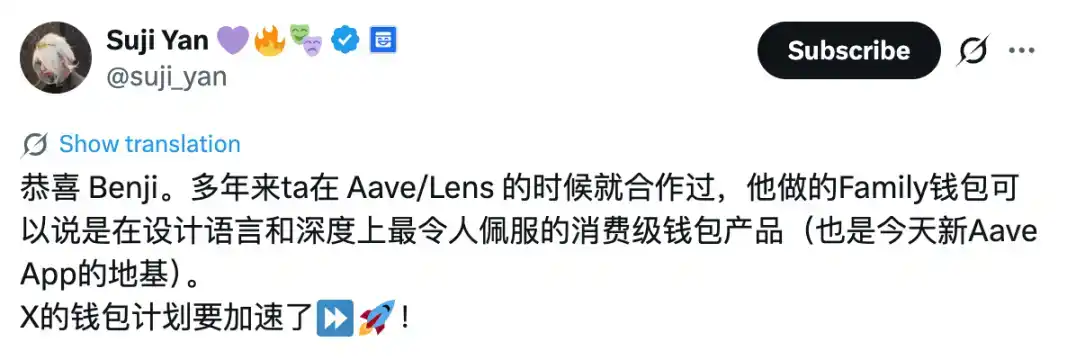
Suji, founder of Mask Network (which acquired Lens), also said on X today that the Family wallet was the most impressive consumer-grade wallet product in terms of design language and depth, and was the foundation of the Aave App.
In October 2025, Benji Taylor left Aave and joined Base as Head of Design. If you pay attention, you'll notice that the more well-known mobile Apps in the Web3 industry today definitely include Aave and Base. An investor in the industry once told me that the mobile App experience for most Web3 products is abysmal. With far more global mobile users than PC users, the fact that only the PC experience is passable is also a hindrance to Web3's user expansion.

This is partly due to imperfect infrastructure and the complications brought by decentralization, which make many processes impossible to simplify. But precisely because of this, only designers like Benji Taylor can create mobile applications for Web3 that might be considered just及格 (passing) by Web2 standards.

The Man Chosen by Musk

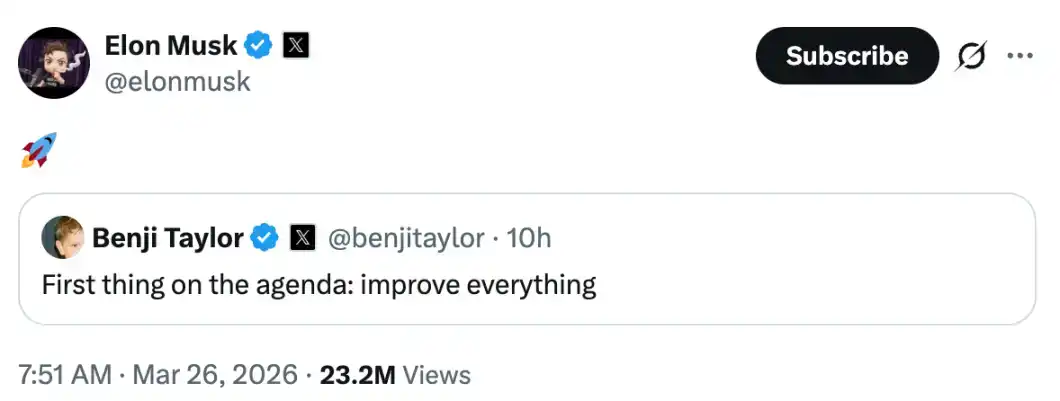
The fact that the extremely picky Musk personally tweeted to welcome his加入 (joining) speaks volumes.

There is much speculation on X about his arrival. Some believe that Nikita Bier, the product lead who served as an advisor to Solana Labs, combined with the former Base design lead, their cryptocurrency industry backgrounds suggest Musk intends to add more cryptocurrency-related features to X.

Others speculate that his experience with social apps and crypto wallets could aid X's encrypted communication app X Chat and payment products.

Benji Taylor himself provided the answer:
In the past, this brilliantly talented young man created many astonishing designs, but from a purely commercial perspective, they seemed曲高和寡 (too highbrow to be popular). After several years of ups and downs, it's believed that within this company integrating social app X, AI model xAI, and Mars-aiming SpaceX, Benji Taylor can utilize his talent to the fullest.

AI's design capabilities are not weak, but the highest level of审美 (aesthetics) does not come from billions or trillions of parameters; it stems from the innate gifts of geniuses.


Tiền kỹ thuật số thịnh hành

Câu hỏi Liên quan

QWho is Benji Taylor and what is his new role at X?

ABenji Taylor is a 26-year-old design prodigy who previously worked as the design lead at Base and was instrumental in the development of Aave App. He has recently joined Elon Musk's X to lead the design team.

QWhat was Benji Taylor's first major product after moving to the US, and what made it unique?

ABenji Taylor's first major product was Honk, a social app launched in 2020. It was unique because it featured live typing without a send button, no chat history, and a 'Honk' notification to invite others into chat rooms, mimicking real-time, in-person conversations.

QWhy did Honk eventually fail despite its innovative design?

AHonk failed primarily because it required both users to be online simultaneously, lacked group chat functionality, and never released an Android version, which limited its user base and product-market fit.

QWhat was the name of the self-custody cryptocurrency wallet developed by Benji Taylor's team, and how was it received?

AThe self-custody cryptocurrency wallet was called Family. It was highly praised within the industry, with many users considering it the 'best-experienced crypto wallet' due to its design language and depth, though it struggled with market推广.

QWhat are the speculations about Benji Taylor's role at X regarding cryptocurrency?

ASpeculations suggest that Benji Taylor's experience with crypto products, combined with his background in social apps, might help X integrate more cryptocurrency-related features, such as enhancing X Chat for encrypted communications or developing payment products.

Nội dung Liên quan

OpenAI không bán tiền dựa trên mô hình đắt nhất

OpenAI đã điều chỉnh giá, giảm 80% cho mô hình GPT-5.6 Luna và 20% cho Terra, đồng thời giới thiệu chế độ Fast cho mô hình mạnh nhất Sol. Động thái này, cùng với việc Anthropic giới thiệu Claude Opus 5 với giá bằng một nửa so với flagship Fable 5, đánh dấu sự thay đổi chiến lược quan trọng: các hãng không còn chỉ tập trung bán mô hình mạnh nhất. Thay vào đó, họ khuyến nghị người dùng kết hợp các mô hình theo nhiệm vụ: dùng Sol (đắt, mạnh) để phân tích và lập kế hoạch phức tạp, sau đó giao cho Luna (rẻ, hiệu quả) thực thi. Điều này cho thấy trọng tâm thương mại đang chuyển từ các mô hình flagship (chứng minh năng lực kỹ thuật) sang các mô hình tầm trung, phục vụ cho lượng truy vấn API khổng lồ hàng ngày của doanh nghiệp, nơi hiệu quả chi phí (ROI) và độ ổn định là yếu tố quyết định. Một yếu tố then chốt giúp giảm chi phí là việc chính các mô hình AI (như Sol) tham gia tối ưu hóa mã nguồn và quy trình vận hành của chính chúng, tạo ra một vòng lặp tự thúc đẩy giảm chi phí. Điều này có thể đẩy nhanh hơn nữa đà giảm giá trong tương lai. Cạnh tranh đang chuyển từ "mô hình thông minh nhất" sang "hệ sinh thái hiệu quả nhất". OpenAI muốn biến các mô hình như Luna thành lựa chọn mặc định cho các tác vụ thường ngày, từ đó gia tăng độ phụ thuộc và chi phí chuyển đổi cho doanh nghiệp. Tương tự như ngành điện hay điện toán đám mây, mục tiêu cuối cùng là AI trở thành một tiện ích phổ biến, hoạt động âm thầm và không thể thiếu trong mọi quy trình, thay vì chỉ là một sản phẩm công nghệ đình đám.

marsbit54 phút trước

OpenAI không bán tiền dựa trên mô hình đắt nhất

marsbit54 phút trước

Lương trăm nghìn đô la săn thợ điện, Meta vội vàng tự mở trường dạy nghề

Cuộc đua AI đang vấp phải nút thắt mới: thiếu hụt nghiêm trọng lao động lành nghề như thợ điện và công nhân xây dựng để xây dựng các trung tâm dữ liệu quy mô lớn. Tại Mỹ, dự báo cần thêm 130.000 thợ điện và 240.000 công nhân xây dựng từ 2023-2030 cho hạ tầng AI, trong khi mỗi năm có 80.000 vị trí thợ điện không thể lấp đầy. Các công ty AI sẵn sàng trả lương cao (thợ điện giỏi có thể kiếm 240.000-280.000 USD/năm), nhưng sự chậm trễ xây dựng vẫn gây thiệt hại hàng chục triệu USD. Độ phức tạp của các trung tâm dữ liệu AI, với công suất điện khổng lồ, hệ thống phân phối điện và làm mát phức tạp, đòi hỏi lao động có kỹ năng đặc biệt. Để giải quyết, các gã khổng lồ công nghệ như Meta và Google đang đầu tư hàng trăm triệu USD vào đào tạo. Meta mở trường dạy nghề miễn phí, cung cấp cả trợ cấp sinh hoạt, trong khi OpenAI hợp tác với công đoàn xây dựng. Chiến dịch tuyển dụng nhắm đến cả học sinh trung học, góp phần làm tăng mạnh tỷ lệ Gen Z theo học trường nghề. Tuy nhiên, nhu cầu điện cho AI tiếp tục bùng nổ, chiếm phần ngày càng lớn trong tổng tiêu thụ điện và đẩy giá điện lên cao. Một nghịch lý tồn tại: các dự án xây dựng cần hàng nghìn lao động cùng lúc, nhưng khi hoàn thành chỉ cần số ít vận hành, dẫn đến rủi ro dư thừa lao động lành nghề trong tương lai.

marsbit54 phút trước

Lương trăm nghìn đô la săn thợ điện, Meta vội vàng tự mở trường dạy nghề

marsbit54 phút trước

Cục Dự trữ Liên bang tháng 9 nhất định tăng lãi suất? Tiền mã hóa và chứng khoán Mỹ sẽ chịu áp lực thế nào?

Tỷ lệ thị trường kỳ vọng Fed tăng lãi suất vào tháng 9 đã tăng vọt từ dưới 50% lên hơn 80% chỉ trong một tuần, chủ yếu do lo ngại lạm phát trỗi dậy từ giá dầu leo thang sau các căng thẳng địa chính trị ở eo biển Hormuz. Cuộc bỏ phiếu 9-3 tại cuộc họp FOMC tháng 7, với 3 thành viên ủng hộ tăng lãi suất ngay lập tức, đã củng cố kỳ vọng này. Mốc then chốt tiếp theo là báo cáo CPI tháng 7 vào ngày 12/8. Đối với tài sản tiền mã hóa, kỳ vọng tăng lãi suất gây áp lực lên Bitcoin, vốn có mối tương quan cao với chu kỳ thanh khoản toàn cầu và thể hiện đặc tính tài sản rủi ro beta cao. Tuy nhiên, tác động có thể không kéo dài nếu thị trường coi đây là bước tăng cuối cùng trong chu kỳ thắt chặt. Trên thị trường chứng khoán Mỹ, các cổ phiếu liên quan đến tiền mã hóa như Coinbase có thể biến động mạnh hơn. Cổ phiếu công nghệ tăng trưởng nói chung phải đối mặt với áp lực định giá do lãi suất chiết khấu tăng. Báo cáo thu nhập quý 2 của các gã khổng lồ công nghệ cho thấy thị trường đang chuyển trọng tâm từ quy mô chi tiêu vốn sang khả năng tạo ra doanh thu và dòng tiền thực tế. Việc tăng lãi suất có thể làm gia tăng chi phí vốn, khiến thị trường khắt khe hơn với câu chuyện tăng trưởng dựa trên việc "đốt tiền" đầu tư.

marsbit1 giờ trước

Cục Dự trữ Liên bang tháng 9 nhất định tăng lãi suất? Tiền mã hóa và chứng khoán Mỹ sẽ chịu áp lực thế nào?

marsbit1 giờ trước

Thợ đào Bitcoin từ từ đầu hàng, nhưng cổ phiếu của họ lại tăng vọt

Tình trạng đầu hàng của thợ đào Bitcoin đang diễn ra, với hash rate và độ khó khai thác giảm mạnh trong nhiều tháng liên tục. Tuy nhiên, có một nghịch lý: trong khi hoạt động khai thác trở nên kém kinh tế và BTC giảm giá khoảng 46%, cổ phiếu của các công ty khai thác niêm yết lại tăng mạnh, thậm chí có mã tăng hơn 430%. Nguyên nhân chính được cho là nhờ câu chuyện về AI, khiến các cổ phiếu này thoát ly khỏi mối tương quan truyền thống với Bitcoin. Thu nhập từ phần thưởng khối (block reward) tính bằng BTC đã chạm mức thấp kỷ lục hàng ngày, phản ánh chu kỳ giảm nửa phần thưởng định kỳ. Hệ số Puell Multiple cho thấy thu nhập hiện tại của thợ đào chỉ bằng khoảng 3/4 mức trung bình năm. Trong khi đó, nguồn thu từ phí giao dịch vẫn rất thấp, chưa đủ để bù đắp cho phần thưởng khối đang teo lại. Sự phân kỳ lần này – thợ đào gặp khó khăn nhưng cổ phiếu ngành lại tăng – cho thấy một động lực mới. Các công ty có thể đang chuyển hướng sang các cơ hội khác như AI. Vấn đề cơ cấu lâu dài vẫn tồn tại: phần thưởng khối sẽ tiếp tục giảm, đặt ra câu hỏi về việc phí giao dịch trong tương lai sẽ đảm bảo an ninh mạng như thế nào. Những thách thức này thường được nhìn nhận nghiêm túc hơn trong thị trường giá xuống.

marsbit1 giờ trước

Thợ đào Bitcoin từ từ đầu hàng, nhưng cổ phiếu của họ lại tăng vọt

marsbit1 giờ trước

Giao dịch

Giao ngay

Bài viết Nổi bật

Làm thế nào để Mua AAVE

Chào mừng bạn đến với HTX.com! Chúng tôi đã làm cho mua Aave Protocol (AAVE) trở nên đơn giản và thuận tiện. Làm theo hướng dẫn từng bước của chúng tôi để bắt đầu hành trình tiền kỹ thuật số của bạn.Bước 1: Tạo Tài khoản HTX của BạnSử dụng email hoặc số điện thoại của bạn để đăng ký tài khoản miễn phí trên HTX. Trải nghiệm hành trình đăng ký không rắc rối và mở khóa tất cả tính năng. Nhận Tài khoản của tôiBước 2: Truy cập Mua Crypto và Chọn Phương thức Thanh toán của BạnThẻ Tín dụng/Ghi nợ: Sử dụng Visa hoặc Mastercard của bạn để mua Aave Protocol (AAVE) ngay lập tức.Số dư: Sử dụng tiền từ số dư tài khoản HTX của bạn để giao dịch liền mạch.Bên thứ ba: Chúng tôi đã thêm những phương thức thanh toán phổ biến như Google Pay và Apple Pay để nâng cao sự tiện lợi.P2P: Giao dịch trực tiếp với người dùng khác trên HTX.Thị trường mua bán phi tập trung (OTC): Chúng tôi cung cấp những dịch vụ được thiết kế riêng và tỷ giá hối đoái cạnh tranh cho nhà giao dịch.Bước 3: Lưu trữ Aave Protocol (AAVE) của BạnSau khi mua Aave Protocol (AAVE), lưu trữ trong tài khoản HTX của bạn. Ngoài ra, bạn có thể gửi đi nơi khác qua chuyển khoản blockchain hoặc sử dụng để giao dịch những tiền kỹ thuật số khác.Bước 4: Giao dịch Aave Protocol (AAVE)Giao dịch Aave Protocol (AAVE) dễ dàng trên thị trường giao ngay của HTX. Chỉ cần truy cập vào tài khoản của bạn, chọn cặp giao dịch, thực hiện giao dịch và theo dõi trong thời gian thực. Chúng tôi cung cấp trải nghiệm thân thiện với người dùng cho cả người mới bắt đầu và người giao dịch dày dạn kinh nghiệm.

Tổng lượt xem 611Xuất bản vào 2024.12.11Cập nhật vào 2026.06.02

Làm thế nào để Mua AAVE

Thảo luận

Chào mừng đến với Cộng đồng HTX. Tại đây, bạn có thể được thông báo về những phát triển nền tảng mới nhất và có quyền truy cập vào thông tin chuyên sâu về thị trường. Ý kiến ​​của người dùng về giá của AAVE (AAVE) được trình bày dưới đây.

活动图片












