More Accurate Than Polls, More Dangerous Than Imagined: Prediction Markets in the Eyes of the Fed

比推Xuất bản vào 2026-02-24Cập nhật gần nhất vào 2026-02-24

Tóm tắt

The Federal Reserve is exploring the use of prediction markets, particularly Kalshi, as a real-time tool for policy insights. A Fed-affiliated working paper found that Kalshi’s predictions for core CPI and unemployment are statistically comparable to—and sometimes more accurate than—Bloomberg consensus estimates. Prediction markets aggregate real-money, belief-backed trading, offering frequent updates and capturing nuanced shifts that traditional surveys miss. For instance, Kalshi priced inflation uncertainty in real time during a trade policy scare—a dynamic monthly surveys couldn’t reflect. While these markets provide valuable signals, they also carry risks. Prices reflect both expectations and risk preferences, and heavy reliance on sports betting for liquidity makes macroeconomic markets vulnerable to regulatory changes. If sports betting is restricted, liquidity could dry up, increasing manipulation risks. Moreover, if the Fed openly uses prediction markets, it could create a feedback loop where traders manipulate smaller markets like Kalshi to influence broader policy communication and traditional financial instruments. Despite these concerns, prediction markets offer a uniquely timely and distributed form of expectation aggregation—especially for events like FOMC meetings, where informed participants trade with real stakes. The Fed should require open data transparency to mitigate manipulation and carefully weigh the signal against the noise.

Source: The Token Dispatch

Author: Prathik Desai

Original Title: The Signal and the Noise


“Forecasts usually tell us more of the forecaster than of the future.”

— Warren Buffett

Money filters out empty talk. Supporters believe this is precisely why prediction markets are reliable. We saw people accurately predict the outcome of the 2024 U.S. presidential election on Polymarket and Kalshi. However, prediction markets themselves are not new, and their success in predicting political outcomes is not the first of its kind.

In October 1988, a group of economists at the University of Iowa supported their academic curiosity with a small, real-money prediction market. They launched a presidential election futures market where participants could buy contracts: if George H. W. Bush won, the contract paid $1; if Michael Dukakis won, it paid $0. On the eve of the election, Bush's contracts traded at 53 cents, while traditional polls suggested a close race. Ultimately, Bush won with 53.4% of the vote and a solid 8-point margin.

Since that academic experiment, these real-money futures markets have outperformed traditional polls in every election predicted more than 100 days in advance. In U.S. presidential elections since 1988, prediction markets have been closer to the final result than polls 74% of the time.

This success stems from a mechanism that forces people to express genuine beliefs backed by real money, something surveys can never achieve. Those who truly believed Bush would win bought and held contracts. For random participants, there is no incentive to spend $50 to support a claim they themselves do not believe. When this behavior aggregates thousands of traders, information converges into a price that reflects the true beliefs of a broad group, rather than a small, disproportionate sample.

That small academic experiment in Iowa, run on a shoestring budget, has now evolved into an institutionalized infrastructure.

Last week, a working paper authored by economists affiliated with the Federal Reserve noted that Kalshi, the largest regulated prediction market in the U.S., could serve as a valuable real-time benchmark for policymakers. The same week, New York Stock Exchange (NYSE) President Lynn Martin stated that Polymarket, the world's highest-volume prediction market, moved S&P index futures on election night by pricing Donald Trump's victory earlier than any news organization. Subsequently, Kalshi announced a partnership with a trading platform that handles $2.6 trillion in daily institutional volume.

In today's in-depth analysis, I will explore whether prediction markets can serve as reliable barometers for policymaking and what risks they bring.

Prediction Markets as Policymaking Tools

The paper found that Kalshi's predictions are statistically similar to Bloomberg's consensus expectations, with nearly identical prediction errors for core CPI and unemployment rates. In fact, the paper also found that Kalshi's predictions for core CPI were significantly better than Bloomberg's estimates.
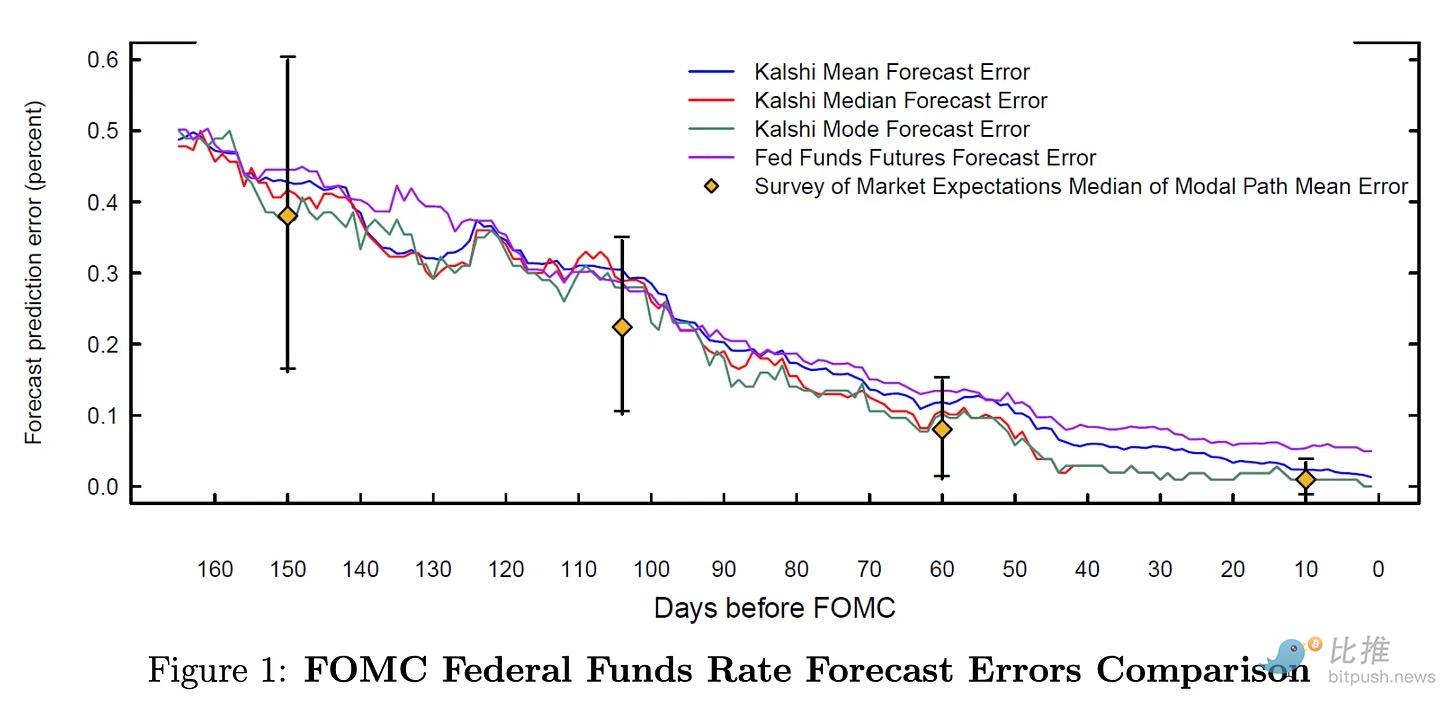
@FederalReserve

Despite similar statistical performance, Kalshi's uniqueness lies in its ability to provide more frequent, real-time probability curve updates for macroeconomic indicators such as GDP growth, core CPI, and unemployment rates. For estimates like inflation, the Bloomberg consensus is only available in the months leading up to the data release. This makes traditional estimates less frequent, with longer gaps that fail to reflect real-time expectation updates.

Kalshi not only provides predictions of outcomes but also real-time uncertainty ranges and tail risks. In early April 2025, uncertainty about trade policy temporarily raised inflation expectations. Although this uncertainty did not materialize, Kalshi priced this dynamic in real time. Monthly Bloomberg estimates could never capture this nuance.
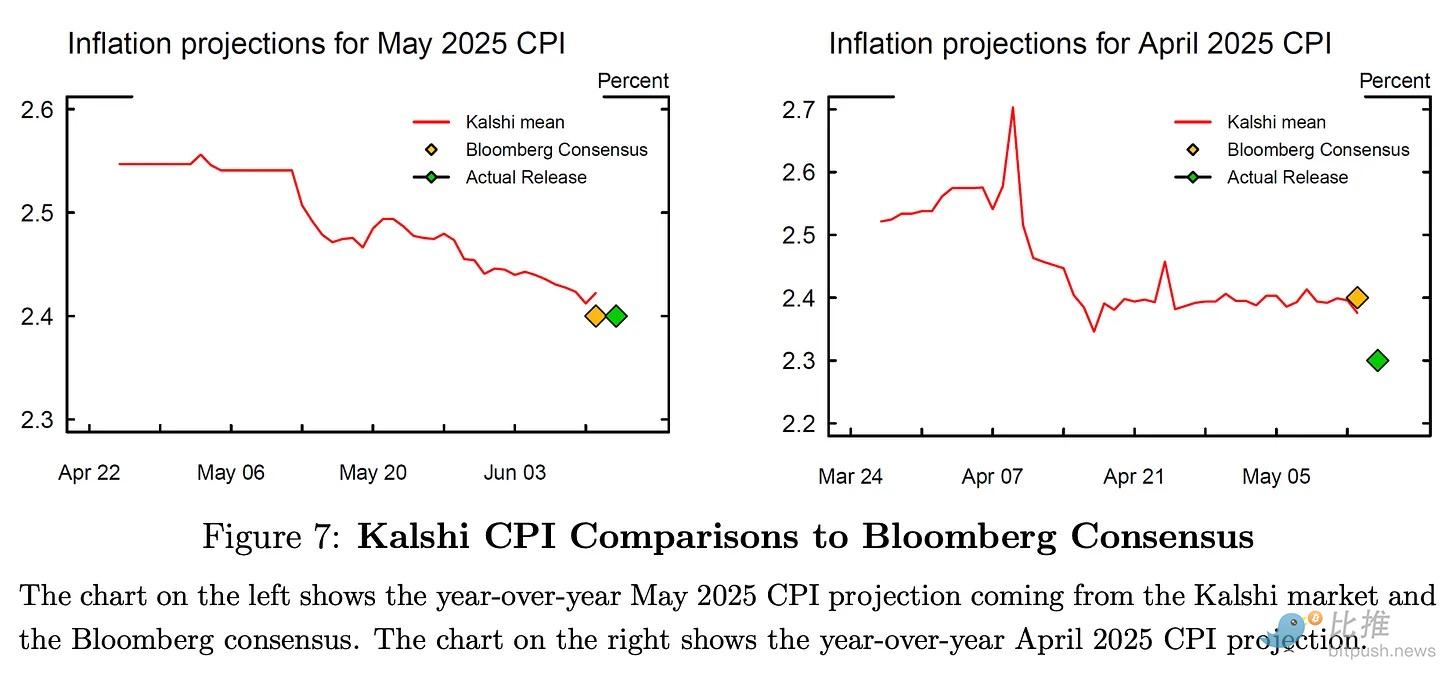
@FederalReserve

Today, when Federal Reserve governors speak at Federal Open Market Committee (FOMC) meetings, Kalshi's market odds move in real time. They price every word from the governors, providing policymakers with a perspective on how traders interpret the expected information.

For example, when Christopher J. Waller made dovish remarks ahead of the July 2025 FOMC meeting, the probability of no rate cut fell to 75%. After the stronger-than-expected June jobs report, this probability quickly rebounded to over 90%. The entire expectation of traders, backed by real money, is presented to policymakers in a way no other tool can currently achieve.

Who Trades on These Markets?

Before deciding how much to trust prediction markets, it is important to examine who is trading and what the volume represents.

Between September 2024 and January 2026, volume on Polymarket for FOMC meetings grew 11-fold, from $59 million to $660 million. In total, Polymarket's FOMC markets processed $2.6 billion, surpassing the combined total of the platform's culture, economy, geopolitics, and science categories.

So, who is trading such large amounts on FOMC meetings? While it is difficult to pinpoint on anonymous prediction platforms like Polymarket, we can speculate: it is hard not to think of macro hedge fund analysts involved in drafting labor statistics reports, or money market fund managers who stand to gain if rates are not cut.

Why them? The Iowa market worked because the number of people who put their money where their mouth is, with reliable information, outweighed those who merely gambling without it. While acknowledging the risk of over-assumption, I believe that when real stakes and funds of this scale are involved, those with reliable information converge on the market, leading to more accurate price discovery.

What to Be Wary Of

All this does not mean prediction markets can be perfect measuring tools for policymakers.

Probabilities in prediction markets also reflect traders' risk preferences. They are not a raw reflection of outcome expectations. For example, when Kalshi prices the probability of unfavorable CPI data at 15% while traditional surveys price it at 10%, this gap can be explained by two factors:

  1. Prediction markets may be pricing real-time information missed by the Bloomberg consensus.

  2. Traders may be paying a premium on prediction markets to hedge against unfavorable outcomes.

Policymakers must understand what this gap reflects before treating this information as a signal for policymaking.

While Kalshi's macroeconomic signals to policymakers seem reliable, over 85% of its total nominal volume comes from the sports category.
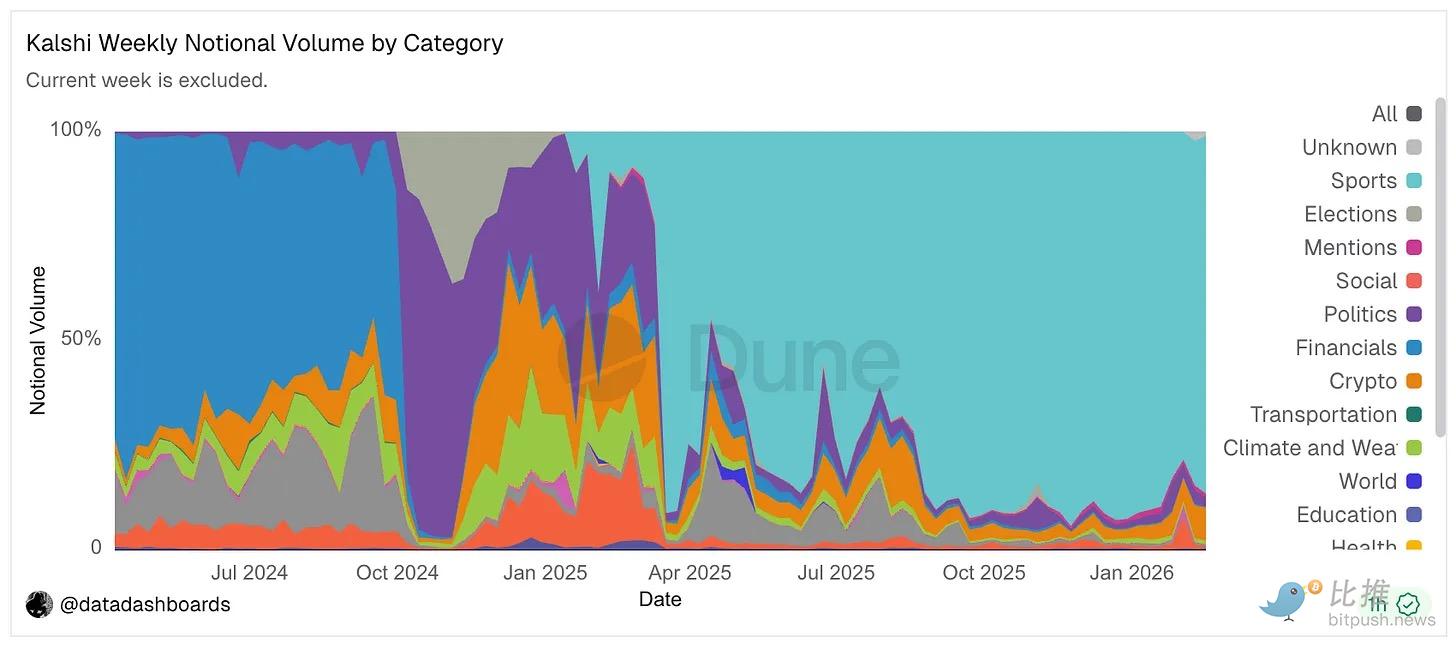
@Dune

Currently, at least 20 federal lawsuits are challenging the regulatory arbitrage achieved through nationwide sports betting for prediction markets.

The reliability of Kalshi's FOMC markets is partly due to sports betting providing the platform with foundational liquidity through active traders, narrow bid-ask spreads, and market-making infrastructure, which sustains all Kalshi markets. Although macro markets operate independently, they benefit from this foundation. If sports betting disappears under regulatory pressure, the platform will lose the liquidity engine that keeps spreads tight and prices continuous. Thinner macro markets become easier to move with less capital, making them more susceptible to manipulation.

The Fed's paper recommends using Kalshi as a monitoring tool, not a decision-making input. But making this intention public is itself problematic.

The authors suggest greater use of Kalshi to interpret incoming data and check real-time interpretations of Fed communications. However, because the intention to reference prediction markets is public, it could create a feedback loop.

For example, a policymaker at the Fed might see Kalshi pricing a 15% probability of a rate cut, lower than the expectation they wish to convey through their actions. In response, they might soften their rhetoric in the next speech, which could then cause fluctuations in global traditional interest rate markets. The problem here is that while Kalshi's FOMC market size is $660 million, the federal funds futures market is worth hundreds of billions of dollars. The former requires relatively small positions to change the odds. A well-funded participant, aware that moving Kalshi could influence subsequent Fed remarks (if not decisions), could use relatively small positions to move a much larger market. Policymakers' communications could become targets for manipulation.

This scenario highlights the difference between the 1988 Iowa futures market and the 2026 prediction markets. The Iowa economists back then simply wanted to determine if a market with real stakes could produce better predictions than surveys. At that time, policymaking was not under such close scrutiny to deter manipulators.

Back then, prices reflected true beliefs because those prices did not influence the world. They merely allowed those with insights to monetize them. Once the Fed publicly announces (if it does so) its intention to use prediction markets as a policy input, this attribute disappears. It also introduces a "performative" element to trading.

However, incorporating prediction market odds into the policy toolbox is not a misstep. Financial commitment still filters out empty talk. Informed participants continue to dominate price discovery. The result is a signal unmatched by surveys in terms of speed and distribution richness. For FOMC markets, this is more pronounced than any other application: there are participants on both sides with genuine hedging capabilities, and the market, by pricing real-time events frequently, better reflects real-time expectations.

Policymakers should mandate open-source data transparency as a prerequisite for formal adoption. If the data is not auditable, manipulation may go undetected. They should understand that both signal and noise come from the same place. People with real money and real beliefs can tell you what they think in real time.

For those powerful enough to game the system, this window of opportunity did not exist when the Iowa economists were conducting their academic experiment decades ago. Today, this window is wider than ever.


Twitter:https://twitter.com/BitpushNewsCN

Bitpush TG Discussion Group:https://t.me/BitPushCommunity

Bitpush TG Subscription: https://t.me/bitpush

Original link:https://www.bitpush.news/articles/7614191

Câu hỏi Liên quan

QAccording to the Federal Reserve working paper, how does the predictive accuracy of Kalshi compare to Bloomberg's consensus forecasts for core CPI and unemployment?

AThe paper found that Kalshi's predictions were statistically similar to Bloomberg's consensus expectations, with nearly identical prediction errors for core CPI and unemployment. In fact, Kalshi's forecasts for core CPI were significantly better than Bloomberg's estimates.

QWhat key advantage does the article highlight for Kalshi over traditional survey-based forecasts like Bloomberg's?

AKalshi provides more frequent, real-time updates to its probability curves for macroeconomic indicators, offering real-time uncertainty ranges and tail risk assessments that traditional surveys, which are only available months before data releases, cannot capture.

QWhat is the primary risk identified if the Federal Reserve were to publicly state its intention to use prediction markets like Kalshi as a policy input?

AIt could create a feedback loop and make policy communication a target for manipulation. A well-funded participant could use a relatively small position to move the odds on Kalshi, potentially influencing subsequent Fed communication and causing volatility in the much larger traditional interest rate markets.

QWhat does the article identify as the main reason for the historical success of prediction markets over traditional polls in forecasting election outcomes?

AThe mechanism forces people to express true beliefs backed by real money, which a survey questionnaire can never do. This aggregates information from a large crowd into a price that reflects genuine collective belief rather than a small, disproportionate sample.

QWhat major category currently provides the vast majority of the nominal trading volume on the Kalshi platform, and why is this a potential concern?

ASports betting accounts for over 85% of Kalshi's total nominal volume. This is a concern because the liquidity from sports trading supports the platform's infrastructure. If sports betting faces regulatory pressure and declines, the macro markets could lose liquidity, becoming thinner and more susceptible to manipulation.

Nội dung Liên quan

Báo cáo Ethereum Q1 2026: Phí giảm, người dùng và khối lượng giao dịch lập kỷ lục mới

Báo cáo Q1/2026 của Ethereum cho thấy một xu hướng đối lập: lượng người dùng, số giao dịch và thông lượng mạng lưới đều đạt mức cao kỷ lục, trong khi phí giao dịch, tổng giá trị bị khóa (TVL), khối lượng giao dịch và vốn hóa pha loãng hoàn toàn (FDV) của ETH lại giảm. Hiện tượng này được giải thích là "Nghịch lý Jevons": việc giảm chi phí sử dụng mạng lưới sau đợt nâng cấp Fusaka đã giải phóng nhu cầu, thúc đẩy tăng trưởng quy mô. Báo cáo nhấn mạnh sự chuyển dịch trong định vị cốt lõi của Ethereum từ một blockchain DeFi sang một tầng thanh toán tài chính toàn cầu. Ethereum tiếp tục thống trị thị trường tài sản được mã hóa, chiếm phần lớn thị phần trong các lĩnh vực stablecoin (61,8%), quỹ được mã hóa (73%), hàng hóa được mã hóa (84%) và cổ phiếu được mã hóa. Sự tham gia của các tổ chức lớn như BlackRock, JPMorgan và Fidelity đang đẩy nhanh quá trình "thể chế lên chuỗi". Mặc dù phí giao dịch tầng cơ sở giảm mạnh (-47,9%), đây được xem là một sự đánh đổi có chủ đích để đổi lấy tăng trưởng mạng lưới dài hạn. Chiến lược này nhằm củng cố vị thế là nền tảng định sẵn cho việc thanh toán và quyết toán các tài sản tài chính ngày càng được mã hóa, từ đó tạo ra giá trị cơ bản cho ETH thông qua nhu cầu sử dụng mạng lưới.

marsbit1 giờ trước

Báo cáo Ethereum Q1 2026: Phí giảm, người dùng và khối lượng giao dịch lập kỷ lục mới

marsbit1 giờ trước

Anh ấy vừa gọi được 2,7 tỷ USD, Lý Phi Phi cũng rót tiền đầu tư

"Generalist AI", công ty khởi nghiệp trí tuệ thể hiện (embodied AI) do Pete Florence - cựu nhà khoa học nghiên cứu cốt cán của Google DeepMind và là một trong những người đặt nền móng cho kiến trúc mô hình VLA (Vision-Language-Action) - sáng lập, vừa huy động thành công 4 tỷ USD (tương đương 27 tỷ RMB) ở vòng gọi vốn mới, định giá 20 tỷ USD. Vòng đầu tư có sự tham gia của các tổ chức và cá nhân uy tín như NVentures (từ NVIDIA), NFDG, Bezos Expeditions, đồng sáng lập Xiaomi Lin Bin, người sáng lập Zoom Eric Yuan, và nhà khoa học nổi tiếng Fei-Fei Li. Mặc dù được coi là người tiên phong trong lĩnh vực "mô hình thế giới" (world model), Florence lại công khai phản đối việc dán nhãn này cho công ty mình. Triết lý của ông, chịu ảnh hưởng từ người thầy Russ Tedrake tại MIT, là ưu tiên "mục tiêu" cụ thể hơn các "nhãn" công nghệ chung chung. Mục tiêu tối thượng của Generalist AI là tạo ra những robot đa năng có thể thực hiện với độ tin cậy cực cao nhiều nhiệm vụ chưa từng thấy mà không cần dữ liệu huấn luyện riêng cho từng tác vụ. Để hiện thực hóa điều này, Generalist AI đã lần lượt ra mắt các mô hình GEN-0 và GEN-1. GEN-1, được công bố vào tháng 4/2026, được huấn luyện trên hơn 50 nghìn giờ dữ liệu tương tác vật lý thu thập qua một thiết bị đeo tay đặc biệt. Theo công ty, mô hình này đạt tỷ lệ thành công 99% trong một số nhiệm vụ thao tác lặp lại và tinh vi (như gấp hộp, đóng gói), với tốc độ nhanh gấp ba lần GEN-0 và chỉ cần khoảng một giờ để thích ứng với tác vụ mới. Thành tựu này chứng minh lộ trình phát triển rõ ràng của công ty và là lý do chính thu hút được sự ủng hộ mạnh mẽ từ các nhà đầu tư hàng đầu, đưa Generalist AI trở thành một trong những công ty được kỳ vọng nhất trong lĩnh vực robot và trí tuệ thể hiện.

marsbit1 giờ trước

Anh ấy vừa gọi được 2,7 tỷ USD, Lý Phi Phi cũng rót tiền đầu tư

marsbit1 giờ trước

Mất hai huyền thoại trong ba ngày: Con đập nhân tài AI của Google đang vỡ?

Chỉ trong ba ngày, Google đã chứng kiến hai huyền thoại AI rời đi: Noam Shazeer (đồng tác giả Transformer, lãnh đạo Gemini) gia nhập OpenAI, và John Jumper (người đoạt giải Nobel Hóa học 2024, lãnh đạo AlphaFold) chuyển sang Anthropic. Đây không phải là trường hợp cá biệt mà là một xu hướng rõ ràng, bổ sung cho việc cựu thành viên sáng lập OpenAI Andrej Karpathy gia nhập Anthropic trước đó. Các tài năng AI hàng đầu đang tập trung ngày càng nhiều vào OpenAI và Anthropic, khiến Google trở thành nguồn cung cấp chính trong cuộc tái cấu trúc nhân tài này. Sự dịch chuyển này bắt nguồn từ sự khác biệt cốt lõi về sứ mệnh. Google, với doanh thu chính phụ thuộc vào quảng cáo, thường đặt các dự án AI trong khuôn khổ phục vụ mục tiêu sản phẩm và lợi nhuận. Ngược lại, OpenAI (với sứ mệnh AGI) và Anthropic (tập trung vào AI an toàn) cho phép các nhà nghiên cứu tập trung hoàn toàn vào việc đẩy xa giới hạn năng lực mô hình. Ngoài ra, cơ hội thu lợi nhuận lớn từ cổ phiếu trước thềm IPO của hai công ty này là động lực hấp dẫn mà Google - một gã khổng lồ trưởng thành - khó có thể sánh được. Việc sáp nhập Google Brain và DeepMind vào năm 2023 cũng tạo ra những lực ly tâm mới, làm xói mòn văn hóa nghiên cứu dài hạn dưới áp lực phải phù hợp với lộ trình sản phẩm. Sự ra đi của các nhân vật then chốt như Jumper và Shazeer phản ánh điều này. Cuộc khủng hoảng nhân tài này mang tính cấu trúc. Google có thể sở hữu cơ sở hạ tầng máy tính khổng lồ và kho dữ liệu đồ sộ, nhưng việc thiếu những bộ óc xuất sắc nhất để khai thác chúng khiến lợi thế đó trở nên vô nghĩa. Trong khi OpenAI và Anthropic củng cố vị thế với đội ngũ tinh nhuệ ngày càng mạnh, Google đang mất dần hào quang là trung tâm hấp dẫn nhân tài AI toàn cầu. Trong cuộc đua mà mật độ tài năng quyết định năng lực mô hình và thị phần, đây là một thách thức tồn vong thầm lặng nhưng nghiêm trọng của Google.

marsbit3 giờ trước

Mất hai huyền thoại trong ba ngày: Con đập nhân tài AI của Google đang vỡ?

marsbit3 giờ trước

Phía sau bảng điểm AI, ẩn giấu một 'người ra đề' gốc Hoa

Mỗi khi một mô hình AI tiên tiến ra mắt, giới công nghệ lại dõi theo những “bảng điểm” quen thuộc như MMLU-Pro, MMMU hay MMMU-Pro. Đây là các tiêu chuẩn đánh giá quan trọng giúp so sánh năng lực của các mô hình lớn như GPT, Claude hay Gemini. Tuy nhiên, ít người biết rằng đằng sau những bộ đề thi này là một nhà nghiên cứu người Hoa: Chen Wenhu (Trần Văn Hổ), trợ lý giáo sư tại Đại học Waterloo, Canada. Ông cùng phòng thí nghiệm TIGERLab (còn gọi là Hổ Đầu Bang) đã tạo ra MMLU-Pro vào năm 2024 để giải quyết vấn đề “mất chuẩn” của bộ đánh giá MMLU cũ, khi nhiều mô hình tiên tiến đạt điểm gần tuyệt đối, khó phân biệt được sự khác biệt thực sự. MMLU-Pro với hơn 12.000 câu hỏi, mở rộng lựa chọn và tăng cường các câu đòi hỏi suy luận, đã giúp kéo giãn khoảng cách điểm số và đánh giá ổn định hơn. Trước đó, nhóm của Chen Wenhu cũng phát triển MMMU - bộ đánh giá đa phương thức (multimodal) yêu cầu mô hình kết hợp hiểu biết hình ảnh, biểu đồ với kiến thức chuyên môn để trả lời câu hỏi. Ngay cả các mô hình mạnh nhất thời điểm đó như GPT-4V cũng chỉ đạt độ chính xác khoảng 56%. Phiên bản MMMU-Pro sau này được thiết kế để đảm bảo mô hình không thể “bỏ qua” thông tin hình ảnh mà chỉ dựa vào văn bản để đoán đáp án. Nghiên cứu của Chen Wenhu tập trung vào việc hiểu thông tin phức tạp, hỏi đáp tri thức và suy luận. Ông từng làm việc tại Google Research và DeepMind, tham gia vào dự án Gemini, trước khi gia nhập Đại học Waterloo và thành lập TIGERLab. Phòng thí nghiệm không chỉ tạo ra các bộ đánh giá mà còn nghiên cứu phát triển mô hình, chẳng hạn trong lĩnh vực xử lý video. Hiện tại, Chen Wenhu làm việc tại Phòng thí nghiệm Siêu trí tuệ (Super Intelligent Lab) của Meta, tiếp tục tập trung vào dữ liệu huấn luyện và đánh giá đa phương thức. Công việc của ông và nhiều nhà nghiên cứu người Hoa khác đang đóng góp quan trọng vào sự phát triển chung của ngành AI, dù có thể không nằm dưới ánh đèn sân khấu.

marsbit3 giờ trước

Phía sau bảng điểm AI, ẩn giấu một 'người ra đề' gốc Hoa

marsbit3 giờ trước

Giao dịch

Giao ngay
Hợp đồng Tương lai
活动图片