Source: Zhang Peng's Tech Business Observation
Early this morning, I received a WeChat message from a co-founder of Manus: "Brother Peng, we have a new development today. We couldn't reveal too much before. Now that it's officially announced, I'm telling you first."
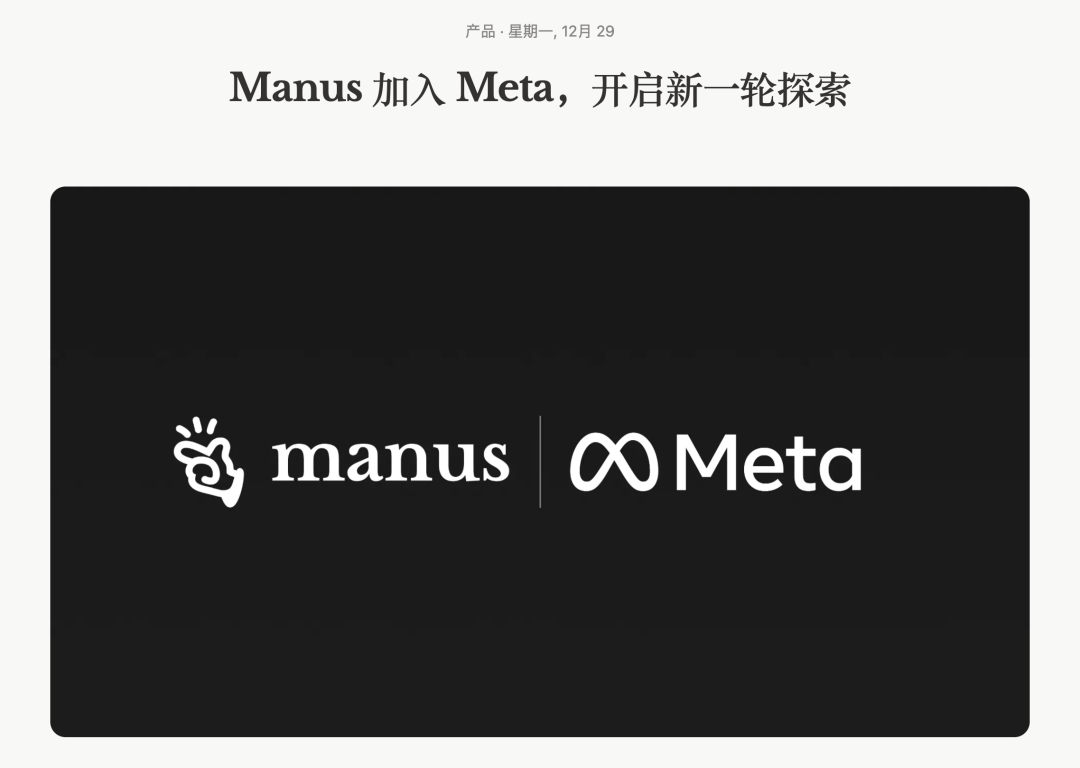
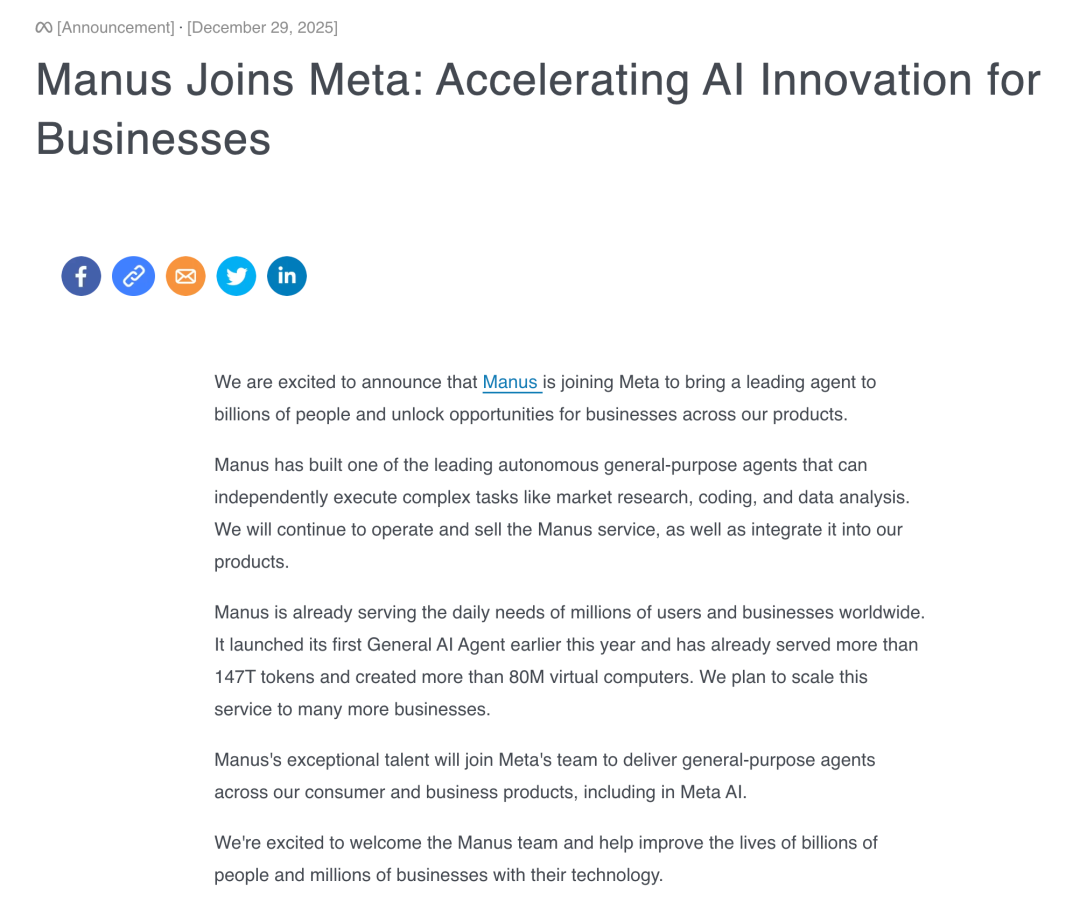
Previously, Manus's new funding round at a $2 billion valuation was underway, which was already confirmed by the industry. But not long ago, I heard about the possibility of a deal with Meta involving nearly $4-5 billion (unconfirmed rumor), which initially seemed too good to be true. I didn't expect it to happen so quickly—it was lightning fast.
Over a year ago, founder Xiao Hong and the team rejected a tens-of-millions-dollar acquisition deal from a certain giant. He told me, "We hesitated, but ultimately realized that there aren't many opportunities in life worth going all-in on. We didn't want to give up this chance." Now, going all-in has paid off. Relying on the Manus product, they achieved over a hundredfold growth in value in less than a year, hitting a "home run" within the year!
We must applaud their decision to boldly explore further back then, congratulate them on their remarkable回报, and also thank them for validating the value and opportunities of AI application innovation before the end of 2025. This will greatly boost the confidence of all entrepreneurs and investors.
I previously wrote an in-depth analysis of Manus. The subsequent developments and today's deal largely confirm that analysis, which I'm sharing again with everyone. (Original article published in May 2025)
Here's to AI entrepreneurs: your upcoming 2026 will be just as exciting!
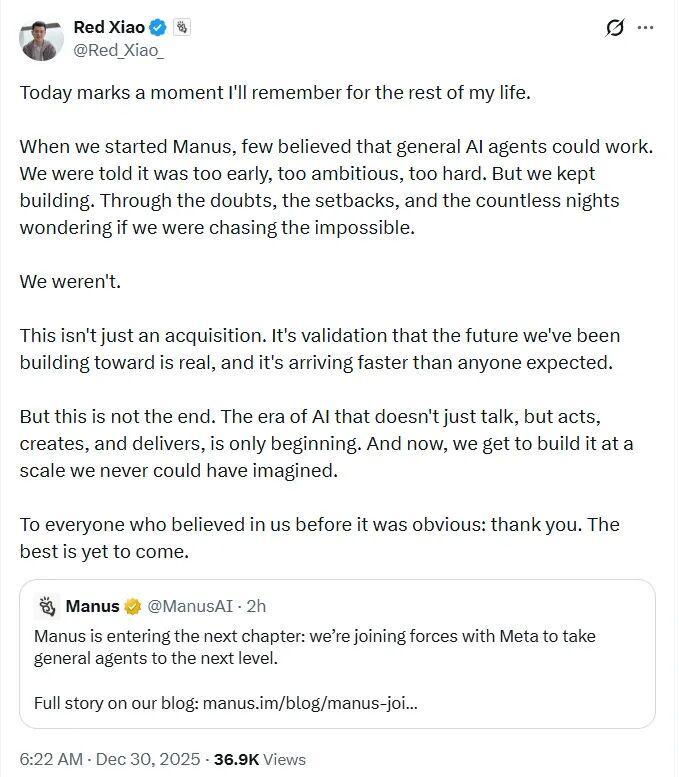
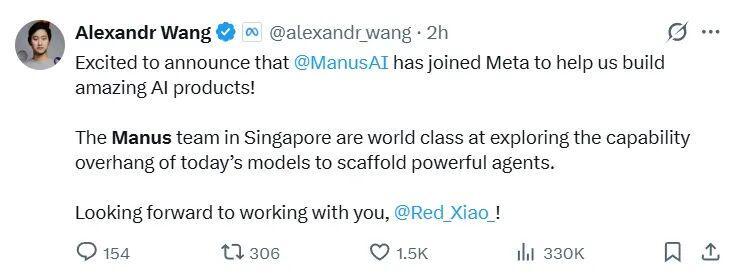
News has been circulating in the circle these days: Manus has nearly $100 million in ARR and has reached a valuation of $2 billion.
After Manus was launched, the reception domestically and internationally was vastly different. It gained significant attention domestically in March this year but was quickly met with widespread skepticism and criticism. Since GeekPark reported on Manus early and gave it high praise, more than one person told me, "GeekPark is betting its 15-year reputation on promoting this company!"
As the saying goes, three people spreading rumors make a tiger. These baseless comments made me quite anxious for a while, even leading me to反思 whether our judgment was truly "amateur."
Later, I realized there was really no need for反思 because when I turned my attention overseas, especially to Silicon Valley, I found that although Manus wasn't as hotly discussed collectively as it was domestically, people in the AI community there generally tended to view it positively.
Particularly in my exchanges with internal personnel at OpenAI, Microsoft, Google, etc., in the U.S., I found these giants are taking Manus very seriously. For example, Google internally places extreme importance on Manus, with engineers almost stationed within the Manus team to assist in better integration with the Gemini model. At Microsoft, CEO Satya Nadella has already met face-to-face with the Manus team, expressed considerable praise, and is actively promoting cooperation. It's no exaggeration to say they are one of the most beloved Agent startup teams by overseas giants recently.
Why can such a relatively early-stage startup originating from China, with a product once deemed "nothing special" by the domestic startup circle, be questioned at home but rapidly "break out" globally in the AI industry ecosystem? This is worth some deep thinking.
01"No Model" but Bringing an Incremental Game
"Not having its own model" is the most common criticism of Manus domestically. But from another perspective, standing from the立场 of giants like Google and Microsoft who possess powerful foundational models, they might see Manus and their eyes light up: "Hey, this guy has no model but can still make something like this! It's another token consumption outlet for my model."
If the AI Agent path ultimately can only be played by giants with their own models, then this game would indeed be too narrow, merely a "存量 game + zero-sum game" among a few giants.
But the truly large companies in this world became giants not just by relying on their own business or product's "self-sufficient small-scale peasant economy," but by building an ecosystem that includes "trade and division of labor." Some of their core capabilities drive ten or even a hundred times more "external" value than their own business, meaning that when they share value with others, they can also obtain greater benefits themselves.
Therefore, the giants who have invested huge resources in developing models also hope to see a prosperous application-layer ecosystem. If someone can use their models to solve more practical problems, create richer application scenarios, and consume more tokens, naturally, the more, the merrier.
A product like Manus, connected to all top models behind the scenes, consumes tokens of the large models and compute power of cloud providers with every task executed. If Manus's ARR is indeed close to $100 million, calculate how much value actually goes to the giants behind the models? It seems reasonable that they are taken seriously.
This suddenly made me feel that sometimes entrepreneurs shouldn't be too hesitant about "will the giants also do this thing?" terminal thinking.
Thoughts are products of the environment. GeekPark has accompanied entrepreneurs for the past 15 years, experiencing too much "giant PTSD" with them. I think my own thinking may have also become accustomed to the Internet era giants' "winner-takes-all" and has a huge惯性 of "存量思维".
Actually, looking at it now, overseas giants, including OpenAI, which internally clearly considers products like Manus as "peers" worth paying attention to, generally have an open mindset, mostly providing active help early on and observing closely in the long term. After all, Manus is still in its early stages, and calling APIs and cloud services is not a bad thing.
Since overseas giants do have control in the model field, which is also the core they are currently死死盯着, and they can generally "dare to be later than the world" and seek stability in productization, they would be happy to see such a vibrant new sprout grow in the ecosystem. If this sprout can grow into a big tree that expands the ecosystem圈, it would be beneficial to the entire ecosystem.
If it becomes clear in the future that this tree has the value to become a forest alone, then whether these closely observing giants will offer sufficiently favorable conditions to turn this "increment" into their own "new存量" depends on the development speed of this new sprout during its growth period, the barriers it explores on its own, and the giants' judgment of its future value ceiling.
This incremental thinking is not only worth借鉴 for entrepreneurs but also worth复盘 for domestic large companies.
Actually, the Manus team had already been noticed by domestic giants when they were working on Monica.im. Their idea to explore a通用 Agent was likely known by the giants, and even之前有巨头 had already made clear acquisition offers. But according to the internal information from domestic giants反馈 to the GeekPark team, they either wanted to recruit them early to work for them now or sought relatively maximum control, wanting to take the lion's share of the value now and in the future.
This可能需要改改了. In the AI era, large companies need to focus on what large companies should do, not engage in a存量 game with entrepreneurs from the start. It is necessary to重新思考 the relationship with entrepreneurs with a more open "incremental thinking."
02"Quantum Tunneling" and "Barrier Change"
If it is understandable "business logic" for Manus to be praised by industry giants, then why can it, as a not-yet-mature cutting-edge product, quickly obtain such high ARR, and why would overseas capital give it such high valuation recognition?
Regardless of whether Manus's product is sufficiently perfect today or whether others can also make it, it must be seen that it has indeed obtained huge "first-mover红利." Even if后续 other relatively better similar products appear, as long as they are not "cross-generation" improvements, it will be difficult to replicate similar excess红利.
I think the "quantum tunneling effect" in quantum physics and the "barrier change" it brings can be a good analogy for the answer to this question.
First, "quantum tunneling." Imagine a small ball trying to climb over a high mountain. According to classical physics, if the ball's kinetic energy is insufficient, it cannot climb over. But in the quantum world, particles have "wave-particle duality"—they are both an entity and a probability wave. Therefore, even with insufficient energy, they still have a certain probability to "tunnel" through, as if appearing out of thin air on the other side of the mountain. This seemingly counterintuitive phenomenon恰恰 can explain the breakthrough paths of many startups: they have limited resources and seem unable to shake the industry格局, but certain innovations allow them to "penetrate" the barriers and achieve market breakthroughs.
And even more神奇的是, once a particle successfully tunnels, the entire competitive landscape undergoes structural changes—this is the "barrier change" in quantum physics. First, the "height" of the barrier decreases—the first mover validates market demand and technical feasibility, making it easier for latercomers to replicate similar products. For example, after OpenAI launched ChatGPT, the barrier to entry for large model entrepreneurship significantly decreased, and various companies quickly followed suit. But at the same time, the "width" of the barrier increases—the user, capital, and ecological advantages accumulated by the first mover make it difficult for latercomers to truly颠覆 its position unless they achieve "cross-generation innovation." Tesla is also a typical case: after it率先突破 the electric vehicle market, although new forces rose faster, it is still difficult to shake its industry dominance至今.
Manus's path is similar. When the通用 AI Agent was not yet mature, it did not wait for the giants to act but used engineering capabilities to "tunnel" through technical barriers and obtain first-mover红利.
So how do entrepreneurs who themselves don't have that much energy obtain such a "quantum tunneling effect"? Actually, quantum physics also has an explanation, which is similar to the way of "probability cloud"—because particles have "wave-particle duality," it seems that a particle's own energy is insufficient to penetrate (a small team doesn't have the energy to break through the giant's capabilities), but sometimes it miraculously bypasses in the form of a "wave" (i.e., makes a technology or product that the giant didn't think of or make). And the smaller the mass of this particle, plus the higher the initial energy, plus the narrower the energy barrier width it faces, the greater the penetration probability.
Isn't this the "efficient + sharp + focused" innovation breakthrough strategy that GeekPark has seen countless startup teams use over the years?
Returning to Manus, I think Manus's achievements still stem from daring to be the first to tackle a goal that others were still watching. Its extremely determined goal selection, all-out engineering investment, plus the practical积累 from past Monica, brought a relatively high "initial energy" within the startup team.
I specifically checked the articles and discussions in the GeekPark community. As early as last spring, discussions about Agent had already begun in the industry. Throughout 2024, progress in Coding and Computer Use was also明牌, vertical field Agents even started to have ARR, but most people were waiting for giants to make通用 Agents because everyone felt that without their own model and world-class engineering capabilities, they couldn't do this.
But actually, the "energy barrier" at this time was not as high as imagined. The rapid development of model capabilities, although still not directly achieving通用 Agent capabilities, was only a large chunk of engineering problems away from the "通用 Agent concept machine" by early 2025. No entrepreneur could penetrate with "particles" (model capabilities), but whoever first passed through in the form of "waves" (engineering enhancement), then "quantum tunneling" was就在眼前.
It can be said that teams like Manus and Genspark were the first to "overestimate their capabilities" and choose this goal that most people were waiting for "giants" to achieve, then started at full throttle to "handcraft," "replace magic with engineering," and successively gave phased clear results. This当然会有市场给予的强烈正反馈.
Writing here, I suddenly remember a line from the movie "Batman v Superman," where Batman says to Superman: "You are not brave, Men are Brave."
He means: Superman's "bravery" is a byproduct of his near-godlike super abilities, while mortals who advance despite difficulties show greater courage.
In front of global AI leaders, even Chinese Internet giants with super abilities like "gods," Deepseek is undoubtedly the "Batman"—a mortal superhero (also consistent with the fact that Liang Wenfeng, like Batman's true identity Bruce Wayne, has certain resources to support his beliefs). And teams like Manus and Genspark are probably amazing "true civilian heroes." And they certainly deserve applause.
In the past, Chinese startup teams rarely received such high-level treatment in the core of the global technology and business ecosystem at such an early stage so quickly. This should show Chinese entrepreneurs another possibility. This is even a significant contribution to the Chinese entrepreneur community. For example, recently, Silicon Valley has become increasingly interested and confident in the product and engineering capabilities of Chinese entrepreneurs in the AI field, which无形中 paves a new path for latercomers.
Therefore, what Chinese entrepreneurs should see from this is not "tactical"刻舟求剑, but also that this is indeed an opportunity to利用时代变革机遇, aim for higher "energy leap" goals.
This requires some "mortal courage" and the ability to think about problems within the broader world view of the global technology ecosystem.
03 What Should Be the Next Goal for Manus and Others?
Next, we should talk about challenges because the challenges for Manus and others are still huge. I think the key next is to, wave after wave, continuously shape hit scenarios on top of their universal AI Agent foundation that allow users to see practical effects and actively participate.
This reminds me of Douyin (TikTok) back in the day. How did it become popular? It was by constantly inspiring everyone to imitate a热门 dance, a challenge,卷入 new users wave after wave. Then new玩法 constantly emerged in the platform, attracting more people to participate. From active use early on to systemic emergence later.
Today's technology is still advancing and仍需不断进步, which determines that user conversion cannot be completed uniformly at some "perfect moment" in an instant but must be a gradual process. So what is needed next is the ability to带动 users,卷入 more users batch by batch.
Actually, before Manus, in 2023, when I discussed their AI browser plugin Monica with Xiao Hong at the AGI Playground conference, it felt more like a "feature phone"—adding functions meant adding pipelines. The birth of every new hotspot might mean a new product development logic, also a completely new project.
But today, Manus has a universal foundation, more like a "smartphone"—on this universal base, more efficient creation of endless good applications is possible. It may not require hiring大量 engineers, building countless project lines, but rather observing in which scenarios users use it well, doing "subtraction," optimizing these verified paths, making delivery results better and more certain, and making operational efficiency higher.
This way, first-mover advantage combined with user反馈 can form a positive cycle—a scene becomes popular, breaks out, and then drives the growth of the entire platform. And it can keep breaking out and growing.
Actually, observing "universal AI products" with high user volume, such as user Q&A demands on ChatGPT or domestic DeepSeek, it can be seen that most demands are not that deep and complex. It's the same in the Agent field; there aren't that many users who have such高频 complex tasks in their minds. It is likely that 80% of users' 80% most commonly used tasks can收敛 to a certain extent. And being the first to deliver 80% well for the tasks where these two 80%s overlap, you are the "universal Agent" in their minds.
The actual震惊 result brought by this demand收敛 model is thatcovering half of the core scenarios can trigger a "universal feeling."
So although Manus's ARR income is already $100 million, I think we should not look at the meaning of today's income with traditional ARR. More income当然 first represents more users卷入, but the income brought by repeated token consumption of similar tasks is more meaningful, as it means effectively locking in the user's "workflow" and "life flow." This retention is key.
Today, don't engage in a "self-sufficient small-scale peasant economy." For example, at this stage, you need the ability to increase users' meaningful token consumption,而不是整天思考如何降低 token 消耗来增加自己的利润. Only then do you play a positive role for other forces in the AI industry.
The level of AI technology and the cost of technology will certainly increase一边 and decrease一边 over time. The result is that optimizing costs today has little significance for the future. Meanwhile, user mindset, the Prompt habits brought by the large model era, personalized data, and the locking of workflows and life flows are resources that are easily obtained with first-mover advantage but will become increasingly expensive to obtain in the long run.
Therefore, for universal AI products, as long as there are resources, the only correct strategy is, on the aforementioned "demand收敛 model," to use continuous innovation results and better delivery to form user卷入. Only users are the barrier, the constantly appreciating asset.
So the $75 million Manus raised seems like a lot, but it certainly isn't enough. And the less sufficient it is, the more effectively it must be spent. The most inappropriate way to spend it might be to directly buy traffic in large amounts, invest in advertising, and pay "startup tax" to giants. Effective investment should be to "regardless of cost" deliver experiences beyond user imagination and continuously achieve those "Amazing goals."
In the final analysis, the simple logic of business is: when others can't do it, and you can, you are most valuable, and you can also acquire users at the lowest cost. After all, entrepreneurs always need to find opportunities at the intersection of the technology diffusion curve and the market demand curve.
04 The Discussion About "Shelling" Can Be Turned Over
Finally, let's talk about the "shelling" issue.
A couple of days ago, I was chatting with Li Zhifei, the founder of Mobvoi, and he made a good point. A computer, as a system, besides the CPU, importantly must have a series of management systems like process management, memory management, peripheral management, etc., to ensure its effective operation. But if we regard large models as a new CPU today, these peripheral systems still have大量 problems未被解决, which is actually a major obstacle currently.
This sparked our thinking: if we regard AI Agent as a revolution in personal computing, meaning the purpose of personal computing is no longer to provide a workbench for various tools in the digital world but to input demands and directly output final results交付. Then relying on large models (analogous to CPU) alone is not enough; a large number of related management systems need to be built. And there are大量工程问题需要被认真地解决 here. For example, better virtual machines, longer context,大量 MCP, even smart contracts... a series of engineering problems are huge demands.
After the industry's狂奔 over the past 2+ years, we should already clearly see that the progress of large models themselves is still the biggest driving force. But as always, after every technological breakthrough, humans discover that "improving engineering precision" still has huge value for technological development.
Manus and others can completely ignore the "shelling" argument. You can say every Apple phone is a shell for the CPU, but this shell can also be a complex and refined product engineering. This certainly has meaning and will inevitably experience a百花齐放,百舸争流, among which companies with sufficient value will certainly be produced.
In this world view, opportunities also belong to more entrepreneurs.



















