Jensen Huang: Prompts are Becoming Obsolete, Loops are the New Paradigm

marsbitXuất bản vào 2026-06-25Cập nhật gần nhất vào 2026-06-25

Tóm tắt

Jensen Huang, alongside AI leaders like Peter Norvig, Boris Cherny, and Andrew Ng, is advocating for a shift from "prompt engineering" to "loop engineering" as the new paradigm for AI development. Instead of manually crafting individual prompts, the focus is now on designing autonomous loops—systems where AI agents execute tasks, self-validate results, and iterate until completion without constant human oversight. A loop is a management framework that enables agents to operate independently. Key implementations are seen in Claude Code (with features like /loop, /goal, and /schedule) and OpenAI Codex, which employ multiple agents working in parallel within isolated environments. A core principle is the separation of roles: one agent (or model) performs the task, while an independent agent (or a smaller, separate model) validates the output to ensure objectivity. The article outlines a practical roadmap for implementing loops, starting with a "four-condition test" to assess suitability, building a minimal viable loop, and emphasizing critical pitfalls to avoid, such as lacking hard stop conditions or allowing loops to handle tasks requiring human judgment. This evolution is framed as the fourth major shift in AI interaction: from Prompt Engineering (crafting instructions) to Context Engineering (providing background information), then to Harness Engineering (building tool-enabled environments), and finally to Loop Engineering (creating self-sustaining systems). This progress...

Prompts are dead, long live loops.

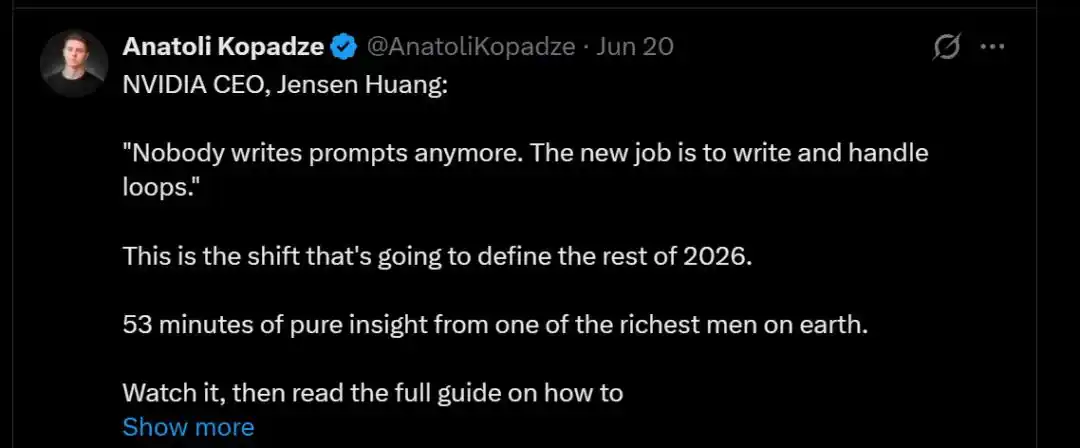
This is the new focus for AI trends recently hyped online and highlighted by Jensen Huang:

Nobody writes prompts anymore. The new job is to write and handle loops.
What is a loop? Translated literally, it means 'cycle,' but in AI circles, it means:

You no longer manually give instructions to the AI. Instead, you design a system where the system gives instructions on your behalf, checks the results, and retries if they are unsatisfactory until the job is done.

Huh? Isn't this what Agents do nowadays? Why coin a new term?

Let's set this question aside for a moment. Looking around, I found this 'loop' concept is indeed hot—

Besides Jensen Huang, big names like Peter Thiel, 'Claude Code father' Boris Cherny, and Andrew Ng are all talking about and strongly promoting loops.

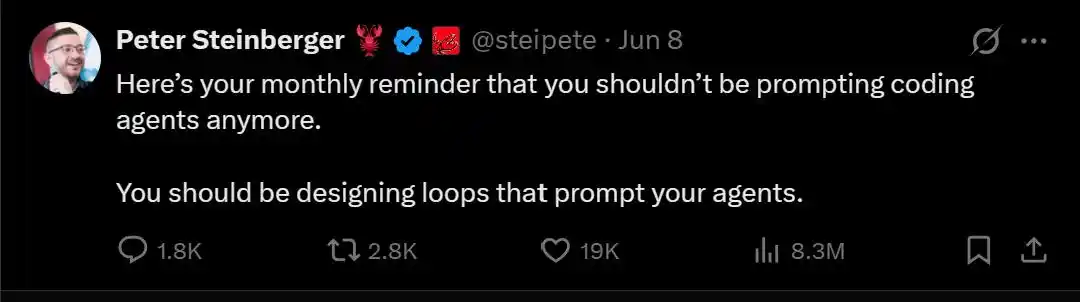
(Peter) Stop writing prompts for programming Agents. Design loops instead, letting the loops prompt the Agent for you.
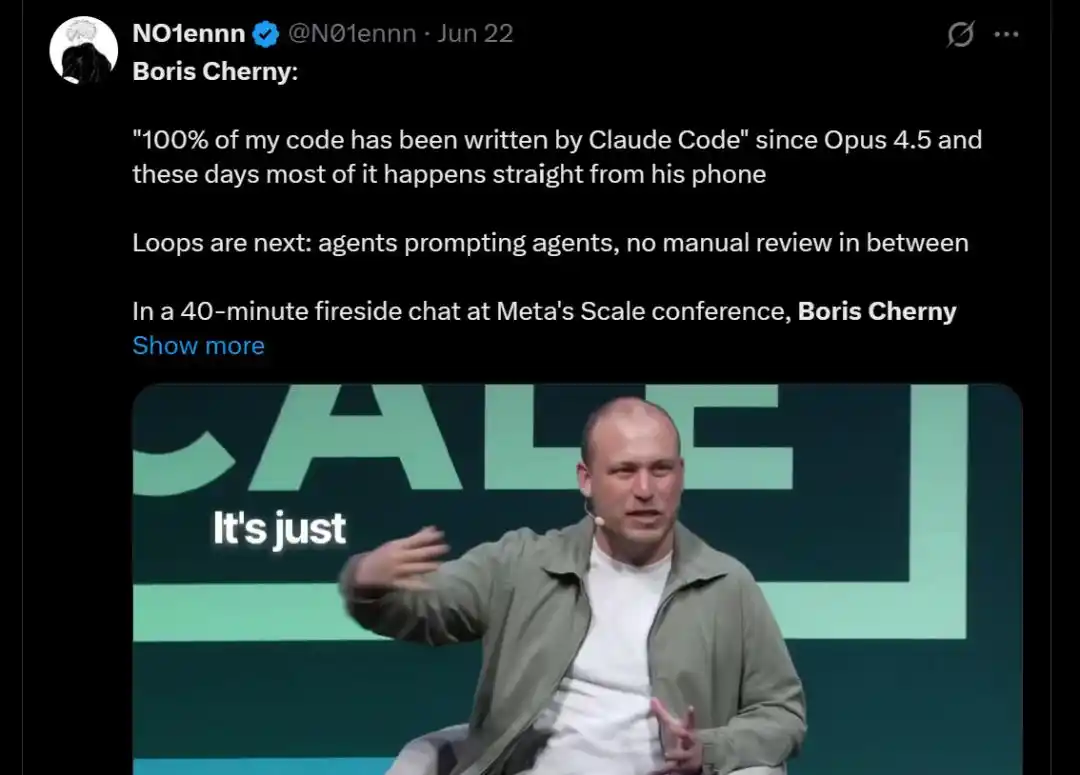
(Boris) I don't write prompts for Claude anymore. I have a bunch of loops running; they are the ones giving Claude instructions and deciding what to do next. My job is to write loops.
Now that 'writing loops' has replaced 'writing prompts' as the new daily routine for these big names, loops have clearly moved beyond just being 'another new concept.'

The remaining questions are only:

What exactly is a loop? And why has it suddenly become so popular?

What exactly is a loop?

To understand this new thing called a loop, we must first review the old paradigm.

The standard practice for AI programming in the past two years was like this:

You write a prompt, the AI spits out some code. If you're not satisfied, you write another prompt, the AI modifies it, you review it again... Back and forth, with you supervising the entire process.

Karpathy indirectly criticized this 'human as the bottleneck' issue and advised:

You can't sit there waiting to write a prompt for every step. You have to remove yourself from the loop.
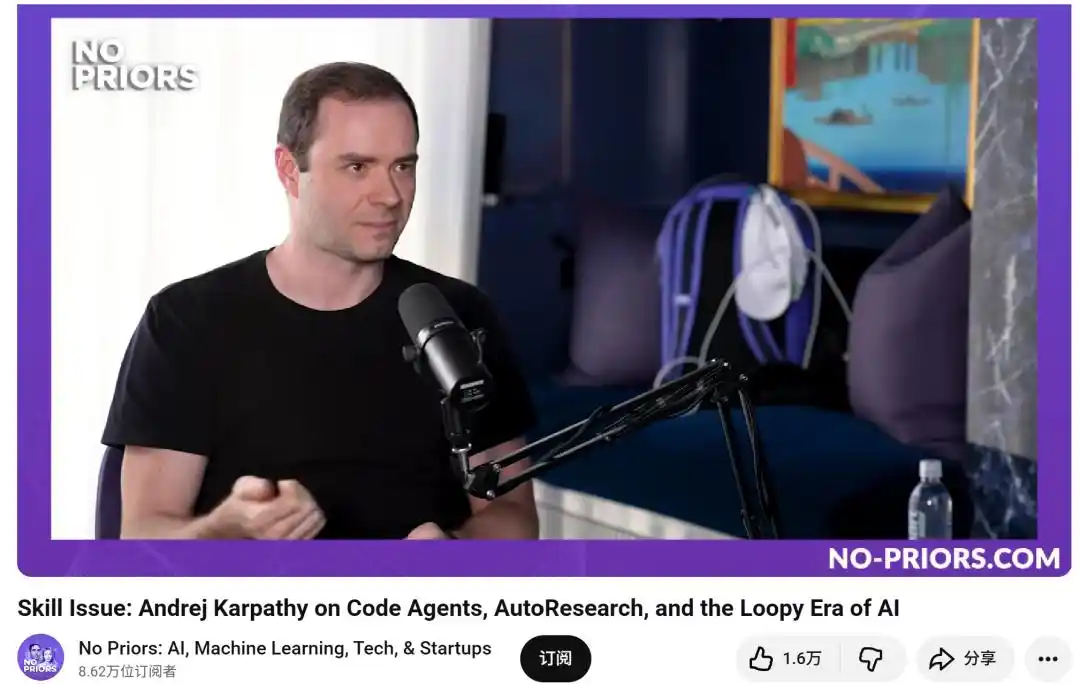
Removing the human from the loop is precisely what loops aim to solve.

The core logic is simply one sentence:

You define a goal. The AI runs by itself, checks its own work upon completion, and if it fails, it takes the error report and starts another round. It stops only when it passes or hits the budget limit.

At this point, the human's role shifts from being a 'messenger' to a 'rule designer.'

So, back to the initial question: How is this different from an Agent?

Obviously, an Agent is the worker, while a loop is the management mechanism that allows this worker to keep working without you watching over it.

An Agent without a loop moves only when you give a command, essentially remaining an obedient tool.

An Agent equipped with a loop truly becomes a self-sustaining system.

The principle sounds simple, but it might still seem a bit abstract.

Don't worry. I looked into the current practical implementations of loops and found they are already embedded in systems we are familiar with.

Regarding product implementation, a 'duopoly' situation has emerged around loops.

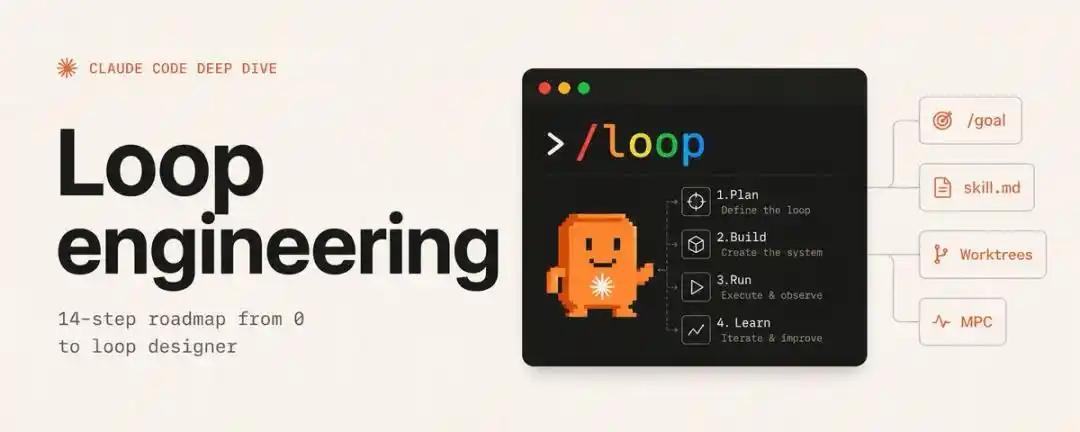
One is Claude Code, which everyone uses daily. It has built a loop suite around three commands:

/loop handles scheduled cycles, /goal handles goal-driven tasks (running until acceptance criteria are met), and /schedule handles cloud-based scheduled tasks (they can run even with your laptop closed).

The most ingenious design is /goal, which embodies the most crucial principle of loops—you can't grade your own paper.

Claude Code has directly built this principle into its product architecture:

A large model writes the code, and an independent smaller model, Haiku, does the validation. The two models have separate responsibilities.

This way, the Agent doesn't give itself an easy high score, ensuring the validation has real constraint power.
The other is OpenAI Codex.

Codex's approach is closer to a combination of 'automated pipeline + goal-driven + multiple sub-agents.' In the practical experience of some developers, you can see up to 8 agents running simultaneously in their respective cloud sandboxes, each doing its own job and finally aggregating the results.

Interestingly, although the two companies' implementation paths are different, the final forms are highly similar—

Both break down complex tasks, assign them to multiple agents to run in parallel, and then aggregate the results.

In public evaluations and community reputation, their performance is already very close.

This also illustrates a point: the models themselves can't differentiate much anymore; the real gap lies in the upper-layer loop orchestration.

At this point, just look at how 'Claude Code father' Boris Cherny works every day, and it all becomes clear.

He said he uninstalled his IDE last November, didn't open it for a month, and simply deleted it.

Now he has hundreds of small agents running simultaneously. Some scan GitHub issues, some read user feedback on Slack, some monitor CI failures. Each agent works in its isolated code branch, with one writing code and another running tests for validation.

Only the ones that can't handle the task end up in his inbox, waiting for his judgment.

He revealed that since Opus 4.5, all his code has been written by Claude Code, and nowadays most of his code is completed directly on his phone.

Next is the loop, where Agents prompt each other without requiring human review in between.
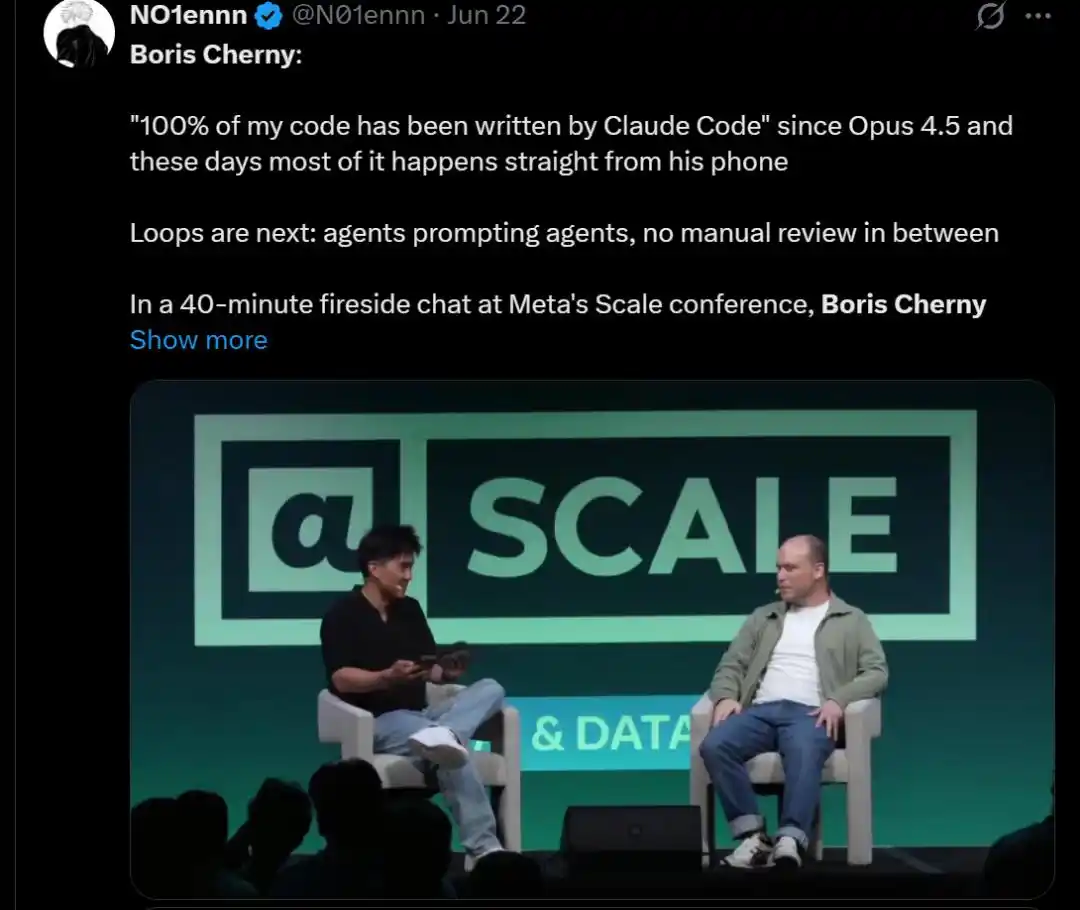
See, the ultimate form of the loop is already quite clear:

Humans don't write code or prompts; they only write rules and judgments. The rest is all handed over to loops.

How to get looped

So, how do we get looped?

A blogger named Codez on X has already summarized everything for everyone. He posted a 14-step practical roadmap; I'll pick some of the key points here.
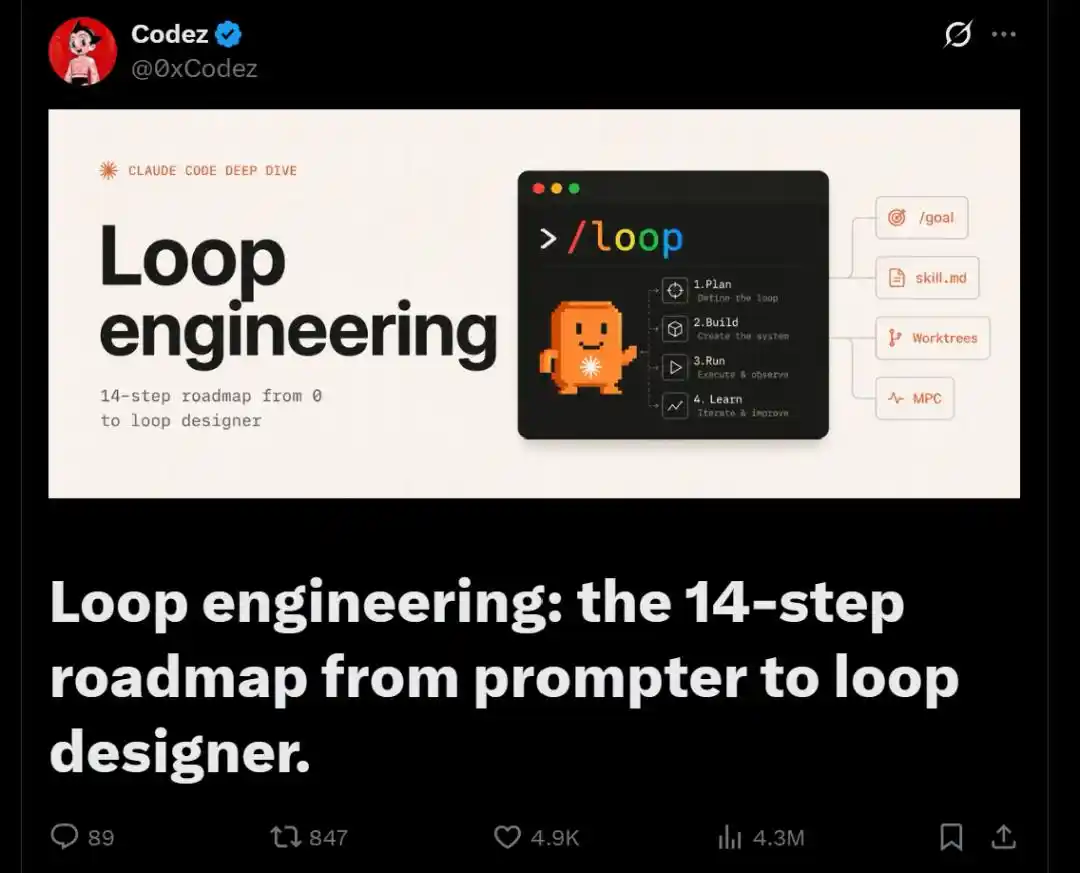
Step 1: Don't rush to build; do the '4-condition test' first.

Not every task is suitable for a loop; building blindly will just lose money.

Before you start, answer four questions:

Does the task occur repeatedly?

Is there an automated validation method?

Can the token budget handle it?

Does the Agent have the tools of a 'senior engineer'?
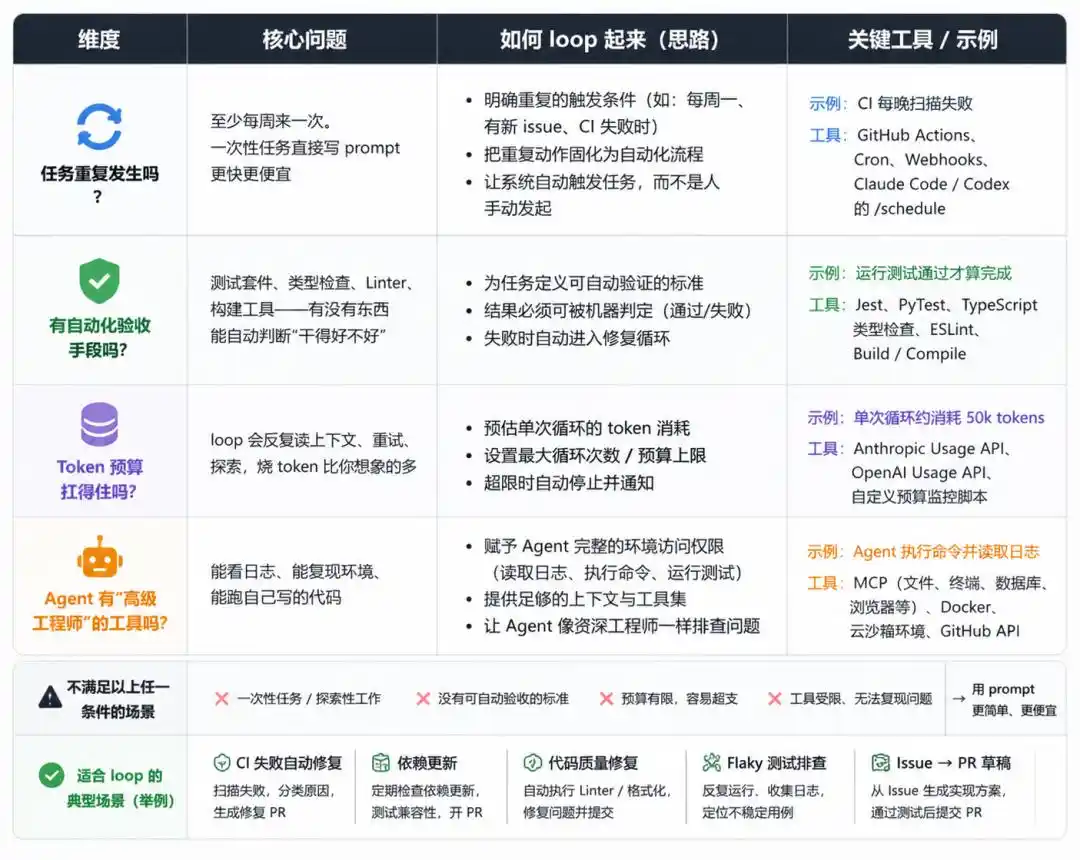
Only pass all four conditions is it worth building a loop.

Step 2: Start with the minimum viable loop.

Don't get fancy the first time; just build a four-piece set:

A trigger (Automation): Can be scheduled runs or event-triggered runs. Use /loop in Claude Code and the Automations panel in Codex.

A skill (Skill): Write the project context into STATE.md so that each run doesn't need to re-explain everything.

A state file (State File): Use Markdown to record 'where we are, what succeeded, what failed' so the next run can continue.

A gate (Gate): Tests, type checks, builds—anything that can automatically block bad results.

And the order is crucial: first, run it manually once successfully → write it as a Skill → wrap it into a loop → only then set up scheduling.

Skipping steps is the main reason loops die in production.

Step 3: Be the one who 'separates the papers,' not the one who 'grades them.'

The most important principle in the entire loop design has been mentioned before—the code writer and the code validator must be separate.

Concretely, this means:

Use one model (or sub-agent) responsible for writing and another independent model (or sub-agent) responsible for validation. The validator must not see the reasoning process of the writer.
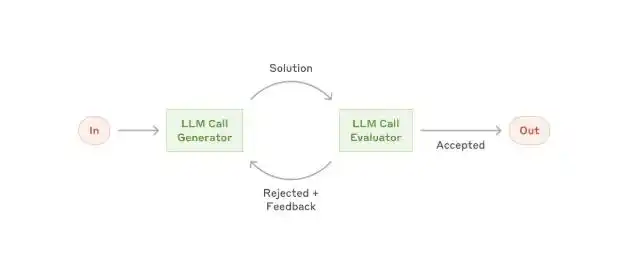
Why is this important? Because when a model grades its own code, it tends to be 'too lenient.'

All code that 'looks good' can probably be picked apart by an independent validator.

Step 4: Don't step into pits others have already stepped into.

Here are a few pitfalls to avoid.

1. No hard stop condition. A loop runs until you notice the bill or get rate-limited, so you need to set token limits, iteration limits, and time limits.

2. State not persisted. An Agent's memory is short-term; what it learns today is forgotten tomorrow, so you need to write it into a state file (STATE.md) and read it for each run.

3. Letting loops handle 'judgment-required' tasks. Don't let loops touch tasks like architectural rewrites, authorization code, payment logic, or product direction decisions. Loops are suitable for tasks with 'clear right/wrong, machine-verifiable, and not dependent on human judgment,' such as Lint auto-fixes, dependency update PRs, CI failure categorization, and Flaky test reproduction.

4. Not reading diffs. Loops merge code faster and faster, while your understanding of the codebase becomes shallower. This is called 'comprehensibility debt'—the real cost isn't the token bill but the day you have to debug a system no one on the team has read. So it's recommended that you read diffs, even if just a glance.

Step 5: There's only one metric that matters.

Ignore how many tokens were burned, how many PRs were opened, or how many tasks were run.

The only useful metric is: What is the average cost per accepted change?

If your 'acceptance rate' is below 50%, it means you're doing the review work that the loop was supposed to save you from, i.e., the loop is losing money.

From prompts to loops: Four paradigm shifts

Now that we understand the principles and methods, the final question remains:

Why are loops so popular now?

Although strictly speaking, the concept of Loop Engineering is less than three weeks old.

It didn't appear out of thin air. Looking back at the timeline reveals a clear evolutionary path.

This path has already been summarized by the big names; we can just copy their homework:

From Prompt → Context → Harness → Loop, a total of four shifts.
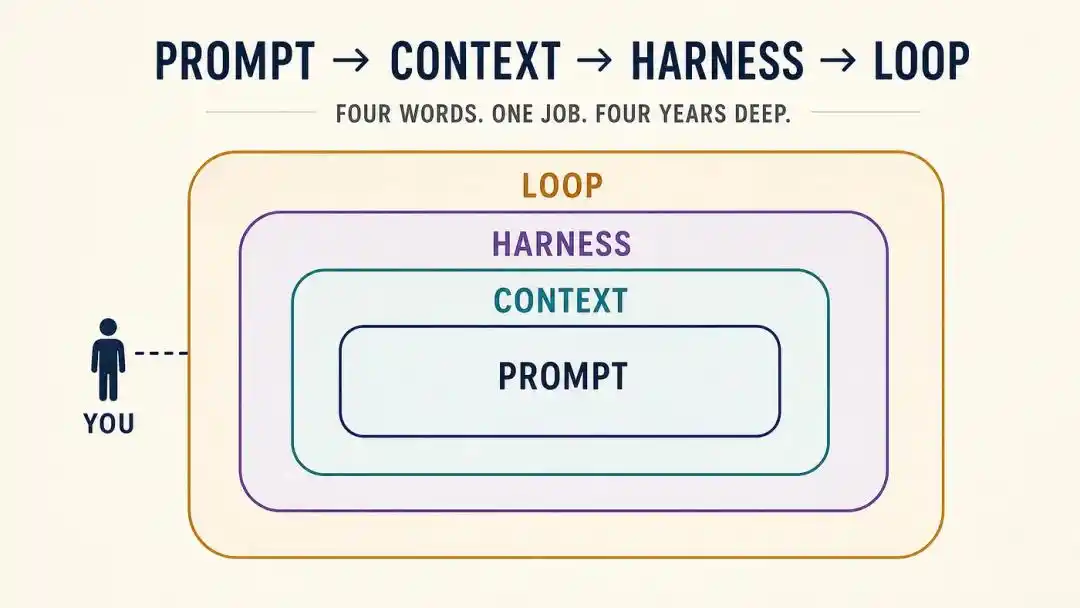
In short, from 2023~2024, it was the era of Prompt Engineering.

Back then, everyone was figuring out one thing: How to write prompts to make AI work properly.

Good prompts vs. bad prompts produced vastly different results. So at that time, 'knowing how to write prompts' basically equated to 'knowing how to use AI.'

At this stage, the relationship between humans and AI remained at the most superficial level—you say one thing, it replies, with every instruction requiring manual input.

But as model capabilities increased, context windows lengthened, and RAG and codebase integration became common, the focus shifted for the first time.

Around 2024 to early 2025, the industry began emphasizing the importance of 'Context Engineering,' shifting the focus from 'how to ask' to 'what to show the AI.'

In other words, AI no longer relied solely on a single prompt but on the entire background you provided.

At this stage, information organization skills became more important than prompt writing, and the granularity of control moved from 'a single sentence' to 'a bundle of information.'

By 2025~2026, as Agent systems gradually entered real development workflows, the problem expanded further.

It was realized that just providing information and context wasn't enough. The AI needed to connect to tools, run code, call APIs, and go through permission approvals.

Therefore, you had to build a runtime environment where it could work, be constrained, and access real-world resources.

'Harness Engineering' was born for this purpose.

And building upon Harness, 'Loop Engineering' became the latest evolutionary direction.

If Harness solved the problem of 'whether AI can work in a real environment,' then Loop solves the problem of 'whether AI can work continuously in this environment, advance tasks on its own, without needing step-by-step human supervision.'

Its core is no longer single-execution capability but the operational capability of a closed-loop system.

So, from Prompt to Context, to Harness, to Loop, it may look like a succession of concepts, but essentially it's a continuous migration path:

Human control over AI has been moving up in granularity, from 'writing a sentence' to 'providing information,' to 'building a system,' and finally to 'designing loops.'

A process of gradually liberating human hands.

In fact, although this loop thing just got hot in the industry, academia already had similar concepts much earlier.

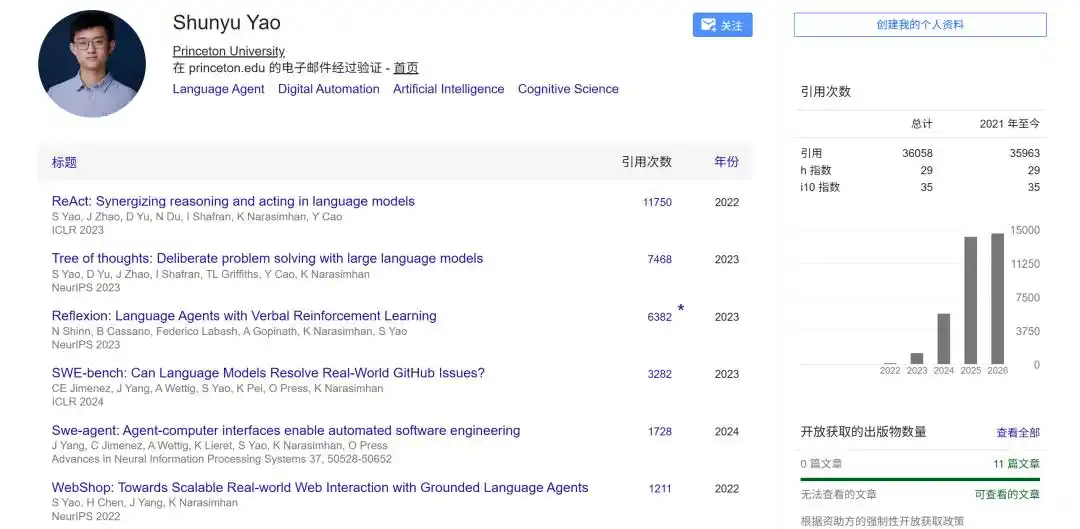
And much of the important work is related to someone familiar to us today: Shunyu Yao (from Tencent).

One of his most representative works in the direction of large model Agents is the ReAct framework (Reason+Act) from 2022.

This work received Oral level at ICLR 2023 and later garnered tens of thousands of citations.
ReAct did a very crucial thing: bounding 'reasoning' and 'action' into a cyclical process.

A large model no longer outputs an answer once; instead, it first engages in interpretable thinking, then calls tools to perform actions, observes environmental feedback after execution, and then enters the next round of reasoning. Abstractly, it's:

Think → Act → Observe → Think again → Act again...

This structure is essentially the earliest systematically expressed prototype of an 'agent loop.'

After ReAct, this route continued to expand. For example, Reflexion introduced a feedback mechanism for 'learning from mistakes,' Tree of Thoughts expanded into multi-path search-style reasoning, and a series of subsequent tool-use agent works gradually perfected the complete chain of 'planning + execution + feedback.'

These academic achievements gradually pushed forward, eventually converging in the engineering world into what we call 'loop systems' today.

So, from an academic perspective, loops are not someone's invention; they are a gradually converging technical path.

It's just that on this path, a familiar Chinese researcher happens to stand at a key node.

Finally, one can't help but marvel at how fast AI development has been, from prompts to loops.

The consequence of being so fast is that some are excited, while others find it hard to hide their concerns.

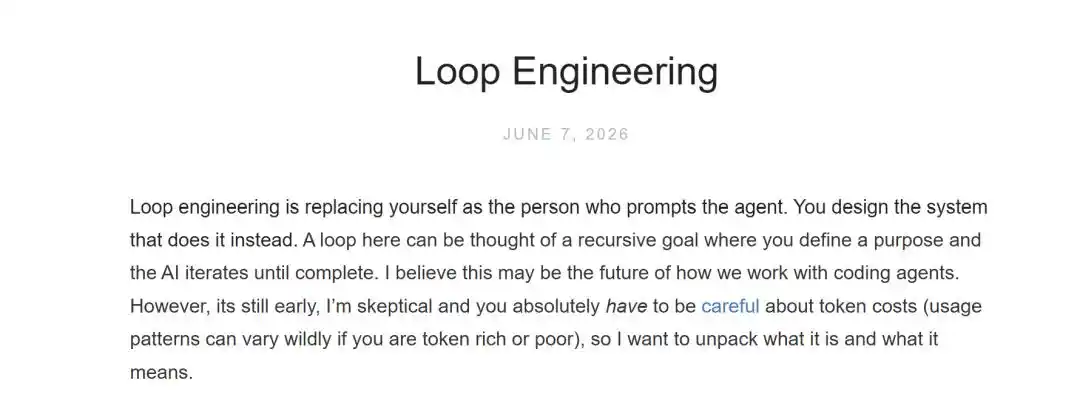
The namesake of Loop Engineering, Google Engineering Director Addy Osmani, is one of the latter.

He made it very clear in his long article 'Loop Engineering':

It's still very early. I'm cautious. You have to be very careful with token costs.
Karpathy's words are even more thought-provoking. At the Sequoia Capital AI Ascent 2026 conference, he quoted a phrase that he himself kept pondering:

You can outsource your thinking, but you cannot outsource your understanding.

To translate: AI can think of solutions for you, but you yourself must truly understand the problem.

This is probably the most sobering voice amid the entire loop frenzy.

References:

[1]https://x.com/i/trending/2068190968809980300

[2]https://x.com/addyosmani/status/2064127981161959567

This article is from the WeChat public account 'QbitAI', author: Yishui

Câu hỏi Liên quan

QAccording to the article, what is the core difference between 'Prompt Engineering' and the emerging 'Loop Engineering' paradigm in AI development?

AThe core difference lies in the granularity of human control and automation. Prompt Engineering involves humans manually writing specific instructions (prompts) for each AI interaction, requiring constant oversight. Loop Engineering shifts the focus to designing automated systems (loops) where the AI (or multiple agents) works autonomously towards a defined goal, self-validates its output, and iterates without human intervention until the task is complete or a budget limit is hit. The human role changes from a direct 'prompter' to a 'rule and system designer'.

QWhat are the two leading product platforms mentioned in the article that have implemented 'loop' systems for AI programming?

AThe two leading platforms are Claude Code (from Anthropic) and OpenAI Codex. Claude Code implements loops through features like /loop, /goal, and /schedule, with a key design principle of using a separate, smaller model (Haiku) to verify the code written by the main model. OpenAI Codex uses an 'automation pipeline + goal-driven + multi-agent' approach, allowing multiple agents to work in parallel in isolated sandboxes.

QThe article lists a 'Four-Condition Test' before building a loop. What are these four conditions?

AThe four conditions to test before building a loop are: 1. Does the task repeat? 2. Is there an automated way to verify the result? 3. Can you afford the token budget? 4. Does the Agent have the tools of a 'senior engineer' (i.e., proper capabilities and context)? All four must be met for a loop to be worthwhile.

QWhat key academic work is mentioned as a foundational precursor to modern loop systems, and what was its core contribution?

AThe key academic work mentioned is the ReAct (Reasoning + Acting) framework by Yao Shunyu (and colleagues). Its core contribution was systematically formalizing an 'agent loop' by binding 'reasoning' and 'action' into a cyclical process: the model thinks (reasons), acts using tools, observes the result, and then re-thinks, creating a loop of 'Think → Act → Observe → Think again...'. This laid the conceptual groundwork for autonomous agent systems.

QWhat major concern or caution does the article highlight about the adoption of Loop Engineering, as voiced by figures like Addy Osmani and Andrej Karpathy?

AThe major concerns highlighted are: 1. **High Cost and Early Stage**: Addy Osmani warns that the technology is still early and that token costs must be managed very carefully. 2. **Loss of Understanding**: Andrej Karpathy emphasizes that while you can outsource thinking (to AI loops), you cannot outsource your own understanding. The risk is that developers might lose deep comprehension of their own codebase as loops autonomously generate and merge code, leading to a 'debt of understanding' that becomes problematic when debugging complex, unfamiliar systems.

Nội dung Liên quan

Vị trí mới trong ngành robot: 'Bác sĩ chỉnh hình' thu nhập 6.000 tệ mỗi tháng, chuyên trị tay chân gãy hỏng

Vào lúc 9h20 tối, Triệu Tân xuất hiện trên livestream Douyin để dạy sửa chữa robot và chó máy. Lượt xem mỗi buổi phát sóng khoảng 1700 người. Số lượng robot hình người và chó máy đang bùng nổ. IDC dự báo năm 2025 toàn cầu xuất xưởng khoảng 18.000 robot hình người, trong khi một quan chức Bộ Công nghiệp Trung Quốc dự đoán sản lượng năm 2026 có thể vượt 100.000 chiếc. Thị trường sửa chữa và bảo dưỡng cũng theo đó mà mở rộng. Triệu Tân, xuất thân từ kỹ thuật xây dựng và dịch vụ, tự học sửa robot. Anh nhấn mạnh **kỹ thuật sửa chữa robot không cao**. Công việc chủ yếu là xác định lỗi qua mô tả và mã lỗi trên app, sau đó thay thế linh kiện hỏng. Độ phức tạp thấp hơn so với sửa drone hay robot hút bụi. Tuy nhiên, **khó khăn lớn nhất là linh kiện bị độc quyền bởi nhà sản xuất**, không có linh kiện phụ, thiếu sơ đồ mạch, khiến việc sửa chữa và chi phí thay thế trở nên đắt đỏ. **Sửa chữa bên thứ ba rẻ và nhanh hơn**. Sau khi hết bảo hành (thường 1 năm), chi phí sửa tại hãng cao, thời gian kéo dài trên một tháng. Các cửa hàng bên thứ ba có giá rẻ hơn 20-50%, thời gian chỉ khoảng một tuần. Khách hàng chủ yếu là các công ty cho thuê robot và blogger phục vụ biểu diễn giải trí. **Hiện tại, sửa chữa robot khó có thể là nghề chính** do số lượng robot hư hỏng cần sửa còn ít. Các cơ sở này thường có "nghề chính" khác như đào tạo, sửa drone, robot hút bụi, hoặc cho thuê robot. Nhiều cơ sở đã mở **khóa đào tạo sửa chữa robot** với thời gian từ 8 đến 40 ngày, học phí 5.000 - 30.000 tệ. Phần lớn học viên tốt nghiệp làm các vị trí bán hàng, vận hành, bảo trì cơ bản hơn là sửa chữa chuyên sâu. **Mức lương trong ngành**: Người mới khoảng 6.000 - 8.000 tệ/tháng, thợ lành nghề có thể trên 10.000 tệ/tháng, tùy khu vực. Các vị trí phát triển phần mềm thứ cấp (secondary development) yêu cầu cao hơn, thường cần bằng đại học. Các đại gia như JD.com cũng đang lên kế hoạch đào tạo số lượng lớn kỹ sư robot. Tuy nhiên, ngành sửa chữa robot vẫn là một thị trường cần thời gian để phát triển.

marsbit1 phút trước

Vị trí mới trong ngành robot: 'Bác sĩ chỉnh hình' thu nhập 6.000 tệ mỗi tháng, chuyên trị tay chân gãy hỏng

marsbit1 phút trước

Thâm Quyến, đang dẫn dắt các thành phố cả nước cùng “phát tài”

Gần đây, sự kiện lớn nhất trên thị trường vốn Trung Quốc là việc Changxin Technology lên sàn. Trong khi Hợp Phì thu lợi nhuận khổng lồ từ khoản đầu tư này, Thâm Quyến cũng đang dẫn dắt các thành phố trên cả nước cùng "phát tài". Tính đến nay, Thâm Quyến đã có thêm 26 công ty niêm yết trong và ngoài nước trong năm nay, đứng đầu trong số các thành phố lớn và vừa của Trung Quốc. Trong danh sách cổ đông của 26 doanh nghiệp này, có sự hiện diện của các quỹ đầu tư nhà nước và quỹ công nghiệp từ khắp nơi trên cả nước. Thông qua đầu tư vốn cổ phần từ sớm, các thành phố này đã thu được lợi nhuận lớn từ các đợt IPO của doanh nghiệp Thâm Quyến. Các doanh nghiệp Thâm Quyến lên sàn phần lớn thuộc các ngành công nghiệp chiến lược mới nổi và công nghiệp tương lai, có hàm lượng công nghệ cao. Môi trường ươm tạo khoa học công nghệ hàng đầu, hệ thống vốn toàn diện và chuỗi công nghiệp hoàn chỉnh của Thâm Quyến đã tạo nền tảng vững chắc cho sự tăng trưởng và khả năng lên sàn của doanh nghiệp. Việc các thành phố trên cả nước đầu tư vào doanh nghiệp Thâm Quyến không chỉ mang lại lợi nhuận vốn, mà còn thông qua các thỏa thuận đầu tư để thu hút các cơ sở sản xuất, bổ sung khoảng trống sản xuất công nghệ cao địa phương. Ví dụ điển hình là HuiKe Co., Ltd., các cổ đông nhà nước từ Miên Dương, Trừ Châu, Trường Sa đều nhận được lợi nhuận kép: lợi nhuận vốn và sự phát triển cụm công nghiệp. Mô hình hợp tác khu vực "Thâm Quyến ươm tạo, cả nước đầu tư, triển khai tại nhiều nơi, chia sẻ lợi ích" này đã thay thế cạnh tranh "nội bộ" trước đây bằng liên kết thị trường, thúc đẩy hợp tác cùng có lợi. Tinh thần này phù hợp với triết lý thịnh vượng chung mà APEC ủng hộ. Vào tháng 11 năm nay, Hội nghị không chính thức lãnh đạo APEC lần thứ 33 sẽ được tổ chức tại Thâm Quyến, nơi sẽ thể hiện sự đổi mới và sức sống của Trung Quốc.

marsbit9 phút trước

Thâm Quyến, đang dẫn dắt các thành phố cả nước cùng “phát tài”

marsbit9 phút trước

Người tiên phong trong ngành tiền điện tử rơi từ trên cao xuống trần truồng: Sự giàu có, cuộc đỏ đen và rạng sáng cuối cùng của Yeh Chun Tak (Harry Yeh)

Ngày 7/8/2026, thi thể Harry Yeh (Diệp Tuấn Đức), nhà sáng lập quỹ tiền mã hóa Quantum Fintech Group, được phát hiện toàn thân trần truồng dưới chung cư cao cấp ở Asunción, Paraguay. Nghi phạm rơi từ tầng 30. Căn hộ của ông mở cửa, lộn xộn, không một bóng người. Giới chức điều tra ba khả năng: tai nạn, tự sát hoặc bị sát hại, đang chờ kết quả khám nghiệm. Yeh, sinh tại Hong Kong, lớn lên ở Canada và Mỹ, là kỹ sư, MBA Stanford. Ông bắt đầu mua Bitcoin từ năm 2013 khi giá 60 USD. Sự nghiệp của ông gắn liền với sự bùng nổ của Bitcoin và DeFi. Ông nổi tiếng nhất với vai trò hồi sinh dự án Tomb Finance trên hệ sinh thái Fantom vào năm 2021, đưa tổng giá trị tài sản khóa (TVL) từ 250 nghìn USD lên đỉnh 1,6 tỷ USD chỉ trong bốn tháng. Ông thường xuyên xuất hiện trên truyền thông, tổ chức hội nghị lớn và tự nhận quản lý tài sản hơn 24 tỷ USD. Cái chết của Yeh làm dấy lên nghi vấn về một vụ "wrench attack" (tấn công vật lý) nhằm cướp tài sản tiền mã hóa. Ngay trước ngày ông qua đời, một báo cáo chỉ ra số vụ tấn công kiểu này đang gia tăng, với nạn nhân thường là các cá nhân giàu có, lộ diện trong ngành. Tuy nhiên, khả năng tự sát do áp lực từ thị trường bear hay các rủi ro tài chính tiềm ẩn cũng chưa được loại trừ. Cuộc đời của Yeh phản ánh sự thăng trầm của ngành công nghiệp tiền mã hóa: từ một kỹ sư đặt cược nhỏ bé trở thành triệu phú, tạo ra những huyền thoại tăng trưởng chóng mặt, nhưng cũng có thể kết thúc trong bí ẩn và bạo lực. Vụ việc đang được điều tra, chờ kết luận chính thức từ cơ quan chức năng Paraguay.

marsbit11 phút trước

Người tiên phong trong ngành tiền điện tử rơi từ trên cao xuống trần truồng: Sự giàu có, cuộc đỏ đen và rạng sáng cuối cùng của Yeh Chun Tak (Harry Yeh)

marsbit11 phút trước

Báo Buổi Sáng Phố Wall: Dữ Liệu Việc Làm Phi Nông Bất Ngờ Làm Bùng Nổ Giao Dịch Giảm Lãi Suất, Cáp Quang Bắt Đầu Cướp Sân Khấu Từ Lưu Trữ, "Bán Khống Lưu Trữ Mua Cáp Quang" Trở Thành Chiến Trường Mới

Báo cáo thị trường sáng nay từ Phố Wall tập trung vào hai chủ đề chính: phản ứng trước dữ liệu việc làm Mỹ yếu và sự chuyển dịch dòng tiền trong lĩnh vực cơ sở hạ tầng AI. Dữ liệu phi nông nghiệp (Non-farm) tháng 7 của Mỹ giảm 23.000 việc làm, thấp hơn nhiều so với kỳ vọng, khiến thị trường giảm mạnh kỳ vọng về việc Fed tăng lãi suất vào tháng 9. Thị trường chứng khoán Mỹ phản ứng tích cực, với S&P 500 lập kỷ lục mới. Vàng tăng mạnh, vượt ngưỡng 4.300 USD/ounce. Tất cả ánh mắt đổ dồn vào số liệu CPI tháng 7 sắp công bố để có tín hiệu rõ ràng hơn về lộ trình chính sách. Giá dầu tăng do bế tắc địa chính trị ở eo biển Hormuz. Trong lĩnh vực AI, một sự luân chuyển vốn rõ rệt đang diễn ra. Tuần qua, các cổ phiếu thuộc nhóm phần mềm, cáp quang và cơ sở hạ tầng AI thể hiện xu hướng mạnh, trong khi nhóm bán dẫn lưu trữ (memory) điều chỉnh. Điều này dẫn đến các thảo luận về chiến lược "bán khống cổ phiếu lưu trữ, mua vào cổ phiếu quang học". Các công ty như Coherent, AAOI, Credo tăng mạnh, trong khi Seagate, Western Digital, SK Hynix giảm. Các nhà giao dịch cho rằng lưu lượng mạng từ AI đang vượt lưu lượng con người, đẩy nhu cầu về linh kiện quang học. Phần mềm cũng phục hồi mạnh, với Atlassian và Palantir tăng vọt sau báo cáo tài chính. Một số diễn biến đáng chú ý khác: SpaceX tăng mạnh bất chấp áp lực giải ngân cổ phiếu; Palantir tăng nhờ doanh thu thương mại Mỹ tăng trưởng cao; Nvidia tiếp tục hưởng lợi từ chu kỳ chi tiêu vốn AI và đầu tư vào cơ sở hạ tầng điện; Apple được cho là đang thử nghiệm chip của ChangXin Memory; Berkshire Hathaway mua ròng cổ phiếu trở lại. Lịch trình tuần này cần theo dõi: Báo cáo CPI Mỹ (14/8), kết quả kinh doanh của Lumentum, CoreWeave, Super Micro Computer (14/8), Coherent (15/8), báo cáo PPI Mỹ (15/8) và lịch trình phát hành 13F của SEC.

marsbit27 phút trước

Báo Buổi Sáng Phố Wall: Dữ Liệu Việc Làm Phi Nông Bất Ngờ Làm Bùng Nổ Giao Dịch Giảm Lãi Suất, Cáp Quang Bắt Đầu Cướp Sân Khấu Từ Lưu Trữ, "Bán Khống Lưu Trữ Mua Cáp Quang" Trở Thành Chiến Trường Mới

marsbit27 phút trước

Úc yêu cầu ngừng hoạt động ATM Bitcoin của Cryptolink do không tuân thủ 'báo cáo cơ bản'

Cơ quan giám sát chống rửa tiền của Úc (AUSTRAC) đã đình chỉ hoạt động của các máy ATM Bitcoin của Cryptolink trong ba tháng, bắt đầu từ Chủ nhật, do những lo ngại liên tục về khả năng tuân thủ các nghĩa vụ chống rửa tiền của công ty. Giám đốc điều hành AUSTRAC Brendan Thomas cho biết việc đình chỉ đăng ký Nhà cung cấp Dịch vụ Tài sản Ảo (VASP) đồng nghĩa với việc các máy ATM tiền mã hóa của họ không được phép hoạt động trong thời gian này. AUSTRAC nêu rõ Cryptolink đã không đáp ứng các yêu cầu báo cáo cơ bản, đặc biệt là báo cáo giao dịch ngưỡng, và không phản hồi yêu cầu cung cấp thông tin của cơ quan này. Hành động này diễn ra sau một thỏa thuận có thể thi hành mà Cryptolink đã ký với AUSTRAC vào tháng 10/2025, cùng với một khoản tiền phạt 56.340 USD mà công ty đã nộp, do các vi phạm bao gồm báo cáo giao dịch chậm trễ và thiếu sót trong đánh giá rủi ro. Cryptolink sở hữu 96 máy ATM tại Úc, chủ yếu ở các thành phố lớn như Sydney, Melbourne và Brisbane, cho phép khách hàng đổi tiền mặt lấy Bitcoin. Úc là quốc gia có số lượng máy ATM tiền mã hóa nhiều nhất khu vực Châu Á-Thái Bình Dương và chính quyền nước này đã siết chặt quản lý việc sử dụng các máy ATM này cho mục đích phạm tội từ cuối năm 2024.

cointelegraph51 phút trước

Úc yêu cầu ngừng hoạt động ATM Bitcoin của Cryptolink do không tuân thủ 'báo cáo cơ bản'

cointelegraph51 phút trước

Giao dịch

Giao ngay
活动图片