Original: Dan Koe
Compiled: Dr.Hash Cyber Hash
In the next 10 years, most skills may become irrelevant.
Everyone is saying this, but is it true?
But if you are a person with "high agency," this is not a problem at all. Why? Because your success does not depend on a specific skill. You are not someone who focuses solely on one area. You haven't confined yourself to the path of pursuing high-paying jobs or prestigious degrees. You have your own vision and understand that in this era, you can learn any skill and acquire any knowledge to achieve the life you want.
Unfortunately, if your parents did not cultivate this "agency," they likely couldn't pass it on to you either. Unless you have gone through a deliberate process of learning and reflection, you still have a long way to go before truly feeling "in control of your future."
Therefore, the most important skill is agency. This ability is crucial now, in ten years, and even until the day you die. Because if you can set the direction of your life, take the necessary actions to achieve your goals, and resist the various temptations and distractions of today's world, you won't face the risk of being "replaced" (and even if you are, it doesn't matter, because you can quickly adapt to new environments).
Next, I want to share five core perspectives on "agency": what it is, why it's more important than ever, and how to practice it to obtain the life you desire.
I. Agency: The Ability to Act Without Permission
"Only those who continually rebel discover the truth, not those who conform."
— Jiddu Krishnamurti
To understand what a high-agency person is like, we must first clarify what it is.
Agency is not blindly following others.
Conformity means your thinking is still dependent on societal standards.
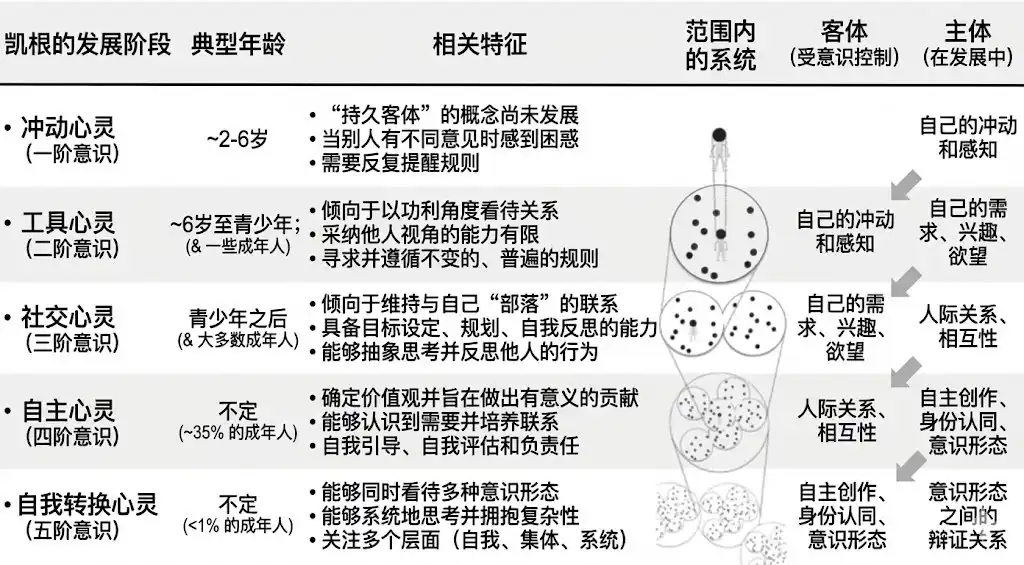
Conformity is a stage of cognitive development where your thinking is entirely influenced by culture, and the standard for judging truth is "whether it's popular" and "whether others accept it," rather than based on your own direct experience or independent thinking.
Think about it carefully; this might be the biggest threat to living a good life.
When you were born, your mind was like a new computer. It had a basic operating system, but the hard drive was empty. For the first 20 years of your life, you weren't thinking independently. That's okay; no one can do it from the start. No matter how independent you think you are, often this is just another form of conformity.
Research shows that about 50% of the population is in the conformity stage, meaning half the people lack the cognitive foundation for true agency.
Conformity stems from the survival instinct. Humans need to survive not only materially (like animals reproducing genes) but also psychologically (spreading beliefs, opinions, and information).
If you have a job, your agency in this area is low because if you lose the job, your survival is threatened. So you must conform.
If you have deep-rooted beliefs tied to a specific religion or political party, your agency is also limited because your concepts of good and evil come from culture, not personal examination and exploration.
In tech and business circles, everyone likes to talk about "high agency," but this is also often a form of conformity to popular culture.
Even this letter itself carries a degree of conformity. In a sense, we are all conformists.
So, what does true agency look like? How do we cultivate this ability within ourselves so that our emotions, finances, and life opportunities are not controlled by others?
(1) High-agency people act without permission
"Having agency means you are the subject of the sentence, not the object. It is a tendency to take initiative, not to wait passively."
— Devon Erickson
Agency literally means "the state of being in action or operation."
When used to describe a person, it means "the tendency to initiate action to achieve goals without external prompts, instructions, or permission."
But observing successful people, we see that success is more than just acting towards a goal. Anyone can start a business, but that doesn't mean they will succeed. In fact, most people don't succeed because they lack a key element:
If something doesn't work, you reflect on the situation, make adjustments, and keep trying until you reach the goal.
So, autonomy is not just action, but a firm commitment to "iteration." Learning and practicing go hand in hand. Making mistakes and correcting them, rather than retreating to comfort because "this method doesn't work."
Yes, I'm talking about those who write articles for two weeks and then give up.
(2) High-agency people treat life as an experiment
Low-agency people often exhibit an "employee mindset."
They are assigned tasks, often accompanied by some status or certificate, which makes them crave recognition from others, leading to limited decision-making.
High-agency people are scientists of their own lives.
They have an idea.
They set their own goals. They form a hypothesis about how to achieve the goal. They test, adjust, research, and strive to get closer to the goal. They fail, many times. But because it's an experiment, failure is part of the process. They expect to fail because how else do you find what works without trial and error?
This is a major misconception people have about success today. They are used to being promised things, like a high-paying job or a business that will make them rich quickly.
They do the steps they are supposed to do, but when they inevitably fail, they think it's impossible and blame everyone but themselves.
(3) High-agency people believe in the value of difficulty
You want to be high-agency because you believe these actions will bring positive changes to your life. You are trying to achieve a goal. There are three types of goals:
-
Simple goals: Things we do every day or can handle with existing skills.
-
Difficult goals: Things we can't do now but can eventually do if we learn the right skills and acquire the right resources.
-
Impossible goals: Things that are either completely impossible in reality or seem impossible until we complete a series of "difficult goals."
Low-agency people often have a skewed view of difficult goals.
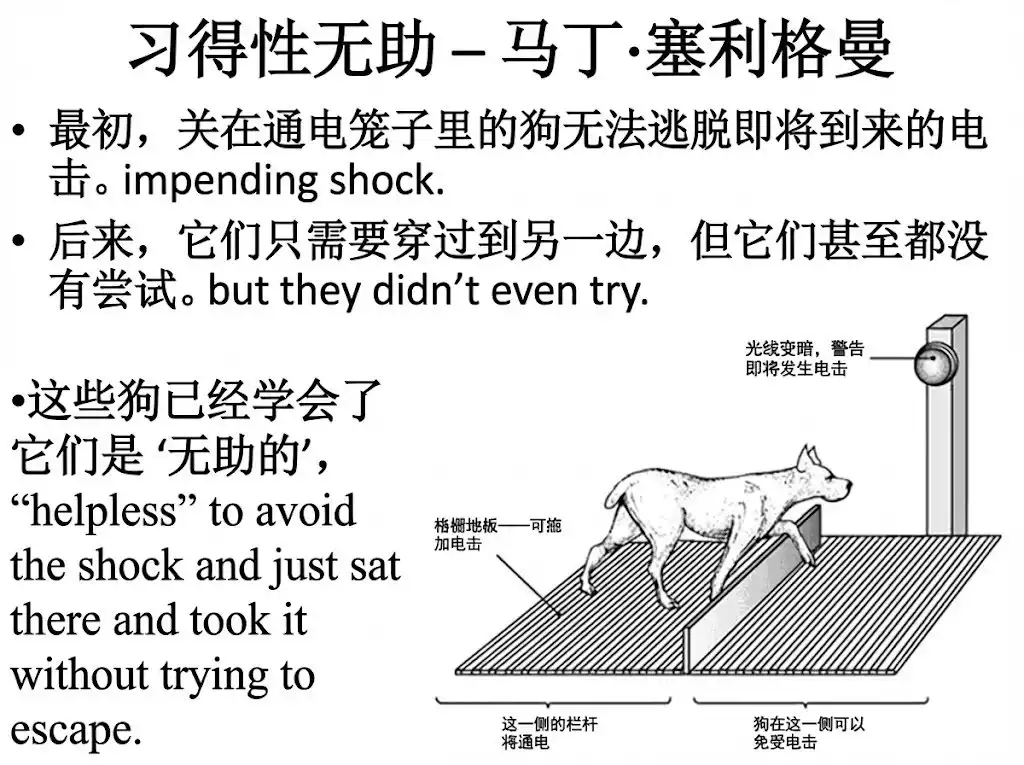
For example, in Seligman's dog experiment, dogs were exposed to unavoidable electric shocks, making them feel they had no control over the environment. Later, when placed in a situation where they could easily jump over a small wall to escape the shock, the dogs did not try. Even though escape was within reach, they just whined and endured the shock. Similarly, achieving your desired life goals may be difficult, but you are trained to believe it is "impossible," so you don't even try. Your brain doesn't even allow you to consider this option. You silently endure the shocks of your predetermined life path.
However, agency can be practiced, but the specific steps only make sense when you deeply understand how it applies in today's world.
II. AI is Not a Threat to High-Agency Individuals

You can now access any knowledge you need to achieve any goal you want.
However...... people still do nothing.
This is the key point.
Success is easier than ever now, but those destined not to succeed still won't succeed. It has never been about "access" or "equal opportunity," but about agency. High-agency people will leave others behind at 10x the speed because they start acting without permission, and the barriers to action are now almost non-existent. If you lack money or resources to achieve a big goal, you can set a smaller, stepping-stone goal to acquire that money or those resources.
Everyone is worried about the same things, and frankly, this fear is just because they can't think clearly.
Look at a typical example: everyone is shouting "There's too much AI-generated content, human creators are finished."
First, AI is a tool.
Tools require people to use them for a specific purpose.
Sure, anyone can have AI generate a viral article or extract a thousand clips from a podcast and have AI sort them by viral potential. But what's the use? You can get a bunch of likes and followers, but does that monetize? Is there loyalty? Are there the things that truly support a brand? Yes, you can have AI help with these, but then you are doing something completely different. You are learning. You are orchestrating the realization of a larger vision, which isn't much different from doing it yourself. You are still the decision-maker.
Sure, AI can generate beautiful images on command, but there's a world of difference between "someone who has a vision and uses AI as a tool to realize it" and "someone who just wants to quickly make a picture." Many artists use AI for initial versions and then use Photoshop for fine-tuning, injecting their style. Overall, AI reveals what is truly important in the creative process.
When you let AI make all the decisions for you (in other words, you let it guess what works based on thousands of opinions on the internet), there is no main thread. No theme. No personality. No vision. No context. This is the essence of a creator: a context creator, not a content creator. Without context, content is meaningless, and so is AI-generated stuff.
Except for those brain-dead contents and memes (although some are indeed funny), their only use is to keep you on the platform to be harvested by ads.
Got it?
99% of AI-generated content will directly become garbage because if the content is effective, the value is already there—whether it's AI-generated or not doesn't matter at all—because it's most likely orchestrated by a human who injected their personal context into it.
When building a business, you must have a brand mission; AI just helps you execute it, and you need to keep iterating.
When writing a book, you must control all the tiny details; besides, you need people to read it (audience, marketing, sales); the book won't do that by itself.
When creating art, you must first have an idea you are trying to bring into reality.
In other words, nothing has changed; people just hate new things, and new things恰恰 illuminate what was originally important. If you can't create art with AI, it means you weren't an artist to begin with. You were just good at using tools like Photoshop. Tools get replaced. Vision and agency do not.
III. Why Generalists Will Win in the AI Era
"Schools were created to enslave the smartest minds, by promising the prestige of specialization, keeping them narrow so they wouldn't overthrow the real rulers."
Whenever I write about becoming a generalist, polymath, or having multiple interests, someone always jumps out to tell me I'm wrong (and never provides any coherent argument for why being a specialist is better).
They quote Shakespeare classic: "A jack of all trades is a master of none." But they don't know this famous quote is taken out of context; its second half is: "But oftentimes better than a master of one."
One might think Shakespeare was a professional playwright, but he was actually a generalist. He had to deeply understand humanity, language, classical literature, stagecraft, religion, philosophy, military tactics, music, navigation, the natural world, social structures, the body and medicine... the list is long. He was an integrator, using diverse interests to his advantage.
Fortune 500 CEOs, Darwin, Jobs, or any hugely successful visionary, strategist, had a specific vision, and then they learned and took the necessary steps to achieve it. Don't confuse a specific vehicle or niche market with "specialization."
Experts attach themselves to one skill. Skills evolve and get replaced with technological progress. We might not see it clearly yet, but Photoshop颠覆了 the art and design industry. AI is doing the same thing, and those "experts" who rely on skills rather than being true artists will be angry, as you've already seen. Conversely, generalists focus on goals, doing what is necessary (including changing goals) to survive in any field.
Let me break down this point further. Humans are tool creators; we can survive in any niche because we can adapt.
If you put a lion in Alaska and a polar bear on the African savanna, they die. If you put a human anywhere, they build shelter, sew clothes, hunt food because they can make plans and put them into practice.
The reality is, to educate large numbers of immigrant children in the 19th century (industrial demand), the U.S. adopted the Prussian education model. This was not education at all, but a weapon of mass conformity. It was designed to produce obedient soldiers, compliant citizens, civil servants, and rule-following workers through compulsory attendance, teacher training, student testing, and grade division. Sound familiar?
Society wants you simple, predictable, easy to categorize.
Why?
Because it's in their best interest. It's most profitable for organizations. If you understand systems theory, you know that systems evolve into forms that best serve the ultimate goal—in the case of society, keeping you weak and stupid, whether intentional or not. This doesn't require a conspiracy theory; systems naturally form according to the desires of humans at the top of the pyramid.
What should you do?
If slaves are expected to do one thing for life, thus closing their minds to learning more (specialists), then you, as a free individual, are destined to do many things in your lifetime. Rebel against the path set for you at birth.
Pursue interest-based education. Use your agency wisely.
IV. The 5 Abilities of Humans
Agency is good, but we are still bound by physical laws.
This raises another huge concern that fluctuates with the AI hype cycle:
Will Artificial General Intelligence make human intelligence irrelevant?
Let's clarify with a few questions.
Are human abilities limited or unlimited? As high-agency generalists, can we learn anything, do anything, as long as our genes don't限制 us? We rely on knowledge and tools to adapt and thrive in various fields. The fundamental question about human capability is: Are there limits to what we can think about and how we think?
If the main limitation is the brain's processing speed and memory, couldn't that be enhanced? When AGI arrives, won't this become more possible? Won't we become AGI? Aren't we already AGI? Won't we be amidst superintelligence?
Speculating on this is fun, but that day is a while off, so I want to focus on the near future.
Humans have 5 basic abilities. Can AI make these abilities irrelevant?
1. Computation (Mental Level)
Is there an upper limit to our computational ability? No, because once you have a general-purpose computer that fits in your hand, computing anything is just a matter of time and memory. We already have this. Even if AGI or aliens have this, they have no advantage over us in terms of computational reserves.
You might say AGI computes faster, but this doesn't accelerate the process of physical transformation, i.e., building things. You can have an idea to build a particle collider, but you still need resources to build it.
2. Transformation (Physical Level)
Transformation is creation. With the right knowledge, we can turn raw materials into rockets.
Human hands and bodies seem particularly good at creating anything by following specific sequences of operations. We built spaceships and telescopes. This means we can make "tools that make tools." We are generalists, making tools to adapt to any environment. We are not animals limited to a single niche.
The question: Is there a limit to these basic operations when strung together in the right way?
The answer is again no. If a human could remotely control a gorilla, given enough time, that gorilla could also follow the steps to build a rocket. Not that a gorilla alone could. Imagine if Musk were controlling the gorilla. What would he do?
The key is time. Transformation takes time, and the singularity won't change that, just as the Enlightenment or the Big Bang didn't change that. Time is a compression algorithm that prevents everything from happening at once. The Enlightenment and Big Bang obviously didn't directly put rockets into space. In other words, AGI might compute faster than our brains, but that doesn't mean it can build physical objects faster than humans. You can have an idea for a rocket, but you still need to acquire resources to build it.
So far, AGI concerns seem to stem from a fundamental misunderstanding of reality itself.
After computation and transformation, there are variation, selection, and attention, which relate to exploring "conceptual space" (i.e., the unknown) or how we create knowledge. We can compute and transform, but are we limited in the knowledge that allows us to do so?
Knowledge has two functions: First, to make specific things happen, preferably good things rather than bad. Second, to capture patterns in reality.
This allows us to store information efficiently, not having to start from scratch every time. We understand macro concepts, like sunrise and sunset, the changing seasons.
Without this understanding, our lives would fall apart. Capturing patterns allows us to plan based on proximity. We know we freeze in cold environments, so we use our knowledge reserves of "jackets" and "hotels" to stay warm while traveling.
Think of conceptual space (or the unknown) as a cosmic map with bright and dark spots. Bright spots are areas you've explored. Dark spots are where your potential lies.
This map is the surface area of ideas that can be discovered and tested against reality for validity. When the outcome doesn't bring you closer to your goal, or takes you further away, problems are exposed, and you must error-correct towards the goal.
3. Variation
Is there a limit to the number of new ideas we can come up with to survive and achieve our heart's desires?
With computation, we can roam the entire conceptual space. With agency, we can take any step in that space, eventually (after many bad ideas) stumbling upon a good one. Through creation, we can move in unique ways, like flying over a forest instead of hiking through it.
Therefore, we can understand anything, create anything, discover infinite new ideas to solve infinite problems. AGI can do this too. We are all constrained by natural laws, but any possibility within the laws is within reach.
4. Selection
We can come up with any idea, but can we find the good ones?
The potential problem is that it's hard to make cumulative progress without learning from mistakes. If you had to start from building gasoline cars to make electric cars, it wouldn't be fun. As a species, we wouldn't be very developed that way either.
As a general control system, we can navigate conceptual space more efficiently, avoiding getting lost. We will correct errors. There is no fundamental difference here either.
5. Attention
Another aspect of humans taken for granted is our ability to shift focus by changing perspective.
When a problem arises, where does your attention go? If you want to build a rocket, does praying to gods help? Or can you switch lenses to view the situation in a way that allows you to perceive opportunities?
Although this is a big problem for humans (paradigm lock and attachment to ideologies), when problems arise, we do have the ability to change where our attention goes. We can put on a spiritual lens to seek peace, a scientific lens to seek progress.
Identifying with a purely spiritual philosophy is no different from being an incomplete system that will be unable to solve certain problems. Spirituality is an excellent tool, but it is not a panacea.
V. How to Actually Practice Agency
In everyday life, we usually adopt means for the sake of ends. But in games, we can adopt ends for the sake of means. Playing a game can be a motivational inversion of ordinary life.
> — C. Thi Nguyen, "Games: Agency as Art"
You develop agency by practicing the agency of others until you can create your own. In other words, you follow rules until you can create your own rules, which means the highest-level agency trait is knowing when to break constraints.
Overall, agency is not a trait but an art.
The best way to observe this art is in games.
Painting lets us record vision.
Music lets us record sound.
Stories let us record narrative.
Games let us record agency.
When playing a game, you almost always start with a goal: to win the game. From there, you have various tasks, but these tasks must be executed in an experiential order. You start at level 1, level up to 2 and beyond, and once you reach higher levels, you can look back and use all your knowledge and skills to design how to achieve the next goal.
The higher the level, the more interesting life becomes because you can choose the next challenging but meaningful goal. It's no longer assigned to you like in the tutorial phase. This is exactly why you feel life is out of control. You leveled up to level 10 (childhood, school, job), and then got stuck. The game is no longer fun because the game designers don't benefit from you leveling up further, so they incentivize you to stay there. You are stuck in a cycle of boredom and anxiety because all tasks are repetitive and mindless, and any further challenge overwhelms you because you don't know how to learn. Your life's most important boss battle is: following your own path.
How to start practicing?
First, you just need to find a goal to pursue.
Any goal will do. Because no one really knows what they want. Instead, they deeply understand what they don't want and use that as a target for the future. From there, you have a direction. Setting a goal makes this direction more actionable, then execute the following steps:
Research the processes others used to succeed. You can find these on YouTube, social media, courses from well-known creators, or mentors.
- Try various methods. Implement the processes you learn and see if you can get results. (By the way, most methods might not work for you, but that's okay).
- Identify patterns, principles, and key points. Record the most important parts of everything you try. These are usually the keys to getting results.
- Create your own process. Adapt what you've learned to your unique lifestyle and situation.
- Teach it to others. The teacher learns more than the student; if you can't explain it clearly in a way that benefits others, you haven't truly understood it.
This is also why I love social media.
First, that's where the attention is. You can't build a life's work by broadcasting on the radio or sending handwritten letters to potential clients. Obviously, you write content.
Besides being a low-barrier, low-risk, low-cost vehicle to do what you want, learning and agency are built into it. It's the greatest game of modern times.
You can learn the agency of others through their content, guides, and courses.
You can experiment in public and get direct feedback—you can quickly identify what works and what doesn't.
You are forced to learn a future-oriented skill set.
You have to真正搞清楚 what you want to talk about on the internet.
This is your opportunity to decide how to use this information.