Hermes Agent Guide: Surpassing OpenClaw, Boosting Productivity by 100x

marsbitXuất bản vào 2026-04-13Cập nhật gần nhất vào 2026-04-13

Tóm tắt

A guide to Hermes Agent, an open-source AI agent framework by Nous Research, positioned as a powerful alternative to OpenClaw. It is described as a self-evolving agent with a built-in learning loop that autonomously creates skills from experience, continuously improves them, and solidifies knowledge into reusable assets. Its core features include a memory system (storing environment info and user preferences in MEMORY.md and USER.md) and a skill system that generates structured documentation for complex tasks. The agent boasts over 40 built-in tools for web search, browser automation, vision, image generation, and text-to-speech. It supports scheduling automated tasks and can run on various infrastructures, from a $5 VPS to GPU clusters. Popular tools within its ecosystem include the Hindsight memory plugin, the Anthropic Cybersecurity Skills pack, and the mission-control dashboard for agent orchestration. Key differentiators from OpenClaw are its architecture philosophy—centered on the agent's own execution loop rather than a central controller—and its autonomous skill generation versus OpenClaw's manually written skills. Installation is a one-line command, and setup is guided. It integrates with messaging platforms like Telegram, Discord, and Slack. It's suited for scenarios requiring a persistent, context-aware assistant that improves over time, automates workflows, and operates across various deployment environments.

On February 25th, a team called Nous Research quietly released a v0.1.0 on GitHub. Initially, the Hermes model only had a one-line installation command and a one-sentence product positioning: "An agent that grows with you".

At the time, very few people noticed it. Even though Nous Research has a certain reputation in the model community, and their Hermes series models have accumulated 33 million downloads on HuggingFace, the entire developer community's attention was focused on the deified OpenClaw "Crawfish". Gaining stars 33% faster than React to become the historical number one, "Crawfish" became the fastest-growing project in GitHub history, peaking at 710 stars per hour. But at the same time, security researchers were disclosing vulnerabilities at an average rate of 2.2 CVEs per day within the same time window, accumulating 138 security vulnerabilities over 63 days. The entire community began to rethink a question: Can this thing actually be used in a production environment?

Against this backdrop, Hermes Agent, as a competing product, finally found an opportunity and welcomed its own first period of rapid growth.

Hermes wrote a one-click migration tool from OpenClaw into its code. Those developers leaving OpenClaw needed a place to land, and Hermes Agent became a well-recommended choice passed around by word of mouth.
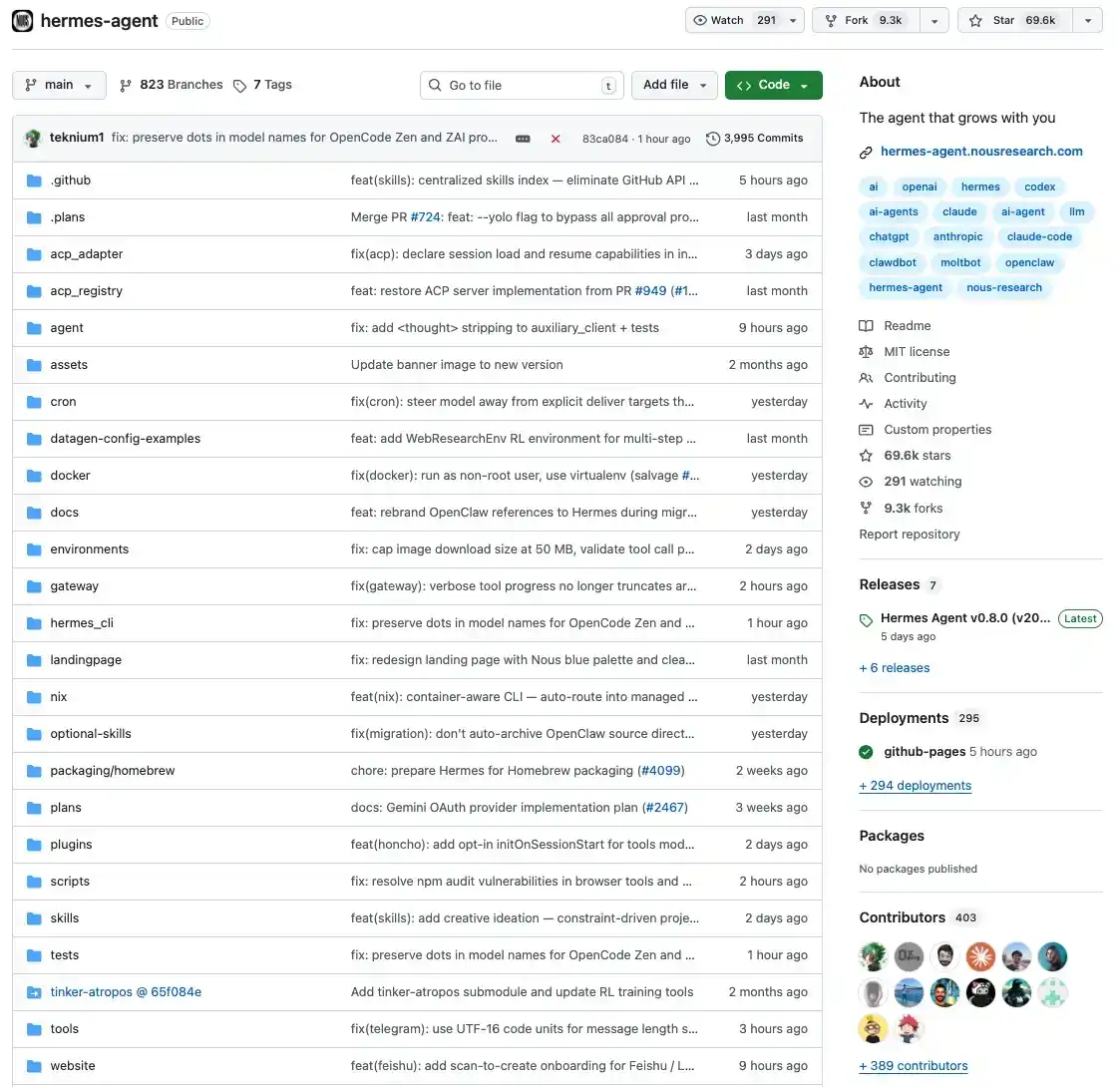
So, starting from early March, Hermes Agent broke into GitHub Trending, reaching a high of 11th place, with stars surpassing 2200. AwesomeAgents called it "the most ambitious open-source Agent release of 2026 so far". Currently, Hermes has 69.9k Stars and 9k Forks on GitHub.

Today, BlockBeats will talk to everyone about what makes this Agent different.

What is Hermes Agent?

Hermes Agent is a self-evolving AI agent built by Nous Research, and it is currently the only Agent with a built-in learning loop.

It can automatically create skills from usage experience, continuously improve these skills during use, actively solidify knowledge into reusable assets, retrieve its own past conversation history, and continuously deepen its understanding of you, the user, across multiple sessions.

So, simply put, the biggest advantage of Hermes Agent is: The more you use it, the smarter and more handy it becomes.

Its positioning is not a programming assistant bound to an IDE, nor is it a chat wrapper for a single API, but a truly autonomous agent that resides on your server, remembers what it has learned, and grows stronger the longer it runs.

Nous Research has positioned itself from the beginning as an open-source first, decentralization-oriented AI lab, aiming to build AI that users can control autonomously, rather than concentrating intelligence in the hands of a few closed companies. Their early work focused on the Hermes model series, while also investing heavily in infrastructure and systems level, exploring technologies like DisTrO for model training across globally distributed consumer-grade GPUs, and simulation environments like WorldSim and Doomscroll for multi-agent interaction and long-term behavior.

The team behind Hermes Agent is the same group that previously built a series of models like Nomos and Psyche.

What are the useful tools?

The core mechanisms of Hermes Agent are its memory system and skill system. The Agent maintains two concise core files: MEMORY.md stores environmental information, conventions, and experiences summarized from past tasks; USER.md stores your preferences and communication style. These two files are automatically injected into the system prompt at the start of each session, acting as the Agent's "long-term working memory". Additionally, all historical sessions are stored in a SQLite full-text search database, allowing the Agent to retrieve conversation content from weeks ago.
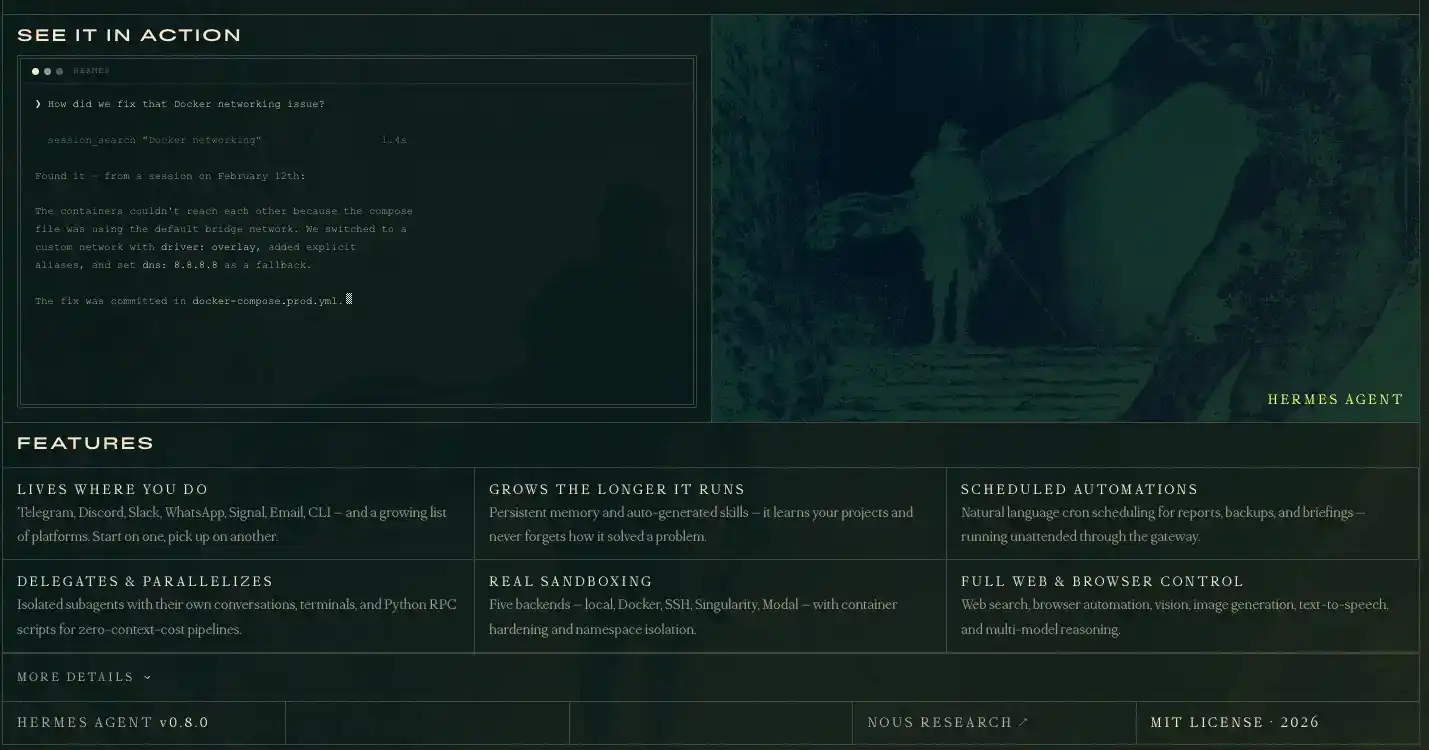
Regarding the skill system, each time a complex task is completed (typically involving 5 or more tool calls), the Agent autonomously creates a structured Markdown "skill document" recording the steps, known information, and verification methods for future reuse. Skill files follow a progressive disclosure pattern: the Agent by default only sees the skill name and description (about 3000 tokens), and loads the full content of a specific skill only when needed, thus controlling token consumption.

At the tool level, Hermes Agent comes with over 40 built-in tools, covering web search, browser automation, visual understanding, image generation, text-to-speech, and also supports setting up scheduled tasks via natural language, allowing the Agent to automatically perform periodic work like report generation, data backup, and system monitoring unattended.

Among these, the most popular tools, meaning those with the highest frequency of use by the community users, the most feedback, and based on Hermes's functional architecture and the typical needs of the developer community, the ones ranked at the top are these:

Hindsight is currently the hottest single tool in the ecosystem and is the officially recommended long-term memory plugin for Hermes. It automatically recalls relevant context before each LLM call, supports local PostgreSQL or cloud deployment, and is already integrated into Hermes as a native Memory Provider.

Anthropic-Cybersecurity-Skills is the skill pack with the highest Stars in the ecosystem, containing 753+ structured cybersecurity skills, fully mapping the MITRE ATT&CK framework, suitable for security research and penetration testing scenarios.

mission-control is currently the most popular Agent orchestration dashboard in the ecosystem, supporting Agent fleet management, task distribution, cost tracking, and multi-Agent collaborative workflows, recommended by the community as the standard for production-level deployment.

Hermes Agent Self-Evolution is an evolutionary self-improvement technique using DSPy + GEPA to optimize skills, prompts, and code.

Hermes Workspace is the native workspace for Hermes, integrating a chat interface, terminal, and skill manager, and is the most popular graphical entry point.

Furthermore, it can spawn independent sub-agents, each with its own dialogue context, independent terminal, and Python RPC scripts, enabling zero-context-cost parallel pipelines.

In terms of infrastructure flexibility, it supports six terminal backends: local run, Docker, SSH remote, Daytona serverless, Singularity containers, and Modal cloud functions. Daytona and Modal hibernate when idle, costing almost nothing. You can run it on a $5 VPS or a GPU cluster, issue commands through Telegram, and have it work on cloud servers you never SSH into directly.

Hermes Agent currently constitutes the most direct competition with OpenClaw, as both are open-source Agent frameworks aimed at developers.

The architectural philosophies of the two are截然不同 (distinctly different): OpenClaw's design core is a "control plane", a unified long-running process responsible for managing sessions, routing, tool execution, and state—everything flows through this central controller. Hermes, however, centers around the Agent's own execution loop, building the gateway, task scheduler, tool runtime, etc., all around this "do, learn, improve" iterative cycle.

The difference in the skill systems is particularly significant: OpenClaw's skills are mostly manually written, loaded from different levels like workspace, personal, shared, or plugins; Hermes's approach is to let the Agent generate skills from experience itself, forming a true autonomous learning loop.

How to Install and Use

Getting started is extremely simple. A single command, "curl -fsSL https://raw.githubusercontent.com/NousResearch/hermes-agent/main/scripts/install.sh | bash", completes the installation. It works on Linux, macOS, and WSL2. Hermes Agent automatically completes all configuration without manual operation.
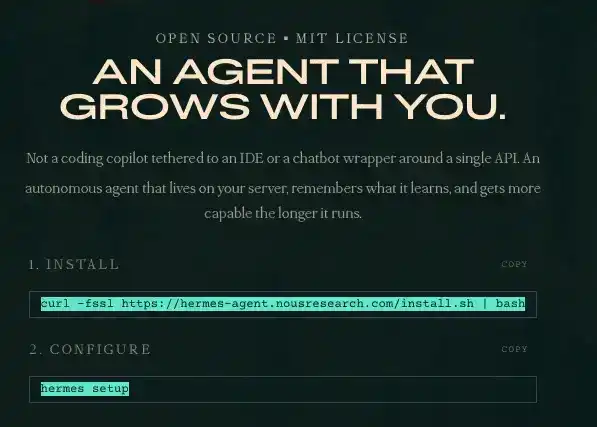
Hermes Official Website

After Hermes Agent is installed, run "hermes setup" to start the setup wizard. Select your model provider (supports Nous Portal, OpenRouter, OpenAI, or any custom endpoint), connect your messaging platform (Telegram, Discord, Slack, or WhatsApp), and then start your first conversation. From the first interaction, Hermes Agent immediately enters learning mode, starting to build memory, create skills, and becoming more capable after each session.

Core commands for daily use include:

hermes (start conversation),

hermes model (select LLM provider and model),

hermes tools (configure which tools to enable),

hermes gateway (start message gateway, connect to Telegram, Discord, etc.),

hermes setup (run the full setup wizard, configure everything at once),

hermes claw migrate (migrate from OpenClaw),

hermes update (update to the latest version),

hermes doctor (diagnose problems);

Hermes Agent is suitable for scenarios including: General AI assistants that need to remember context across sessions and continuously improve capabilities; Custom Agent workflows that need to combine tools, plugins, MCP servers, browsers, or Shell; Deploying Agents on local hardware, cloud VMs, or low-cost serverless infrastructure; and Persistent assistant scenarios that require cross-platform searchable conversation history and acquired skills.

More specifically, you can use it to talk to it on Telegram while it executes tasks on a cloud VM, set up automations and push reports to any platform, have it take over periodic tasks; you can also integrate it into Slack or Discord to provide AI collaboration support for the entire team; or utilize its trajectory export function to generate training data for RL training of next-generation tool-calling models.


Câu hỏi Liên quan

QWhat is the core mechanism that makes Hermes Agent unique according to the article?

AIts memory system and skill system. It maintains two core files (MEMORY.md and USER.md) for long-term working memory and autonomously creates structured Markdown skill documents from complex tasks for future reuse.

QWhat was a key factor that contributed to Hermes Agent's initial growth period?

AThe security vulnerabilities discovered in the competing project OpenClaw, which caused the developer community to reconsider its use in production environments. Hermes provided a migration tool for developers leaving OpenClaw.

QName one of the most popular tools in the Hermes Agent ecosystem mentioned in the article.

AHindsight, which is the official long-term memory plugin that automatically recalls relevant context before each LLM call.

QHow does the installation process for Hermes Agent work?

AWith a single command: `curl -fsSL https://raw.githubusercontent.com/NousResearch/hermes-agent/main/scripts/install.sh | bash`. It automatically completes all configuration.

QWhat is the fundamental architectural difference between Hermes Agent and OpenClaw as described in the article?

AOpenClaw is designed around a central 'control plane' that manages everything, while Hermes is built around the agent's own execution loop of 'do, learn, improve', with all components supporting that cycle.

Nội dung Liên quan

Gần 3 triệu fan hâm mộ, "nữ thần thiện nguyện" đều do AI tổng hợp, làm giả trại mồ côi xuyên biên giới, sự nghiệp "làm từ thiện giả" sụp đổ chỉ sau một đêm

Cô gái người Úc có tên Lily Jay (tên thật Lily Jay Hinson) đã gây chấn động mạng xã hội khi bị phát hiện sử dụng AI để tạo ra một vụ lừa đảo từ thiện quy mô lớn. Với gần 3 triệu người theo dõi trên Instagram, cô xây dựng hình ảnh một tín đồ Hồi giáo ngoan đạo và tích cực thông qua "Quỹ Lily Jay", tuyên bố xây dựng nhà thờ Hồi giáo, cứu trợ trẻ mồ côi ở Uganda, Sudan, Nepal và phân phát bánh mì cho người tị nạn ở Gaza. Tuy nhiên, điều tra từ ABC News Verify đã vạch trần hàng loạt bằng chứng giả mạo: video khánh thành trại trẻ mồ côi ở Uganda với những đứa trẻ cầm kẹo, biểu ngữ và chính người phụ nữ trong video đều do AI tạo ra, kể cả chi tiết lỗi chính tả trên áo phông. Hình ảnh nhận giải thưởng nhân đạo cũng chứa watermark của ChatGPT. Quỹ này thậm chí không đăng ký hoạt động hợp pháp tại Uganda và không có tên trong sổ đăng ký từ thiện ở Úc, đồng thời đã giấu một dòng tuyên bố "không phải là tổ chức từ thiện" trên website. Hoạt động của quỹ đầy nghi vấn: trụ sở đặt ở Kosovo, cá nhân Lily Jay sống ở Cyprus và không phải là giám đốc quỹ. Sau khi bị ABC chất vấn, trang web đã gỡ video giả và nút quyên góp đối với truy cập từ Úc, nhưng vẫn để mở cho người dùng quốc tế. Chuyên gia cảnh báo đây là kiểu lừa đảo nguy hiểm, lợi dụng lòng trắc ẩn và sự tin tưởng. Vụ việc gióng lên hồi chuông cảnh tỉnh về việc AI có thể bị lạm dụng để tạo ra những câu chuyện giả tưởng hoàn hảo, đánh cắp sự thiện nguyện của công chúng trong thời đại số.

marsbit6 phút trước

Gần 3 triệu fan hâm mộ, "nữ thần thiện nguyện" đều do AI tổng hợp, làm giả trại mồ côi xuyên biên giới, sự nghiệp "làm từ thiện giả" sụp đổ chỉ sau một đêm

marsbit6 phút trước

L2 'Tái hiệu chuẩn': Khi L1 Trở Thành Rollup Của Chính Mình, Cục Diện Cuối Cùng Của Ethereum Là Gì?

"L2 Hiệu chỉnh lại": Khi L1 trở thành Rollup của chính nó, tương lai cuối cùng của Ethereum là gì? Cộng đồng Ethereum từng lo lắng về việc L2 làm xói mòn giá trị của L1 và phá vỡ khả năng kết hợp toàn cầu. Bài viết phân tích sự điều chỉnh mối quan hệ giữa L1 và L2 trong bối cảnh mở rộng quy mô của Ethereum. Định vị mới của L2: Với việc L1 tự nâng cao khả năng xử lý (tăng Gas Limit, zkEVM...), vai trò chính của L2 không còn đơn thuần là cung cấp không gian giao dịch rẻ hơn. Thay vào đó, L2 sẽ chuyển sang cung cấp các chức năng khác biệt mà L1 khó đáp ứng thống nhất, như tối ưu hóa ứng dụng cụ thể, tính riêng tư và mô hình quản trị linh hoạt. L2 sẽ trở thành một dải phổ liên tục từ các Rollup kế thừa bảo mật tối đa của Ethereum đến các môi trường thực thi độc lập hơn. Tương tác & Kết hợp lại: Sự phân mảnh giữa các L2 gây ra vấn đề về thanh khoản và trải nghiệm người dùng. Giải pháp nằm ở việc cải thiện khả năng tương tác, không chỉ là "một nút chuyển chuỗi", mà là làm cho các trạng thái giữa các môi trường thực thi có thể tin cậy lẫn nhau nhanh hơn, thông qua các khung công việc Intent, Lớp Tương tác Ethereum (EIL) và việc rút ngắn đáng kể thời gian xác nhận cuối cùng (finality). L1 như "Rollup của chính nó": Với sự phát triển của hệ thống chứng minh (như zkEVM), trong tương lai, các trình xác thực L1 có thể xác minh trạng thái thông qua bằng chứng mật mã thay vì thực thi lại mọi giao dịch. Điều này chia sẻ kiến trúc "thực thi-tách biệt-xác minh" với Rollup, làm mờ ranh giới truyền thống giữa L1 và L2. Các L2 tiên tiến (Native Rollup) có thể kế thừa trực tiếp hơn khả năng xác minh từ giao thức L1. Tóm lại, tương lai của Ethereum không phải là L1 thay thế L2 hay ngược lại, mà là một hệ sinh thái gồm nhiều môi trường thực thi (L2) đa dạng về chức năng và hiệu suất, nhưng có thể chia sẻ nền tảng bảo mật, thanh khoản và quan hệ trạng thái, từ đó tái tạo lại trải nghiệm "một chuỗi" thống nhất cho người dùng.

marsbit8 phút trước

L2 'Tái hiệu chuẩn': Khi L1 Trở Thành Rollup Của Chính Mình, Cục Diện Cuối Cùng Của Ethereum Là Gì?

marsbit8 phút trước

Grayscale Nộp Đơn Đăng Ký ETF Worldcoin Đầu Tiên Lên SEC Dưới Mã Ticker GWLD

Công ty Grayscale Investments đã nộp hồ sơ đăng ký Biểu mẫu S-1 lên Ủy ban Chứng khoán và Giao dịch Hoa Kỳ (SEC) để ra mắt một quỹ ETF tiền mã hóa mới, dự kiến niêm yết trên sàn Nasdaq với mã GWLD. Quỹ này nhằm cung cấp cho nhà đầu tư Mỹ cách tiếp cận được quy định đối với Worldcoin (WLD), đặc biệt khi công dân Mỹ không đủ điều kiện nhận tài trợ người dùng trực tiếp từ Worldcoin. Thông báo này đã giúp giá WLD tăng hơn 8%, dù token trước đó đã chạm mức thấp kỷ lục. Hồ sơ cũng nêu bật các vấn đề về tokenomics, chẳng hạn như 100 địa chỉ ví hàng đầu nắm giữ ~90% nguồn cung lưu hành và việc mở khóa token liên tục cho đến năm 2028 có thể gây áp lực bán. Ngoài ra, hệ sinh thái Worldcoin với công nghệ quét mống mắt (Orbs) đối mặt với những thách thức pháp lý về thu thập dữ liệu sinh trắc học ở nhiều khu vực pháp lý. Dù việc niêm yết có thể bị trì hoãn đến cuối năm 2026, Grayscale vẫn đang mở rộng danh mục sản phẩm đầu tư tiền mã hóa có quy định, cho thấy nỗ lực thiết lập vị thế trên thị trường ETF non trẻ trước khi các tổ chức khác tham gia.

TheNewsCrypto22 phút trước

Grayscale Nộp Đơn Đăng Ký ETF Worldcoin Đầu Tiên Lên SEC Dưới Mã Ticker GWLD

TheNewsCrypto22 phút trước

Những mảnh vỡ vĩnh cửu của tiền bạc: Thanh toán bên thứ ba không có tính nguyên tắc đầu tiên

**Tóm tắt: Mảnh vỡ vĩnh cửu của tiền tệ: Ngành thanh toán bên thứ ba không có 'tính nguyên lý đầu tiên'** Ngành thanh toán đang ở một thời điểm then chốt. Stripe, sau khi bỏ lỡ cơ hội IPO trong đại dịch, đang cố gắng mua lại PayPal để bổ sung năng lực thị trường C2C, trong một nỗ lực nhằm kích thích định giá và kể một câu chuyện mới trước khi lên sàn. Tuy nhiên, cuộc chiến trong ngành thanh toán bên thứ ba giống như một trận chiến tiêu hao vĩnh viễn, khó có thể loại bỏ các công ty nhỏ hơn do hai đặc điểm cốt lõi: sự phân mảnh theo quốc gia, ngành và khách hàng; và bản chất là sản phẩm phụ của hệ thống ngân hàng. Stripe đã thử mở rộng từ thị trường nhà phát triển (D) sang doanh nghiệp (B) và người tiêu dùng (C), đồng thời đặt cược vào tương lai thông qua ổn định tiền (stablecoin) và thanh toán tự động (Agentic Payment). Nhưng stablecoin chưa phải là xu hướng thanh toán phổ biến, và các Agent vẫn cần một lối vào hệ thống truyền thống. Giá trị của Stripe giống như một sản phẩm quyền chọn, phụ thuộc vào mức độ thành công của những câu chuyện này. Cơ hội thực sự trong làn sóng stablecoin và Agent có lẽ không nằm ở việc phát hành stablecoin, mà nằm ở hệ thống thanh toán bù trừ (clearing network) hiệu quả cao. Các công ty như Stripe (với Tempo) và Circle (với Arc) đang xây dựng các blockchain và stablecoin của riêng họ, với mục tiêu cuối cùng là thiết lập các mạng lưới thanh toán bù trừ có thể thu hút dòng tiền và giữ lại lợi nhuận, phần nào thoát khỏi sự phụ thuộc hoàn toàn vào hệ thống ngân hàng thương mại truyền thống. Đây có thể là con đường để vượt qua cấu trúc phân mảnh và phụ thuộc vốn có của ngành thanh toán.

marsbit31 phút trước

Những mảnh vỡ vĩnh cửu của tiền bạc: Thanh toán bên thứ ba không có tính nguyên tắc đầu tiên

marsbit31 phút trước

Cuộc Chạy Đua Thông Qua Dự Luật Clarity: Con Đường Thoả Hiệp Hai Đảng Ở Mỹ Gai Góc

Đạo luật Clarity về cấu trúc thị trường tiền mã hóa tại Mỹ đang phải đối mặt với một chặng đường lập pháp đầy chông gai, nơi sự thỏa hiệp giữa hai đảng trở thành yếu tố then chốt cho sự sống còn của nó. Hành trình của dự luật bắt đầu với sự gián đoạn vào tháng 1, khi CEO Coinbase Brian Armstrong làm đảo lộn một thỏa thuận lưỡng đảng tại Ủy ban Ngân hàng Thượng viện. Phải đến bốn tháng sau, nhờ một thỏa hiệp về vấn đề "lợi nhuận" giữa Thượng nghị sĩ Angela Alsobrooks (Dân chủ) và Thom Tillis (Cộng hòa), dự luật mới được đưa vào chương trình nghị sự. Tuy nhiên, các điều khoản về đạo đức lại trở thành điều kiện bắt buộc đối với phe Dân chủ, khiến dự luật cuối cùng được thông qua tại Ủy ban Nông nghiệp Thượng viện chỉ với sự ủng hộ theo đường lối đảng, không có phiếu nào từ phe Dân chủ. Các tranh cãi tiếp tục bùng phát vào tháng 7. Ngoài vấn đề đạo đức, các bất đồng về quy định "lợi nhuận" đã khiến một số nghị sĩ Cộng hòa đứng về phía các ngân hàng lớn, trong khi các cơ quan thực thi pháp luật phản đối mạnh mẽ các điều khoản bảo vệ nhà phát triển. Mối quan tâm chính vẫn là rủi ro tài chính bất hợp pháp và bảo vệ người tiêu dùng. Dù vậy, động lực cho dự luật vẫn đang hình thành. Các cuộc thảo luận giữa các nghị sĩ và quan chức Nhà Trắng đang được tiến hành để tìm kiếm ngôn ngữ thỏa hiệp về đạo đức. Cộng đồng kỳ vọng một bản dự thảo hòa giải giữa hai ủy ban của Thượng viện sẽ sớm được công bố. Tuy nhiên, vẫn còn nhiều nghi ngờ về khả năng đạt được sự ủng hộ đủ rộng rãi từ cả hai đảng. Mục tiêu ngắn hạn của cộng đồng tiền mã hóa có thể là một hành động biểu tượng tại Thượng viện trước kỳ nghỉ hè tháng 8, hoặc hướng tới việc thông qua dự luật tại cả hai viện và được ký thành luật vào năm 2026. Con đường phía trước vẫn còn nhiều trở ngại, nhưng quá trình vận động hành lang kiên trì, giành từng phiếu bầu và từng nghị sĩ, chính là chiến thuật mà ngành công nghiệp này cần theo đuổi.

Foresight News1 giờ trước

Cuộc Chạy Đua Thông Qua Dự Luật Clarity: Con Đường Thoả Hiệp Hai Đảng Ở Mỹ Gai Góc

Foresight News1 giờ trước

Giao dịch

Giao ngay
活动图片