Glassnode: BTC Rally a 'False Breakout', Fragile Bottom Still Awaiting Formation

marsbitXuất bản vào 2026-01-22Cập nhật gần nhất vào 2026-01-22

Tóm tắt

Glassnode's analysis indicates that the recent Bitcoin price rebound is a "false breakout," with the market remaining structurally fragile and lacking a confirmed bottom. Despite some signs of seller exhaustion in early January 2026, the rally faced strong resistance near the $98K level—the cost basis for short-term holders—where profit-taking and break-even selling intensified. On-chain data reveals persistent overhead supply from both short-term and long-term holders, creating sustained selling pressure and limiting upward momentum. While spot flows have turned slightly positive with reduced exchange outflows, demand remains selective and not yet broad-based. Corporate treasury inflows are sporadic and event-driven, failing to provide consistent buying support. Derivatives markets show low participation, with muted futures volume and cautious leverage usage. Options markets saw only short-term volatility spikes in response to events, while longer-term implied volatility remained stable. Dealer gamma positioning turned net short below $90K, increasing downside vulnerability. In summary, the market is in a low-engagement consolidation phase, driven more by a lack of selling rather than strong buying interest. A durable bottom has yet to form, and any sustained recovery will require a robust catalyst to absorb overhead supply and boost investor conviction.

Entering early January 2026, the market showed signs of seller exhaustion, creating an opportunity for a price rebound towards the upper boundary of the current trading range. However, this rally comes with elevated risk as prices approach the ~$98k zone, where recent investors have formed active 'breakeven' selling pressure around their cost basis.

Core Insights

· On-chain structure remains fragile: Price hovers near key cost basis levels, lacking sustained confirmation of conviction from long-term holders.

· Supply overhang persists: Recent buyers face overhead resistance, limiting the sustainability of any advance and making rallies prone to sell-offs.

· Spot flows turn positive: Selling pressure on major exchanges has eased, but buying remains selective, not broad-based.

· Treasury inflows are patchy: Treasury activity is sporadic and event-driven, not yet forming a coordinated buying trend, with limited impact on overall demand.

· Derivatives participation is low: Futures volume is contracting, leverage use is cautious, and the market is in a low-engagement state.

· Options market sees only short-term pressure: Short-term implied volatility reacted to risk events, while medium-to-long-term volatility remains stable.

· Hedging demand spikes then normalizes: The surge in the Put/Call Volume Ratio has subsided, indicating risk aversion was tactical.

· Dealer gamma positioning is net short: This weakens mechanical support for price stability and increases market sensitivity to liquidity shocks.

On-Chain Deep Dive

Over the past two weeks, the anticipated technical rebound has largely played out, with price stalling below the Short-Term Holder cost basis after touching resistance, once again confirming substantial overhead selling pressure. This report will focus on the structure and behavior of this 'overhead' supply to reveal emerging seller dynamics.

Technical Rebound Meets Resistance

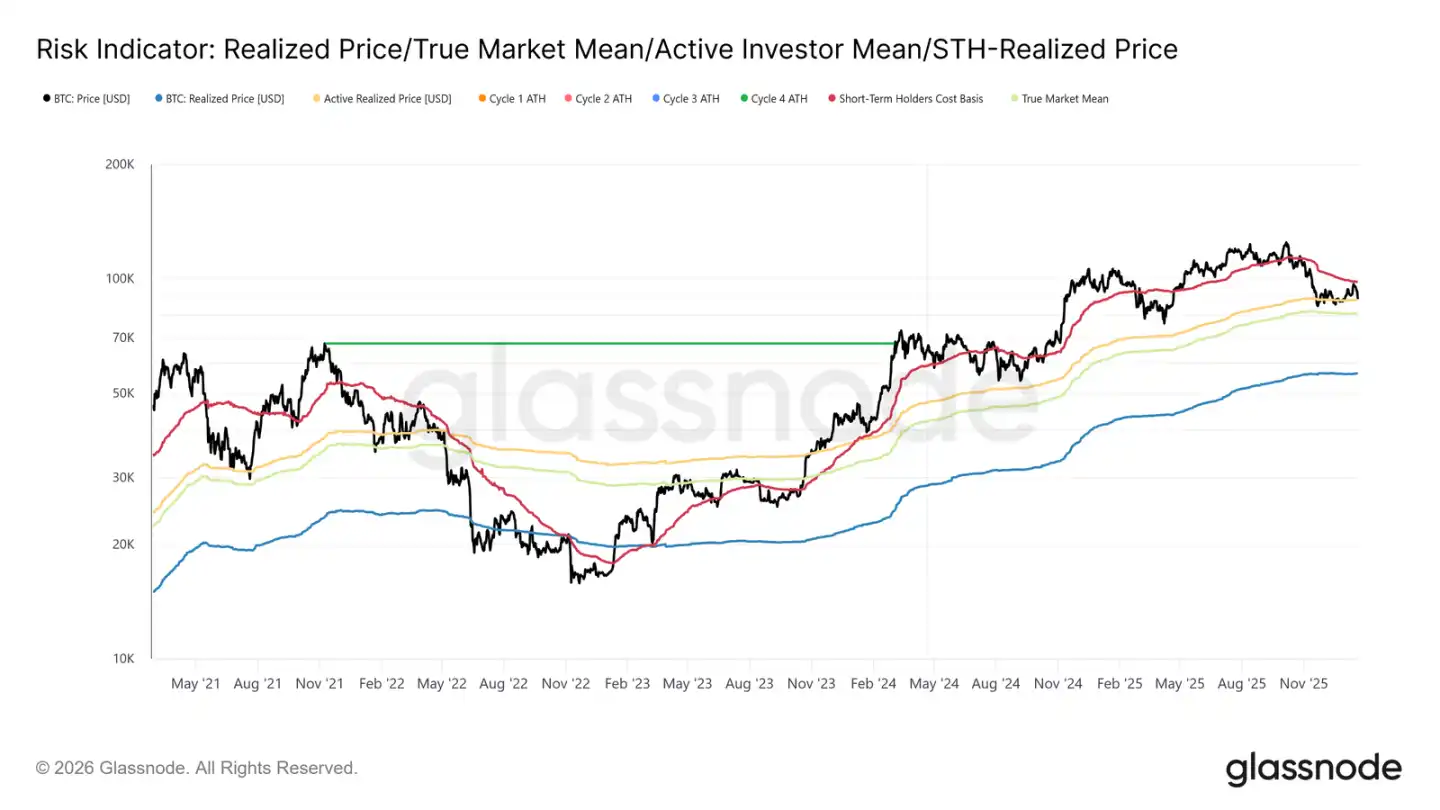
A clear narrative has emerged: the market has been in a mild bearish phase. Its lower bound is supported by the ~$81.1k Realized Mean, while the upper bound is capped by the average cost basis of Short-Term Holders. This range creates a fragile equilibrium where downside pressure is absorbed, but upside attempts are repeatedly sold into by investors who bought between Q1 and Q3 2025.

Entering early January 2026, the exhaustion of seller momentum opened a window for price to rebound towards the range high. However, this rally is at high risk as prices near the ~$98k zone, where recent investors show increased willingness to sell around their breakeven point.

The recent rejection around ~$98.4k (the STH cost basis) mirrors the market structure seen in Q1 2022. Back then, the market repeatedly failed to decisively break above the cost basis of recent buyers, leading to a prolonged consolidation period. This similarity underscores the fragile nature of the current recovery attempt.
Overhead Supply Pressure Remains

Building on the observation of price rejection at key cost levels, a closer look at the on-chain supply distribution provides clearer insight into why upward momentum has repeatedly faltered.

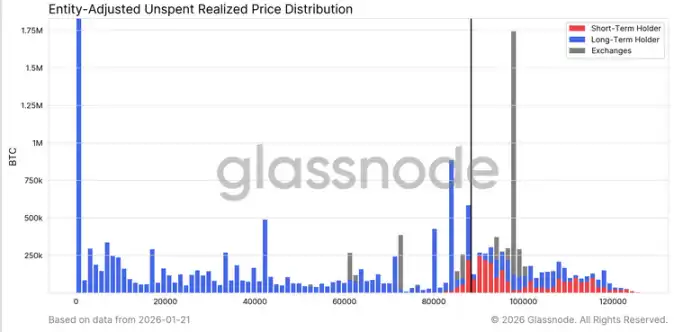
The URPD (Unrealized Profit/Loss Distribution) chart clearly illustrates why the excess supply above $98k remains the primary force capping near-to-mid-term rallies. The recent rebound partially filled the 'vacuum zone' between ~$93k and $98k, primarily through early buyers distributing to new entrants, forming a new cluster of Short-Term Holder supply.

However, the supply distribution above $100k reveals a broad and dense supply zone, with these coins gradually aging into Long-Term Holder status. This undigested 'overhead' supply is a persistent source of selling pressure, likely keeping price suppressed below the $98.4k (STH cost basis) and $100k psychological levels. Thus, a significant and sustained acceleration in demand momentum is required for a decisive breakout.
Long-Term Holders Also Present Resistance

Expanding the view from Short-Term Holders to longer-term holdings, we find the same structural constraints persist.

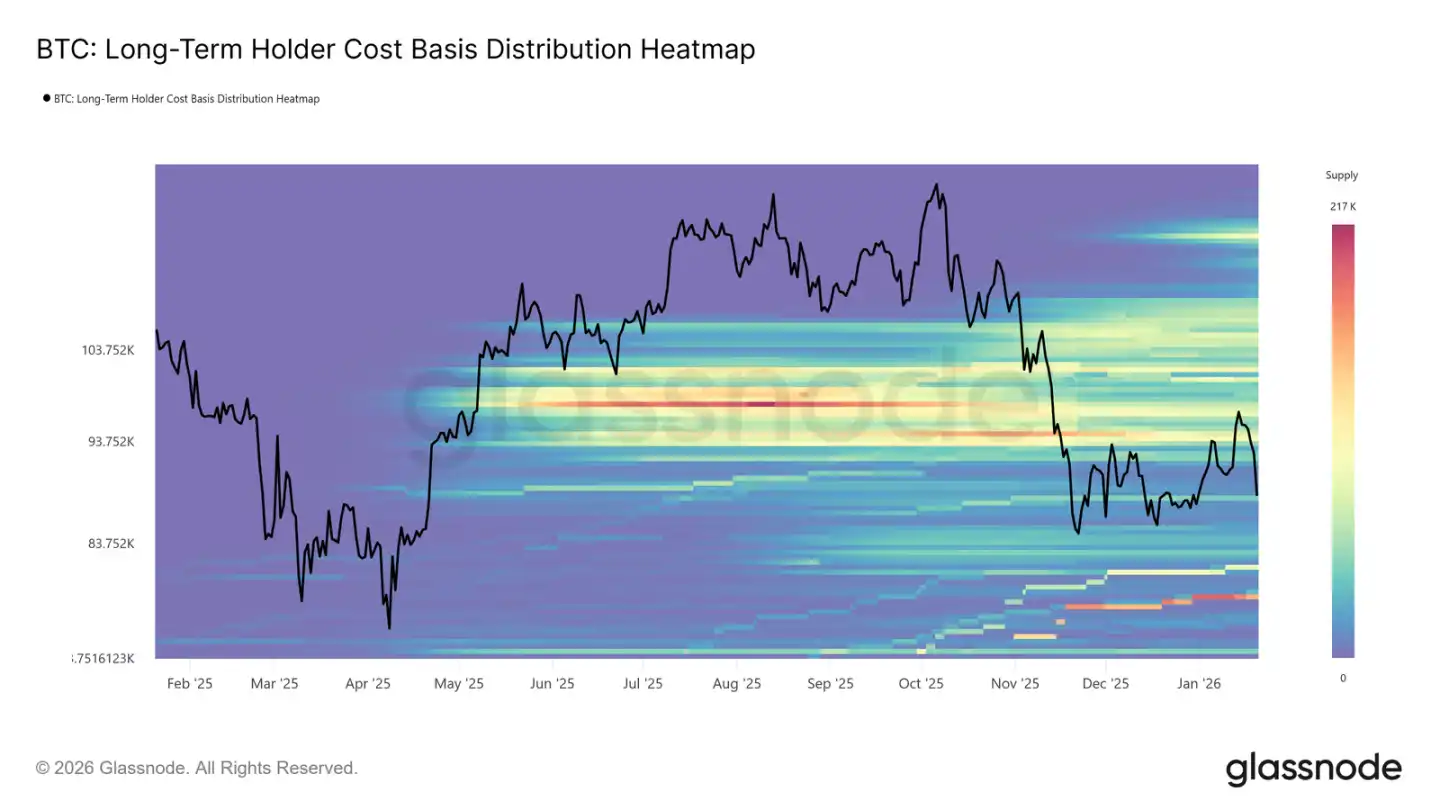
The Long-Term Holder cost basis distribution heatmap shows a dense cluster of long-term coin acquisition costs above the current spot price. This zone represents a significant source of potential seller liquidity when price rallies towards these historical entry levels.

Long-Term Holders will remain a potential source of resistance until new, sufficiently strong demand emerges to absorb this overhead supply. Therefore, upside potential is likely to remain capped, and any rally vulnerable to renewed selling, until this 'overhead' supply is thoroughly digested.
Rally Meets Profit-Taking and Stop-Loss Selling

Going further, we can identify which investor cohorts were actively distributing (for profit or stop-losses) during the recent push towards ~$98k, thus capping the price.

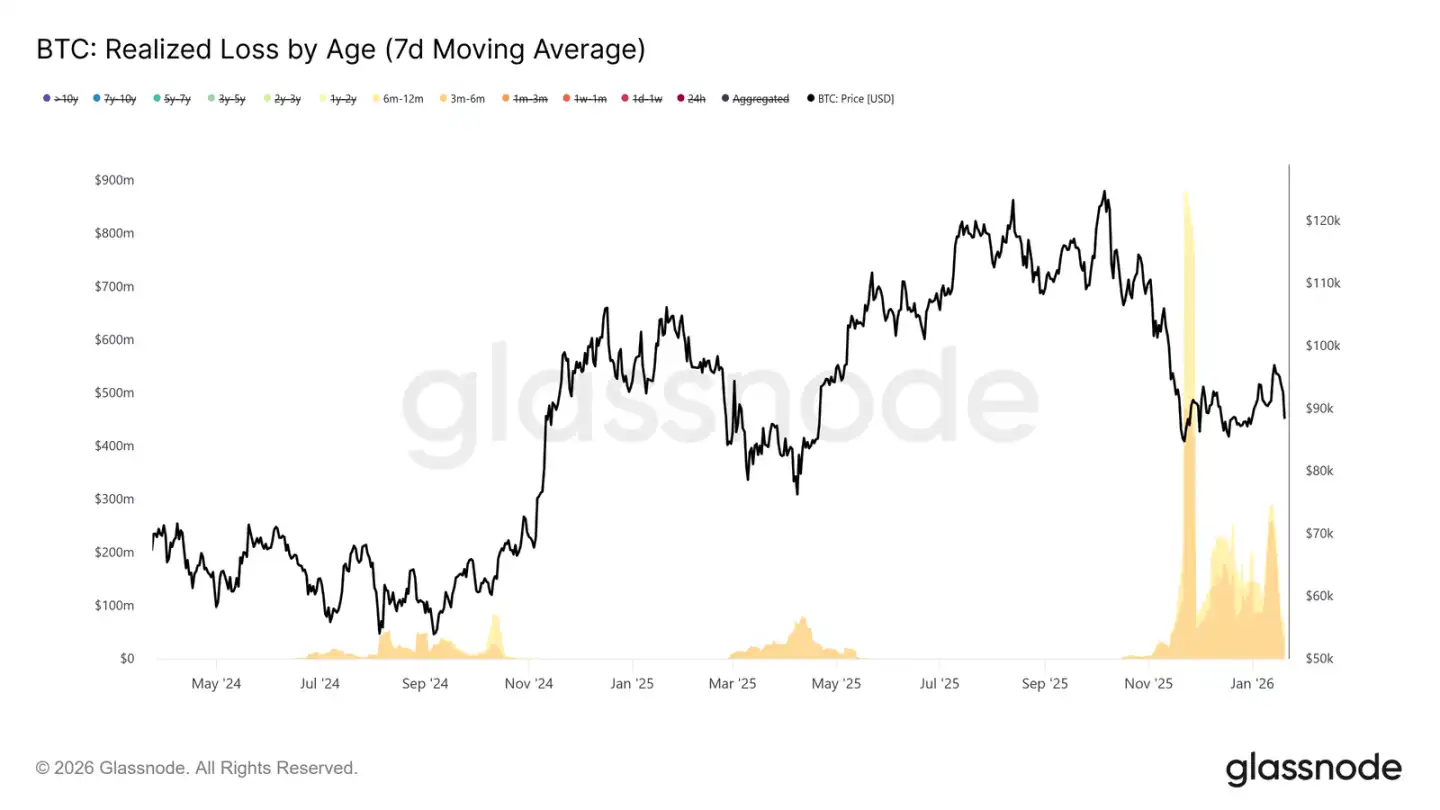
Realized Losses broken down by coin age show that loss-taking was dominated by the 3-6 month cohort, followed by the 6-12 month holders. This pattern is characteristic of 'pain capitulation,' particularly from those who bought above $110k and are now exiting as price approaches their cost basis. This behavior reinforces seller pressure around key recovery levels.
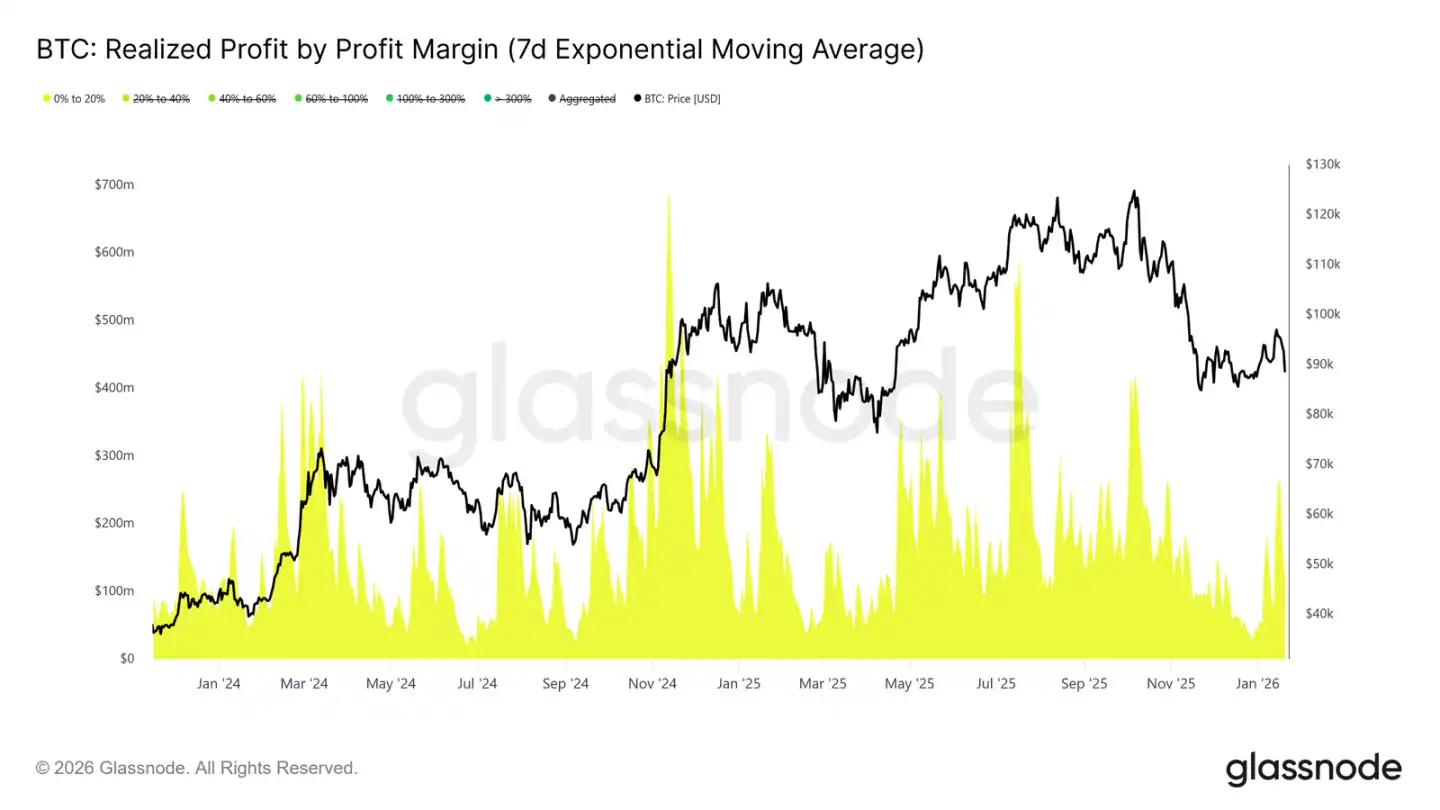
Concurrently, Realized Profits segmented by profit margin show a notable increase in the proportion of profit-taking within the 0% to 20% margin bracket. This highlights the influence of 'breakeven sellers' and short-term swing traders who tend to exit upon modest gains rather than waiting for trend continuation.

This behavior is common during market transitions where investor conviction is fragile, prioritizing capital preservation and tactical profits. This increase in low-margin selling continuously undermines upward momentum as supply is released around cost basis.
Off-Chain Market Watch

Spot Flows Turn Positive

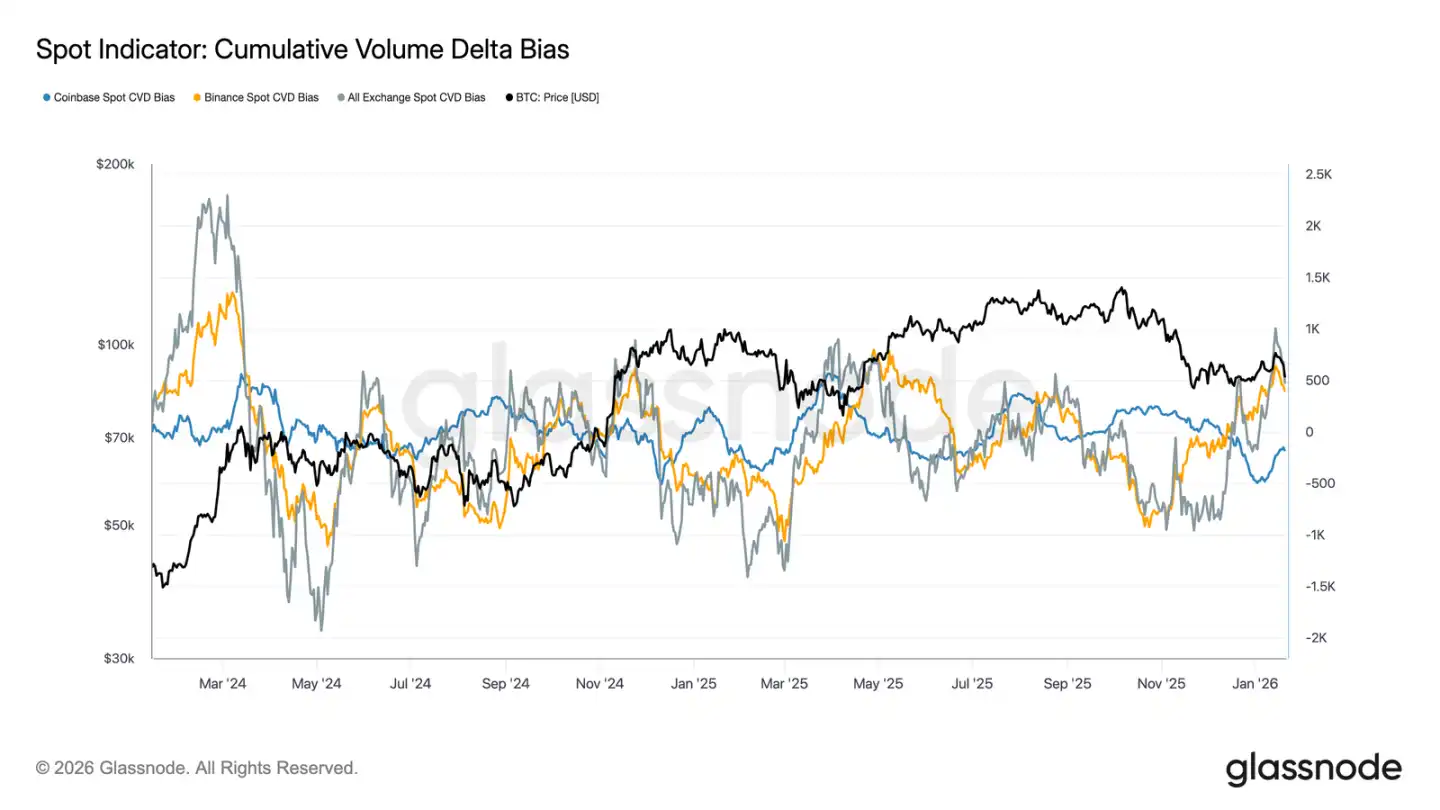
Spot market behavior has improved following the recent decline. The Binance and Exchange Composite CVD (Cumulative Volume Delta) metrics have flipped back to net buying, indicating spot participants are starting to re-accumulate rather than sell into strength, contrasting with the persistent selling pressure seen in earlier consolidation phases.

Coinbase, which had been a primary source of sell pressure during the range-bound trading, has also seen a significant slowdown in its net selling pace. The abatement of selling from Coinbase helps reduce overhead supply, stabilizing price action and supporting the recent bounce.

Although spot participation hasn't yet shown the sustained, aggressive buying typical of a trending expansion phase, the shift back to net buying on major platforms marks a positive improvement in the underlying spot market structure.
Digital Asset Treasury Inflows Remain Patchy

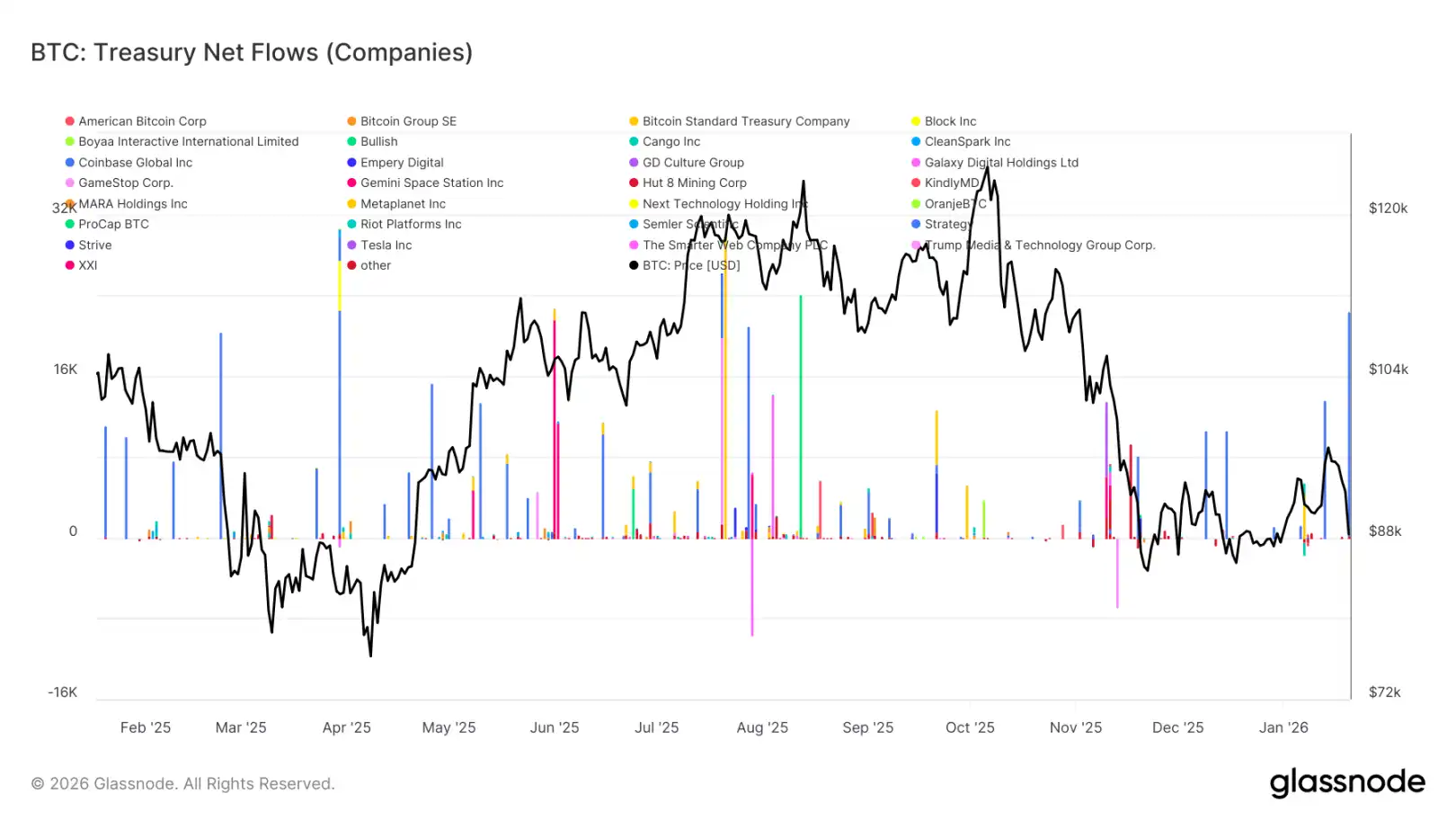
Recent net flows for digital asset treasuries remain patchy and uneven, characterized by isolated event-driven activity rather than broad trend buying. While there have been notable buying spikes from individual companies over the past few weeks, overall corporate demand has not yet entered a sustained accumulation mode.

Overall, digital asset treasury flows are oscillating narrowly around the zero line, indicating most corporate treasuries are currently in a wait-and-see or opportunistic mode, not systematically accumulating. This contrasts with earlier phases where multiple corporations bought in concert, driving trend acceleration.

Overall, the latest data shows corporate treasuries are only a marginal, selective source of demand, with an intermittent impact that is not yet decisive for overall price dynamics.
Derivatives Markets Are Quiet

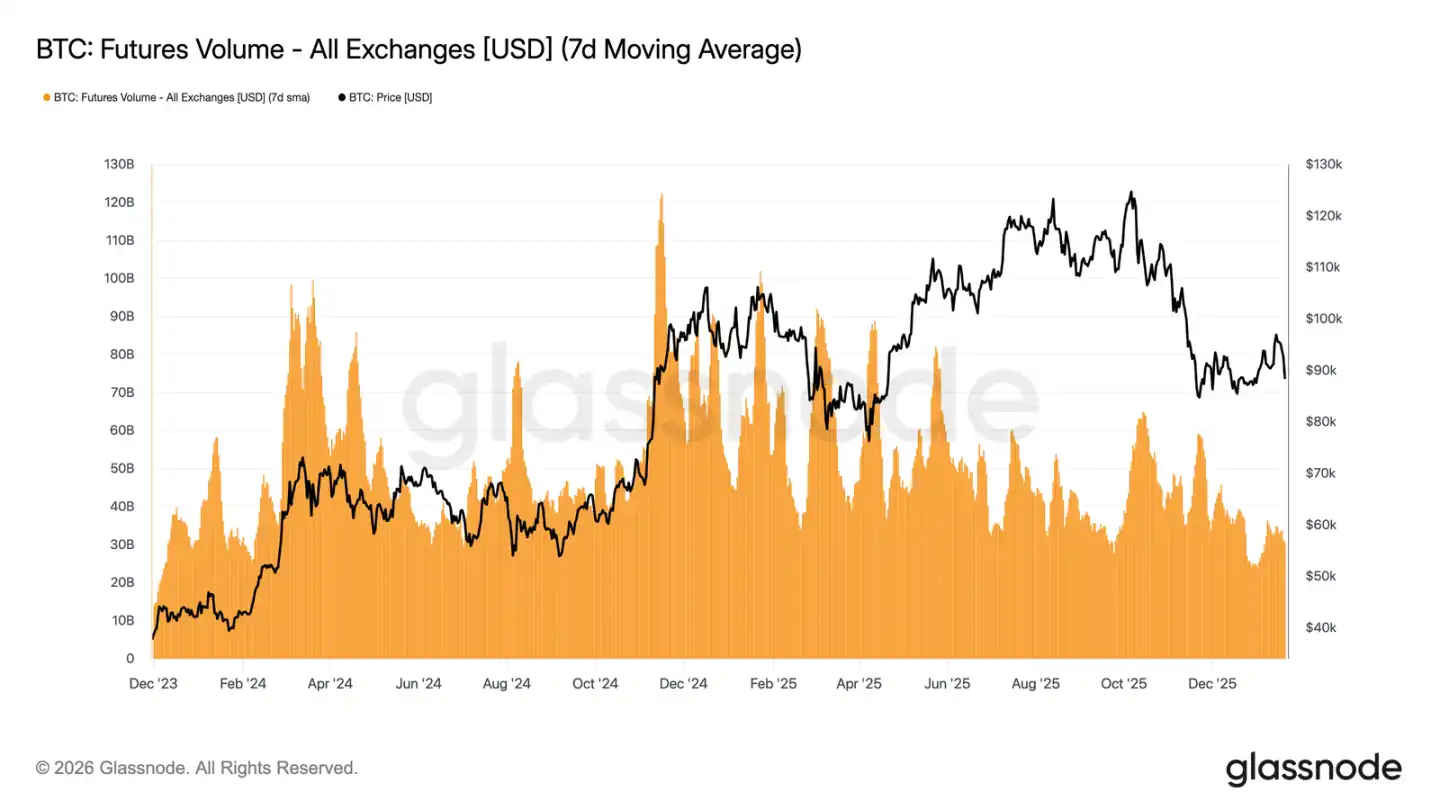
Bitcoin futures' 7-day moving average volume continues to contract, remaining well below levels typically associated with trending markets. The recent price volatility has not been accompanied by a meaningful expansion in volume, highlighting the low participation and lack of confidence in the derivatives market.

The current market structure suggests recent price action is more driven by sparse liquidity than aggressive positioning. Adjustments in Open Interest also lack concurrent volume growth, reflecting more the adjustment and rebalancing of existing risk rather than the deployment of new leverage.

In summary, the derivatives market is currently in a low-engagement 'quiet' state with sparse speculative interest. This 'ghost market' characteristic means the market could be very sensitive to any recovery in trade volume, but its influence on price discovery is currently limited.
Implied Volatility Spikes Only Short-Term

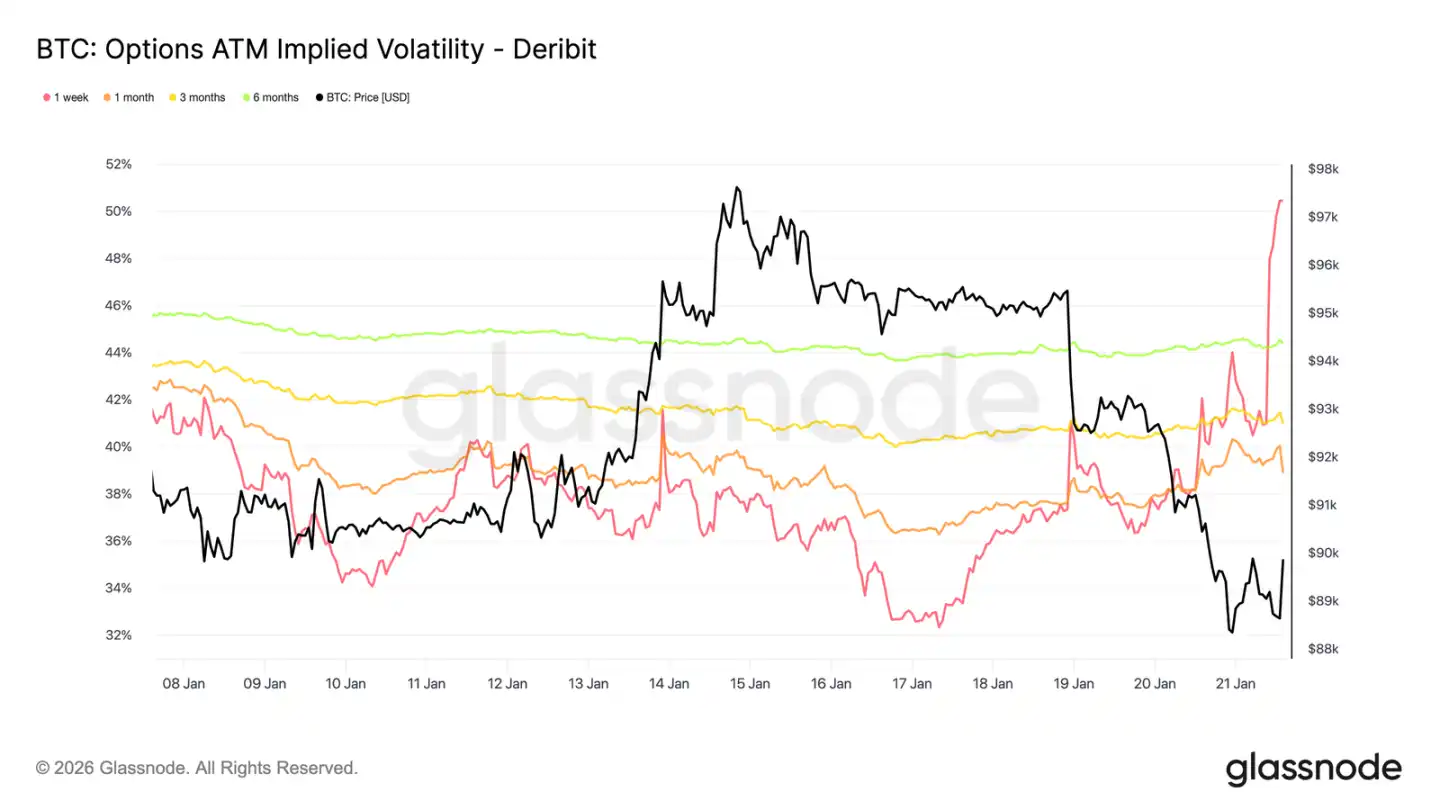
The spot sell-off triggered by macro and geopolitical news only stimulated a rise in short-term volatility. Since Sunday's drop, 1-week implied volatility rose by over 13 volatility points, while 3-month implied volatility rose only ~2 points, and 6-month implied volatility barely moved.

This acute steepening at the very front of the volatility curve indicates traders are engaging tactically, not reassessing the medium-term risk structure. Only short-term vol adjusted, reflecting event-driven uncertainty, not a shift across the volatility complex.

The market is pricing transient risk, not lasting turmoil.
Short-Dated Skew Experiences Wild Swings

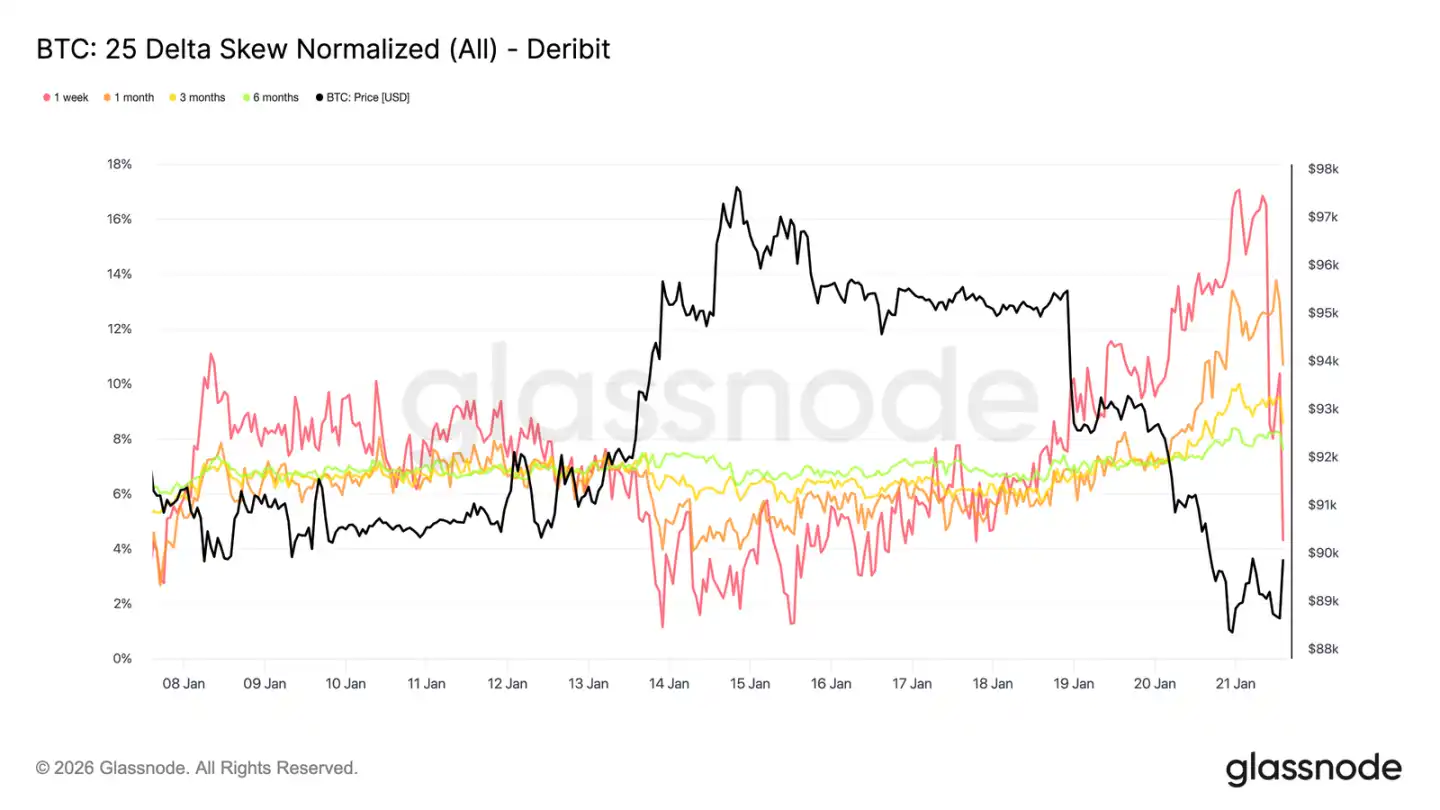
Similar to at-the-money volatility, short-dated skew also dominated this adjustment. The 1-week 25 Delta skew, which was near equilibrium a week ago, has sharply pivoted to a 'puts richer' state.

Since last week, this skew measure has moved ~16 volatility points towards puts, reaching a put premium of nearly 17%. The 1-month skew also reacted, while longer-dated skews, already in put territory, only deepened slightly.

Such a violent skew inversion often accompanies local extremes where the market is over-positioned and the prevailing trend is difficult to sustain. As the market digested the impact of Davos-related commentary, the downside premium was partially taken profit on, and skew began retracing rapidly.
Volatility Risk Premium Holds High

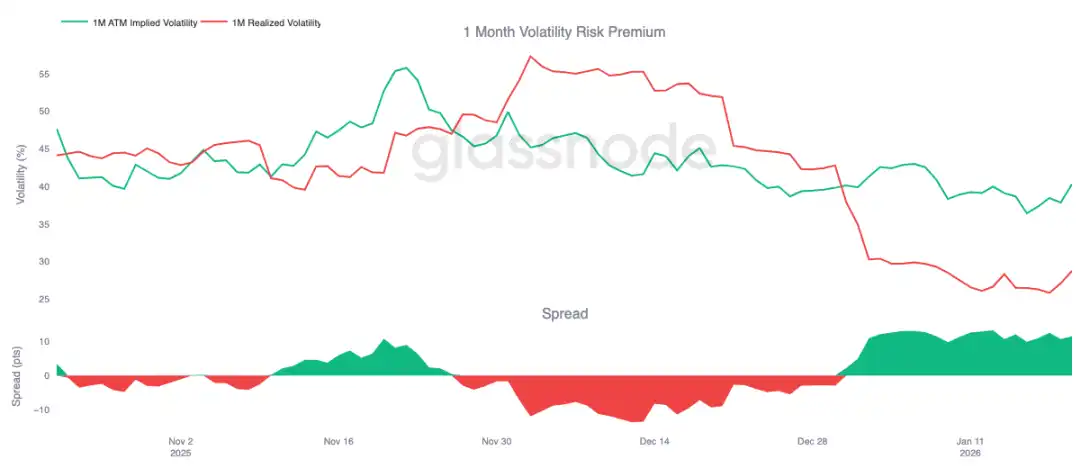
The 1-month Volatility Risk Premium has held in positive territory since the start of the year. Despite implied volatility being at historically absolute lows, its pricing remains consistently higher than actual realized volatility. In other words, options remain 'expensive' relative to the price volatility actually occurring.

The Volatility Risk Premium captures the difference between implied and realized volatility. A positive premium means option sellers are compensated for assuming volatility risk. This creates a favorable environment for 'short vol' strategies – holding short gamma positions can generate returns as long as realized vol remains contained.

This dynamic is self-reinforcing, suppressing volatility. As long as selling volatility is profitable, more participants will join, keeping implied vol suppressed. As of Jan 20, the 1-month vol spread sits at ~11.5 volatility points in favor of sellers, which speaks volumes about the continued friendliness of the environment for selling volatility.
Dealer Positioning Flips Net Short

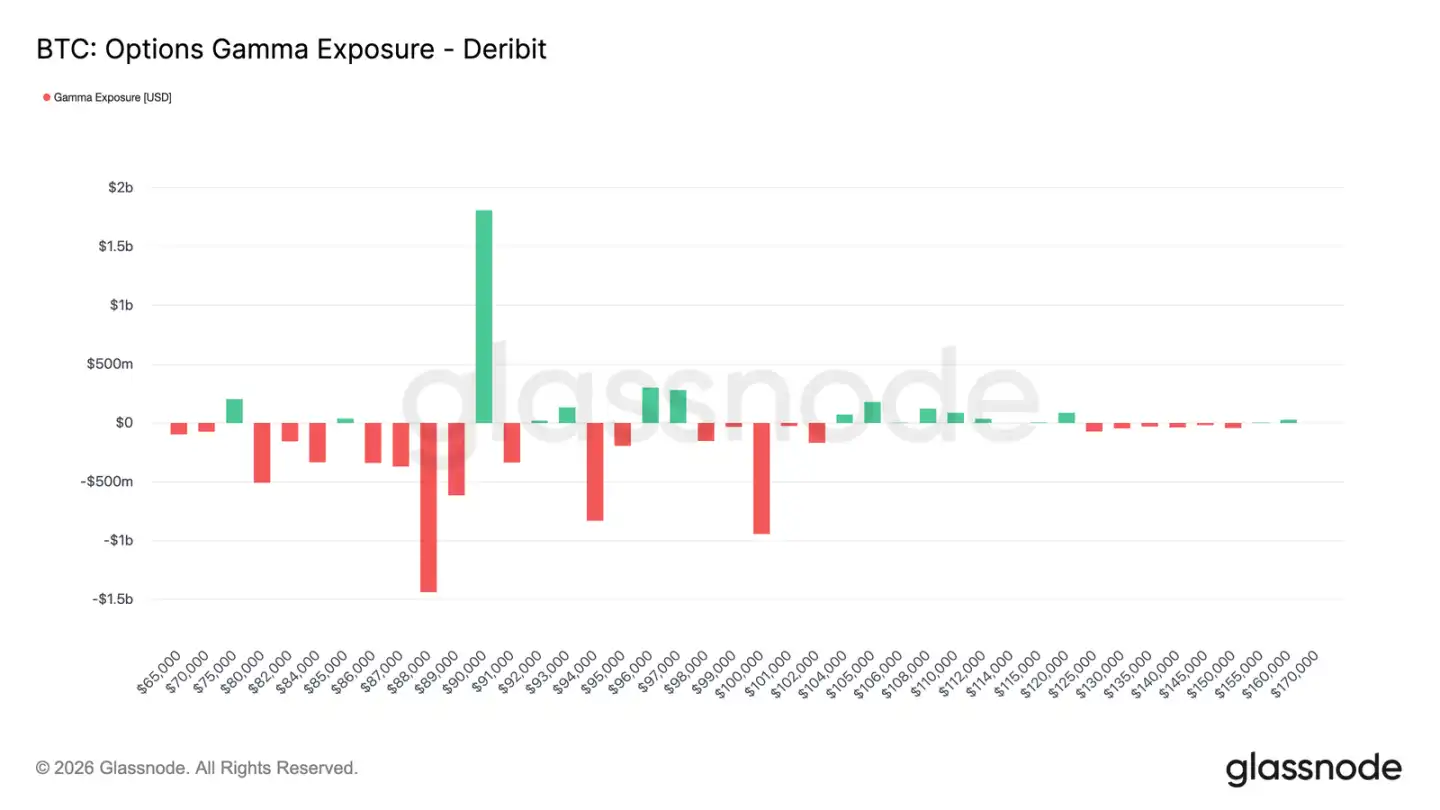
Dealer gamma positioning is a key structural force influencing short-term price action. Recent flow data shows investors actively bought downside protection, leaving dealers net short gamma below $90k. Concurrently, some investors financed this by selling upside calls, leaving dealers net long gamma above $90k.

This creates an asymmetric setup: Below $90k, dealers are net short gamma, meaning price declines could be self-accelerating due to their hedging activity (selling futures or spot). Above $90k, dealers' net long gamma acts as a stabilizer, as rallies trigger their hedging buys, dampening the move.

Thus, price action below $90k is likely to remain fragile, while the $90k level itself becomes a key friction point. A decisive and sustained break above this level would require sufficient market momentum and confidence to digest the dealer hedging flows and push their gamma exposure to higher strikes.
Conclusion

The Bitcoin market remains in a state of low participation, with current price action stemming more from 'reduced selling pressure' than 'aggressive buying.' On-chain data continues to reveal issues of supply overhang and fragile structural support. Spot flows, while improved, have not yet translated into a sustained buying trend.

Institutional demand remains cautious, with treasury flows stabilizing around the zero line and activity dominated by sporadic trades. Derivatives markets are quiet, with futures volume contraction and constrained leverage use, collectively creating a low-liquidity environment where price is hypersensitive to slight positioning changes.

The options market also reflects this restraint. Volatility repricing was confined to the short term, hedging demand has normalized, and elevated volatility risk premiums continue to anchor overall vol levels.

Overall, the market appears to be quietly building a base. The current consolidation stems not from overheated participation but from a temporary pause in investor conviction, as they await the next catalyst capable of inspiring broad engagement.


Câu hỏi Liên quan

QAccording to Glassnode, why is the recent BTC rebound considered a 'false breakout'?

AThe rebound is considered a 'false breakout' because the price has stalled below the cost basis of short-term holders (around $98k), confirming substantial overhead selling pressure. The market lacks sustained confirmation from long-term holders and faces persistent supply overhang from investors who bought at higher prices, making any rally vulnerable to renewed sell-offs.

QWhat key resistance level is currently capping Bitcoin's price upside as per the on-chain analysis?

AThe key resistance level capping Bitcoin's price upside is the Short-Term Holder (STH) cost basis at approximately $98,400, along with the psychological $100,000 level. Above this, there is a dense supply zone from coins acquired at higher prices that act as a persistent source of selling pressure.

QHow does the article describe the current state of demand from corporate treasuries?

ADemand from corporate treasuries is described as sporadic, event-driven, and uneven. Activity is characterized by isolated buying spikes from individual companies rather than a broad, coordinated trend of accumulation. Overall, corporate treasury flows are oscillating near the zero line, indicating a观望or opportunistic stance rather than systematic buying.

QWhat is the significance of the '9k gamma level' mentioned in the derivatives market analysis?

AThe '9k gamma level' is a key friction point identified from dealer positioning. Below $90,000, dealers hold negative gamma, meaning price declines could be self-accelerating due to their hedging activities (selling futures or spot). Above $90,000, dealers hold positive gamma, which acts as a stabilizer as price rises trigger their hedging buys. This creates an asymmetric market structure where moves below $90k are more fragile.

QWhat does the low participation in the derivatives market, described as a 'ghost market', imply for price action?

AThe low participation in the derivatives market, or 'ghost market' state, implies that recent price action is more driven by thin liquidity rather than aggressive new positioning. It means the market is in a low-conviction environment with subdued speculative interest, making prices highly sensitive to any influx of volume, though such influence is currently limited.

Nội dung Liên quan

Ghi chép 8 năm khởi nghiệp của đối tác định hướng AI tại a16z

Tác giả, một doanh nhân tiên phong trong lĩnh vực AI generative, đã chia sẻ hành trình 8 năm xây dựng Rosebud AI và những suyết định quan trọng trước khi chuyển sang vai trò mới với tư cách đối tác tại a16z, tập trung đầu tư vào cơ sở hạ tầng AI. Bắt đầu từ năm 2018 khi AI generative còn được gọi là "truyền thông tổng hợp", ông tin tưởng vào tiềm năng biến việc sáng tạo trở nên dễ dàng như chơi game. Các sản phẩm ban đầu như TokkingHeads đã thu hút hàng triệu người dùng bằng cách thiết kế trải nghiệm đơn giản, che đi những hạn chế của mô hình AI thời kỳ đầu. Sự ra mắt của GPT-4 vào năm 2023 là bước ngoặt, khi khả năng tạo mã đủ mạnh để phát triển công cụ trò chơi cho người sáng tạo không chuyên. Ông nhấn mạnh rằng giai đoạn chứng minh khả năng của AI generative đã kết thúc, và cuộc cạnh tranh tiếp theo sẽ xoay quanh việc tổ chức, sản phẩm hóa và thương mại hóa các khả năng này. Trong vai trò mới tại a16z, ông sẽ tập trung vào đầu tư vào frontier model stack, cơ sở hạ tầng và các công cụ phát triển xung quanh mô hình AI. Ông cũng bày tỏ sự lạc quan về những đột phá mà AI mang lại trong lĩnh vực toán học và khoa học.

marsbit9 giờ trước

Ghi chép 8 năm khởi nghiệp của đối tác định hướng AI tại a16z

marsbit9 giờ trước

Giao dịch

Giao ngay
Hợp đồng Tương lai

Bài viết Nổi bật

BITCOIN là gì

Hiểu về HarryPotterObamaSonic10Inu (ERC-20) và Vị Trí của Nó trong Không Gian Crypto Trong những năm gần đây, thị trường tiền điện tử đã chứng kiến sự gia tăng mạnh mẽ về sự phổ biến của các đồng meme, thu hút sự quan tâm không chỉ của các nhà giao dịch mà còn của những người tìm kiếm sự gắn kết cộng đồng và giá trị giải trí. Trong số các token độc đáo này là HarryPotterObamaSonic10Inu (ERC-20), một dự án thú vị kết hợp các tham chiếu văn hóa vào cấu trúc tiền điện tử. Bài viết này đi sâu vào các khía cạnh chính của HarryPotterObamaSonic10Inu, khám phá cơ chế, tinh thần hướng tới cộng đồng và sự tương tác của nó với bối cảnh crypto rộng lớn hơn. HarryPotterObamaSonic10Inu (ERC-20) là gì? Như tên gọi của nó, HarryPotterObamaSonic10Inu là một đồng meme được xây dựng trên blockchain Ethereum, được phân loại theo tiêu chuẩn ERC-20. Khác với các tiền điện tử truyền thống có thể nhấn mạnh vào công dụng thực tiễn hoặc tiềm năng đầu tư, token này phát triển dựa trên giá trị giải trí và sức mạnh của cộng đồng. Dự án nhằm mục đích tạo ra một môi trường nơi người dùng gắn bó có thể tập hợp lại, chia sẻ ý tưởng và tham gia vào các hoạt động được truyền cảm hứng từ các hiện tượng văn hóa đa dạng. Một đặc điểm nổi bật của HarryPotterObamaSonic10Inu là không có thuế trên các giao dịch. Yếu tố hấp dẫn này nhằm khuyến khích việc giao dịch và sự tham gia của cộng đồng, không có các khoản phí bổ sung có thể răn đe các nhà giao dịch quy mô nhỏ. Tổng cung của đồng tiền này được đặt ở mức một tỷ token, một con số đánh dấu ý định duy trì sự lưu thông đáng kể trong cộng đồng. Người sáng lập HarryPotterObamaSonic10Inu (ERC-20) Nguồn gốc của HarryPotterObamaSonic10Inu phần nào bị bao trùm trong sự bí ẩn; các thông tin cụ thể về người sáng lập vẫn chưa được biết đến. Sự phát triển của token này thiếu một đội ngũ xác định hoặc một kế hoạch rõ ràng, điều này không phải là hiếm trong lĩnh vực đồng meme. Thay vào đó, dự án đã xuất hiện một cách tự nhiên, với tiến trình phụ thuộc nặng nề vào sự nhiệt tình và tham gia của cộng đồng. Nhà đầu tư của HarryPotterObamaSonic10Inu (ERC-20) Về các khoản đầu tư và hỗ trợ bên ngoài, HarryPotterObamaSonic10Inu cũng vẫn mơ hồ. Token này không liệt kê bất kỳ quỹ đầu tư nào nổi tiếng hoặc sự hỗ trợ tổ chức đáng kể. Thay vào đó, nguồn sống của dự án là cộng đồng cơ sở, điều này định hình sự phát triển và tính bền vững thông qua hành động tập thể và sự tham gia trong không gian crypto. HarryPotterObamaSonic10Inu (ERC-20) hoạt động như thế nào? Với tư cách là một đồng meme, HarryPotterObamaSonic10Inu chủ yếu hoạt động bên ngoài các khuôn khổ truyền thống thường chi phối giá trị tài sản. Có một số khía cạnh đặc biệt định nghĩa cách thức hoạt động của dự án: Giao dịch không thuế: Với không có phí thuế cho các giao dịch, người dùng có thể tự do mua và bán token mà không lo ngại về các khoản chi phí ẩn. Gắn kết cộng đồng: Dự án phát triển dựa trên sự tương tác trong cộng đồng, tận dụng các nền tảng mạng xã hội để tạo ra sự chú ý và thúc đẩy sự tham gia. Các cuộc thảo luận, chia sẻ nội dung và tương tác là những yếu tố quan trọng giúp mở rộng tầm với và tạo sự trung thành giữa các người ủng hộ. Không có tính hữu dụng thực tiễn: Cần lưu ý rằng HarryPotterObamaSonic10Inu không cung cấp giá trị hữu hình nào trong hệ sinh thái tài chính. Thay vào đó, nó được phân loại chủ yếu là một token dành cho giải trí và các hoạt động cộng đồng. Tham chiếu văn hóa: Token này khôn ngoan tích hợp các yếu tố từ văn hóa đại chúng để thu hút sự quan tâm, kết nối với những người yêu thích meme và những người theo dõi crypto. HarryPotterObamaSonic10Inu là một ví dụ về cách mà các đồng meme hoạt động khác biệt so với các dự án tiền điện tử truyền thống hơn, gia nhập thị trường như những cấu trúc xã hội sáng tạo thay vì các tài sản hữu ích. Lịch sử HarryPotterObamaSonic10Inu (ERC-20) Lịch sử của HarryPotterObamaSonic10Inu nổi bật với một số cột mốc đáng chú ý: Sự ra đời: Token này xuất hiện từ một meme lan truyền, thu hút trí tưởng tượng của nhiều người đam mê crypto. Ngày tạo ra cụ thể không có sẵn, điều này nhấn mạnh sự gia tăng tự nhiên của nó. Niêm yết trên các sàn giao dịch: HarryPotterObamaSonic10Inu đã xuất hiện trên nhiều sàn giao dịch khác nhau, tạo điều kiện thuận lợi cho việc truy cập và giao dịch của cộng đồng. Các sáng kiến gắn kết cộng đồng: Các hoạt động liên tục nhằm nâng cao sự tương tác trong cộng đồng, bao gồm các cuộc thi, chiến dịch truyền thông xã hội và tạo nội dung từ người hâm mộ và những người ủng hộ. Kế hoạch mở rộng tương lai: Lộ trình của dự án bao gồm việc ra mắt bộ sưu tập NFT, hàng hóa và một trang thương mại điện tử liên quan đến các chủ đề văn hóa của nó, thu hút thêm sự gắn bó của cộng đồng và cố gắng thêm nhiều khía cạnh cho hệ sinh thái của nó. Các điểm chính về HarryPotterObamaSonic10Inu (ERC-20) Tính chất hướng tới cộng đồng: Dự án ưu tiên sự tham gia và sáng tạo của tập thể, đảm bảo rằng sự tham gia của người dùng là trung tâm trong sự phát triển của nó. Phân loại đồng meme: Nó đại diện cho biểu tượng của tiền điện tử dựa trên giải trí, khác biệt so với các phương tiện đầu tư truyền thống. Không có mối liên hệ trực tiếp với Bitcoin: Dù có sự tương đồng trong tên ký hiệu, HarryPotterObamaSonic10Inu là một thực thể độc lập và không có mối quan hệ nào với Bitcoin hay các tiền điện tử đã được thành lập khác. Tập trung vào sự hợp tác: HarryPotterObamaSonic10Inu được thiết kế để tạo ra một không gian cho sự hợp tác và chia sẻ văn hóa giữa các nhà giữ, cung cấp một con đường cho sự sáng tạo và sự gắn kết trong cộng đồng. Triển vọng tương lai: Tham vọng mở rộng vượt ra ngoài ý tưởng ban đầu vào NFT và hàng hóa vạch ra một con đường cho dự án để có khả năng gia nhập các phương diện chính thống hơn trong văn hóa kỹ thuật số. Khi các đồng meme tiếp tục thu hút trí tưởng tượng của cộng đồng tiền điện tử, HarryPotterObamaSonic10Inu (ERC-20) nổi bật nhờ vào mối liên hệ văn hóa và cách tiếp cận tập trung vào cộng đồng của nó. Trong khi nó có thể không phù hợp với khuôn mẫu điển hình của một token dựa trên tiện ích, bản chất của nó nằm trong niềm vui và tình bạn được duy trì giữa các người ủng hộ, làm nổi bật bản chất đang tiến hóa của tiền điện tử trong một thời đại ngày càng số hóa. Khi dự án tiếp tục phát triển, sẽ rất quan trọng để theo dõi cách mà động lực cộng đồng ảnh hưởng đến hướng đi của nó trong bối cảnh công nghệ blockchain đang thay đổi.

Tổng lượt xem 1.3kXuất bản vào 2024.04.01Cập nhật vào 2024.12.03

BITCOIN là gì

Làm thế nào để Mua BTC

Chào mừng bạn đến với HTX.com! Chúng tôi đã làm cho mua Bitcoin (BTC) trở nên đơn giản và thuận tiện. Làm theo hướng dẫn từng bước của chúng tôi để bắt đầu hành trình tiền kỹ thuật số của bạn.Bước 1: Tạo Tài khoản HTX của BạnSử dụng email hoặc số điện thoại của bạn để đăng ký tài khoản miễn phí trên HTX. Trải nghiệm hành trình đăng ký không rắc rối và mở khóa tất cả tính năng. Nhận Tài khoản của tôiBước 2: Truy cập Mua Crypto và Chọn Phương thức Thanh toán của BạnThẻ Tín dụng/Ghi nợ: Sử dụng Visa hoặc Mastercard của bạn để mua Bitcoin (BTC) ngay lập tức.Số dư: Sử dụng tiền từ số dư tài khoản HTX của bạn để giao dịch liền mạch.Bên thứ ba: Chúng tôi đã thêm những phương thức thanh toán phổ biến như Google Pay và Apple Pay để nâng cao sự tiện lợi.P2P: Giao dịch trực tiếp với người dùng khác trên HTX.Thị trường mua bán phi tập trung (OTC): Chúng tôi cung cấp những dịch vụ được thiết kế riêng và tỷ giá hối đoái cạnh tranh cho nhà giao dịch.Bước 3: Lưu trữ Bitcoin (BTC) của BạnSau khi mua Bitcoin (BTC), lưu trữ trong tài khoản HTX của bạn. Ngoài ra, bạn có thể gửi đi nơi khác qua chuyển khoản blockchain hoặc sử dụng để giao dịch những tiền kỹ thuật số khác.Bước 4: Giao dịch Bitcoin (BTC)Giao dịch Bitcoin (BTC) dễ dàng trên thị trường giao ngay của HTX. Chỉ cần truy cập vào tài khoản của bạn, chọn cặp giao dịch, thực hiện giao dịch và theo dõi trong thời gian thực. Chúng tôi cung cấp trải nghiệm thân thiện với người dùng cho cả người mới bắt đầu và người giao dịch dày dạn kinh nghiệm.

Tổng lượt xem 3.9kXuất bản vào 2024.12.12Cập nhật vào 2025.03.21

Làm thế nào để Mua BTC

$BITCOIN là gì

VÀNG KỸ THUẬT SỐ ($BITCOIN): Phân Tích Toàn Diện Giới thiệu về VÀNG KỸ THUẬT SỐ ($BITCOIN) VÀNG KỸ THUẬT SỐ ($BITCOIN) là một dự án dựa trên blockchain hoạt động trên mạng Solana, nhằm kết hợp các đặc điểm của kim loại quý truyền thống với sự đổi mới của công nghệ phi tập trung. Mặc dù nó chia sẻ tên với Bitcoin, thường được gọi là “vàng kỹ thuật số” do được coi là một kho lưu trữ giá trị, VÀNG KỸ THUẬT SỐ là một token riêng biệt được thiết kế để tạo ra một hệ sinh thái độc đáo trong bối cảnh Web3. Mục tiêu của nó là định vị mình như một tài sản kỹ thuật số thay thế khả thi, mặc dù các chi tiết về ứng dụng và chức năng của nó vẫn đang được phát triển. VÀNG KỸ THUẬT SỐ ($BITCOIN) là gì? VÀNG KỸ THUẬT SỐ ($BITCOIN) là một token tiền điện tử được thiết kế rõ ràng để sử dụng trên blockchain Solana. Trái ngược với Bitcoin, vốn cung cấp một vai trò lưu trữ giá trị được công nhận rộng rãi, token này có vẻ tập trung vào các ứng dụng và đặc điểm rộng hơn. Những khía cạnh đáng chú ý bao gồm: Hạ tầng Blockchain: Token được xây dựng trên blockchain Solana, nổi tiếng với khả năng xử lý các giao dịch nhanh và chi phí thấp. Động lực Cung cấp: VÀNG KỸ THUẬT SỐ có tổng cung tối đa được giới hạn ở 100 triệu triệu token (100P $BITCOIN), mặc dù các chi tiết về nguồn cung lưu hành hiện tại chưa được công bố. Tiện ích: Mặc dù các chức năng chính xác chưa được nêu rõ, có những dấu hiệu cho thấy token có thể được sử dụng cho nhiều ứng dụng khác nhau, có thể liên quan đến các ứng dụng phi tập trung (dApps) hoặc các chiến lược token hóa tài sản. Ai là Người sáng tạo VÀNG KỸ THUẬT SỐ ($BITCOIN)? Hiện tại, danh tính của những người sáng tạo và đội ngũ phát triển đứng sau VÀNG KỸ THUẬT SỐ ($BITCOIN) vẫn không rõ. Tình huống này là điển hình trong nhiều dự án đổi mới trong không gian blockchain, đặc biệt là những dự án liên quan đến tài chính phi tập trung và hiện tượng đồng meme. Mặc dù sự ẩn danh như vậy có thể thúc đẩy một văn hóa cộng đồng, nhưng nó cũng làm gia tăng mối quan ngại về quản trị và trách nhiệm. Ai là Nhà đầu tư của VÀNG KỸ THUẬT SỐ ($BITCOIN)? Thông tin hiện có cho thấy VÀNG KỸ THUẬT SỐ ($BITCOIN) không có bất kỳ nhà đầu tư tổ chức nào hoặc các khoản đầu tư vốn mạo hiểm nổi bật. Dự án dường như hoạt động theo mô hình ngang hàng tập trung vào sự hỗ trợ và chấp nhận của cộng đồng hơn là các con đường tài trợ truyền thống. Hoạt động và tính thanh khoản của nó chủ yếu nằm trên các sàn giao dịch phi tập trung (DEXs), chẳng hạn như PumpSwap, thay vì các nền tảng giao dịch tập trung đã được thiết lập, càng làm nổi bật cách tiếp cận từ cơ sở của nó. Cách VÀNG KỸ THUẬT SỐ ($BITCOIN) Hoạt động Cơ chế hoạt động của VÀNG KỸ THUẬT SỐ ($BITCOIN) có thể được giải thích dựa trên thiết kế blockchain và các thuộc tính mạng lưới của nó: Cơ chế Đồng thuận: Bằng cách tận dụng bằng chứng lịch sử (PoH) độc đáo của Solana kết hợp với mô hình bằng chứng cổ phần (PoS), dự án đảm bảo xác thực giao dịch hiệu quả, góp phần vào hiệu suất cao của mạng lưới. Tokenomics: Mặc dù các cơ chế giảm phát cụ thể chưa được mô tả chi tiết, tổng cung token tối đa khổng lồ cho thấy rằng nó có thể phục vụ cho các giao dịch vi mô hoặc các trường hợp sử dụng ngách vẫn chưa được xác định. Tính tương tác: Có tiềm năng tích hợp với hệ sinh thái rộng lớn hơn của Solana, bao gồm nhiều nền tảng tài chính phi tập trung (DeFi). Tuy nhiên, các chi tiết về các tích hợp cụ thể vẫn chưa được xác định. Thời gian của các sự kiện quan trọng Dưới đây là một thời gian biểu nổi bật các cột mốc quan trọng liên quan đến VÀNG KỸ THUẬT SỐ ($BITCOIN): 2023: Việc triển khai ban đầu của token diễn ra trên blockchain Solana, được đánh dấu bằng địa chỉ hợp đồng của nó. 2024: VÀNG KỸ THUẬT SỐ trở nên nổi bật khi nó có sẵn để giao dịch trên các sàn giao dịch phi tập trung như PumpSwap, cho phép người dùng giao dịch nó với SOL. 2025: Dự án chứng kiến hoạt động giao dịch không thường xuyên và sự quan tâm tiềm năng từ các hoạt động do cộng đồng dẫn dắt, mặc dù chưa có các quan hệ đối tác đáng chú ý hoặc tiến bộ kỹ thuật nào được ghi nhận cho đến nay. Phân tích quan trọng Điểm mạnh Khả năng mở rộng: Hạ tầng Solana hỗ trợ khối lượng giao dịch cao, điều này có thể nâng cao tiện ích của $BITCOIN trong nhiều kịch bản giao dịch khác nhau. Khả năng tiếp cận: Giá giao dịch tiềm năng thấp cho mỗi token có thể thu hút các nhà đầu tư bán lẻ, tạo điều kiện cho sự tham gia rộng rãi hơn nhờ cơ hội sở hữu phân đoạn. Rủi ro Thiếu minh bạch: Việc thiếu các nhà đầu tư, nhà phát triển hoặc quy trình kiểm toán công khai có thể tạo ra sự hoài nghi về tính bền vững và độ tin cậy của dự án. Biến động thị trường: Hoạt động giao dịch phụ thuộc nhiều vào hành vi đầu cơ, điều này có thể dẫn đến sự biến động giá đáng kể và sự không chắc chắn cho các nhà đầu tư. Kết luận VÀNG KỸ THUẬT SỐ ($BITCOIN) nổi lên như một dự án thú vị nhưng mơ hồ trong hệ sinh thái Solana đang phát triển nhanh chóng. Mặc dù nó cố gắng tận dụng câu chuyện “vàng kỹ thuật số”, sự khác biệt của nó so với vai trò đã được thiết lập của Bitcoin như một kho lưu trữ giá trị nhấn mạnh sự cần thiết phải phân biệt rõ hơn về tiện ích và cấu trúc quản trị của nó. Sự chấp nhận và áp dụng trong tương lai có thể sẽ phụ thuộc vào việc giải quyết tình trạng không minh bạch hiện tại và xác định rõ hơn các chiến lược hoạt động và kinh tế của nó. Lưu ý: Báo cáo này bao gồm thông tin tổng hợp có sẵn tính đến tháng 10 năm 2023, và có thể đã có những phát triển xảy ra ngoài khoảng thời gian nghiên cứu.

Tổng lượt xem 86Xuất bản vào 2025.05.13Cập nhật vào 2025.05.13

$BITCOIN là gì

Thảo luận

Chào mừng đến với Cộng đồng HTX. Tại đây, bạn có thể được thông báo về những phát triển nền tảng mới nhất và có quyền truy cập vào thông tin chuyên sâu về thị trường. Ý kiến ​​của người dùng về giá của BTC (BTC) được trình bày dưới đây.

活动图片













