Author: Frank, PANews
As the narrative红利 in the crypto market gradually fades, capital is seeking the next certain outlet. Recently, prediction markets have emerged as a dark horse, not only because of their independent performance in volatile markets but also due to a series of high-return "smart money" strategies behind them, making them widely regarded as one of the most explosive tracks by 2026.
However, for most onlookers, prediction markets still seem like a black box wrapped in a blockchain exterior. Although they are built on smart contracts, oracles, and stablecoins, their core mechanisms differ significantly from traditional "coin speculation" logic. Here, there are no candlestick charts, only probabilities; no stories, only facts.
For new entrants, questions arise: How does this market operate efficiently? What is the essential difference between it and traditional crypto玩法? What little-known arbitrage models do the legendary "smart money" masters possess? And does this seemingly狂热 market truly have the capacity to carry trillions in funds?
With these questions, PANews conducted a comprehensive survey of current prediction markets. We will peel back the表象 of "gambling," delve into the underlying mechanisms and on-chain data, deconstruct this mathematical war of cognitive monetization, and还原 the risks and opportunities that may have been overlooked.
Data Truth: The Eve of the Prediction Market Explosion
From the actual development situation, prediction markets are indeed one of the few "bull market" tracks in 2025 (similar to stablecoins). While the entire crypto market has been sluggish in recent months, prediction markets led by Polymarket and Kalshi are still growing rapidly and疯狂.
This trend is clearly visible from the trading volume. In September of this year, Polymarket's average daily trading volume was still in the range of $20-30 million, and Kalshi was similar. However, after the entire crypto market began to decline in mid-October, the daily trading volume of these two leaders in prediction markets started to increase significantly. On October 11th, Polymarket's daily trading volume reached $94 million, while Kalshi exceeded $200 million. The increases were about 3-7 times, respectively, and they remain at high and soaring levels until now.
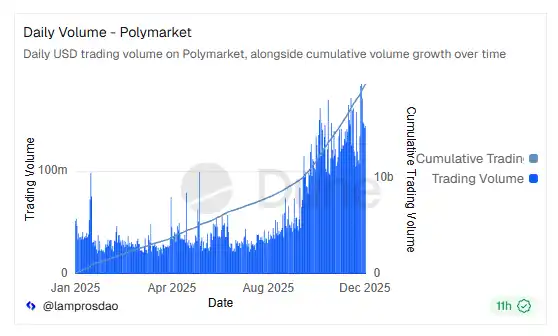
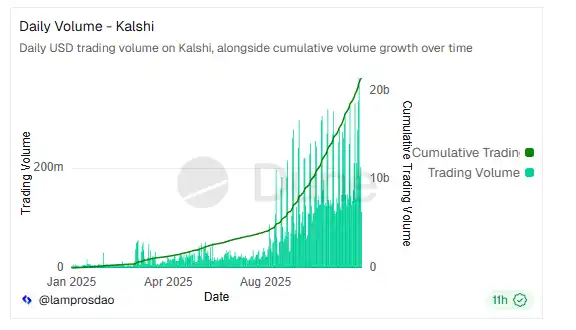
However, in terms of size, prediction markets are still at an early stage. The cumulative trading volume of Polymarket and Kalshi combined is only about $38.5 billion. This total volume is still less than the daily trading volume of Binance exchange, and a daily average of $200 million in trading volume can only rank around 50th among all exchanges.
However, with the hosting of the 2026 FIFA World Cup, the market generally expects the scale of prediction markets to be further pushed higher. Citizens Financial Group predicts that the overall size of prediction markets could reach the trillion-dollar level by 2030. The Eilers & Krejcik (E&K) report forecasts annual trading volume could reach $1 trillion by the end of this decade (around 2030). Based on this scale projection, this market still has tens of times growth potential, and several institutional reports also mention that the 2026 World Cup will become a catalyst and stress test event for this market's growth.
Deconstructing Smart Money: Analysis of Eleven Arbitrage Strategies
Against this background, the biggest attraction of prediction markets recently remains those eternal "wealth stories." After seeing these wealth stories, many people's first thought is to复制 or follow. However, exploring the core principles, implementation conditions, and underlying risks of these strategies might be a more reliable choice. PANews has compiled ten热门 strategies in the current prediction market that are widely discussed.
1、Pure Mathematical Arbitrage
Logic: Utilize the mathematical imbalance where Yes + No is less than 1. For example, when the probability of YES for an event is 55% on Polymarket and the probability of NO is 40% on Kalshi, the total probability is 95%. Placing orders for YES and NO on both sides respectively, the total cost is 0.95, but the final result will always yield 1, thus creating a 5% arbitrage space.
Conditions: This requires participants to have strong technical means to quickly identify such arbitrage opportunities, after all, there is more than one person捡漏.
Risks: Many platforms have different判定条件 for the same event. Ignoring these conditions can lead to losses on both sides. As @linwanwan823 pointed out, in the 2024 US government shutdown event, arbitrageurs found: Polymarket判定 "shutdown occurred" (YES), while Kalshi判定 "shutdown did not occur" (NO). The reason was that Polymarket's settlement standard was "OPM issuing a shutdown announcement," while Kalshi required "actual shutdown for more than 24 hours."
2、Cross-Platform/Cross-Chain Hedging Arbitrage
Logic: Utilize pricing discrepancies for the same event across different platforms (information silos). For example, the odds for "Trump winning the election" might be out of sync between Polymarket and Kalshi. For instance, one side is 40%, the other is 55%, so buy different directions on both sides. This ultimately constructs a hedged outcome.
Conditions: Similar to the first type, requires极强的 technical conditions for scanning and discovery.
Risks:同样需要警惕不同平台对同一事件的判定条件。
3、High-Probability "Bond" Strategy
Logic: Treat high-certainty events as "short-term bonds." When an event outcome is already clear (e.g., the market consensus reaches 99% on the eve of a Fed interest rate decision), but the prediction market price remains at 0.95 or 0.96 due to capital占用成本, this is essentially picking up "time interest."
Conditions: Large capital size, because the yield per transaction is low, requiring larger capital to achieve meaningful profits.
Risks: Black swan events;一旦发生小概率翻转,将损失巨大。
4、Initial Liquidity Sniping
Logic: Exploit the "central limit order book vacuum period" when a new market is just created. A new market has no sell orders, so the first person to place an order has absolute pricing power. Write scripts to monitor on-chain events. Place a large number of extremely low-priced buy orders (0.01-0.05) at the moment the market opens. Later, when liquidity normalizes, usually sell at a price of 0.5 or higher.
Conditions: Due to numerous competitors, servers need to be hosted极 close to the nodes to reduce latency.
Risks: Similar to抢开盘 in MEME coins; if the speed advantage is lost, one might become the bag holder.
5、AI Probability Modeling Trading
Logic: Use AI large models to conduct in-depth market research and discover conclusions different from the market. Then buy when there is an arbitrage opportunity. For example, after analysis by an AI large model, the true probability of "Real Madrid winning the match today" is 70%, but the market price is only 0.5, so buy.
Conditions: Complex data analysis tools and machine learning models; AI computing power costs are high.
Risks: AI prediction errors or unexpected events can lead to loss of principal.
6、AI Information Gap Model
Logic: Utilize the time difference where "machine reading speed > human reading speed." Obtain information faster than other普通 users and buy before the market changes.
Conditions: Expensive information sources,可能需要付费购买机构级API和精准的AI识别能力算法。
Risks: Fake news attacks or AI hallucinations.
7、Correlated Market Arbitrage
Logic: Utilize the lag in the transmission of causal chains between events. Price changes in the main event often happen instantly, but the reaction of secondary related events is slower. For example: "Trump wins the election" and "Republican Party wins the Senate."
Conditions: Must deeply understand the underlying logical connections between political or economic events,同时能够监控数百个市场的价格联动。
Risks: Event correlation failure, e.g.,梅西缺席比赛 and team losing did not achieve a positive correlation.
8、Automated Market Making and Market Making Rewards
Logic: Be the "shovel seller." Don't bet on direction, only provide liquidity, earning bid-ask spreads and platform rewards.
Conditions: Professional market-making strategies and substantial capital.
Risks: Transaction fees and black swan events.
9、On-Chain Copy Trading and Whale Tracking
Logic: Believe that "smart money" possesses insider information. Monitor high-win-rate addresses; once a whale makes a large position, the bot immediately follows.
Conditions: On-chain analysis tools, need to clean data to exclude whales' "test orders" or "hedging orders." Quick response capability.
Risks: Whale反向收割 and hedging intentions.
10、Exclusive Research-Based "Information Arbitrage"
Logic: Possess "private information" unknown to the market. For example, during the 2024 US election, French trader Théo, through the "neighborhood effect," discovered "invisible voter" tendencies and heavily逆势重仓 when the odds were pessimistic.
Conditions: Exclusive research plans and high costs.
Risks: Research method errors, leading to obtaining wrong "insider information," thus heavily betting on the wrong direction.
11、Manipulating the Oracle
Logic: It's about who is the referee. Since prediction markets contain many complex events, these complex events cannot be simply adjudicated by algorithms. Therefore, external oracles need to be introduced. Currently, Polymarket uses UMA's Optimistic Oracle. After each event ends, someone needs to manually submit a判定结果 in the UMA protocol. If the voting rate exceeds 98% within 2 hours, this result is considered true. Disputed results require further community research and voting to complete.
However, this mechanism显然也存在漏洞和操纵空间. In July 2025, regarding "Did Ukrainian President Zelensky wear a suit before July?", although multiple media reported that Zelensky had worn a suit, in the UMA vote, four大户 held over 40% of the tokens and最终将结果判定为"NO", causing users who invested in the opposite side to lose about $2 million. Additionally, events like "Did Ukraine sign a rare earth mineral agreement with the US?" and "Did the Trump administration declassify UFO files in 2025?" also showed varying degrees of manipulation traces. Many users believe that it is not reliable to have a token with a market cap of less than $100 million, UMA, act as the referee for a market like Polymarket.
Conditions: Large holdings of UMA or controversial adjudication conditions.
Risks: Oracle upgrades will gradually block similar vulnerabilities. In August 2025,引入MOOV2 (Managed Optimistic Oracle V2), restricting proposals to a whitelist and reducing spam/malicious proposals.
Overall, these strategies can be categorized into technical players, capital players, and professional players. Regardless of the type, they all establish盈利 models through独家的不对等优势. However, these strategies might only be effective in this short-term immature stage of the market (similar to arbitrage玩法 in the early crypto market). As secrets are revealed and the market matures, most arbitrage spaces will become smaller and smaller.
Why Prediction Markets Can Become the "Antidote to the Information Age"
Behind the market expansion and institutional optimism, what is the magic of prediction markets? The mainstream market view believes that prediction markets solve a core pain point: in an era of information explosion and fake news泛滥, the cost of truth is getting higher and higher.
Behind this starting point, there might be three main reasons.
1、"Real money" voting is more reliable than research. Traditional market research or expert predictions often have no actual cost for accuracy, and this predictive power is held by certain individuals and institutions with a voice. This also leads to many predictions having no置信度. The structure of prediction markets is the result of monetary博弈 among multiple investors. Firstly, it realizes the collective wisdom formed by multiple individual information sources. Secondly, voting with money adds weight to these predictions. From this perspective, prediction markets as a product本身解决的是社会层面的“真相难题”, which itself has value.
2、Ability to convert personal professional or information advantages into money. This is well reflected in the top smart money addresses in prediction markets. Although their strategies vary, the analysis of their success reasons无非在于他们在某一方面掌握了某种专业优势或者信息优势. For example, some might have deep knowledge of a particular sports event, thus having significant professional advantages in predicting various elements of that event. Or, some users, through technical means, can verify the outcome of an event faster than others, allowing them to exploit arbitrage opportunities in the final stages of the prediction market. This is vastly different from traditional finance and crypto markets, where capital is no longer the biggest advantage (and is even a disadvantage in prediction markets); technology and ability are. This also attracts大批的能人异士 to focus on prediction markets. Then, these标杆式的案例 attract more people's追捧.
3、The simple logic of the binary option attribute has a lower barrier to entry than coin speculation. Essentially, prediction markets are binary options; the directions people bet on are无非只有“YES” or "NO". The trading门槛 is lower, requiring less consideration of price direction, trends, technical indicators, and other complex trading systems. Additionally, the trading标的 are usually simple and easy to understand. Which of these two teams will win? Rather than, what is the technical principle of this zero-knowledge proof project? This also注定 prediction markets' user base is likely to be much larger than the crypto market.
Of course, prediction markets also have their drawbacks, such as typically short cycles for individual markets, insufficient liquidity in niche markets, risks of insider trading and manipulation, compliance issues, etc. And the most important reason is that, at the current juncture, prediction markets seem to be filling the "narrative vacuum" during the crypto market's boring period.
The essence of prediction markets is a pricing revolution about the "future." It pieces together the cognitive fragments of countless individuals through monetary博弈 into the puzzle closest to the truth.
For bystanders, this is the "truth machine" of the information age. For participants, it is a mathematical war without smoke. As 2026 approaches, the画卷 of this trillion-dollar track is just beginning to unfold. But no matter how algorithms evolve or strategies iterate, the most朴素真理 of prediction markets has never changed: there is no free lunch here, only the ultimate reward for cognitive monetization.