From the "$140k Poverty Line" to the "Middle-Class Execution Line": Survival or Dignity?

marsbitXuất bản vào 2025-12-24Cập nhật gần nhất vào 2025-12-24

Tóm tắt

The article discusses the viral narrative shift from the "140k poverty line" in the U.S. to the "middle-class斩杀线" (beheading line) in China, highlighting a growing sense of financial strain despite economic growth. It originates from Mike Green's analysis, which argues that the official U.S. poverty line ($31,200 for a family of four) is outdated. Green claims the real cost of "respectable living"—covering housing, healthcare, and childcare—is actually $140,000 annually. This creates a "斩杀线" effect: middle-income earners lose welfare benefits as their income rises, facing higher taxes and essential costs without support, making them financially vulnerable. Green attributes this to historical shifts like union monopolization, anti-trust policy changes, and capital outsourcing to China. He proposes solutions like taxing corporations more (while exempting investments) and reducing wage taxes for lower earners. Critics note data flaws in his analysis, but the "poverty sensation" resonates due to "Baumol’s Cost Disease": service sectors (e.g., healthcare, education) become expensive as wages rise without efficiency gains, while manufactured goods cheapen. The article contrasts this with China, where service costs are suppressed, avoiding a similar "beheading line." However, it hints at hidden social trade-offs, such as lower wages and dignity for service workers. Ultimately, it questions the balance between survival and dignity in modern economies.

The narrative of the "execution line" first caught my attention in November within X and Substack circles. It originated from Mike Green's "$140k poverty line" theory, which went viral in the U.S. I didn't expect that over a month later, this narrative would spread and mutate into the "execution line" in China, which is quite fascinating.

It's a pity my AI narrative radar (see here) wasn't ready at that time; otherwise, I would have loved to see if AI could track the spread and evolution of this narrative.

01

At the end of November, I read three articles by Mike Green on Substack:

These are three extremely long articles that feel like they take an eternity to read; the three combined have the word count of a small book.

I'll summarize the main points in plain language as follows:

The gist of the articles is: If you feel that current economic data looks good, but life is still tight, and a $100,000 annual salary still leaves you poor, it's not your fault. It's because the ruler used to measure wealth and poverty is like Doraemon's self-deceiving ruler.

The articles present three main points:

1. The "Poverty Line" is Actually Like Carving on a Moving Boat (刻舟求剑 - missing the point by using outdated methods)

The official U.S. poverty line is an annual income of $31,200 for a family of four; if your income exceeds $30,000, you are not considered poor.

But this ruler was created in 1963. The logic back then was simple: a family spent about one-third of its money on food, so by calculating the minimum food cost and multiplying it by 3, you got the poverty line.

But the situation is vastly different now. You've probably all seen that famous chart—"Baumol's Cost Disease":
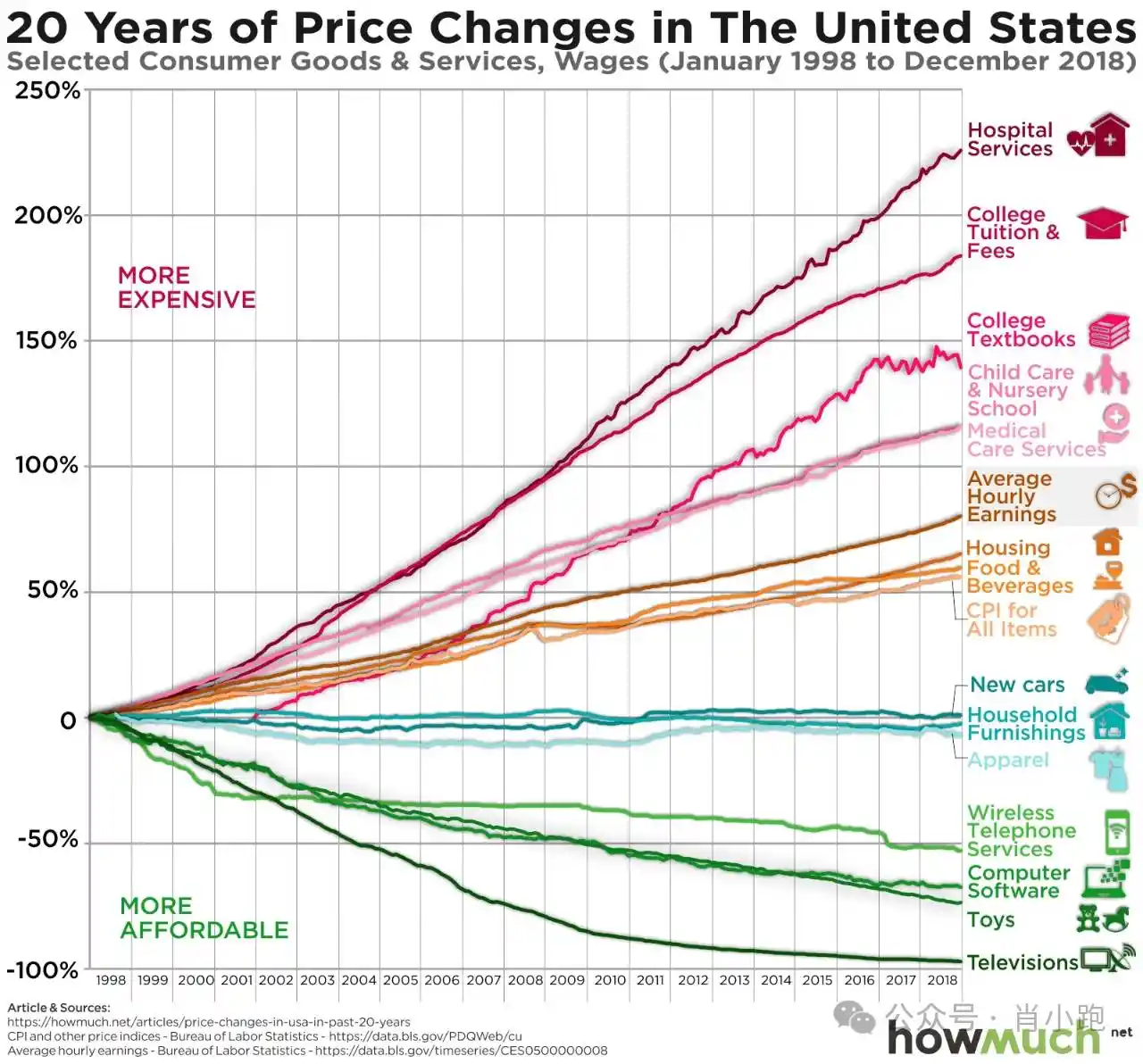
Food has become cheaper, but the costs of housing, healthcare, and childcare have skyrocketed. If you recalculate based on the 1963 standard of living—meaning the ability to normally "participate" in society (having a place to live, a car to drive, childcare, and access to healthcare when sick)—the real poverty line today is not $30,000+, but $140,000 (approx. 1 million RMB), just to live decently in this society.

2. The Harder You Work, The Poorer You Become

There's a huge bug in the design of the U.S. welfare system: When your annual salary is $40,000, you are officially poor. The state gives you food stamps, covers your healthcare (Medicaid), and subsidizes childcare costs. Life is tight, but there's a safety net.

But when you work hard and your salary to $60,000, $80,000, or even $100,000, disaster strikes: Your income is higher, but the benefits disappear. Now you need to pay for expensive health insurance and rent in full.

The result is: A family with a $100,000 annual salary might have less disposable cash left at the end of each month than a family with a $40,000 salary (receiving benefits).

This is the origin of the "execution line" and the "execution line specifically targets the middle class" narrative on Chinese social networks: Just like in a game where your health drops to a certain threshold, a skill can instantly kill you, taking you out in one hit; the middle class, stuck in the middle,刚好踩在 (just steps on) the point where benefits are withdrawn, tax burdens increase, and all kinds of rigid expenses (health insurance, rent, childcare, student loans) fully kick in. They lose subsidies while bearing high costs. Once they encounter unemployment, illness, or rent increases, they are locked in by the execution line.

3. The Assets You Own Are Actually Inflated (很水 - watery, not substantial)

Because:

Your house is not an asset; it's prepaid rent: Did you get richer if your house appreciated from $200,000 to $800,000? No. Because if you sell it, you still have to spend $800,000 to buy a similar house to live in. You haven't gained additional purchasing power; your cost of living has just increased.

The inheritance you're waiting for isn't a wealth transfer: The inheritance from the Baby Boomer generation won't be passed down to you; it will go to nursing homes and the healthcare system. Nursing care (dementia care, nursing homes) in the U.S. now costs $6,000 to over $10,000 per month. An $800,000 house owned by parents will most likely turn into medical bills, collected by medical institutions and insurance companies.

Your class has become a caste: In the past, you could跨越阶级 (cross classes) through hard work. Now it depends on "admission tickets"—Ivy League degrees, recommendation letters from core circles. The inflation rate of these "assets" is even higher than that of houses. So a $150,000 salary allows you to survive, but it can't buy the ticket for your children to enter the upper class.

02

What exactly caused the great inflation of the U.S. "poverty line" (or, in our context—the great shift of the "execution line")?

Mike Green believes it's three turning points in U.S. history:

Turning Point 1: The deterioration and monopolization of unions in the 60s, leading to decreased efficiency and increased costs.

Turning Point 2: The major antitrust shift in the 70s, where large companies疯狂兼并 (frantically merged), controlled the market, and suppressed wages.

Turning Point 3 (which everyone can probably guess): The China Shock. But the article's viewpoint isn't that China forcibly took away jobs, but that U.S. capitalists engaged in capital arbitrage—moving almost all factories out of the U.S. to profit from the differential.

But Teacher Green didn't just kill and not bury (只管杀不管埋 - criticize without offering solutions); he finally proposed a very hardcore solution called the "Rule of 65,"核心思路 (core idea) is very familiar to us Chinese: "打土豪分田地" (beat the local tyrants and distribute the land): (1) Increase taxes on corporations (but exempt investments from taxes); (2) Prevent large companies from deducting interest on borrowed money,坚决打击 (resolutely crack down on) financial空转 (idling - unproductive financial activities); (3) Reduce the burden on the workhorses (牛马):大幅降低 (significantly reduce) the payroll tax (FICA) for ordinary people, putting more cash in their hands. Where does the missing money come from? Make the rich pay more, remove the cap on social security taxes for the wealthy.

Chinese experience is absolutely practical.

03

Teacher Mike Green's views were enthusiastically shared among the U.S. middle-class masses. But it激起 (stirred up) collective resistance from the elite class and various economists.

There are indeed many data漏洞 (loopholes/flaws) in his articles. For example, using data from affluent areas (Essex County, top 6% in U.S. housing prices) as the national average; assuming all children go to expensive daycare centers (over $30,000 per year), when in fact most American families still take care of their own kids; some concepts are also somewhat混淆 (confused), like equating "average expenditure" with "minimum survival needs."

Later, Green appeared on many podcasts to补 (make up for/excuse) himself: This $140,000 does not refer to the traditional poverty of "not having enough to eat," but rather the "decent living threshold" for an ordinary family that does not rely on government subsidies and can still save some money.

Although Teacher Green's math seems indeed wrong, the critics didn't win either, because regardless of what the exact poverty line is, people's "poverty feeling" is very real. And the "feeling of being executed" is becoming more and more real—whether for Americans or Chinese.

Why? I think the real reason is still "Baumol's Disease."

"Baumol's Cost Disease" was proposed by economist William Baumol in 1965 to describe an economic phenomenon:

Some industries (like manufacturing) rely on machines and technology, becoming more and more efficient, with unit costs getting lower and lower; but some industries (like education, healthcare) rely mainly on people, where efficiency is difficult to significantly improve—one lesson still takes an hour, one doctor seeing one patient also takes time, impossible to speed up multiples like a factory.

So here's the problem: Wages across society will rise along with those efficient industries. To prevent teachers and doctors from jumping to higher-paying industries, schools and hospitals also have to raise wages. But their efficiency hasn't improved much, yet wages have risen, resulting in higher and higher costs and prices rising accordingly.

In other words: Industries that can be sped up by machines raise overall wages. Industries that cannot be sped up also have to raise wages to retain people, but efficiency hasn't changed, so they become more expensive. This is "Baumol's Cost Disease."

This is why on the chart at the beginning of the article: The lines representing industrial goods like TVs, phones, and toys go downward, getting cheaper and cheaper; while the lines representing education, healthcare, and childcare costs soar.

The logic behind this is actually very realistic:

In areas that can be replaced by machines and automation, efficiency will only get higher. For example, phones, although the price doesn't seem to have dropped much, their performance is worlds apart from a few years ago, with computing power and storage multiplying several times—this is essentially a kind of "invisible price reduction" brought by technology. Not to mention Chinese manufacturing, photovoltaics, EVs, and lithium batteries, where automation is increasing, and costs are driven straight to the floor price.

But the problem lies in those places where "machines cannot replace people." When I was little, the nanny aunt who took care of me could look after four kids by herself. Even today, she can still only look after four at most, and because today's parents have higher demands, she might even be able to look after fewer children. This means that the production efficiency of the service industry hasn't changed for decades, or has even regressed.

However, the service industry (specifically in the U.S.) must raise wages for nannies and nurses to prevent them from running off to deliver food or work in factories; they have to keep up with the overall income level of society. The coffee beans in a coffee shop aren't expensive, but the exorbitant price you pay is mostly for the staff's labor, rent, and utilities. Efficiency hasn't increased, but wages have to rise, so the cost can only be passed on to the consumer. (Note: This specifically refers to the U.S.)

So the American middle-class families being "executed" are not poor to the point of not having enough to eat. They have cars, iPhones, and various video memberships, but when facing "service-based expenditures" like buying a house, seeing a doctor, or raising children, their wallets are instantly emptied. Therefore, it's not that the American people have truly become poorer; it's that the American people's money becomes less and less spendable in the face of those "inefficient but死贵 (dead expensive)" services.

Writing到这里 (up to here), I know everyone has been wanting to ask: Does China have an execution line? Does China's execution line execute the middle class? Has China's poverty line also risen?

The answer is most likely no.

So our "execution line" might not appear. I discussed this with Dean Liu in the "Wall Crack Forum" (墙裂坛) podcast episode: "When China Becomes an Industrial Cthulhu, What's Left of Trade? Higher Productivity, Why Lower Wages?"

The situation in China, we Chinese should know: Chinese society is more sensitive to service prices. For things that are "non-production tools," people are generally unwilling to pay, especially for services. In the expenditure structure of labor force reproduction, certain service expenditures have long been suppressed very low in China, even to the extent that "this part of the wage doesn't have to be paid." When services are undervalued and the welfare stage is different, the wage system naturally presents a structure completely different from the West.

This creates a奇妙的现象 (wonderful phenomenon): One can always "survive" no matter what. Because the cost of living can be pressed extremely low.

Therefore, China might not have an "execution line," but that doesn't mean there isn't an invisible threshold. For example, how low can the dignity of service workers be pressed? How high can the intensity be pushed?

So it's still that saying: Everything comes at a cost.

Câu hỏi Liên quan

QWhat is the origin of the '140k poverty line' narrative discussed in the article?

AThe '140k poverty line' narrative originated from Mike Green's theory in the United States, which argued that the official poverty line of $31,200 for a family of four is outdated. Green recalculated it to $140,000 ( about 1 million RMB) to account for modern costs like housing, healthcare, and childcare, which have skyrocketed since the 1960s.

QHow does the 'killing line' metaphor apply to the middle class according to the article?

AThe 'killing line' metaphor describes a threshold where middle-class families, despite earning higher incomes (e.g., $100,000), lose government benefits (like food stamps and Medicaid) while facing high costs for healthcare, rent, and childcare. This leaves them with less disposable income than lower-income families receiving benefits, making them vulnerable to financial collapse from events like job loss or illness.

QWhat is 'Baumol's Cost Disease' and how does it relate to the 'killing line' phenomenon?

ABaumol's Cost Disease explains why services like education, healthcare, and childcare become more expensive over time. While efficiency improves in sectors like manufacturing (lowering costs), service sectors rely on human labor with limited efficiency gains. To retain workers, wages in these sectors must rise with the economy, driving up costs. This makes essential services unaffordable for the middle class, contributing to the 'killing line' effect where incomes are drained by high service expenses.

QWhy does the article suggest that China might not have a 'killing line' for the middle class?

AChina might not have a 'killing line' because its societal structure suppresses service costs and wages in non-productive sectors. Chinese consumers are highly sensitive to service prices, and certain labor costs (e.g., childcare, domestic help) are kept artificially low. This allows living costs to remain minimal, preventing a sharp financial threshold like the U.S. 'killing line,' though it may come at the expense of service workers' dignity and working conditions.

QWhat policy solutions does Mike Green propose to address the 'poverty line inflation' in the U.S.?

AMike Green proposes the 'Rule of 65' policy package: (1) Increase taxes on corporations but exempt investments to encourage productive use of capital, (2) Eliminate tax deductions for corporate debt to reduce financial speculation, and (3) Reduce payroll taxes (FICA) for ordinary workers to increase disposable income, funded by removing the cap on Social Security taxes for the wealthy.

Nội dung Liên quan

Sau ba quý liên tiếp suy giảm, thị trường tiền điện tử có thể đón cửa sổ ổn định trong quý III?

Thị trường tiền mã hóa vừa trải qua quý tồi tệ nhất kể từ năm 2022, với vốn hóa giảm 12.6% xuống 2.1 nghìn tỷ USD, khối lượng giao dịch sụt giảm và dòng tiền rút mạnh khỏi các quỹ ETF Bitcoin. Bitcoin và Ethereum lần lượt giảm 14.2% và 25.4% trong quý, đánh dấu sự đảo ngược so với mối tương quan trước đây với các tài sản rủi ro như Nasdaq. Dòng vốn ETF chứng khoán Mỹ ghi nhận dòng ròng rút khoảng 46.7 tỷ USD trong quý II, báo hiệu áp lực bán. Tuy nhiên, dấu hiệu tích cực ban đầu xuất hiện khi các nhà đầu tư dài hạn bắt đầu tích lũy trở lại và dòng ETF có đợt thu hút ngắn hạn. Toàn bộ thị trường hiện tập trung vào cuộc họp của Cục Dự trữ Liên bang Mỹ (FOMC) vào cuối tháng 7. Các tín hiệu chính sách tiền tệ sẽ quyết định xu hướng: tín hiệu ôn hòa có thể đẩy Bitcoin lên vùng 68,000-84,000 USD, trong khi lập trường cứng rắn có thể kéo giá về vùng 50,000-56,000 USD. Tiến trình pháp lý của Đạo luật CLARITY gần như đình trệ, làm giảm kỳ vọng và gia tăng phí rủi ro cho toàn ngành. Trong bối cảnh ảm đạm, hai lĩnh vực nổi bật là thị trường dự đoán (tăng trưởng 48.7%) và bộ sưu tập kỹ thuật số được mã hóa (tăng ~143%), cho thấy sự chuyển dịch nhu cầu thực tế. Nhìn chung, thị trường thiếu động lực cho một đợt tăng trưởng mạnh dựa trên tâm lý. Các quyết định giao dịch trong quý III sẽ chủ yếu xoay quanh diễn biến giá, lựa chọn chính sách và kỳ vọng lãi suất.

marsbit10 giờ trước

Sau ba quý liên tiếp suy giảm, thị trường tiền điện tử có thể đón cửa sổ ổn định trong quý III?

marsbit10 giờ trước

Giao Dịch SpaceX, Đã Mở Khóa: SPCXON Được Giao Dịch Trên WEEX

SpaceX đã thực hiện đợt IPO lớn nhất lịch sử vào tháng 6/2026, nhưng nhiều nhà giao dịch không thể tiếp cận do các rào cản như hạn chế môi giới và khu vực. Sàn giao dịch tiền điện tử WEEX đã giới thiệu SPCXON/USDT, một công cụ token hóa cho phép tiếp cận biến động giá của SpaceX thông qua tài khoản crypto được quyết toán bằng USDT, mà không cần môi giới Mỹ hay tài khoản ngân hàng. Sản phẩm này, xây dựng trên nền tảng cổ phiếu token hóa của Ondo, dành cho các nhà giao dịch bên ngoài Hoa Kỳ. Trường hợp đầu tư dựa trên đà tăng doanh thu Starlink và các cột mốc Starship, trong khi các yếu tố cần thận trọng bao gồm định giá cao, lượng cổ phiếu lưu hành công chúng ít và sự kiện mở khóa cổ phiếu nội bộ sắp tới. Lưu ý quan trọng: SPCXON cung cấp mức tiếp xúc với hiệu quả kinh tế, không phải quyền sở hữu cổ phiếu trực tiếp, và có thể giao dịch ở mức cao hơn hoặc thấp hơn giá trị tài sản ròng. WEEX tích hợp SPCXON cùng các sản phẩm TradFi token hóa khác như MicroStrategy (MSTRON) và Micron (MUON) vào một tài khoản thống nhất, cho phép luân chuyển giữa crypto và cổ phiếu dễ dàng. Sàn cũng đang chạy chiến dịch TradFi Trading Challenge với quỹ thưởng $50,000.

TheNewsCrypto10 giờ trước

Giao Dịch SpaceX, Đã Mở Khóa: SPCXON Được Giao Dịch Trên WEEX

TheNewsCrypto10 giờ trước

BIT Trading Hours: BTC Vẫn Chịu Áp Lực Từ Đường MA 200 Tuần, Bị Từ Chối Có Thể Tái Khởi Động Đợt Giảm, Ngành Lưu Trữ và Bán Dẫn Tăng Mạnh Đêm Qua Bắt Đầu Giảm Trong Khung Giờ Giao Dịch Ban Đêm

Bitcoin (BTC) hiện giao dịch quanh mức $66,000, đối mặt với vùng kháng cự mạnh gần $68,000 - nơi tập trung nhiều lệnh mua trước đó có thể chốt lời. Về mặt kỹ thuật, BTC đang nằm giữa đường trung bình động 200 tuần (MA ~$63,333) và đường trung bình động hàm mũ 200 tuần (EMA ~$68,328). Việc không thể vượt qua mức $68,000 có thể kéo giá về kiểm tra lại vùng hỗ trợ $63,000. Thị trường hiện có tính thanh khoản thấp và được xem là đang trong đợt phục hồi nhẹ. Trên thị trường chứng khoán Mỹ, các chỉ số tương lai giảm nhẹ. Nhóm cổ phiếu bán dẫn và lưu trữ, vốn tăng mạnh vào đêm trước, đã điều chỉnh giảm trong phiên giao dịch ngoài giờ. Tuy nhiên, Super Micro Computer (SMCI) tăng mạnh sau báo cáo doanh thu và đơn đặt hàng tích cực. Dầu thô tăng (trên $91) và lợi suất trái phiếu kho bạc Mỹ tăng cao tiếp tục gây áp lực lên thị trường cổ phiếu và làm dấy lên lo ngại lạm phát. Tại châu Á, thị trường Hàn Quốc phục hồi nhẹ cùng với cổ phiếu công nghệ, trong khi Nhật Bản thận trọng do đồng Yên yếu kỷ lục. Các sự kiện quan trọng sắp tới bao gồm báo cáo thu nhập từ các gã khổng lồ công nghệ như Alphabet, Tesla, IBM; sự kiện AI của AMD; và cuộc họp chính sách tiền tệ của Ngân hàng Trung ương châu Âu.

marsbit10 giờ trước

BIT Trading Hours: BTC Vẫn Chịu Áp Lực Từ Đường MA 200 Tuần, Bị Từ Chối Có Thể Tái Khởi Động Đợt Giảm, Ngành Lưu Trữ và Bán Dẫn Tăng Mạnh Đêm Qua Bắt Đầu Giảm Trong Khung Giờ Giao Dịch Ban Đêm

marsbit10 giờ trước

Chủ tịch CFTC cũ, Chủ tịch Circle Tarbert: Một mặt khuyên bạn chủ nghĩa dài hạn, mặt kia tự mình thoái vốn 30 triệu USD

Tác giả: Zen, PANews Trước tình cảnh cổ phiếu Circle (CRCL) giảm 70% so với đỉnh và bị hạ xếp hạng, Chủ tịch Heath Tarbert - cựu Chủ tịch CFTC - trong một cuộc phỏng vấn ngày 14/7 đã kêu gọi các nhà đầu tư kiên nhẫn và tập trung vào tầm nhìn dài hạn của công ty. Tuy nhiên, hành động của ông lại trái ngược hoàn toàn. Kể từ khi Circle IPO, Tarbert đã không ngừng bán cổ phiếu CRCL thông qua kế hoạch giao dịch 10b5-1 được lập trước, thu về tổng cộng khoảng 30 triệu USD. Ông chưa từng mua lại cổ phiếu trên thị trường mở, ngay cả khi giá cổ phiếu lao dốc. Bài viết nêu bật sự mâu thuẫn giữa lời nói "chủ nghĩa dài hạn" và hành động "thoái vốn" mạnh tay của Tarbert. Sự nghiệp của ông được mô tả là điển hình của "cánh cửa xoay" chính trị-thương mại Mỹ: từ các vị trí cấp cao tại Bộ Tài chính và CFTC, ông nghỉ hưu chỉ 27 ngày trước khi gia nhập Citadel Securities - một nhà tạo lập thị trường lớn - vào thời điểm công ty này đang đối mặt với cuộc điều tra của Quốc hội sau sự kiện GameStop. Sau đó, ông chuyển sang Circle, nơi ông được cho là đã sử dụng kinh nghiệm và quan hệ quản lý để giúp công ty vượt qua các rào cản pháp lý và niêm yết thành công. Bài báo đặt câu hỏi liệu Tarbert có thực sự tin vào tương lai dài hạn của Circle hay không, khi mà ông liên tục chốt lời trong khi lại khuyên các cổ đông nhỏ lẻ giữ vị thế. Nó gợi ý rằng mô hình của ông là tận dụng tối đa kiến thức về chu kỳ chính sách và cơ hội thị trường để biến các nguồn lực và uy tín tích lũy được thành lợi thế nghề nghiệp và tài chính cá nhân, trong khi rủi ro dài hạn được chuyển sang cho các nhà đầu tư tin tưởng vào những tường thuật công khai của ông.

marsbit10 giờ trước

Chủ tịch CFTC cũ, Chủ tịch Circle Tarbert: Một mặt khuyên bạn chủ nghĩa dài hạn, mặt kia tự mình thoái vốn 30 triệu USD

marsbit10 giờ trước

Gate Research: Làn sóng "phố Wall hóa" trong các sản phẩm tài chính tiền điện tử - Cạnh tranh hay Hội tụ?

Gate Research Institute: Sự hòa hợp hay cạnh tranh trong làn sóng "phố Wall hóa" các sản phẩm tài chính tiền mã hóa? Từ tầm nhìn ban đầu về một hệ thống tài chính phi tập trung, loại bỏ trung gian của Bitcoin, thị trường tiền mã hóa đang chứng kiến sự hội tụ mạnh mẽ với tài chính truyền thống (TradFi). Các quỹ ETF Bitcoin, tài sản thế giới thực được mã hóa (RWA) và trái phiếu chính phủ trên chuỗi cho thấy các tổ chức như BlackRock, Fidelity đang đưa tài sản mã hóa vào hệ thống phát hành, định giá, lưu ký và phân phối truyền thống. Tuy nhiên, đây không phải là một trò chơi tổng bằng không. Xu hướng này thể hiện sự bổ sung lẫn nhau: TradFi cung cấp khung pháp lý, mạng lưới phân phối rộng và sự tin cậy, trong khi Crypto mang lại tính mở, thanh khoản toàn cầu 24/7 và khả năng thanh toán lập trình được. Hai hướng đi tiêu biểu minh chứng cho sự hội tụ hai chiều: các sàn giao dịch tiền mã hóa (CEX) như Gate mở rộng sang giao dịch cổ phiếu thực, ETF thông qua cơ sở hạ tầng môi giới truyền thống; trong khi các công ty môi giới truyền thống như Robinhood tích hợp tài sản mã hóa và phát triển tài sản mã hóa (như cổ phiếu mã hóa) để thu hút người dùng. Mục tiêu chung của cả hai hướng là tranh giành "tài khoản tài chính tổng hợp" thế hệ tiếp theo - một điểm vào duy nhất nơi người dùng có thể giao dịch đa dạng tài sản từ cổ phiếu, tiền mã hóa đến RWA. Sự tăng trưởng mạnh mẽ của thị trường RWA, đặc biệt là cổ phiếu mã hóa, bất chấp xu hướng thị trường giảm, cho thấy đây là một xu hướng cấu trúc thực sự. Kết luận, "phố Wall hóa" không có nghĩa là thị trường tiền mã hóa bị TradFi thôn tính. Thay vào đó, đây là một sự chuyển đổi hai chiều, nơi cả hai hệ thống đang cùng nhau định hình lại thị trường vốn thành một cấu trúc hỗn hợp hiệu quả và toàn cầu hơn, với trải nghiệm người dùng liền mạch cho nhiều loại tài sản khác nhau.

marsbit10 giờ trước

Gate Research: Làn sóng "phố Wall hóa" trong các sản phẩm tài chính tiền điện tử - Cạnh tranh hay Hội tụ?

marsbit10 giờ trước

Giao dịch

Giao ngay
活动图片