Author: Zen, PANews
As prediction markets continue to divert retail investors' attention, traditional financial institutions and exchanges are clearly unwilling to stand by idly.
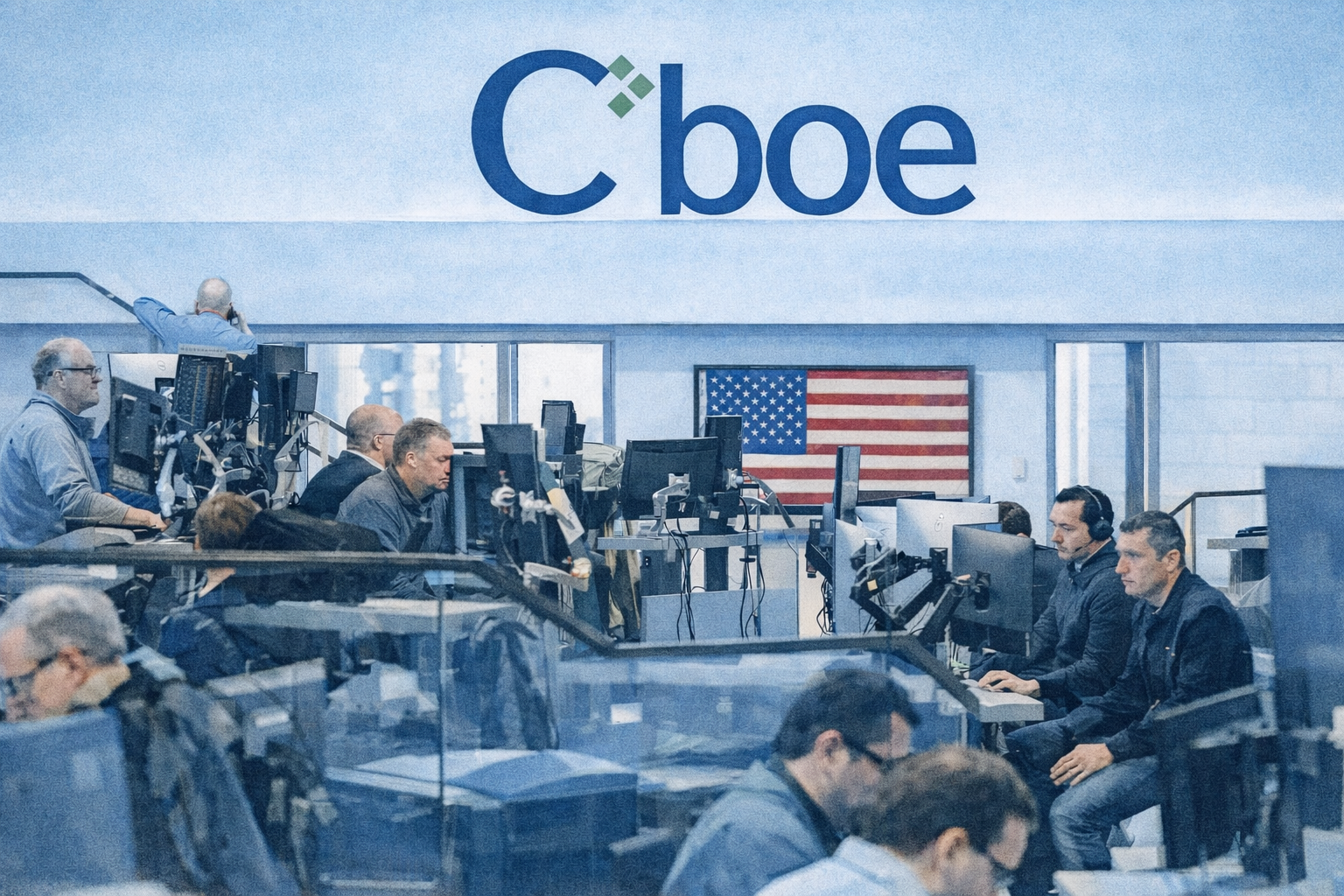
Chicago Board Options Exchange (Cboe Global Markets) is taking the initiative, exploring the relaunch of "all-or-nothing" binary options contracts to attract retail investors. These contracts have a simple structure, paying a fixed return (e.g., $100) at expiration if predetermined conditions are met, otherwise expiring worthless.
According to a WSJ report, the new product will undergo rigorous legal and compliance reviews before official listing. Regulatory oversight may fall under the U.S. Securities and Exchange Commission (SEC) or the Commodity Futures Trading Commission (CFTC), with clearing support provided by the Options Clearing Corporation (OCC).
Cboe previously launched binary options linked to the S&P 500 Index (SPX) and the Volatility Index (VIX) in 2008, but they were delisted due to insufficient liquidity. Their comeback now is particularly noteworthy.
The First Attempt 18 Years Ago and the Quiet Exit
"All-or-nothing" options contracts are not a novel concept or product; Cboe itself introduced them over a decade ago. But ultimately, it was a case of starting early yet arriving late.
In July 2008, Cboe announced the launch of binary options linked to the S&P 500 (SPX) and the Cboe Volatility Index (VIX). According to an approval document released by the SEC in May of the same year, Cboe applied to add a framework for "cash-settled, European-style exercise" binary index options to its exchange rules. The document also clarified that the OCC (Options Clearing Corporation) would be responsible for issuance, clearing, and settlement, and amended its relevant bylaws and rules accordingly.
Compared to the later proliferation of "black platform binary options" on the internet, Cboe's binary options were a standardized, centrally cleared derivative innovation. They compressed the complex payoff curve of options into a fixed payout, allowing traders to use a more direct way to express their view on whether an index would reach a certain level. At launch, Cboe expected to attract diverse participants, including individual investors and hedge funds, to bet on the direction of these indices.
However, this product did not generate the anticipated market enthusiasm, nor did it achieve significant scale or sustained trading, ultimately leading to its quiet delisting. Behind this were both structural market issues and deep-seated problems stemming from its product positioning.
At that time, the market was dominated by institutional investors, with very low retail participation, leading to insufficient liquidity and lackluster subscription interest. Binary options require a "two-way street" between brokers and retail investors. But in the early stages of mobile internet development, the financial dissemination power of social media was far from formed, and retail investors typically lacked trading motivation and habits.
When demand didn't materialize, the supply side became even harder to sustain. Thin trading weakened market maker incentives, wider spreads further suppressed demand, creating a reflexive "liquidity death spiral." This was the main reason a compliant, centrally cleared binary option failed commercially.
In terms of positioning, the 2008 binary options were also more like tools for professional traders, a new product addition for existing options participants. Their product language, settlement rules, and underlying selection were more "institutionalized" rather than products for the masses. They were linked to SPX and VIX, with strike prices and settlement rules that were not intuitive for the average investor. Even though their payoff was binary in form, the barrier to understanding remained high.
In contrast, today's popular prediction markets have spread largely because they replaced the underlying assets with more intuitive events, including but not limited to political elections, sports events, etc. Retail investors can participate directly in trading without needing overly complex analytical logic. Cboe did not have such an ecosystem back then.
Relaunch Plan as Timing Matures
Cboe's current proposal for a relaunch is closely related to the current market environment. Since the 2024 U.S. presidential election, prediction market activity has experienced "explosive growth." In January 2026, combined trading volume on Kalshi and Polymarket exceeded $17 billion, hitting a record high.
As the prediction market boom brings a surge in retail derivative trading, the industry has begun to see it as an emerging growth area and an opportunity for exchanges and financial institutions to develop new businesses, thus joining the battle for users. In December 2025, CME Group partnered with sports betting giant FanDuel to launch an official prediction market platform in some U.S. states.
Equally noteworthy alongside prediction markets is the explosive enthusiasm of retail investors for derivative trading. Following the 2020 pandemic shock, U.S. options trading volume repeatedly hit record highs, with retail investors playing a significant role. Data from the Options Clearing Corporation shows that the average daily trading volume in the U.S. options market in 2025 was approximately 61 million contracts, a historical record.
At the same time, the rise of internet brokers and social media has fundamentally changed trading methods. Retail investors can quickly access trading strategies and contract information through mobile apps and online communities. In this environment, simple and clear derivative contracts have a natural appeal to retail users.
If the core reason for the failure of binary options in 2008 was the "absence of retail investors," today's market is the opposite, with distribution channels and product strategies now mature. Cboe realizes it's time to relaunch binary options contracts.
Not Nostalgia, but an "Entry Point Battle"
Binary options carry unavoidable historical baggage.
In the U.S. regulatory context, the term was once highly associated with internet fraud and manipulation. The CFTC and SEC jointly issued investor alerts, pointing out that regulators had received numerous complaints about fraud involving online binary options platforms, including refusal to return funds, identity theft, manipulation of trading software causing client losses, etc.
It is precisely for this reason that Cboe's current move particularly emphasizes strict compliance review before listing and oversight by the SEC or CFTC. The subtext is platform controllability, safety, and transparency. This also explains why traditional exchanges feel urgency amidst the prediction market frenzy. They do not want to completely cede the retail demand for outcome betting to a sector with more complex regulation and blurrier boundaries.
There are several key differences between the binary options being relaunched now and the 2008 version. First, the target audience is different. The previous product was mainly aimed at institutions and experienced investors, attracting almost no retail traders. This time, it explicitly targets the retail group, hoping to provide a simple and easy-to-understand derivative entry point for mass investors.
Second, there is a difference in product positioning. The 2008 contracts were essentially special options linked to indices (SPX, VIX), used to precisely express bullish or bearish views on market indices. Now, Cboe emphasizes introducing simpler, event-based contract forms, aiming to cater to ordinary investors' interest in betting on event outcomes.
Another key factor is the change in the external environment mentioned above. At the market level, Cboe's new product has different technological and channel support for marketing and participation. At the regulatory level, event contract products in the U.S. today are more often under CFTC oversight, whereas the previous binary options required SEC approval. This also reflects the regulatory boundary tensions brought by prediction markets.
Stringing these clues together, Cboe's move can be understood as: a recapture of the retail trading gateway for event outcomes. In 2008, Cboe early on brought binary options into the exchange system, but encountered an era where retail was absent, the understanding barrier was relatively high, and distribution channels were insufficient, ultimately leading to failure.
Today, prediction markets have cultivated a user mindset for intuitive betting and created a huge market imagination space. At the same time, retail options trading volume has long proven that散户 are willing to pay for derivatives that are "simple, short-cycle, and have clear outcomes."
The most critical factor going forward might be whether Cboe can, within compliance constraints, provide a trading experience sufficiently close to the "intuitive, smooth, low-friction" feel of prediction markets. If it fails, its fate might repeat itself. If it succeeds, it could become a landmark event in the "redrawing of boundaries" between traditional exchanges and prediction markets.