Written by: Bitget Wallet
Original Title: 36 Years, 4 Wars, 1 Script: How Does Capital Price the World in Conflict?
War shows the world ruins, but capital only cares about prices.
When the flames of war reignite in the Middle East, colleagues in distant Dubai report bombings and air raid sirens; missiles streak across the sky as humanity awaits an unknown fate.
Yet, on another invisible timeline, global financial markets have already begun recalculating: How high should oil prices go? Will gold continue to surge? When will the stock market bottom out and rebound?
Capital does not sympathize, nor does it rage. It does one thing coldly—pricing uncertainty. For most people, it's invisible, intangible, its logic冷酷, its rhythm无情.
But in turbulent times, understanding the logic of capital operation and risk pricing might be the last line of defense between ordinary people and the torrent of history. Looking back at human geopolitical conflicts and financial history, you'll find an almost unbreakable pattern: in the face of war, capital markets always repeat the same script, and over the past 36 years, this script has been fully performed four times.
What Capital Fears Most Is Not Conflict, but "Waiting"
From the 1991 Gulf War, the 2003 Iraq War, to the 2022 Russia-Ukraine conflict, the script is always the same. These three geopolitically influential crises demonstrate the pricing规律 of capital markets during the "incubation period — outbreak period — clarity period".
Financial markets are essentially an expectation discounting machine. When conflict is in the incubation period, fear of the unknown supply disruption drives原油 and黄金 to sky-high prices, while global stock markets plummet悬崖式. However, Wall Street has a bloody iron rule: "Buy to the sound of cannons".
Once the first shot is fired (or the situation becomes clear), the greatest uncertainty is cleared. Safe-haven assets often peak and fall rapidly, while the stock market completes a deep V-shaped reversal at the point of绝望. The war may continue, but capital's panic is over.
Below is an in-depth analysis of the changes in capital markets during these three historical events:
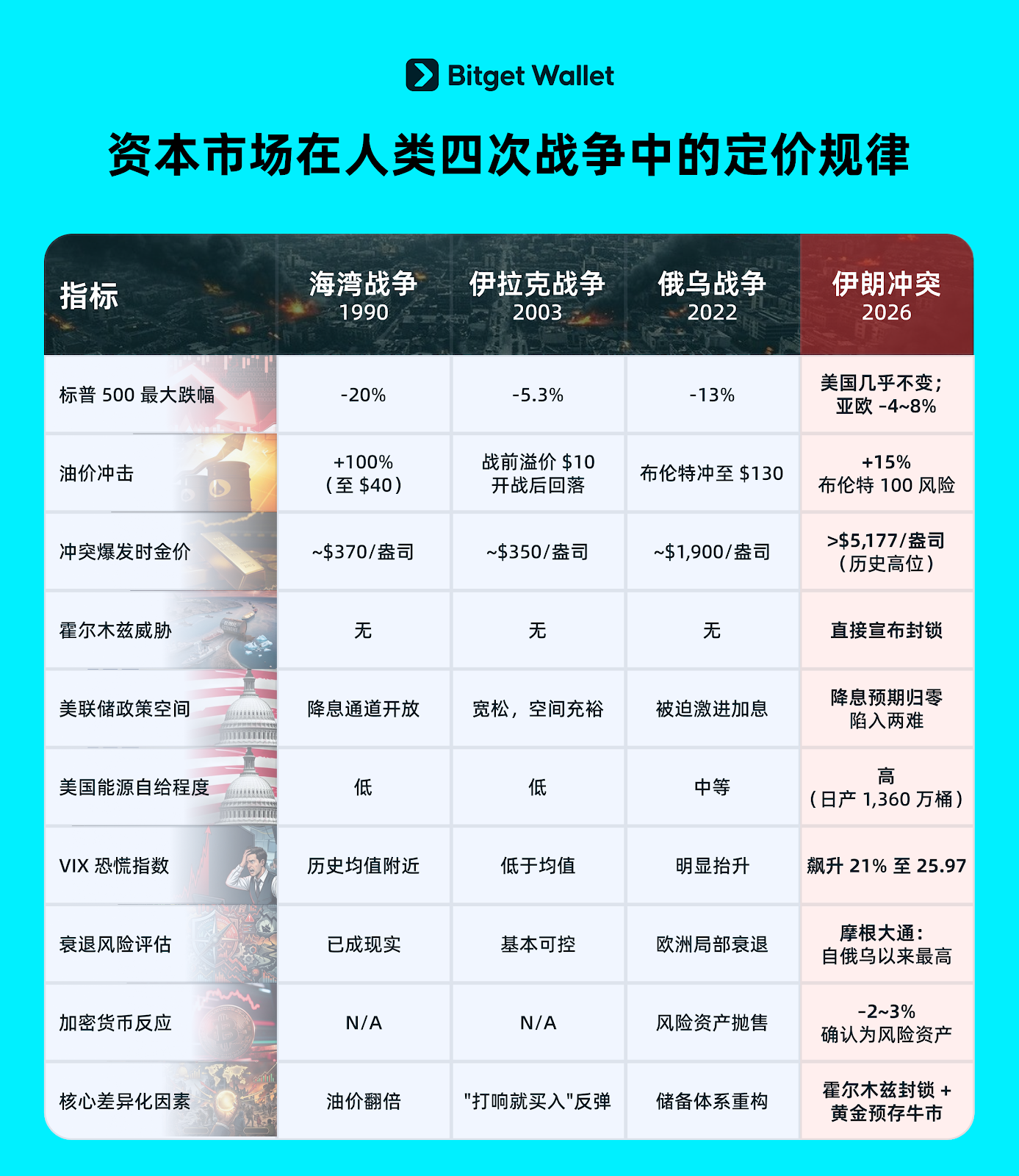
1. 1990-1991 Gulf War: The Classic "V-Shaped Reversal" and原油 Shock
This war is a textbook case for studying geopolitical shocks in modern financial history, perfectly诠释了 'buy the rumor, sell the news'.
-
Crisis Incubation Period (August 1990 – January 1991): Panic and Safe-Haven Flows
-
原油 Surge: After Iraq invaded Kuwait, the market was极度恐慌 of Middle Eastern oil supply disruptions. In just two months, international oil prices soared from around $20 per barrel to over $40, a increase of more than 100%.
-
Stock Market Plunge: Affected by soaring oil prices and the war clouds, the U.S. S&P 500 index fell nearly 20% between July and October 1990.
-
Boots on the Ground (January 17, 1991): Counterintuitive Market Shift
-
On the first day of the U.S.-led "Desert Storm" operation, the market experienced an极度反直觉的走势: because the war progress showed an overwhelming态势, "uncertainty" was instantly eliminated.
-
原油 Crash: Oil prices recorded one of the largest single-day declines in history on the day the war started (plummeting over 30%).
-
Stock Market Rally: The S&P 500 index rose sharply that day and subsequently embarked on a sharp V-shaped reversal, not only recovering all losses within six months but also hitting new historical highs.
2. 2003 Iraq War: "Relief" After a Long, Grinding Decline
The 2003 Iraq War叠加了 the aftermath of the dot-com bubble burst and the security anxiety post-9/11. The market's reaction was more of a "better a short pain than a long pain" kind of relief.
-
Crisis Incubation Period (Late 2002 – March 2003): Death by a Thousand Cuts
-
During the months of diplomatic wrangling and war preparations, capital markets were like startled birds. The S&P 500 index continued its阴跌, and global capital flowed into gold and U.S. Treasuries due to避险情绪.
-
Oil prices were slowly pushed from $25 to nearly $40 due to war expectations and factors like the Venezuelan strike.
-
Boots on the Ground (March 20, 2003): Bad News is Good News
-
Quite戏剧性的是, the absolute bottom of the U.S. stock market occurred about a week before the war started (around March 11, 2003).
-
When missiles actually fell on Baghdad, the market反而视作 "利空出尽" (the end of bad news is good news). The stock market迅速拉升 shortly after, launching a four-year bull market. Safe-haven assets like gold cooled down rapidly as the war progressed smoothly.
3. 2022 Russia-Ukraine Conflict: "Super Stagflation" Triggered by Supply Chain断裂
Unlike the previous two Middle East wars (where the U.S. achieved rapid, overwhelming victory without causing long-term substantial damage to global supply chains), the Russia-Ukraine conflict had a more profound and沉重 impact on capital markets, changing the underlying logic of the macroeconomy.
-
Crisis Outbreak (February 2022): Epic Commodity Storm
-
Russia is a global energy and industrial metals giant; Ukraine is the "breadbasket of Europe." After the conflict broke out, Brent crude oil一度突破 $130/barrel; European natural gas prices surged several times; prices for wheat, nickel, and other commodities hit historical highs.
-
Lasting Impact: The "Double Whammy" of Inflation Rebound and Monetary Tightening
-
Stocks and Bonds Fell Together: The most致命的市场影响 of the Russia-Ukraine conflict was that it彻底打碎了 the fragile global supply chain post-pandemic, directly igniting the most severe inflation in Europe and the U.S. in 40 years.
-
To combat this "imported inflation" triggered by geopolitical war, the Fed was forced to initiate the most aggressive interest rate hike cycle in history. The result was a rare "stock and bond双杀" in 2022 (stocks fell, bonds fell too), with the Nasdaq index plummeting over 30% that year.
Fatal Illusion: Never Try to Make a "War Fortune"
Let's bring the timeline back to reality.
The sudden tension in the current Middle East situation has once again pushed global capital markets into a "stress test" period full of uncertainty.
From the perspective of the macroeconomic transmission chain, the core threat of the Middle East conflict to capital markets lies in "physical supply chain disruption → energy price surge → global inflation反弹 → central banks forced to maintain tightening → risk asset暴跌".
Analysis of the Chain Reaction in Capital Markets
-
International Crude Oil: The Absolute Center of the Storm
Chain Reaction: The Middle East holds the lifeline of global crude oil (especially key shipping lanes like the Strait of Hormuz). Once there is a risk of the conflict escalating or involving major oil-producing countries, the market will immediately price in a "geopolitical risk premium." This will lead to a脉冲式暴涨 in Brent and WTI crude oil prices in the short term.
Deep Impact: Crude oil is the mother of all industries. Soaring oil prices will not only increase costs for aviation, logistics, and chemical industries but also directly threaten the刚刚企稳的物价指数 (CPI) globally in the form of "imported inflation."
-
Precious Metals (Gold/Silver): The Traditional Ultimate Safe Haven
Chain Reaction: In the face of war, geopolitical turmoil, and potential恶性通胀, funds instinctively flock to gold. Gold prices usually gap up before and at the initial stage of conflict, reaching阶段性 or even historical highs;白银, due to its industrial attributes, tends to have greater volatility than gold.
Deep Impact: It's important to note that gold's surge is often emotion-driven. Once the situation becomes clearer (even if the conflict continues),避险情绪退潮, gold prices are prone to冲高回落, returning to the pricing logic dominated by the real美元利率.
-
U.S. Stock Market: The Inflation Ghost and "Valuation Kill"
Chain Reaction: War is generally bearish for U.S. stocks overall. The fear index (VIX) will surge rapidly, funds will withdraw from high-valuation tech stocks (e.g., AI sector, semiconductors) and flow into defensive sectors like defense, traditional energy, and utilities.
Deep Impact: What U.S. stocks fear most is not the artillery fire in the Middle East, but the inflation反弹 triggered by it. If surging oil prices cause U.S. CPI to remain stubbornly high, the Fed will be forced to delay rate cuts or even hike rates again. This tightening of macro liquidity will deal a heavy blow to the valuation of tech stocks, represented by the Nasdaq.
-
Crypto Market (Crypto): Liquidity Drain for High-Risk Assets
Chain Reaction: Although Bitcoin has always had the narrative of "digital gold," in past real geopolitical crises (like the initial outbreak of the Russia-Ukraine conflict, Middle East escalation), the actual performance of the crypto market has been more like an "ultra-elastic Nasdaq index."
Deep Impact: Faced with war panic, Wall Street institutions will优先抛售 the most liquid and highest-risk assets to raise cash, and the crypto market is often the first to be hit, experiencing declines. At the same time, altcoins will face liquidity drying up. However, if the conflict causes local fiat currency collapse or traditional banking systems are受阻, the "censorship-resistant and borderless transfer"避险属性 of crypto assets will be favored by some避险资金.
Comparing the three historical geopolitical conflicts, we can extract core规律 for ordinary people to cope with geopolitical crises:
-
"Uncertainty" is the Biggest Killer: The most惨烈的下跌 in the stock market almost always occurs during the incubation and博弈期 before the war breaks out. Once the war actually starts (especially when the situation becomes predictable), the stock market often bottoms out and rebounds. This confirms the Wall Street saying: "Buy when the cannons roar."
-
The "Bag-Holding Trap" of Commodities: Before and at the beginning of the war,原油 and黄金 are often pushed to不可思议的高价 due to panic. But if the war does not substantially and长期切断 physical supply (like the Gulf and Iraq wars), prices will quickly halve after the war starts. Blindly chasing commodities makes you极易 become the bag-holder for institutions.
-
Distinguish between "Emotional Shock" and "Fundamental Destruction": If the war is only an emotional shock (e.g., localized, lopsided conflict), the stock market will quickly recover after falling. But if the war leads to long-term断裂 of core supply chains (like the energy/food crisis triggered by the Russia-Ukraine conflict), it will change the global capital pricing anchor through "inflation and interest rate hikes." In this case, the market's pain period will be very long.
History doesn't repeat itself simply, but it often rhymes. When observing current capital异动, we need to冷静判断: is the current conflict a temporary emotional panic, or a true black swan that will reshape global inflation and interest rate cycles?
Geopolitical games have no rules可言; a late-night ceasefire announcement can instantly wipe out highly leveraged long positions. In a crisis, the primary principle is always to preserve capital.
Defensive Formations in Turbulent Times: How Should Ordinary People Make Their Move?
Under the double shadow of war and inflation, the core goal of ordinary investors must shift from "pursuing high returns" to "preserving capital, defending against inflation, hedging tail risks." It is recommended to reorganize assets according to the following "defensive counterattack" formation:
Strategy 1: Build a High Cash Moat (20%-30% allocation)
-
Action: Increase holdings of cash and cash equivalents (e.g., high-interest dollar deposits, short-term Treasuries, money market funds).
-
Logic: In times of crisis, liquidity is the lifeline. Having sufficient cash on hand not only ensures your family's quality of life is unaffected by soaring prices in extreme situations but also gives you the "ammunition" to "buy the dip" on quality assets after a crash.
Strategy 2: Buy Inflation "Insurance" (10%-15% allocation)
-
Action: Appropriately allocate to gold ETFs, physical gold, or a small amount of broad-based energy sector ETFs.
-
Logic: The mission of this portion of funds is not to make big money, but to hedge. If war leads to oil supply disruptions and soaring prices, the increased cost of your living expenses can be compensated for by the rise in gold and the energy sector. Remember: Do not go all-in and chase highs when headlines are everywhere.
Strategy 3: Consolidate Positions, Hold Core Equity (30%-40% allocation)
-
Action: Sell highly indebted, unprofitable marginal individual stocks, and concentrate funds into broad-based index ETFs (e.g., S&P 500) or giant companies with strong cash flow.
-
Logic: During war, individual stocks face enormous black swan risks (e.g., sudden supply chain断裂 leading to bankruptcy). Embracing broad-based indices means using the national fortune and the systemic resilience of the entire economy to hedge against the fragility of a single enterprise. As long as you坚持定投 and ignore short-term paper losses, crises often create long-term "golden pits."
Strategy 4: "De-risking" Crypto Assets (For Web3 Users)
-
Action: Appropriately reduce positions in high-volatility altcoins, Meme coins; consolidate funds into Bitcoin (BTC) as a long-term core holding, or convert to USD stablecoins (USDC/USDT) and deposit them on top-tier compliant platforms to earn活期收益. Once geopolitical risks are deemed controllable and market liquidity returns, you can allocate 10-30% of your funds (based on your risk appetite) to invest in Meme coins to capture alpha opportunities.
-
Logic: The liquidity crisis triggered by war has a greater impact on small-cap coins. Stablecoins can both provide避险 during crises and offer more flexible liquidity reserves than traditional banks.
Absolutely Untouchable Red Lines
-
Strictly No Leverage: Geopolitics changes in the blink of an eye; a ceasefire announcement can cause oil to crash 10%. In leveraged trading, you might not live to see the long-term victory, as you could be wiped out in the short-term剧烈波动.
-
Abandon the Gambling Psychology of "Making a War Fortune": The information asymmetry in capital markets is extremely残酷. When you decide to go long on an asset because you see the war escalating, Wall Street quant institutions are often already prepared to "take profits, sell the news."
In the face of macro shocks, the most powerful weapon for ordinary people is not accurate prediction, but common sense, patience, and a healthy balance sheet.
The flames of war will eventually be extinguished, and order will be rebuilt on the ruins.
At the peak of extreme panic, the most counter-intuitive operation is to stay rational, and the most dangerous move is to panic and liquidate. Remember the oldest adage in investing: Never bet on the end of the world—because even if you win, there will be no one to pay you.
And our greatest wish, after all, remains for conflicts to cease, forcibly separated families to reunite, and world peace.
Twitter:https://twitter.com/BitpushNewsCN
Bitpush TG Discussion Group:https://t.me/BitPushCommunity
Bitpush TG Subscription: https://t.me/bitpush